The honest answer
Balanced vs Force-Free Dog Training: An Honest Look at Both Sides
E-collars and prong collars vs purely positive reinforcement — the debate gets ugly fast online. Here's what the behavioral research, the AVSAB position, and practitioners on both sides actually say.
Karen Nguyen
Senior research correspondent · Why she does this work

Few topics in dog ownership get as nasty as this one. Search "balanced vs force-free dog training" and within minutes you'll find professional trainers calling each other abusers and quacks. I want to walk you through what the actual peer-reviewed evidence says, what each camp gets right, and where this leaves you and your normal pet dog. I'll show my work. You can disagree with my conclusion at the end and still walk away with the science.
Affiliate disclosure: Dog Orthopedic is reader-supported. When you buy through links on our site we earn a commission at no extra cost to you — about 3% on most pet products, and the same rate on every product we compare, so no pick earns us more than another. Prescription medication earns us nothing, and seeing your vet earns us nothing; we recommend both anyway. Learn more.
Imagery: Lifestyle photographs on this site are licensed from Pexels (royalty-free) and credited per image. Pexels imagery illustrates conditions and contexts — it does not depict the specific dogs or test sessions described in the text. Product photographs come from Amazon's Creators API. Breed portraits are illustrations of typical breed type rather than photographs of individual dogs, and are not drawn to scale against one another.
The two camps, defined fairly#
I want to start by describing both sides the way they would describe themselves — not the way their critics caricature them.
The force-free / R+ camp#
"Force-free" trainers (also called positive reinforcement, R+, or LIMA — Least Intrusive, Minimally Aversive) believe that dogs learn fastest and live happiest when behavior is shaped through reinforcement of what you want, plus thoughtful management of what you don't want. Tools include high-value food rewards, clickers, front-clip harnesses, head halters, baby gates, long lines, and structured environment setup. Aversive tools — e-collars, prong collars, choke chains, leash pops — are off the table on principle.
Representative voices: Dr. Ian Dunbar (founder of the Association of Professional Dog Trainers); Dr. Karen Overall, DACVB; Jean Donaldson; Kathy Sdao; the Karen Pryor Academy lineage; Dr. Susan Friedman (operant learning across species). The professional credentialing bodies that lean R+ include the Pet Professional Guild and the Karen Pryor Academy. The Certification Council for Professional Dog Trainers (CCPDT) and the International Association of Animal Behavior Consultants (IAABC) both follow LIMA.
The balanced camp#
"Balanced" trainers use the full operant-conditioning quadrant — positive reinforcement and positive punishment / negative reinforcement, in the technical learning-theory sense. In practice that means rewards for what you want, plus corrections (leash pops, prong corrections, e-collar stim) for what you don't want. Done well, the corrections are conditioned at low levels first, are paired with clear cues, and become a vocabulary the dog understands rather than a punishment they fear.
Representative voices: Larry Krohn, Robert Cabral, Tyler Muto, Sean O'Shea, Michael Ellis (e-collar conditioning); the Tom Rose School; many police K9, IPO/IGP, and field-trial trainers; the International Association of Canine Professionals (IACP). Their argument is essentially: in the real world, dogs need an off-switch, and a properly conditioned correction is humane, fast, and gives the dog more freedom (off-leash hiking, off-leash recall reliability) than R+ alone often delivers.
Both groups, at their best, share more than the internet suggests: both prioritize the dog–human relationship, both use food, both believe training should be enjoyable, both reject "alpha rolls" and physical intimidation. The disagreement is narrower and sharper: is positive punishment ever necessary, and what does it cost the dog?
Where the science actually lands on aversives#
Let me walk through the studies you'll see cited again and again — what they did, what they found, and what their limitations are. I'll be square about the latter, because the literature isn't enormous and good-faith critics on both sides know it.
The AVSAB position statement (2021)#
The American Veterinary Society of Animal Behavior — the professional body for vets who specialize in behavior — issued a position statement in 2021 explicitly recommending against shock, prong, and choke collars and against confrontational training methods generally.1 The statement is grounded in the studies I'm about to walk through. It's worth reading in full; it's six pages, and it's measured rather than activist in tone.
This matters because DACVB-credentialed veterinary behaviorists are the most-trained practitioners in the dog world — board certification requires a residency under another DACVB, peer-reviewed publication, and a comprehensive exam. They are not anti-discipline ideologues. When this profession aligns this clearly, it's a signal worth weighing.
The American Animal Hospital Association's 2015 (and reaffirmed) Canine and Feline Behavior Management Guidelines take the same line.2
Cooper et al. 2014 — the headline e-collar study#
Cooper and colleagues ran the largest controlled study to date on pet-dog e-collar use, published in PLOS ONE in 2014.3 They split 63 pet dogs across three groups — e-collar trainers, reward-only trainers using the same training organizations' methods, and a control reward-only group — and measured stress behaviors and obedience outcomes.
What they found:
- Dogs in the e-collar group showed significantly more stress signals during training: tense body posture, lowered tail, yelping, body shaking, and a pattern of behavior the researchers coded as low welfare.
- Obedience outcomes were equivalent or better in the reward-based group on the recall task. The e-collar didn't deliver the reliability advantage its proponents claim.
- This was a real-world comparison using working professional trainers, not a contrived lab setup.
Limitations to be honest about: n=63 is moderate, not huge. The trainers were studied as they actually trained, which is more ecologically valid but means the e-collar protocols varied. The e-collar advocates' best counterargument is that the trainers in the study didn't always represent the high-skill conditioning approach (Lawrence Krohn / Michael Ellis style) — that this study tested what e-collars look like in average hands, not in expert hands. That's a fair critique. It's also, arguably, the relevant comparison for pet owners.
Vieira de Castro et al. 2020 — the cortisol study#
This is the one balanced trainers least like to talk about. Vieira de Castro and colleagues, also in PLOS ONE, looked at 92 companion dogs from seven training schools across Portugal — three using aversive methods (leash corrections, yelling, physical manipulation), three using reward-based methods, and one mixed.4 They measured salivary cortisol after training sessions and ran a cognitive bias test (an "is the bowl half-full or half-empty" assessment of underlying mood).
What they found:
- Dogs trained with aversive methods showed higher cortisol elevations after training than reward-trained dogs.
- Aversively-trained dogs were more pessimistic on the cognitive bias test — they took longer to approach ambiguous bowls that might or might not contain food, suggesting a baseline negative emotional state.
- The effect persisted outside the training context, meaning it wasn't just acute stress from a hard session.
Limitations: salivary cortisol is noisy as a stress measure; cognitive bias tests are still a developing methodology in canine research; the aversive schools used a mix of tools (not specifically e-collars). But this is one of the few studies measuring physiological and emotional state rather than just behavior, and the direction of the effect is consistent with the behavioral data.
Ziv 2017 — the systematic review#
Ziv published a systematic review in the Journal of Veterinary Behavior in 2017 covering 17 studies on aversive vs reward-based methods.5 The conclusion: aversive training is associated with higher stress, more fear, and more aggression, with no consistent obedience benefit. Reward-based methods showed equal or better outcomes across the studies reviewed.
Caveats: systematic reviews are only as good as the studies they include, and most canine training research is methodologically modest (small n, observational rather than RCT, varying definitions of "aversive"). But the consistency of the direction across 17 studies is harder to dismiss than any single study.
Schalke et al. 2007 — the cortisol and learning study#
A German study published in Applied Animal Behaviour Science in 2007 looked at e-collar training of laboratory beagles in three conditions: shock for chasing prey, shock at random times, and shock paired with a command the dog hadn't learned.6 Dogs that received shock when they didn't understand why showed dramatic and persistent cortisol elevations and learning impairments. Dogs that received shock contingent on a clear behavior showed less stress.
This is the study balanced trainers like to cite, and they're not wrong to: it shows that the contingency matters, not just the tool. A skilled trainer who has conditioned the e-collar properly may indeed produce less stress than a frustrated owner using the same tool poorly. But that's a high bar — and it's the same study that shows what happens when the bar isn't met, which is a lot of pet households.
The dominance / alpha question#
This one is short, because the science has been clear for a long time and the public is just catching up.
The "alpha wolf" idea came from L. David Mech's 1970 book The Wolf.7 Mech based the framework on captive wolves — unrelated adults forced to live together in a zoo enclosure, where status fights make sense because nobody can leave. He spent the next four decades studying wild wolves in Yellowstone, Denali, and Ellesmere Island, and discovered that wild wolf packs are family groups: a breeding pair (the "parents") and their offspring from successive litters. There is no dominance fight to become alpha. You become a parent, and your kids defer to you the way kids defer to parents in any social mammal.8
Mech has explicitly asked publishers to stop reprinting his old book and has spent years on the lecture circuit walking back the framing. The dominance model, applied to wolves, was wrong. Applied to dogs — who diverged from wolves 15,000+ years ago and have been shaped by humans into a different cooperative species — it's even more wrong.
AVSAB's 2008 position statement on dominance theory rejects the framework outright as a basis for training.9 AAHA's behavior management guidelines do the same.2 What modern behavior science says instead: dogs do what gets reinforced. If your dog jumps on guests, somebody is reinforcing it (attention counts, even negative attention). If your dog "ignores" you on a recall, you haven't built enough reward history against the competing reinforcer (the squirrel). Look at the contingencies, not at imaginary hierarchies.
Practical translation: stop "alpha rolling," stop "being the pack leader," stop eating before your dog as some kind of status signal. None of it does what people think. Spend that energy on reinforcement timing, environmental management, and clear cues.
The steelman case for balanced training#
I want to do the balanced camp the courtesy of presenting their best argument, not their worst one — because their best argument is real and the welfare community sometimes ducks it.
Reliability matters when the cost of failure is catastrophic. A herding dog around stock, a hunting dog on point near a road, a search-and-rescue dog working off-leash terrain — these dogs need recall reliability that approaches 100%. R+ trainers can absolutely produce strong recalls, but the realistic ceiling for many handlers is 90–95% — and the 5–10% miss rate is exactly when the dog hits a fence or chases a deer onto pavement.
A properly conditioned e-collar may not function as punishment. This is the technical claim that gets dismissed too quickly. In the Michael Ellis / Lawrence Krohn / Robert Cabral approach, the e-collar is conditioned at the dog's individual perception threshold — typically a level the dog notices but the handler can barely see (a slight head turn). It's then paired with a known cue. Over time, the dog learns the "tap" means "do the thing I already know." It functions as a tactile cue, not a punisher. This is testable in principle, and the existing studies (Cooper, Vieira de Castro) didn't isolate this skilled-hands condition.
Some dogs are not safe candidates for management-based approaches. A 130-pound Mastiff with a history of dog-aggressive lunging cannot be safely managed by an average owner with a head halter alone. The realistic alternatives for such a dog are: a board-certified veterinary behaviorist plus medication plus careful management; a balanced trainer with serious credentials; or rehoming/euthanasia. The R+ purist position can sound, to the owner of such a dog, like it's pricing them out of keeping their dog alive.
The alternative to skilled balanced training isn't always skilled R+. Sometimes it's a frustrated owner doing nothing, then surrendering the dog. The pragmatic question isn't "is R+ better than balanced in a controlled study?" — it's "what is this owner, with this dog, with this budget, going to actually be able to do?"
I find this argument partially persuasive. Where I think it falls down is that the Cooper and Vieira de Castro studies measured average pet-dog training environments — i.e. exactly the place where most of us actually live — and the welfare hit was visible there. The "skilled hands only" defense protects elite practitioners, but the tools are sold to everyone.
Where this leaves a normal owner with a normal pet dog#
Most of the people reading this are not training a Schutzhund dog or a livestock guardian. You have a Labrador who pulls on leash, or a rescue who barks at the doorbell, or a teenage shepherd who blows you off when he sees a squirrel. Here's what the research suggests for that dog:
- Default to reward-based methods. The evidence base — AVSAB, AAHA, Cooper, Vieira de Castro, Ziv's review — converges on this. For pet-dog problems, R+ produces equal or better outcomes with measurably less stress.
- Manage the environment. A front-clip harness on a puller does more in 10 minutes than three weeks of arguing about training philosophy. Baby gates, leashes in the house, removing reinforcement opportunities — these are the unglamorous core of behavior change.
If you are trying to translate point 2 into something you can actually buy and put on the dog this weekend: a widely used front-clip harness is the PetSafe Easy Walk (we cut our earlier "most R+ trainers default to it" line — no prescribing survey exists). Front-clip leverage works on measured physics, not punishment: in the one strain-gauge comparison, a front-clip harness cut pulling impulse significantly versus a martingale collar10 — when the dog pulls, they get redirected sideways instead of being able to lean into a flat collar — and it is the difference between a walk you dread and one you can use as training time.

PetSafe
PetSafe Deluxe Easy Walk Front-Clip Harness
Our score
$26.99
Best for
Day-one management for a dog who pulls on leash
Buy it for the mechanism, which is better evidenced than we used to say: in a 2024 strain-gauge trial a front-clip harness reduced pulling force as much as a prong collar did, with none of the prong's baggage. Two honest caveats go with that. PetSafe's own two websites disagree about whether this handles a heavy puller or only light-to-moderate pulling, and the tightening martingale chest strap is the one feature the 2025 review of this equipment tells you to treat with caution. Buy the new listing, not the Amazon Resale one, because used stock is excluded from the warranty.
Pros
- The mechanism has a real trial behind it. Johnson and Wynne (PeerJ 2024; 12:e18131, DOI 10.7717/peerj.18131) walked 23 dogs on four rigs with a strain gauge on the leash. A front-connection harness cut pulling impulse significantly against a martingale flat collar (Z = -3.69, p < 0.001) — and was statistically indistinguishable from both a metal prong collar and a Starmark. You get prong-level pull reduction from a harness
- The most recent peer-reviewed review of walking equipment lands on this category: "For dogs that pull, non-tightening front-clip harnesses appear to offer the best balance between discomfort and reduction in pulling" (Cavalli and Protopopova, Animals 2025;15(15):2162, DOI 10.3390/ani15152162 — 21 full-text articles reviewed)
- No channel markup. $26.99 on Amazon and $26.99 on petsafe.com for the same SKU, EWH-D-HC-L-STL, checked 2026-08-14
- Four adjustment points (PetSafe's own figure), and the Deluxe adds padded neoprene straps and reflector strips over the plain version
Cons
- PetSafe contradicts itself about your dog on its own two channels. The Amazon listing for this exact SKU says the harness "safely controls light to moderate pulling." petsafe.com's page for the same SKU says it "stops lunging and pulling" and lists the perfect use as "For heavy pullers." Both were live on 2026-08-14. If you have a genuinely heavy puller, the manufacturer has published both a yes and a no, and we are not going to pick one for you
- The chest strap is a patented martingale — it tightens. That matters, because the same 2025 review that endorses non-tightening front-clip harnesses puts tightening harnesses and martingales in the caution group: "Tightening harnesses, martingale collars, and head collars can pose greater discomfort and should be used with caution" (Cavalli and Protopopova 2025). This harness sits on both sides of that sentence
- The "a Y-front would be kinder to his shoulder" line you have read everywhere is not what the one study to measure it found. Lafuente, Provis and Schmalz (Veterinary Record 2019, DOI 10.1136/vr.104946) filmed nine dogs on a treadmill: every harness reduced shoulder extension against no harness, and the non-restrictive Y-front reduced it MORE than the restrictive type — by 2.6 degrees at walk and 4.4 degrees at trot. Nine dogs on a treadmill is a small study and we will follow better evidence when it appears, but as of today the Y-front advantage for the shoulder is unsupported and points the wrong way
- The warranty is narrower than the listing implies. PetSafe's published terms: one year from delivery, "non-transferable," and it "does not apply to products purchased from unauthorized sellers, including unauthorized Internet sites, as well as used, refurbished or 'as-is' products." The 45-day satisfaction return is a petsafe.com return only — for Amazon, their page says "please contact retailer directly"
- Watch which Amazon offer you click. Alongside the $26.99 new listing there was a $22.48 "Amazon Resale" offer, one unit left, on 2026-08-14. Resale is used stock, and used product is named in PetSafe's warranty exclusions
- If your dog eats it, the fix is not free. PetSafe covers chewed nylon as a one-time courtesy replacement and their policy refers to a "nominal chew fee." Their returns page also requires goods be "in original condition and in original packaging" — which a harness you have fitted to a dog is not
- Management, not training. It does not teach loose-leash walking
For dogs whose pulling or reactivity isn't yet manageable on a front-clip alone — and especially for owners physically smaller than their dog — the head halter is what veterinary behaviorists most often recommend on top. The Gentle Leader traces to veterinarian R.K. Anderson's 1980s head-collar patents (we previously called him board-certified, which we could not verify and no longer print), and the most recent equipment review actually places head collars in its caution group, steering most pullers to non-tightening front-clip harnesses first11 — so treat this as the escalation option, not the default. It is management, not a training substitute, and it requires a 1–2 week conditioning protocol before walks. Done right, it is the lowest-aversive, highest-control option on the shelf.
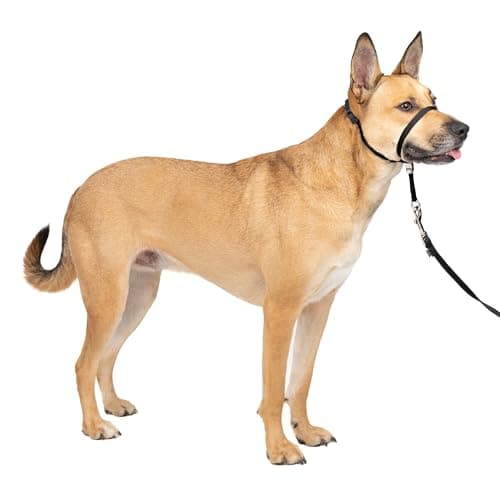
PetSafe
PetSafe Gentle Leader Head Collar
Our score
$14.95
Best for
Managing a strong dog's pulling and lunging while reward-based training is underway — for owners willing to do the acclimation work first
A real tool for a real problem: if your dog outweighs your ability to hold him, turning his head turns him, and nothing on a chest strap does that as directly. But we have downgraded it. The 2025 review of walking equipment groups head collars with the devices to use with caution and steers pulling dogs toward a non-tightening front-clip harness instead, and the one recent trial that actually measured leash force left head collars out entirely. If you use one, do the acclimation properly and never let your dog hit the end of the leash in it — that instruction is PetSafe's, not ours.
Pros
- The head-halter idea is genuinely old and genuinely veterinary. The patent family behind it, "Combination collar and muzzle humane training aid," is indexed in Europe PMC under Anderson Robert K, Foster Ruth E and Levine Jeffrey A, with records in 1986, 1988 and 1989. Anderson also published in the veterinary literature (Duxbury, Jackson, Line and Anderson, JAVMA 2003;223(1):61–66, DOI 10.2460/javma.2003.223.61)
- Turning the head turns the dog. For a 90 lb dog who lunges, a head collar gives a physically smaller handler control that no chest attachment gives them
- PetSafe publishes who it does not fit, which most brands will not do: "This headcollar won't fit our furry friends with super short snouts (like pugs or bulldogs)"
- Cheap enough to try, and getting cheaper. $14.95 on Amazon against $19.99 direct as last checked 2026-08-23 — Amazon is now about $5 cheaper. The listing itself shows a $19.50 "typical price," which is where both channels sat at near parity on 2026-08-14, so the gap is a deepening Amazon discount rather than a channel game: $19.50 on 08-14, $16.75 on 08-23, $14.95 on 09-05. Stock is thin at 2 units, so expect it to bounce back
Cons
- The most recent peer-reviewed review of walking equipment puts head collars in the caution group, not the recommended one: "Tightening harnesses, martingale collars, and head collars can pose greater discomfort and should be used with caution," and for dogs that pull it recommends non-tightening front-clip harnesses instead (Cavalli and Protopopova, Animals 2025;15(15):2162, DOI 10.3390/ani15152162). We used to call this the most humane option on the shelf. The current review literature does not say that, so neither do we any more
- We can no longer find the trial that would settle it. The largest recent force-measured comparison of walking gear — Johnson and Wynne, PeerJ 2024;12:e18131, 23 dogs, strain gauge on the leash — tested a martingale, a front-clip harness, a Starmark and a metal prong collar. It did not include a head collar at all. So the head-collar-versus-harness question has no strain-gauge answer we can point you to
- There is no DVD in the box. We previously said this shipped with a DVD-and-instruction conditioning protocol; petsafe.com's box contents for this SKU on 2026-08-14 read "1 Gentle Leader Headcollar," and the Amazon listing names no training materials either. The acclimation guidance is on the web page, not in the package. Corrected 2026-08-14
- PetSafe's own safety line is the one to read twice: "Never jerk or yank on the leash when it's connected to your dog's headcollar because your dog's snout is sensitive." A head collar puts your leash on your dog's face. If your dog hits the end of it at speed, that force goes through his head and neck
- "Most effective no-pull solution" and "has helped improve 5 million walks around the world" are PetSafe's marketing lines, and Amazon adds "Recommended by vets." None of the three is sourced to a survey, a trial or a count we can check. Treat all of them as advertising
- PetSafe's page says "Designed by a veterinary behaviorist" and does not name him. We can verify Robert K. Anderson from the patent record; we could not verify a board certification (DACVB) from any source we checked on 2026-08-14, so we have removed that credential from this page
- Most dogs object on day one, and the acclimation is real work — PetSafe's own instruction is to let the dog wear it with no leash attached while he eats and plays before you ever walk him in it
- One year limited warranty, non-transferable, void on used stock, and the 45-day satisfaction return is petsafe.com only. For an Amazon purchase their page says "please contact retailer directly"
- Hire a credentialed trainer or behaviorist for hard cases. Look for: CCPDT-KA or CCPDT-KSA (knowledge or knowledge+skills assessed); IAABC certified consultants; Karen Pryor Academy graduates; or — for serious behavior problems including aggression — a DACVB-credentialed veterinary behaviorist (find one through the American College of Veterinary Behaviorists directory).12
- Be skeptical of any trainer who promises fast results through corrections, tells you your dog is "dominant," or refuses to discuss training methodology before you sign up. Those are the same red flags whether the trainer brands themselves R+ or balanced.
- If you're considering an e-collar for off-leash recall on a working-line dog or for a specific reliability problem you've already worked at hard with R+, the literature doesn't say "never." It says the welfare risk is real, the skill bar is high, and the cost of getting it wrong is bigger than the cost of just continuing to train without it. Working with a balanced trainer who has serious credentials (IACP-CDT or above, plus a documented track record with the breed and problem you have) is a different proposition than buying an Amazon e-collar and watching YouTube.
The R+ practitioner's actual toolkit is unglamorous and cheap. A clicker — to mark the moment the dog does the right thing within the one-second reinforcement window the operant-learning literature keeps emphasizing — and a treat pouch so you can deliver the reward fast enough for that mark to mean anything. Trainers widely favor a soft-click marker over a louder box clicker for sound-sensitive dogs, and to a magnetic-snap pouch over a Ziploc-in-the-pocket setup for the obvious reason.

PetSafe
PetSafe Clik-R Training Clicker
Our score
$4.81
Best for
Marker-based reward training and capturing precise behaviours
Buy one, and buy it direct if you are ordering anything else from PetSafe, because $2.99 there against $4.81 on Amazon is the same clicker. Then set your expectations correctly: a 2025 trial in 28 detection dogs found real advantages for the marker, while the review that covers the wider literature says the comparisons done so far have not shown a benefit over a control. The thing that unquestionably works is what the click is attached to — a food reward, delivered every single time, within about a second.
Pros
- The best current evidence for markers is genuinely positive, and it is recent. Lazarowski and colleagues (Frontiers in Veterinary Science 2025;12:1538452, DOI 10.3389/fvets.2025.1538452) randomised 28 candidate detection dogs, 14 per group, to training with or without a clicker. The clicker group finished training in fewer trials, alerted more accurately in the odour-recognition test, indicated the odour source more precisely in open-area searches, and kept working longer when the food reward was withheld
- Three dollars. Whatever the effect size turns out to be, the downside risk of trying a marker is a cup of coffee — and unlike almost everything else in dog training, there is no way for it to hurt your dog
- No batteries, no app, no subscription. PetSafe's own description: "no batteries or apps required"
- The finger band is the practical bit — it keeps the clicker on your hand so the same hand that clicks can deliver the treat inside the reinforcement window
Cons
- "The cheapest, most-evidence-backed dog training tool you can buy" was our old line and it overstated the case. The standing review of this literature is blunt: "the few studies that have compared clicker training to a control have not provided evidence that adding a clicker is beneficial to training" (Dorey and Cox, PeerJ 2018;6:e5621, DOI 10.7717/peerj.5621). The 2025 detection-dog study above is the strongest counterweight, and it is 28 working dogs learning odour work — not pet dogs learning to sit. The honest position is that the marker probably helps and the evidence is thinner than the training world implies. Corrected 2026-08-14
- You are paying Amazon 61% over the manufacturer for it. petsafe.com lists the Clik-R at $2.99; the Amazon listing we link is $4.81, up from $4.36 a month earlier while the direct price stayed put. On a $3 item that is a rounding error in dollars and a real markup in percent, and you should know it before you click. Verified on both sites 2026-09-13
- We have removed three claims from this page because nothing published supports them. There is no waterproof rating on PetSafe's page or the Amazon listing. There is no decibel or loudness figure anywhere, so we cannot tell you it is quieter than any other clicker. And no trainer, academy or certification programme is named as using it on either page — our previous Karen Pryor Academy claim had no source and is gone. Corrected 2026-08-14
- Click every time, feed every time. Cimarelli and colleagues (Animal Cognition 2021, DOI 10.1007/s10071-020-01425-9) found that omitting the food after some clicks did not speed learning and pushed dogs toward a pessimistic-like affective state on a judgement-bias test. The clicker is a promise; breaking it costs you more than it saves in treats
- A dog who is frightened of sudden sharp sounds may need a softer marker or a spoken word instead. We can point you at no measurement of this clicker's volume to help you judge in advance
- The warranty is a formality at this price, but for the record: one year limited, non-transferable, void on used stock, and the 45-day satisfaction return applies to petsafe.com purchases only

Mighty Paw
Mighty Paw Dog Treat Pouch 2.0
Our score
$19.99
Best for
Reward-based training where the trainer's hands need to be free
A good bag at a fair price, and the rare case where the direct and Amazon prices are identical — which means the deciding factor is the warranty, and the warranty only exists if you buy from mightypaw.com. Reward-based training falls apart when you are fumbling with a Ziploc, and four compartments plus a bag dispenser solves that. Go in knowing the one complaint that recurs in Mighty Paw's own published reviews: some owners find the magnetic clasp will not stay open when they need a treat fast, and one found it too strong. Six critical reviews out of 48 is not an indictment — it is the specific thing to test in your first session.
Pros
- Verified against both the live Amazon listing and Mighty Paw's own product feed on 2026-08-14: 7 × 2.5 × 5 inches, four storage compartments, holds up to two cups of treats plus a phone and keys, and the strap adjusts from 30 to 52 inches — so it genuinely wears over the shoulder, cross-body, on a waist belt, or clipped to a belt with the metal clip
- A built-in poop bag dispenser on the side, and Mighty Paw includes a roll of bags. Small thing; it is the item people otherwise leave at home
- No channel markup and one channel discount. $19.99 direct, $19.99 on Amazon for the same bag, with a second Amazon offer at $17.99 on the day we checked
- Both colourways were in stock direct and the Amazon buy box is held by Mighty Paw rather than a reseller
Cons
- The recurring complaint is the clasp, and it cuts both ways. Mighty Paw publishes its own reviews through Yotpo; we pulled the complete corpus on 2026-08-14 — 48 reviews, average 4.67, distribution 39 five-star, 3 four-star, 5 three-star, 1 two-star, 0 one-star. All six sub-four-star reviews are readable, and the two that describe the bag in use disagree with each other: the two-star says "the pouch does not stay open for immediate reward," and a three-star says "the magnetic closure is way to strong." That is a small denominator and we are not going to inflate it — but for a training pouch, "does not stay open" is the failure that matters, because a bag you have to fight is a bag that puts you outside the reinforcement window
- Your warranty does not survive the Amazon purchase, and this is the reason to buy direct at the same price. Mighty Paw's warranty policy (last updated 7 May 2025) offers a "limited, lifetime-of-the-product warranty" limited to "the original purchaser of products from this website," and states "For purchases made through Amazon, please contact Amazon Customer Service directly." Their 90-day return with a prepaid label carries the same exclusion. Buying the $17.99 Amazon offer costs you $2 less and the lifetime warranty
- Mighty Paw's three warranty pages contradict each other. /pages/warranty-policy grants the lifetime warranty outright; /pages/lifetime-warranty says you must register the product to get it; /pages/warranty-1 is in their sitemap and is blank. Register it and keep the receipt
- We have removed three claims from this page because we could find no source for them. No published figure supports "magnets weaken after a year or two." Neither Mighty Paw nor the Amazon listing states a water-resistance rating in either direction, so we cannot tell you it is or is not waterproof. And our old comparison to a cheaper tote quoted a competitor price we did not verify. Corrected 2026-08-14
- At 7 × 2.5 × 5 inches this is a session bag. A group-class instructor working six dogs will want something bigger
- One reviewer flagged that a phone sits in a mesh pocket rather than a closed one. Worth knowing before you bend over a muddy dog with a phone in it
The reliability question — recall in particular — is where the e-collar camp's argument lands hardest, and where R+ has a real, evidence-supported answer that often gets skipped. The R+ approach to bombproof recall is a high reward history plus long-line management until the dog earns off-leash freedom. (Brake gradually as the dog nears the line's end — no published injury data exists either way, so treat sudden full-length stops as a commonsense risk rather than a documented one.) It is the practical alternative to a low-level e-collar tap for proofing recall around real-world distractions.

Mighty Paw
Mighty Paw 30 ft Check Cord
Our score
$16.46
Best for
Building recall at distance while the dog is still physically attached to you
Still the right tool for the job: a long line is how you build a recall you can actually trust, and 30 feet of floating quarter-inch rope does that better than flat webbing does. Buy it with two things understood. Mighty Paw has taken it off their own website — it exists on Amazon and nowhere else we can find — and the lifetime warranty their marketing leans on does not reach an Amazon purchase, so what you actually have is Amazon's return window. If long lines are part of how you train, that argues for buying a spare now rather than later.
Pros
- 30 feet is the point. It lets you call your dog from further away than he has ever been reliably called, and still guarantees the outcome — which is the whole mechanism behind a recall that holds up
- Verified against the live listing on 2026-08-14: quarter-inch rock climbers' rope, 360 inches end to end (30 ft exactly), orange, with reflective stitching, and it floats — which is what makes creek and lake work practical rather than a wrestling match with a waterlogged strap
- Sold with the buy box held by Mighty Paw itself, not a reseller, so you are buying the maker's own stock
- No handle, by design — Mighty Paw calls it a "dual purpose design" and expects you to tie your own loop. A handle on a 30 ft line is something to snag on brush; a knot you tied is something you can move
Cons
- Mighty Paw no longer lists this product on its own website at all. On 2026-08-14 we checked all 91 products in mightypaw.com's live product feed, the full product sitemap, and three plausible URLs — the Check Cord is in none of them and every URL 404s. The only long line on their own store is the flat webbing "Long Leash" (15 ft $14.99, 30 ft $15.99) and both lengths show as unavailable. We previously wrote that Mighty Paw replaced the webbing line with this rope version; the delisting runs the other way round. Corrected 2026-08-14
- The Amazon stock signal is soft, not green. The five other items we audited the same day returned a plain "In Stock" message; this one returned an empty availability message with the type flagged as a future availability date. It is buyable today at $16.46. We would not count on it being buyable in six months, and if you use long lines, buy the spare now
- Your warranty does not survive the Amazon purchase. Mighty Paw's warranty policy (last updated 7 May 2025) offers a "limited, lifetime-of-the-product warranty" — then limits it to "the original purchaser of products from this website" and says "For purchases made through Amazon, please contact Amazon Customer Service directly." Their 90-day return with a prepaid label carries the same carve-out: "These remarks do not apply to transactions from Amazon.com via Prime." Since the maker no longer sells this item direct, there is no way to buy it and be inside the lifetime warranty
- Mighty Paw's own three warranty pages do not agree. /pages/warranty-policy grants the lifetime warranty on its terms; /pages/lifetime-warranty says you must register the product to receive it; /pages/warranty-1 is listed in their sitemap and is completely blank. We are not going to resolve that for them — register your product and keep the receipt
- Chewing and cutting are excluded from the warranty by name ("Excessive chewing or cutting"), which on a rope a dog drags through a field is the likeliest way it will ever fail
- "The clip is a strong, metal hardware that won't break" is Mighty Paw's claim, and no breaking strength, working load or test standard is published anywhere on the listing or their site. A 30 ft line arresting a sprinting dog is the highest-force moment in ordinary dog gear and it is the one number nobody publishes. We also found no manufacturer guidance on what to clip it to. Attach it to a well-fitted harness rather than a collar and ask your vet or trainer if you are unsure — we have no citation that quantifies the risk either way, and we are not going to invent one
- Mighty Paw says the rope is "designed to be tangle-free and won't get caught on underbrush." Handlers who use long lines report otherwise, and our own view is that 30 feet of anything tangles around legs and trees unless you manage it actively. Take the maker's claim as a claim
- Rope burn is real on bare hands with a fast dog. Wear gloves for field work
What I'd do#
If a friend asked me — a friend with a normal pet dog, a normal household, a normal training budget — here's where I'd land, with full transparency that this is my synthesis of the evidence rather than a settled scientific consensus on every detail:
I'd start force-free. Not because of ideology, but because the failure modes are gentler. If R+ doesn't work, I've lost time. If aversive training doesn't work, I may have a more anxious dog. The expected value, for an average owner, favors R+.
I'd skip the dominance framing entirely. It's been wrong for 50 years and it makes owners worse at reading their dogs.
For genuinely hard cases — dog-directed aggression, severe reactivity, working-dog reliability needs — I'd consult a board-certified veterinary behaviorist before consulting any trainer of any school. The DACVB credential exists precisely so you don't have to gamble between an R+ purist and a balanced trainer when the stakes are highest. They can tell you whether medication is part of the picture, whether your dog's behavior has a medical driver (pain is often missed), and what the realistic prognosis is.
And I'd extend grace to the owners on both sides of this argument. Almost every owner I've ever talked to chose their training approach because they love their dog and want to do right by them. The question isn't whether you're a good owner. The question is what the data actually show. The data, right now, lean R+ for most pet dogs. I'm willing to be moved by better data later. That's how this is supposed to work.
Sources#
Pauli AM, Bentley E, Diehl KA, Miller PE. Effects of the application of neck pressure by a collar or harness on intraocular pressure in dogs. Journal of the American Animal Hospital Association, 2006;42(3):207–211. https://doi.org/10.5326/0420207
Additional referral resources:
- Certification Council for Professional Dog Trainers (CCPDT): https://www.ccpdt.org
- International Association of Animal Behavior Consultants (IAABC): https://iaabc.org
- Karen Pryor Academy: https://karenpryoracademy.com
A note from Karen: I know this debate is exhausting. People are loud about it because they love dogs and they're scared of getting it wrong. If you've used an e-collar with your dog and it worked out, your dog isn't broken and you aren't a bad person — survivorship is real, and a lot of dogs come through skilled balanced training fine. If you're R+ and your recall isn't there yet, your dog isn't ruined and you aren't failing — it just takes longer than the marketing promises. Either way, the work is worth it. They notice.
Footnotes#
-
American Veterinary Society of Animal Behavior. Position Statement on Humane Dog Training. AVSAB, 2021. https://avsab.org/wp-content/uploads/2021/08/AVSAB-Humane-Dog-Training-Position-Statement-2021.pdf ↩
-
Hammerle M, Horst C, Levine E, et al. 2015 AAHA Canine and Feline Behavior Management Guidelines. Journal of the American Animal Hospital Association, 2015;51(4):205–221. https://doi.org/10.5326/JAAHA-MS-6527 ↩ ↩2
-
Cooper JJ, Cracknell N, Hardiman J, Wright H, Mills D. The Welfare Consequences and Efficacy of Training Pet Dogs with Remote Electronic Training Collars in Comparison to Reward Based Training. PLOS ONE, 2014;9(9):e102722. https://doi.org/10.1371/journal.pone.0102722 ↩
-
Vieira de Castro AC, Fuchs D, Morello GM, Pastur S, de Sousa L, Olsson IAS. Does training method matter? Evidence for the negative impact of aversive-based methods on companion dog welfare. PLOS ONE, 2020;15(12):e0225023. https://doi.org/10.1371/journal.pone.0225023 ↩
-
Ziv G. The effects of using aversive training methods in dogs — A review. Journal of Veterinary Behavior, 2017;19:50–60. https://doi.org/10.1016/j.jveb.2017.02.004 ↩
-
Schalke E, Stichnoth J, Ott S, Jones-Baade R. Clinical signs caused by the use of electric training collars on dogs in everyday life situations. Applied Animal Behaviour Science, 2007;105(4):369–380. https://doi.org/10.1016/j.applanim.2006.11.002 ↩
-
Mech LD. The Wolf: The Ecology and Behavior of an Endangered Species. University of Minnesota Press, 1970/1981. (The "alpha" framing in this book is what Mech later retracted.) ↩
-
Mech LD. Alpha status, dominance, and division of labor in wolf packs. Canadian Journal of Zoology, 1999;77(8):1196–1203. https://doi.org/10.1139/z99-099 ↩
-
American Veterinary Society of Animal Behavior. Position Statement on the Use of Dominance Theory in Behavior Modification of Animals. AVSAB, 2008. https://avsab.org/wp-content/uploads/2018/03/Dominance_Position_Statement_download-10-3-14.pdf ↩
-
Johnson A, Wynne CDL. "Comparing efficacy in reducing pulling and welfare impacts of four types of leash walking equipment." PeerJ 2024;12:e18131. https://doi.org/10.7717/peerj.18131 ↩
-
Cavalli C, Protopopova A. "Review of Collars, Harnesses, and Head Collars for Walking Dogs." Animals 2025;15(15):2162. https://doi.org/10.3390/ani15152162 ↩
-
American College of Veterinary Behaviorists, directory of board-certified veterinary behaviorists. https://www.dacvb.org/search/custom.asp?id=4709 ↩
Frequently asked
- Are e-collars actually harmful?
- The major veterinary behavior bodies say yes — or at minimum, that the welfare risks outweigh the benefits when reward-based methods are equally or more effective. The American Veterinary Society of Animal Behavior (AVSAB) explicitly recommends against shock, prong, and choke collars. The strongest controlled study on the question — Cooper et al. 2014 in PLOS ONE, n=63 pet dogs — found dogs trained with e-collars showed more stress behaviors (lowered tail, yelping, tense body) than dogs trained with reward-based methods, with no measurable advantage in obedience outcomes. Vieira de Castro et al. 2020 in PLOS ONE then found elevated cortisol and pessimistic cognitive bias in dogs trained aversively at companion-dog schools. Effect sizes are real but moderate; the studies aren't huge, but they consistently point the same direction.
- Is dominance/alpha theory still valid?
- No. The 'alpha wolf' framing came from David Mech's 1970 book on captive, unrelated wolves forced together. Mech himself spent the next 40 years trying to retract it — wild wolf packs are family groups led by parents, not winners of dominance fights. Both AVSAB and the American Animal Hospital Association (AAHA) now reject pack-leader / alpha-roll training. Dogs aren't trying to 'take over'; they're doing what's been reinforced. Look at what's paying off in your dog's environment, not at imaginary status battles.
- What's the difference between R+ trainers and balanced trainers in practice?
- On a leash-pull: a force-free (R+) trainer rewards loose-leash walking, uses a front-clip harness or head halter for management, and stops moving when the leash tightens so the dog never gets paid for pulling. A balanced trainer might use the same rewards but add a leash pop or e-collar correction when the dog pulls past a learned threshold. On recall: R+ builds a high-value reward history and proofs gradually with long-line work; balanced trainers often use an e-collar set to a low 'tap' to interrupt distractions and reinforce the recall cue. Both can produce a trained dog. The disagreement is whether the corrections are necessary — and what they cost the dog emotionally.
- Are prong collars worse than choke or flat collars at injury risk?
- Surprisingly — the limited veterinary data we have suggests flat collars and choke chains may pose more risk to the trachea and cervical structures than prong collars, because pressure on a flat collar is concentrated over a small area. Pauli et al. 2006 in JAAHA measured intraocular pressure spikes when dogs pulled on flat collars, raising concern for dogs with glaucoma or thin corneas. There is not yet a large prospective veterinary study comparing prong, choke, and flat collar injury rates head-to-head, so this is suggestive, not settled. Harnesses remain the safest option for any dog that pulls — because they move load off the neck and trachea, not because of shoulder mechanics: the one published gait comparison (Lafuente 2019, Vet Rec 184:64) actually found Y-front designs reduced shoulder extension slightly more than strap-over-shoulder designs, so pick for fit, not front-strap geometry.
- If positive-only is best, why do so many working/sport trainers use e-collars?
- Because reliability matters when the cost of failure is high. A dog working livestock, doing field trials, or doing protection sports is making decisions at distance, often around prey or other huge distractions, where a missed recall could mean a hit-by-car or a livestock loss. E-collar advocates argue a low-level conditioned 'tap' gives them an off-switch they can't get any other way. The honest steelman: in skilled hands, with proper conditioning, low-level e-collar work doesn't look like punishment — it looks like a tactile cue. The honest critique: most pet owners aren't skilled hands, the same proofing can usually be built with long lines and management for non-working dogs, and the tool's failure mode (a frustrated owner cranking the dial) is much worse than an unreliable recall.