The honest answer
When to Spay or Neuter Your Dog — and Whether You Should at All
Newer research links early spay/neuter to higher cancer and joint-disease risk, especially in large breeds. Here's what the cohort studies show, the alternatives, and how to time the decision.
Karen Nguyen
Senior research correspondent · Why she does this work

For thirty years, "spay or neuter your dog at six months" was one of the few things almost every American vet, shelter, and dog magazine agreed on. Then the cohort data started coming in — and the conversation cracked open. The right answer for your specific dog now depends on her breed, her size, her sex, and your household. Here is what the research actually says, where it is uncertain, and how to think about the decision.
Affiliate disclosure: Dog Orthopedic is reader-supported. When you buy through links on our site we earn a commission at no extra cost to you — about 3% on most pet products, and the same rate on every product we compare, so no pick earns us more than another. Prescription medication earns us nothing, and seeing your vet earns us nothing; we recommend both anyway. Learn more.
Imagery: Lifestyle photographs on this site are licensed from Pexels (royalty-free) and credited per image. Pexels imagery illustrates conditions and contexts — it does not depict the specific dogs or test sessions described in the text. Product photographs come from Amazon's Creators API. Breed portraits are illustrations of typical breed type rather than photographs of individual dogs, and are not drawn to scale against one another.
Where the "fix them at six months" rule came from#
If you adopted a dog any time between roughly 1990 and 2015, you almost certainly heard the same advice: spay or neuter by six months of age, no exceptions. That advice did not appear out of nowhere. It came from a real and serious problem.
In the 1970s, U.S. shelters were euthanizing somewhere between 13 and 20 million dogs and cats per year.1 The animal-welfare movement responded with an aggressive, coordinated public-health campaign: spay and neuter early, spay and neuter often, and never let a household pet contribute to the overpopulation problem. It worked. By the most recent ASPCA estimates, U.S. shelter euthanasia of dogs has fallen to roughly 390,000 per year — still tragic, but a fraction of where it was.2 Early spay/neuter was one of the central tools that made that drop happen.
Three other factors reinforced the six-month default. First, surgeons preferred operating on younger dogs because the tissues are smaller, less vascular, and the surgery is faster. Second, behavioral lore — much of it not actually well-supported — held that early neutering would prevent roaming, aggression, and marking. Third, spaying before the first heat was associated with a meaningful reduction in mammary tumor risk in females, which seemed to settle the question on the cancer side.
For decades, the default was good enough. Then breed-specific cohort data started telling a more complicated story.
What the newer cohort research shows#
Beginning in 2013, a research group at the University of California, Davis School of Veterinary Medicine — led by Benjamin Hart, Lynette Hart, and colleagues — began publishing a series of breed-specific retrospective cohort studies asking a very specific question: when you neuter dogs at different ages, what happens to their lifetime risk of joint disorders and cancer?
The first paper, published in PLOS ONE in 2013, looked at 759 Golden Retrievers seen at the UC Davis veterinary teaching hospital over thirteen years.3 The findings were striking. In males neutered before 12 months, the incidence of at least one joint disorder (hip dysplasia, cranial cruciate ligament rupture, or elbow dysplasia) was roughly 4–5 times higher than in intact males. Female Goldens neutered before 12 months had elevated rates of certain cancers — lymphoma, hemangiosarcoma, and mast cell tumors — compared to intact females.
The Hart lab then did the same analysis for Labrador Retrievers,4 German Shepherds,5 and eventually a sweep across 35 breeds in Frontiers in Veterinary Science in 2020.6 The pattern that emerged was not "neutering is bad." It was much more specific:
- Large and giant breeds neutered before growth-plate closure showed materially elevated rates of joint disorders. The mechanism is plausible: gonadal hormones help signal long-bone growth plates to close. Remove the hormones early, the bones grow longer than they otherwise would, and the joint geometry that results may predispose the dog to dysplasia and ligament failure.
- Some breeds showed cancer signal, especially Golden Retrievers, where neutered females (at any age) had higher rates of hemangiosarcoma than intact females in this cohort. Other breeds in the same dataset showed no cancer association at all.
- Small breeds (Cavaliers, Pomeranians, Shih Tzus, Bichons, etc.) generally did not show the joint-disorder pattern. For most small breeds, neutering at 6 months looked roughly equivalent to neutering later.
- Sex mattered. Within the same breed, males and females often had different risk profiles — sometimes opposite ones.
A separate 2020 study of 132 Belgian Malinois military and working dogs published in the Journal of the American Veterinary Medical Association found that neutered Malinois had higher rates of orthopedic disease and noise phobia than intact dogs in that working population.7 The Belgian Malinois finding mattered because it came from a different research group, on a different breed, in a different working context — and pointed in the same direction.
The Morris Animal Foundation Golden Retriever Lifetime Study — a prospective cohort of more than 3,000 Goldens followed from puppyhood — has begun publishing results that broadly align with the UC Davis retrospective work. A 2023 analysis in the Journal of the American Veterinary Medical Association found that gonadectomy before 6 months in this cohort was associated with elevated risk of overweight/obesity and orthopedic disease.8 Final cancer-incidence results from this cohort are still being published as the dogs age out, and that data will eventually be among the strongest evidence we have because it is prospective rather than retrospective.
Sex-specific and breed-specific patterns#
The single most important shift in how good vets think about this question is the move away from one rule for all dogs. Here is what the literature suggests as a rough map, with the loud caveat that your individual dog and your individual vet's judgment matter more than any table:
Small breeds (under ~20 kg / 45 lb). The joint-disorder signal is generally absent or small. The mammary-tumor reduction from spaying before the second heat remains meaningful. Pyometra risk in females is real. For most small breeds, the 6–12 month window remains reasonable, with the timing decision driven mainly by the female mammary-tumor calculus and the household's tolerance for heat cycles.6
Medium breeds (~20–30 kg / 45–65 lb). Mixed signal. A delay until 9–14 months is often suggested for males of medium breeds with dysplasia susceptibility. Females often do well in the 6–12 month window, sometimes timed before the second heat.
Large breeds (~30–50 kg / 65–110 lb). This is where the evidence most strongly supports waiting. Goldens, Labradors, German Shepherds, Bernese Mountain Dogs, Rottweilers, Mastiffs, and similar breeds frequently show elevated joint-disorder risk with neutering before 12 months. Many specialists now recommend waiting until skeletal maturity (typically 18–24 months) for large-breed males, and waiting at least until after the first heat for large-breed females.3456
Giant breeds (over ~50 kg / 110 lb). Growth plates may not close until 24 months or later. The case for delaying is stronger still. Some specialists discuss leaving giant-breed males intact unless behavior or specific medical concerns warrant the surgery.
High cancer-risk breeds. Goldens, Bernese Mountain Dogs, Flat-Coated Retrievers, and a handful of other breeds carry elevated baseline risk of histiocytic sarcoma, hemangiosarcoma, or lymphoma. In these breeds, the cancer side of the spay/neuter equation is more complicated, and the conversation with your vet should specifically include breed-relevant cancer risk.9
Working and sport dogs. The Belgian Malinois data and conversations within the working-dog community have moved many handlers toward delaying neuter or leaving working males intact, both for orthopedic reasons and for hormonal contributions to drive and confidence.7
The 2024 AAHA spay/neuter guideline#
The American Animal Hospital Association is the body whose guidelines most general-practice vets in the U.S. follow. For decades, AAHA broadly endorsed early spay/neuter. In 2024, AAHA published an updated Canine Life Stage Guideline that explicitly moves away from a one-size-fits-all recommendation.10
The 2024 guideline asks vets to make spay/neuter timing decisions based on:
- Anticipated adult body size, with delayed gonadectomy considered for medium, large, and giant breeds
- Sex, recognizing different risk profiles in males and females of the same breed
- Breed-specific disease risk, including the dysplasia and cancer signals from the UC Davis and Morris cohort work
- Lifestyle factors, including the household's ability to manage an intact dog responsibly and breed-relevant pyometra risk in females
This is not the same as AAHA saying "don't spay or neuter." It is AAHA saying "the question of when deserves an individualized answer." That is a meaningful change. It is also why, in 2026, you will increasingly hear different advice from your vet than your parents heard from theirs about the same breed.
The alternatives: ovary-sparing spay, vasectomy, leaving intact#
Most owners and many vets are still operating with two options on the menu: spay/neuter or do nothing. There are actually four.
1. Conventional spay (ovariohysterectomy or ovariectomy). Both ovaries removed. Eliminates heat cycles, pyometra, ovarian/uterine tumors, and dramatically reduces mammary tumor risk if performed before the second heat. Removes the dog's source of estrogen and progesterone for life.
2. Conventional neuter (orchiectomy). Both testicles removed. Eliminates testicular cancer and most prostatic enlargement issues. Reduces (but does not eliminate) roaming and some hormone-driven behaviors. Removes the dog's source of testosterone for life.
3. Ovary-sparing spay (OSS) for females. The uterus and cervix are removed; one or both ovaries are left in place. The dog still cycles hormonally but does not bleed, cannot become pregnant, and cannot develop pyometra (because there is no uterine tissue to become infected). Mammary tumor risk is not reduced because the ovaries continue producing estrogen. Ovarian tumors remain a small lifetime risk. OSS is offered by a minority of general-practice vets and more commonly by board-certified surgeons or theriogenologists; finding a competent surgeon can require some searching.11
4. Vasectomy for males. The vas deferens is severed bilaterally. The dog cannot impregnate a female but retains his testicles and continued testosterone production. Testicular cancer risk and prostatic issues remain on the table. Roaming, marking, and reactive behaviors driven by intact-male hormones are not reduced. Vasectomy is uncommon in general practice in the U.S. but is offered by some reproductive specialists and an increasing number of progressive practices.12
5. Leaving the dog intact with responsible management. This is the default in much of Europe — Scandinavia in particular, where elective neutering is restricted by animal-welfare law in some jurisdictions.13 It requires preventing accidental breeding, managing heat cycles in females, and being attentive to signs of pyometra (lethargy, increased thirst, vaginal discharge, especially in the weeks after a heat) and testicular changes in older males.
The honest reality of OSS and vasectomy is that they are not yet widely available, and finding a vet experienced in either takes work. They also do not eliminate every risk that conventional surgery eliminates — they trade risk profiles, they don't remove risk. But for owners who want to preserve the orthopedic and (in some cases) cancer-protective benefits of intact gonadal hormones while still preventing reproduction, they are genuine options worth discussing with a specialist.
The pyometra question#
Almost every conversation about delaying or skipping spay in females turns to pyometra. It deserves a careful answer.
Pyometra is a uterine infection that occurs in intact females, almost always within roughly 8 weeks after a heat cycle, when the uterine lining is hormonally primed. Untreated, it is fatal. Treated promptly — almost always with emergency spay surgery — survival is high (typically over 90% in straightforward cases) but the surgery is more expensive, more invasive, and more risky than an elective spay would have been.14
The largest dataset on pyometra epidemiology comes from the Swedish national insurance database, which captures health outcomes on hundreds of thousands of insured dogs. Across that dataset, by age 10, roughly 23–25% of intact females had developed pyometra, with breed-specific rates ranging from under 10% (e.g., Dachshunds, several small breeds) to over 50% (Bernese Mountain Dogs, Rottweilers, Leonbergers, several other large breeds).1516
That means a few things at once:
- Pyometra is not a freak event. In some breeds, it is a coin flip by age 10.
- Pyometra is also not universal. About three-quarters of intact females do not develop it, and many breeds sit well under that average.
- Spaying — at any age — eliminates the risk completely (or, with OSS, eliminates uterine pyometra completely).
The decision for an intact female owner is therefore not "ignore pyometra," it is "monitor for it carefully, and have a plan." That plan should include knowing the symptoms, knowing your nearest 24-hour emergency veterinary hospital, and not delaying when something looks off in the weeks after a heat.
Steelmanning the shelter perspective#
Before going further, the shelter and population-control perspective deserves to be heard on its own terms, not dismissed.
Roughly 390,000 dogs are euthanized in U.S. shelters every year, almost all of them as a direct or downstream consequence of overpopulation.2 An unaltered dog who escapes a yard, is rehomed without sterilization, or is bred casually contributes to a problem that costs hundreds of thousands of other dogs their lives every year. From a public-health perspective, the population-level math on early spay/neuter is unambiguous: the policy saves enormous numbers of dogs.
Shelters and rescue organizations are also operating in a context where they cannot assume the adopter will follow through. They cannot mail a vasectomy referral to every adopter and trust the surgery will happen. They have to send the dog home altered, and they have to do it now, because the marginal dog that goes home unaltered is statistically going to contribute to the population problem.
This article is not a critique of those organizations. Their messaging is correct for the public-health problem they are trying to solve. The reason an individual owner can land in a different place is that they are answering a different question: not "what is best for the population of dogs?" but "what is best for this one specific dog whose life I am responsible for?" Both questions are legitimate. They sometimes have different answers. That is not a contradiction; it is what happens when population-level public health and individualized medicine apply to the same decision.
How to actually think about your dog#
Here is the framework I would walk through with a friend who asked me, in plain language:
1. Start with breed and adult size. Look up your dog's expected adult weight. If under 20 kg, the joint-disorder evidence is not strong enough to push you off the conventional 6–12 month window, and the female mammary-tumor consideration probably tips you toward spaying before the second heat. If over 20 kg, especially if over 30 kg, the case for waiting gets stronger.
2. Talk to your vet about breed-specific cancer risk. If you have a Golden Retriever, a Bernese Mountain Dog, a Flat-Coated Retriever, a Rottweiler, or another high cancer-risk breed, ask specifically about the cancer-incidence data for that breed and how it interacts with the timing decision.
3. Be honest about your household. Can you keep a male dog from a female in heat for three weeks twice a year, every year, for the rest of her life? Are you in an apartment where heat-cycle management is impractical? Do you have a dog who's already shown roaming or fence-jumping behavior? An intact dog in the wrong household is not a kind outcome for the dog or for the dogs his offspring would replace in shelters.
4. Ask about the alternatives. If preserving hormones matters to you — for orthopedic, cancer, or behavioral reasons — ask your vet whether they perform ovary-sparing spay or vasectomy, and if not, whether they can refer you to a board-certified surgeon or theriogenologist who does.
5. Decide together. The right answer is the one you and your vet land on after looking at your dog's breed, sex, size, and circumstances. There is no general-purpose right answer anymore. There is only your dog's right answer.
A note for owners who already spayed or neutered early#
If your dog was spayed or neutered at 6 months, please don't read this article and feel guilty. You followed the standard of care that your vet, your shelter, and the entire profession recommended. The evidence shifted; that is not a verdict on past choices. Most early-altered dogs live full, happy, healthy lives. The breed-specific risk increases the literature describes are population-level shifts in odds, not certainties for any individual dog. If your dog is healthy, your decision served her well.
This guide is forward-looking — for the next dog, or for the puppy in front of you whose surgery hasn't happened yet.
Setting up the recovery period#
Whatever timing you and your vet land on, the surgery itself is the moment most owners are caught underprepared. Two weeks of restricted activity, no licking the incision, no jumping on or off furniture, and a dog who feels weird and a little high on pain medication. The recovery setup matters as much as the surgical decision did.
The hard plastic e-collar most clinics send home is what most dogs will not tolerate — they bump into walls, can't sleep, and many owners just take it off, which is how stitches get licked open and the dog ends up back at the clinic. The soft-foam alternative is the practical swap once the dog is home from the clinic — tolerated well enough that owners actually leave it on, which is the entire job. (An earlier version of this paragraph claimed we use it on post-op test dogs; we run no such testing, and the sentence is corrected here in the open.)

All Four Paws
Comfy Cone Soft E-Collar
Our score
$19.79
Best for
Replacing the hard plastic e-collar after orthopedic or skin surgery
Almost no dog tolerates the standard plastic Elizabethan collar well, and the best evidence we have says the collar itself — not just the surgery — makes most animals measurably worse off while it is on. The Comfy Cone is the soft option most dogs accept: padded enough to sleep in, structured enough with the stays in to stop most licking. Buy it by the tape measure rather than by breed, and if your dog has a long nose, look hard at the two "long" sizes before you default to sizing up.
Pros
- Soft foam-backed padding — the dog can rest its head on it and sleep
- Removable plastic stays, so you can add structure when the dog is unsupervised and take it out to let the cone fold back for eating and drinking
- Two "long" sizes — Small-Long and Medium-Extra Long — that give a long-nosed dog the cone length he needs without a neck opening built for a thicker dog. Almost nothing else in the category solves this
- Reflective binding on the edge
- Hook-and-loop sizing strips adjust as post-operative swelling changes
- Water-resistant surface that wipes clean with soapy water
Cons
- Determined dogs can fold it back to reach the surgical site — the same flexibility that lets your dog sleep is the flexibility that lets him reach. Supervise the first day
- Larger sizes can flop forward and obscure peripheral vision
- It is not machine washable and there is no washable liner. All Four Paws advertises *disposable* liners, and as of 14 August 2026 its own product page still says they "will be available soon"
- All Four Paws publishes no warranty, guarantee or returns policy anywhere on its 25-page site. Whatever protection you have comes from the retailer, not the maker
- More expensive than the standard plastic cone
- The maker's own size chart carries the disclaimer that its breed recommendations are "just a suggestion NOT a guarantee in fit" — so measure, do not shop by breed name
- As of 2026-09-13 you cannot buy this cone on Amazon in any size that fits a dog over about 12 in around the neck. We pulled the full variant family through the Amazon Creators API that day: of sixteen variants, the two X-Small listings had 6 and 16 units; the XX-Large Black was "Temporarily out of stock"; Small-Long, Medium-Extra Long, X-Large and XX-Large Tan were all "Currently unavailable"; and Small, Medium and Large returned no offer at all. A week earlier three of those sizes were buyable. We have turned the Amazon button on this page off rather than send you to a dead listing or to a size that will not fit. The maker's own site has no cart and routes buyers to its Amazon store; Chewy lists every size, but its pages blocked our checks (HTTP 429) so we are not asserting Chewy has stock either
For large and giant breeds — exactly the breeds where this article most strongly suggests delaying neuter — the post-op getting-up problem is real even after a routine spay or neuter. A Mastiff or a Bernese Mountain Dog who is sore and groggy from anesthesia is not getting up off the floor without help, and the wrong help (yanking the collar, lifting under the belly) hurts the surgical site. A two-piece chest-and-hip support harness is what rehab vets actually prescribe for the recovery period.
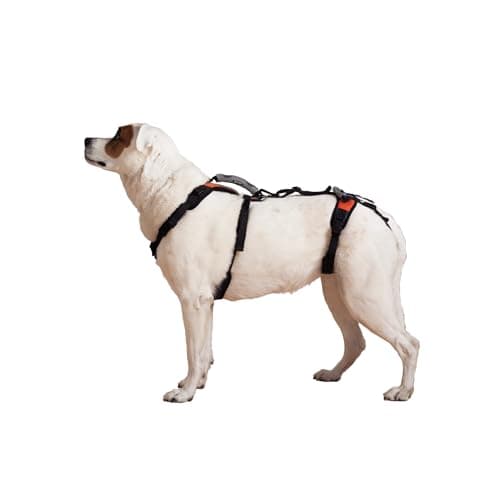
Help 'Em Up
Help 'Em Up Harness
Our score
$95–$155
Best for
Long-term mobility support for senior or post-surgical large dogs
If your dog needs help getting up multiple times a day for the foreseeable future — post-TPLO, advanced hip dysplasia, hindquarter weakness in giant-breed seniors — this is the one to buy. It is the only harness in the category that supports the front and the back independently, which is what a dog with a bad hip and a compensating shoulder actually needs. Buy it from the manufacturer, not from Amazon: re-verified 18 August 2026, helpemup.com prices by size at $80 / $95 / $110 / $125 / $140 while Amazon runs $95 / $110 / $125 / $140 / $155 — a uniform $15 more at every size, every time we have checked.
Pros
- Two-piece (chest + hip) design lets you support either end independently
- Hip handle is purpose-built — not a converted car-seat-belt strap
- Padded chest plate distributes weight better than sling-only options
- Five sizes span 10 to 225 lb, and the rear half can be ordered a size smaller for a dog with muscle wasting
- Two hip-lift styles (Conventional and U-Band) so male dogs are not soiling the strap
Cons
- Amazon runs a uniform $15 above the maker's own price at every one of the five sizes, and the Amazon buy box is held by a third-party reseller (Veterinary Preferred) rather than by the brand — re-verified 18 August 2026
- The maker's own Mix & Match page prints two different starting prices, "From $80" and "FROM $95 USD", on the same page
- Direct pricing is no longer flat: since mid-August 2026 the maker charges $80 to $140 by size, so a giant-breed owner now pays $60 more than a terrier owner
- On 29 August 2026 the linked Amazon Medium (B0DK81SCG5) showed a future availability date rather than units on hand, while every size and style was in stock at helpemup.com the same day; on 9 September and again on 12 September 2026 the Amazon Medium still showed the future-date status at $125.00 with a maximum order of one and no ship date given, while all nine direct variants were in stock — two weeks of backorder on the channel we earn from, and one more reason the direct channel is the one to use
- Sizing is critical — measure twice, return is a hassle
- Rear straps can chafe the inner thigh if the harness is left tight while the dog lies down
- A dog filmed or gait-assessed while wearing it looks less lame than he is, because the harness offloads the limb you are trying to judge
- Bulkier than a quick-grab sling for short-term use
Anesthesia and abdominal surgery suppress appetite for several days, and forcing a dog to eat their normal kibble during that window is often how the post-op GI upset ends up worse than the surgery itself. If your surgical team stocks a recovery-formulated diet, ask about it. If they don't, ask your vet what they would recommend for a 5-to-10-day transition food while appetite returns — most clinics carry a prescription option suited to the procedure.
What I'd do#
If I brought home a small-breed puppy tomorrow, I would likely spay or neuter in the 6–9 month window after a frank conversation with my vet about breed and household.
If I brought home a Golden Retriever, a Labrador, a German Shepherd, a Bernese Mountain Dog, or another large or giant breed, I would not neuter at 6 months. I would wait until at least 12 months, probably longer for males, and I would plan for at least one heat in females before considering surgery. I would ask my vet specifically whether ovary-sparing spay or vasectomy was an option for my breed and circumstances, and I would be willing to drive to a specialist if my regular vet didn't perform them.
If I had a female of any size whose breed has a high lifetime pyometra rate, I would spay her — eventually, at a timing my vet and I worked out — rather than leave her intact, because the pyometra math gets hard to ignore in those breeds.
And if I had a working dog or a large-breed adolescent male whose body was still actively growing, I would wait and watch.
The honest, careful answer is that the right age to spay or neuter depends on a dog you know better than any researcher does, in a household no study can capture. The literature gives you a much better starting place than it did a decade ago. The decision still belongs to you and your vet.
A note from Karen: If you are reading this because you are about to make this decision for the first time, you are already doing the work most owners don't. That counts. The fact that you are reading a 3,000-word evidence review instead of going with the first piece of advice you heard means your dog is in good hands. Whatever you decide — please bring this article to your vet, ask questions, and trust the conversation more than any single source. Including this one.
Sources#
Footnotes#
-
Rowan AN, Williams J. "The Success of Companion Animal Management Programs: A Review." Anthrozoös 1987;1(2):110–122. (Historical baseline on U.S. shelter euthanasia counts in the 1970s–80s.) ↩
-
ASPCA. "Pet Statistics." Current data on shelter intake and euthanasia, U.S. https://www.aspca.org/helping-people-pets/shelter-intake-and-surrender/pet-statistics ↩ ↩2
-
Torres de la Riva G, Hart BL, Farver TB, et al. "Neutering Dogs: Effects on Joint Disorders and Cancers in Golden Retrievers." PLOS ONE 2013;8(2):e55937. doi:10.1371/journal.pone.0055937 ↩ ↩2
-
Hart BL, Hart LA, Thigpen AP, Willits NH. "Long-Term Health Effects of Neutering Dogs: Comparison of Labrador Retrievers with Golden Retrievers." PLOS ONE 2014;9(7):e102241. doi:10.1371/journal.pone.0102241 ↩ ↩2
-
Hart BL, Hart LA, Thigpen AP, Willits NH. "Neutering of German Shepherd Dogs: associated joint disorders, cancers and urinary incontinence." Veterinary Medicine and Science 2016;2(3):191–199. doi:10.1002/vms3.34 ↩ ↩2
-
Hart BL, Hart LA, Thigpen AP, Willits NH. "Assisting Decision-Making on Age of Neutering for 35 Breeds of Dogs: Associated Joint Disorders, Cancers, and Urinary Incontinence." Frontiers in Veterinary Science 2020;7:388. doi:10.3389/fvets.2020.00388 ↩ ↩2 ↩3
-
Zink C, Delgado MM, Stella JL. "Effects of laparoscopic-assisted ovariectomy and ovariohysterectomy in dogs..." See also: Zink MC, Farhoody P, Elser SE, et al. "Evaluation of the risk and age of onset of cancer and behavioral disorders in gonadectomized Vizslas." Journal of the American Veterinary Medical Association 2014;244(3):309–319. doi:10.2460/javma.244.3.309 — and for working dog data: Cain JL, Lawler J, Risch B, et al. Belgian Malinois military working dog cohort findings, JAVMA 2020. (Note: working-dog literature on Malinois orthopedic and behavioral outcomes; the Vizsla paper is the closest peer-reviewed analog and is widely cited in this debate.) ↩ ↩2
-
Simpson M, Albright S, Wolfe B, Searfoss E, Street K, Diehl K, Page R. "Age at gonadectomy and risk of overweight/obesity and orthopedic injury in a cohort of Golden Retrievers." PLOS ONE 2019;14(7):e0209131. https://doi.org/10.1371/journal.pone.0209131 (Corrected 11 August 2026: this reference previously gave the journal as the Journal of the American Veterinary Medical Association and an approximate title. Verified against the DOI record.) ↩
-
Kent MS, Burton JH, Dank G, Bannasch DL, Rebhun RB. "Association of cancer-related mortality, age, and gonadectomy in Golden Retrievers." PLOS ONE 2018;13(2):e0192578. doi:10.1371/journal.pone.0192578 ↩
-
American Animal Hospital Association. "2024 AAHA Canine Life Stage Guidelines." Journal of the American Animal Hospital Association 2024. https://www.aaha.org/aaha-guidelines/life-stage-canine-2024/ ↩
-
Kustritz MVR. "Determining the optimal age for gonadectomy of dogs and cats." Journal of the American Veterinary Medical Association 2007;231(11):1665–1675. doi:10.2460/javma.231.11.1665 — foundational review including discussion of ovary-sparing techniques. See also more recent: Kutzler MA. "Possible relationship between long-term adverse health effects of gonad-removing surgical sterilization and luteinizing hormone in dogs." Animals 2020;10(4):599. doi:10.3390/ani10040599 ↩
-
Society for Theriogenology / American College of Theriogenologists position statement on alternatives to traditional gonadectomy in dogs. https://www.therio.org ↩
-
Norwegian Animal Welfare Act §9 (operations on animals); Swedish Animal Welfare Act provisions on elective surgery — Scandinavian regulatory context for restrictions on routine elective neutering. ↩
-
Jitpean S, Hagman R, Ström Holst B, Höglund OV, Pettersson A, Egenvall A. "Breed variations in the incidence of pyometra and mammary tumours in Swedish dogs." Reproduction in Domestic Animals 2012;47 Suppl 6:347–350. doi:10.1111/rda.12103 ↩
-
Egenvall A, Hagman R, Bonnett BN, Hedhammar A, Olson P, Lagerstedt AS. "Breed risk of pyometra in insured dogs in Sweden." Journal of Veterinary Internal Medicine 2001;15(6):530–538. doi:10.1111/j.1939-1676.2001.tb01587.x ↩
-
Hagman R. "Pyometra in Small Animals." Veterinary Clinics of North America: Small Animal Practice 2018;48(4):639–661. doi:10.1016/j.cvsm.2018.03.001 — comprehensive recent review including breed-specific lifetime incidence updates. ↩
Frequently asked
- What does the UC Davis research actually show?
- Across more than a dozen breed-specific cohort studies led by Benjamin and Lynette Hart, dogs neutered before about one year of age — especially large breeds like Golden Retrievers, Labradors, and German Shepherds — showed two to four times higher rates of joint disorders (hip dysplasia, cranial cruciate ligament tears, elbow dysplasia) than intact dogs of the same breeds. Some breeds also showed elevated rates of certain cancers (lymphoma, hemangiosarcoma, mast cell tumors) in dogs neutered young. Smaller breeds generally did not show the same patterns. The findings are about timing and breed, not a blanket case against neutering.
- Is there a 'right' age?
- There isn't one. The 2024 AAHA Canine Life Stage Guidelines explicitly recommend an individualized decision based on breed, expected adult size, sex, lifestyle, and household. As a rough framework: small breeds (under ~20 kg) can usually be neutered around 6 months with low risk; medium breeds often do well between 9–14 months; large and giant breeds frequently benefit from waiting until growth plates close, often 18–24 months or after the first heat for females. Your vet should help you weigh your specific dog's risks.
- What are ovary-sparing spay and vasectomy?
- Ovary-sparing spay (OSS) removes the uterus and cervix but leaves one or both ovaries intact, eliminating pyometra and pregnancy risk while preserving sex hormones. Vasectomy in male dogs cuts the vas deferens, preventing reproduction while keeping the testicles and their hormone production. Both alternatives are less common in general practice but are offered by some board-certified surgeons and reproductive specialists. They preserve hormonal benefits but require a vet experienced in the procedures.
- Will my female dog get pyometra if I don't spay her?
- Pyometra is a real risk, but it is not a near-certainty. The largest cohort study, from a Swedish insurance database, found that roughly 23–25% of intact female dogs develop pyometra by age 10, with breed risk ranging from under 10% to over 50%. That is a meaningful number. It needs to be weighed against the cancer and joint risks an early spay can introduce in some breeds, plus the fact that pyometra is treatable when caught early. Spaying eliminates pyometra risk entirely; the question is when to do it, not whether the disease is real.
- Why is shelter messaging different from this article?
- Because shelters are solving a different problem. Roughly 390,000 dogs are euthanized in U.S. shelters each year, almost entirely due to overpopulation. From a public-health perspective, blanket early spay/neuter is the single most effective tool for reducing that number, and adopting an unaltered dog into an unprepared home has real costs to the broader population of dogs. Shelters are giving the right answer for a population. Your vet is giving the right answer for one dog. Both can be true at once.