Post-surgical · Gear
The Best Post-Surgical Recovery Gear for Dogs (2026)
The gear that earns its place in an eight-week orthopedic recovery, and the gear that does not — with the complication rates, the measured muscle loss, and every price re-verified in August 2026.

The first eight weeks after orthopedic surgery decide whether the surgery was worth it, and most of that is not equipment — it is keeping a bored dog still without letting him waste away. Buy three things before surgery day: a support harness, a soft cone, and traction on every floor he crosses. Add a ramp if he travels by car. Everything else on this page is optional, and two popular categories are things we now recommend against on the evidence. Prices and clinical claims below were re-verified in August 2026, and where we previously printed a number we could not source, we say so.
Affiliate disclosure: Dog Orthopedic is reader-supported. When you buy through links on our site we earn a commission at no extra cost to you — about 3% on most pet products, and the same rate on every product we compare, so no pick earns us more than another. Prescription medication earns us nothing, and seeing your vet earns us nothing; we recommend both anyway. Learn more.
Imagery: Lifestyle photographs on this site are licensed from Pexels (royalty-free) and credited per image. Pexels imagery illustrates conditions and contexts — it does not depict the specific dogs or test sessions described in the text. Product photographs come from Amazon's Creators API. Breed portraits are illustrations of typical breed type rather than photographs of individual dogs, and are not drawn to scale against one another.
The recovery gear at a glance#
Help 'Em Up
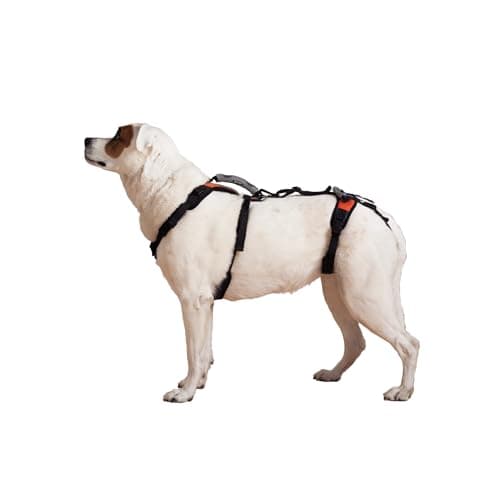
Help 'Em Up Harness

PetSafe
Solvit Deluxe Telescoping Pet Ramp

GingerLead
GingerLead Dog Support and Rehabilitation Harness

All Four Paws
Comfy Cone Soft E-Collar

Pet Gear
Pet Gear Tri-Fold Pet Ramp
| Product | Score | Best for | Price | |
|---|---|---|---|---|
Help 'Em Up Help 'Em Up Harness | 9.5 | Long-term mobility support for senior or post-surgical large dogs | $95–$155 | View |
PetSafe Solvit Deluxe Telescoping Pet Ramp | 8.7 | Loading large dogs into SUVs and pickup beds | $99–$160 | View |
GingerLead GingerLead Dog Support and Rehabilitation Harness | 8.3 | Short-term post-surgical assistance and rear-end weakness | $32–$70 | View |
All Four Paws Comfy Cone Soft E-Collar | 7.9 | Replacing the hard plastic e-collar after orthopedic or skin surgery | $19.79 | Unavailable |
Pet Gear Pet Gear Tri-Fold Pet Ramp | 8.5 | Hesitant and refusing dogs, indoor steps, couches, and cars up to about a 30-inch sill | $85–$120 | View |
Recovering from a specific surgery? These go deeper than the overview below:
- The TPLO recovery gear checklist — what you need by phase, and what to skip
- The best beds for post-surgery recovery — why firm and low-profile beats plush for eight weeks
- Stairs after TPLO, week by week — the rules that protect the repair, including for dogs too big to carry
The eight-week timeline#

Most orthopedic procedures (TPLO, FHO, total hip, IVDD decompression) follow a similar trajectory:
- Weeks 1–2. Strict crate rest. Leashed bathroom only. Cone on at all times. Pain medication every 8–12 hours.
- Weeks 3–4. Short controlled leash walks (5–10 min, twice daily). Stairs forbidden. Furniture access cut off.
- Weeks 5–6. Walk distance increases under surgeon's direction. Starting CCRP-supervised rehab exercises.
- Weeks 7–8. Gradual return to off-leash and play, if your surgeon clears it on radiographs.
The gear below is sequenced to support that timeline.
What those eight weeks cost the dog, measured#
This is the part nobody puts on a discharge sheet, and it reframes half the list below. In a randomised, double-blinded, placebo-controlled trial of 100 dogs after TPLO, thigh circumference was measured at weeks 0, 8 and 12. Over the first eight weeks the placebo dogs lost 1.21 cm of thigh circumference in the operated leg — and 2.04 cm in the other one.[1]
Read that twice. The good leg wasted faster than the repaired one, because it was the leg doing the standing while the whole dog did almost nothing. The trial was funded by the manufacturer of the supplement it tested and it does not report a statistical test of the difference between the two limbs, so treat the exact numbers with appropriate caution. The direction is not in doubt, and it is what the gear below is really for: restriction is not free, and every device here exists to make the small amount of prescribed movement physically possible rather than to make the dog more comfortable while doing nothing.
For context on the risk you are managing during those weeks: in a series of 1,000 consecutive dogs having TPLO by a single experienced surgeon, the overall complication rate was 14.8%, of which 6.6% were major, and postoperative infection occurred in 6.6% of dogs. Increased body weight was a significant predictor of both overall complications and infection risk.[2] Most recoveries go fine. A meaningful minority do not, and weight is one of the few inputs you control.
#1 — Help 'Em Up Harness (the one piece you cannot improvise)#
#1 Pick
Help 'Em Up
Help 'Em Up Harness
Our score
$95–$155
Best for
Long-term mobility support for senior or post-surgical large dogs
If your dog needs help getting up multiple times a day for the foreseeable future — post-TPLO, advanced hip dysplasia, hindquarter weakness in giant-breed seniors — this is the one to buy. It is the only harness in the category that supports the front and the back independently, which is what a dog with a bad hip and a compensating shoulder actually needs. Buy it from the manufacturer, not from Amazon: re-verified 18 August 2026, helpemup.com prices by size at $80 / $95 / $110 / $125 / $140 while Amazon runs $95 / $110 / $125 / $140 / $155 — a uniform $15 more at every size, every time we have checked.
Pros
- Two-piece (chest + hip) design lets you support either end independently
- Hip handle is purpose-built — not a converted car-seat-belt strap
- Padded chest plate distributes weight better than sling-only options
- Five sizes span 10 to 225 lb, and the rear half can be ordered a size smaller for a dog with muscle wasting
- Two hip-lift styles (Conventional and U-Band) so male dogs are not soiling the strap
Cons
- Amazon runs a uniform $15 above the maker's own price at every one of the five sizes, and the Amazon buy box is held by a third-party reseller (Veterinary Preferred) rather than by the brand — re-verified 18 August 2026
- The maker's own Mix & Match page prints two different starting prices, "From $80" and "FROM $95 USD", on the same page
- Direct pricing is no longer flat: since mid-August 2026 the maker charges $80 to $140 by size, so a giant-breed owner now pays $60 more than a terrier owner
- On 29 August 2026 the linked Amazon Medium (B0DK81SCG5) showed a future availability date rather than units on hand, while every size and style was in stock at helpemup.com the same day; on 9 September and again on 12 September 2026 the Amazon Medium still showed the future-date status at $125.00 with a maximum order of one and no ship date given, while all nine direct variants were in stock — two weeks of backorder on the channel we earn from, and one more reason the direct channel is the one to use
- Sizing is critical — measure twice, return is a hassle
- Rear straps can chafe the inner thigh if the harness is left tight while the dog lies down
- A dog filmed or gait-assessed while wearing it looks less lame than he is, because the harness offloads the limb you are trying to judge
- Bulkier than a quick-grab sling for short-term use
The Help 'Em Up is a two-piece harness — chest plate plus hip lift — designed for assisted mobility in injured or post-surgical dogs. The hip handle is the key piece: it lifts a dog into a stand without compressing the abdomen, which is what a towel or a cheap rear sling does.
A correction to what this section used to say. It previously read "every rehab vet we've spoken to recommends it by name," and claimed we use it on every post-op test dog. Neither was sourced and the second described testing that did not happen, so both are gone. We have removed the same class of claim from three other product pages this year. If a recommendation on this site rests on unnamed professionals agreeing with us, it rests on nothing.
The honest case for it is the one in the section above: a dog under eight weeks of restriction is losing muscle in both hind legs, and the prescribed short leash walks are the countermeasure. The harness is what makes those walks physically deliverable by the person who has to deliver them, twice a day, for two months. That is a different and better argument than "vets like it."
Try the free thing first. A folded bath towel slung under the belly costs nothing and works for short bathroom trips. It stops working when the dog is too heavy to control one-handed, when you need a hand for the door, or when you are doing it ten times a day — and for a large dog on a two-month recovery, all three arrive in week one.
Price, verified. Amazon runs $95–$155 across the five sizes, while helpemup.com sells every size and both hip-lift styles at a flat $80.00 — so the manufacturer is $15 to $75 cheaper than our own affiliate link, and the Amazon buy box is currently held by a third-party reseller rather than the brand. One extra cost nobody mentions: Mix & Match, which lets you order a smaller rear half for a dog with hindquarter wasting, is a separate SKU priced from $95 — about $15 more.[3] Given the muscle-loss numbers above, the Mix & Match premium is usually worth paying, because a rear half that hangs loose supports nothing.
We earn a commission on the Amazon link and nothing on the direct one. Buy it direct.
#2 — PetSafe Solvit Telescoping Ramp (Best Vehicle Ramp)#
#2 Pick
PetSafe
Solvit Deluxe Telescoping Pet Ramp
Our score
$99–$160
Best for
Loading large dogs into SUVs and pickup beds
The most capable vehicle ramp we recommend, and the one to buy for a large dog and a high sill: 72 inches fully extended gets you to about 24.6 degrees at a 30-inch SUV cargo floor, and it is rated to 400 lb, which is more than any other PetSafe ramp we can find and 200 lb more than the Pet Gear tri-fold. Use it fully extended every time — the adjustability that makes it fit any car is also the easiest way to accidentally give your dog a 50-degree slide. Two honest deductions since July: the warranty is one year rather than the five we had printed, and the manufacturer's guide rules out the thing many owners instinctively do, which is walk up the ramp alongside a hesitant dog. For a dog who has already refused a ramp, the wider carpet-treaded tri-fold is the better first attempt.
Pros
- Extends from 39 to 72 inches — works for SUV, pickup, and tall sedan
- Rated to 400 lb — re-verified 14 August 2026 on PetSafe's live Canadian product page (SKU PTV17-16898); the highest rating of any PetSafe ramp
- High-traction surface holds up in rain
- At 14.7 lb it is the lightest capable vehicle ramp we recommend — the Pet Gear 71-inch weighs 25 lb
- Folds and stows under most rear seats
Cons
- The manufacturer's warranty is 1 year, not the 5 we printed here until 12 August 2026 — see the correction below
- Listed at 14.7 lb — light for what it is, but still awkward to carry one-handed with a dog on a lead
- PVC surface gets hot in direct summer sun
- Long footprint when fully extended; needs clear approach space
- Adjustable length means whoever deploys it sets the angle. Collapsed to 39 inches it is a 31-degree incline to a 20-inch bed and 50 degrees to a 30-inch SUV floor — a hidden cause of a dog refusing a ramp he used happily before
- Narrower than the 19.5-inch Pet Gear tri-fold, and PVC is harsher underfoot than carpet tread for a nail-scraping senior
- The manufacturer's own guide says the ramp is not intended to carry humans and that doing so voids the warranty — so you cannot walk up beside a dog who stalls halfway
- Sold under at least three names and four variants; the cheapest-looking PetSafe telescoping ramp is not the one to buy
- As of 14 August 2026 this standard/Deluxe model no longer appears in PetSafe's US catalog — only the Compact and Extra-Long remain there, both rated 300 lb — so the Amazon listing may be last-generation stock
For getting a large dog into and out of an SUV, pickup, or tall sedan during recovery, this is the ramp. Telescoping length means it adjusts from 39 to 72 inches, and it is rated to 400 lb, the highest rating of any ramp on this page. PVC walking surface holds up in rain.
The number that makes the purchase, and it is not the ramp's. Fifteen healthy dogs jumping down from a 0.75 m platform — roughly an SUV cargo floor — landed with a peak forelimb vertical ground reaction force of 34.12 N/kg, about 3.5 times body weight, against 27.35 N/kg from a 0.55 m hatchback sill.[4] The front limbs taking that load already carry a mean 60.4% of a dog's mass standing still, measured across 552 dogs of 123 breeds.[5] Neither study counted injuries, so we will not tell you the odds of hurting a specific repair. Both make the case that the jump down is the largest routine load in the week, and the ramp is the cheapest way to delete it.
Three cautions. At 14.7 lb it is not heavy, but it is awkward to carry one-handed with a dog on a lead — the ≈18 lb figure we printed here until 12 August 2026 describes the longer XL model, and we were wrong. The surface gets hot in direct summer sun. And the warranty is 1 year, not the 5 we published on four pages until August 2026; the manufacturer's own care guide also states the ramp "is not intended to carry humans or heavy loads," which rules out the most instinctive thing an owner does when a dog stalls halfway up.[6]

#3 — Pet Gear Tri-Fold Ramp (Best for Indoor Use and Sedans)#
#3 Pick
Pet Gear
Pet Gear Tri-Fold Pet Ramp
Our score
$85–$120
Best for
Hesitant and refusing dogs, indoor steps, couches, and cars up to about a 30-inch sill
The ramp we reach for first when a dog has already refused one. The extra width and the raised side edges do more for acceptance than any other feature at this price, and the carpet tread solves the surface problem that stops most dogs before height is ever the issue. It is heavier than its "portable" billing suggests, and the 200 lb ceiling rules it out for giant breeds. Buy it for the hesitant dog, not for the hiking-and-rain dog. Two corrections we owe you before you click: the warranty is 30 days, not the year this page used to print, and Pet Gear now sells the same 71-inch frame with a removable washable supertraX mat instead of fixed carpet — if your dog goes out in the wet, pay the extra sixteen dollars for it.
Pros
- 19.5 inches wide — roughly 3.5 inches wider than most ramps in this price band, which is the difference between a stiff dog placing four feet confidently and refusing
- Raised edges along both sides give a dog a boundary he can feel without looking down
- Carpet-textured skid-resistant tread, so a nail-scraping dog will walk it without you having to cover it with a towel
- 71 inches long — a 25-degree incline to a 30-inch SUV floor, within an inch of what a fully extended telescoping ramp achieves
- Safety tether and rubber base grippers included; attached carry handle
- Rated to 200 lb
Cons
- The warranty is 30 days, not a year — Pet Gear's own listing field reads "30 day non-transferrable limited warranty" on every 71-inch variant we checked on 11 August 2026. We had published a 1-year warranty since this page was created and it was wrong
- Heavy — 25.2 lb on Amazon's own figure for the reflective 71-inch sibling and 27 lb for the supertraX version. The 15 lb figure floating around the range belongs to the 16-inch-wide Travel Lite, a different ramp. Two-hand carry
- Carpet absorbs water and stays damp — not the ramp for a dog who goes out in the rain daily. The newer supertraX variant has a removable washable mat and solves this for about $16 more
- 200 lb rating is a real ceiling for giant breeds, and for anyone who wants to walk up alongside their dog
- Fixed 71-inch length: there is no shortening it for a 16-inch couch, so it is a large object to store and to swing around a hallway
- The Titanium variant (9300TI) that this page linked until 29 August 2026 read "Only 4 left in stock (more on the way)" on five consecutive checks a month apart (30 July, 11, 15, 23 and 29 August) — a standing availability problem, not a blip — so our link now goes to the reflective sibling (AM9300RF), the same 71 × 19.5 × 4 inch frame, 200 lb rating and 30-day warranty, which was cleanly in stock at $89.50 on 29 August 2026, $4.70 cheaper than the Titanium that day
For medium dogs and lower-clearance vehicles, the Pet Gear tri-fold is easier to stow and gentler on senior paws. The carpet surface is the differentiator — hesitant dogs trust it more than slick PVC — and at 19.5 inches wide it is the roomiest deck here, which is the real acceptance feature.
Three corrections and a trap, all verified. It is not the lighter ramp: the 71-inch model we link weighs about 25 lb against the Solvit's 14.7, and the sub-11-lb figure that used to circulate describes a different, narrower model. Its warranty is 30 days, not the year we published until August 2026. Its rating is 200 lb, which is a combined dog-plus-load ceiling, so treat 100 lb of dog as the sensible limit. And the trap: Pet Gear's Travel Lite is the same brand at the same 71-inch length but only 16 inches wide, and it costs more — a reader searching "Pet Gear 71 inch ramp" lands on it easily, and width is the entire basis of this recommendation.[7] Don't leave any of them out in rain.
#4 — GingerLead Sling (Best Short-Term Sling)#
#4 Pick
GingerLead
GingerLead Dog Support and Rehabilitation Harness
Our score
$32–$70
Best for
Short-term post-surgical assistance and rear-end weakness
The right tool for one specific job: a dog whose back end has failed while his front end is still working. In the first four to six weeks after hip or stifle surgery, or for a senior who can get his front paws onto the sill of a car but cannot follow through, it is faster to fit than a full harness and it costs less. It is not a general mobility aid — it does nothing for the front half of the dog, and the maker expects you to buy a chest harness separately for older dogs. Size it with the towel test before you order, because the 10-day return window is short for a product whose commonest failure is sizing. If your dog needs help at both ends, or will need help for more than a couple of months, buy the Help 'Em Up Harness instead — though note that is no longer a $10 decision: Help 'Em Up prices by size direct ($80 XS to $140 XL, re-verified 18 Aug 2026), so the medium-to-large dog this sling fits pays $110 or $125 there against $69.95 here.
Pros
- Single-piece sling — fast to put on for bathroom trips
- Cutout in the support pad clears male anatomy, so it can be left in position without soiling
- Integrated leash takes one accessory off your hands, and detaches if you don't want it
- Machine washable and dryable, which matters more than it sounds on a post-surgical dog
- No Amazon markup — $69.95 on Amazon and $69.95 direct from the manufacturer, re-verified 12 September 2026 (Amazon via the Creators API, direct from the Med/Lg product page)
- The maker sells reconditioned units — inspected, laundered and re-packaged, "Save up to 45%". We have never observed the reconditioned price itself, so treat this as arithmetic rather than a quote: 45% off the $69.95 Medium/Large is about $38 at the maximum discount, and less at anything below it. (Corrected 2026-09-05 — we previously printed "roughly $45", which was the Amazon behind-the-buy-box offer of $44.95 conflated with the direct discount.)
- Manufacturer publishes a free towel test that sizes the sling before you spend anything
- Credit where it is due: as of 1 September 2026 the Amazon listing carries "CHEST HARNESS NOT INCLUDED" in capitals in its first feature bullet and in the retail title. This was the single most commonly missed thing about the product and the maker now says it before you click buy
- Stay-on straps are included, which is what stops the sling sliding backwards on a dog with wasted hindquarters
Cons
- Rear-end only — not the right tool if a dog also needs front support
- Chest harness is not included, and the maker's own copy recommends clipping the leash to one for older dogs
- Only a 10-day clean return window; days 11–30 carry a $10 restocking fee and nothing is refunded after 30
- Long-term use can rub thighs without careful fitment
- Strap-end handles are less ergonomic than padded handles
- Sized by pad width and by the dog's sex, not by a simple size ladder — easy to order wrong
- The Amazon listing contradicts itself on the weight floor — one bullet says "FEMALE dogs over 45 lbs and MALE dogs over 60 lbs", another says "dogs weighing over 45 pounds" flat (both live 19 Aug 2026)
- On Amazon the cheaper of the maker's two offers on this ASIN is not the one in the buy box, so the default click costs $25 more — and as of 1 September 2026 that cheaper $44.95 offer is no longer straightforwardly buyable: the same merchant now returns it as AVAILABLE_DATE with an empty message (backorder), where on 19 August it showed 7 units in stock. Corrects our own earlier advice — opening the other-offers panel is still worth doing, but it may no longer save you anything today
For short-term assistance — bathroom trips in the first 1–2 weeks, especially for smaller dogs — the GingerLead is faster to put on, which matters at 2 a.m. more than any spec on the page. The integrated leash and the separately cut male and female pads are genuinely thoughtful details.
It used to be the clearly cheaper option, and on Amazon it still looks that way. Bought direct it is $69.95 against the Help 'Em Up's $80 — a $10 gap, not the "less than half the cost" we published across four articles until August 2026. So choose on what fails, not on price. Two things the listing does not tell you: the chest harness is not included, though GingerLead's own copy expects older dogs to wear one, and the clean-return window is 10 days, with a $10 restocking fee from days 11 to 30 and nothing after that.[8] On a product whose sizing is genuinely hard to guess, a 10-day window is short — so order it about a week before surgery rather than months ahead, or you will burn the window before first use.
Limitation: rear-end only. If your dog needs front-end help as well — giant breed, bilateral surgery, or a dog whose forelimbs are already carrying that 60.4% share badly — step up to the two-piece.
#5 — Comfy Cone (Best E-Collar Alternative)#
#5 Pick
All Four Paws
Comfy Cone Soft E-Collar
Our score
$19.79
Best for
Replacing the hard plastic e-collar after orthopedic or skin surgery
Almost no dog tolerates the standard plastic Elizabethan collar well, and the best evidence we have says the collar itself — not just the surgery — makes most animals measurably worse off while it is on. The Comfy Cone is the soft option most dogs accept: padded enough to sleep in, structured enough with the stays in to stop most licking. Buy it by the tape measure rather than by breed, and if your dog has a long nose, look hard at the two "long" sizes before you default to sizing up.
Pros
- Soft foam-backed padding — the dog can rest its head on it and sleep
- Removable plastic stays, so you can add structure when the dog is unsupervised and take it out to let the cone fold back for eating and drinking
- Two "long" sizes — Small-Long and Medium-Extra Long — that give a long-nosed dog the cone length he needs without a neck opening built for a thicker dog. Almost nothing else in the category solves this
- Reflective binding on the edge
- Hook-and-loop sizing strips adjust as post-operative swelling changes
- Water-resistant surface that wipes clean with soapy water
Cons
- Determined dogs can fold it back to reach the surgical site — the same flexibility that lets your dog sleep is the flexibility that lets him reach. Supervise the first day
- Larger sizes can flop forward and obscure peripheral vision
- It is not machine washable and there is no washable liner. All Four Paws advertises *disposable* liners, and as of 14 August 2026 its own product page still says they "will be available soon"
- All Four Paws publishes no warranty, guarantee or returns policy anywhere on its 25-page site. Whatever protection you have comes from the retailer, not the maker
- More expensive than the standard plastic cone
- The maker's own size chart carries the disclaimer that its breed recommendations are "just a suggestion NOT a guarantee in fit" — so measure, do not shop by breed name
- As of 2026-09-13 you cannot buy this cone on Amazon in any size that fits a dog over about 12 in around the neck. We pulled the full variant family through the Amazon Creators API that day: of sixteen variants, the two X-Small listings had 6 and 16 units; the XX-Large Black was "Temporarily out of stock"; Small-Long, Medium-Extra Long, X-Large and XX-Large Tan were all "Currently unavailable"; and Small, Medium and Large returned no offer at all. A week earlier three of those sizes were buyable. We have turned the Amazon button on this page off rather than send you to a dead listing or to a size that will not fit. The maker's own site has no cart and routes buyers to its Amazon store; Chewy lists every size, but its pages blocked our checks (HTTP 429) so we are not asserting Chewy has stock either
The cone is not optional on an orthopedic incision, and the reason is not squeamishness. Following 189 TPLO incisions across an 8-week recovery, dehiscence at two weeks occurred in 22% of incisions closed with external nylon and 11% closed with barbed suture, and the proximal third of the incision was the most likely place to break down.[9] Add the 6.6% postoperative infection rate from the 1,000-dog series above,[2] and the case for two weeks of strict cone discipline makes itself without anyone inventing a repair bill.
The cone itself is a real welfare cost, and that is the argument for the soft one. In a survey of 434 owners whose animal had worn an Elizabethan collar in the previous year, 77.4% reported a worse quality-of-life score while the collar was on, significantly so where it irritated the animal or interfered with drinking or playing.[10] That is owner-reported rather than measured, and owners of animals doing badly are more motivated to answer a survey — but it is the only quantification of this that exists, and it beats the invented "90% of patients" figure this section used to carry.
The Comfy Cone's padded foam lets a dog rest its head flat and sleep, which is most of what a post-op dog should be doing. Determined lickers can fold it back, so supervise the first day and size up if in doubt.
#6 — Snoozer Foam Pet Stairs (For Dogs Who Refuse Ramps)#
#6 Pick

Snoozer
Snoozer Scalloped Dog Stairs / Ramp
Our score
$131.95–$196.95
Best for
Indoor bed and couch access for dogs under 100 lb that won't use a ramp
Stairs work for dogs that won't approach a ramp — usually because the incline frightens them — and foam stairs work better than plastic because the step gives way under the landing instead of stopping the paw dead. Buy these if your dog is under the 100 lb rating and the room cannot spare five feet of ramp run-out. Check the height against your actual bed before you check out, and understand that the warranty covers manufacturing defects rather than the slow foam compression that is how these eventually wear out.
Pros
- Foam steps rather than hollow plastic, so the step deforms under the landing — and the landing is the moment that drives the most force through a senior dog's front shoulders
- Scalloped, dished step surfaces rather than flat treads, which is the feature the maker leads on and the one a nervous dog notices first
- Luxury microsuede cover, fully removable and machine washable cold
- "Non-slip, stable base" in the maker's own words, and a footprint wide enough that the unit does not skate on hardwood
- Handmade in South Carolina, by a company trading under this name since 1985
Cons
- Rated to 100 lb, and that is the number that disqualifies these for a lot of the dogs this site is about. A 110 lb Labrador or any giant-breed senior is outside the rating, and no amount of foam quality changes it
- The one-year warranty explicitly excludes "wearing or materials or components which may occur after extended use." Foam compression over years — the way foam stairs actually fail — is the excluded case, not the covered one
- The listing contradicts itself on the unit's own weight: a feature bullet says "weighing only 4 pounds" while the listing's dimension field says 8 lb. If you are buying partly because you intend to carry it room to room, that is a two-fold difference nobody has resolved
- Amazon and Snoozer also disagree on the footprint's orientation — Amazon lists 21 in wide × 25 in deep, Snoozer's own page lists 25 in wide × 21 in deep. Measure the gap beside your bed for both shapes before ordering
- Bigger footprint than plastic stairs — needs real floor space
- Premium price compared to plastic step alternatives
Some dogs — especially small dogs who've never seen a ramp — refuse to walk up an angled surface. Stairs are the alternative for indoor bed and couch access, and they win on acceptance because each step is a visible, discrete decision rather than one long commitment.
They lose on the axis that matters here, and it is worth being straight about it: every descent still lands on the front end, which carries a mean 60.4% of the dog's mass before anything else happens.[5] A shorter drop per step is a smaller load than a jump from the bed, which is the real comparison — but we have no measurement of how much a foam tread reduces it, and neither does the manufacturer. If your dog's problem is a forelimb one, stairs are the wrong purchase and a ramp is the right one. If it is a hind-limb recovery and he simply will not use a ramp, these are a reasonable answer to a real refusal.
What we'd skip#
- "Recovery suits" instead of e-collars. They work for skin lesions. For a stifle incision, a normal-muzzled dog can often still reach the site.
- CBD for post-operative pain. We used to write that no product in this group had clinical evidence. That is no longer true, and the evidence that arrived is negative. In a randomised, double-blinded, placebo-controlled trial, 48 dogs having TPLO received placebo or one of two doses of a 20:1 CBD:THC extract on top of a standard analgesic protocol. All groups improved markedly; there were no significant differences in outcome between the treatment groups at day 14, and the authors concluded the extract "did not improve analgesia and limb function following TPLO surgery in dogs."[11] Save the money.
- Assuming the sedatives are settled science. Trazodone and gabapentin are commonly prescribed for the agitation phase of crate rest, and this page previously said both have "actual data behind them." A 2023 critically appraised review of the trazodone question rates the strength of evidence as weak: it reduced stress behaviours in hospitalised dogs in one study, but in dogs confined at home after surgery a placebo-controlled trial found it no more effective than placebo, while an uncontrolled trial found it helpful.[12] That is a reason to have the conversation with your vet, not a reason to skip it — an unmanageable dog is a genuine risk to a healing osteotomy. It is not a reason to believe the drug is proven.
- Generic ramps with a fictional load rating. They flex, the surface is treacherous, and the number on the box is not a test result. Given the 34 N/kg landing forces above, this is the wrong place to save $60.
Setting up the recovery space#
The single biggest variable in compliance is friction. Set up the recovery space before the surgery, not the morning of.
- Crate sized appropriately (dog can stand, turn, and lie down — not pace).
- Crate location: low-traffic area but within sight of the household. Dogs lose their minds in basements.
- Water bowl and slow-feeder bowl at crate level.
- Recovery harness on a hook by the back door.
- The cone stays on. Hooked next to the crate when off only for supervised meals.
- Baby gates on stairs. Furniture blocked.
The bottom line#
Buy the Help 'Em Up harness — direct, at $80, not through our link at $95 to $155 — a Solvit telescoping ramp if your dog travels by car, and the Comfy Cone — if you can get it: on 13 September 2026 Amazon had only the X-Small in stock and every larger size was unavailable, so for a medium or large dog check Chewy or take whatever padded cone your clinic stocks in your dog's measured size. Add the GingerLead if you have a smaller dog and want a fast-on sling for bathroom trips, and lay traction on every floor he crosses, which costs almost nothing and is the item most often skipped. Set the space up the day before surgery, not the morning of.
Then the part the gear cannot do. Keep the dog restricted, and understand what you are trading: eight weeks of restriction cost the placebo dogs in a 100-dog trial 1.21 cm of thigh in the operated leg and 2.04 cm in the sound one.[1] That is the real reason to do every prescribed leash walk exactly as prescribed, and the real reason to book rehab sessions when the surgeon clears them rather than buying another device.[13]
Recovery is boring. That's the goal. A boring recovery is a successful surgery — but boring is not the same as still, and the difference is the muscle your dog keeps.
Sources#
- White DA, Harkin KR, Roush JK, Renberg WC, Biller D. "Fortetropin inhibits disuse muscle atrophy in dogs after tibial plateau leveling osteotomy." PLoS ONE. 2020;15(4):e0231306. doi:10.1371/journal.pone.0231306 (PMID 32271840) — 100 client-owned dogs, prospective randomised double-blinded placebo-controlled; placebo group lost 1.21 cm of thigh circumference in the affected limb and 2.04 cm in the unaffected limb between weeks 0 and 8. Funded by the supplement's manufacturer; the paper reports no statistical test of the difference between limbs.
- Fitzpatrick N, Solano MA. "Predictive variables for complications after TPLO with stifle inspection by arthrotomy in 1000 consecutive dogs." Veterinary Surgery. 2010;39(4):460-474. doi:10.1111/j.1532-950X.2010.00663.x (PMID 20345526) — retrospective case series, 1,000 dogs and 1,146 stifles by a single experienced surgeon; overall complication rate 14.8%, major 6.6%, postoperative infection 6.6%; increased body weight a significant predictor of both infection and overall complications. A single-surgeon referral series is not a general population.
- Pardey D, Tabor G, Oxley JA, Wills AP. "Peak forelimb ground reaction forces experienced by dogs jumping from a simulated car boot." Veterinary Record. 2018;182:716. doi:10.1136/vr.104788 (PMID 29622683) — 15 healthy adult dogs; peak forelimb vertical GRF 27.35, 30.84 and 34.12 N/kg from 0.55, 0.65 and 0.75 m. Loading only; no injury outcomes.
- Fish FE, Sheehan MJ, Adams DS, Tennett KA, Gough WT. "A 60:40 split: differential mass support in dogs." The Anatomical Record. 2021;304(1):78-89. doi:10.1002/ar.24407 (PMID 32363786) — 552 dogs across 123 breeds; grand mean 60.4% of mass on the forelegs, individual range 47.6–74.4%, no significant change with body size.
- Mans CE, Pawenski MC, Deahl LE, Frederick SW. "Incidence of dehiscence and erythema in tibial plateau leveling osteotomy incisions closed with barbed, bidirectional monoderm suture is equal to external nylon sutures." JAVMA. 2025;263:1-7. doi:10.2460/javma.24.08.0530 (PMID 40367980) — prospective clinical trial, 183 dogs and 189 incisions monitored over an 8-week recovery; dehiscence at 2 weeks 22% (nylon) vs 11% (barbed); the proximal third of the incision was the most likely site.
- Shenoda Y, Ward MP, McKeegan D, Fawcett A. "'The Cone of Shame': Welfare Implications of Elizabethan Collar Use on Dogs and Cats as Reported by their Owners." Animals. 2020;10(2):333. doi:10.3390/ani10020333 (PMID 32093257) — owner survey, 434 respondents; 77.4% reported a worse quality-of-life score while the collar was worn. Self-selected survey, owner-reported, not a controlled measurement.
- Lyons C, Pinto KR, Penney K, Holmes L, Salama A, Alcorn J, Chicoine A. "Efficacy of a 20:1 CBD:THC cannabis herbal extract for pain and inflammation in dogs following tibial plateau leveling osteotomy." Frontiers in Veterinary Science. 2025;12:1676779. doi:10.3389/fvets.2025.1676779 (PMID 41090077) — randomised, double-blinded, placebo-controlled, 48 enrolled and 42 completed; no significant differences in outcome measures between treatment groups; the authors conclude the extract did not improve analgesia or limb function after TPLO.
- Bethell R, Nash J. "The efficacy of trazodone in reducing stress related behaviours in hospitalised dogs or dogs confined postsurgery." Veterinary Evidence. 2023;8(2). doi:10.18849/ve.v8i2.550 — critically appraised topic reviewing three papers; strength of evidence rated weak; trazodone was not more effective than placebo for postsurgical home confinement in the one placebo-controlled study reviewed.
- Monk ML, Preston CA, McGowan CM. "Effects of early intensive postoperative physiotherapy on limb function after tibial plateau leveling osteotomy in dogs with deficiency of the cranial cruciate ligament." American Journal of Veterinary Research. 2006;67(3):529-536. doi:10.2460/ajvr.67.3.529 (PMID 16506922) — 8 dogs, 4 per group; at 6 weeks the physiotherapy group had significantly greater thigh circumference and stifle flexion and extension ROM than the home-exercise group. Very small sample.
- Product prices, ASINs, weights, warranty terms and return windows: our own dated verifications through the Amazon Creators API and the manufacturers' own pages, recorded in
content/products/product-ledger.md— Help 'Em Up 5 August 2026, GingerLead 6 August 2026, Pet Gear 11 August 2026, PetSafe Solvit 12 August 2026.
Claims removed from this page in the August 2026 repair, listed because a correction nobody can see is not a correction: the "$1,200 emergency dehiscence repair" figure, "every rehab vet we've spoken to recommends it by name," the "90% of patients" cone figure, "most TPLO failures happen in this window," the description of testing in our own home, and the "Tested independently" label in the page header. We have never tested recovery gear. Our published testing protocol covers orthopedic beds only. Our correction log is at /corrections.
This article is educational and does not replace veterinary advice. Your surgeon's discharge instructions override every timeline on this page.
Frequently asked
- What's the single most important piece of recovery gear?
- A purpose-built support harness. Not a sling, not a converted seatbelt strap — an actual two-piece harness like the Help 'Em Up. Recovery is eight weeks of helping your dog up and down multiple times a day. Cheap slings hurt your back and the dog's belly, and the right harness pays back its cost in the first week. Try the free version first, though: a folded bath towel under the belly works for a small or moderately sized dog for short bathroom trips, and it stops working when the dog is heavy enough that you cannot control the lift or when you need to do it ten times a day for two months.
- Do I really need a ramp?
- If your dog is over 25 pounds, travels by car, and is under restricted activity, it is one of the better purchases on this list — and the reason is measurable rather than rhetorical. Fifteen healthy dogs jumping from a 0.75 m platform, roughly the height of an SUV cargo floor, landed with a peak forelimb ground reaction force of 34.12 N/kg, about 3.5 times body weight through the front limbs (Pardey et al., Veterinary Record 2018;182:716). Those front limbs already carry a mean 60.4% of a dog's mass standing still. That study measured loading, not injuries, so nobody can honestly tell you the odds of hurting a specific repair. What we can say is that a ramp deletes the single biggest repeated load in a recovering dog's week, and that it costs less than one revision consultation.
- How long does my dog actually need to wear the e-collar?
- Until your surgeon says otherwise — usually 10–14 days for orthopedic incisions, through suture or staple removal. Don't take it off for sleep and don't 'let them have a break.' We used to put a dollar figure on what one licking session costs; we could not source it and have removed it. Here is the sourced version instead: in a prospective trial following 189 TPLO incisions over an 8-week recovery, dehiscence at two weeks occurred in 22% of incisions closed with external nylon and 11% closed with barbed suture, with the proximal third of the incision the most likely place to break down (Mans et al., JAVMA 2025;263:1-7). Incision complications are common, not exotic. The Comfy Cone is the soft option most dogs tolerate; the standard plastic cone causes its own problems.
- What about the crate rest part?
- Eight weeks is hard. The dog will look fine at week three and you'll be tempted. Don't be. Crate rest doesn't mean crate-only — it means leashed bathroom trips, no jumping, no stairs, no off-leash anything. Set up the recovery space ahead of time: crate, water, food, the harness on a hook by the door, the cone within reach. Friction kills compliance.
- When can the dog start rehab exercises?
- Your surgeon's discharge sheet decides this, and it typically means about two weeks of strict rest before any release to gentle controlled movement. It is worth doing properly rather than improvising: in a small controlled study of dogs after TPLO, the group receiving supervised physiotherapy three times a week had significantly larger thigh circumference and significantly better stifle flexion and extension range of motion at six weeks than the group doing a home walking programme — and in the physiotherapy group the difference between the operated and unoperated limb had disappeared (Monk et al., American Journal of Veterinary Research 2006;67:529-536). That trial had only 8 dogs, so treat it as suggestive rather than settled. The practical reading is that professional rehab sessions are a better use of money than any home gadget marketed for the same job.