Recovery guide
TPLO Surgery Recovery: A Week-by-Week Guide
Tibial-Plateau-Leveling Osteotomy is the gold-standard repair for canine cruciate disease. Here's what to expect, week by week, and the gear that makes recovery survivable.

TPLO — tibial-plateau-leveling osteotomy — is the best-supported repair for canine cruciate disease: a systematic review of 444 papers found the evidence most strongly backs it for returning dogs to normal function.[1] It is also a major operation: the surgeon cuts and rotates the tibia, then plates it back together. Plan for roughly eight weeks of restriction — but get your own surgeon's protocol in writing at discharge, because protocols genuinely vary and no evidence-based guideline exists for anyone to follow.[2] The gear and the household setup below are what separate a clean recovery from a setback.
Affiliate disclosure: Dog Orthopedic is reader-supported. When you buy through links on our site we earn a commission at no extra cost to you — about 3% on most pet products, and the same rate on every product we compare, so no pick earns us more than another. Prescription medication earns us nothing, and seeing your vet earns us nothing; we recommend both anyway. Learn more.
Imagery: Lifestyle photographs on this site are licensed from Pexels (royalty-free) and credited per image. Pexels imagery illustrates conditions and contexts — it does not depict the specific dogs or test sessions described in the text. Product photographs come from Amazon's Creators API. Breed portraits are illustrations of typical breed type rather than photographs of individual dogs, and are not drawn to scale against one another.
What TPLO actually does#
The cranial cruciate ligament (CCL) — the dog version of the human ACL — keeps the femur from sliding off the back of the tibia during weight-bearing. When it tears, the joint becomes unstable and progressively arthritic.
The TPLO doesn't replace the cruciate. Instead, the surgeon cuts the top of the tibia, rotates it to flatten the slope it sits at, and plates it. With the slope flattened, the cruciate's job is no longer needed during weight-bearing — the geometry holds the joint stable on its own.
Cruciate rupture is not evenly distributed across dogs. In a UK primary-care study comparing 1,000 confirmed unilateral cruciate cases against 500,000 dogs without, the raised-risk groups after adjustment were dogs aged 6 to under 9 years, neutered dogs of both sexes, and Rottweilers, Bichon Frise and West Highland White Terriers in particular. Dogs of 20 kg or more were more likely to be managed surgically.[3] That last point is worth holding onto: the size of the dog changes what gets offered, not just what is needed.
The downside is that it is a bone-cut surgery, and the honest timeline is longer than eight weeks. Eight weeks is roughly when practices re-radiograph to check the cut, not when the dog is finished. In a series of large dogs re-evaluated at six weeks, the median bone-healing score was 3 out of 5.[4] In small-breed dogs assessed at 8 to 14 weeks, bone-healing scores had improved but only reached complete union at the follow-up beyond six months.[5]
And on the measure that matters most to you — is he walking normally again — force-plate studies put the answer between six months and one year, not eight weeks. Dogs after TPLO reached limb loading indistinguishable from a normal control population by six months to a year post-operatively.[6] If your dog is at week ten and not yet himself, you are not behind. You are on schedule.
Pre-surgery prep#
Order the recovery gear before the surgery. The morning you bring your dog home is not when you want to be Amazon-shopping with one hand.
The essential kit#
#1 Pick
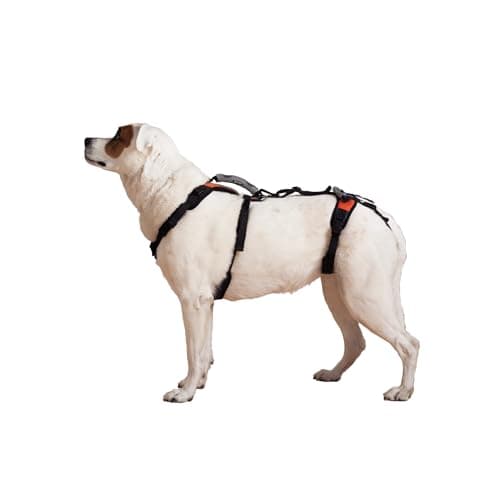
Help 'Em Up
Help 'Em Up Harness
Our score
$95–$155
Best for
Long-term mobility support for senior or post-surgical large dogs
If your dog needs help getting up multiple times a day for the foreseeable future — post-TPLO, advanced hip dysplasia, hindquarter weakness in giant-breed seniors — this is the one to buy. It is the only harness in the category that supports the front and the back independently, which is what a dog with a bad hip and a compensating shoulder actually needs. Buy it from the manufacturer, not from Amazon: re-verified 18 August 2026, helpemup.com prices by size at $80 / $95 / $110 / $125 / $140 while Amazon runs $95 / $110 / $125 / $140 / $155 — a uniform $15 more at every size, every time we have checked.
Pros
- Two-piece (chest + hip) design lets you support either end independently
- Hip handle is purpose-built — not a converted car-seat-belt strap
- Padded chest plate distributes weight better than sling-only options
- Five sizes span 10 to 225 lb, and the rear half can be ordered a size smaller for a dog with muscle wasting
- Two hip-lift styles (Conventional and U-Band) so male dogs are not soiling the strap
Cons
- Amazon runs a uniform $15 above the maker's own price at every one of the five sizes, and the Amazon buy box is held by a third-party reseller (Veterinary Preferred) rather than by the brand — re-verified 18 August 2026
- The maker's own Mix & Match page prints two different starting prices, "From $80" and "FROM $95 USD", on the same page
- Direct pricing is no longer flat: since mid-August 2026 the maker charges $80 to $140 by size, so a giant-breed owner now pays $60 more than a terrier owner
- On 29 August 2026 the linked Amazon Medium (B0DK81SCG5) showed a future availability date rather than units on hand, while every size and style was in stock at helpemup.com the same day; on 9 September and again on 12 September 2026 the Amazon Medium still showed the future-date status at $125.00 with a maximum order of one and no ship date given, while all nine direct variants were in stock — two weeks of backorder on the channel we earn from, and one more reason the direct channel is the one to use
- Sizing is critical — measure twice, return is a hassle
- Rear straps can chafe the inner thigh if the harness is left tight while the dog lies down
- A dog filmed or gait-assessed while wearing it looks less lame than he is, because the harness offloads the limb you are trying to judge
- Bulkier than a quick-grab sling for short-term use
A two-piece harness with a hip handle is the difference between assisting your dog ten times a day for eight weeks and destroying your back doing the same. Buy it for the hip handle and the load spread, and read the sizing carefully: the failure mode is a matched set that gapes at the back on a dog who has already lost hindquarter muscle — which, eight weeks in, is every dog.
#2 Pick

PetSafe
Solvit Deluxe Telescoping Pet Ramp
Our score
$99–$160
Best for
Loading large dogs into SUVs and pickup beds
The most capable vehicle ramp we recommend, and the one to buy for a large dog and a high sill: 72 inches fully extended gets you to about 24.6 degrees at a 30-inch SUV cargo floor, and it is rated to 400 lb, which is more than any other PetSafe ramp we can find and 200 lb more than the Pet Gear tri-fold. Use it fully extended every time — the adjustability that makes it fit any car is also the easiest way to accidentally give your dog a 50-degree slide. Two honest deductions since July: the warranty is one year rather than the five we had printed, and the manufacturer's guide rules out the thing many owners instinctively do, which is walk up the ramp alongside a hesitant dog. For a dog who has already refused a ramp, the wider carpet-treaded tri-fold is the better first attempt.
Pros
- Extends from 39 to 72 inches — works for SUV, pickup, and tall sedan
- Rated to 400 lb — re-verified 14 August 2026 on PetSafe's live Canadian product page (SKU PTV17-16898); the highest rating of any PetSafe ramp
- High-traction surface holds up in rain
- At 14.7 lb it is the lightest capable vehicle ramp we recommend — the Pet Gear 71-inch weighs 25 lb
- Folds and stows under most rear seats
Cons
- The manufacturer's warranty is 1 year, not the 5 we printed here until 12 August 2026 — see the correction below
- Listed at 14.7 lb — light for what it is, but still awkward to carry one-handed with a dog on a lead
- PVC surface gets hot in direct summer sun
- Long footprint when fully extended; needs clear approach space
- Adjustable length means whoever deploys it sets the angle. Collapsed to 39 inches it is a 31-degree incline to a 20-inch bed and 50 degrees to a 30-inch SUV floor — a hidden cause of a dog refusing a ramp he used happily before
- Narrower than the 19.5-inch Pet Gear tri-fold, and PVC is harsher underfoot than carpet tread for a nail-scraping senior
- The manufacturer's own guide says the ramp is not intended to carry humans and that doing so voids the warranty — so you cannot walk up beside a dog who stalls halfway
- Sold under at least three names and four variants; the cheapest-looking PetSafe telescoping ramp is not the one to buy
- As of 14 August 2026 this standard/Deluxe model no longer appears in PetSafe's US catalog — only the Compact and Extra-Long remain there, both rated 300 lb — so the Amazon listing may be last-generation stock
The vehicle ramp removes the SUV jump-down from the recovery entirely. We used to call that jump "the most common single way owners reinjure a TPLO repair"; no published breakdown of re-injury mechanisms exists, so the claim is gone. The defensible version is enough on its own — a ramp replaces an uncontrolled landing with a controlled walk, on the one trip you cannot skip during the healing window, which is the drive to the follow-up appointment. Get a telescoping ramp that fits your tallest vehicle, and if your dog has never used one, practise on the flat before you need it; our guide for when a dog won't use a ramp covers the introduction.
#3 Pick

All Four Paws
Comfy Cone Soft E-Collar
Our score
$19.79
Best for
Replacing the hard plastic e-collar after orthopedic or skin surgery
Almost no dog tolerates the standard plastic Elizabethan collar well, and the best evidence we have says the collar itself — not just the surgery — makes most animals measurably worse off while it is on. The Comfy Cone is the soft option most dogs accept: padded enough to sleep in, structured enough with the stays in to stop most licking. Buy it by the tape measure rather than by breed, and if your dog has a long nose, look hard at the two "long" sizes before you default to sizing up.
Pros
- Soft foam-backed padding — the dog can rest its head on it and sleep
- Removable plastic stays, so you can add structure when the dog is unsupervised and take it out to let the cone fold back for eating and drinking
- Two "long" sizes — Small-Long and Medium-Extra Long — that give a long-nosed dog the cone length he needs without a neck opening built for a thicker dog. Almost nothing else in the category solves this
- Reflective binding on the edge
- Hook-and-loop sizing strips adjust as post-operative swelling changes
- Water-resistant surface that wipes clean with soapy water
Cons
- Determined dogs can fold it back to reach the surgical site — the same flexibility that lets your dog sleep is the flexibility that lets him reach. Supervise the first day
- Larger sizes can flop forward and obscure peripheral vision
- It is not machine washable and there is no washable liner. All Four Paws advertises *disposable* liners, and as of 14 August 2026 its own product page still says they "will be available soon"
- All Four Paws publishes no warranty, guarantee or returns policy anywhere on its 25-page site. Whatever protection you have comes from the retailer, not the maker
- More expensive than the standard plastic cone
- The maker's own size chart carries the disclaimer that its breed recommendations are "just a suggestion NOT a guarantee in fit" — so measure, do not shop by breed name
- As of 2026-09-13 you cannot buy this cone on Amazon in any size that fits a dog over about 12 in around the neck. We pulled the full variant family through the Amazon Creators API that day: of sixteen variants, the two X-Small listings had 6 and 16 units; the XX-Large Black was "Temporarily out of stock"; Small-Long, Medium-Extra Long, X-Large and XX-Large Tan were all "Currently unavailable"; and Small, Medium and Large returned no offer at all. A week earlier three of those sizes were buyable. We have turned the Amazon button on this page off rather than send you to a dead listing or to a size that will not fit. The maker's own site has no cart and routes buyers to its Amazon store; Chewy lists every size, but its pages blocked our checks (HTTP 429) so we are not asserting Chewy has stock either
For the post-op cone, the Comfy Cone is the e-collar dogs actually tolerate. They can rest their heads, sleep, and eat without the constant scraping of plastic on furniture. How long it stays on is your surgeon's call — we previously printed a flat "two-week minimum" as if it were a standard, and it isn't one.
The reason to take the incision seriously rather than the cone: in 208 dogs over 50 kg having TPLO, 21.3% developed clinical signs compatible with post-operative infection, and the choice of implant and whether post-operative antibiotics were given both significantly changed that rate.[7] That is a giant-breed figure and not a general one, but if you have a very large dog, the cone is not about the cone. It is about that number.
#4 Pick

GingerLead
GingerLead Dog Support and Rehabilitation Harness
Our score
$32–$70
Best for
Short-term post-surgical assistance and rear-end weakness
The right tool for one specific job: a dog whose back end has failed while his front end is still working. In the first four to six weeks after hip or stifle surgery, or for a senior who can get his front paws onto the sill of a car but cannot follow through, it is faster to fit than a full harness and it costs less. It is not a general mobility aid — it does nothing for the front half of the dog, and the maker expects you to buy a chest harness separately for older dogs. Size it with the towel test before you order, because the 10-day return window is short for a product whose commonest failure is sizing. If your dog needs help at both ends, or will need help for more than a couple of months, buy the Help 'Em Up Harness instead — though note that is no longer a $10 decision: Help 'Em Up prices by size direct ($80 XS to $140 XL, re-verified 18 Aug 2026), so the medium-to-large dog this sling fits pays $110 or $125 there against $69.95 here.
Pros
- Single-piece sling — fast to put on for bathroom trips
- Cutout in the support pad clears male anatomy, so it can be left in position without soiling
- Integrated leash takes one accessory off your hands, and detaches if you don't want it
- Machine washable and dryable, which matters more than it sounds on a post-surgical dog
- No Amazon markup — $69.95 on Amazon and $69.95 direct from the manufacturer, re-verified 12 September 2026 (Amazon via the Creators API, direct from the Med/Lg product page)
- The maker sells reconditioned units — inspected, laundered and re-packaged, "Save up to 45%". We have never observed the reconditioned price itself, so treat this as arithmetic rather than a quote: 45% off the $69.95 Medium/Large is about $38 at the maximum discount, and less at anything below it. (Corrected 2026-09-05 — we previously printed "roughly $45", which was the Amazon behind-the-buy-box offer of $44.95 conflated with the direct discount.)
- Manufacturer publishes a free towel test that sizes the sling before you spend anything
- Credit where it is due: as of 1 September 2026 the Amazon listing carries "CHEST HARNESS NOT INCLUDED" in capitals in its first feature bullet and in the retail title. This was the single most commonly missed thing about the product and the maker now says it before you click buy
- Stay-on straps are included, which is what stops the sling sliding backwards on a dog with wasted hindquarters
Cons
- Rear-end only — not the right tool if a dog also needs front support
- Chest harness is not included, and the maker's own copy recommends clipping the leash to one for older dogs
- Only a 10-day clean return window; days 11–30 carry a $10 restocking fee and nothing is refunded after 30
- Long-term use can rub thighs without careful fitment
- Strap-end handles are less ergonomic than padded handles
- Sized by pad width and by the dog's sex, not by a simple size ladder — easy to order wrong
- The Amazon listing contradicts itself on the weight floor — one bullet says "FEMALE dogs over 45 lbs and MALE dogs over 60 lbs", another says "dogs weighing over 45 pounds" flat (both live 19 Aug 2026)
- On Amazon the cheaper of the maker's two offers on this ASIN is not the one in the buy box, so the default click costs $25 more — and as of 1 September 2026 that cheaper $44.95 offer is no longer straightforwardly buyable: the same merchant now returns it as AVAILABLE_DATE with an empty message (backorder), where on 19 August it showed 7 units in stock. Corrects our own earlier advice — opening the other-offers panel is still worth doing, but it may no longer save you anything today
For very short bathroom trips in the first week or two — crate to grass and back — a sling is faster on and off than a full harness. The honest division of labour: the two-piece harness for anything sustained, a sling for the thirty-second trips where buckling a harness costs more than it saves. Many owners genuinely only need one. If money is tight, buy the harness, because it does both jobs adequately while the sling only does one.
Set up the recovery space#

- Crate sized appropriately. The dog should be able to stand, turn around, and lie down comfortably — not pace.
- Crate location: low-traffic but within sight of household activity.
- Water and food: at crate level, not requiring the dog to bend.
- Recovery harness: hanging on a hook by the back door.
- The cone stays on. Hooked next to the crate when off only for supervised meals.
- Baby gates on stairs. Furniture blocked.
- Slip-proof flooring in the recovery zone — yoga mats, runners — anywhere your dog will walk in the first two weeks.
Week by week#
Read this first: the schedule below is a common shape, not a standard. There are no published evidence-based rehabilitation guidelines after cruciate surgery. When 376 veterinarians who perform these operations were surveyed, 71% consistently recommended post-operative rehabilitation — but they recommended it more than twice as often after extracapsular repair than after osteotomies like TPLO, and most said they would welcome evidence-based guidelines that do not currently exist.[2] So when your protocol differs from the one below, your protocol wins. Ask for it in writing before you leave the building, and ask what changes if your dog is doing well — because "he's doing well" is the sentence that causes most of the trouble in this article.
Week 1: Rest, pain control, watch the incision#
Bring the dog home in the harness. Most dogs are heavily medicated for the first 48 hours; expect grogginess. Set up the cone immediately.
- Pain meds on schedule. Don't skip and try to "see how they're doing."
- Bathroom only on leash with the harness.
- Crate at all other times.
- Watch the incision — call the surgeon if you see redness spreading, discharge, or significant swelling.
On icing. We used to instruct "4× daily for 10 minutes" as though it were established. It is widely recommended and it is not well evidenced. In the one randomised comparison we found — 21 dogs assigned after TPLO to cold compression therapy, a modified Robert-Jones bandage, or both — there was no significant difference between groups in weight-bearing, range of motion or limb swelling at 12, 24 and 36 hours.[8] Twenty-one dogs is small and a negative result in a pilot is not proof of nothing. Ice if your surgeon asks you to and your dog tolerates it; do not feel you have failed him if he won't lie still for it.
Week 2: Suture removal, continued strict rest#
Suture removal at days 10–14. Most dogs feel better and start testing the limits — do not give them.
- Cone stays until your surgeon clears it (usually after suture removal and clean incision check).
- Continue leashed bathroom only.
- Begin gentle passive range-of-motion (PROM) exercises if your surgeon prescribes them. Don't improvise from YouTube.
Week 3–4: Short controlled walks begin#
Your surgeon will release you to short controlled leash walks: typically 5 minutes twice daily, increasing slowly.
- Walk on flat ground, leashed, with the harness.
- No stairs. No jumping. No off-leash anything.
- This is the window where owners relax, because the dog looks recovered and is not.
What we cut here, and what replaced it. This page used to state that the bone is "mechanically weakest" during this window and that "most TPLO failures happen here." We could not source either claim, so both are gone. What is documented is the overall picture, and it is reassuring: across 1,519 TPLO procedures in 943 dogs having one knee done and 288 having both staged, the total complication rate was 11.4% (95% CI 9.8–13.2%), split into 3.1% major and 8.3% minor. Complications were more likely in German Shepherd Dogs (OR 3.2), with a tibial plateau angle over 30° (OR 1.6), and with increasing body weight (OR rising 1.10 for every 4.5 kg).[9]
Read that as permission and as a warning at once. Roughly nine dogs in ten get through this cleanly. The three risk factors are all things you already know about your dog before surgery — so if he is a heavy German Shepherd with a steep plateau angle, this is the paragraph to take personally.

Week 5–6: Walk distance increases, rehab starts#
Walks lengthen under your surgeon's direction. Many practices recommend starting structured rehab with a CCRP (Certified Canine Rehab Practitioner) at this point.
Is formal rehab worth the money? The honest answer is that the evidence is thin but points one way. In the one controlled trial we found, eight dogs after TPLO were assigned to supervised physiotherapy three times weekly or a home walking programme. At six weeks the physiotherapy group had significantly larger thigh circumference and significantly better stifle flexion and extension — and in that group the difference between the operated and unoperated legs had disappeared entirely. Lameness and weight-bearing scores improved in both groups with no difference between them.[10]
Eight dogs. Four per arm. That is a very small trial and you should hold the conclusion loosely. But note precisely what it moved and what it didn't: it moved muscle and range of motion, not the lameness you can see. Which means if you are judging whether rehab is working by watching your dog walk, you are watching the wrong thing.
- Add CCRP-supervised exercises (sit-to-stand, weight-shifting, controlled cavaletti work).
- Continue the harness for any movement the dog isn't already steady on.
- Still no off-leash.
The muscle you cannot see going. In the placebo arm of a 100-dog randomised trial of dogs recovering from exactly this surgery, thigh circumference fell 1.21 cm in the operated leg over the first eight weeks — and 2.04 cm in the leg that had nothing wrong with it.[11] Crate rest costs the whole dog, not the sore part. You can track it yourself with a soft tape and four minutes a fortnight; our muscle wasting guide has the measuring protocol and the repeatability figures.
Week 7–8: Gradual return#
Practices typically re-radiograph around week 8 to assess healing of the cut. Bear in mind what "healed" means at that point: in large dogs re-evaluated at six weeks the median healing score was 3 out of 5,[4] and complete union in one small-breed series was documented at the follow-up beyond six months rather than at the 8-to-14-week check.[5] A green light at week 8 is a green light to progress, not a finish line.
- Increase off-leash time slowly — start with 5–10 minutes in a fenced yard, not a long off-leash run.
- Swimming is widely used at this stage as a low-impact way back to fitness. We have not found a canine trial establishing it as superior to controlled land walking after TPLO, so treat it as a sensible option rather than a proven one — and clear it with your surgeon first, because the incision has to be fully closed.
- Avoid fetch, hard turns, and high-speed sprints for another month.
Long-term joint care#
After TPLO recovery, your dog is at elevated risk of osteoarthritis in the operated joint regardless of how well the surgery went. That makes long-term joint support meaningful — and it makes it worth being straight about which parts of "joint support" are actually supported.

Nutramax
Dasuquin with MSM Soft Chews
Our score
$50–$135
Best for
Step-up from Cosequin for dogs with diagnosed osteoarthritis or post-surgical recovery
The joint supplement to buy when you have decided to buy one and the dog has real, diagnosed osteoarthritis. The ASU component is what separates it from Cosequin and the only reason to pay the premium, and the honest framing is that the supporting evidence is strongest in the laboratory and weakest in blinded canine trials — which is true of the entire category. Buy one product, run it properly for 4–6 weeks, and judge the result against something you measured before you started. Score lowered 9.2 to 8.8 on 2026-08-13: the product has not changed, but we read the trial that tested it by name and found it did not separate from placebo on a force plate, and a second blinded trial by a different group using activity monitors reached the same answer. It stays a defensible first purchase because it is inexpensive, well tolerated and unusually well disclosed. It is no longer a product we can describe as well evidenced.
Pros
- Adds ASU (avocado/soybean unsaponifiables) to the glucosamine/chondroitin base — the ingredient that separates it from Cosequin, with laboratory and animal-model evidence for cartilage protection
- Same FCHG49 glucosamine and TRH122 chondroitin as Cosequin
- Soft chew form factor most dogs eat as a treat
- Genuinely a veterinary-channel line, not just marketed as one — the Advanced tier is sold through clinics rather than retail. Note that the box's "#1 veterinarian recommended" rests on an unnamed survey. dasuquin.com's own footnote, read 2026-09-08, gives the source as a "survey conducted among small animal veterinarians who recommended animal supplements" — so the denominator is vets who already recommend a supplement, not vets. No sample size, date or sponsor is published
- Published per-chew analysis — you can see exactly what a chew contains, which most competitors do not publish to the same standard — including, unusually, an omega-3 line the equivalent chewable tablet does not carry
Cons
- 30–40% pricier than Cosequin DS
- Soft chews can stick together in heat
- Only meaningful upgrade if diagnosed OA — for healthy dogs Cosequin is enough
- The canine clinical evidence for ASU is thinner than the marketing: the strongest data is laboratory and animal-model work, not blinded trials in pet dogs. No joint supplement has evidence in the same class as an NSAID
- This exact product was the glucosamine arm of a blinded, placebo-controlled force-plate trial and it did not separate from placebo. Kampa et al. 2023 (Front Vet Sci, DOI 10.3389/fvets.2023.1033188) names "DASUQUIN with MSM Soft Chews, Nutramax" and reports a week-4 change in peak vertical force of −0.05 against placebo's +0.08, while two green-lipped mussel lipid extracts and carprofen all improved significantly. Two fair caveats: small arms — 16 dogs in the glucosamine group, 14 to 15 in the others — and the trial ran maintenance dosing (about 30 mg/kg) through the window this label says to double.
- Contains no manganese, unlike both of its Nutramax siblings — Cosequin prints 3 mg per tablet and Dasuquin Advanced prints 3 mg per large-dog chew, while this tier has no manganese row on the panel and none in the other-ingredients list (all three panels read 19 August 2026). Whether that matters is genuinely unclear, since manganese's role here is a cofactor claim rather than a tested effect. We list it as a con because the maker sells it as an active in the tier above and the buyer of this tier is never told it is absent
- No calorie figure on the panel, on dasuquin.com or on the Amazon listing (verified absent 19 August 2026) — two chews a day is two treats a day for a dog whose weight is the strongest lever anyone has
We used to write that "most rehab vets recommend Dasuquin for post-orthopedic-surgery dogs." We have no survey behind that sentence and it is gone. Here is what we do have, and it does not flatter the product we earn a commission on. In a blinded, placebo-controlled trial of 75 dogs measured on a force plate, the glucosamine and chondroitin arm did not separate from placebo at four or six weeks, while green-lipped mussel lipid extracts and carprofen both did.[12] An independent group replicated the null with activity monitors: 30 dogs against 30 on placebo for 97 days, no difference in daily activity counts, while owner-reported pain scores improved equally in both arms.[13]
The fair defences: 15 dogs per arm, powered for a different effect, and run at roughly a maintenance dose for the whole six weeks rather than the loading dose the label prescribes. It is a cheap, safe thing to try. It is not the load-bearing part of the plan, and if your budget this quarter is finite, spend it on the rehab sessions instead.

Big Barker
Big Barker 7-inch Pillow Top
Our score
$250–$460
Best for
Large and giant breeds with hip, elbow, or arthritis pain
The bed every senior-large-breed owner eventually buys, and the one we still recommend first for a dog over about 80 lb — because seven inches of foam is the only thing that reliably keeps a heavy dog's hip off the floor plane overnight. (It is not one solid slab, as we used to say: the maker's own copy describes a 3-layer build, a 2" base under a 3" support layer under a 2" comfort top.) It is also the only bed in the category with a clinical study attached, and we would rather you knew what that study is: forty dogs, no control group, no blinding, and outcomes scored by the owners who had just been given a free bed. That is a reason to be interested, not a reason to be convinced. Buy on the foam depth and the ten-year warranty, which are facts. On where to buy: the price is the same either way, so buy direct for the 180-night sleep trial, which Amazon's return window does not match. The two editions both sell on both channels at identical prices, re-verified 6 September 2026 — flat Large $249.95, Headrest Large $289.95. We have published two wrong things about this in the past, a $40 Amazon markup and a direct-only cheap edition; both are retired, and the honest version is that the channel decides your trial, not your price.
Pros
- Seven inches of foam — a 3-layer build (2" base, 3" support, 2" top comfort) deep enough that a 100 lb dog's hip does not reach the floor plane, which is the whole job
- 10-year warranty — foam must retain at least 90% of its original shape and support, or it is replaced
- The only bed in the category with a published clinical study behind it, even though that study is a single-arm pilot
- Made in the USA
- Microfiber cover unzips and machine-washes
Cons
- Premium price
- Editions, not channels, are what the price difference is. Both are on Amazon and both are on bigbarker.com at identical prices, re-verified 2026-09-06: the flat headrest-free Large is $249.95 (B0GRBXBPXH) and the Headrest Large is $289.95 (B0GRBX5TBL), both In Stock with the buy box held by Big Barker itself, both matching the maker's own site. We previously misread this as a $40 Amazon markup, and then as the cheap edition being direct-only. Both claims are retired
- Bulky — measure your space, not just your dog
- Cover-only style isn't bolstered (consider Sofa edition for nesters)
- The clinical study everyone cites is open-label, single-arm, and owner-scored, with no control group
A lying dog concentrates pressure at a few bony points — the shoulder joint, the greater trochanter of the hip and the thirteenth rib — and the thinnest dogs produce the highest peak pressures on every surface tested.[14] A dog eight weeks into crate rest, having lost one to two centimetres of thigh circumference,[11] is exactly that dog. This is the strongest argument for good foam during recovery, and it is a physics argument rather than a marketing one.
What this page previously overstated. We called the Big Barker "the bed with documented joint-score improvement in clinical trial." The study exists but that phrasing oversells it: it is a University of Pennsylvania Final Study Report Summary, self-described as "a single center, open-label, proof of concept study," 40 dogs, no control group, no blinding, every headline outcome an owner-completed questionnaire, and not peer-reviewed.[15] Against a measured caregiver placebo rate of 39.7% in owners scoring their own dog's lameness with a force plate running alongside,[16] an unblinded owner-scored study cannot separate the foam from the hope. Buy it for the seven inches and the ten-year no-flatten warranty. And before you spend anything: press your current bed hard with a fist where the hip lands. If your knuckles hit the floor, so does he — and if they don't, this can wait until after the surgery bills.
Watch the other knee#
This page used to tell you the other cruciate had a 40–50% chance of tearing within 18 months. We could not source that figure and have retired it. Here is what is actually published, and it is both less frightening and more useful.
In 831 medium-to-large dogs (15 kg or more) who were eight years or older at their first rupture, 19.1% ruptured the contralateral side — 95% confidence interval 16.6–22.0% — at a median of 12.9 months, over a median follow-up of more than nine years. The authors note explicitly that this is lower than previously reported and that the risk falls as dogs age.[17] In a separate longitudinal study of 380 dogs across all ages, median survival of the second cruciate was 947 days — around two and a half years — with steeper tibial plateau angles shortening it and older age at first diagnosis lengthening it.[18]
And here is the question to actually ask, which is worth more than any average. The risk is not spread evenly, and it is largely predictable from radiographs your surgeon has already taken. In a cohort of 85 dogs analysed in detail, dogs whose unoperated stifle showed severe synovial effusion at the time of the first diagnosis had an odds ratio of 13.4 for rupturing it within one year; severe osteophytosis on that side gave an odds ratio of 9.9. Breed, age, body weight, sex and tibial plateau angle did not significantly change the time to contralateral rupture in that analysis — the state of the other knee did.[19]
So at your next appointment, ask: "What did the other stifle look like on the films you already have?" If the answer is "clean," you can relax considerably. If the answer is "there was fluid and some osteophytes," you are in a different conversation about a different budget, and you would rather have it now than in eleven months.
Either way, watch for:
- New limping on the unoperated rear leg
- Sudden refusal to put weight on the unoperated leg
- "Sit-to-stand" hesitation on the unoperated side
If any of these appear, schedule with the surgeon. Catching a partial cruciate tear early gives you better surgical options, and our guide on telling a limp that's improving from one that isn't covers what to record in the meantime.
The bottom line#
TPLO works, and the evidence for it is better than for the alternatives: a systematic review that screened 444 papers and included 34 found the strongest support for TPLO in returning dogs to normal function, and specifically that intermediate-term recovery was better after TPLO than after lateral extracapsular suture.[1] Force-plate work adds the number that should reassure you most: by six months to a year after surgery, TPLO dogs were loading the operated limb indistinguishably from dogs who had never been injured.[6] The same group found the tibial tuberosity advancement comparison broadly similar.[20] We have removed the "90%+ good-to-excellent outcomes" line this page used to carry; we could not source it, and the complication figure that is sourced — 11.4% total, 3.1% major across 1,519 procedures[9] — tells you more anyway.
Buy the right gear before surgery. Set up the recovery space the day before. Then follow your surgeon's protocol, in writing, rather than any schedule you read online including this one.
And keep one thing in mind through the boring weeks. The hardest part of this recovery is not week one, when your dog is sore and you are frightened and everybody is being careful. It is week five, when he looks fine, and you are tired, and the bone is not finished. He cannot tell you the difference between feeling better and being healed. That gap is the whole job.
Sources#
Every source below was opened and read on 14 August 2026. Four claims that previously appeared on this page — the 40–50% contralateral rupture rate, the "90%+ good-to-excellent outcomes" figure, the "bone is mechanically weakest at weeks 3–5" mechanism, and "most rehab vets recommend Dasuquin" — were removed because no source could be found for them. Each removal is stated in the text above rather than made silently.
- Bergh MS, Sullivan C, Ferrell CL, Troy J, Budsberg SC. "Systematic review of surgical treatments for cranial cruciate ligament disease in dogs." Journal of the American Animal Hospital Association. 2014;50(5):315-321. doi:10.5326/JAAHA-MS-6356 (PMID 25028440) — 444 manuscripts identified, 34 met inclusion criteria (2 level 1, 6 level 2, 6 level 3, 20 level 4); TPLO n=14 studies, lateral extracapsular suture n=13, TTA n=6. Evidence most strongly supports TPLO for return to normal function and superior intermediate-term recovery vs lateral extracapsular suture; insufficient data to evaluate other procedures.
- Eiermann J, Kirkby-Shaw K, Evans RB, et al. "Recommendations for rehabilitation after surgical treatment of cranial cruciate ligament disease in dogs: A 2017 survey of veterinary practitioners." Veterinary Surgery. 2020;49(1):80-87. doi:10.1111/vsu.13294 (PMID 31390083) — 376 responses (13% response rate); 71% consistently recommended post-operative rehabilitation; rehabilitation more than twice as likely to be recommended after extracapsular stabilisation than after osteotomies (P = .0142); most respondents did not recommend bandaging beyond 24 hours (P = .00012); "most respondents would welcome evidence-based guidelines for rehabilitation protocols."
- Pegram C, Brodbelt DC, Diaz-Ordaz K, et al. "Risk factors for unilateral cranial cruciate ligament rupture diagnosis and for clinical management in dogs under primary veterinary care in the UK." The Veterinary Journal. 2023;292:105952. doi:10.1016/j.tvjl.2023.105952 (PMID 36708945) — 1,000 unilateral CCL rupture cases against a random 500,000 non-cases from VetCompass, 2019. Increased odds of diagnosis in dogs aged 6 to under 9 years, neutered males and females, insured dogs, and Rottweiler, Bichon Frise and West Highland White Terrier. Increased odds of surgical management in insured dogs and dogs ≥20 kg; reduced odds in dogs ≥9 years and dogs with a non-orthopaedic comorbidity.
- Acuña J, Barnhart MD, Kennedy SC, Benjamino KP, Woodard M. "Effect of a 3.5 mm Tibial Plateau Leveling Osteotomy Locking Compression Plate on Serial Postoperative Tibial Plateau Angle Maintenance, Short-Term Osteotomy Healing, and Complication Rates in 45 to 70 kg Dogs." VCOT. 2026, online ahead of print. doi:10.1055/a-2865-3650 (PMID 42140230) — retrospective study in dogs 45–70 kg; median healing score 3/5 (range 2–5) at the six-week re-evaluation; 8/36 dogs had post-operative complications, 2/36 surgical site infections; mean TPA difference between immediate post-op and six weeks 1.9 ± 2.27 degrees.
- Jung C, Kim J, Yun SY, Lee B, Kang BJ. "10-millimeter radial tibial plateau-leveling osteotomy can achieve favorable outcomes with low complication rates in small-breed dogs." American Journal of Veterinary Research. 2026;87(6):ajvr.25.12.0443. doi:10.2460/ajvr.25.12.0443 (PMID 41771253) — outcomes assessed at 8–14 weeks and ≥6 months; lameness scores 3.2 ± 1.5 preoperatively, 0.9 ± 1.0 short-term, 0.1 ± 0.3 long-term; bone healing scores 1.5 ± 0.6 short-term improving to 1.0 ± 0.0 long-term, complete union in all cases at the later timepoint; owner-assessed outcome excellent in 36/40 stifles; complications in 3 stifles (6.0%).
- Nelson SA, Krotscheck U, Rawlinson J, Todhunter RJ, Zhang Z, Mohammed H. "Long-term functional outcome of tibial plateau leveling osteotomy versus extracapsular repair in a heterogeneous population of dogs." Veterinary Surgery. 2013;42(1):38-50. doi:10.1111/j.1532-950X.2012.01052.x (PMID 23153073) — prospective clinical trial, 79 normal control dogs and 38 with unilateral CCL disease (TPLO n=15, extracapsular n=23), force-plate gait analysis preoperatively and at 2 weeks, 8 weeks, 6 months and 1 year. At 8 weeks the TPLO group had more symmetric loading at walk and trot; TPLO symmetry indices were no different from controls by 6 months to 1 year; extracapsular remained less symmetric at every timepoint. Treatment was not randomised.
- Solano MA, Danielski A, Kovach K, Fitzpatrick N, Farrell M. "Locking plate and screw fixation after tibial plateau leveling osteotomy reduces postoperative infection rate in dogs over 50 kg." Veterinary Surgery. 2015;44(1):59-64. doi:10.1111/j.1532-950X.2014.12212.x (PMID 24861524) — retrospective case series, 208 dogs over 50 kg, 2003–2011; 40 dogs (21.3%) had clinical signs compatible with post-operative infection, positive microbiology in 16/40; post-operative antibiotics associated with lower incidence (P = .006), non-locking plates with higher (P = .01).
- Kieves NR, Bergh MS, Zellner E, Wang C. "Pilot study measuring the effects of bandaging and cold compression therapy following tibial plateau levelling osteotomy." Journal of Small Animal Practice. 2016;57(10):543-547. doi:10.1111/jsap.12533 (PMID 27467420) — 21 client-owned dogs randomised to cold compression therapy, modified Robert-Jones bandage, or both; no significant difference between groups in weight-bearing, range of motion or limb swelling at 12, 24 and 36 hours.
- Coletti TJ, Anderson M, Gorse MJ, Madsen R. "Complications associated with tibial plateau leveling osteotomy: a retrospective of 1519 procedures." The Canadian Veterinary Journal. 2014;55(3):249-254. PMID 24587508 — 943 dogs with unilateral and 288 with staged bilateral TPLO; total complication rate 11.4% (95% CI 9.8–13.2%), major 3.1% (2.3–4.1%), minor 8.3% (7.0–9.8%). German Shepherd Dog OR 3.2; tibial plateau angle >30° OR 1.6; OR increased 1.10 for every 4.5 kg of body weight.
- Monk ML, Preston CA, McGowan CM. "Effects of early intensive postoperative physiotherapy on limb function after tibial plateau leveling osteotomy in dogs with deficiency of the cranial cruciate ligament." American Journal of Veterinary Research. 2006;67(3):529-536. doi:10.2460/ajvr.67.3.529 (PMID 16506922) — 8 dogs, 4 assigned to physiotherapy 3×/week and 4 to a home walking programme. At 6 weeks the physiotherapy group had significantly larger thigh circumference and significantly greater flexion and extension range of motion, with the operated/unoperated difference abolished; lameness and weight-bearing scores improved in both groups with no difference between them.
- White DA, Harkin KR, Roush JK, Renberg WC, Biller D. "Fortetropin inhibits disuse muscle atrophy in dogs after tibial plateau leveling osteotomy." PLoS ONE. 2020;15(4):e0231306. doi:10.1371/journal.pone.0231306 — 100 client-owned dogs, prospective randomised double-blinded placebo-controlled; placebo group lost 1.21 cm of thigh circumference in the affected limb and 2.04 cm in the unaffected limb from week 0 to week 8. Funded by the manufacturer, MYOS RENS Technology Inc. The paper does not report a statistical test of the difference between the two limbs.
- Kampa N, Kaenkangploo D, Jitpean S, et al. "Study of the effectiveness of glucosamine and chondroitin sulfate, marine based fatty acid compounds (PCSO-524 and EAB-277), and carprofen for the treatment of dogs with hip osteoarthritis: A prospective, block-randomized, double-blinded, placebo-controlled clinical trial." Frontiers in Veterinary Science. 2023;10:1033188. doi:10.3389/fvets.2023.1033188 (PMID 36816197) — 75 dogs, five arms of 15. At week 4 the glucosamine/chondroitin change in peak vertical force was −0.05 ± 6.34 against placebo 0.08 ± 1.90, while PCSO-524 (3.90), EAB-277 (4.17) and carprofen (3.08) were significant and significantly greater than both. Subjective orthopaedic scores did not change in any group, including carprofen. Funded by Pharmalink International Ltd, owner of the EAB-277 and Antinol trademarks; the senior author discloses paid consultancy for VetzPetz Asia. Note the population is hip osteoarthritis, not post-surgical stifles.
- Scott RM, Evans R, Conzemius MG. "Efficacy of an oral nutraceutical for the treatment of canine osteoarthritis. A double-blind, randomized, placebo-controlled prospective clinical trial." VCOT. 2017;30(5):318-323. doi:10.3415/VCOT-17-02-0020 (PMID 28763523) — 30 dogs vs 30 placebo, 97 days, continuous activity monitors; no difference in daily activity counts; owner-completed Canine Brief Pain Inventory improved in both arms.
- Caraty J, De Vreught L, Cachon T, et al. "Comparison of the different supports used in veterinary medicine for pressure sore prevention." Journal of Small Animal Practice. 2019;60(10):623-630. doi:10.1111/jsap.13061 (PMID 31364781) — cadaver dogs of differing body condition scores in lateral recumbency across four supports, pressures mapped over 4 hours; recurrent risk zones at the scapulohumeral articulation, greater trochanter and thirteenth rib; thinnest dogs produced the highest peak pressures on every surface.
- Mengel GA (principal investigator). A Pilot Study to Evaluate the Big Barker Therapeutic Mattress in Dogs with Osteoarthritis — Final Study Report Summary. University of Pennsylvania School of Veterinary Medicine, Veterinary Clinical Investigations Center. Full report PDF, read in full 14 August 2026. Study Design section verbatim: "This clinical trial was a single center, open-label, proof of concept study." Forty dogs >3 years and >70 lb, radiologist-confirmed osteoarthritis, 38 days enrolled with day 28 the primary endpoint, no control group, no blinding; assessment tools "completed by the owners weekly." Significance level set at α = 0.02, with the single exception (Pacing, p = 0.0456) reported as significant at α = 0.05. Not a peer-reviewed journal publication. Note also that the study population is osteoarthritic dogs, not post-surgical ones.
- Conzemius MG, Evans RB. "Caregiver placebo effect for dogs with lameness from osteoarthritis." JAVMA. 2012;241(10):1314-1319. doi:10.2460/javma.241.10.1314 (PMID 23113523) — placebo arm of a prospective, randomised, double-blinded, placebo-controlled multicentre trial, 58 dogs, force platform running alongside; owners judged lameness improved 39.7% of the time, veterinarians 43.1–44.8%.
- Murphy CL, Niles J, Radasch RM. "The Prevalence and Risk Factors of Contralateral Cranial Cruciate Ligament Rupture in Medium-to-Large (≥15kg) Breed Dogs 8 Years of Age or Older." VCOT. 2024;37(1):8-12. doi:10.1055/s-0043-1771350 (PMID 37487534) — cross-sectional retrospective study of 831 client-owned dogs, median follow-up 112.7 months; 19.1% (159/831, 95% CI 16.6–22.0%) ruptured the contralateral cruciate at a median of 12.9 months (25th/75th quartiles 6.5/24.3). Age and Golden and Labrador Retriever breed were significant. The authors state the prevalence is lower than previously reported and that risk decreases with age.
- Muir P, Schwartz Z, Malek S, et al. "Contralateral cruciate survival in dogs with unilateral non-contact cranial cruciate ligament rupture." PLoS ONE. 2011;6(10):e25331. doi:10.1371/journal.pone.0025331 (PMID 21998650) — baseline population of 380 dogs; median contralateral cruciate survival 947 days; increasing tibial plateau angle shortened survival, increasing age at diagnosis lengthened it, neutered dogs had reduced survival.
- Chuang C, Ramaker MA, Kaur S, et al. "Radiographic risk factors for contralateral rupture in dogs with unilateral cranial cruciate ligament rupture." PLoS ONE. 2014;9(9):e106389. doi:10.1371/journal.pone.0106389 (PMID 25254499) — retrospective longitudinal cohort, 85 dogs after filtering from 513. Odds ratio for contralateral rupture with severe contralateral stifle effusion 13.4 at one year and 11.4 at two years; with severe contralateral osteophytosis 9.9 at one year. Breed, age, body weight, gender and tibial plateau angle did not significantly influence time to contralateral rupture in this analysis.
- Krotscheck U, Nelson SA, Todhunter RJ, Stone M, Zhang Z. "Long Term Functional Outcome of Tibial Tuberosity Advancement vs. Tibial Plateau Leveling Osteotomy and Extracapsular Repair in a Heterogeneous Population of Dogs." Veterinary Surgery. 2016;45(2):261-268. doi:10.1111/vsu.12445 (PMID 26768085) — prospective clinical trial; TTA n=14, TPLO n=15, extracapsular n=23, normal controls n=80; force-plate symmetry indices preoperatively and at 2 and 8 weeks and 6 and 12 months.
This article is educational and does not replace veterinary advice. Your surgeon's discharge protocol supersedes every timeline on this page. Medication, dosing and the decision to advance activity belong to the veterinary team who operated on your dog. If the incision opens, discharges, or the dog suddenly stops using the leg after having used it, that is a same-day call.
Frequently asked
- How much does TPLO cost?
- Roughly $3,500–$6,500 per knee in the U.S. — but treat that as a working range collected from practice quotes and owner reports, not a sourced figure, because no published national survey of canine TPLO pricing exists that we could find. It varies by geography, surgeon experience, and whether the procedure is done at a teaching hospital, specialty practice, or private surgical center. Ask two practices for written estimates and check whether radiographs, follow-up visits and the eight-week recheck are inside or outside the quoted number, because that is where the estimates diverge most. Most pet insurance covers it if the policy was active before the injury.
- How long is the recovery?
- Plan for roughly eight weeks of restricted activity that expands in stages, with return to normal function taking considerably longer than that. Here is the honest version: protocols vary between surgeons, there are no published evidence-based guidelines for post-TPLO rehabilitation, and a survey of 376 veterinarians performing cruciate surgery found most of them would welcome some. So the schedule that matters is your surgeon's, in writing, at discharge — not ours. What the objective data show is that recovery is slower than the eight-week number implies: in force-plate studies, TPLO dogs reached limb loading indistinguishable from normal dogs somewhere between six months and one year after surgery.
- Will my dog need the other knee done?
- This page used to say 40–50% within 18 months. We could not source that and have replaced it with what the literature actually reports. In 831 medium-to-large dogs aged eight or older at their first rupture, 19.1% ruptured the other side, at a median of 12.9 months. In a separate cohort of 380 dogs, median survival of the second cruciate was 947 days — around two and a half years. The risk is real but it is not a coin flip, and crucially it is not evenly spread: dogs whose *unoperated* stifle already showed severe joint fluid on radiographs at the time of the first diagnosis had roughly 13 times the odds of rupturing it within a year. Ask your surgeon what the other knee looked like on the films they already took. That question is free and it is the one that actually predicts.
- Is TPLO better than extracapsular ('lateral suture') repair?
- The evidence favors TPLO, and it is reasonably strong. A systematic review that screened 444 papers and included 34 concluded that the evidence most strongly supports TPLO for returning dogs to normal function, and specifically supported better intermediate-term functional recovery after TPLO than after lateral extracapsular suture. Force-plate work backs this: TPLO dogs achieved symmetric limb loading faster, and by six months to a year were indistinguishable from normal dogs, while the extracapsular group remained less symmetric at every time point measured. Note the surgeries were not randomised in those force-plate studies. For smaller dogs both remain in use. Talk to a board-certified surgeon.
- What's the most common recovery mistake?
- Letting the dog do more than the protocol allows because it's 'doing so well' — and stairs are the usual vehicle. Two honest notes. We used to write that weeks 3–5 are when the bone is at its 'weakest mechanical point during remodeling'; we could not find a source for that and have removed it. What is documented is which dogs get into trouble: in 1,519 TPLO procedures, complications were more likely in German Shepherd Dogs (odds ratio 3.2), in dogs with a tibial plateau angle over 30° (1.6), and in heavier dogs. If your dog is in those groups, be stricter, not more relaxed. Block stairs with a baby gate. Do not negotiate.