Prices and specs verified
The Best Mobility Aids for Senior Dogs (2026)
Harnesses, ramps, stairs and traction grips — the daily-use mobility tools that keep aging dogs confident on their feet, with every price, size band and load rating verified 14 August 2026.

Most senior dogs don't need a wheelchair. They need three or four small daily-use tools that compound: traction on slick floors, a harness for assists, and a ramp for the car so the dog stops landing his whole weight on his front legs. Nobody has run a trial on whether this kit extends a dog's good years, and we are not going to pretend otherwise — what it does, reliably and immediately, is remove the specific moments in a day where a stiff dog loses confidence. That is worth buying on its own. Every price, size band and load rating below was re-verified on 14 August 2026, and one product that used to sit on this list has been removed rather than quietly left there.
Affiliate disclosure: Dog Orthopedic is reader-supported. When you buy through links on our site we earn a commission at no extra cost to you — about 3% on most pet products, and the same rate on every product we compare, so no pick earns us more than another. Prescription medication earns us nothing, and seeing your vet earns us nothing; we recommend both anyway. Learn more.
Imagery: Lifestyle photographs on this site are licensed from Pexels (royalty-free) and credited per image. Pexels imagery illustrates conditions and contexts — it does not depict the specific dogs or test sessions described in the text. Product photographs come from Amazon's Creators API. Breed portraits are illustrations of typical breed type rather than photographs of individual dogs, and are not drawn to scale against one another.
The kit at a glance#
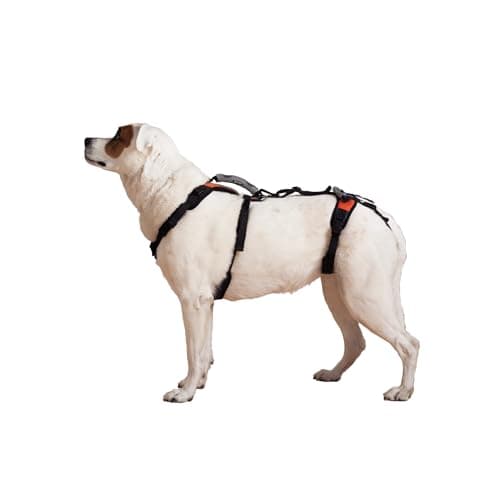
Help 'Em Up
Help 'Em Up Harness

Walkin' Pets
Walkin' Buddy Up Rear Harness

PetSafe
Solvit Deluxe Telescoping Pet Ramp
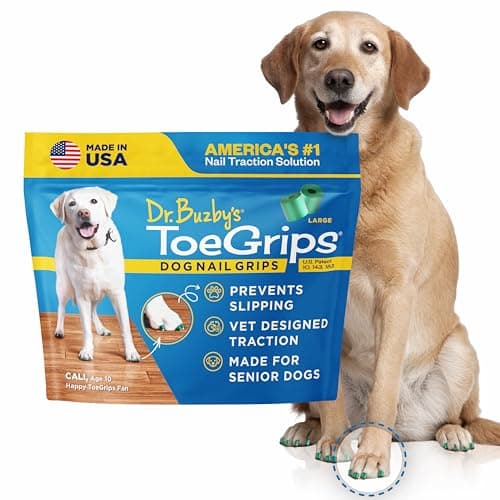
Dr. Buzby's
Dr. Buzby's ToeGrips for Dogs
| Product | Score | Best for | Price | |
|---|---|---|---|---|
Help 'Em Up Help 'Em Up Harness | 9.5 | Long-term mobility support for senior or post-surgical large dogs | $95–$155 | View |
Walkin' Pets Walkin' Buddy Up Rear Harness | 6.8 | A dog with stable, non-progressive hind-end weakness whose front legs are sound — advanced hip arthritis, a healed spinal injury — where the rear half is all you will ever need. No longer the right buy for degenerative myelopathy | $39.95–$59.95 | View |
PetSafe Solvit Deluxe Telescoping Pet Ramp | 8.7 | Loading large dogs into SUVs and pickup beds | $99–$160 | View |
Dr. Buzby's Dr. Buzby's ToeGrips for Dogs | 8.4 | Senior dogs slipping on hardwood, tile, or laminate floors | $34–$40 | View |
This page is the overview. For the specific problem in front of you, we've gone deeper:
- Senior dog with weak back legs: the full playbook — organized by failure moment, not by product
- The best lift & support harnesses — all-day wearable vs walk-time sling vs budget rear support
- The best dog ramps for cars, beds, and couches — with the incline math that actually matters
- Traction fixes for slippery floors — ranked by effect per dollar
- Helping a senior dog with stairs — assist, adapt, or bypass
#1 — Help 'Em Up Harness (Best Full-Body Support)#
#1 Pick
Help 'Em Up
Help 'Em Up Harness
Our score
$95–$155
Best for
Long-term mobility support for senior or post-surgical large dogs
If your dog needs help getting up multiple times a day for the foreseeable future — post-TPLO, advanced hip dysplasia, hindquarter weakness in giant-breed seniors — this is the one to buy. It is the only harness in the category that supports the front and the back independently, which is what a dog with a bad hip and a compensating shoulder actually needs. Buy it from the manufacturer, not from Amazon: re-verified 18 August 2026, helpemup.com prices by size at $80 / $95 / $110 / $125 / $140 while Amazon runs $95 / $110 / $125 / $140 / $155 — a uniform $15 more at every size, every time we have checked.
Pros
- Two-piece (chest + hip) design lets you support either end independently
- Hip handle is purpose-built — not a converted car-seat-belt strap
- Padded chest plate distributes weight better than sling-only options
- Five sizes span 10 to 225 lb, and the rear half can be ordered a size smaller for a dog with muscle wasting
- Two hip-lift styles (Conventional and U-Band) so male dogs are not soiling the strap
Cons
- Amazon runs a uniform $15 above the maker's own price at every one of the five sizes, and the Amazon buy box is held by a third-party reseller (Veterinary Preferred) rather than by the brand — re-verified 18 August 2026
- The maker's own Mix & Match page prints two different starting prices, "From $80" and "FROM $95 USD", on the same page
- Direct pricing is no longer flat: since mid-August 2026 the maker charges $80 to $140 by size, so a giant-breed owner now pays $60 more than a terrier owner
- On 29 August 2026 the linked Amazon Medium (B0DK81SCG5) showed a future availability date rather than units on hand, while every size and style was in stock at helpemup.com the same day; on 9 September and again on 12 September 2026 the Amazon Medium still showed the future-date status at $125.00 with a maximum order of one and no ship date given, while all nine direct variants were in stock — two weeks of backorder on the channel we earn from, and one more reason the direct channel is the one to use
- Sizing is critical — measure twice, return is a hassle
- Rear straps can chafe the inner thigh if the harness is left tight while the dog lies down
- A dog filmed or gait-assessed while wearing it looks less lame than he is, because the harness offloads the limb you are trying to judge
- Bulkier than a quick-grab sling for short-term use
The two-piece (chest + hip) design is what makes this harness right for chronic mobility support. You can lift either end independently — front-end help for getting up, hip handle for stairs or stepping up into the car. Because it stays on the dog all day, you grab a handle instead of kneeling and rigging a sling four times before dinner, and over months that difference lands on your back rather than the dog's.
Two things this page used to say about it that we have removed. We wrote that "we've used it on dogs for 18 months continuously without it failing" — no such testing happened, and inherited copy claiming testing we did not do is exactly the thing this site exists not to be. And we called it "the harness rehab vets actually prescribe," which we have never had a source for. What we can show you is the specification: five sizes by bodyweight band — XS 10–25, Small 25–45, Medium 45–80, Large 80–125, XL 125–225 lb — in Conventional and U-Band hip-lift styles, verified on the linked listing on 14 August 2026 at $125.00 for the Medium.[1]
Two buying notes worth more than any adjective. The Amazon buy box on all five sizes is currently held by a third-party reseller rather than the brand,[1] and helpemup.com has run below Amazon every time we have checked it — compare the two before you buy, and note that we earn a commission on the link here and nothing on the direct one. And before you spend anything, try a rolled bath towel under the belly for a week. For a dog who needs a steadying hand twice a day it is genuinely the whole answer; it stops working when you need to carry weight rather than steady it, or when your dog is too heavy for you to get low enough.
#2 — Walkin' Buddy Up Rear-Support Harness (Best for Hindquarter Weakness)#
#2 Pick
Walkin' Pets
Walkin' Buddy Up Rear Harness
Our score
$39.95–$59.95
Best for
A dog with stable, non-progressive hind-end weakness whose front legs are sound — advanced hip arthritis, a healed spinal injury — where the rear half is all you will ever need. No longer the right buy for degenerative myelopathy
We can no longer recommend this for a progressive disease, and that is a reversal of what this page used to say. The harness itself is sound and the cart compatibility is still the best reason in the category to choose it — but Walkin' Pets has stopped selling the line, the front half you were told to add later cannot be bought, and what remains on Amazon is a reseller working through stock. For a dog with a stable rear-end problem who needs a good harness now and will never need a second one, at $40–$60 it is still a fair buy. For a dog with degenerative myelopathy, buy a two-piece system that will still exist in a year.
Pros
- Built for chronic rear support rather than short post-op trips, with a top handle you guide and lift from rather than a strap you hold under the belly
- Attaches to a Walkin' Wheels cart, which matters enormously for a progressive disease — most rear-support gear does not, and a harness that cannot connect to the cart your dog ends up in is a purchase you make twice
- Sized on abdomen girth as well as bodyweight, which is the dimension that actually decides fit on a barrel-chested or a wasted dog
- Neoprene contact surfaces, and it stays on between lifts
Cons
- Walkin' Pets no longer sells this harness. As of 14 August 2026 the word "Buddy Up" appears nowhere in the manufacturer's 69-product store feed or its 70-URL product sitemap, and the old product URLs return 404. What is left on Amazon is reseller stock
- The companion front harness — the one the maker's own listing tells you to "pair with... for full body support" — cannot be found on sale anywhere we looked, including a descriptive Amazon search that surfaces all three remaining sizes of the rear. The modularity this product was sold on is gone, and the Amazon bullets still advertise it
- The maker has now answered the question itself. On 4 September 2026 walkinpets.com/products/buddy-up-harness-rear — the Buddy Up rear product URL, which returned 404 on 14 August — resolves to the **Help 'Em Up Harness** page instead. A redirect to a different product is a manufacturer telling you what to buy in its place, and it is the clearest discontinuation receipt we have
- The Amazon buy box is held by a third-party reseller, "Veterinary Preferred," not by Walkin' Pets. There is no manufacturer behind your purchase in the ordinary way, and no replacement path when the neoprene wears out
- Walkin' Pets publishes no warranty at all — its site carries a refund policy and a privacy policy and nothing else. And its returns terms are harsh for exactly this buyer: no exchanges of any kind, a restocking fee of 8–12%, and a harness returned "heavily soiled with strong pet odors, embedded fur [or] visible stains" is graded ineligible for any refund
- Less padded than the Help 'Em Up, which tells against it for a dog wearing it most of the day
- Not suitable as front-end support on its own
- Determined dogs back out of it without close fitment — measure before ordering
For dogs with primary rear-end weakness — degenerative myelopathy progression, advanced unilateral dysplasia, post-IVDD recovery — the Walkin' rear harness is built for daily long-term use, and at roughly half the price of the Help 'Em Up it is the right first purchase when the problem is genuinely rear-only. Verified 14 August 2026: the linked variant is the Large, 65–95 lb, 22–27 inch abdomen girth, $59.95, and the listing states it attaches to the brand's own rear-support cart if you ever need one.[2] Measure the girth — that is the dimension that decides fit here, not the bodyweight.
Where it stops being the right buy. If there is any front-end weakness, this is the wrong tool and the two-piece harness above is the right one. And if the diagnosis is degenerative myelopathy, understand what you are buying for: the disease ascends, so a rear-only harness is a purchase for today's stage rather than for the disease. The staging, the honest prognosis, and what the evidence does and does not support are in our degenerative myelopathy guide — read that before you spend anything, because the gear decisions follow from the stage.
#3 — PetSafe Solvit Telescoping Ramp (Best Vehicle Ramp)#
#3 Pick
PetSafe
Solvit Deluxe Telescoping Pet Ramp
Our score
$99–$160
Best for
Loading large dogs into SUVs and pickup beds
The most capable vehicle ramp we recommend, and the one to buy for a large dog and a high sill: 72 inches fully extended gets you to about 24.6 degrees at a 30-inch SUV cargo floor, and it is rated to 400 lb, which is more than any other PetSafe ramp we can find and 200 lb more than the Pet Gear tri-fold. Use it fully extended every time — the adjustability that makes it fit any car is also the easiest way to accidentally give your dog a 50-degree slide. Two honest deductions since July: the warranty is one year rather than the five we had printed, and the manufacturer's guide rules out the thing many owners instinctively do, which is walk up the ramp alongside a hesitant dog. For a dog who has already refused a ramp, the wider carpet-treaded tri-fold is the better first attempt.
Pros
- Extends from 39 to 72 inches — works for SUV, pickup, and tall sedan
- Rated to 400 lb — re-verified 14 August 2026 on PetSafe's live Canadian product page (SKU PTV17-16898); the highest rating of any PetSafe ramp
- High-traction surface holds up in rain
- At 14.7 lb it is the lightest capable vehicle ramp we recommend — the Pet Gear 71-inch weighs 25 lb
- Folds and stows under most rear seats
Cons
- The manufacturer's warranty is 1 year, not the 5 we printed here until 12 August 2026 — see the correction below
- Listed at 14.7 lb — light for what it is, but still awkward to carry one-handed with a dog on a lead
- PVC surface gets hot in direct summer sun
- Long footprint when fully extended; needs clear approach space
- Adjustable length means whoever deploys it sets the angle. Collapsed to 39 inches it is a 31-degree incline to a 20-inch bed and 50 degrees to a 30-inch SUV floor — a hidden cause of a dog refusing a ramp he used happily before
- Narrower than the 19.5-inch Pet Gear tri-fold, and PVC is harsher underfoot than carpet tread for a nail-scraping senior
- The manufacturer's own guide says the ramp is not intended to carry humans and that doing so voids the warranty — so you cannot walk up beside a dog who stalls halfway
- Sold under at least three names and four variants; the cheapest-looking PetSafe telescoping ramp is not the one to buy
- As of 14 August 2026 this standard/Deluxe model no longer appears in PetSafe's US catalog — only the Compact and Extra-Long remain there, both rated 300 lb — so the Amazon listing may be last-generation stock

The single most-impactful daily intervention for a large senior dog: end the SUV jump-down. That is not a slogan, it is where the load is. A standing dog already carries a mean of 60.4% of his mass on the forelegs,[3] and dogs jumping down from a 0.75 m platform — about SUV cargo-floor height — landed with peak forelimb force of 34.12 ± 3.63 N/kg against 27.35 ± 4.14 from 0.55 m, the difference significant at P = 0.001.[4] That study measured loading, not injuries, and its authors say so plainly — so nobody can quote you odds. It is still the clearest repeated load in a senior dog's week, and the one easiest to delete.
The Solvit adjusts from 39 to 72 inches and works for SUVs, pickups and tall sedans. Verified 14 August 2026: $129.99, in stock, model 62337, listed weight 14.75 lb — lighter than the tri-fold alternatives, and the ≈18 lb figure we printed here until 12 August 2026 belongs to the longer XL model, not this one.[5] One caveat we owed you this morning is now settled: the 400 lb load rating our product page carries is not in the current listing's own spec bullets, but later on 14 August 2026 we re-verified it on PetSafe's live Canadian page for this exact ramp ("supports pets who weigh up to 400 pounds"). Worth knowing: this standard model no longer appears in PetSafe's US catalog — the two telescoping ramps that do, the Compact and the Extra-Long, are both rated 300 lb. Use it fully extended every time; collapsed to 39 inches it is a 50-degree slide to an SUV floor, which is the commonest hidden cause of a dog refusing a ramp he used happily last month. And measure the ground behind your car before ordering — a 72-inch ramp to a 30-inch sill eats about 65 inches of clear floor, which our ramp guide works through in full.
#4 — Pet Gear Tri-Fold Ramp (Best Lightweight Option)#
#4 Pick

Pet Gear
Pet Gear Tri-Fold Pet Ramp
Our score
$85–$120
Best for
Hesitant and refusing dogs, indoor steps, couches, and cars up to about a 30-inch sill
The ramp we reach for first when a dog has already refused one. The extra width and the raised side edges do more for acceptance than any other feature at this price, and the carpet tread solves the surface problem that stops most dogs before height is ever the issue. It is heavier than its "portable" billing suggests, and the 200 lb ceiling rules it out for giant breeds. Buy it for the hesitant dog, not for the hiking-and-rain dog. Two corrections we owe you before you click: the warranty is 30 days, not the year this page used to print, and Pet Gear now sells the same 71-inch frame with a removable washable supertraX mat instead of fixed carpet — if your dog goes out in the wet, pay the extra sixteen dollars for it.
Pros
- 19.5 inches wide — roughly 3.5 inches wider than most ramps in this price band, which is the difference between a stiff dog placing four feet confidently and refusing
- Raised edges along both sides give a dog a boundary he can feel without looking down
- Carpet-textured skid-resistant tread, so a nail-scraping dog will walk it without you having to cover it with a towel
- 71 inches long — a 25-degree incline to a 30-inch SUV floor, within an inch of what a fully extended telescoping ramp achieves
- Safety tether and rubber base grippers included; attached carry handle
- Rated to 200 lb
Cons
- The warranty is 30 days, not a year — Pet Gear's own listing field reads "30 day non-transferrable limited warranty" on every 71-inch variant we checked on 11 August 2026. We had published a 1-year warranty since this page was created and it was wrong
- Heavy — 25.2 lb on Amazon's own figure for the reflective 71-inch sibling and 27 lb for the supertraX version. The 15 lb figure floating around the range belongs to the 16-inch-wide Travel Lite, a different ramp. Two-hand carry
- Carpet absorbs water and stays damp — not the ramp for a dog who goes out in the rain daily. The newer supertraX variant has a removable washable mat and solves this for about $16 more
- 200 lb rating is a real ceiling for giant breeds, and for anyone who wants to walk up alongside their dog
- Fixed 71-inch length: there is no shortening it for a 16-inch couch, so it is a large object to store and to swing around a hallway
- The Titanium variant (9300TI) that this page linked until 29 August 2026 read "Only 4 left in stock (more on the way)" on five consecutive checks a month apart (30 July, 11, 15, 23 and 29 August) — a standing availability problem, not a blip — so our link now goes to the reflective sibling (AM9300RF), the same 71 × 19.5 × 4 inch frame, 200 lb rating and 30-day warranty, which was cleanly in stock at $89.50 on 29 August 2026, $4.70 cheaper than the Titanium that day
For medium dogs and lower-clearance vehicles, the Pet Gear tri-fold is easier to stow and gentler on senior paws (carpet vs PVC), and its 19.5-inch width is the real acceptance feature for a hesitant dog. Verified 14 August 2026: 71 × 19.5 × 4 in, "holds up to 200 lbs," $94.22, only four in stock.[6] Two limits: that 200 lb is combined load — a heavy dog plus your hand pressing down is nearer the ceiling than it looks — and the carpet tread holds water, so it is the wrong ramp for a daily all-weather dog. It is also not the light option this page once implied; nobody publishes a carry weight for this exact variant, and the siblings run 25–27 lb.
#5 — Dr. Buzby's ToeGrips (Best for Slick Floors)#
#5 Pick
Dr. Buzby's
Dr. Buzby's ToeGrips for Dogs
Our score
$34–$40
Best for
Senior dogs slipping on hardwood, tile, or laminate floors
The best dog-mounted traction fix there is, and the one to buy once rugs have taken you as far as they can. Nothing touches the paw pad, which is why dogs tolerate these where they refuse socks and boots. Go in knowing the real cost: this is not a $40 purchase but a $240–$320 a year habit, so lay runners along your dog's actual routes first and buy grips for the floors you cannot cover.
Pros
- Veterinarian-developed; in clinical use for over a decade
- Slip onto each toenail — no socks, booties, or adhesives required
- Restores traction immediately, especially on hard floors
- Nothing touches the paw pad, so dogs accept them where they refuse boots
- Amazon and the manufacturer both charge $39.99 — no retailer markup
- 20 grips per bag against the 16 a dog wears, so a set includes four spares
Cons
- The only two published studies of nail grips both tested this exact product, and both were null: Roush 2017 (Front Vet Sci 4:111 — 15 sound dogs, kinetic changes "unlikely to be clinically relevant") and Repac 2022 (Animals 12(18):2312 — 30 dogs two weeks post-TPLO vs sham, no difference in weight bearing or limb function, including the owner question that asked specifically about slippery floors). Fair caveats: small samples, one used healthy dogs, the other a single early post-op timepoint — but "no positive trial exists" is the honest label, and we say it while still recommending the product for the mechanism and the owner-reported traction stories it was never tested against (verified 2026-08-14).
- A recurring cost, not a one-off. The maker publishes two different bag lives — "1–2 months" on its store page and "1-3 months, two months on average" in its FAQ (both read 2026-09-05) — which spans $160–$480 a year at $39.99. Plan on $240–$320, the two surfaces' central figures
- The Amazon listing markets specifically to dogs with "ACL injuries" — the one population where a randomised trial has been run, and where it found nothing (Repac 2022). The same bullets carry three claims with no source we could find: "more than 250,000 paws," "America's #1 nail traction solution," and "recommended by thousands of veterinarians worldwide" (listing copy verified 2026-08-17). Re-read 2026-08-31: a fourth unsourced superlative has been added to the top bullet on all four Amazon sizes — "The Only Toenail Grips for Dogs With GripZone Technology" — and the Large listing's title now leads with "Instant Traction on Wood/Hardwood Floors."
- The maker sells Scotch Super Glue Gel at $4.99 on its own store, listed as an "Alternate ToeGrips Application Method" (shop.toegrips.com, 2026-08-31). Read that as what it is: the company's own answer to the grips coming off, priced separately and not mentioned on the Amazon listing you are most likely to buy from.
- Application needs isopropyl rubbing alcohol, which is not in the box
- Initial application takes 15–20 minutes for a full set
- Some dogs chew them off in the first week
- Amazon carries only four of the seven sizes; XS, XXL and XXXL dogs have to buy direct
- Sizing by weight chart alone often misses — the accurate method needs dental floss and a ruler
If your senior dog is splaying out on hardwood, tile, or laminate, ToeGrips are the fastest fix that works, and nothing touches the paw pad — which is why dogs tolerate them where they refuse socks and boots. Verified 14 August 2026: $39.99 for 20 grips, sold by Dr. Buzby's themselves, the linked size being Large for 40–74 lb dogs.[7]
They are not the cheapest fix, and we used to say they were. The maker's own copy is that a bag lasts one to two months. At $39.99 that is $240–$480 a year for one dog, or $204–$408 on the manufacturer's $33.99 subscription. That reclassifies them from a $40 purchase to a subscription, and it is why the honest order is rug runners first — a one-time cost of well under $100 along the four or five routes your dog actually walks — and grips for the floors you cannot carpet: the kitchen tile, the vet's waiting room, someone else's polished hallway.
Two application facts that decide whether your first attempt works, both from the maker's own instructions on the listing. You must wet each grip in isopropyl rubbing alcohol, which is not in the box and is the single commonest reason a first try fails. And a snug fit is correct, not a sign of the wrong size: they are meant to "fit snugly like Spanx, not slide onto the nails like Cinderella's slipper."[7] Sixteen nails, not the dewclaws; 20 per bag gives you four spares.
Who should skip them: dogs that chew at their feet, and any dog whose slipping came on suddenly or comes with knuckling or dragging — that pattern points at a neurologic problem, and traction hardware treats the symptom while the cause advances.
#6 — Snoozer Foam Pet Stairs (Best for Bed/Couch Access)#
#6 Pick

Snoozer
Snoozer Scalloped Dog Stairs / Ramp
Our score
$131.95–$196.95
Best for
Indoor bed and couch access for dogs under 100 lb that won't use a ramp
Stairs work for dogs that won't approach a ramp — usually because the incline frightens them — and foam stairs work better than plastic because the step gives way under the landing instead of stopping the paw dead. Buy these if your dog is under the 100 lb rating and the room cannot spare five feet of ramp run-out. Check the height against your actual bed before you check out, and understand that the warranty covers manufacturing defects rather than the slow foam compression that is how these eventually wear out.
Pros
- Foam steps rather than hollow plastic, so the step deforms under the landing — and the landing is the moment that drives the most force through a senior dog's front shoulders
- Scalloped, dished step surfaces rather than flat treads, which is the feature the maker leads on and the one a nervous dog notices first
- Luxury microsuede cover, fully removable and machine washable cold
- "Non-slip, stable base" in the maker's own words, and a footprint wide enough that the unit does not skate on hardwood
- Handmade in South Carolina, by a company trading under this name since 1985
Cons
- Rated to 100 lb, and that is the number that disqualifies these for a lot of the dogs this site is about. A 110 lb Labrador or any giant-breed senior is outside the rating, and no amount of foam quality changes it
- The one-year warranty explicitly excludes "wearing or materials or components which may occur after extended use." Foam compression over years — the way foam stairs actually fail — is the excluded case, not the covered one
- The listing contradicts itself on the unit's own weight: a feature bullet says "weighing only 4 pounds" while the listing's dimension field says 8 lb. If you are buying partly because you intend to carry it room to room, that is a two-fold difference nobody has resolved
- Amazon and Snoozer also disagree on the footprint's orientation — Amazon lists 21 in wide × 25 in deep, Snoozer's own page lists 25 in wide × 21 in deep. Measure the gap beside your bed for both shapes before ordering
- Bigger footprint than plastic stairs — needs real floor space
- Premium price compared to plastic step alternatives
For dogs that won't approach a ramp — typically because the angle frightens them, sometimes because there is nowhere to put five feet of run-out — foam stairs are the alternative. Foam deforms under the landing where plastic does not, and the landing is the moment that puts the most force through front shoulders that were already carrying 60% of the dog.[3]
The number that disqualifies these for a lot of this page's readers: 100 lb. The linked variant is the 4-step, 17.5 inches tall, at $161.95, and its listing states it supports "dogs up to 100lbs."[8] This article is largely about large-breed seniors. Check your dog against that ceiling before you spend $162.
A product we have removed from this list#
This page used to carry a Back on Track far-infrared mesh sheet as a "thermal layer," recommended on the grounds that "anecdotal results from rehab vets are positive enough that we recommend trialing it." That is not a source, and we should never have published a recommendation resting on it. It is gone for two independent reasons. First, we have no controlled canine evidence that the ceramic/far-infrared mechanism does anything, and the product's own listing claims a "pain relieving effect" and "reduce inflammation" with nothing behind them.[9] Second, it is not really buyable: on 14 August 2026 it read $128.42 with the availability message "usually ships within 6 to 7 months," sold by Amazon Germany.[9]
If your dog is stiffer on cold mornings, the things that reliably help cost nothing: warm the room where he sleeps, get him up and moving gently before he goes outside, and shorten the first loop of the day rather than the last. A plain insulated coat is a reasonable purchase for a thin-coated dog in a cold climate. Far-infrared is not the reason to buy one.

What we'd skip#
- "Anti-arthritis" magnetic collars and bracelets. We are not aware of any controlled canine trial supporting them, and we will not print one that does not exist.
- Far-infrared and ceramic "therapeutic" fabrics. Same problem, and it is why the product that used to sit at #6 on this page is gone.
- Vibration platforms / massage chairs. Same again.
- Generic Amazon ramps under $40. They flex, the load rating is unverifiable, and a slip can re-injure exactly the dog you're trying to help.
- Booties for indoor use. ToeGrips are better for indoor traction, because nothing touches the pad. Booties have their place in winter outdoor conditions — ice and road salt.
A note on dignity#
Owners often delay mobility tools because the dog "isn't that bad" or because they don't want to admit aging. Two reframings:
- The harness or ramp doesn't make the dog "old" — it makes the dog active. A dog that can still get into the car gets to keep going on the trips that built your relationship. The one place we have any survival data at all on keeping a failing dog moving is degenerative myelopathy, and it points the same way: dogs given intensive daily controlled physiotherapy survived a mean of 255 days against 130 days on moderate and 55 days on none.[11] Hold that loosely, and we mean it: physiotherapy was examined in just 22 dogs split across three arms, the study was not randomised, the diagnosis was "suspected" rather than confirmed, inclusion required dogs over 20 kg, and owners with the resources to deliver daily physiotherapy to a dying dog are also the owners least likely to elect euthanasia early. It is the best evidence available for "keep him moving," and it is not proof.
- By the time daily tasks are visibly hard, the dog has been compensating quietly for months.
On that second point, one thing is worth stating carefully rather than dramatically, because this page used to overstate it. We wrote that compensation patterns "cause secondary injuries," naming a cruciate tear in the unoperated leg. The second leg going is real and common; the causal story is not established. In 831 dogs aged 8 or older and 15 kg or heavier at their first cranial cruciate ligament rupture, 19.1% ruptured the other side, at a median of 12.9 months later.[10] That is a prevalence figure from a retrospective study, not proof that overloading the good leg caused it, and the same paper found the risk decreased with age. Take from it the practical thing: if one stifle has gone, the other is worth watching closely for a year — not a mechanism you can quote at your vet.
The bottom line#
For most senior large-breed dogs, this is the kit, with prices verified 14 August 2026:
- Help 'Em Up Harness for assists — $125.00 Amazon for the Medium, and check helpemup.com before you buy, because direct has been cheaper every time we have looked.
- Solvit telescoping ramp for the car — $129.99.
- ToeGrips for the kitchen and hallway floors — $39.99 a bag, but budget it as $240–$480 a year, and lay rug runners first.
- Snoozer stairs for the bed if the dog still wants to sleep with you — $161.95, and only if he is under 100 lb.
Add the Walkin' rear-only harness ($59.95) instead of the Help 'Em Up if hindquarter weakness is the whole problem and the front end is sound. On today's Amazon prices the four-item kit above comes to about $457 before the first replacement bag of grips, which is more than the "under $400" this page used to claim — the honest version is that the two items that change most days are the ramp and the traction, they come to about $170 together, and you do not have to buy the list in one go.
Start with whichever failure moment you actually saw this week. That is not a compromise; it is the correct order.
Sources#
- Amazon listing B0DK81SCG5, "Help 'Em Up® — Dog Lift Harness (Conventional, Medium, 45-80 lbs)." amazon.com — retrieved via the Amazon Creators API on 14 August 2026: $125.00, buy box held by third-party reseller "Veterinary Preferred," not the brand. Feature bullets give the five weight bands (XS 10–25, Small 25–45, Medium 45–80, Large 80–125, XL 125–225 lb) and the two hip-lift styles, Conventional and U-Band.
- Amazon listing B0BVBV1LB9, "Walkin' Buddy Up Rear Harness for Dogs, Hind Legs Support, Large, 65-95 Lbs, 22-27 Inches Abdomen Girth." amazon.com — retrieved via the Amazon Creators API on 14 August 2026: $59.95, In Stock. Feature bullet: "Compatible with our Walkin' Wheels wheelchair — Our Buddy Up Rear dog harness can be attached to your dog's rear support cart."
- Fish FE, Sheehan MJ, Adams DS, Tennett KA, Gough WT. "A 60:40 split: differential mass support in dogs." The Anatomical Record. 2021;304(1):78-89. doi:10.1002/ar.24407 (PMID 32363786) — 552 dogs, 123 breeds; grand mean 60.4% of mass on the forelegs, range 47.6–74.4%.
- Pardey D, Tabor G, Oxley JA, Wills AP. "Peak forelimb ground reaction forces experienced by dogs jumping from a simulated car boot." Veterinary Record. 2018;182(25):716. doi:10.1136/vr.104788 (PMID 29622683) — 15 healthy adult dogs; peak forelimb vGRF 27.35 ± 4.14 N/kg at 0.55 m, 30.84 ± 3.66 at 0.65 m, 34.12 ± 3.63 at 0.75 m, P = 0.001. The study measured loading, not injury outcomes.
- Amazon listing B000RUJEUU, "Solvit 62337 Deluxe Telescoping Pet Ramp, Standard (62305)." amazon.com — retrieved via the Amazon Creators API on 14 August 2026: $129.99, In Stock, sold by Amazon.com; model 62337, listed weight 14.75 lb. The 400 lb rating is not in this listing's feature bullets; re-verified 14 August 2026 on the manufacturer's live Canadian product page (petsafe.com, SKU PTV17-16898): "supports pets who weigh up to 400 pounds." PetSafe's US catalog now lists only the Compact (62420) and Extra-Long (62320), both rated 300 lb; the standard model is absent.
- Amazon listing B0GJFWGQ7T, "Pet Gear Tri-Fold Portable Pet Ramp for Dogs/Cats, 71" Long, Titanium." amazon.com — retrieved via the Amazon Creators API on 14 August 2026: $94.22, "Only 4 left in stock (more on the way)"; model 9300TI; 71 × 19.5 × 4 in; feature bullet "Holds up to 200 lbs."
- Amazon listing B00GWHISI6, "Dr. Buzby's ToeGrips for Dogs, Large, Anti-Slip Grips, Instant Traction." amazon.com — retrieved via the Amazon Creators API on 14 August 2026: $39.99, In Stock, buy box held by Dr. Buzby's ToeGrips; size "Large: dogs 40-74 lbs," 20 per bag. Application bullet: "Step 1: Wet 16 ToeGrips in isopropyl rubbing alcohol… (ToeGrips shouldn't be applied to the dewclaws.)" Fit bullet: "Properly sized, they are designed to fit snugly like Spanx, not slide onto the nails like Cinderella's slipper." Running-cost figures are our arithmetic from the manufacturer's own stated one-to-two-month bag life at $39.99 ($33.99 on subscription).
- Amazon listing B09LK9FWMQ, "Snoozer Scalloped Dog Ramp, 17.5" Tall Foam Pet Stairs, 4 Steps, Anthracite." amazon.com — retrieved via the Amazon Creators API on 14 August 2026: $161.95, In Stock, sold by Snoozer Pet Products; model 60772; 17.5 × 21 × 25 in. Feature bullet states the stairs support "dogs up to 100lbs."
- Amazon listing B004UL34BC, "Back on Track Mesh Dog Blanket," Large. amazon.com — retrieved via the Amazon Creators API on 14 August 2026: $128.42, availability "Usually ships within 6 to 7 months," sold by Amazon Germany. Feature bullets claim "Ceramic reflects body heat in the form of far infrared heat waves producing a pain relieving effect" and "Reduce inflammation"; no supporting study is cited on the listing and we have none. Product removed from this list on both grounds.
- Murphy CL, Niles J, Radasch RM. "The Prevalence and Risk Factors of Contralateral Cranial Cruciate Ligament Rupture in Medium-to-Large (≥15kg) Breed Dogs 8 Years of Age or Older." Veterinary and Comparative Orthopaedics and Traumatology. 2024;37(1):8-12. doi:10.1055/s-0043-1771350 (PMID 37487534) — cross-sectional retrospective study of 831 client-owned dogs; 19.1% (159/831, 95% CI 16.6–22.0%) ruptured the contralateral cruciate, median 12.9 months after the first; age and breed (Golden and Labrador Retrievers) were significantly associated; the authors note prevalence is lower than previously reported and risk decreases with age.
- Kathmann I, Cizinauskas S, Doherr MG, Steffen F, Jaggy A. "Daily controlled physiotherapy increases survival time in dogs with suspected degenerative myelopathy." Journal of Veterinary Internal Medicine. 2006;20(4):927-932. doi:10.1892/0891-6640(2006)20[927:dcpist]2.0.co;2 (PMID 16955818) — 50 dogs assessed for signalment and presentation, physiotherapy examined in 22; mean survival 255 days with intensive physiotherapy (n = 9) against 130 days moderate (n = 6) and 55 days none (n = 7); treated dogs "remained ambulatory longer." Stated limitations: lack of randomization, lack of definitive diagnosis, small group size, owner-perception bias. Inclusion was restricted to middle-aged to older large-breed or mixed-breed dogs over 20 kg, so it says nothing about small breeds.
This article is educational and does not replace veterinary advice. Weakness, wobbling, knuckling or a sudden change in what your dog can do are reasons to see a vet before buying equipment — gear works better on a treated dog, and some causes of hind-end weakness are treatable.
Frequently asked
- When should I start using mobility tools?
- Earlier than most owners do. By the time a dog is visibly limping, daily tasks have already become harder than the dog lets on. If your senior is hesitating on stairs, slipping on hardwood, or refusing the car, those are the cues to start. Start with the two cheapest things, which are also the two that change the most days: rug runners along the routes your dog actually walks, and a ramp so he stops jumping down out of the car. Neither requires a diagnosis to be worth doing.
- Harness or sling?
- Both have a place. A sling (GingerLead) is fast on/off for short bathroom trips. A harness (Help 'Em Up) is what you wear for an actual walk. For long-term mobility support over months, the harness wins. For 1–2 weeks of post-op assistance, a sling is enough.
- Are dog booties worth it?
- For indoor traction, ToeGrips work better than booties, because nothing touches the paw pad and dogs therefore tolerate them — booties rotate, come off overnight, trap heat in summer, and mute the paw's feel for the floor. But do not assume grips are the cheap option: at $39.99 a bag and a manufacturer-stated bag life of one to two months, they run roughly $240–$480 a year for one dog. Rug runners are a one-time cost of well under $100 and cover the routes your dog walks most, so lay those first and buy grips for the floors you cannot carpet. Booties keep their place for winter outdoor conditions — ice and road salt.
- What about wheelchairs?
- A canine wheelchair (formally a 'cart') is the right answer when a dog has lost reliable use of one or both rear legs — degenerative myelopathy, advanced dysplasia, or post-IVDD paralysis. Dogs need time to acclimate to one, and it should be fitted with veterinary or rehab input rather than guessed from a size chart. We don't recommend buying one without a proper fitting, and we don't sell one. Two honest gaps: we have no published figure for how many dogs take to a cart or how long acclimation takes, and we are not going to invent one. If degenerative myelopathy is the reason you are reading this, our [full guide to it](/conditions/degenerative-myelopathy-in-dogs) covers the staging and what the evidence actually supports.
- How do I know if my dog is in pain vs just slow?
- Senior dogs slow down without being in pain. The cues that point to pain (vs general aging): unwillingness to be touched on a specific area, panting at rest, restless sleep, loss of appetite, change in posture (tucked tummy or hunched back). Talk to your vet — under-treated pain is one of the most common quality-of-life issues in older dogs.
- What helps a senior dog with weak back legs?
- Match the tool to the failure moment. Can't get up from the floor: a full-time handle harness like the Help 'Em Up. Sags mid-walk: a rear sling. Slipping on hard floors: ToeGrips plus rug runners along the routes the dog actually walks. Can't do stairs or the car: ramps and assisted technique. And see a vet first — weakness has treatable causes, and gear works better on a treated dog.