Recovery guide
Your Dog Can't Walk After Back Surgery: How to Move Him, Set Up the Pen, and Get Through the First Four Weeks
Use a pen, not a crate, and lift with a hand under the chest and one under the pelvis. Most dogs with feeling in their toes walk in 1 to 3 weeks. The bladder is the real job: roughly a third get a urinary infection.

Use a pen, not a crate. The surgeon's instruction is about how little space he has, not what shape the walls are, and a pen lets you lift him from above with a hand under the chest and a hand under the pelvis instead of dragging him through a door. If he had feeling in his toes going into surgery, most dogs like him are taking steps within one to three weeks. The job that fills the weeks in between is not the walking. It is the bladder, which is now yours to empty three or four times a day, and which gets infected in roughly a third of these dogs whether or not anyone notices.
Affiliate disclosure: Dog Orthopedic is reader-supported. When you buy through links on our site we earn a commission at no extra cost to you — about 3% on most pet products, and the same rate on every product we compare, so no pick earns us more than another. Prescription medication earns us nothing, and seeing your vet earns us nothing; we recommend both anyway. Learn more.
Imagery: Lifestyle photographs on this site are licensed from Pexels (royalty-free) and credited per image. Pexels imagery illustrates conditions and contexts — it does not depict the specific dogs or test sessions described in the text. Product photographs come from Amazon's Creators API. Breed portraits are illustrations of typical breed type rather than photographs of individual dogs, and are not drawn to scale against one another.
How do I actually move him?#
It is six in the morning. He is lying on his side where you left him, awake, tail moving, back legs not. You have to get him outside, and the crate you were told to use has a door built for a dog who walks through it.
Here is what the discharge sheets we read actually say, and what they leave out. Southeast Veterinary Neurology: the pet should remain crated at all times, only being carried in and out to urinate and defecate; large dogs may be walked with a sling or short leash.[2] Southfields: remove your pet very gently from the crate or cage three times a day, support them by putting your arm under them or creating a sling out of a towel, and avoid quick, jerky movements because that will aggravate the healing spine.[1] The Animal Clinic of Billings: a sling may help support the hind limbs, particularly when the dog is urinating and defecating.[3]
What none of them say is how to get a dog who cannot use his back legs out of a wire box with a low door without dragging his pelvis across the tray. That is the question you typed, and the honest answer is that the crate is the wrong container for this fortnight.
The lift. Crouch beside him, not over him. Slide one forearm under his chest just behind the front legs and the other under his belly just in front of the back legs, so the pelvis rests on your arm rather than hanging. Bring him against your body before you stand, and keep his back level with the floor the whole way, the way you would carry a tray. Set him down back end first so the hind legs never take a landing. For a dachshund or a French bulldog this is a one-person job. Our own rule of thumb, not a published one: over about 25 lb it is two people or a harness with a rear handle, which we come to below.
The towel sling. Outside, for a dog who can bear some weight on the front, a bath towel folded lengthways under the belly in front of the back legs lets him stand on his front legs while you hold the back end up. Southfields' instruction is the towel; the Animal Clinic of Billings adds the goal, which is to help him place his feet, offering as much support as needed but as little as possible.[3] A dog who has no movement at all in the back legs is carried out and held in a standing position while you express the bladder. He does not walk.
The container. An exercise pen has no roof. You step in through the door, or lean over the side of the 24-inch version, do the lift above, and step out. Nothing is dragged. The pen's footprint is 16 square feet, which is smaller than a small bathroom and larger than any crate, and it folds to half that against a wall. It is the one purchase on this page that changes how he is handled four times a day.

How long will he be like this?#
The number your surgeon gave you was probably a range, and the reason is that the published series give ranges. Here is what they say, with the groups kept separate, because the group your dog is in decides everything.
| Study | Dogs | Who they were | What happened |
|---|---|---|---|
| Davis and Brown, 2002[4] | 112 | Could not walk, could still feel their toes, decompressive surgery | 96% walked within 3 months. Mean time to walking 12.9 days: 7.9 days if the dog had any voluntary leg movement after surgery, 16.4 days if not |
| Zidan and colleagues, 2018[5] | 30 | Could not walk, could still feel pain, decompressive surgery | Median time to walking 7.5 days, range 2 to 37 |
| Langerhuus and Miles, 2017, meta-analysis[6] | Pooled case series | Three grades, surgery | Recovered: 93% of dogs who could not walk but could move their legs; 93% of paralysed dogs with deep pain sensation; 61% of paralysed dogs without it |
Read the first row twice. The single thing that predicted a faster recovery was whether the dog could move his legs at all after the operation, and nothing else the authors measured, not age, not weight, not how long he had been down before surgery, changed the time to walking.[4] So if the surgeon told you he twitched a toe on the table, that is worth more than it sounded.
Read the last row honestly, too. If your dog had lost deep pain sensation before surgery, roughly six in ten recover in the pooled series, and the meta-analysis authors are clear that the evidence behind all of these figures is low, with no controlled studies and only case series to pool.[6] Nobody can tell you the week. They can tell you the odds, and they are better than most owners fear on the first night home.
The bladder is the job nobody warned you about#
Here is the sentence to put on the fridge. Wet bedding is not proof that he can pee. A bladder that overflows is not a bladder that empties, and Southeast Veterinary Neurology says exactly this: finding urine in the bedding does not confirm voluntary urination, so palpate the bladder to make sure it is not full.[2]
The numbers behind that sentence are not small. In a prospective study of 92 dogs with surgically treated disc extrusions, 27% had a urinary tract infection at some point between admission and the seventh day after surgery, 15% before the operation had even happened, and the dogs at higher risk included females and dogs that could not walk or urinate voluntarily.[7] When 25 dogs were followed for three months after surgery, with urine cultured at one and three months, 38% developed an infection, most of them between weeks one and six, and 60% of those infections were occult, meaning nothing in the urine or the dog announced them.[8] The authors' recommendation was routine urine culture regardless of what the urinalysis says. Ask your surgeon when the first one is booked.
Why so many? Because expressing a bladder by hand does not empty it. The ACVIM consensus statement on this disease reports that the efficacy of manual expression varies widely, with a mean of 50% bladder emptying.[9] On average, half stays behind, and urine that stays behind grows things. A randomized trial that compared manual expression with indwelling and intermittent catheters found that the method did not decide who got infected; the number of days the bladder needed managing did, with each additional day raising the risk 1.5 times.[10]
So the schedule is not optional and the technique is not something to learn from a video. Southeast Veterinary Neurology: initially four times a day, until you are comfortable with it.[2] Animal Clinic of Billings: three to four times daily to prevent retention.[3] If nobody put your hands on your dog's belly and showed you the squeeze before you left the hospital, ring them and go back for a lesson. That fifteen minutes is worth more than any product on this page.
“Because your dog can't tell you how much pain he or she is in.”
What goes in the pen, and in what order#

The ACVIM consensus lists the core components of managing this disease at home as activity restriction, pain management, treatment of retention incontinence, and prevention and treatment of skin damage and pressure ulcers, and then says something worth knowing: few studies evaluate any of these critically, so the panel could not make evidence-based recommendations about them.[9] What follows is therefore discharge-sheet practice, not trial evidence, and we say so.
- A waterproof, washable pad across the whole floor. Human incontinence bed pads from a pharmacy do this for a few dollars and go through the washing machine. Whatever you use, it must cover the full footprint, because he will not choose where he leaks.
- A firm bed at least an inch thick on top. That figure is the minimum the Animal Clinic of Billings specifies: soft, dry bedding at least 1 inch in thickness to prevent pressure sores.[3] A folded blanket compresses to nothing under a hip bone within an hour. Foam does not.
- Turn him. Every time you handle him for the bladder, which is at least three or four times a day, put him down on the other side. That is not a number from a trial; it is what the expression schedule gives you for free, and a dog who lies on one hip for twelve hours is how a sore starts.
- Water within reach of a dog who cannot move. A low, heavy bowl at nose height, on the pad, not the bed.
#1 Pick

MidWest Homes for Pets
MidWest 30-Inch Exercise Pen with Door
Our score
$59
Best for
Confining a dog who cannot walk after back surgery, where the person doing the lifting needs to get to the dog without dragging him through a crate door
The honest answer to "how do I get a dog who cannot walk into a crate" is that you mostly should not be using a crate. A pen does the one thing the surgeon's instructions need, a small enclosure the dog cannot leave, without the one thing a crate adds, a door you have to drag a paralysed dog through four times a day. This is the plainest version of that pen: wire, a door, a 16 square foot footprint, and no pretence. Its faults are real and all of them are mechanical: it slides on hard floors, its shape supports fall off, and the clamps can be sharp. None of that matters much for a dog who is not moving, which is exactly the dog this page is for. It matters a great deal once he walks again, which is when the 30-inch height and a corner placement start doing the work. Score reflects a product that is right for the job and built to a price.
Pros
- You lift the dog from above or step in through the door. A wire crate makes you slide a paralysed dog out through a low opening; a pen lets you get both hands under him where he lies
- Eight 24-inch-wide panels give 16 square feet, which is small enough to stop a recovering dog running and big enough for a bed, a pad and a water bowl without the dog lying in his own urine
- Reconfigures. Fold it to four panels against a wall and the footprint halves; unfold it later for the room-rest weeks
- Step-through door with a slide-bolt latch, so the pen does not have to be lifted apart to get in and out at 6am
- Sold by Amazon.com, not a third-party reseller (re-checked 13 October 2026)
Cons
- Nothing fixes it to an indoor floor. The four ground anchors in the box are for outdoor use, and reviewers on the maker's own site report the pen sliding on tile when a 5 lb dog leaned on it. On hardwood, expect to push it back into place, or back it into a corner
- The plastic edge supports that hold the octagon shape are the recurring complaint: reviewers on midwesthomes4pets.com describe them popping off and the pen losing its shape when a dog leans on it (read 9 September 2026)
- Sharp edges are reported at the panel clamps by more than one reviewer, one of whom cut a finger. Run a hand along every join before the dog goes in
- No floor. A dog who cannot control his bladder will wet whatever is under him, so the pen needs a washable waterproof pad underneath, which is a second purchase
- 30 inches holds a dachshund or a French bulldog. It will not hold a Lab who has recovered enough to stand on his back legs, and the maker's own listing says pets that jump or climb need a mesh top or a taller pen
- Awkward to carry folded, and rust is reported early by some reviewers on the black finish. Amazon's own record has given two weights for it (21.4 lb on 9 September 2026, 12.27 lb at every read since 23 September) and the maker's page lists none, so we cannot tell you which is right
The pen we link is the plainest one MidWest makes: eight wire panels, a step-through door, 30 inches high, $58.51 sold by Amazon.com on 13 October 2026 (it was $46.99 when we first linked it on 9 September). Its faults are mechanical and we list every one on its page: it slides on hard floors because nothing anchors it indoors, its plastic shape supports fall off, and reviewers on the maker's own site report sharp edges at the clamps.[11] For a dog who is not moving, none of that matters. Back it into a corner and run a finger along the joins before he goes in. The cheaper thing first: a small bathroom with the mat removed, or a hallway between two baby gates, meets the surgeon's instruction for nothing. The bathroom's drawback is that the family is in the other room, and a dog facing four weeks of lying still does better where he can see people. That is the whole case for spending $59.
#2 Pick

K9 Ballistics
K9 Ballistics Tough Ripstop Orthopedic Crate Bed
Our score
$140–$320
Best for
Diggers, scratchers and light chewers that shred ordinary bed covers
The right bed for a dog who digs, scratches and roughhouses his bedding into the bin, and a genuinely good crate mattress at 4 inches with a warranty against flattening. Be precise about which problem you have, because we were not precise enough here until August 2026: this is the Tough Ripstop line, built for digging, scratching and occasional light chewing, and on this bed the chew warranty — 1 year, 365 days, re-verified 2026-09-06 — covers the cover only. A dog who has actually eaten three beds needs K9 Ballistics' separate Chew Proof Armored line, where the guarantee replaces the whole bed. Buy the right line and this is excellent. Buy this one for a determined chewer and you will be disappointed by a product that never claimed to do that job.
Pros
- Ripstop ballistic cover genuinely survives digging and scratching, which is what kills most bed covers
- Replaceable covers sold separately — repair, don't replace
- Carries a 10-year won't-flatten warranty as well as the chew guarantee, and it is defined concretely: more than 2 inches of flattening in 10 years and they replace the mattress once
- Foam is CertiPUR-US certified and made in the USA
- Corner anchor loops let you zip-tie the pad to a wire crate floor
Cons
- Cover texture is less plush than memory-foam beds
- Heavy at larger sizes — awkward to move around
- Premium price for the durable construction
- Not the bed for a determined chewer — the Tough Ripstop line is rated for digging, scratching and occasional light chewing only, and on this bed the 1-year chew warranty replaces the cover only, with the mattress excluded
- The Amazon listing contradicts itself on the foam: one bullet says CertiPUR-US shredded foam, another says a 4-inch solid foam mattress
- The 10-year won't-flatten warranty explicitly excludes chewing, scratching and water damage, so on a bed sold for rough dogs the two guarantees do not overlap
- Durability is the split verdict in the reviews, not a settled strength: Amazon's review summary for the linked listing (4.5 stars, 827 ratings, read 8 October 2026) says some owners find it outlasts other beds while others report it destroyed in less than two months and not chew-resistant enough. That matches the line's own rating (digging, scratching, light chewing), and it is why the cover-only chew warranty matters
- The listing's marketing outruns its own warranty: a bullet claims the mattress "won't flatten over time, even for the biggest and heaviest of breeds" and is "designed to last decades," while the brand's warranty defines acceptable performance as up to 2 inches of flattening in 10 years — half the mattress. The enforceable promise is the 2-inch threshold, not the bullet (listing re-read 25 August 2026)
The bed we would put in it is the one we already recommend for beds after surgery, for a reason that has nothing to do with chewing this time. Under its ripstop cover is a water-resistant mattress protector over 4 inches of foam, and that combination is the pen problem solved: four times the minimum thickness, and a mattress that survives being leaked on. The tradeoff is size. The variant we link is the X-Large, 47 by 29 inches, built for a 48-inch crate; and at 47 by 29 inches it covers about 9.5 of the pen's 16 square feet, which is fine for a Lab and too much bed for a dachshund, who is better served by a smaller mattress from the same line. It is also $148.75 on Amazon on 9 September 2026, which is a lot for a six-week job, so if your dog will not need a bed after this, two inches of firm foam from a fabric shop under a waterproof cover does the same work.
How long does the confinement last?#
Three discharge sheets and a consensus statement, four numbers. This is where the reconciliation is the deliverable.
| Source | Strict confinement | Then |
|---|---|---|
| ACVIM consensus statement, 2022[9] | At least 4 weeks, confined to a crate ideally or a small room without furniture, out only for rehabilitation exercises and toileting; no off-leash walking, no furniture, no stairs | Supported, in the panel's own words, by low-level evidence |
| Southfields Veterinary Specialists[1] | 3 weeks strict cage rest | 2 weeks room confinement, then 2 weeks house rest |
| Animal Clinic of Billings[3] | 30 days, completely restricted: no running, jumping, walks or stairs | Per surgeon |
| Southeast Veterinary Neurology[2] | "The first few weeks", crated at all times except toileting | Not specified |
They disagree by about a week, and the consensus panel explains why: many clinicians advise a period of decreased activity based on anecdote or institutional convention, published recommendations range from absolute cage rest to room rest without details, and in a retrospective series of 223 dogs the duration of restricted activity, from none to more than four weeks, was not associated with outcome.[9]
That is not permission to stop early. It is an explanation of why your surgeon's number and your neighbour's surgeon's number differ, and the panel still recommends at least four weeks. Take your own surgeon's number as the floor. The pen folds flat afterwards, and for a dachshund or a French bulldog it is worth keeping: the consensus reports recurrence at another disc in 25% of dachshunds and 44% of French bulldogs after surgery, before prophylactic fenestration is taken into account.[9]
Does physiotherapy at home make him walk sooner?#
The honest answer is that it has been tested properly once, and the answer was no. Zidan and colleagues randomized 30 non-ambulatory dogs with pain perception to a basic or an intensive 14-day rehabilitation programme after decompressive surgery, with blinded assessors. Gait score and coordination at 14 days did not differ, none of the secondary measures at 42 days differed, and the authors report no adverse events associated with the rehabilitation.[5] Their conclusion: early rehabilitation after this surgery is safe but does not improve the rate or level of recovery in dogs with incomplete spinal cord injury.
One detail of that trial changes how to read it. The comparison was not exercises against no exercises: every dog in both groups had passive range of motion every 12 hours, and the trial's protocol supplement specifies fifteen repetitions at the hip, stifle, hock and toes, starting 48 hours after surgery, then twice a day at home between weeks 2 and 6.[5] So the trial is evidence that the extras added nothing, not evidence that the basic movements do nothing. The basic movements have never been tested against nothing in dogs.
So do the movements your surgeon prescribed, because they were safe in the trial, they are meant to keep the joints from stiffening and they cost nothing. The Animal Clinic of Billings describes gently grasping the paw and moving each limb in flowing, circular, forward-to-backward movements, 10 to 15 repetitions, several times daily.[3] Do not pay for an intensive package on the promise that it will bring the walking forward. The one trial that looked found no such effect, and the median across both groups was 7.5 days. Other specialist handouts give anywhere from 2 to 20 repetitions and two to five sessions a day; our range-of-motion guide puts them side by side, with the joints, the order and the signs to stop.

The large dog#
Everything above assumes a dog you can lift alone. The disease does not stop at 25 lb, and a paralysed Labrador or shepherd turns every line of this article into a two-person problem: the lift, the toileting, the turning. Two people and a towel work for the first days. The cheaper tool for the weeks is a rear sling, $35 to $90 in the comparison on the harness page below, which is what that page tells you to buy for any job under two months, and if your surgeon expects him walking in a few weeks, buy the sling. The case for the harness is narrower and specific to this dog: a single belly strap lets a pelvis with no leg function swing, while a padded handle over the pelvis lets one person carry the back end level. If he is large, likely to be down for more than a month or two, or you are the only adult in the house, that is worth the difference.
#3 Pick
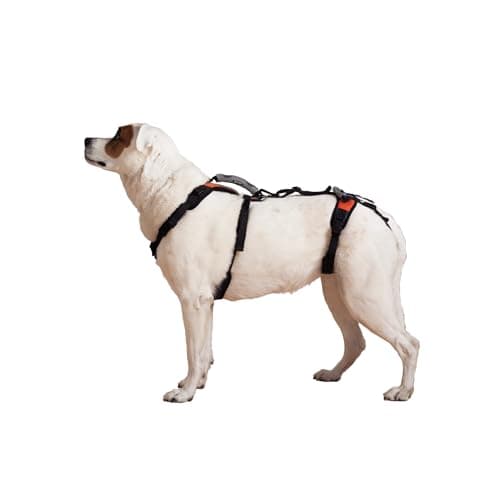
Help 'Em Up
Help 'Em Up Harness
Our score
$95–$155
Best for
Long-term mobility support for senior or post-surgical large dogs
If your dog needs help getting up multiple times a day for the foreseeable future — post-TPLO, advanced hip dysplasia, hindquarter weakness in giant-breed seniors — this is the one to buy. It supports the front and the back independently, as two halves you can lift separately, which is what a dog with a bad hip and a compensating shoulder actually needs. It is not the only design that does this, but it is the one whose sizing, returns and channel prices we have read most closely. Buy it from the manufacturer, not from Amazon: re-verified 3 October 2026, helpemup.com prices by size at $80 / $95 / $110 / $125 / $140 while Amazon runs $95 / $110 / $125 / $140 / $155 — a uniform $15 more at every size, every time we have checked.
Pros
- Two-piece (chest + hip) design lets you support either end independently
- Hip handle is purpose-built — not a converted car-seat-belt strap
- Padded chest plate distributes weight better than sling-only options
- Five sizes span 10 to 225 lb, and the rear half can be ordered a size smaller for a dog with muscle wasting
- Two hip-lift styles (Conventional and U-Band) so male dogs are not soiling the strap
Cons
- Amazon runs a uniform $15 above the maker's own price at every one of the five sizes, and the Amazon buy box is held by a third-party reseller (Veterinary Preferred) rather than by the brand — re-verified 18 August 2026
- The maker's own Mix & Match page prints two different starting prices, "From $80" and "FROM $95 USD", on the same page
- Direct pricing is no longer flat: since mid-August 2026 the maker charges $80 to $140 by size, so a giant-breed owner now pays $60 more than a terrier owner
- On 29 August 2026 the linked Amazon Medium (B0DK81SCG5) showed a future availability date rather than units on hand, while every size and style was in stock at helpemup.com the same day; on 9 September and again on 12 September 2026 the Amazon Medium still showed the future-date status at $125.00 with a maximum order of one and no ship date given, while all nine direct variants were in stock — two weeks of backorder on the channel we earn from, and one more reason the direct channel is the one to use. By 3 October 2026 it had spread: every Conventional-style Amazon listing we checked (X-Small, Small, Medium, Large) showed a future availability date, and only the Large and X-Large U-Band were in stock, while all nine direct variants were available. On 15 October 2026 the linked Medium was back In Stock on Amazon at $125.00 (maximum order 30) for the first time since 29 August, but X-Small, Small and Large Conventional still showed a future availability date with a maximum order of one
- Sizing is critical — measure twice, return is a hassle
- Rear straps can chafe the inner thigh if the harness is left tight while the dog lies down
- A dog filmed or gait-assessed while wearing it looks less lame than he is, because the harness offloads the limb you are trying to judge
- Bulkier than a quick-grab sling for short-term use
Amazon, 15 October 2026: the Medium this button links is In Stock at $125, the first time since 29 August it has not shown a future availability date. X-Small, Small and Large Conventional on Amazon still had no ship date. Every size and style was in stock direct the same day, $15 cheaper.
Who should not buy this: anyone whose dog is under about 25 lb. Your hands are the equipment and a $95 to $155 harness on a dachshund is money spent on a problem you do not have. For the large dog, buy it from the maker rather than Amazon: the direct price runs $15 lower at every size, and on 9 September 2026 the linked Amazon Medium still showed a future availability date rather than units in stock, as it did on 29 August and 5 September; on 29 August every size and style was in stock at helpemup.com. One fitting note that matters here more than anywhere: a dog who has been down for weeks loses muscle over the back end quickly, and the maker's mix-and-match ordering lets the rear half be bought a size smaller than the front, which is the configuration a wasted back end needs.
What to do this week#
The delay is the injury, and after surgery the delay changes shape. It is no longer the months of not noticing. It is the day the bladder goes unexpressed because the technique was never shown, the night on a folded blanket that becomes a sore, the week the pen stays in the box because the crate was what the sheet said. You are not his owner for the next four weeks. You are his back legs and his bladder, and the surgeon has handed you the half of the operation that happens at home.
- Get the bladder lesson. If nobody put your hands on your dog and showed you the squeeze, ring the hospital today and go back. Ask when the first urine culture is booked, and ask for one regardless of how the urine looks.
- Set up the pen in the room you live in, waterproof pad across the floor, firm bed on top, water on the pad. Put the crate away or take its roof off.
- Write the schedule on the fridge: bladder three or four times a day, turned onto the other side each time, range of motion after each. Wet bedding is not proof that he can pee.
- Note what moved. A toe, a tail, a leg drawn up. The one thing that predicted faster walking in 112 dogs was whether anything moved after surgery, so the movement you see on day three is data, and your surgeon wants it.
- Know the call. Worse instead of better, feeling lost in a foot, pain climbing, or 24 hours without urine: the surgical hospital, tonight.
He cannot tell you how much of this hurts, or which of the things you are doing is working. For the next four weeks the reading you did tonight is the only instrument in the house, and it is enough.
If you are earlier in this story, before surgery or deciding whether to have it, start with IVDD in dogs. If you have a dachshund and want to know how long this was coming, read when IVDD starts. If a limp rather than paralysis is what you are watching, is the limp getting better is the page for that.
Sources#
- Southfields Veterinary Specialists. "Spinal surgery recovery." southfields.co.uk — read 9 September 2026: enclosure large enough to lie down, stand and turn but not to stand on the hind legs or jump; three weeks strict cage rest, two weeks room confinement, two weeks house rest; removed very gently three times a day with an arm under them or a towel sling; avoid quick, jerky movements; contact the clinic if urination is fewer than twice daily; any deterioration in the ability to move is potentially an emergency.
- Southeast Veterinary Neurology. "Resources for Post-Op Care & Recovery." sevneurology.com — read 9 September 2026: crated at all times, carried in and out; large dogs walked with a sling; bladder expression four times a day initially; urine in bedding does not confirm voluntary urination, palpate the bladder; call if unable to express in a 24-hour period.
- Animal Clinic of Billings. "Dog Spine Surgery Recovery Resources." animalclinicofbillings.com — read 9 September 2026: activity completely restricted for 30 days; sling walking with as much support as needed but as little as possible; bladder expressed three to four times daily; bedding at least 1 inch thick to prevent pressure sores; range of motion 10 to 15 repetitions several times daily.
- Davis GJ, Brown DC. "Prognostic indicators for time to ambulation after surgical decompression in nonambulatory dogs with acute thoracolumbar disk extrusions: 112 cases." Veterinary Surgery. 2002;31(6):513-518. doi:10.1053/jvet.2002.36015 — 107 of 112 dogs (96%) ambulatory within 3 months; mean 12.9 days; 7.9 days with postoperative voluntary motor function versus 16.4 without; no other variable associated.
- Zidan N, Sims C, Fenn J, Williams K, Griffith E, Early PJ, Mariani CL, Munana KR, Guevar J, Olby NJ. "A randomized, blinded, prospective clinical trial of postoperative rehabilitation in dogs after surgical decompression of acute thoracolumbar intervertebral disc herniation." Journal of Veterinary Internal Medicine. 2018;32(3):1133-1144. doi:10.1111/jvim.15086 — 30 dogs; median time to walking 7.5 days (2 to 37); no difference between basic and intensive rehabilitation at 14 or 42 days; no adverse events associated with rehabilitation reported.
- Langerhuus L, Miles J. "Proportion recovery and times to ambulation for non-ambulatory dogs with thoracolumbar disc extrusions treated with hemilaminectomy or conservative treatment: A systematic review and meta-analysis of case-series studies." The Veterinary Journal. 2017;220:7-16. doi:10.1016/j.tvjl.2016.12.008 — recovery 93%, 93% and 61% for grades 3, 4 and 5 with hemilaminectomy; evidence low, case series only.
- Stiffler KS, Stevenson MA, Sanchez S, Barsanti JA, Hofmeister E, Budsberg SC. "Prevalence and characterization of urinary tract infections in dogs with surgically treated type 1 thoracolumbar intervertebral disc extrusion." Veterinary Surgery. 2006;35(4):330-336. doi:10.1111/j.1532-950X.2006.00153.x — 92 dogs; UTI prevalence 27%; higher in females and in dogs unable to walk or urinate voluntarily.
- Olby NJ, MacKillop E, Cerda-Gonzalez S, Moore S, Muñana KR, Grafinger M, Osborne JA, Vaden SL. "Prevalence of urinary tract infection in dogs after surgery for thoracolumbar intervertebral disc extrusion." Journal of Veterinary Internal Medicine. 2010;24(5):1106-1111. doi:10.1111/j.1939-1676.2010.0567.x — 25 dogs followed 3 months; 38% developed UTI, most between weeks 1 and 6; 60% occult; routine culture recommended regardless of urinalysis.
- Olby NJ, Moore SA, Brisson B, Fenn J, Flegel T, Kortz G, Lewis M, Tipold A. "ACVIM consensus statement on diagnosis and management of acute canine thoracolumbar intervertebral disc extrusion." Journal of Veterinary Internal Medicine. 2022;36(5):1570-1596. doi:10.1111/jvim.16480 — at least 4 weeks of restricted activity recommended, supported by low-level evidence; a 223-dog series in which duration of restriction was not associated with outcome; manual expression achieves a mean of 50% bladder emptying; core components of home management listed with the note that few studies evaluate them; recurrence at another disc 25% in dachshunds and 44% in French bulldogs.
- Bubenik L, Hosgood G. "Urinary tract infection in dogs with thoracolumbar intervertebral disc herniation and urinary bladder dysfunction managed by manual expression, indwelling catheterization or intermittent catheterization." Veterinary Surgery. 2008;37(8):791-800. doi:10.1111/j.1532-950X.2008.00452.x — randomized, 62 dogs; method did not decide UTI risk; each additional day of bladder management raised the risk 1.5 times.
- MidWest Homes for Pets. "Exercise Pen" product page and customer reviews. midwesthomes4pets.com — read 9 September 2026: reviewer reports of the pen sliding on tile, edge supports falling off, sharp edges at the clamps and early rust; Amazon listing for the 30-inch door model (B002908DX0) $46.99, sold by Amazon.com, via the Creators API the same day; re-read 13 October 2026 at $58.51, still sold by Amazon.com.
This article is educational and does not replace the discharge instructions from the hospital that operated on your dog. Where this page and your surgeon's sheet differ, follow the sheet, and ask the surgeon about the difference.
Frequently asked
- How do I get a dog who can't walk into a crate after back surgery?
- Mostly, you don't. The surgeon's instruction is about space, not furniture: Southfields Veterinary Specialists describes an enclosure large enough to lie down, stand and turn in, but not large enough to stand on the hind legs or jump. An exercise pen meets that, and it has no roof, so you lift the dog from above with one hand under the chest and one under the pelvis, keeping the spine level, instead of sliding him through a crate door. If you must use a crate, take the roof panel off if the design allows, or open the crate door onto a pen and let him be lifted in from the pen side.
- How long until my dog walks again after IVDD surgery?
- If he still had feeling in his toes before surgery, the published numbers are encouraging. In a series of 112 non-ambulatory dogs with intact pain sensation, 96% walked within 3 months and the mean time to walking was 12.9 days, or 7.9 days if the dog could move his legs at all after surgery and 16.4 days if he could not. In a 2018 randomized trial of 30 similar dogs, the median was 7.5 days with a range of 2 to 37. If he had lost deep pain sensation before surgery, the odds are different: a meta-analysis put recovery at 61% for those dogs with surgery, and the timeline is longer and less predictable. Ask your surgeon which group your dog was in.
- How often should I express my dog's bladder after back surgery?
- Southeast Veterinary Neurology's discharge guidance says four times a day to begin with, until you are comfortable with it, and to call if you cannot express the bladder in a 24-hour period. The Animal Clinic of Billings says three to four times daily. Two warnings from the same sources: wet bedding does not prove he urinated on his own, because an overfull bladder overflows, so palpate it to check it is not full; and manual expression empties a bladder by about 50% on average according to the ACVIM consensus statement, which is why infections are so common. Your surgeon or a technician should show you the technique on your dog before discharge.
- Should I use a crate or an exercise pen for IVDD recovery?
- A pen for a dog who cannot walk, in almost every case, because the confinement is what matters and the crate door is what hurts. The exception is a dog who is already calm and settled in his crate and small enough to lift through the door without touching the sides. Once he is walking again and can lean on or rear against the sides, a pen becomes the weaker enclosure and a small room with the furniture out, or the crate, is safer.
- Does physiotherapy at home help a dog walk sooner after disc surgery?
- The only randomized, blinded trial we can find says not measurably. Thirty non-ambulatory dogs with pain perception were randomized to a basic or an intensive 14-day rehabilitation programme after decompressive surgery, and there was no difference in gait score or coordination at 14 days or in any secondary measure at 42 days. The authors report no adverse events associated with the rehabilitation. So do the gentle range-of-motion movements your surgeon prescribes, because they keep the joints moving and cost nothing, but do not buy an intensive programme on the promise it will speed walking. The evidence does not support that promise.