Owner's Guide
Is My Dog's Limp Getting Better, or Am I Just Hoping?
Two people can watch the same dog and disagree. Here is why the eye is a poor instrument for tracking a limp, and what to write down instead: a scored questionnaire, a fixed weekly video, nine defined items.

This question is harder to answer than it looks, and the difficulty is not a failure of attention. In the placebo arm of a blinded osteoarthritis trial, owners judged their dogs improved 39.7% of the time while the mean force plate readings underneath did not move, and the veterinarians did it slightly more often than the owners did. The fix is not to watch harder. It is to write three things down on a schedule: a questionnaire with a threshold you set in advance, a weekly video filmed the same way every time, and nine items that have a definition instead of an impression. All three are free and you can start tonight.
Affiliate disclosure: Dog Orthopedic is reader-supported. When you buy through links on our site we earn a commission at no extra cost to you — about 3% on most pet products, and the same rate on every product we compare, so no pick earns us more than another. Prescription medication earns us nothing, and seeing your vet earns us nothing; we recommend both anyway. Learn more.
Imagery: Lifestyle photographs on this site are licensed from Pexels (royalty-free) and credited per image. Pexels imagery illustrates conditions and contexts — it does not depict the specific dogs or test sessions described in the text. Product photographs come from Amazon's Creators API. Breed portraits are illustrations of typical breed type rather than photographs of individual dogs, and are not drawn to scale against one another.
Why can't I just tell whether he's better?#
Because on a mild limp, an impression is not a reliable way to tell, including for the people who do it for a living.
Fifty-eight dogs with lameness from osteoarthritis were enrolled in the placebo arm of an FDA-approved trial, with force platform gait analysis running throughout. Owners reported improvement 39.7% of the time. Veterinarians examining the same dogs reported it 44.8% of the time at a walk, 44.8% at a trot, and 43.1% when checking for pain on palpating the joint. Meanwhile the mean ground reaction forces did not move. Taken dog by dog over 42 days, five got measurably worse by 5% or more, seven got measurably better by 5% or more, and forty-six stayed within 5%. The effect was significantly stronger the longer the trial ran.[1]
A longer look was not a more reliable look. It was a more contaminated one.
Nobody in that trial was being careless. The authors call what they measured a caregiver placebo effect: people who are hoping for improvement see it. One addition of ours, which the paper did not test, is that memory makes this easier, because memory does not hold last month's dog still while you compare him to this one.
The second study is harder still on the eye. Three small-animal veterinarians with orthopedic training scored twenty-one dogs on both a numerical rating scale and a visual analogue scale, against force plate readings taken at the same moments. Agreement between the three of them was generally low, reaching an acceptable level only at the four-week time point. Only one force plate variable had a significant relationship with any observer's scores. And when the very lame dogs were taken out of the analysis, no significant relationship between any observer's scores and the force plate data survived at all. The authors' conclusion was that each observer uses an individually unique scale.[2]
One thing to hold against that study before you carry it too far: those were research dogs with a surgically created lameness — a tibial osteotomy held with an external fixator — scored before surgery and at four and eight weeks. That is not your dog with a chronic, fluctuating limp. It tells you about the reliability of the instrument rather than about the disease.
So the eye works best when the dog is severely lame, which is the situation in which you did not need help. On the mild-to-moderate limp you are trying to track from one Sunday to the next, an unrecorded impression is a weak instrument.
"Better" is three questions wearing one coat#
Here is the distinction that reorganises the whole problem, and it is the reason two reasonable people in one house can watch the same dog and come to opposite conclusions. They are answering different questions.
- Is he putting weight through the leg? That is limb loading, and a force plate or pressure walkway is what measures it.
- Does it hurt less? That is pain, and owner-completed questionnaires measure it.
- Is he doing more of his life? That is function, and questionnaires and activity monitors measure that.
These do not move together. In 222 dogs with osteoarthritis, three validated owner questionnaires were tested against force platform analysis. They agreed with each other — the authors' word is "moderate" — the Liverpool Osteoarthritis in Dogs score correlating with the Helsinki Chronic Pain Index at 0.766. Against the force plate they were weak or absent: 0.232 for the LOAD total score, 0.297 for its lameness sub-score, 0.281 and 0.276 for the two halves of the Canine Brief Pain Inventory, and 0.128 for the Helsinki index, which narrowly missed significance (p = 0.058). The authors say outright that they are not certain why the Helsinki index failed to correlate. And in the 79 dogs followed to six weeks of treatment, no significant correlation was found between change in any questionnaire score and change in peak vertical force or in any activity measure.[3]
| The question you are really asking | What measures it | How closely it tracks limb loading |
|---|---|---|
| Is he loading the leg? | Force plate or pressure walkway, at a referral centre | This is the measurement |
| Does it hurt less? | Canine Brief Pain Inventory | Weak (rs 0.281 severity, 0.276 interference) |
| Does it hurt less? | Helsinki Chronic Pain Index | Not significant (rs 0.128, p = 0.058) |
| Is he doing more? | Liverpool Osteoarthritis in Dogs questionnaire | Weak (rs 0.232; 0.297 for its lameness items) |
| Is he moving more? | Activity monitor | Not compared with loading in this study; questionnaire changes did not track activity changes either |
The temptation is to read that table as three instruments and pick the accurate one. That is the mistake. The questionnaires are not bad force plates. They are good instruments for a different quantity, which is why "he seems happier in himself but he's still limping" is a coherent observation rather than a contradiction, and why one household member can be right about the pain while the other is right about the leg.
“Because your dog can't tell you how much pain he or she is in.”
The three things to write down#
None of this is new science and none of it costs money, though one of the questionnaires has to come through your vet. The first of the three is a validated questionnaire used in carprofen trials and free to download. The second is a filming routine. The third is a scoring checklist from a 2022 study of 27 dogs — promising rather than established, and labelled as such below.
1. A questionnaire, monthly, with the threshold set in advance#
The Canine Brief Pain Inventory is four questions about how severe your dog's pain is and six about how much it interferes with ordinary activities, each answered 0 to 10. The mean of the first four is the Pain Severity Score; the mean of the last six is the Pain Interference Score.[11] The University of Pennsylvania School of Veterinary Medicine distributes it free as a PDF.[4]
What makes it worth doing is not the questionnaire. It is that somebody has already worked out a pre-set definition of success for it. Analysing 150 dogs across two carprofen trials, the definition of treatment success with the most consistent statistical power was a drop of at least 1 point in the Pain Severity Score together with a drop of at least 2 points in the Pain Interference Score, measured from day 0 to day 14.[5]
That is a threshold you can borrow. Score your dog before the treatment starts. Write the target on the same page. Then score him again on the agreed date, and let the numbers rather than the afternoon decide.
Be clear about what this does not fix. The questionnaire is still you rating your own dog, so it is exposed to exactly the hope the placebo trial measured. Setting the threshold in advance stops the goalposts moving. It does not stop the hope. That is why it is one of three records rather than the only one. The scored items below are on video, and someone else can score the video, ideally someone who does not know whether the new treatment has started.
Two honest qualifications. Even in the trial data the threshold was chosen from, it had only about a 63 to 65% chance of detecting carprofen's real advantage over placebo across the group. That is a statement about statistical power, not about how often one treated dog clears the bar, and the authors describe that power as consistently robust. Our own reading is that a group-level test with that power is a coarse tool for judging one dog, so treat your own dog's result as something to discuss with your vet rather than as a verdict.[5] And the CBPI was validated as an owner questionnaire, not as a lameness meter — see the table above for what it is and is not tracking. If your dog's problem is chronic joint disease rather than a single injured leg, the Liverpool Osteoarthritis in Dogs questionnaire is a good alternative and holds together well internally (Cronbach's α 0.88), but Elanco's download page says it is "intended only for animal healthcare professionals" so ask your vet to print you a copy.[3]
2. A video, weekly, filmed the same way every time#
This is the step we think does most to turn a bad instrument into a usable one, and one study shows how high agreement can go when lameness is scored from video.
Six observers scored eighteen dogs with radiographically confirmed elbow osteoarthritis from video, at a walk and a trot, the clips randomly sequenced, each observer scoring every one twice at least two weeks apart. Agreement, both between the six of them and within each of them across the two sittings, came out above 0.9.[6]
Be careful about what that does and does not prove. It shows that high agreement on canine lameness scoring is achievable, where Quinn's three vets, working from twenty-one dogs, reported generally low agreement. It does not prove the video is why. Aulakh's study had no comparison arm scoring the same dogs any other way, and the two studies differ in almost every other respect: different dogs, different joints, different observers, different statistics. The inference that holding the surface, the speed, the angle and the dog's day still is what raised the agreement is ours, not the paper's. It is a reasonable inference, not a finding.
The protocol below. Some of it is sourced and some of it is simply our own choice of a fixed number — the point of a specification here is that it does not move, not that it is optimal:
- Same route. Ten to fifteen metres of flat, even, non-slip ground. Not a lawn, not tile, not a slope. A slippery floor changes how any dog moves, which is the last thing you want in a recording.
- Same camera position. Side on, roughly at your dog's shoulder height, at a spot you have physically marked. Put a bit of tape on the paving.
- Same handler, lead slack. A dog being pulled is a dog whose gait you are altering.
- Same pace. When ground reaction forces were analysed in twenty clinically normal dogs at a trot, the sources of variance in order of size were the individual dog, then velocity, then trial repetition, then which limb.[7] Within a moderate band of trotting speeds, 1.5 to 2.2 metres a second, speed made no significant difference, so the point is not a precise pace but avoiding the extremes: his ordinary walk, not a dawdle or a dash. Surface, lead, handler and camera were not part of that study, so the rest of these specifications are our own choices.
- A walk and then a trot. In the elbow study the same dogs scored as less lame at a walk than at a trot, though how big that gap looks depends on which scale you read it on — 0.17 of a point on the numerical rating scale, 3.54 on the much longer visual analogue scale.[6] Film both, which costs you thirty seconds, rather than treating either gait as definitive.
- Same time of day, at the same point relative to rest and to the last dose of anything.
- Name the file with the date, and never delete one. In March you will want to compare against January, not against last week.
One thing we cannot tell you, because nobody has tested it: whether an owner filming at home produces readings as consistent as six observers scoring a research video. We would not assume so. Do it anyway — the alternative you are comparing it against is memory.

3. Nine items with a definition#
In 2022 a group at Tennessee built a stifle function score for dogs with cruciate disease: fourteen items, 100 points, combining what a clinician finds on examination with functional tasks the dog performs. Scored against force-plate symmetry in 27 dogs, the complete score correlated at −0.863 (p < 0.0001).[8]
Set that beside Quinn's finding that a single eyeballed lameness grade had no surviving relationship with force plate data once the very lame dogs were excluded. Different dogs, different study, so this is a comparison rather than a controlled contrast, and it is not simply glance against checklist: in Gundersen's own data even the single graded lameness items tracked the plate well (−0.78 to −0.82), scored by one experienced evaluator using written definitions. What the two studies together suggest is that definitions and a consistent observer are what make the eye usable. Both are things you can supply at home.
| Gait asymmetry on the force plate | Mean stifle function score (out of 100) |
|---|---|
| Under 5% | 97.8 |
| 5.1–10% | 85.2 |
| 10.1–20% | 65.4 |
| 20.1–25% | 63 |
| Over 25% | 56.4 |
The paper groups its fourteen items into eight functional tests and six clinical measures. By the point values in its Methods, the functional tests carry 65 of the 100 points and the clinical measures 35. That addition is ours, and the paper's own Table 1 lists stance at 5 points rather than the Methods' 10, so treat the totals as approximate. All eight functional tests are things you can observe at home. We have added a ninth, thigh circumference, which the paper files under clinical measures — that reclassification is ours, and we make it because the item needs only a tape measure, and our muscle-wasting article sets out a home protocol for using one. By the same arithmetic, that gives you nine items and about 75 of the 100 points. The five you cannot do are pain response on palpation, joint effusion, stifle extension, stifle flexion, and cranial drawer or tibial thrust.
The scoring criteria below are the study's own, condensed to the anchor points:
| Item | Full marks | In between | Zero |
|---|---|---|---|
| Limb use at a walk (0–10) | 10 = no lameness, weight-bearing on every stride | 6 = lame but weight-bearing on >95% of strides; 4 = 50–95%; 2 = 5–50% | 0 = weight-bearing on fewer than 5% of strides |
| Limb use at a trot (0–10) | Same criteria as the walk | Same | Same |
| Lameness at a walk (0–10) | 10 = normal locomotion | 8 = slight lameness; 6 = mild; 4 = moderate and obvious; 2 = intermittently non-weight-bearing | 0 = completely non-weight-bearing |
| Lameness at a trot (0–10) | Same criteria as the walk | Same | Same |
| Stance (0–10) | 10 = stands with equal weight on both hind legs | 6 = bears less weight on the affected side, or the limb trembles; 4 = puts the foot down for balance but takes under 10% of normal weight | 0 = does not bear weight standing |
| Thigh circumference (0–10) | 10 = normal muscle mass | 6 = thigh girth 1–5% smaller than the other side; 4 = 6–10% smaller | 0 = more than 11% smaller |
| Stair climbing (0–5) | 5 = no difficulty | 3 = slight difficulty; 1 = skips steps or bunny-hops | 0 = cannot climb stairs |
| Sit-to-stand (0–5) | 5 = sits and rises squarely and symmetrically | 3 = some difficulty (slight hesitation, mild asymmetry); 1 = difficulty with hesitation and obvious asymmetry | 0 = cannot without assistance |
| Dancing (0–5) | 5 = moves freely | 3 = resists | 0 = unable to bear weight |
Three notes on using that table honestly.
The gift in it is the phrase "weight-bearing on more than 95% of strides." It turns part of an adjective into a count, and it is worth knowing which part. Play the video back, count forty strides, and count how many of them the foot takes weight on. Write down the raw count, say 37 of 40, not just the band, because a count that lands exactly on 95% falls between the paper's bands. For a dog who skips strides, the count decides the score between 6, 4 and 2. For a mildly lame dog who takes weight on every stride, it cannot: the choice between 10 and 6 is still whether he looks lame, which is the impression the count was meant to replace, and that is where the same weekly video has to do the work. Either way it is a number a second person can check against the same video, which an impression is not. Whether two people actually get the same count was not tested, and the caveats below say so.
The two "lameness" rows ask for a graded impression (slight, mild, moderate), which is the kind of judgement on which Quinn's three veterinarians with orthopedic training generally did not agree. In Gundersen's study they correlated well, but with one experienced evaluator doing all the scoring. Score them from the video rather than from the doorstep, and if they wobble from week to week, lean on the counted rows.
Two of the items are physical manoeuvres, not observations. "Dancing" means lifting the front legs off the ground, supporting them, and walking him forward and back on his hind legs. Thigh circumference is a tape measure; the full protocol, including where on the thigh to measure and why the same person has to do it every time, is in why is my dog's muscle wasting on one back leg. Ask your vet before trying either on a dog whose diagnosis is not yet established.
Now the caveats, and one of them matters more than the study's own. Twenty-seven dogs is a small sample, the score was built for stifles rather than hips, elbows or feet, and the authors state plainly that they lacked adequate repeated measurements to establish whether the score works for monitoring a dog over time, which is precisely what you would be using it for. One evaluator scored every dog, and the authors say agreement within and between observers still has to be established before the score goes into general use. And the one the paper does not raise, because it had no reason to: the −0.863 and the band table above belong to the whole fourteen-item score, examination findings included. Nobody has published a correlation for the nine-item, owner-only subset, so you cannot claim it inherits the parent score's accuracy. What you inherit is the definitions, which is still the most useful thing available.
One finding worth acting on directly: of the fourteen items, two had no significant correlation with force-plate symmetry. One was stifle flexion. The other was pain response on palpation, which in the study was a vet pressing around the joint to see whether the dog reacted. If you have been doing a home version of that, on this evidence it is one of the two items that tell you least about how much weight your dog is actually putting through the leg.

What about counting sit-to-stands?#
It is easy to do at home, and a study that measured it against the walk is not encouraging, though it measured force on a pressure walkway rather than owners counting at home.
Ten dogs with unilateral cruciate rupture and eighteen sound dogs were measured on a pressure-sensitive walkway during both a walk test and a sit-to-stand test. Using peak vertical force symmetry, the walk test identified 100% of the lame dogs and the sit-to-stand 90%. Using vertical impulse, the walk test again identified 100% and the sit-to-stand 50%. The sit-to-stand was quicker to perform, and the authors concluded it has relatively limited clinical utility in the form they tested.[9]
So keep sit-to-stand as one scored item out of five, because the stifle function score includes it and it earns its place there. Do not build your whole tracking system on it. On that walkway the walk was the better test. That it is also the better one to film at home is our inference, and a convenient one, because it is the thing you were going to do anyway.
How long before you should expect to see anything#
The single most useful thing you can do is agree the review date with your vet before the treatment starts, not after. Otherwise the date drifts, and the caregiver placebo effect grows with time.[1]
Rough anchors, with the honest caveat that each comes from one study population and your dog is not in it:
| Situation | When the evidence looks for a change | What that means for you |
|---|---|---|
| Carprofen for osteoarthritis, in trials | Day 14, the endpoint those trials chose[5] | For any anti-inflammatory, ask your vet for the review date, then score on day 0 and on that date, not whenever you remember |
| After cruciate surgery (one study, TTA) | On the two pressure measures used to score lameness, significant improvement over pre-surgery values appeared at 90 days, not 30[10] | A dog still visibly lame at one month is not necessarily off course; your surgeon judges your dog |
| After cruciate surgery (one study, TTA), symmetry | The operated limb was still significantly behind the healthy one at 120 days[10] | Not yet even at four months is not automatically a failed operation |
That surgical study followed twenty dogs after tibial tuberosity advancement rather than TPLO, on a pressure-sensitive walkway. It is a small study of one procedure. Our TPLO recovery guide has the week-by-week version of what to expect after the commoner operation.
What counts as worse#
Short of that, these are the patterns that should move your appointment forward rather than wait for the review date:
- A step down on the same scored item across two consecutive readings. One bad week can be noise. Two in the same direction is worth raising, even though it may still be noise.
- A change in when the limp shows. If his limp has always been worst after rest and eased once he got moving, a limp that now gets worse with exercise, or no longer eases at all, is a change in kind, not just in degree, and worth raising.
- A new limb. A second leg joining in is not the first one worsening; it is a different event, and it needs its own examination rather than a note in the same column. We cover that pattern in is my dog limping, or is it something else.
- Something he did last week that he now declines. The car, the sofa, the last flight of stairs. A dropped behaviour can show up before anything the tape or the video catches, and it is the observation most likely to be filed as him slowing down.
- A thigh that is losing bulk. A limp is a behaviour and a dog can mask it; muscle is a record. The tape-measure protocol lives in why is my dog's muscle wasting on one back leg. It is a measurement rather than an impression, though two people, or two tapes, can disagree, which is why the same person with the same tape should do it every time.
What your vet does with the file#

Bring the whole thing. The questionnaire scores with their dates, the scored items, and two or three videos chosen to span the period rather than to show the worst day.
The reason this is worth more than it sounds is buried in the Quinn paper's own advice: observers must stay the same over the course of a study, because each one is running a private scale.[2] A grade of 2/5 from a locum in April and a grade of 2/5 from your regular vet in August are not two readings of the same instrument. Your file is the only continuous observer in the story, and nobody else can generate it retrospectively.
Expect the consult to add what you cannot: joint-by-joint palpation, drawer and thrust testing on a stifle, range of motion, and imaging if indicated. If the picture is one of weakness or unsteadiness rather than a limp, say so explicitly and ask for a neurologic examination — that is a different appointment, described in telling a limp from weakness.
The gear question, and the one way gear corrupts the measurement#
Everything above costs nothing. You need a phone, a tape mark on the ground, a free PDF and somewhere to write numbers down, and if you buy nothing else after reading this we will consider the article to have worked.
There is one purchase worth naming, and it is not for the measuring. It is for the dog who has started needing help to get up, so that the short walks his plan calls for keep happening on the days when the person doing the lifting is tired. We covered that argument from the exercise side in how much walking is right for a dog with arthritis.
Before you spend anything: a rolled bath towel under the belly, held at both ends, does one or two lifts a day for nothing, and it tells you within an afternoon whether your dog needs holding at the front, the back or both. It stops being enough when the lifts get frequent enough to hurt your own back, or when there is no longer enough muscle on the hindquarters for the towel to grip.
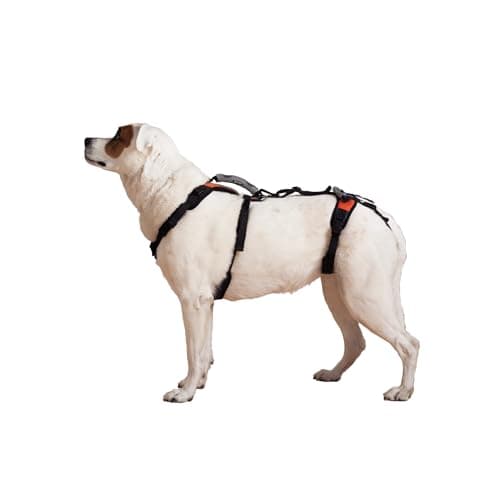
Help 'Em Up
Help 'Em Up Harness
Our score
$95–$155
Best for
Long-term mobility support for senior or post-surgical large dogs
If your dog needs help getting up multiple times a day for the foreseeable future — post-TPLO, advanced hip dysplasia, hindquarter weakness in giant-breed seniors — this is the one to buy. It supports the front and the back independently, as two halves you can lift separately, which is what a dog with a bad hip and a compensating shoulder actually needs. It is not the only design that does this, but it is the one whose sizing, returns and channel prices we have read most closely. Buy it from the manufacturer, not from Amazon: re-verified 3 October 2026, helpemup.com prices by size at $80 / $95 / $110 / $125 / $140 while Amazon runs $95 / $110 / $125 / $140 / $155 — a uniform $15 more at every size, every time we have checked.
Pros
- Two-piece (chest + hip) design lets you support either end independently
- Hip handle is purpose-built — not a converted car-seat-belt strap
- Padded chest plate distributes weight better than sling-only options
- Five sizes span 10 to 225 lb, and the rear half can be ordered a size smaller for a dog with muscle wasting
- Two hip-lift styles (Conventional and U-Band) so male dogs are not soiling the strap
Cons
- Amazon runs a uniform $15 above the maker's own price at every one of the five sizes, and the Amazon buy box is held by a third-party reseller (Veterinary Preferred) rather than by the brand — re-verified 18 August 2026
- The maker's own Mix & Match page prints two different starting prices, "From $80" and "FROM $95 USD", on the same page
- Direct pricing is no longer flat: since mid-August 2026 the maker charges $80 to $140 by size, so a giant-breed owner now pays $60 more than a terrier owner
- On 29 August 2026 the linked Amazon Medium (B0DK81SCG5) showed a future availability date rather than units on hand, while every size and style was in stock at helpemup.com the same day; on 9 September and again on 12 September 2026 the Amazon Medium still showed the future-date status at $125.00 with a maximum order of one and no ship date given, while all nine direct variants were in stock — two weeks of backorder on the channel we earn from, and one more reason the direct channel is the one to use. By 3 October 2026 it had spread: every Conventional-style Amazon listing we checked (X-Small, Small, Medium, Large) showed a future availability date, and only the Large and X-Large U-Band were in stock, while all nine direct variants were available. On 15 October 2026 the linked Medium was back In Stock on Amazon at $125.00 (maximum order 30) for the first time since 29 August, but X-Small, Small and Large Conventional still showed a future availability date with a maximum order of one
- Sizing is critical — measure twice, return is a hassle
- Rear straps can chafe the inner thigh if the harness is left tight while the dog lies down
- A dog filmed or gait-assessed while wearing it looks less lame than he is, because the harness offloads the limb you are trying to judge
- Bulkier than a quick-grab sling for short-term use
Amazon, 15 October 2026: the Medium this button links is In Stock at $125, the first time since 29 August it has not shown a future availability date. X-Small, Small and Large Conventional on Amazon still had no ship date. Every size and style was in stock direct the same day, $15 cheaper.
The part that belongs in this article: never film him in it. A supported dog's gait is not his gait. The harness is built to take weight off the legs, and how much weight goes through the bad leg is the quantity the scored items exist to track, so a video taken with a hand on the hip handle is likely to read as improvement that belongs to the equipment rather than to him. Take it off, or slacken it and drop the handles, for the few minutes of filming.
Where to buy it, re-read on 3 October 2026: the maker sells it direct at $80 to $140 by size, $15 less than Amazon at every size,[13] and on that date every Conventional-style listing we checked on Amazon, including the Medium we link, showed a future availability date instead of stock, as that Medium has at every check since 29 August.[14] The maker's own page says Conventional is "for all Female Dogs & 80% of Male Dogs."[13] Buy direct, which is the button on the card that earns us nothing. If his hindquarters have wasted, order the rear half a size smaller: the halves are sold separately at half the matched price, so that costs less, not more. The full size-by-size table is on our harness page.
The real downside: left tight while he lies down, it can chafe, and the maker's FAQ says to loosen the straps whenever he lies down in it, to prevent hot spots, chafing and overheating.[15]
A correction, dated. Until 3 October 2026 this section said the maker charged a flat $80 at every size and that the smaller-rear option carried a $15 premium. The flat price ended in mid-August, as the dated price history on our harness page records, and the premium was our misreading of a headline figure on the maker's ordering page. Both are logged on our corrections page.
What to do this week#
Tonight, download the Canine Brief Pain Inventory, score it, and write today's date on it. It is ten scored questions, and it is the baseline that everything else gets compared against. Without a day-0 reading, a day-14 reading tells you nothing.
Tomorrow, put a piece of tape on the ground where the camera goes, film a walk out and back, repeated until you have about forty strides of the sore leg, then a trot out and back, and name the file with the date. Then work down the nine defined items from the table and write the nine numbers under it.
Then put a recurring reminder in your phone: the video weekly, the scored items fortnightly, the questionnaire monthly. And before you start any new treatment, ask your vet for two things in writing: the date you will both review it, and what would count as it having worked.
The reason to do this is not that your judgement is poor. It is that the thing you are trying to detect is a small change in a body you see every day, and none of the studies above shows anyone tracking a change like that reliably by eye, including the observers with veterinary training. A dated file is not a substitute for your attention. It is the instrument your attention has been missing, and it has been in the clinical literature the whole time.
Sources#
- Conzemius MG, Evans RB. "Caregiver placebo effect for dogs with lameness from osteoarthritis." Journal of the American Veterinary Medical Association. 2012;241(10):1314-1319. doi:10.2460/javma.241.10.1314 — 58 dogs in the placebo arm of an FDA-approved trial; caregiver placebo effect 39.7% for owners, 44.8% for veterinarians at a walk, 44.8% at a trot, 43.1% on joint palpation; effect significantly enhanced with time; mean ground reaction forces unchanged; individually 5 dogs worsened by ≥5%, 7 improved by ≥5%, and 46 were unchanged over 42 days.
- Quinn MM, Keuler NS, Lu Y, Faria ML, Muir P, Markel MD. "Evaluation of agreement between numerical rating scales, visual analogue scoring scales, and force plate gait analysis in dogs." Veterinary Surgery. 2007;36(4):360-367. doi:10.1111/j.1532-950x.2007.00276.x — 21 dogs, 3 small-animal veterinarians with orthopedic training; agreement generally low among observers for both scales; only impulse had a significant relationship with some observers' scores; no significant relationships between any observer's scores and force plate data existed if very lame dogs were omitted; "each observer uses an individually unique scale"; observers must stay the same for the duration of a study. Note the model: these were mixed-breed research dogs with a right-limb tibial osteotomy repaired with an external fixator, not client-owned dogs with naturally occurring disease.
- Walton MB, Cowderoy E, Lascelles D, Innes JF. "Evaluation of construct and criterion validity for the 'Liverpool Osteoarthritis in Dogs' (LOAD) clinical metrology instrument and comparison to two other instruments." PLoS ONE. 2013;8(3):e58125. doi:10.1371/journal.pone.0058125 — 222 dogs cross-sectional, 79 longitudinal; LOAD Cronbach's α 0.88; LOAD vs HCPI rs 0.766; against symmetry index for peak vertical force, LOAD total rs 0.232 and LOAD lameness index rs 0.297, CBPI pain severity rs 0.281 and pain interference rs 0.276, all p < 0.01, while HCPI came in at rs 0.128 and was not among the significant correlations — the authors write that it is "not certain why HCPI did not correlate with SI-PVF"; no significant correlations between changes in any instrument's scores and changes in peak vertical force or any activity parameter.
- University of Pennsylvania School of Veterinary Medicine. "PennChart — Canine Brief Pain Inventory." vet.upenn.edu — the CBPI as an owner-completed questionnaire, distributed free as a PDF. This page is cited for availability only; the instrument's structure is sourced separately at note 11.
- Brown DC, Bell M, Rhodes L. "Power of treatment success definitions when the Canine Brief Pain Inventory is used to evaluate carprofen treatment for the control of pain and inflammation in dogs with osteoarthritis." American Journal of Veterinary Research. 2013;74(12):1467-1473. doi:10.2460/ajvr.74.12.1467 — 150 dogs across two identically designed carprofen studies, day 0 compared with day 14; defining treatment success as a reduction of ≥1 in the pain severity score and ≥2 in the pain interference score had consistently robust power (62.8% where baseline scores were ≥2, 64.7% where ≥3). Note: the published abstract states this criterion in the Results section and reverses the two scores in the Conclusions sentence. We have used the Results-section version, because the Results are where the analysis is reported.
- Aulakh KS, Dongaonkar KR, Barnes K, Gines AJ, Bordelon JT, Hulse D, Aulakh HK, Liu CC. "Influence of orthopedic examination on lameness scores and interobserver and intraobserver agreement in dogs with naturally occurring elbow osteoarthritis." Veterinary Surgery. 2020;49(3):455-462. doi:10.1111/vsu.13390 — 18 client-owned dogs with radiographically confirmed elbow osteoarthritis; 6 observers each scored randomly sequenced videos twice at least 2 weeks apart; intraclass correlation coefficient for both scores for all observers >0.9; numerical rating and visual analogue scores at a walk were lower than at a trot before orthopedic examination (by 0.17 and 3.54 respectively); an orthopedic examination did not exacerbate scores.
- Hans EC, Zwarthoed B, Seliski J, Nemke B, Muir P. "Variance associated with subject velocity and trial repetition during force platform gait analysis in a heterogeneous population of clinically normal dogs." The Veterinary Journal. 2014;202(3):498-502. doi:10.1016/j.tvjl.2014.09.022 — 20 clinically normal dogs trotted at habitual velocity; the magnitude of variance effects from largest to smallest was dog, velocity, trial repetition, and limb; a velocity range of 1.5–2.2 m/s captured 84.2% of trials with no significant effect on peak vertical force or vertical impulse.
- Gundersen K, Millis D, Zhu X. "Development and testing of a stifle function score in dogs." Frontiers in Veterinary Science. 2022;9:895567. doi:10.3389/fvets.2022.895567 — 27 dogs (21 with unilateral cranial cruciate ligament disease, 6 controls); 14-item score out of 100, divided by the authors into eight functional tests (65 points) and six clinical measures (35 points); correlation with force-plate symmetry index −0.863 (p < 0.0001); mean score by symmetry index band 97.8, 85.2, 65.4, 63 and 56.4; all items significantly correlated with the symmetry index except pain response and stifle flexion; stated limitations include the small number of dogs and a lack of adequate repeated measurements to assess the score's utility for monitoring.
- Triviño A, Davidson C, Clements DN, Ryan JM. "Objective comparison of a sit to stand test to the walk test for the identification of unilateral lameness caused by cranial cruciate ligament disease in dogs." Journal of Small Animal Practice. 2024;65(1):24-29. doi:10.1111/jsap.13679 — 10 dogs with unilateral cranial cruciate ligament rupture and 18 non-lame dogs on a pressure-sensitive walkway; hindlimb peak vertical force symmetry indices were 100% sensitive on the walk test and 90% on the sit-to-stand; vertical impulse symmetry indices 100% and 50% respectively; the sit-to-stand test "has relatively limited clinical utility in its tested form."
- Guadalupi M, Crovace AM, Monopoli Forleo D, Staffieri F, Lacitignola L. "Pressure-Sensitive Walkway System for Evaluation of Lameness in Dogs Affected by Unilateral Cranial Cruciate Ligament Rupture Treated with Porous Tibial Tuberosity Advancement." Veterinary Sciences. 2023;10(12):696. doi:10.3390/vetsci10120696 — 20 dogs measured before surgery and at 30, 90 and 120 days after porous TTA; lameness score and total pressure index increased significantly compared with pre-operative values from 90 days onward; a statistically significant difference between the operated limb and the healthy contralateral limb remained at every time point, including 120 days.
- Wells JR, Young AL, Crane A, Moyaert H, Michels G, Wright A. "Linguistic Validation of the Canine Brief Pain Inventory (CBPI) for Global Use." Frontiers in Veterinary Science. 2021;8:769112. doi:10.3389/fvets.2021.769112 — describes the instrument's structure: "four items pertaining to the severity of pain evident in a dog (pain severity domain) and six items relating to pain interference with daily activities (pain interference domain)," each on a 0–10 numerical rating scale, with the mean of each set of responses forming the two scores.
- Olby NJ, Moore SA, Brisson B, Fenn J, Flegel T, Kortz G, Lewis M, Lewis M, Tipold A. "ACVIM consensus statement on diagnosis and management of acute canine thoracolumbar intervertebral disc extrusion." Journal of Veterinary Internal Medicine. 2022;36(5):1570-1596. doi:10.1111/jvim.16480 — panel of 8 experts; the majority of available literature described observational studies and most recommendations were supported by a low or moderate level of evidence; areas identified as needing further study include "better understanding of the ideal timing for surgical decompression."
- Help 'Em Up. "Help 'Em Up Harness" product page and its public variant feed. helpemup.com — read 3 October 2026: X-Small $80, Small $95, Medium $110, Large $125, X-Large $140, all nine size-and-style variants available; front halves and hip lifts sold separately at $40, $47.50, $55, $62.50 and $70 by size. Amazon figures from the Amazon Creators API the same day: B0DK821BBF X-Small Conventional $95, B0DK81ZPPV Small Conventional $110, B0DK81SCG5 Medium Conventional $125 and B0DK7Z6VBN Large Conventional $140 all showing a future availability date with no ship date; B0DK7Z4H9P Large U-Band $140 and B0DK81XRPS X-Large U-Band $155 in stock; every buy box held by the reseller Veterinary Preferred.
- Amazon listing B0DK81SCG5, "Help 'Em Up Dog Lift Harness, Full Support, Medium Conventional (45-80lbs)." amazon.com — read through the Amazon Creators API on 29 August, 5 September, 9 September, 12 September, 24 September and 3 October 2026; every read returned a future availability date with no ship date and the buy box held by Veterinary Preferred, at $125.00. The API is not public, so the dated reads are recorded here; the listing itself is the page to check.
- Help 'Em Up. "FAQ." helpemup.com — read 12 September and 3 October 2026: the maker's instruction to loosen the harness straps when the dog lies down; returns within 30 days and exchanges within 14 days for US and Canada orders.
This article is educational and does not replace veterinary advice. A tracking protocol is a way of bringing better information to an appointment, not a substitute for one. Any limp that is sudden, non-weight-bearing, accompanied by heat and swelling, or accompanied by weakness or incoordination needs to be seen rather than measured.
Frequently asked
- How can I tell if my dog's limp is actually getting better?
- Not by watching, which is the hard part. In the placebo arm of a blinded osteoarthritis trial with a force plate running throughout, owners judged their dogs improved 39.7% of the time while the mean measured limb loading did not move, and the veterinarians did it slightly more often than the owners did. What works instead is writing things down on a schedule: score a validated owner questionnaire once a month, film the same short walk the same way once a week, and score nine items that have written definitions rather than forming an impression. All three are free. The point of each of them is to compare today's dog with a record of your own dog rather than with your memory of him.
- How do I score my dog's lameness at home?
- Use definitions instead of adjectives. The most useful set of definitions comes from a canine stifle function score built and tested on 27 dogs, eight of whose fourteen items are functional tests you can run at home, plus a ninth we have moved across because it only needs a tape measure. The trick in it is that limb use is counted rather than judged: 10 points if the dog bears weight on every stride, 6 if he is lame but loading the leg on more than 95% of strides, 4 if between 50% and 95%, 2 if between 5% and 50%, and 0 if he is loading it on fewer than 5%. Film forty strides, count how many the foot takes weight on, and write the raw count down. Only the limb-use items are true counts, and even they only separate a dog who skips strides from one who does not; for a mild limp on every stride, the choice between 10 and 6 is still a judgement, which is why the weekly video matters. For standing square, stairs, and sitting down and getting up, use the written definitions rather than your own adjectives. A count or a definition is something you can check again on the video; an adjective is not.
- Should I film my dog walking to show the vet?
- Yes, and film it the same way every week rather than only on a bad day. When six observers scored the same set of videos of eighteen dogs, agreement both between observers and within each observer was above 0.9, in contrast with the generally low agreement three orthopedically trained vets reported in a separate study. The two studies used different dogs and different statistics, so that is a contrast rather than a measured difference, and the video is the plausible reason rather than the proven one. Either way the setup is free. So: same flat non-slip route, camera in the same marked spot at about your dog's shoulder height, side on, lead slack, same handler, same pace, at a walk and then at a trot, same time of day relative to rest and to medication. Name the file with the date and keep every one.
- How long should I wait before deciding a treatment isn't working?
- It depends what the treatment is, and the honest answer is that you should agree the review date with your vet before you start rather than after. The carprofen trials behind the questionnaire threshold on this page scored success at day 14, but that was the endpoint those trials chose for one drug, not a rule for every treatment, which is why the date should come from your vet. Recovery from cruciate surgery can be slower. In one small study of twenty dogs after tibial tuberosity advancement, a different operation from TPLO, followed on a pressure-sensitive walkway, the two pressure measures used to score lameness did not show significant improvement over pre-surgery values until 90 days, and on those measures the operated limb was still behind the healthy one at 120 days. In that study a leg not yet symmetrical at four months was the group's normal, not a sign of failure, but your surgeon, not one study's average, decides what is on course for your dog. Set the date, keep the file, and read the file on the date.
- Is it a bad sign if the limp comes and goes?
- Not necessarily, but do not assume it is harmless either. A limp that has not been diagnosed and comes and goes needs an examination, not a tracking sheet, because an intermittent limp can be a sign in its own right. Once you have a diagnosis, day-to-day variation is exactly why single observations mislead: how a dog moves depends on things like the surface, how long he rested first and how recently he was medicated, which is why the protocol on this page asks you to hold as many of those as you can still. What matters is the direction of the trend across weeks, not the reading on any one day. The patterns worth flagging to your vet are different in kind: a limp that changes its pattern, for instance one that used to ease with movement and no longer does, a limp that appears in a second limb, or a step down on the same scored item across two consecutive readings.