Owner's Guide
How Much Walking Is Right for a Dog With Arthritis?
Exercise is the one part of an arthritis plan that gets prescribed without a number, so it quietly shrinks to nothing. Here is what the canine evidence actually supports, and how to write the dose down.

The honest answer is that nobody has established the correct dose, and the useful answer is that consistency matters more than the number you pick. The canine evidence does not support the instinct most owners follow, which is to shorten the walk because the dog is sore — the one study to look at exercise duration in arthritic dogs found the ones walking over an hour a day were less lame than the ones walking under twenty minutes. So: choose a duration your dog finishes comfortably, do it every single day, write it down, and change it by about ten per cent a week. The writing it down is not administrative fussiness. It is the entire intervention.
Affiliate disclosure: Dog Orthopedic is reader-supported. When you buy through links on our site we earn a commission at no extra cost to you — about 3% on most pet products, and the same rate on every product we compare, so no pick earns us more than another. Prescription medication earns us nothing, and seeing your vet earns us nothing; we recommend both anyway. Learn more.
Imagery: Lifestyle photographs on this site are licensed from Pexels (royalty-free) and credited per image. Pexels imagery illustrates conditions and contexts — it does not depict the specific dogs or test sessions described in the text. Product photographs come from Amazon's Creators API. Breed portraits are illustrations of typical breed type rather than photographs of individual dogs, and are not drawn to scale against one another.
Why the walk got shorter without anyone deciding#
Ask an owner of an arthritic dog how long they walk him and you will usually get a number. Ask them how long they walked him eighteen months ago and you will usually get a pause.
This is the part of arthritis management that goes wrong silently. Every other element of the plan arrives with a number attached. The anti-inflammatory has a milligram dose and a frequency. The weight target has a kilogram figure and a recheck date. The joint supplement has a scoop size on the tub. Exercise arrives as a verb — keep him moving, gentle exercise, little and often — and a verb has no dose, no schedule, and no review date. So it is the only part of the plan that can decay to nothing while everyone involved believes it is still happening.
The decay has been documented, and reading it is uncomfortable because it is so recognisable. Belshaw, Dean and Asher interviewed 40 owners of 35 dogs with osteoarthritis in the UK and asked how walks had changed since diagnosis. The paper is called Slower, shorter, sadder.[1] One owner described the mechanism better than any clinician has: "She's now cutting a wee corner off here, a wee corner off there, as if just to get herself back."
A wee corner off here. A wee corner off there. Nobody decided. Nobody wrote it down. And a year later the walk is a quarter of what it was, and the household's honest belief is that the dog chose that.
Here is the distinction worth carrying out of this article. A shortening walk is not your dog telling you he wants less. It is a negotiation you are both losing a few metres at a time, and neither of you is keeping score. The dog shortens it because today's joint hurts. You shorten it because you love him and he looked tired. Both of those are reasonable on any given Tuesday. Added up across a year they produce a dog with less muscle holding a worse joint, and that dog did not consent to it either.
“Because your dog can't tell you how much pain he or she is in.”
What the evidence actually says — including the part that surprises people#
Three findings, in descending order of how much they should change what you do.
Longer daily exercise was associated with less lameness, not more. Greene, Marcellin-Little and Lascelles studied 60 client-owned Labrador Retrievers with hip dysplasia, taking owner questionnaires on daily exercise duration and type and measuring hip range of motion with a goniometer. Dogs with hip arthritis exercising more than 60 minutes a day had lower lameness scores than dogs exercising less than 20 minutes a day.[2]
Read that carefully before you act on it, because the direction of causation is genuinely unsettled. This was a cross-sectional questionnaire study. Dogs that are less lame are easier to walk for an hour, which would produce exactly this result with no benefit from the exercise at all. What it does do is close off the assumption that runs the other way. If long daily walks were straightforwardly harmful to arthritic hips, the dogs walking three times as long should have looked worse. They did not.
The consensus guidance specifies consistency, not a number. The COAST Development Group's international consensus guidelines for treating canine osteoarthritis call for daily exercise with "consistency in duration (but may change according to age/life stage)," and advise avoiding "high-impact exercises and activities that encourage sudden changes in direction (twists and turns) in unconditioned dogs."[3] Note what is being asked for. Not thirty minutes. Not three sessions. Consistency in duration — the same amount, reliably, so that the joint and the muscle around it are loaded predictably rather than in bursts.
And the honest limitation, which almost nobody publishes. A 2022 review of physiotherapeutic strategies for canine osteoarthritis states that "the clinical efficacy of strengthening exercises in osteoarthritic dogs has not been established yet but are recommended on a routine basis clinically," and notes that studies comparing walking at different velocities and durations for their effect on cartilage metabolism are simply missing in veterinary medicine.[4]
So the position we are actually in: exercise is universally recommended, the recommendation rests on clinical reasoning and human data rather than canine trials, and the specific dose has never been tested. That is not a reason to skip it. It is a reason to stop pretending that "20 minutes twice daily" is a finding rather than a convention, and to build your dog's plan around the thing that is supported — regularity — while measuring the response yourself.

What about "little and often"? An honest audit#
"Little and often" is repeated everywhere, including in our own earlier articles, and it is probably right. It is worth being clear that it is probably right rather than demonstrably right.
Nobody has run a trial in dogs taking one weekly exercise total and splitting it different ways — four fifteen-minute walks against one hour, five days off and one long hike against daily moderate walks. The "weekend warrior is harmful" claim is universal in pet content and does not, as far as we can find, rest on a canine study. What exists is a real observation from the adjacent direction: accelerometers on 56 dogs with veterinarian-diagnosed osteoarthritis found total activity counts significantly higher at weekends than weekdays, which the authors attributed to owner work schedules.[5] That tells us the weekend-loaded pattern is real and common. It does not tell us it causes harm.
The mechanical argument for splitting is still good, and it is the reason we recommend it: a stiff dog is worst in the first minutes of movement, so three outings buy three warm-ups instead of one, and no single session accumulates as much continuous load. Take that as sound reasoning, not as a citation.
One more finding from that same accelerometer study deserves a place in your thinking, because it is a warning about your own judgement. Total activity counts and activity type were not correlated with pain as scored by veterinarians, nor with pain intensity or severity as scored by owners. How much a dog moves and how much a dog hurts are not the same signal, and neither you nor your vet can read one reliably from the other by eye.
The dose, written down#
Since the literature will not give you a number, here is a defensible starting framework. It is built from the consensus guidance on consistency, the Greene association, and standard rehabilitation practice on progression rates. Treat the columns as a starting point to adjust from, not a prescription.
| If your dog's arthritis is | Start at | Split into | Progress by | Surface priority |
|---|---|---|---|---|
| Mild — stiff after rest, no visible limp | 45–60 min/day | 2–3 walks | +10% per week if the mornings hold | Grass and dirt over pavement |
| Moderate — visible limp some days, slow to rise | 30–40 min/day | 3 walks | +10% per fortnight | Flat, non-slip, no stairs on route |
| Advanced — needs help rising, tires within minutes | 15–20 min/day | 3–4 short outings | Hold steady, do not chase gains | Level ground, short loops near home |
| A flare day, any stage | Half the usual | Same number of outings | Return to baseline over 3–4 days | Whatever is closest and softest |
Four rules make the table work, and the rules matter more than the numbers.
Do not skip a flare day, halve it. The instinct on a bad day is total rest, and total rest is what starts the decay. Take the same number of outings at half the length. Dogs in the placebo arm of a study of 100 dogs restricted after knee surgery lost 1.21 cm of thigh circumference on the affected leg over eight weeks of enforced rest.[6] Rest is not neutral; it has a price, and the price is the muscle holding the joint together.
Judge the dose the next morning, not during the walk. Almost every owner who overdoes it does so because the dog looked happy. Over-dosing shows up eight to twelve hours later as extra stiffness, which is far enough from the cause that nobody connects the two. Pick a single fixed observation — how many attempts to stand after breakfast is the best one — and read that, every day.
Change one variable at a time. Longer, or faster, or hillier, or a new surface. Not two. When something goes wrong you want to know which one did it.
Let the sniffing count. A dog who spends ten of his thirty minutes with his nose in the grass has had thirty minutes outdoors and roughly twenty minutes of load. For a dog whose problem is load tolerance, that is not a wasted walk, it is a well-engineered one. This is also the single easiest way to lengthen a walk that cannot be lengthened by distance.
The equipment question, answered honestly#
For most dogs reading this, the answer is that you do not need to buy anything. The dose is free, and the tracking is a notes app.
Two purchases genuinely change what is possible, and one of them costs less than twenty dollars.
If the walk keeps getting cut short by pace, not distance#
The commonest reason a walk shortens is not that the dog cannot go further. It is that the dog cannot go further at the speed the lead is asking for. On a six-foot lead the human sets the pace, and a stiff dog on a fixed lead is either being gently pulled along or stopping the whole party every thirty seconds. Both feel like the walk failing. What is actually failing is the coupling.
A long line changes the geometry. At twenty or thirty feet the dog sets pace and route within a radius you control, which is exactly what Belshaw's owners described their dogs doing anyway — more sniffing than walking, cutting their own corners. This lets that happen without the owner interpreting it as a walk going badly.
#2 Pick

Mighty Paw
Mighty Paw 30 ft Check Cord
Our score
$16.46
Best for
Building recall at distance while the dog is still physically attached to you
Still the right tool for the job: a long line is how you build a recall you can actually trust, and 30 feet of floating quarter-inch rope does that better than flat webbing does. Buy it with two things understood. Mighty Paw has taken it off their own website — it exists on Amazon and nowhere else we can find — and the lifetime warranty their marketing leans on does not reach an Amazon purchase, so what you actually have is Amazon's return window. If long lines are part of how you train, that argues for buying a spare now rather than later.
Pros
- 30 feet is the point. It lets you call your dog from further away than he has ever been reliably called, and still guarantees the outcome — which is the whole mechanism behind a recall that holds up
- Verified against the live listing on 2026-08-14: quarter-inch rock climbers' rope, 360 inches end to end (30 ft exactly), orange, with reflective stitching, and it floats — which is what makes creek and lake work practical rather than a wrestling match with a waterlogged strap
- Sold with the buy box held by Mighty Paw itself, not a reseller, so you are buying the maker's own stock
- No handle, by design — Mighty Paw calls it a "dual purpose design" and expects you to tie your own loop. A handle on a 30 ft line is something to snag on brush; a knot you tied is something you can move
Cons
- Mighty Paw no longer lists this product on its own website at all. On 2026-08-14 we checked all 91 products in mightypaw.com's live product feed, the full product sitemap, and three plausible URLs — the Check Cord is in none of them and every URL 404s. The only long line on their own store is the flat webbing "Long Leash" (15 ft $14.99, 30 ft $15.99) and both lengths show as unavailable. We previously wrote that Mighty Paw replaced the webbing line with this rope version; the delisting runs the other way round. Corrected 2026-08-14
- The Amazon stock signal is soft, not green. The five other items we audited the same day returned a plain "In Stock" message; this one returned an empty availability message with the type flagged as a future availability date. It is buyable today at $16.46. We would not count on it being buyable in six months, and if you use long lines, buy the spare now
- Your warranty does not survive the Amazon purchase. Mighty Paw's warranty policy (last updated 7 May 2025) offers a "limited, lifetime-of-the-product warranty" — then limits it to "the original purchaser of products from this website" and says "For purchases made through Amazon, please contact Amazon Customer Service directly." Their 90-day return with a prepaid label carries the same carve-out: "These remarks do not apply to transactions from Amazon.com via Prime." Since the maker no longer sells this item direct, there is no way to buy it and be inside the lifetime warranty
- Mighty Paw's own three warranty pages do not agree. /pages/warranty-policy grants the lifetime warranty on its terms; /pages/lifetime-warranty says you must register the product to receive it; /pages/warranty-1 is listed in their sitemap and is completely blank. We are not going to resolve that for them — register your product and keep the receipt
- Chewing and cutting are excluded from the warranty by name ("Excessive chewing or cutting"), which on a rope a dog drags through a field is the likeliest way it will ever fail
- "The clip is a strong, metal hardware that won't break" is Mighty Paw's claim, and no breaking strength, working load or test standard is published anywhere on the listing or their site. A 30 ft line arresting a sprinting dog is the highest-force moment in ordinary dog gear and it is the one number nobody publishes. We also found no manufacturer guidance on what to clip it to. Attach it to a well-fitted harness rather than a collar and ask your vet or trainer if you are unsure — we have no citation that quantifies the risk either way, and we are not going to invent one
- Mighty Paw says the rope is "designed to be tangle-free and won't get caught on underbrush." Handlers who use long lines report otherwise, and our own view is that 30 feet of anything tangles around legs and trees unless you manage it actively. Take the maker's claim as a claim
- Rope burn is real on bare hands with a fast dog. Wear gloves for field work
The downsides are real and you should hear them before you buy. Rope tangles around legs and trees unless you actively manage it, and around an arthritic dog's own hind legs is the last place you want a taut line — this is a tool for open grass, not for a busy pavement or a crowded park. It ships without a handle, so you tie your own loop. Rope burn on bare hands is a genuine risk with a dog that accelerates, so wear gloves. And it must clip to a harness, never a flat collar, because thirty feet of slack plus a sudden stop is a whiplash injury waiting to happen.
The free version first, because it works: simply stop walking at your own pace. Slow to the dog's speed and let the lead stay slack. If the walk works after that, you have saved twenty dollars and learnt something more useful than the product would have taught you.
If the back half of the walk is where he fails#
This is a different problem and it needs a different tool. Some dogs manage the outbound leg and then have nothing left for the return — the last two hundred metres become a haul, and the owner ends up half-carrying a dog by the collar or by a fistful of loose skin.
#1 Pick
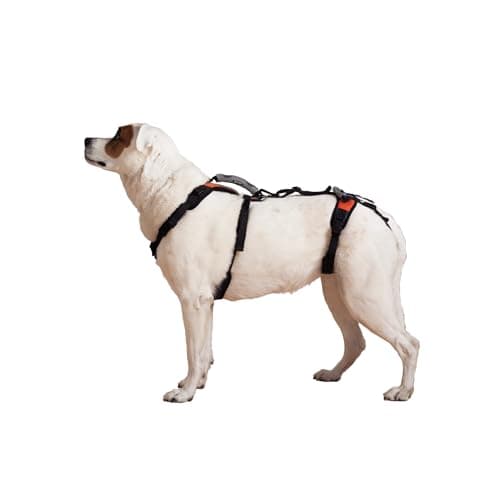
Help 'Em Up
Help 'Em Up Harness
Our score
$95–$155
Best for
Long-term mobility support for senior or post-surgical large dogs
If your dog needs help getting up multiple times a day for the foreseeable future — post-TPLO, advanced hip dysplasia, hindquarter weakness in giant-breed seniors — this is the one to buy. It is the only harness in the category that supports the front and the back independently, which is what a dog with a bad hip and a compensating shoulder actually needs. Buy it from the manufacturer, not from Amazon: re-verified 18 August 2026, helpemup.com prices by size at $80 / $95 / $110 / $125 / $140 while Amazon runs $95 / $110 / $125 / $140 / $155 — a uniform $15 more at every size, every time we have checked.
Pros
- Two-piece (chest + hip) design lets you support either end independently
- Hip handle is purpose-built — not a converted car-seat-belt strap
- Padded chest plate distributes weight better than sling-only options
- Five sizes span 10 to 225 lb, and the rear half can be ordered a size smaller for a dog with muscle wasting
- Two hip-lift styles (Conventional and U-Band) so male dogs are not soiling the strap
Cons
- Amazon runs a uniform $15 above the maker's own price at every one of the five sizes, and the Amazon buy box is held by a third-party reseller (Veterinary Preferred) rather than by the brand — re-verified 18 August 2026
- The maker's own Mix & Match page prints two different starting prices, "From $80" and "FROM $95 USD", on the same page
- Direct pricing is no longer flat: since mid-August 2026 the maker charges $80 to $140 by size, so a giant-breed owner now pays $60 more than a terrier owner
- On 29 August 2026 the linked Amazon Medium (B0DK81SCG5) showed a future availability date rather than units on hand, while every size and style was in stock at helpemup.com the same day; on 9 September and again on 12 September 2026 the Amazon Medium still showed the future-date status at $125.00 with a maximum order of one and no ship date given, while all nine direct variants were in stock — two weeks of backorder on the channel we earn from, and one more reason the direct channel is the one to use
- Sizing is critical — measure twice, return is a hassle
- Rear straps can chafe the inner thigh if the harness is left tight while the dog lies down
- A dog filmed or gait-assessed while wearing it looks less lame than he is, because the harness offloads the limb you are trying to judge
- Bulkier than a quick-grab sling for short-term use
The reason we keep coming back to this harness is not the padding, it is the workflow. It stays on the dog. That sounds minor and it is the whole point: the moment you need to support a dog is at the far end of the walk, four hundred metres from the house, which is precisely where a sling hanging on a hook by the door cannot help you. A support device you have to fetch is a support device that is never present at the moment it is needed. The two-piece design means you can take the hip handle on a bad-hip day and the chest handle on a bad-elbow day, mid-walk, without changing equipment.
The honest costs. It is bulkier than a grab-and-go sling and warmer to wear in summer, which matters if it is on all day. Sizing is unforgiving, and the manufacturer's instruction for a dog between sizes is to size down, which is the opposite of most people's instinct. The rear straps can chafe the inner thigh if left tight while the dog lies down — a real complaint from retailer reviews, and a real design weakness in a product sold for continuous wear. And the manufacturer's own site now prices by size — $80 X-Small up to $140 X-Large, read off its live variant feed on 14 August 2026; the flat-$80-for-every-size pricing we verified twice in early August is over. Direct still undercuts Amazon on the sizes most buyers need (Medium $110 direct vs $125 on Amazon); we link Amazon because that commission funds this site, and we would still rather you paid the lower direct price.
Before either purchase, try a rolled bath towel under the belly for one walk. It costs nothing and it tells you which end of your dog actually needs holding, which is the question the sizing page will ask you.

What about swimming and hydrotherapy?#
Worth doing if you have safe access, worth being calm about. Nganvongpanit and colleagues had 55 dogs swim over eight weeks, including 22 with hip osteoarthritis, and found most clinical parameters improved by week 8, with pain on palpation improving by week 6.[7] Set against that, the 2022 review is blunt: clinical efficacy of aquatic exercise forms for muscle strengthening "has neither been investigated for healthy nor for osteoarthritic dogs," and long-term benefits for function, stiffness, comfort and range of motion "have not been investigated yet."[4]
Swim as a supplement. Do not trade the daily walk for a weekly swim, because the thing the evidence supports most clearly is the daily part.
What actually stops the walk, and it is usually not the dog#
Three things end walking programmes, and only one of them is the arthritis.
The floor between the bed and the front door. A dog who has slipped on hardwood does not want the walk that starts with crossing it. Fix the route inside the house before you diagnose reluctance outside it — our guide to dogs slipping on floors has the coverage math, and it is mostly rug runners.
The night before. A dog who spent eight hours on a hard cold floor starts the morning walk already stiff, and the walk gets blamed. Several inches of solid foam is thermal insulation and pressure relief in one object.
#3 Pick

Big Barker
Big Barker 7-inch Pillow Top
Our score
$250–$460
Best for
Large and giant breeds with hip, elbow, or arthritis pain
The bed every senior-large-breed owner eventually buys, and the one we still recommend first for a dog over about 80 lb — because seven inches of foam is the only thing that reliably keeps a heavy dog's hip off the floor plane overnight. (It is not one solid slab, as we used to say: the maker's own copy describes a 3-layer build, a 2" base under a 3" support layer under a 2" comfort top.) It is also the only bed in the category with a clinical study attached, and we would rather you knew what that study is: forty dogs, no control group, no blinding, and outcomes scored by the owners who had just been given a free bed. That is a reason to be interested, not a reason to be convinced. Buy on the foam depth and the ten-year warranty, which are facts. On where to buy: the price is the same either way, so buy direct for the 180-night sleep trial, which Amazon's return window does not match. The two editions both sell on both channels at identical prices, re-verified 6 September 2026 — flat Large $249.95, Headrest Large $289.95. We have published two wrong things about this in the past, a $40 Amazon markup and a direct-only cheap edition; both are retired, and the honest version is that the channel decides your trial, not your price.
Pros
- Seven inches of foam — a 3-layer build (2" base, 3" support, 2" top comfort) deep enough that a 100 lb dog's hip does not reach the floor plane, which is the whole job
- 10-year warranty — foam must retain at least 90% of its original shape and support, or it is replaced
- The only bed in the category with a published clinical study behind it, even though that study is a single-arm pilot
- Made in the USA
- Microfiber cover unzips and machine-washes
Cons
- Premium price
- Editions, not channels, are what the price difference is. Both are on Amazon and both are on bigbarker.com at identical prices, re-verified 2026-09-06: the flat headrest-free Large is $249.95 (B0GRBXBPXH) and the Headrest Large is $289.95 (B0GRBX5TBL), both In Stock with the buy box held by Big Barker itself, both matching the maker's own site. We previously misread this as a $40 Amazon markup, and then as the cheap edition being direct-only. Both claims are retired
- Bulky — measure your space, not just your dog
- Cover-only style isn't bolstered (consider Sofa edition for nesters)
- The clinical study everyone cites is open-label, single-arm, and owner-scored, with no control group
We rate this bed highly for a specific physical reason — seven inches of foam (the maker's own spec: a three-layer 2″+3″+2″ system, a correction from the “solid” we previously printed) is deep enough that a heavy dog's hip does not reach the floor plane — and we have just rewritten its page to be straighter about the study everyone quotes. That trial was open-label, single-arm, and scored by the owners who had been given the bed. In the placebo arm of a blinded canine osteoarthritis trial, owners judged their dogs improved 39.7% of the time while force-plate analysis ran alongside.[8] Buy this for the foam depth and the ten-year warranty, which are verifiable facts, not for the percentages. Like-for-like the two channels now match on price (a distinction we untangled in August 2026 after previously calling it a $40 markup) — the reason to buy direct is the 180-night trial, which no Amazon purchase carries. And if your dog is under 50 lb, or your current bed passes the fist test — press hard where the hip lies, and see whether your knuckles reach the floor — do not buy it at all.
The owner's own week. Belshaw's study found most owners would not walk without their dog, out of guilt, so the dog's decline became the household's decline. If the reason the walk is not happening is that it now takes 25 minutes instead of 12 and nobody has 25 minutes at 7am, that is a scheduling problem and it has scheduling solutions. Name it as that rather than as the dog getting worse.
If what is failing is genuinely the back end rather than the routine, the walk plan is one piece of a larger picture — our guides to weak back legs and telling a limp from weakness are where to go next, and arthritis in dogs covers the medical side this article deliberately does not.
What to do this week#
Tonight, write down two numbers: how many minutes your dog walked today, and how many attempts it took him to stand up after breakfast. That is the whole tracking system, and it takes eleven seconds.
Tomorrow, do the same duration again. Not more. The same. Consistency is the part the consensus guidance actually specifies, and you cannot be consistent about a quantity you have never measured.
Next Sunday, look at the seven pairs of numbers. If the standing figure held steady, add ten per cent to the walk. If it crept up, hold. If it climbed sharply, halve the walks for three days and then rebuild — and if it climbed sharply and did not come back down, book the appointment, because that is not a dosing problem.
And if you cannot answer how long you walked him eighteen months ago, that is the finding. Not a failure — nobody gave you a number to write down, and the plan was designed in a way that made the drift invisible. The delay is the injury, and this is the version of the delay that hides inside a routine everybody believes is still happening. Your dog cannot tell you the walk was the treatment. That is the part you get to know for him.
Sources#
- Belshaw Z, Dean R, Asher L. "Slower, shorter, sadder: a qualitative study exploring how dog walks change when the canine participant develops osteoarthritis." BMC Veterinary Research. 2020;16:85. doi:10.1186/s12917-020-02293-8 — 40 owners of 35 osteoarthritic dogs, semi-structured interviews; owner quotes on incremental route shortening and on guilt preventing solo walks.
- Greene LM, Marcellin-Little DJ, Lascelles BDX. "Associations among exercise duration, lameness severity, and hip joint range of motion in Labrador Retrievers with hip dysplasia." Journal of the American Veterinary Medical Association. 2013;242(11):1528-1533. Finding quoted as published by Canine Arthritis Resources and Education; the AVMA full text is paywalled and we have not read it in full.
- Cachon T, Frykman O, Innes JF, et al. "COAST Development Group's international consensus guidelines for the treatment of canine osteoarthritis." Frontiers in Veterinary Science. 2023;10:1137888. doi:10.3389/fvets.2023.1137888
- Mille MA, McClement J, Lauer S. "Physiotherapeutic strategies and their current evidence for canine osteoarthritis." Veterinary Sciences. 2022;10(1):2. doi:10.3390/vetsci10010002
- Lee AH, Detweiler KB, Harper TA, et al. "Physical activity patterns of free living dogs diagnosed with osteoarthritis." Journal of Animal Science. 2021;99(8):skab204. doi:10.1093/jas/skab204 — 56 dogs, accelerometer collars over 49 days; weekend-versus-weekday difference, and activity counts uncorrelated with owner- or veterinarian-scored pain.
- White DA, Harkin KR, Roush JK, Renberg WC, Biller D. "Fortetropin inhibits disuse muscle atrophy in dogs after tibial plateau leveling osteotomy." PLoS ONE. 2020;15(4):e0231306. doi:10.1371/journal.pone.0231306 — 100 dogs; placebo group lost 1.21 cm thigh circumference on the affected limb over 8 weeks of exercise restriction (P = 0.03).
- Nganvongpanit K, Tanvisut S, Yano T, Kongtawelert P. "Effect of swimming on clinical functional parameters and serum biomarkers in healthy and osteoarthritic dogs." International Scholarly Research Notices. 2014;2014:459809. doi:10.1155/2014/459809
- Conzemius MG, Evans RB. "Caregiver placebo effect for dogs with lameness from osteoarthritis." Journal of the American Veterinary Medical Association. 2012;241(10):1314-1319. PMID 23113523 — placebo arm of a blinded, placebo-controlled multicentre trial, 58 dogs; caregiver placebo effect in owners assessing lameness 39.7% of the time.
This article is educational and does not replace veterinary advice. An exercise plan for a dog with diagnosed orthopedic disease should be set with your veterinarian, and any new or worsening lameness needs examining rather than dosing.
Frequently asked
- How much should I walk a dog with arthritis?
- There is no validated dose, and anyone giving you one to the minute is guessing. What the canine data supports is daily, consistent, low-impact walking rather than long weekend outings, and it does not support cutting walks short by default. The one study that looked directly at exercise duration in arthritic dogs — 60 Labrador Retrievers with hip dysplasia — found that dogs exercising more than 60 minutes a day had lower lameness scores than dogs exercising less than 20 minutes a day. That is an association in a questionnaire study, not proof that more walking caused less lameness. Practically: pick a duration your dog finishes comfortably, do that same duration every day, write it down, and change it by about 10% a week rather than by mood.
- Is it better to do one long walk or several short ones?
- Several short ones, though the evidence for this is clinical convention rather than a trial. Nobody has run a study in dogs comparing the same weekly total split into different patterns, so the honest answer is that the split is not proven and the consistency is. What the international COAST consensus guidelines actually specify is daily exercise with 'consistency in duration' — the regularity is the recommendation, not a magic number of sessions. The practical case for splitting is that a stiff dog is at his worst in the first few minutes of movement, so three short outings give three warm-ups and less time in one continuous load.
- Should I stop walking my dog if he limps after a walk?
- No — shorten the next one, do not cancel it. Limping that appears after exercise and clears with rest usually means the dose was too big for that day, and the fix is to reduce the duration by about a quarter and rebuild slowly, not to stop. Stopping has its own cost, and it is measurable: in the placebo arm of a trial of dogs restricted after knee surgery, thigh circumference on the affected leg fell by 1.21 cm over eight weeks of enforced rest. That is muscle that was stabilising the joint. Limping that is present before the walk, worsening week over week, or affecting one side sharply is a different problem and needs a vet.
- Does walking make arthritis worse in dogs?
- Controlled, low-impact walking is not what damages an arthritic joint. What is consistently advised against is high-impact loading — jumping down from cars and furniture, ball chasing with hard stops, and sudden twisting turns — and the COAST guidelines specifically flag activities involving sudden changes in direction in unconditioned dogs. A flat, predictable, moderate-paced walk on a good surface is the opposite of that. The bigger honest caveat is that clinical efficacy of therapeutic exercise in osteoarthritic dogs has not actually been established in trials; it is recommended on clinical reasoning and human evidence, and we would rather tell you that than pretend otherwise.
- How do I know if my dog's walk is the right length?
- Judge it the next morning, not during the walk. A well-dosed walk leaves a dog who gets up at breakfast about as easily as he did the previous day. An over-dosed walk shows up as extra stiffness eight to twelve hours later — the evening after, or the following morning — which is why owners so often misjudge it in the moment when the dog looked delighted. Keep one fixed measure, such as how many attempts he takes to stand up after breakfast, and track that rather than the walk itself.
- Is swimming better than walking for an arthritic dog?
- It is genuinely lower impact, and there is some canine evidence for it, but it is a supplement rather than a replacement. A study of 55 dogs including 22 with hip osteoarthritis had them swim over eight weeks and found improvement across most clinical parameters by week 8, with pain on palpation improving by week 6. A 2022 review is more sober: the clinical efficacy of aquatic exercise for muscle strengthening has not been investigated in either healthy or osteoarthritic dogs, and long-term benefits for function and stiffness have not been studied. Swim if you have safe access to it and your dog enjoys it. Do not drop the daily walk to do it.