Mobility Guide
Dog Slipping on Hardwood Floors: Traction Fixes That Actually Work
A dog slipping on hardwood floors needs traction, not luck: rug runner routes, ToeGrips, nail and paw care, and the fixes to skip. Ranked by value.

The fixes for a dog slipping on hardwood floors, ranked by effect per dollar: rug runners along the routes your dog walks, ToeGrips on the nails, and a strict nail-and-paw-fur routine. Socks, boots, and paw wax are last resorts. Fix the floor before you buy anything for the dog — that order is not just about money, because the only two published studies of nail grips both failed to find a measurable benefit, while a rug on the route your dog walks is physics you can see working the same afternoon. And if the slipping started suddenly or comes with dragging paws, the problem is medical, not the floor — start at the vet.
Affiliate disclosure: Dog Orthopedic is reader-supported. When you buy through links on our site we earn a commission at no extra cost to you — about 3% on most pet products, and the same rate on every product we compare, so no pick earns us more than another. Prescription medication earns us nothing, and seeing your vet earns us nothing; we recommend both anyway. Learn more.
Imagery: Lifestyle photographs on this site are licensed from Pexels (royalty-free) and credited per image. Pexels imagery illustrates conditions and contexts — it does not depict the specific dogs or test sessions described in the text. Product photographs come from Amazon's Creators API. Breed portraits are illustrations of typical breed type rather than photographs of individual dogs, and are not drawn to scale against one another.
Why is my dog slipping on the hardwood?#
A dog's traction system has two parts: nails that dig in like cleats, and paw pads whose texture grips rough ground. Polished hardwood, tile, and laminate defeat both at once — there is nothing to dig into and nothing for the pad to grab.
The most useful published sentence on this describes what dogs do wrong in response. Introducing a gait study on nail traction devices, the authors write that poor traction on slick surfaces is difficult for dogs with neurologic deficits, osteoarthritis, or recovering from injury or surgery, and that "many dogs respond inappropriately to slick surfaces by decreasing digital pad-floor contact and extending their toenails."[1] That is the tense, high-toed, tiptoeing walk you have watched your dog do in the kitchen. It is the dog trying to solve the problem, and it takes the grippiest surface he owns further off the floor.
Three things stack on top of that in an older dog. Two of them we can point at, and one we cannot:
- Overgrown nails hold the pads off the floor. If you hear clicking on hardwood, the nails are touching first. This one follows directly from the mechanism above — the maladaptive response is toenail extension, and long nails do the same thing passively.
- Slipper fur. On Goldens, Berners, and other furry breeds, hair grows over the pads and turns each paw into a sock.
- Weak hindquarters can't catch a slide. A young dog corrects a small paw slip before you see it. This is the one every article in this category asserts, ours included until now, and we could find no study measuring it. It is mechanically plausible and it is what rehabilitation practitioners describe, but treat it as reasoning rather than a finding. We have also removed a claim we used to make here — that paw pads "wear smooth" with age — because we could not find a source for it either.
Then the part owners consistently underestimate: after one bad fall, many dogs start refusing rooms, stranding themselves on a rug island, or waiting rather than walking to the water bowl at night. That behavioural cost is what most owners actually come here to fix, and it is a better reason to lay rugs than any injury statistic.

What we are not going to tell you about cruciate tears#
This page used to say a splay-legged fall was "the classic final straw for an already-degenerating cruciate ligament." We are walking that back, because the sources point the other way.
The American College of Veterinary Surgeons states plainly that in cruciate disease, "ligament rupture is a result of subtle, slow degeneration that has been taking place over a period of time rather than the result of a sudden trauma to an otherwise healthy ligament (which is very rare)."[2] Post-mortem work backs that up from the other end: of 56 dogs whose cruciate ligaments were still macroscopically intact, 40 already had degenerative changes in the ligament, and the severity of those changes correlated with age and body weight.[3] The ligament is usually failing long before the day it goes.
So a rug is not cruciate insurance, and we should not have implied it was. We could find no study linking household floor slips to ligament rupture in dogs, and if one exists we have not seen it. What a slick floor demonstrably costs you is the visible stuff: falls, lost confidence, and a dog who stops moving around the house — which matters on its own, because a dog who stops moving loses the muscle that was holding dysplastic hips and arthritic joints together. That is a good enough reason to spend forty dollars on rugs. It does not need a scarier one.
The fixes, ranked by effect per dollar#
1. Rug runners along your dog's actual routes#
The highest-value move costs the least: put continuous traction along the four or five routes your dog actually walks. Watch your dog for one day and you will see them — bed to water bowl, bowl to back door, couch to front door, the hallway. Then lay rubber-backed runners along those paths. Think of them as traction highways: your dog doesn't need the whole floor fixed, it needs its commute fixed.
Rules that make this work: the paths must be continuous (a gap in the middle of a slick hallway is where the fall happens), every rug needs a non-slip backing or gripper pad underneath, and the highest-traffic turns — in front of the bowl, inside the back door — earn the most coverage.
Any cheap runner works. The objection is almost always aesthetic — nobody wants a house that looks like a yoga studio — and that is the niche the PupRug fills for the living room: it reads as a designer rug, comes in a runner shape, has an anti-skid base, and being a foam bed rather than a mat, it doubles as a cushioned rest stop on the route.
Two corrections we owe you here, a year apart and pointing the same way. Until 14 August 2026 this page said the PupRug was "3 inches of memory foam over an inch of support foam." Those numbers came from nowhere we could point at. We then said Paw.com publishes no foam depth at all — and on 6 September 2026 we found that it does, in its own FAQ rather than on any product page or listing: the memory foam base "measures approximately 2 inches thick."[8] Density is still published nowhere.[4] Two inches is a genuine cushion on a hard floor for a small or middleweight dog, and it is not an orthopedic mattress — what matters under an arthritic hip is what is left after the dog settles, and two inches leaves very little. Buy it for the look, the washable cover, and the anti-skid base. If your dog is over about 50 lb with sore joints, buy the traction fix here and buy depth separately.

Paw Brands
PupRug Faux Fur Memory Foam Bed
Our score
$119.95
Best for
Owners who want orthopedic support without a 'dog bed' look
Buy it for the room, not for the joints, and now we can say that with a number instead of a suspicion. Paw.com's FAQ puts the memory foam base at approximately 2 inches — a figure that appears nowhere a shopper would see it. Two inches is a good cushion for a small or middleweight dog on a hard floor and it is not an orthopedic mattress for a 38 lb dog with sore hips, which is exactly the complaint reviewers keep making. Score cut 8.6 to 7.6 on 2026-09-06: the bed did not change, we finally found the depth. What is verifiable: a machine-washable cover, an included waterproof liner, a genuinely handsome object, a ten-year flatten guarantee with a real claim process, and 2 inches of foam under your dog.
Pros
- Looks like a designer rug — disappears into living-room decor
- Cover is machine-washable (cold, gentle cycle, per Paw.com's own care copy — corrected 2026-08-14; we previously said spot-clean only) and a waterproof liner is included
- Skid-proof backing
Cons
- The memory foam base is "approximately 2 inches thick" — Paw.com's own FAQ, read 2026-09-06. That is the single most important number about this bed and it appears on none of the ten product pages and on no Amazon listing; you have to leave the shop to find it. Two inches of memory foam is a cushion, not an orthopedic mattress for a heavy dog
- Density is still published nowhere, on any surface, so the 2-inch figure cannot be compared to a 2-inch layer from another maker
- Memory foam construction runs warm in summer
- Larger sizes are heavy and awkward to move
- The advertised "LIFETIME no-flat-foam guarantee" carries no measurable threshold at all — unlike Big Barker's ≥90%-shape and K9's 2-inch terms, there is no number to hold it to, which makes it the weakest promise in the premium tier despite the biggest word
- Amazon availability is unreliable by variant. The Large/Extra-Large Sable Tan we linked from 2026-08-14 went "Currently unavailable" and was still dead on 2026-09-06; the Medium we link now showed only 16 units. Colourways go out and stay out on both channels — two of the ten Curve variants on paw.com were sold out the same day. Price the exact colour and size you want in both places before you decide, and note that Paw.com's collection grid quotes the Small's price
It is genuinely a bed — it's the aesthetics pick in our orthopedic bed roundup — so treat it as the anchor piece in the room where looks matter, and use ordinary runners everywhere else. Second correction, same date and in the product's favour this time: we used to say the faux-fur top was spot-clean only. Paw.com's own care copy says the cover is machine washable on a cold gentle cycle, and a waterproof liner is included.[4]
2. ToeGrips on the nails#
Rugs fix the floor; ToeGrips fix the dog — which matters for the tile you can't carpet and the hard floors of other people's houses. They are small natural-rubber sleeves that slide onto each toenail, and the design intent is to restore the cleat function the smooth floor took away. They are widely used by rehabilitation practitioners, which is how most owners hear about them.[5]
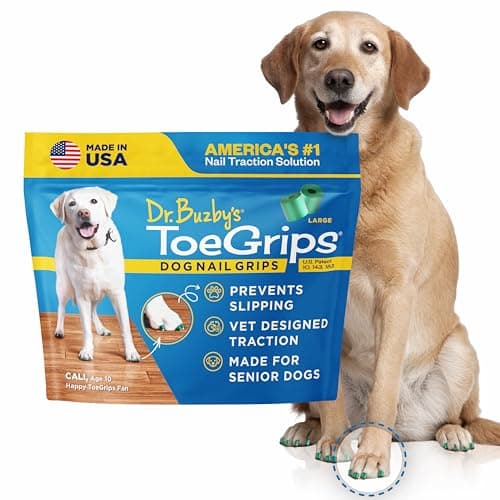
Dr. Buzby's
Dr. Buzby's ToeGrips for Dogs
Our score
$34–$40
Best for
Senior dogs slipping on hardwood, tile, or laminate floors
The best dog-mounted traction fix there is, and the one to buy once rugs have taken you as far as they can. Nothing touches the paw pad, which is why dogs tolerate these where they refuse socks and boots. Go in knowing the real cost: this is not a $40 purchase but a $240–$320 a year habit, so lay runners along your dog's actual routes first and buy grips for the floors you cannot cover.
Pros
- Veterinarian-developed; in clinical use for over a decade
- Slip onto each toenail — no socks, booties, or adhesives required
- Restores traction immediately, especially on hard floors
- Nothing touches the paw pad, so dogs accept them where they refuse boots
- Amazon and the manufacturer both charge $39.99 — no retailer markup
- 20 grips per bag against the 16 a dog wears, so a set includes four spares
Cons
- The only two published studies of nail grips both tested this exact product, and both were null: Roush 2017 (Front Vet Sci 4:111 — 15 sound dogs, kinetic changes "unlikely to be clinically relevant") and Repac 2022 (Animals 12(18):2312 — 30 dogs two weeks post-TPLO vs sham, no difference in weight bearing or limb function, including the owner question that asked specifically about slippery floors). Fair caveats: small samples, one used healthy dogs, the other a single early post-op timepoint — but "no positive trial exists" is the honest label, and we say it while still recommending the product for the mechanism and the owner-reported traction stories it was never tested against (verified 2026-08-14).
- A recurring cost, not a one-off. The maker publishes two different bag lives — "1–2 months" on its store page and "1-3 months, two months on average" in its FAQ (both read 2026-09-05) — which spans $160–$480 a year at $39.99. Plan on $240–$320, the two surfaces' central figures
- The Amazon listing markets specifically to dogs with "ACL injuries" — the one population where a randomised trial has been run, and where it found nothing (Repac 2022). The same bullets carry three claims with no source we could find: "more than 250,000 paws," "America's #1 nail traction solution," and "recommended by thousands of veterinarians worldwide" (listing copy verified 2026-08-17). Re-read 2026-08-31: a fourth unsourced superlative has been added to the top bullet on all four Amazon sizes — "The Only Toenail Grips for Dogs With GripZone Technology" — and the Large listing's title now leads with "Instant Traction on Wood/Hardwood Floors."
- The maker sells Scotch Super Glue Gel at $4.99 on its own store, listed as an "Alternate ToeGrips Application Method" (shop.toegrips.com, 2026-08-31). Read that as what it is: the company's own answer to the grips coming off, priced separately and not mentioned on the Amazon listing you are most likely to buy from.
- Application needs isopropyl rubbing alcohol, which is not in the box
- Initial application takes 15–20 minutes for a full set
- Some dogs chew them off in the first week
- Amazon carries only four of the seven sizes; XS, XXL and XXXL dogs have to buy direct
- Sizing by weight chart alone often misses — the accurate method needs dental floss and a ruler
The evidence, which is not what the marketing implies#
This is the part of the article we would most like to have been able to write differently, because we earn a commission on this product and it appears in twelve articles on this site.
There are two published studies. Neither found a benefit.
The first fitted the grips to 15 normal dogs and ran kinetic gait analysis before and after. Stance time went up in all four limbs and stride velocity went down. Peak vertical force went down significantly in both hind limbs, though within the group standard deviations. The authors' own summary: the grips "result in a slower gait, with slightly decreased VPF in the hindlimbs and increased effort for propulsion," and the changes "were of minor magnitude and unlikely to be clinically relevant."[1]
The second is the one that matters more, because it used sick dogs and a control. Thirty dogs recovering from cruciate surgery were randomised to nail grips or sham grips, with blinded assessors, for the first two weeks after the operation. There was no difference between the groups in visual lameness score or in total pressure index at any time point. And there was no difference on the owner-scored outcomes either — including the one that asked specifically about walking on slippery flooring (p = 0.78).[5] The grips and the shams were supplied by Dr. Buzby's ToeGrips; the study was funded by a grant from the American Association of Rehabilitation Veterinarians, and the authors state the funders had no role in the design, analysis or decision to publish.
Now the defences, because they are real and we would want them raised if this were a product we disliked:
- The trial was underpowered and its own authors say so. The power calculation asked for 56 dogs; a post-hoc recalculation after the first 20 suggested 28. Thirty were enrolled, split 13 and 17. A null in a small trial is weak evidence of absence.
- Two weeks after cruciate surgery is the worst possible window to detect an aid, because pain and weight-bearing improve fast on their own over exactly that period. The authors name this as a limitation.
- Neither study tested the thing you are buying. One used healthy dogs in a gait lab. The other used post-surgical dogs indoors at a New York hospital. Nobody has run the study that matters here: an arthritic senior, at home, on a wood floor, measured on falls rather than force plates.
- The sham was still a device on a nail. The authors note that placing anything on the nail may alter sensory input, so "no benefit over sham" is not the same as "no benefit over nothing."
Our read, stated as a read: for a dog who is slipping, the grips are a reasonable thing to try and a poor thing to rely on. Fix the floor first. The one advantage they hold over boots is documented rather than asserted — nothing covers the pad, so the dog keeps direct paw-to-floor contact, and they are less likely to trap the moisture full coverage can.[5]
The practical fine print#
They come in seven sizes keyed by colour — XS yellow (0–7 lb), S red (8–14), M blue (15–39), L green (40–74), XL purple (75–99), XXL orange (100–124), XXXL navy (125+) — and Amazon stocks only four of them, so very small and very large dogs buy direct.[6] Nail circumference is the accurate sizing method, not bodyweight. A bag holds 20 grips, which the maker describes as enough for "all 16 nails in contact with the ground and 4 spares." The first application takes 15–20 minutes for a full set, some dogs chew at them in the first week, and they need replacing every one to three months as the nails grow out. The guarantee is 30 days, judged by postmark.[6]
On the rubbing alcohol, we have to correct ourselves twice over. We used to say you need isopropyl alcohol and that its absence from the box is why first attempts fail. The maker's own FAQ says the opposite: applying them with isopropyl alcohol "is not required, but it facilitates application," and "you can use plain water or even apply ToeGrips dry."[6] Note the company then contradicts itself: the numbered application steps on the same site, and its own Amazon copy, both open by immersing the grips in alcohol.[7] Publish both, because that is what the maker published. The part that is simply true: no page of theirs says alcohol is supplied, so have a bottle in the house before you start.
Price it properly before you buy, because the sticker understates it badly. A bag is $39.99. That is the price at Amazon, where the buy box is held by Dr. Buzby's themselves, and it is $39.99 direct across all seven sizes — no retailer markup, which is unusual enough in this category to be worth crediting.[7][6] The manufacturer's own subscription is $33.99. But Dr. Buzby's copy also says a bag lasts one to two months. That is $240 to $480 a year at full price, or roughly $204–$408 on subscription — which makes this a standing cost rather than a purchase, and it is exactly why runners come first on this list.[6]
3. Nail trims and paw-fur maintenance#
Nearly free, and often half the problem. Two jobs, on a schedule:
- Nails every 2–4 weeks. The click test is the reminder: if you hear nails on hardwood, they are long enough to be tipping weight off the pads. Seniors wear their nails down less because they walk less, so the interval that worked at age five is too long at age twelve.
- Pad fur every grooming cycle. Part the toes and trim the tufts flush with the pad surface with blunt-nosed scissors or a small clipper. Ten careful minutes per month returns skin-to-floor contact on the exact surface the dog grips with.
If your dog fights nail trims, a groomer or vet tech will do it for a few dollars — cheaper than any product on this page.
4. Socks, boots, and paw wax — the honest trade-offs#
The products people buy first are the ones that work least well indoors:
- Grip socks rotate around the paw, fall off in the night, wear through quickly, and their rubber dots flatten. They also mute the paw's feel for the floor, which some seniors find worse than slipping.
- Boots are a winter outdoor tool — ice, salt, hot pavement. Indoors they trap heat, and a large share of dogs high-step, freeze, or refuse to walk in them at all.
- Paw wax gives a brief traction bump, needs constant reapplication, and ends up on the floors.
They have their places — boots in January, socks for a dog that tolerates them overnight when ToeGrips are off. As the primary indoor fix we would still put runners first and grips second, but be clear about what that ranking rests on: cost, comfort and consistency, not trial evidence. No published study compares any of these traction products against each other in dogs. Our mobility aids roundup reaches the same verdict from the gear side.
A room-by-room traction plan#
| Room | Where dogs actually slip | The fix |
|---|---|---|
| Kitchen | At the bowls, and the tight turn around the island | Non-slip mat under both bowls; runner covering the approach |
| Hallway | The whole length — dogs accelerate in hallways | One continuous rubber-backed runner, no gaps |
| Living room | The couch dismount and the path to the door | Runner on the path; cushioned landing mat at the dismount; PupRug where looks matter |
| Bedroom | The jump down from the bed at 2 a.m. | Padded mat at the bedside; ramp or foam stairs for the bed itself |
| Stairs | The top two treads, on the way down | Stick-on carpet treads; baby gate when unsupervised |
| Entryway | The greeting zone inside the front door | Large washable rubber-backed mat — excitement plus hardwood is the classic wipeout |

Stairs deserve their own plan beyond treads — gates, spotting technique, and when to retire the second floor entirely — which is exactly what our guide to helping a senior dog with stairs covers. And if the reason for all of this is a back end that is visibly weakening, the traction plan is one piece of the larger playbook in our weak back legs guide.
The bottom line#
Do it in this order, and most of it this week. Lay runners along your dog's actual routes today, with non-slip backing and no gaps — this is the step with the clearest mechanism and the lowest cost, and it is the one to do even if you do nothing else. Book the nail trim and clip the pad fur; between them they are close to free and they undo the exact thing the published mechanism describes, a dog holding his pads off the floor. Then, for the floors you cannot cover, try ToeGrips — knowing that the evidence for them is two null studies and a great deal of owner report, and that at $240–$480 a year they are a standing cost rather than a purchase. Skip socks, boots, and wax unless the first three aren't enough.
Then maintain it: nails every 2–4 weeks, grips every 1–3 months if you are using them, and a monthly walk-through looking for rug creep and bare gaps. A slick floor quietly taxes everything a senior dog does — the falls, the confidence, the rooms he quietly stops entering — and most of that you can fix this weekend for the price of two rugs.
Frequently asked
- Why is my senior dog suddenly slipping on the floor?
- Dogs grip floors with their nails and the texture of their paw pads, and polished hardwood defeats both. The published mechanism is a maladaptive one: many dogs respond to slick surfaces by decreasing pad-to-floor contact and extending their toenails, which takes the grippiest surface they own further off the ground. Overgrown nails do the same thing passively, which is why a nail trim is the cheapest fix there is. Two things we used to list here have been removed for lack of any source: that paw pads 'wear smooth' with age, and that weak hindquarters cannot catch a slide — the second is plausible and widely repeated, but we could find nothing measuring it. If slipping appeared suddenly, is getting worse fast, or comes with dragging or knuckling paws, see your vet — that pattern points to a neurologic cause, not a traction problem.
- Do ToeGrips really work for dogs slipping on hardwood?
- Honest answer: owners report they help, and the two published studies did not find a measurable benefit. They are small natural-rubber sleeves that slide onto each toenail, and they are widely used by rehabilitation practitioners. But a gait-lab study in 15 normal dogs found the kinetic changes after fitting them were of minor magnitude and unlikely to be clinically relevant, and a blinded trial in 30 dogs after cruciate surgery found no difference against sham grips — including on the owner-scored measure that specifically asked about walking on slippery flooring. Neither study tested the thing you are buying them for: a stiff senior on a domestic wood floor. A bag costs $39.99, the first application takes 15–20 minutes, and the maker says a bag lasts one to two months — roughly $240–$480 a year, which is why rug runners come first and grips cover what runners cannot.
- What is the cheapest way to stop a dog slipping on hardwood?
- Rug runners laid along the routes your dog actually walks — bowl to door, bed to living room — deliver the most traction per dollar, and secondhand runners work as well as new ones. Add a nail trim every 2–4 weeks and clip the fur that grows over the paw pads on furry breeds. Those two steps are close to free and fix a surprising share of slipping before you buy anything else.
- Are socks or boots better than ToeGrips for indoor traction?
- For indoor use, the trade-offs favour grips and rugs, though none of this is settled by trial evidence. Socks rotate, fall off, and wear through quickly, and their grip dots flatten with use. Boots are a winter outdoor tool — indoors they trap heat, and many dogs high-step or freeze in them. Paw wax works briefly but needs constant reapplication. One real advantage nail grips have over full footwear is documented: because nothing covers the pad, the dog keeps direct paw-to-floor sensory contact and the design avoids trapping the moisture that full coverage can.
- Can slipping on floors actually injure my dog?
- Be careful how you read this, because the honest version is less dramatic than the usual one. We could find no published study linking household floor slips to cruciate rupture. What is established is the opposite emphasis: the American College of Veterinary Surgeons states that cruciate rupture in dogs results from slow degeneration over time rather than sudden trauma to a healthy ligament, which it calls very rare — and post-mortem work found degenerative changes in the majority of dogs whose ligaments were still intact. So a slick floor is not what tears a ligament. The defensible reasons to fix your floors are the ones you can see: falls, lost confidence, and dogs that stop using rooms.