Mobility Guide
How to Help a Senior Dog With Stairs: Assist Him Down, Not Up
If you only help in one direction, help him down. Across 552 dogs the forelegs carried a mean 60.4% of standing weight, and descending loads that same front end while he brakes. Assist, adapt, or bypass.

There are three ways to help a senior dog with stairs: assist (your hands plus a sling or harness), adapt (traction, lighting, and gates), or bypass (one-floor living with ramps for the short stuff). The right one depends on how much hind-end strength your dog still has — and the wrong ones are the ones that end in a fall, for the dog or for you. Here is how to choose, and the technique that protects your back while you help.
Affiliate disclosure: Dog Orthopedic is reader-supported. When you buy through links on our site we earn a commission at no extra cost to you — about 3% on most pet products, and the same rate on every product we compare, so no pick earns us more than another. Prescription medication earns us nothing, and seeing your vet earns us nothing; we recommend both anyway. Learn more.
Imagery: Lifestyle photographs on this site are licensed from Pexels (royalty-free) and credited per image. Pexels imagery illustrates conditions and contexts — it does not depict the specific dogs or test sessions described in the text. Product photographs come from Amazon's Creators API. Breed portraits are illustrations of typical breed type rather than photographs of individual dogs, and are not drawn to scale against one another.
First: which dog do you have?#
Stairs trouble is a spectrum, and the strategy should match where your dog actually is this month — not where they were last year. Be honest about what you are seeing:
| What you're seeing | Lead strategy | What that looks like |
|---|---|---|
| Manages stairs, but slower and more deliberate | Adapt | Treads for traction, better lighting, gate at night, keep an eye on trends |
| Occasional slips, splayed legs, or scrambling | Adapt, assist on bad days | Traction on steps and paws, spot the dog from below, sling for the descent |
| Needs help every time | Assist, with proper gear | A harness with handles worn through the day; you take the downhill side |
| Falls, freezes, refuses, or trembles at the stairs | Bypass | One-floor living, gates at all times, ramps for entry steps |
| Recovering from surgery (TPLO and similar) | Follow the surgeon's protocol | Stairs are usually restricted early — see our stairs after TPLO guide |
| Could do stairs yesterday, suddenly cannot today | Vet, today | Sudden loss of hind-end function is a red flag — see below |
One rule applies to every row: a senior dog with stairs trouble should never have unsupervised access to the staircase. The attempt you do not see is the one that ends badly. Gates are not a defeat; they are the cheapest insurance in this whole article — and for a dog recovering from surgery they are not optional, because the ACVS's own owner guidance is that pets be kept in a controlled environment such as a crate or small room to prevent unsupervised activity, and taken out on a lead for bathroom breaks only unless the surgeon says otherwise.[1]
Does "stairs" even count as a symptom? That depends which form your vet uses#
One thing worth knowing before you build a plan, because it changes what you should do with everything you have just observed. Stairs are the symptom owners notice first. They are not always the symptom that gets written down.
When a vet wants to turn "he's slowing down" into a number that can be compared at the next visit, the tool is a clinical metrology instrument: a validated, owner-completed questionnaire. Three are in common use for canine arthritis. We read all three forms at source today and looked for the word "stairs."
| Instrument | Scored items | Stairs item? | The item, verbatim |
|---|---|---|---|
| Canine Brief Pain Inventory (CBPI) | 11 | Yes | "Ability to Climb Stairs, Curbs, Doorsteps, etc." — 0 does not interfere to 10 completely interferes[3] |
| Helsinki Chronic Pain Index (HCPI) | 11 | Yes | "Rate your dog's ability and/or willingness to walk up and/or down stairs" — 0 very willing/able to 4 does not do stairs at all[4] |
| Liverpool Osteoarthritis in Dogs (LOAD) | 13 | No | there is no stairs item — and none mentioning steps, climbing, curbs or jumping either[2] |
LOAD's thirteen scored items cover mobility in general, how disabled the dog is by his lameness, how active he is, the effect of cold damp weather, stiffness after lying down, and eight further questions about exercise: how active and how interested he is at exercise, his ability to exercise, how often he stops, and the effect of lameness and of cold damp weather on all of it. (The form also collects distance, number of walks, terrain and how the dog is handled on a separate lifestyle page. Those are context for the clinician and are not part of the score.) That is a real instrument, it is validated, and it is worth scoring. It simply does not contain the thing you came to this page about. We searched both the initial-consult and the follow-up forms for stairs, steps, climbing, curbs and jumping, and got no match on either.[2]
So a dog can get quietly worse in the exact way his owner noticed, and the score can stay where it was. Two of the thirteen items are broad enough to catch it if the owner reads them broadly — "how is your dog's mobility in general" and "how disabled is your dog by his lameness" are both places a conscientious owner might mark him down. But nothing on the form asks, and if his walks are unchanged there is no item that obliges the answer to move. The thing that changed was never one of the thirteen things being measured.
That is not an argument against the form, and it is certainly not a reason to arrive at your appointment arguing about which questionnaire to use. It is a reason to bring the staircase yourself, in writing, with dates on it: he stopped coming upstairs in June; since August he takes the last three steps in a hop, and only on the left. Two sentences like that outperform any score, and they survive a change of vet. Ask which instrument your practice uses. If it is LOAD, you now know precisely which gap you are filling.
“Because your dog can't tell you how much pain he or she is in.”
Now the limit, because it is a large one and it applies to all three. When the three instruments were tested side by side in 222 dogs with osteoarthritis and scored against force-platform analysis — a plate in the floor recording what each limb is genuinely carrying — the correlations with that objective measure were weak where they existed at all: 0.232 for LOAD, and 0.281 and 0.276 for the CBPI's pain-severity and pain-interference scores.[5]
And the result we would have preferred to leave out, since it is the worst of the three and it belongs to one of the two instruments that does ask about stairs: the HCPI did not correlate with the force plate at all. The authors say so plainly — "it is not certain why HCPI did not correlate with SI-PVF" — and suggest it may be because their factor analysis did not extract a clean lameness component from it.[5] So the instrument with the best stairs question has the weakest link to what a dog's legs are measurably doing, and the one with no stairs question at all has the better link. That is not a tidy finding and we are not going to tidy it. The three instruments agreed moderately well with each other and poorly with the plate.
The authors still concluded LOAD can be recommended for clinical use, and we agree with them: one owner's answers tracked over months catch change that a single day on a force plate cannot. But no score here is a measurement of your dog's pain, and anyone who hands you one as though it were has overread it. That includes us.
One more distinction, because it decides which appointment you need rather than which form you fill in. All three instruments are built to detect arthritis pain. Stairs trouble is not always pain. It can be hind-end weakness, which is a different mechanism, a different examination and a different prognosis, and no pain questionnaire will catch a neurological problem whatever items it has. Telling those two apart is the whole subject of limping versus weakness, and it is worth doing before you spend anything at all.

Option 1 — Assist: slings, harnesses, and technique#
Assisting well is mostly positioning. This is our own protocol rather than a published standard — no controlled study compares methods of helping a dog up a staircase — and it is written to keep the dog's spine level and your load close to your centre:
- Stay on the downhill side. Behind the dog going up, in front of the dog going down. You are positioned to block a stumble, and gravity brings the dog toward you, not away.
- Let the dog set the pace. Your job is steadying, not hauling. Lift just enough that the hind end stops wobbling; the dog should still be doing the work. Old dogs do lose muscle, and it has been measured: across nineteen healthy Labradors, the ten aged over eight had significantly less epaxial muscle on ultrasound than the nine aged one to five.[8] Be careful how far you carry that, though, because the same study measured the quadriceps — the muscle that actually pushes a dog up a step — and found no significant difference between the age groups, in a sample of nineteen dogs of one breed. "Use it or lose it" is a reasonable principle and, for the stair muscle specifically, not a demonstrated one. Hauling a dog who could have climbed is still the wrong instinct. We just cannot tell you what it costs him.
- Lift straight up, keep the spine level. No sideways yanking, no dragging forward by the collar. Support under the hips or belly, level with the dog's own posture.
- One dog, one flight, no rushing. Excited dogs take stairs in a scramble. Leash on, calm start, every time.
- Respect the descent. Down is harder than up, and the reason is measurable rather than impressionistic. A standing dog already carries a mean of 60.4% of his mass on the forelegs — 552 dogs across 123 breeds, individual range 47.6% to 74.4%, with no significant change by body size.[6] Coming down a staircase, that front end is also doing the braking. When eight healthy dogs were filmed descending four steps at a 35° slope, shoulder and elbow range of motion were significantly greater on the stairs than on the flat.[7] Those were sound dogs on four steps. Yours is neither. If you only assist one direction, assist down.
Two honest limits before you build a plan on those numbers. Both studies measured healthy dogs, and neither followed any dog to see who got hurt. They tell you where the load goes. They do not tell you your dog's odds of falling, and anyone quoting you that figure made it up. And the second limit cuts against how we have just used the stair study: its authors read their own result the opposite way round, concluding that descending stairs "may be beneficial for increasing the ROM of the shoulder and elbow joints" — that is, as a rehabilitation exercise rather than a hazard.[7] Both readings can be true. Loading a joint through more of its range is how you rehabilitate a sound dog and how you provoke a painful one, and which of those your dog is on any given week is a clinical judgement rather than something the paper settles.
Your own back matters here, because you may be doing this several times a day for years. The gear determines your posture — the right strap length lets you walk fully upright, and a real handle beats a towel clamped in your fist on every count. Try the towel first anyway, for a week: for a dog who needs steadying twice a day rather than lifting, it is often the whole answer, and finding that out costs nothing.

GingerLead
GingerLead Dog Support and Rehabilitation Harness
Our score
$32–$70
Best for
Short-term post-surgical assistance and rear-end weakness
The right tool for one specific job: a dog whose back end has failed while his front end is still working. In the first four to six weeks after hip or stifle surgery, or for a senior who can get his front paws onto the sill of a car but cannot follow through, it is faster to fit than a full harness and it costs less. It is not a general mobility aid — it does nothing for the front half of the dog, and the maker expects you to buy a chest harness separately for older dogs. Size it with the towel test before you order, because the 10-day return window is short for a product whose commonest failure is sizing. If your dog needs help at both ends, or will need help for more than a couple of months, buy the Help 'Em Up Harness instead — though note that is no longer a $10 decision: Help 'Em Up prices by size direct ($80 XS to $140 XL, re-verified 18 Aug 2026), so the medium-to-large dog this sling fits pays $110 or $125 there against $69.95 here.
Pros
- Single-piece sling — fast to put on for bathroom trips
- Cutout in the support pad clears male anatomy, so it can be left in position without soiling
- Integrated leash takes one accessory off your hands, and detaches if you don't want it
- Machine washable and dryable, which matters more than it sounds on a post-surgical dog
- No Amazon markup — $69.95 on Amazon and $69.95 direct from the manufacturer, re-verified 12 September 2026 (Amazon via the Creators API, direct from the Med/Lg product page)
- The maker sells reconditioned units — inspected, laundered and re-packaged, "Save up to 45%". We have never observed the reconditioned price itself, so treat this as arithmetic rather than a quote: 45% off the $69.95 Medium/Large is about $38 at the maximum discount, and less at anything below it. (Corrected 2026-09-05 — we previously printed "roughly $45", which was the Amazon behind-the-buy-box offer of $44.95 conflated with the direct discount.)
- Manufacturer publishes a free towel test that sizes the sling before you spend anything
- Credit where it is due: as of 1 September 2026 the Amazon listing carries "CHEST HARNESS NOT INCLUDED" in capitals in its first feature bullet and in the retail title. This was the single most commonly missed thing about the product and the maker now says it before you click buy
- Stay-on straps are included, which is what stops the sling sliding backwards on a dog with wasted hindquarters
Cons
- Rear-end only — not the right tool if a dog also needs front support
- Chest harness is not included, and the maker's own copy recommends clipping the leash to one for older dogs
- Only a 10-day clean return window; days 11–30 carry a $10 restocking fee and nothing is refunded after 30
- Long-term use can rub thighs without careful fitment
- Strap-end handles are less ergonomic than padded handles
- Sized by pad width and by the dog's sex, not by a simple size ladder — easy to order wrong
- The Amazon listing contradicts itself on the weight floor — one bullet says "FEMALE dogs over 45 lbs and MALE dogs over 60 lbs", another says "dogs weighing over 45 pounds" flat (both live 19 Aug 2026)
- On Amazon the cheaper of the maker's two offers on this ASIN is not the one in the buy box, so the default click costs $25 more — and as of 1 September 2026 that cheaper $44.95 offer is no longer straightforwardly buyable: the same merchant now returns it as AVAILABLE_DATE with an empty message (backorder), where on 19 August it showed 7 units in stock. Corrects our own earlier advice — opening the other-offers panel is still worth doing, but it may no longer save you anything today
The GingerLead is the quick tool: a padded sling you can put on in seconds for a bathroom trip or a single flight. Be precise about which one, because the range is organised by pad width and the dog's build rather than by a simple size ladder. The variant we link is the Medium/Large unisex with a cutout — a 5.5-inch-wide support pad, 22.5 inches long, with the sling adjustable from 38 to 60 inches, which the maker says typically fits female dogs over 45 lb and male dogs over 60 lb. Re-verified 5 September 2026 at $69.95, In Stock, buy box held by GingerLead. One small thing that happened in between: the listing title now reads "GingerLead® K9 Sling" where in August it read "GINGERLEAD Dog Sling." Same ASIN, same pad, same price. We mention it only because a quietly renamed listing is how a product you were happy with becomes hard to find again.
Two cheaper routes, since this page hands money back on everything else and should not make an exception where our own link holds the buy box. Both come from our GingerLead page rather than from today's listing pull, and we are dating them rather than restating them as current, because gingerlead.com would not render its prices or policy text to us this run. On our 19 August 2026 read, GingerLead sold reconditioned slings in every size from a drop-down on its own shop — "inspected, laundered, re-packaged," and "Save up to 45%." We have never seen the reconditioned price itself, so take the arithmetic rather than a figure from us: 45% off the $69.95 Medium/Large is about $38 at the maximum discount, and less of a saving at anything below it. For a product bought for eight weeks after a surgery and then shelved, a market in barely-used units is exactly what you would expect to exist, and almost nobody knows it does. Second, on Amazon this ASIN has carried a lower offer from the same merchant behind the buy box at $44.95 — though by 1 September that offer had turned into a backorder rather than something you can act on. Open the other-offers panel and look; do not plan around it. And one thing to weigh against both, also from the 19 August read: direct returns ran only 10 clean days, with a $10 restocking fee to day 30 and nothing after — the shortest window of anything recommended on this page, and the practical argument for doing the free towel test first.[9]
The thing the listing says that the marketing does not: the chest harness is not included. GingerLead's own copy says the integrated leash clips "to a chest harness for older dogs needing additional support" — so the senior dog most likely to need this sling needs a second purchase the box does not contain.[9] Budget for it, or plan to clip to the collar, which is fine for a steady dog and wrong for one who might go down.
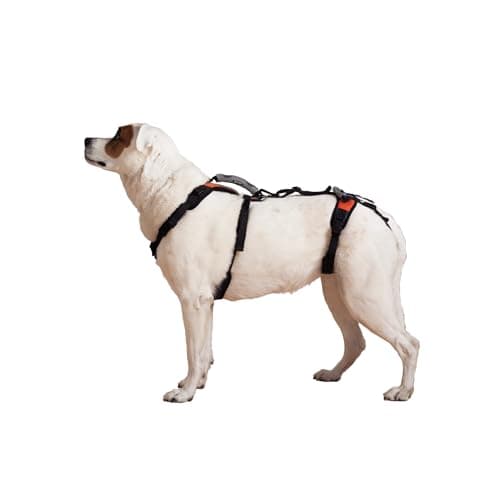
Help 'Em Up
Help 'Em Up Harness
Our score
$95–$155
Best for
Long-term mobility support for senior or post-surgical large dogs
If your dog needs help getting up multiple times a day for the foreseeable future — post-TPLO, advanced hip dysplasia, hindquarter weakness in giant-breed seniors — this is the one to buy. It is the only harness in the category that supports the front and the back independently, which is what a dog with a bad hip and a compensating shoulder actually needs. Buy it from the manufacturer, not from Amazon: re-verified 18 August 2026, helpemup.com prices by size at $80 / $95 / $110 / $125 / $140 while Amazon runs $95 / $110 / $125 / $140 / $155 — a uniform $15 more at every size, every time we have checked.
Pros
- Two-piece (chest + hip) design lets you support either end independently
- Hip handle is purpose-built — not a converted car-seat-belt strap
- Padded chest plate distributes weight better than sling-only options
- Five sizes span 10 to 225 lb, and the rear half can be ordered a size smaller for a dog with muscle wasting
- Two hip-lift styles (Conventional and U-Band) so male dogs are not soiling the strap
Cons
- Amazon runs a uniform $15 above the maker's own price at every one of the five sizes, and the Amazon buy box is held by a third-party reseller (Veterinary Preferred) rather than by the brand — re-verified 18 August 2026
- The maker's own Mix & Match page prints two different starting prices, "From $80" and "FROM $95 USD", on the same page
- Direct pricing is no longer flat: since mid-August 2026 the maker charges $80 to $140 by size, so a giant-breed owner now pays $60 more than a terrier owner
- On 29 August 2026 the linked Amazon Medium (B0DK81SCG5) showed a future availability date rather than units on hand, while every size and style was in stock at helpemup.com the same day; on 9 September and again on 12 September 2026 the Amazon Medium still showed the future-date status at $125.00 with a maximum order of one and no ship date given, while all nine direct variants were in stock — two weeks of backorder on the channel we earn from, and one more reason the direct channel is the one to use
- Sizing is critical — measure twice, return is a hassle
- Rear straps can chafe the inner thigh if the harness is left tight while the dog lies down
- A dog filmed or gait-assessed while wearing it looks less lame than he is, because the harness offloads the limb you are trying to judge
- Bulkier than a quick-grab sling for short-term use
For the dog that needs help every time, the Help 'Em Up is the long-haul answer: a two-piece harness with padded handles at the shoulders and the hips that lives on the dog all day. You grab a handle instead of kneeling and rigging a sling four times before dinner — that difference is what saves your back over months. Sizing is by bodyweight band — XS 10–25, Small 25–45, Medium 45–80, Large 80–125, XL 125–225 lb — in Conventional and U-Band styles; the linked Medium was $125.00 on 5 September 2026, with the buy box held by a third-party reseller rather than the brand. Check the shipping estimate before you click, because it has now read the same way for a week: on both 29 August and 5 September the listing returned an order-by date instead of a stock status — the API's backorder signal — with no availability message and a maximum order quantity of two. The brand's own variant feed, read on 29 August, priced this size at $110 with all nine size-and-style variants available; on 5 September helpemup.com rendered only an $80.00 base price to us and no per-variant stock, so we are quoting the 29 August figures with their date rather than pretending they are today's. On that reading direct was the brand, direct was $15 cheaper, and we earned nothing there. Check it yourself before you pay Amazon's price for a backordered harness.[10] Get the sizing right the first time; measure carefully. Our lift harness roundup compares these two and the alternatives in detail.
Option 2 — Adapt: make the staircase safer#
If your dog still manages the stairs, make the stairs easier before making the dog dependent on you.
Traction on the steps. Bare wood stairs are the enemy. Carpet stair treads or a runner change everything for a dog whose paws slip on the push-off. This article has told you to do the treads first since it was published without ever telling you what they cost, so here is the product and the arithmetic.

KOECKRITZ
KOECKRITZ Dog Assist Carpet Stair Treads, 9 × 27 in (Set of 7)
Our score
$120.99
Best for
A dog who has stopped taking the stairs because he cannot get purchase on them — not because his joints have run out
The right fix for the right dog, bought the wrong way. If your dog has stopped taking the stairs because he scrabbles on them rather than because his joints have given out, carpeting the treads is the cheapest genuine answer there is, and this is a purpose-marketed, US-made version of it from a company you can actually phone. But buy it direct unless your flight is exactly seven steps, which is the one count where the Amazon pack is the only exact fit and the cheaper buy. The Amazon set of 7 works out at $17.28 a tread against $11.09 for the maker's Cornerstone line, we earn a commission on the first and nothing on the second, and we would still rather you kept the money. Whichever you choose, count your stairs first — seven treads cover seven steps — and understand that no company in this category, this one included, publishes a slip-resistance test of any kind. You are buying carpet on the mechanism, not on a measurement.
Pros
- Purpose-marketed for exactly the failure this fixes. The listing's own first bullet is "Helps to reduce slips and falls for your dog on your hardwood stairs," and slipping is the single most-discussed failure mode in our 73-transcript video corpus (34 of 73 videos)
- Carpet-faced treads with double-sided tape are the cheapest real fix for a slippery staircase, and unlike nail grips or boots they do not have to be reapplied, refitted or tolerated by the dog
- "Made in the U.S.A" on the listing, from a real company with a real address — Koeckritz Rugs Inc, Elk Grove Village, Illinois, trading online since 2011. That is more corporate identity than most of this category can show
- The maker publishes actual face weights and fibre content for most of its tread lines — 40 oz Milliken nylon, 30 oz polyester, 100% solution-dyed polyester filament — which is more material disclosure than the Amazon listing gives, and more than the dog-stairs aisle gives at all
Cons
- The Amazon set of 7 is the most expensive way to buy this product, and we earn nothing on the cheaper one. At $17.28 per tread it is dearer per tread than five of Koeckritz's own 9 × 27 in Dog Assist lines sold direct. The Cornerstone line is $66.55 for six — $11.09 a tread, and $9.08 a tread at a set of 18. Verified against the maker's live variant feed 2026-09-05
- "Set of 7" does not exist at the manufacturer. We checked every variant of all 25 tread SKUs on koeckritzrugs.com: the maker sells sets of 6, 9, 12, 13, 14, 15, 16, 17 and 18, and nothing at $120.99. So the Amazon pack cannot be matched, specced or price-checked against the maker's own catalogue, and the Amazon part number 153697 appears nowhere on the maker's site or in the listing's own page source
- Amazon's spec table describes a product Koeckritz does not make. It lists Material Type "Plastic, Polypropylene" and Construction Type "Handmade." No Koeckritz dog-assist line is polypropylene — they are polyester filament, polyester cut pile, Milliken nylon or BCF synthetic — and none is handmade. Amazon's dimensions field reads 324" L × 108" W, which is 27 × 12 and 9 × 12, an aggregate that contradicts the stated set of 7 as well
- No slip-resistance number, anywhere, from anyone. We regex-scanned all 25 of the maker's tread pages for ASTM, ANSI, A326.3, D2047, coefficient of friction, DCOF and NFSI: zero matches. Every traction claim in this catalogue is unquantified prose. This is the whole reason to buy the product and there is no test behind it
- The one "Certified" claim in the catalogue is about air, not grip. Koeckritz states that its Starlight line is "Certified by the Carpet & Rug Institute (CRI) Green Label Plus" — a VOC-emissions and indoor-air-quality mark. It says nothing whatever about slip resistance, and on a product bought for safety it is the kind of word that gets read as though it did
- Seven treads cover seven steps. A typical household flight has more, so many houses need two sets — a $242 purchase, not a $121 one. Count your stairs before you order; nothing on the listing prompts you to
- Nobody will tell you whether the tape is safe on your floor. Several Koeckritz tread pages promise "residue-free" double-sided carpet tape — but the tape's own product page never uses that word, saying only that it "adheres well to most hard surfaces." There is no statement anywhere that it is safe on polyurethane, wax or oiled hardwood, and no warning that it might not be. A claim that disappears when you follow it to its own page is a claim we report rather than repeat
- The warranty on the maker's site is a 90-day limited "Area Rug Warranty" covering excessive wear or staining, with defects to be reported within 7 business days of delivery. There is no stair-tread-specific warranty and no warranty text on any tread product page, so whether it covers these at all is not stated. The Amazon listing carries no warranty field
- Returns direct are 30 days, unused, with the return shipping label cost deducted from your refund — the amount is not published. Custom-cut treads are Special Orders: non-returnable after 2 business days, with a 25% restocking fee
- No weight limit and no dog-size guidance is published on the listing or on any of the 25 maker SKUs. For a product bought for large arthritic dogs, that is a conspicuous silence
- The single most useful fitting instruction is published on the wrong page. Koeckritz tells buyers of its Starlight line to "leave a ½" to 1" gap from the front edge of each step." That guidance appears on no dog-assist line, including the one sold on Amazon — even though the stair nose is precisely where a descending dog's paw lands and slips
- This is a building-materials product wearing a dog name. Amazon files the ASIN under Building Materials › Stair Parts, and Koeckritz is a custom area-rug business that applies the "Dog Assist" label to conventional carpet treads sold alongside matching runners. There is no paw-traction testing, no claw-resistance spec and no orthopedic rationale published anywhere
Before the price, the fitting instruction, because on this page it matters more than anything else about the product and almost nobody has it. Koeckritz publishes one genuinely useful piece of guidance. Its Starlight line's page reads: "For best results, we recommend leaving a ½" to 1" gap from the front edge of each step for proper fit, wear, and safety."[17] That instruction appears on none of the dog-assist lines — not on the Cornerstone page we would send you to, which we searched for it today, and not on the pack sold on Amazon.[12] Follow it anyway, whichever line you buy, and follow it because of this article's whole argument: the nose of the step is exactly where a descending dog's paw lands, and a tread that overhangs the nose can shear forward under that paw at the one moment the dog has his weight on the front end and nothing in reserve. A tread fitted flush to the nose is a tread that can slide when it is most load-bearing. Set it back.
Then count your stairs before you order, because nothing in this category prompts you to. The Amazon pack is seven treads, which covers seven steps. A typical flight has more, and a fourteen-step flight is two packs.[11] At $120.99 for seven that is $17.28 a tread, and it is the most expensive way to buy this product. We pulled the maker's own live variant feed today: the Cornerstone line in the same 9 × 27 inch size runs $66.55 for a set of six and $127.05 for a set of twelve, and the per-tread price falls as the set grows, from $11.09 down to $9.08 at a set of eighteen. Prices are identical across all four colourways.[12] We earn a commission on the Amazon pack and nothing on any of those. Buy it direct — with one exception that runs against us in the other direction. Cornerstone sells sets of six and then twelve upwards, with no set of seven and no set of nine, so if your flight is exactly seven steps the Amazon pack is the only exact seven on sale anywhere and the next direct option is a set of twelve at $127.05. At seven steps, take the Amazon pack — it is $6.06 cheaper and you are not left with five spare treads. At twelve steps and above direct wins by $103 to $218, and it is not close. The product page has the arithmetic by step count.
And know what you are not buying. We searched all twenty-five of this maker's tread pages for ASTM, ANSI, A326.3, D2047, coefficient of friction, DCOF and NFSI, and got zero matches: every traction claim in the catalogue is prose. That establishes it about Koeckritz, and we have not found a published slip test from any competitor either — but we have only run the search properly on one company, so treat the category-wide version as our impression rather than our finding. Carpet grips where hardwood does not, and on this product the mechanism is the entire case. Our product page has the rest of the fine print, including a warranty that turns out to be an area-rug warranty and an Amazon spec table describing a product Koeckritz does not make.
Traction on the paws. The other half of the equation is the paw side — senior paws with long nails and furry pads skate on hard surfaces.
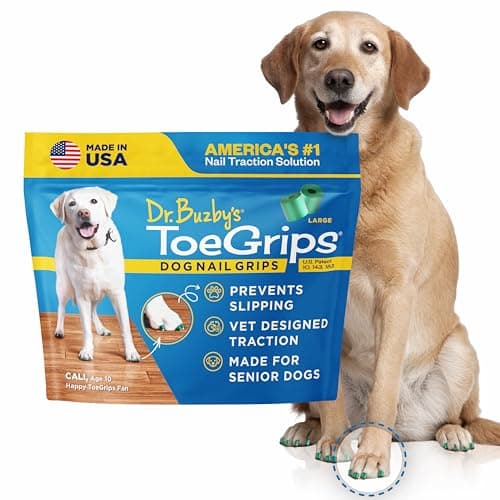
Dr. Buzby's
Dr. Buzby's ToeGrips for Dogs
Our score
$34–$40
Best for
Senior dogs slipping on hardwood, tile, or laminate floors
The best dog-mounted traction fix there is, and the one to buy once rugs have taken you as far as they can. Nothing touches the paw pad, which is why dogs tolerate these where they refuse socks and boots. Go in knowing the real cost: this is not a $40 purchase but a $240–$320 a year habit, so lay runners along your dog's actual routes first and buy grips for the floors you cannot cover.
Pros
- Veterinarian-developed; in clinical use for over a decade
- Slip onto each toenail — no socks, booties, or adhesives required
- Restores traction immediately, especially on hard floors
- Nothing touches the paw pad, so dogs accept them where they refuse boots
- Amazon and the manufacturer both charge $39.99 — no retailer markup
- 20 grips per bag against the 16 a dog wears, so a set includes four spares
Cons
- The only two published studies of nail grips both tested this exact product, and both were null: Roush 2017 (Front Vet Sci 4:111 — 15 sound dogs, kinetic changes "unlikely to be clinically relevant") and Repac 2022 (Animals 12(18):2312 — 30 dogs two weeks post-TPLO vs sham, no difference in weight bearing or limb function, including the owner question that asked specifically about slippery floors). Fair caveats: small samples, one used healthy dogs, the other a single early post-op timepoint — but "no positive trial exists" is the honest label, and we say it while still recommending the product for the mechanism and the owner-reported traction stories it was never tested against (verified 2026-08-14).
- A recurring cost, not a one-off. The maker publishes two different bag lives — "1–2 months" on its store page and "1-3 months, two months on average" in its FAQ (both read 2026-09-05) — which spans $160–$480 a year at $39.99. Plan on $240–$320, the two surfaces' central figures
- The Amazon listing markets specifically to dogs with "ACL injuries" — the one population where a randomised trial has been run, and where it found nothing (Repac 2022). The same bullets carry three claims with no source we could find: "more than 250,000 paws," "America's #1 nail traction solution," and "recommended by thousands of veterinarians worldwide" (listing copy verified 2026-08-17). Re-read 2026-08-31: a fourth unsourced superlative has been added to the top bullet on all four Amazon sizes — "The Only Toenail Grips for Dogs With GripZone Technology" — and the Large listing's title now leads with "Instant Traction on Wood/Hardwood Floors."
- The maker sells Scotch Super Glue Gel at $4.99 on its own store, listed as an "Alternate ToeGrips Application Method" (shop.toegrips.com, 2026-08-31). Read that as what it is: the company's own answer to the grips coming off, priced separately and not mentioned on the Amazon listing you are most likely to buy from.
- Application needs isopropyl rubbing alcohol, which is not in the box
- Initial application takes 15–20 minutes for a full set
- Some dogs chew them off in the first week
- Amazon carries only four of the seven sizes; XS, XXL and XXXL dogs have to buy direct
- Sizing by weight chart alone often misses — the accurate method needs dental floss and a ruler
ToeGrips slip over the toenail tips and are meant to act as a rubber cleat where a hard nail meets a hard floor — on the stairs and on the slick landing at the bottom. Nothing touches the paw pad, which is why dogs accept them where they refuse socks and boots.
Before anything else, the evidence, because it is thinner than the category implies and it is the first thing a sceptical reader should be told. Two published studies have tested nail grips and both tested this exact product. Neither found a functional benefit. Roush 2017 applied them to fifteen sound dogs and measured ground reaction forces: stance time lengthened in all limbs, peak vertical force fell slightly in both hindlimbs, and the authors concluded the kinetic changes were "of minor magnitude and unlikely to be clinically relevant."[18] Repac 2022 is the harder test — thirty dogs two weeks after a TPLO, thirteen in grips and seventeen in sham grips, scored by blinded observers — and found no difference in visual lameness score (p = 0.44) or total pressure index (p = 0.59), nor on the owner-scored question about walking on slippery flooring specifically (p = 0.78). The authors' own summary: the study "did not demonstrate a benefit."[19]
So we recommend these on mechanism, not on outcome, and you should hold them to that standard. A rubber cleat on a nail that would otherwise skate is a real mechanism, and the argument for it here is household safety on a specific staircase rather than a measurable improvement in your dog's limb function. If you want the evidence file in full it is on our ToeGrips page. If a null result in the one population anyone has studied properly is enough to put you off, that is a defensible reading and the stair treads above are the better spend anyway.
Three practical things before you order, and a correction we owe you on the first of them. The Amazon listing's Step 1 says to wet sixteen grips in isopropyl rubbing alcohol, and the alcohol is not in the box. We have previously called that omission the commonest reason a first attempt fails, and the maker's own FAQ is gentler than its own listing: alcohol "is not required, but it facilitates application," and "you can use plain water or even apply ToeGrips dry."[14] So the missing bottle is an inconvenience rather than a blocker. Buy the alcohol if you want an easier evening; water works. Second, a snug fit is correct rather than a sign of the wrong size: they are meant to "fit snugly like Spanx, not slide onto the nails like Cinderella's slipper." Third, it is 16 nails, not the dewclaws, with 20 in a bag so you have four spares. Re-verified 5 September 2026: $39.99 for the Large (40–74 lb), In Stock, sold by Dr. Buzby's themselves, and unchanged in price since 17 August.[13]
Do the stair treads first, though, and here is the arithmetic behind that order. The maker publishes two different bag lives on two of its own surfaces, and we have now read both on the same day. Its store page says "Each ToeGrips bag lasts 1–2 months depending on dog size and stride."[20] Its FAQ says grips "typically last 1-3 months, two months on average."[14] Those are not the same claim, and their middles are not the same number. Counting a month as a twelfth of a year throughout: the store's 1–2 months centres on a month and a half, which is eight bags a year and $320, while the FAQ's stated average of two months is six bags and $240. Taken together the two surfaces put the full span at $160 to $480 a year for one dog — a bag every three months at best, every month at worst — and the sensible place to plan from is the pair of central figures, $240 to $320 a year, or $204 to $272 on the 15% repeat-customer subscription. Whichever figure you use, the classification is the point: grips are a subscription, not a $40 purchase. Our ToeGrips page carries the same band.
One instruction lowers that figure and appears on no retail listing. The maker's FAQ says to take the grips off periodically so you can inspect the nails, clean the grips, "replace those that are badly worn, and reapply the grips that are less than 20% worn" — rotated to new positions, which it says extends their life.[14] Twenty grips for sixteen nails is four spares by design. Nobody selling you a bag mentions any of this, and on a two-monthly consumable it is the difference between two bags a year and three. Carpet treads on the staircase are a one-time cost, they fix the exact surface this article is about, and they work on a dog who chews at his feet — which grips do not. Buy grips for the surfaces you cannot carpet: the landing, the kitchen tile, the vet's waiting room. Keep nails trimmed and the fur between the pads short either way, and see our floor traction guide for the whole-house version.
Light the staircase. A dark stairwell at 10 p.m. is a depth-perception test your dog does not need to take, and plug-in nightlights at the top and bottom cost almost nothing. A strip of high-contrast tape on the edge of the top and bottom steps helps a dog judge where the staircase starts. (We used to assert here that older dogs see measurably worse in dim conditions. It is a reasonable expectation and we could not find a canine study to put behind it, so treat the lighting as cheap insurance rather than a sourced claim — and if your dog is genuinely bumping into things or hesitating in low light, that is an eye exam, not a nightlight.)
Gate it. A gate at the top of the stairs prevents the worst accident in this article: the half-asleep dog that follows you down at 2 a.m. If the dog sleeps upstairs, gate the top; if downstairs, gate the bottom. Supervised attempts only.

Option 3 — Bypass: stop needing the stairs#
At some point the kindest move is to retire the staircase. That is not giving up — it is engineering.
Move life to one floor. Bed, water, food, and the favorite window spot all on the main level. If the dog has always slept in your room, the honest options are moving your evenings down or carrying the dog up safely once a night — what does not work is the dog attempting the flight alone. A proper orthopedic bed on the main floor makes the new headquarters an upgrade rather than an exile.
Ramp the short transitions. Most homes still have two-to-three-step obstacles after the staircase is retired: the porch, the deck, the garage step, the car.

Pet Gear
Pet Gear Tri-Fold Pet Ramp
Our score
$85–$120
Best for
Hesitant and refusing dogs, indoor steps, couches, and cars up to about a 30-inch sill
The ramp we reach for first when a dog has already refused one. The extra width and the raised side edges do more for acceptance than any other feature at this price, and the carpet tread solves the surface problem that stops most dogs before height is ever the issue. It is heavier than its "portable" billing suggests, and the 200 lb ceiling rules it out for giant breeds. Buy it for the hesitant dog, not for the hiking-and-rain dog. Two corrections we owe you before you click: the warranty is 30 days, not the year this page used to print, and Pet Gear now sells the same 71-inch frame with a removable washable supertraX mat instead of fixed carpet — if your dog goes out in the wet, pay the extra sixteen dollars for it.
Pros
- 19.5 inches wide — roughly 3.5 inches wider than most ramps in this price band, which is the difference between a stiff dog placing four feet confidently and refusing
- Raised edges along both sides give a dog a boundary he can feel without looking down
- Carpet-textured skid-resistant tread, so a nail-scraping dog will walk it without you having to cover it with a towel
- 71 inches long — a 25-degree incline to a 30-inch SUV floor, within an inch of what a fully extended telescoping ramp achieves
- Safety tether and rubber base grippers included; attached carry handle
- Rated to 200 lb
Cons
- The warranty is 30 days, not a year — Pet Gear's own listing field reads "30 day non-transferrable limited warranty" on every 71-inch variant we checked on 11 August 2026. We had published a 1-year warranty since this page was created and it was wrong
- Heavy — 25.2 lb on Amazon's own figure for the reflective 71-inch sibling and 27 lb for the supertraX version. The 15 lb figure floating around the range belongs to the 16-inch-wide Travel Lite, a different ramp. Two-hand carry
- Carpet absorbs water and stays damp — not the ramp for a dog who goes out in the rain daily. The newer supertraX variant has a removable washable mat and solves this for about $16 more
- 200 lb rating is a real ceiling for giant breeds, and for anyone who wants to walk up alongside their dog
- Fixed 71-inch length: there is no shortening it for a 16-inch couch, so it is a large object to store and to swing around a hallway
- The Titanium variant (9300TI) that this page linked until 29 August 2026 read "Only 4 left in stock (more on the way)" on five consecutive checks a month apart (30 July, 11, 15, 23 and 29 August) — a standing availability problem, not a blip — so our link now goes to the reflective sibling (AM9300RF), the same 71 × 19.5 × 4 inch frame, 200 lb rating and 30-day warranty, which was cleanly in stock at $89.50 on 29 August 2026, $4.70 cheaper than the Titanium that day
A tri-fold ramp handles those. The Pet Gear is 71 × 19.5 × 4 inches and its listing states it "holds up to 200 lbs."[15]
A housekeeping correction, because we were citing the wrong listing. This section priced and specced ASIN B0GJFWGQ7T while the card below has always linked B09BBV892J. Both are the 71-inch Pet Gear tri-fold at the same published dimensions and the same 200 lb rating, so nothing we told you about the ramp itself was wrong — but the two listings are not interchangeable on price or stock. On 5 September the one we link is $89.11 and In Stock; the one we were citing is $94.36 with only four left.[16] We have moved the citation to the listing we actually send you to, which is also the cheaper one, and which describes two things the other does not: a safety tether and reflective side markers. The reflectors are not a gimmick on this page specifically. A ramp off a dark porch at 10pm is the same depth-perception problem as an unlit staircase, and it is the same fix.
The 19.5-inch width is the feature that matters, and the cleanest comparison is inside Pet Gear's own range: its Travel Lite is 16 inches wide, so this is three and a half inches more ramp underfoot from the same maker[16] — which is the difference between a stiff dog walking and a stiff dog balancing — and the carpet tread gives hesitant seniors confidence that slick plastic does not.
Two corrections we owe you on this ramp, both in the flattering direction. This page said it "folds to about 18 inches deep" and "weighs under 11 pounds." The folded depth was never verified anywhere and is gone; the 11-pound figure describes the 42-inch model, not this 71-inch one. Pet Gear publishes 26 lb for this range while Amazon's dimension fields give 25.2 lb and 27 lb for the 71-inch siblings, and the 15 lb figure that circulates belongs to the 16-inch-wide A9371GT Travel Lite, which our ramp page priced at $129.24 on 14 August 2026 — narrower and dearer than the one recommended here, and the easiest way to waste money in this range.[16] We publish the manufacturer-versus-retailer disagreement rather than pick a number, but nothing in that range is a one-handed carry, which matters on this page specifically: if you cannot manage the ramp, the ramp is not the fix.
Three honest limits. The 200 lb figure is published as a rating for the animal — "suitable for pets up to 200 pounds" on the listing we link, "Holds up to 200 lbs" on the sibling[15][16] — and neither listing says whether your steadying hand on the dog counts toward it. We previously called it a combined load, which is an inference we cannot source. If your dog is anywhere near the ceiling you are relying on an unstated margin, so treat the number as a limit rather than a target. The carpet holds water, so it is the wrong ramp for a daily all-weather dog. And a ramp needs somewhere to land: a ramp of length L reaching a height h consumes √(L² − h²) of clear floor, so this one at a 24-inch garage step still wants about 67 inches of run-out behind it. Above all, a ramp replaces a few steps, not a staircase — a safe angle over a full flight would need a ramp longer than most hallways. For giant breeds over the 200-pound rating and for high vehicles, see our full ramp guide.
How to carry a dog on stairs (small vs. large)#
Sometimes carrying is the right call — a small dog, a single nightly flight, a bad day. Do it like this:
Small dogs (under about 25 pounds). One arm around the front of the chest, the other under the hips, dog held snug against your body, spine level — never dangling by the armpits with the back hanging vertically. On the stairs, slow down: you have no free hand for the rail, so your own footing is the safety system. Long-backed small breeds — Dachshunds especially — must be carried with both ends supported and the back horizontal, every single time; see our IVDD guide for why their spines forgive nothing.
Medium dogs (roughly 25–50 pounds). Possible for a strong adult on a short flight: one arm around the chest, one behind the rear legs, dog against your torso. Squat to pick the dog up — legs, not back — and do not attempt it while tired, rushed, or in socks.
Large dogs (over about 50 pounds). Treat a full carry as a two-person lift — one person at the chest, one at the hips, moving on a count — or do not do it at all. A single person carrying a squirming 70-pound dog down a staircase is how one fall injures two backs and four knees. The better answers at this size are a handled harness and assisted walking, or the bypass strategy above.

Whichever size: hold the dog close to your center, never twist mid-flight, keep the stairs clear of clutter, and wear real shoes.
When should a senior dog stop using stairs entirely?#
Retire the staircase — fully, with gates — when any of these show up:
- A fall, or repeated slips even with supervision and traction
- Freezing, trembling, or panting at the base of the stairs. We read that as fear, pain, or both, and it is our inference rather than a validated sign — but it is a dog declining a thing he used to do, which is reason enough to stop asking him
- Noticeably worse soreness the evening or morning after stairs
- Significant vision loss, or stumbling in dim light
- Your vet has restricted stairs — post-surgery, or with a disc-disease diagnosis
- Progressive hind-end weakness, covered in our weak back legs guide
The bottom line#
Match the strategy to the dog in front of you: adapt the staircase while your dog still manages it, assist with a proper sling or handled harness when the hind end needs backup, and bypass the stairs without guilt when they stop being worth the risk. Combine freely — most households run adapt-plus-assist for a year or two, then shift to one-floor living.
Three rules stay constant the whole way: gate the stairs so there are no solo attempts, take the downhill side and let the dog set the pace, and protect your own back with real equipment — because your dog needs you upright for all the years this list is going to cover. And if the stairs got hard suddenly rather than slowly, put down the gear and call the vet first.
Sources#
Questionnaire forms and product listings were read at source on 5 September 2026; Amazon data was retrieved via the Amazon Creators API the same day. Where a figure is carried over from an earlier check, its date is given.
- American College of Veterinary Surgeons. "Postoperative Care After Surgery: What Animal Owners Should Expect." acvs.org — read 14 August 2026: "Pets should be kept in a controlled environment, such as a crate or small room, to prevent unsupervised activity"; "Dogs should be taken outside on a leash for bathroom breaks only, unless otherwise instructed." The page defers the length of any restriction to the veterinary team rather than stating a fixed period.
- University of Liverpool / Elanco Animal Health. "Liverpool Osteoarthritis in Dogs (LOAD)," initial-consult questionnaire. assets.elanco.com — read 5 September 2026. Thirteen scored mobility items: mobility in general; degree of disability from lameness; activity; effect of cold damp weather; stiffness after a lie-down; then eight items on exercise (activity at exercise, interest in exercising, ability to exercise, effect of exercise on lameness, frequency of resting during exercise, effect of weather on ability to exercise, stiffness after a lie-down following exercise, effect of lameness on ability to exercise). We searched the full text of this form and of the follow-up questionnaire for "stair," "step," "climb," "curb" and "jump": no matches on either form. Scores run 0–52.
- Brown DC. "Canine Brief Pain Inventory," printable form. University of Pennsylvania School of Veterinary Medicine. vet.upenn.edu — read 5 September 2026. Four pain-severity items (worst, least, average, right now) on 0–10; six function items on 0–10 from "does not interfere" to "completely interferes," of which item 10 is verbatim "Ability to Climb Stairs, Curbs, Doorsteps, etc."; plus one overall quality-of-life item.
- Hielm-Björkman AK, Rita H, Tulamo RM. "Psychometric testing of the Helsinki chronic pain index by completion of a questionnaire in Finnish by owners of dogs with chronic signs of pain caused by osteoarthritis." American Journal of Veterinary Research. 2009;70(6):727-734. doi:10.2460/ajvr.70.6.727 (PMID 19496661) — 61 client-owned dogs with osteoarthritis; principal component analysis yielded a single stable component, so the HCPI is best explained as an 11-item single-construct index; Cronbach alpha 0.82, test-retest ICC 0.92 for the index. The English translation of the instrument in clinical circulation, as reproduced by FourLeg.com and read 5 September 2026, scores each of the eleven items 0–4 and includes verbatim: "Rate your dog's ability and/or willingness to walk up and/or down stairs," anchored 0 very willing/able to 4 does not do stairs at all. We cite the translated form for the item wording and the paper for the instrument's properties. The paper is in English; what was Finnish-language was the instrument it validated.
- Walton MB, Cowderoy E, Lascelles D, Innes JF. "Evaluation of construct and criterion validity for the 'Liverpool Osteoarthritis in Dogs' (LOAD) clinical metrology instrument and comparison to two other instruments." PLoS ONE. 2013;8(3):e58125. doi:10.1371/journal.pone.0058125 — 222 dogs with osteoarthritis, LOAD, CBPI and HCPI completed by owners and compared against a force-platform peak vertical force symmetry index. Significant moderate correlations between instruments; weak correlations with the force-plate measure: LOAD rs = 0.232, CBPI pain severity rs = 0.281, CBPI pain interference rs = 0.276 (all p < 0.01). The HCPI did not correlate significantly with the symmetry index at all; the authors write that "correlation of LOAD and CBPI with SI-PVF is the first reported evidence of criterion validity for these CMIs. It is not certain why HCPI did not correlate with SI-PVF," and suggest their factor analysis did not extract a clean lameness component from it. The authors conclude LOAD can be recommended for clinical use.
- Fish FE, Sheehan MJ, Adams DS, Tennett KA, Gough WT. "A 60:40 split: differential mass support in dogs." The Anatomical Record. 2021;304(1):78-89. doi:10.1002/ar.24407 (PMID 32363786) — 552 dogs across 123 breeds, from Chihuahua to Mastiff, weighed on a digital scale while standing with alternating foreleg and hind leg support; grand mean 60.4% of mass on the forelegs, individual range 47.6–74.4%; no significant change in the ratio with total mass.
- Kopec NL, Williams JM, Tabor GF. "Kinematic analysis of the thoracic limb of healthy dogs during descending stair and ramp exercises." American Journal of Veterinary Research. 2018;79(1):33-41. doi:10.2460/ajvr.79.1.33 (PMID 29287160) — 8 privately owned healthy dogs, 2-D kinematic markers on the left thoracic limb; stairs were 4 steps at a 35° slope, the ramp a solid plank laid over the same steps; mean range of movement of the shoulder and elbow during stair descent was significantly greater than during trotting on the flat, and peak elbow extension was greatest on the flat. Healthy dogs only; the study did not examine injury.
- Hutchinson D, Sutherland-Smith J, Watson AL, Freeman LM. "Assessment of methods of evaluating sarcopenia in old dogs." American Journal of Veterinary Research. 2012;73(11):1794-1800. doi:10.2460/ajvr.73.11.1794 (PMID 23106466) — 9 healthy young (1–5 years) and 10 old (over 8 years) Labrador Retrievers, all body condition score 5–6 of 9. Mean epaxial muscle area by ultrasonography was significantly lower in the old group; by CT only after normalisation for vertebral height. Neither temporal nor quadriceps muscle measurements differed significantly between age groups, and serum C-reactive protein and IGF-1 did not differ either. One breed, nineteen dogs; the authors state much additional research is required.
- Amazon listing B00GPYFA50, "GingerLead® K9 Sling Hind Leg Support, M/LG Unisex with Cutout, Made in USA." amazon.com — retrieved 5 September 2026: $69.95, In Stock, buy box held first-party; unchanged in price since 14 August, when the listing title read "GINGERLEAD Dog Sling Hind Leg Support." Feature bullets: "CHEST HARNESS NOT INCLUDED"; "Support pad is 5.5 inches wide at the cutout x 22.5 inches long. Sling length adjusts from 38 inches to 60 inches long"; "Typically fits FEMALE dogs over 45 lbs and MALE dogs over 60 lbs"; the integrated leash "may be hooked to a collar for younger dogs recovering from orthopedic surgery or to a chest harness for older dogs needing additional support."
- Amazon listing B0DK81SCG5, "Help 'Em Up® — Dog Lift Harness (Conventional, Medium, 45-80 lbs)." amazon.com — retrieved 5 September 2026: $125.00, buy box held by a third-party reseller rather than the brand, availability returned as an order-by date with an empty availability message and a maximum order quantity of 2 — the API's backorder shape, identical to the reading taken on 29 August 2026. Feature bullets give the five weight bands (XS 10–25, Small 25–45, Medium 45–80, Large 80–125, XL 125–225 lb) and the Conventional versus U-Band hip-lift styles. The brand's own variant feed at helpemup.com, read 29 August 2026, priced the range $80/$95/$110/$125/$140 by size with all nine size-and-style variants available; helpemup.com's product page on 5 September showed a $80.00 base price without rendering per-variant stock to automated retrieval, so we report the 29 August variant figures with their date rather than restating them as today's.
- Amazon listing B072DV3L9G, "Dog Assist Carpet Stair Treads / Size: 9" x 27" (Set of 7), Includes 1 roll of Double Sided Carpet Tape." amazon.com — retrieved 5 September 2026: $120.99, "Only 9 left in stock," buy box held by Koeckritz; price unchanged since 22 August. Feature bullets: "Helps to reduce slips and falls for your dog on your hardwood stairs"; "Each stair tread measures 27 inches by 9 inches"; "Set includes 7 Stair treads and 1 roll of double sided tape"; "Made in the U.S.A." The $17.28 per tread is our arithmetic from the listing price and stated count.
- Koeckritz Rugs. "Cornerstone Dog Assist Carpet Stair Treads — 1/2" Thick | 8x24 or 9x27 (Sets 6-18)." koeckritzrugs.com — live product variant feed read 5 September 2026, 64 variants across four colourways (Taffy, Bronzite, Cream, Pewter Gray) at identical prices. 9 × 27 in: set of 6 $66.55, 12 $127.05, 13 $133.10, 14 $139.15, 15 $145.20, 16 $151.25, 17 $157.30, 18 $163.35 — $11.09 down to $9.08 per tread, our arithmetic. 8 × 24 in: set of 6 $60.50 rising to $157.30 for 18. There is no set of 7 and no set of 9 on this line, though other lines in the catalogue do offer 9. The page also states "One roll of residue-free double-sided carpet tape per order," 100% PureColor solution-dyed polyester filament, ½ in thick. The URL we cited on 22 August now 301-redirects here, and the $66.55 figure for the 9 × 27 in set of six re-verifies unchanged. The half-inch-to-one-inch front-edge gap instruction is published on the maker's Starlight line and on none of its dog-assist lines, verified 22 August 2026. The catalogue-wide search for ASTM, ANSI, A326.3, D2047, coefficient of friction, DCOF and NFSI across all 25 tread pages, returning zero matches, was run 22 August 2026 and is documented on our product page.
- Amazon listing B00GWHISI6, "Dr Buzby's Large ToeGrips for Dogs — Instant Traction on Wood/Hardwood Floors, 1 Pack (20 Grips)." amazon.com — retrieved 5 September 2026: $39.99, In Stock, buy box held by Dr. Buzby's ToeGrips; size "Large: dogs 40-74 lbs," 20 per bag; price unchanged since 17 August. Application bullet: "Step 1: Wet 16 ToeGrips in isopropyl rubbing alcohol… (ToeGrips shouldn't be applied to the dewclaws.)" Fit bullet: "Properly sized, they are designed to fit snugly like Spanx, not slide onto the nails like Cinderella's slipper."
- Dr. Buzby's ToeGrips. FAQ, "How long do ToeGrips last?", "Do I need to remove and replace ToeGrips periodically?" and Repeat Customer Program — all read 5 September 2026. "ToeGrips® dog nail grips typically last 1-3 months, two months on average"; applying with isopropyl alcohol "is not required, but it facilitates application," and "you can use plain water or even apply ToeGrips® dog nail grips dry"; on periodic removal, you can "replace those that are badly worn, and reapply the grips that are less than 20% worn," which rotates them and "will extend their lifespan"; the subscription is stated as "save 15%." The maker's store page, shop.toegrips.com, read the same day, states instead: "Each ToeGrips bag lasts 1–2 months depending on dog size and stride," at $39.99. We publish both figures because the maker publishes both. All annual figures in this article are our arithmetic from those two bag lives at $39.99: the full span $160–$480 (a bag every 3 months to every month), the store page's 1–2 month midpoint of 1.5 months giving 8 bags and $320, the FAQ's stated 2-month average giving 6 bags and $240, and the 15% subscription equivalents ($33.99 a bag) $272 and $204. A month is treated as a twelfth of a year throughout.
- Amazon listing B09BBV892J, "Pet Gear Tri-Fold Portable Pet Ramp for Dogs and Cats, 71" Long, Extra Wide, Holds up to 200lbs, Patented Design, Compact/Easy Fold with Safety Tether." amazon.com — retrieved 5 September 2026: $89.11, In Stock. This is the ASIN the product card on this page links. Feature bullets: "Dimensions: 71"L x 19.5"W x 4"H; suitable for pets up to 200 pounds"; "High-visibility reflective material aids in guiding your pet up and down the ramp"; "Side safety reflectors allow for maximum visibility when the ramp is in use"; "Slip-resistant surface provides sure footing and rubber grippers on bottom help keep ramp steady."
- Amazon listing B0GJFWGQ7T, "Pet Gear Tri-Fold Portable Pet Ramp for Dogs/Cats, 71" Long, Titanium" (model 9300TI). amazon.com — retrieved 5 September 2026: $94.36, "Only 4 left in stock (more on the way)"; 71 × 19.5 × 4 in; "Rubber grippers on bottom help keep ramp steady; Holds up to 200 lbs." This is the sibling listing this article cited in error until today; it was $94.22 on 14 August 2026. No carry weight is published for either variant; sibling listings give 25.2 lb and 27 lb against Pet Gear's own 26 lb, while the 15 lb figure that circulates belongs to the 16-inch-wide A9371GT Travel Lite, all as checked 14 August 2026.
- Koeckritz Rugs. "Starlight Berber Loop Carpet Stair Treads." koeckritzrugs.com — read 5 September 2026, verbatim: "For best results, we recommend leaving a ½" to 1" gap from the front edge of each step for proper fit, wear, and safety." Available 8 × 24 in and 9 × 27 in. We searched the Cornerstone page (source 12) for this instruction the same day and it is not present there, which is the mismatch reported in the body.
- Roush JK, Moore LE, Renberg WC. "Dr. Buzby's ToeGrips® application results in minimal changes in kinetic gait parameters in normal dogs." Frontiers in Veterinary Science. 2017;4:111. doi:10.3389/fvets.2017.00111 (PMID 28752090) — 15 normal dogs, kinetic gait analysis before and after application. Stance time significantly increased in all limbs; stride velocity slower in all limbs but significantly so only in the left forelimb; peak vertical force significantly decreased in both hindlimbs, though the decrease was within the group standard deviations; vertical impulse significantly increased in both forelimbs and the right hindlimb. Authors' conclusion: the grips "result in a slower gait, with slightly decreased VPF in the hindlimbs and increased effort for propulsion," and the "kinetic changes were of minor magnitude and unlikely to be clinically relevant." Sound dogs only; this study did not test whether grips prevent slipping.
- Repac J, Alvarez LX, Lamb KE, Spector D. "Effect of nail grips on weight bearing and limb function in 30 dogs 2 weeks post tibial plateau leveling osteotomy." Animals. 2022;12(18):2312. doi:10.3390/ani12182312 (PMID 36139171) — 30 dogs, 13 in nail grips and 17 in sham grips, assessed by blinded observers on day 1 and day 14 ± 3 after TPLO. No differences in visual lameness score (p = 0.44) or total pressure index (p = 0.59) at any time point; client-specific outcome measures for walking on slippery flooring, ability to rise, and consistent use of the surgical limb over a 5-minute walk were also not different (p = 0.78, p = 0.80, p = 0.63). Grips were well tolerated. Authors' conclusion: "This study did not demonstrate a benefit for dogs wearing nail grips during the first two weeks after TPLO; however, further studies are warranted."
- Dr. Buzby's ToeGrips. Store product page, shop.toegrips.com — read 5 September 2026, verbatim: "Each ToeGrips bag lasts 1–2 months depending on dog size and stride," at a listed $39.99. This is the surface that disagrees with the FAQ figure in source 14, and the disagreement is the basis of the $240–$320 planning band.
Run-out figures are our own arithmetic, √(length² − height²), from the ramp lengths above. The carrying techniques in this article are our own protocol rather than a published standard; they are written to keep a dog's spine level and your own load close to your centre, and no controlled study compares canine carrying methods.
This article is educational and does not replace veterinary advice. A dog who could do stairs yesterday and cannot today needs a vet the same day, not equipment.
Frequently asked
- How can I help my senior dog climb stairs?
- Pick one of three strategies based on ability. Assist: use a rear-support sling or a two-piece harness with handles, stay on the downhill side, and let the dog set the pace. Adapt: add stair treads for traction, light the staircase well, and gate it against unsupervised attempts. Bypass: move the dog's life to one floor and use ramps for short transitions. Most households end up combining two of the three.
- Why can my dog still go up stairs but struggles coming down?
- Because descending puts the load on the front end, and the front end was already the busy end. Measured across 552 dogs of 123 breeds, the forelegs carry a mean of 60.4% of a standing dog's mass. Going down, the dog has to brake its own body weight step by step onto those same front limbs while looking down a visually intimidating slope — and in a kinematic study of eight healthy dogs, shoulder and elbow range of motion during stair descent was significantly greater than while trotting on the flat. Two things belong with that figure: the comparator was a trot rather than a walk, and the study's own authors read their result as rehabilitation-positive, concluding stair descent "may be beneficial for increasing the ROM" of those joints. So it explains why the descent is the demanding direction; it does not establish that stairs injure dogs, and neither study measured falls at all. Assist the descent because that is where the load and the braking are, not because anyone has counted which direction dogs fall in.
- Should I stop my old dog from using stairs completely?
- Not automatically. Supervised, assisted stair use with good traction is fine for many senior dogs, and letting a dog do the work he can still do is the general principle in rehabilitation — though we should be honest that for the stair muscle specifically it is not demonstrated: a study that measured quadriceps mass in nineteen healthy Labradors, ten of them over eight years old, found no significant difference between the age groups. Stop entirely when the dog falls or freezes, trembles or pants at the staircase, is recovering from surgery, or has a condition like IVDD where your vet has ruled stairs out. Whatever you decide, gate the stairs so the dog cannot attempt them alone.
- How do I carry an old dog up and down stairs safely?
- Small dogs: one arm around the chest in front of the front legs, the other under the hips, dog held against your body with the spine level. Large dogs are a genuine two-person lift — one person at the chest, one at the hips — or a job for a handled harness instead. Never carry a dog you cannot fully control on a staircase; a mid-flight squirm can injure you both.
- Will my vet actually record that my dog is struggling with stairs?
- That depends entirely on which questionnaire your practice uses, and it is worth asking. Of the three validated owner-completed instruments in common use for canine arthritis, two score stairs directly: the Canine Brief Pain Inventory asks about "Ability to Climb Stairs, Curbs, Doorsteps, etc." on a 0-to-10 interference scale, and the Helsinki Chronic Pain Index asks about your dog's "ability and/or willingness to walk up and/or down stairs," where the worst answer is "does not do stairs at all." The third, LOAD, has thirteen scored items and no stairs question at all, on either its initial or its follow-up form. So a dog whose walks are unchanged but who has quietly stopped using the staircase can score no worse on LOAD than he did three months ago. Bring the staircase yourself, in writing, with dates.
- Are ramps or stairs better for a senior dog?
- For weak or arthritic dogs, ramps are usually better because they replace stepping with a smooth, low-impact grade. They are the right tool for couches, beds, cars, and porches with a few steps. A full staircase cannot realistically be ramped — a safe angle would need a ramp far longer than the staircase — so for whole floors the real choice is assisted stairs or one-floor living.