Help 'Em Up
Help 'Em Up Harness
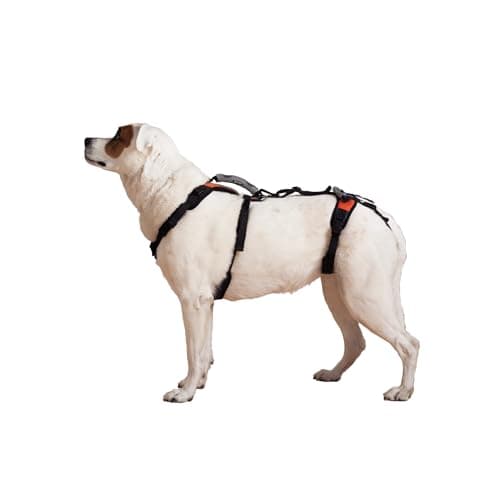
$95–$155 on Amazon by size ($95 XS / $110 S / $125 M / $140 L / $155 XL); $80–$140 direct at helpemup.com — both re-verified 18 August 2026
Check price on AmazonWe earn a commission if you buy through this link. It does not change what we recommend or how we score it — see our affiliate disclosure.
Best for
Long-term mobility support for senior or post-surgical large dogs
If your dog needs help getting up multiple times a day for the foreseeable future — post-TPLO, advanced hip dysplasia, hindquarter weakness in giant-breed seniors — this is the one to buy. It is the only harness in the category that supports the front and the back independently, which is what a dog with a bad hip and a compensating shoulder actually needs. Buy it from the manufacturer, not from Amazon: re-verified 18 August 2026, helpemup.com prices by size at $80 / $95 / $110 / $125 / $140 while Amazon runs $95 / $110 / $125 / $140 / $155 — a uniform $15 more at every size, every time we have checked.
What works
- Two-piece (chest + hip) design lets you support either end independently
- Hip handle is purpose-built — not a converted car-seat-belt strap
- Padded chest plate distributes weight better than sling-only options
- Five sizes span 10 to 225 lb, and the rear half can be ordered a size smaller for a dog with muscle wasting
- Two hip-lift styles (Conventional and U-Band) so male dogs are not soiling the strap
What doesn't
- Amazon runs a uniform $15 above the maker's own price at every one of the five sizes, and the Amazon buy box is held by a third-party reseller (Veterinary Preferred) rather than by the brand — re-verified 18 August 2026
- The maker's own Mix & Match page prints two different starting prices, "From $80" and "FROM $95 USD", on the same page
- Direct pricing is no longer flat: since mid-August 2026 the maker charges $80 to $140 by size, so a giant-breed owner now pays $60 more than a terrier owner
- On 29 August 2026 the linked Amazon Medium (B0DK81SCG5) showed a future availability date rather than units on hand, while every size and style was in stock at helpemup.com the same day; on 9 September and again on 12 September 2026 the Amazon Medium still showed the future-date status at $125.00 with a maximum order of one and no ship date given, while all nine direct variants were in stock — two weeks of backorder on the channel we earn from, and one more reason the direct channel is the one to use
- Sizing is critical — measure twice, return is a hassle
- Rear straps can chafe the inner thigh if the harness is left tight while the dog lies down
- A dog filmed or gait-assessed while wearing it looks less lame than he is, because the harness offloads the limb you are trying to judge
- Bulkier than a quick-grab sling for short-term use
Specifications
- Materials
- Padded ballistic nylon, neoprene-lined chest plate, foam-padded handles
- Sizes
- X-Small (10–25 lb) · Small (25–45 lb) · Medium (45–80 lb) · Large (80–125 lb) · X-Large (125–225 lb)
- Warranty
- 1-year manufacturer warranty, 14-day exchange window
- Made in
- USA
Sizing: the two decisions people get wrong
Sizing is by bodyweight and nothing else, which makes it look easy and hides two traps.
| Size | Bodyweight | Hip-lift styles |
|---|---|---|
| X-Small | 10–25 lb | Conventional only |
| Small | 25–45 lb | Conventional, U-Band |
| Medium | 45–80 lb | Conventional, U-Band |
| Large | 80–125 lb | Conventional, U-Band |
| X-Large | 125–225 lb | Conventional, U-Band |
Trap one: the dog on a size boundary. The manufacturer's instruction is to size down, and almost every owner's instinct is to size up. A support harness that is slightly loose does not support — the padding sits off the pressure points, the hip strap slides back toward the stifles, and the dog gets lifted by webbing rather than by foam.
Trap two: the dog whose back end has wasted. This is the more important one, because it describes most of the dogs the harness is bought for. A dog with three months of chronic hind-limb pain has thinner thighs and a narrower pelvis girth than his bodyweight suggests, and a rear half sized to his chest will hang. The company sells the halves separately through Mix & Match precisely so you can order a smaller rear. Nobody in the reviews mentions it and it is the difference between a harness that works and one that rubs.
The male-dog decision. Conventional or U-Band is not a preference, it is anatomy. The manufacturer's test is the clearest we have seen anyone publish: if the tip of your dog's penis is not visible from a side view, order the U-Band. Otherwise Conventional.
What it costs, and where
Direct column re-read from the maker's live variant feed on 12 September 2026 (unchanged since 18 August, all nine size and style variants available); the Amazon column was read in full on 18 August 2026, and the linked Medium re-read on 12 September at $125.00, still on backorder.
| Size | Direct (helpemup.com) | Amazon | Gap |
|---|---|---|---|
| X-Small (10–25 lb) | $80.00 | $95.00 | $15 |
| Small (25–45 lb) | $95.00 | $110.00 | $15 |
| Medium (45–80 lb) | $110.00 | $125.00 | $15 |
| Large (80–125 lb) | $125.00 | $140.00 | $15 |
| X-Large (125–225 lb) | $140.00 | $155.00 (U-Band) | $15 |
| Mix & Match (split front/rear sizes) | Average of the two halves | Not offered | — |
Direct prices re-read from helpemup.com's live variant feed on 18 August 2026, unchanged from 14 August. The flat $80-for-every-size pricing this table showed until mid-August — verified twice in early August — is over; the maker now prices by size.
Three things in that table are worth saying out loud.
The Amazon premium is a uniform $15, and we had it wrong. We have been printing "$15 to $75," which was an artefact of comparing today's Amazon prices against the retired flat-$80 direct price. Size for size it is $15, every time, and correcting it makes the channel that pays us look better — which is exactly the direction of error worth going back and fixing.
You are buying through a middleman on Amazon. The buy box is held by a third-party reseller trading as Veterinary Preferred (merchant A1S0TH159ELJMT), not by Help 'Em Up, even though the brand and manufacturer fields on the listing both read Help 'Em Up. That is most of the explanation for the markup.
Mix & Match does not carry a premium, and this corrects us too. We previously wrote that the split front/rear option cost $15 more than a matched harness. Re-checked on 18 August 2026, the maker sells each half separately at exactly half the matched price — $40, $47.50, $55, $62.50 and $70 for XS through XL — so a split order costs the average of the two sizes. A Medium front with a Small hip lift is $102.50, which is less than a matched Medium at $110. What is fair to say is that the maker's own Mix & Match page shows two different starting prices, "From $80" and "FROM $95 USD", on the same screen, so read the configured total rather than the headline.
We link Amazon. We earn a commission there and nothing at all when you buy direct. Buy direct.
One more line for the budget, from reading insurance policy documents for our pet-insurance article on 26 August 2026: do not plan on a pet insurance policy reimbursing this purchase. Spot's sample policy excludes "devices intended to prevent injury or illness, but that do not treat a condition" by name, with ramps and bedding listed alongside; whether a harness for a diagnosed dog clears that bar is a question to put to your own insurer in writing, not one to assume. The gear that lowers the odds of the claim is out-of-pocket in every scenario we could verify.
Returns and exchanges: the 14-day clock, and the channel that cannot say when it ships
The commonest way this purchase fails is sizing, so the return terms are not fine print here. They are the insurance on the decision. Read at source on 12 September 2026:
| Direct (helpemup.com) | Amazon (linked Medium) | |
|---|---|---|
| Returns | Within 30 days, US and Canada orders | Third-party reseller's terms; we could not read them (Amazon blocks our fetcher), so treat them as unknown |
| Size exchanges | Within 14 days | Unknown |
| Warranty | 1 year, stated on the product page | Same product, but the seller in the buy box is not the maker |
| Ships when? | In stock, all nine variants, 12 September 2026 | Backorder with no date shown on 29 August, 9 September and 12 September 2026; maximum order quantity one |
Two things follow from that table.
The 14-day exchange window starts at delivery, not at the first time you get the harness on a reluctant dog. If you order a Medium for a 78 lb dog who has lost muscle over the back end, discover the rear half hangs, and take a week to get round to trying it properly, you have a week left to swap it. Do the measuring before you order: bodyweight for the size, and for a dog with wasted hindquarters, seriously consider the Mix & Match with a smaller rear half, because that is the fit problem the exchange window most often has to absorb.
A backorder is not a price. The Amazon listing has read as a future-date availability at every check for two weeks, with no date shown. For a dog who cannot get up today, the $110 direct Medium that ships today is not $15 cheaper than the $125 Amazon Medium; it is the only one of the two that exists. We say that knowing it costs us the commission.
What we could not verify: the Amazon reseller's own return and exchange policy. Amazon blocks our fetcher from seller pages, so the right-hand column is honestly blank rather than reassuring, and if you do buy there, read the seller's returns tab before you click.
One thing this harness will do to your records
If you are tracking whether your dog's limp is improving — counting weight-bearing strides, filming a weekly walk, scoring stairs and sit-to-stands — take the harness off before you film.
A supported dog's gait is not his gait. The harness exists to move load off the bad leg, and load on the bad leg is exactly the quantity a home lameness protocol is trying to measure. A video shot with a hand resting on the hip handle will read as improvement, and the improvement will be the equipment's rather than the dog's. Slacken it and drop the handles for the ninety seconds of filming, then pick him back up.
This is a real cost of an otherwise excellent product and it is not mentioned anywhere by anyone. The protocol it interferes with is in is my dog's limp getting better, or am I just hoping.
The recurring complaint, adjudicated
The one complaint that shows up more than once in retailer reviews is the rear straps cutting into the inner thigh — in one reported case badly enough to need veterinary attention within a week, with the owner noting the padding was thinner than the older combination harness they had used before.
Is it fair? Partly. Two things are true at once. The manufacturer does tell you to loosen the straps when the dog lies down, and a harness worn tight for twenty-four hours a day against a thin-skinned, low-muscle inner thigh will chafe — that is a use problem, not a defect. But it is also true that a product sold specifically for all-day wear on dogs with wasted hindquarters ought to be robust to the most obvious mistake its buyers will make, and this one is not. Check the inner thighs for the first week the way you would check a new pair of boots, and loosen the rear straps every time your dog settles.
Who should not buy this
- Dogs who need help for four to six weeks and then won't. After an FHO or a straightforward TPLO, this is more harness than the job needs. A rear sling is quicker to fit and half the price.
- Dogs whose problem is only the back end and always will be — a rear-only sling is lighter, cooler, and faster.
- Dogs under about 25 lb who can simply be picked up. Nothing here beats two arms.
- Households where nobody can bend to fit it. The front half is genuinely fiddly the first few times. If the person doing the lifting has their own back or shoulder problem, get a demonstration before you commit.
Head-to-head with the GingerLead, on one axis: how long you need it
Both products lift a dog. They are built for different durations, and duration is the only axis that matters when choosing between them.
The GingerLead is a single-piece rear sling with an integrated leash. Time from picking it up to the dog being outside: seconds. That is the right trade for the first six weeks after surgery, when you are doing four supported bathroom trips a day and then, mercifully, stopping.
The Help 'Em Up is a garment. It is meant to stay on, and the reason to accept the extra bulk is that it carries a hip handle and a chest handle. A dog eighteen months into bilateral hip arthritis is not failing at one end — he is failing at the back and overloading the front to compensate. On a bad-elbow day you want the front handle. A rear sling cannot offer you that choice.
Rough rule: if the honest answer to "how long will we need this" is under two months, buy the sling. Over six months, buy this. In between, buy the sling and keep the receipt.
Longevity: what wears first
The foam-padded handles and the ballistic nylon body outlast the dog in most cases. What goes first, in order: the hook-and-loop closures lose bite once dog hair works into them, usually inside a year of daily use; the fleece lining on the rear straps mats down and loses loft where it takes load; and the buckles get brittle if the harness is dried on a radiator rather than air-dried. It is machine or hand washable and the manufacturer asks for mild soap, no bleach, and air drying — following that is most of the longevity story. The warranty is one year, with a 14-day exchange window, which is short enough that you should fit it and use it properly within the first fortnight rather than leaving it in the box until the dog gets worse.
The part nobody mentions, and the reason the longevity question is less frightening than it looks: you can replace one half. Help 'Em Up sells the front and the hip lift as separate catalogue items at exactly half the matched-harness price — front halves at $40 / $47.50 / $55 / $62.50 / $70 and hip lifts in both Conventional and U-Band at the same figures, all in stock and re-checked 18 August 2026. So the rear strap that mats down after eighteen months of daily load is a $55 part on a Medium, not a $110 re-buy. It also means a dog who keeps losing condition over the back end can be re-sized at the back only, later, without buying a whole second harness. Accessories run alongside it — a walking leash and shoulder strap at $29 or $34, walking loop handles at $22.50 or $26.50, and an $18–$22 tripod support — none of which are needed to make the harness work, and all of which are cheaper than replacing it.
After spinal surgery: the one job the rear handle does that a sling cannot
Most of this page is about dogs who can stand and need help staying up. A dog who cannot use his back legs at all after disc surgery is a different lifting problem, and it is the one place the two-piece design earns its price on day one rather than month six. The discharge sheets we read for our back-surgery pen article all say the same thing in different words: carry him, keep the spine level, no quick or jerky movements. A rear sling lifts the belly from one strap, which lets the pelvis swing. The hip handle on this harness sits over the pelvis, so one person carries the back end level while a second person, or the dog's own front legs, takes the front. For a paralysed dog over about 25 lb, that is the difference between a bathroom trip that needs two adults and one that needs one.
Three things to get right for that dog, all from the maker's own fitting guidance rather than from us:
- Size the rear half down. A dog who has been off his back legs for more than a week or two loses muscle over the hindquarters fast, and the maker's rule for a dog between sizes is to go smaller. Mix and match the halves if the front is still a size up.
- Loosen the straps whenever he is lying down, which for this dog is most of the day. The chafing complaint in reviews comes from a harness left tight on a recumbent dog.
- Check the U-Band question before ordering. A male dog whose bladder is being expressed by hand is wet under the strap several times a day; the wrong hip-lift style gets soiled on every one.
Who this section is not for: a dachshund or a French bulldog, which is most of the dogs who have this surgery. Under about 25 lb your two hands are the equipment, one under the chest and one under the pelvis, and the harness is money spent on a problem you do not have.
The cheaper things first
A rolled bath towel under the belly, held at both ends, costs nothing and works for one or two lifts a day. It also tells you, in an afternoon, whether your dog needs holding at the front, the back, or both — which is the question the Mix & Match sizing above is asking you to answer.
A rear sling at $35–$90 covers the short post-surgical window.
And when you do buy this one, buy it direct. The size-by-size figures are in the table above: $80–$140 from the manufacturer against $95–$155 on Amazon, re-verified 18 August 2026. Direct has been $15 cheaper at every size, every time we have looked.
Frequently asked
- Do I need this for a dog who cannot walk after back surgery?
- Only if you cannot lift him alone. Under about 25 lb, a dachshund, French bulldog or similar, your two hands are the equipment: one under the chest, one under the pelvis, spine level, and the harness is money spent on a problem you do not have. Above that, a paralysed dog turns every bathroom trip into a two-person lift, and the rear handle lets one person carry the pelvis level while the dog uses whatever he has in front. Size the rear half down if he has been off his legs for more than a week or two, because muscle over the back end goes quickly, and loosen the straps whenever he is lying down, which for this dog is most of the day.
- What size Help 'Em Up harness do I need?
- Sizing is by bodyweight, not girth: X-Small 10–25 lb, Small 25–45 lb, Medium 45–80 lb, Large 80–125 lb, X-Large 125–225 lb. The manufacturer's own instruction for a dog between two sizes is to size down, and that is the opposite of what most owners guess. If your dog has lost muscle over the back end — which is the usual reason people are buying this — the rear half can be ordered a size smaller than the front through the Mix & Match option, and that is the single most useful thing on the ordering page. We previously described Mix & Match as carrying a flat $15 premium; re-checked on 18 August 2026, that is no longer the right way to put it. The maker sells each half separately at exactly half the matched-harness price — $40, $47.50, $55, $62.50 and $70 for XS through XL — so a split order costs the average of the two sizes you pick, not a surcharge. A Medium front with a Small hip lift is $102.50, which is less than a matched Medium at $110. The Mix & Match landing page itself shows two starting prices, 'From $80' and 'FROM $95 USD', on the same screen, so configure it and read the total rather than trusting the headline.
- What is the difference between the Conventional and U-Band styles?
- It is a clearance question for male dogs, and the manufacturer gives an unusually concrete test: if the tip of your dog's penis is not visible from a side view, order the U-Band. Otherwise the Conventional style is correct, and it is correct for all female dogs. Get this wrong and the strap gets soiled on every walk, which is how a $95–$155 harness ends up in a cupboard. X-Small is only made in Conventional.
- Where is the Help 'Em Up harness cheapest?
- Direct, at every size, by exactly $15. Re-verified 18 August 2026 from the live variant feed: helpemup.com prices by size at $80 X-Small, $95 Small, $110 Medium, $125 Large and $140 X-Large, while Amazon runs $95, $110, $125, $140 and $155 for the same five. The earlier flat-$80-for-every-size direct pricing, which we verified twice in early August, ended mid-month. We have also been printing the gap as '$15 to $75', which was an artefact of comparing today's Amazon prices against that retired flat $80 — the real premium is a uniform $15 at every size, and we would rather correct it in the direction that makes the channel we earn on look better than leave a wrong number up. The Amazon buy box is held by a third-party reseller called Veterinary Preferred (merchant A1S0TH159ELJMT) rather than by Help 'Em Up itself, which is part of why the markup exists. The conflicting 'From $80' and 'From $95' figures we saw on 4 August turned out to be the Mix & Match page, which is a genuinely different product at $95 and up. We link Amazon because that is the affiliate programme that pays for this site, and we would rather tell you the harness is cheaper elsewhere than pretend it isn't.
- Can my dog wear it all day?
- It is designed to be left on, and that is most of the point — a harness you have to fit before every bathroom trip is a harness you stop using by week two. But the manufacturer specifically advises loosening the straps when your dog lies down, to prevent hot spots and chafing, and to give the dog breaks from it where you can. The one recurring complaint we can find in retailer reviews is exactly this failure mode: the rear straps cutting the inner thigh over about a week of continuous wear.
- Will pet insurance reimburse a support harness?
- Plan on no, and read your own policy before assuming otherwise. In the policy documents we read at source on 26 August 2026 for our pet-insurance article, Spot's sample policy excludes 'non-medical supplies such as but not limited to toys, leashes, ramps, bedding or other devices intended to prevent injury or illness, but that do not treat a condition' — prevention gear is excluded by name. Whether a harness bought for an already-diagnosed dog counts as treatment rather than prevention is exactly the kind of question a policy answers differently by brand and by state form, and we did not find a policy that promises to cover one. The practical version: budget the $80–$140 as out-of-pocket in every scenario, and if your insurer's form has a 'mobility devices' or 'medical supplies' line, ask them in writing with the diagnosis attached before you count on it.
- Can I return or exchange it if I get the size wrong?
- Direct from the maker, yes, on a short clock: returns within 30 days and size exchanges within 14 days for US and Canada orders, per the maker's FAQ read on 12 September 2026, with a 1-year warranty on the harness itself. Fourteen days is not long for a product whose commonest failure is sizing, so weigh the dog and decide on Mix & Match before you order rather than after. On Amazon the buy box is held by a third-party reseller, not the brand, and we could not read that seller's return terms, so if you buy there, check its returns tab first. As of 12 September 2026 the Amazon Medium was also on backorder with no ship date, so the question may be moot.
- Is it worth it over a cheap sling?
- It depends entirely on how long you need it. For four to six weeks after an FHO or a TPLO, a $35–$90 rear-end sling does the job and is faster to grab. For a dog who will need lifting several times a day for the rest of his life, the two-piece design is a different tool: you can support the front end on a day the elbows are bad and the back end on a day the hips are, and you are not bending over a strap at 6am. Before either, try a rolled bath towel under the belly for a day — it costs nothing and it tells you which end your dog actually needs held.
Where we recommend it
The articles this product earns a place in, and the context it earns it for.

recovery
Your Dog Can't Walk After Back Surgery: How to Move Him, Set Up the Pen, and Get Through the First Four Weeks
Use a pen, not a crate, and lift with a hand under the chest and one under the pelvis. Most dogs with feeling in their toes walk in 1 to 3 weeks. The bladder is the real job: roughly a third get a urinary infection.

surgery
Is Pet Insurance Worth It for a Big Dog's Knees? Read the Bilateral Clause First
We pulled the actual policy documents. The knee waiting period runs 14 days to 6 months by brand, one knee's history can delete the other knee's coverage, and one state form caps year-one cruciate claims at $200.

breeds
Bernese Mountain Dog Joint Problems: Why the Elbows Come First and Why Waiting Costs More
Bernese Mountain Dogs sit among the worst breeds for elbow dysplasia, and they get fewer years than most dogs to live with it. What that changes about screening, timing and treatment.

conditions
My Dog's Back Legs Are Giving Out and He Isn't in Pain — What Is Degenerative Myelopathy?
Painless, progressive hind-leg weakness in a dog over eight points at degenerative myelopathy. What the disease is, how it is diagnosed, what the published evidence says about slowing it, and why it gets named late.
breeds
Great Dane Joint Problems: The 18 Months That Decide the Next Eight Years
A Great Dane builds a 30-inch skeleton in about 18 months, and most of what goes wrong happens during the build. What the calcium evidence says, when wobbler shows up, and why the short lifespan changes everything.

tools
How Do I Get My Dog Into the Car When He Can't Jump and I Can't Lift Him?
The bumper is four problems wearing one coat. How to tell which one you have, what the published lifting guidelines say about the crouch you do six times a week, and why the way out matters most.

conditions
Is My Dog's Limp Getting Better, or Am I Just Hoping?
Two people can watch the same dog and disagree. Here is why the eye is a poor instrument for tracking a limp, and what to write down instead: a scored questionnaire, a fixed weekly video, nine counted items.

conditions
Why Is My Dog's Muscle Wasting on One Back Leg?
One hind leg thinner than the other usually means the body has been offloading a painful joint for months. Unlike a limp, it is measurable at home. Here is the protocol, and when it is neurologic instead.

conditions
How Much Walking Is Right for a Dog With Arthritis?
Exercise is the one part of an arthritis plan that gets prescribed without a number, so it quietly shrinks to nothing. Here is what the canine evidence actually supports, and how to write the dose down.

surgery
Is My Dog Too Old for Orthopedic Surgery?
Age is a stand-in for the things that actually decide this. Here is what the anaesthetic risk really is by age and health status, and the four separate questions hiding inside "he's too old."

conditions
How Cold Is Too Cold for a Dog With Arthritis?
There is no single temperature. The honest evidence that cold worsens canine arthritis is thinner than you have been told, and the three things that actually change in winter are not on the thermometer.

surgery
FHO Surgery Recovery in Dogs: A Realistic Timeline
Most dogs put weight on the leg within days of FHO surgery and reach function in three to four months — crate rest is what ruins it. The realistic timeline, and how serious an FHO really is.

tools
The Best Lift & Support Harnesses for Senior Dogs (2026)
The right dog lift harness depends on when your dog needs help: all-day support, mid-walk sagging, or budget rear lift. The three worth buying, compared.

breeds
German Shepherd Hip Dysplasia: Signs by Age, Odds, and What Actually Helps
About one in four German Shepherds screened in Sweden graded dysplastic. Here are the signs at every age, what OFA and PennHIP each actually measure, and the weight and surgery numbers that decide how it ends.

tools
How to Help a Senior Dog With Stairs: Assist Him Down, Not Up
If you only help in one direction, help him down. Across 552 dogs the forelegs carried a mean 60.4% of standing weight, and descending loads that same front end while he brakes. Assist, adapt, or bypass.

conditions
How to Tell If Your Dog Is in Pain: The Signs Owners Miss
How to tell if your dog is in pain: the movement, posture, sleep, and facial changes dogs show instead of crying, and what to do once you spot them.

tools
Senior Dog With Weak Back Legs: How to Help Them Stand, Walk, and Keep Going
A senior dog with weak back legs needs a vet visit to find the cause, then the right support harness, traction at home, and a smarter walk routine. The full plan.

surgery
Stairs After TPLO: None for Two Weeks, Sling-Assisted Through Week 8
Stairs after TPLO, week by week: none for weeks 0–2, sling-assisted and only-if-unavoidable through week 8, gradual return after recheck X-rays confirm healing.

surgery
TPLO vs Total Hip Replacement: Different Joints, Different Surgeries
TPLO vs total hip replacement: one repairs a torn knee ligament, the other replaces the hip joint with an implant. What the published outcome data actually say, and which conversation your dog is in.

tools
The Best Mobility Aids for Senior Dogs (2026)
Harnesses, ramps, stairs and traction grips — the daily-use mobility tools that keep aging dogs confident on their feet, with every price, size band and load rating verified 14 August 2026.

recovery
The Best Post-Surgical Recovery Gear for Dogs (2026)
The gear that earns its place in an eight-week orthopedic recovery, and the gear that does not — with the complication rates, the measured muscle loss, and every price re-verified in August 2026.

conditions
Hip Dysplasia in Dogs: Signs, Treatment, and Why to Ask for a PennHIP Number
An OFA grade and a PennHIP distraction index are not the same test — one sorts hips into seven categories, the other measures laxity as a number. What the disease is, how to catch it early, and what actually helps.

surgery
TPLO Surgery Recovery: A Week-by-Week Guide
Tibial-Plateau-Leveling Osteotomy is the gold-standard repair for canine cruciate disease. Here's what to expect, week by week, and the gear that makes recovery survivable.