Breed Guide
Great Dane Joint Problems: The 18 Months That Decide the Next Eight Years
A Great Dane builds a 30-inch skeleton in about 18 months, and most of what goes wrong happens during the build. What the calcium evidence says, when wobbler shows up, and why the short lifespan changes everything.

Almost everything that goes wrong with a Great Dane's skeleton is decided while it is being built. A Dane goes from a puppy you can lift with one arm to a dog standing thirty inches or more at the shoulder in roughly eighteen months, and the diseases that define the breed — the bone pain of the growth plates, osteochondrosis, and the neck compression called wobbler syndrome — all cluster inside that window or just after it. The second thing that makes this breed different is the clock at the other end. In the UK Kennel Club and BSAVA purebred health survey, the median age at death for the breed was six and a half years. That means a Dane owner does not get to use the strategy most owners use, which is to wait and see how the next year goes.
Affiliate disclosure: Dog Orthopedic is reader-supported. When you buy through links on our site we earn a commission at no extra cost to you — about 3% on most pet products, and the same rate on every product we compare, so no pick earns us more than another. Prescription medication earns us nothing, and seeing your vet earns us nothing; we recommend both anyway. Learn more.
Imagery: Lifestyle photographs on this site are licensed from Pexels (royalty-free) and credited per image. Pexels imagery illustrates conditions and contexts — it does not depict the specific dogs or test sessions described in the text. Product photographs come from Amazon's Creators API. Breed portraits are illustrations of typical breed type rather than photographs of individual dogs, and are not drawn to scale against one another.
The build, and what it costs#
The Great Dane standard is unusual in that it specifies height and never mentions weight. A male "shall not be less than 30 inches at the shoulders, but it is preferable that he be 32 inches or more"; a female not less than 28, preferably 30 or more.[20] The breed is also required to be square: as tall as it is long.
Read that as an engineering brief and the orthopedic consequences write themselves. A square dog of that height needs long bones with enormous growth plates, and it needs them to lengthen at a rate no other domestic animal of that mass manages. The growth plate — the soft cartilage disc near the end of each long bone that turns into bone as the puppy lengthens — is not a passive thing. It is a busy, fragile, actively remodelling tissue, and it is under load from a body that gets heavier every week.
Almost every classic Great Dane orthopedic disease is a disease of that tissue, or of the bone immediately behind it:
- Osteochondrosis is a failure of the blood supply to growth cartilage, leaving a flap or a crater in a joint surface.
- Metaphyseal osteopathy (hypertrophic osteodystrophy) is painful inflammation in the bone just behind the growth plate.
- Panosteitis is inflammation inside the marrow cavity of the long bones themselves.
- Wobbler syndrome in this breed is bony overgrowth of the neck vertebrae, narrowing the canal the spinal cord runs through.
None of these are wear-and-tear problems. They are construction problems. The arthritis comes later, and it comes because a joint that was built badly at nine months has been carrying a hundred and forty pounds ever since.

What this breed actually gets, ranked by how likely it is#
The most useful data on what Great Danes actually suffer from, rather than what they theoretically might, comes from the Kennel Club and BSAVA purebred dog health survey. For Great Danes it covered 225 living dogs and 171 reported deaths.[7]
Two findings from it deserve to be read slowly.
Musculoskeletal disease was the single most-reported health category in living Great Danes — 19 of 122 reported conditions, 15.6 percent, ahead of skin, eyes and heart. The specific conditions named, in descending order, were osteochondrosis (shoulder most often, then elbow, then stifle), hip dysplasia, and arthritis.[7]
The median age at diagnosis, across every condition reported in the breed, was two years. Not eight. Two.[7]
On the mortality side, the neurologic category accounted for 12 of the 171 deaths (7.0 percent), and the most commonly named specific cause within it was wobbler syndrome. Gastrointestinal causes led overall at 22.8 percent, headed by GDV; cardiac was 13.5 percent; cancer 12.3 percent, headed by osteosarcoma.[7]
Be honest about what that survey is. It was a postal questionnaire with a 24 percent overall response rate, 20 percent for Great Danes, and the report itself opens with a warning that breed-specific analyses should be interpreted with caution.[8] Owners who respond to health surveys are not a random sample of owners. Treat the ranking as a reliable picture of what Dane owners deal with, and the percentages as approximate.
Two more numbers belong here because they come from much larger datasets.
Osteosarcoma. In a VetCompass study of 905,552 UK dogs, Great Danes had an annual prevalence of bone cancer of 0.87 percent (95% CI 0.43–1.55) and odds of diagnosis 34.24 times those of crossbred dogs (95% CI 17.81–65.83). Across the whole study population the median age at diagnosis was 9.64 years, and longer-legged, longer-skulled dogs carried higher risk.[15] This matters here for one practical reason: in a Great Dane, a new limp in a middle-aged or older dog is not automatically arthritis. It needs an X-ray, not a course of painkillers and a review in a month.
Osteochondrosis. In insured Swedish dogs from 2011 to 2016, appendicular osteochondrosis ran at 3.77 cases per 10,000 dog-years across the whole population, every breed at increased risk was large or giant, and males were 1.76 times more likely to be affected than females.[11] We could not obtain the Great Dane-specific incidence figure from that paper, so we are not going to quote one.
When it shows up#
| Age | What is happening | What owners actually notice |
|---|---|---|
| 8–32 weeks | Metaphyseal osteopathy. Median age at presentation in a 39-dog series was 14 weeks.[9] | A puppy who was fine yesterday, is hot, flat and feverish today, and will not get up. Swelling just above both wrists |
| 4–10 months | Osteochondrosis of the shoulder, then elbow, then stifle and hock | A front-leg limp that is worse after rest and worse after hard play. Often no yelp, just a shortened front stride |
| 6–16 months | Panosteitis. Self-limiting, resolves at skeletal maturity, but recurs in episodes[21] | A limp that moves. Left front this fortnight, right hind the next. Genuinely painful and genuinely temporary |
| 8 months – 3 years | Wobbler syndrome, bony form. Median age at onset of signs 1.3 years in one Great Dane series; median age 2 years in a 27-dog cohort[13][12] | A wide, swaying, uncoordinated hind end. Hind nails scuffing. A young dog who looks drunk on turns |
| 2–5 years | Arthritis establishing in joints that were damaged during growth | Slow to rise, reluctant on stairs, lying down mid-walk, thinning muscle over the hips |
| 5 years and up | Arthritis advancing; osteosarcoma risk rising | A persistent one-legged lameness that does not shift and does not respond — this needs radiographs |
One honest correction to the folklore, while we are here. Great Danes are routinely listed among the breeds predisposed to metaphyseal osteopathy, and the per-breed rates you will see quoted come from an analysis of Veterinary Medical Database records from 1980 to 1989, which found dogs under six months of age at greatest risk.[10] We could not read that primary table, so we are not quoting its numbers. And in the most recent UK referral series of 39 affected dogs, the commonest breeds were border collies, Weimaraners and Labradors — Great Danes were not among them.[9] Watch for it, because a hot, feverish, non-weight-bearing puppy is an emergency in any breed. Do not assume it because you own a Dane.
The line to carry out of that table: in a Great Dane, the age at which a limp is "probably just growing pains" and the age at which a limp is a serious neurological or oncological problem are separated by about a year. No other breed compresses those two things so tightly.
The earliest sign, in a Great Dane specifically#
Generic advice tells you to watch for limping. In this breed the three earliest signs are more specific than that, and two of them are not limps at all.
The sit that goes wrong. A young Dane whose shoulders or elbows hurt does not usually cry. He changes how he lowers himself. He drops the back end abruptly rather than folding, or he slides one hind leg out to the side, or he props on a wall. Watch him sit five times, not once.
The hind end that swings wide. Early wobbler signs are ataxia, not weakness — the dog does not know exactly where his back feet are. On a turn he will swing the outside hind leg wide, cross over, or knuckle briefly and correct. Check the hind nails. Tips worn flat on the outside edge in a two-year-old Dane is a neurological finding, not a grooming one. Our guide to telling a limp from weakness is the distinction that matters most here, because the two lead to completely different appointments.
The dog who sits down mid-walk. This is the one Dane owners describe most and interpret least. A four-month-old who lies down two hundred yards from the house is not being stubborn. A three-year-old who does it is not being lazy. In a breed this heavy, stopping is what pain looks like before limping is.
“Because your dog can't tell you how much pain he or she is in.”
Because a Dane hides discomfort behind sheer size — a dog this big taking three percent less weight through a shoulder is invisible to the eye — the physical checks are worth more than watching. Feel both wrists in a puppy for heat and swelling. Feel both thighs at the same height in an adult; measurable asymmetry is the record a limp will not give you, and we set out how to measure it at home in detail. And if you are unsure whether what you are seeing is pain at all, the subtle signs a dog is hurting is ten minutes well spent.
The calcium and growth-rate evidence, honestly#
This is the part of Great Dane advice that is most confidently stated online and most often overstated. Here is what has actually been done.
The excess-calcium evidence is real, it is causal, and it was collected in this breed. Great Dane puppies fed a supplement containing three times the recommended calcium developed significant skeletal changes: irregular retained cartilage with disturbed endochondral ossification, described by the authors as comparable to osteochondrotic lesions, plus retarded maturation and remodelling of bone and fewer osteoclasts.[2] A later Great Dane trial fed control, high-calcium, and high-calcium-plus-phosphorus diets from early weaning to 17 weeks and then normalised intake for ten weeks. High calcium without matching phosphorus produced hypercalcaemia, hypophosphataemia and rickets-type disturbance; once calcium was normalised the rickets lesions resolved but osteochondrotic changes then appeared. The high calcium-and-phosphorus group grew more slowly and developed osteochondrosis-like changes that only partly improved after correction.[3] This whole line of work traces back to an experimental study of overnutrition and skeletal disease in growing Great Danes published in 1974.[1]
That evidence is why AAFCO's nutrient panel lowered the maximum calcium concentration for growth and reproduction diets to 1.8 percent of dry matter, explicitly citing concern about excess calcium in growing large and giant breeds. The committee then applied that single cap to every dog food formulated to meet the growth profile, rather than only to large-breed ones.[5]
The practical translation is not the one most articles give. The dangerous act is not choosing the wrong bag. It is adding calcium on top of a complete food — supplements, bone meal, eggshell powder, large quantities of dairy — which is precisely the intervention those Great Dane studies modelled, and which no owner thinks of as a drug.
The protein claim, which you will hear constantly, is not supported. Seventeen Great Dane pups were fed isoenergetic diets containing 31.6, 23.1 or 14.6 percent protein on a dry matter basis for eighteen weeks from seven weeks of age. There was no difference in height at the shoulder between groups. The authors concluded that "the differences in protein intake per se had no demonstrable consequences for calcium metabolism and skeletal development" and that "a causative role for dietary protein in the development of osteochondrosis in dogs is unlikely."[4] Seventeen puppies is a small trial and it is thirty-five years old. It is also the only direct test in this breed, and it points the opposite way from the advice.
And there is no growth chart to hold your Dane to. The largest attempt to build canine growth standards, using veterinary practice data, produced usable curves for five size categories. The sixth, for dogs over 40 kg, could not be modelled — the authors state that the commonest breeds in it, the Great Dane among them, "had widely varying growth trajectories and, consequently, it was not possible to create a growth curve model for this category."[6] So when a breeder or a forum gives you the weight your puppy "should" be at twenty-two weeks, that number is not coming from a published standard, because there isn't one. Body condition scored by your vet is the instrument you have. Use it every visit.
| The claim you will hear | What the evidence supports |
|---|---|
| "Never feed a Dane puppy high protein" | Not supported. In the only Great Dane trial, protein from 14.6% to 31.6% made no difference to skeletal development[4] |
| "Excess calcium damages growing joints" | Supported, causally, in this breed. Three times recommended calcium produced osteochondrosis-like lesions[2] |
| "Add calcium or cottage cheese to help his bones" | Directly contradicted by the same studies. This is the actual risk |
| "Keep him under X lb at Y months" | No published growth standard exists for giant breeds[6] |
| "Keep him lean" | Sound, free, and the one instruction worth following without reservation |
Wobbler syndrome, and why it is a young Dane's disease#
Cervical spondylomyelopathy is the condition most associated with this breed, and the version Danes get is not the version Dobermans get. In Dobermans the compression is usually from a bulging disc in a middle-aged dog. In Great Danes it is usually osseous-associated: the small joints and arches of the neck vertebrae overgrow and narrow the canal from the sides and above.
An MRI study of thirty Great Danes, fifteen affected and fifteen clinically normal, found that affected dogs had larger caudal articular process areas, significantly smaller vertebral canal and spinal cord areas at C5-C6 and C6-C7, narrower canal width at C6-C7 and C7-T1, and smaller foraminal heights from C3-C4 through to C7-T1.[14] That is a structural narrowing built into the neck, not something that develops from use.
Which explains the ages. In a retrospective series of 27 dogs with the osseous form — 15 of them Great Danes — the median age was two years.[12] In a Great Dane-only follow-up study, the median age at onset of clinical signs was 1.3 years, with the range running from 0.7 to 3 years.[13]
The outcome data is more encouraging than the reputation. In that 27-dog series, seven dogs treated medically had a median survival of 43 months and twenty treated surgically had a median survival of 60 months; fifteen of nineteen surgical dogs had improved neurological grades at four to eight weeks and a good to excellent long-term outcome.[12] Those are small numbers from a referral population, and the surgical dogs started with worse neurological grades than the medical ones, so this is not a clean comparison of treatments. It is enough to say that a wobbler diagnosis in a young Dane is not a death sentence and that both routes are legitimate.
The follow-up imaging carries one more useful finding: over roughly two years, most dogs did not develop new sites of narrowing, and progression of canal stenosis was seen in four of twelve dogs.[13] This is not a disease that inevitably marches.
If a neck operation is on the table, the questions to ask a veterinary orthopedic surgeon is the list we would take into that consultation, and for an older Dane where the answer is genuinely unclear, is my dog too old for surgery is the honest version of that conversation.

Screening, and what the paperwork does and does not tell you#
The Great Dane Club of America's CHIC panel asks for hips, heart, eyes and thyroid. Elbows are not on it. Neither, and this is the important part, is anything for wobbler syndrome — the breed's signature orthopedic-neurological disease has no screening scheme at all. There is no test a breeder can run, no grade to show you, and no certificate that means your puppy will not develop it.
For hips, the Orthopedic Foundation for Animals grades on a seven-point scale: Excellent, Good and Fair are within normal limits, then Borderline, then Mild, Moderate and Severe dysplastic. Preliminary screening is available from four months to 23 months of age; the final evaluation comes later.[17] OFA publishes breed statistics for hip dysplasia and we are not going to reproduce their table here; go and read it at the source, and read it knowing that submission is voluntary, which means obviously abnormal films frequently never get sent.
What a stack of paperwork does tell you: this breeder screens, records results publicly, and is not hiding a bad hip. What it does not tell you: whether this specific puppy will get osteochondrosis, panosteitis, metaphyseal osteopathy or wobbler. For the full mechanics of hip grading and what a grade predicts, our hip dysplasia guide covers it, and the German Shepherd page sets out the OFA-versus-PennHIP decision in more depth.
On neutering, the largest breed-specific dataset is a fifteen-year UC Davis record set of 353 Great Danes. Joint disorders occurred in 1 percent of intact males and 2 percent of intact females, and the authors found no evident increase in joint disorders in neutered dogs at any age. Their guideline was that "lacking a noticeable occurrence of increased joint disorders or cancers in neutered males or females, those wishing to neuter should decide on the appropriate age. However, given the large body size, and physiology of late musculoskeletal development, neutering well-beyond year 1 should be considered."[18] That is a hospital record set rather than a trial, and 353 dogs is not many. It is still the best breed-specific number available, and it is worth raising before a date is booked. Our guide to spay and neuter timing covers the wider debate.
What actually helps#
Lean body condition, first and always. It is the largest modifiable factor in canine joint disease and it costs nothing. In a dog whose joints may have been built imperfectly, every pound is carried across those same imperfect surfaces for six or seven years. Ask your vet for a body condition score at every visit and write it down.
Traction, second. A Great Dane on a laminate floor is a specific mechanical problem: long legs, high centre of mass, and a splay that cannot be arrested once it starts. Runners along the three or four routes he actually walks, nails kept short, and the fur between the pads clipped will solve most of it for very little money. Our floor traction guide has the room-by-room version.
Activity type over activity volume. Forced repetitive exercise on hard surfaces during the growth period is the thing to avoid: road running alongside a bike, long jogs, repetitive fetch on concrete. Free play on grass, where the puppy sets his own pace and stops when he wants to, is a different proposition. For an adult Dane already arthritic, how much walking is right sets out the dosing question properly, and is my dog's limp getting better is the tool for judging whether a rest period is working.
Then, and only then, gear. Two things genuinely change for a dog this size, and both are about physics rather than comfort.
#1 Pick

Big Barker
Big Barker 7-inch Pillow Top
Our score
$250–$460
Best for
Large and giant breeds with hip, elbow, or arthritis pain
The bed we still recommend first for a dog over about 80 lb. Our reason is depth: seven inches, published layer by layer, is more than most beds we cover print, and for a heavy dog we would rather have the depth than not. That is our judgement; nobody has measured how far a hip sinks into this bed. (It is not one solid slab, as we used to say: the maker's own copy describes a 3-layer build, a 2" base under a 3" support layer under a 2" comfort top.) It is also the only bed we cover with a clinical study attached, and we would rather you knew what that study is: forty dogs, no control group, no blinding, and outcomes scored by the owners who had just been given a free bed. That is a reason to be interested, not a reason to be convinced. Buy on the foam depth and the ten-year warranty, which are facts. On where to buy: the price is the same either way, so buy direct for the 180-night sleep trial, which Amazon's return window does not match. Read its conditions first: no return in the first 30 days except size exchanges, the bed is donated to a shelter rather than shipped back, and one trial return per household (bigbarker.com refund policy, 2026-10-04). The two editions both sell on both channels at identical prices, re-verified 4 October 2026 — flat Large $249.95, Headrest Large $289.95. We have published two wrong things about this in the past, a $40 Amazon markup and a direct-only cheap edition; both are retired, and the honest version is that the channel decides your trial, not your price.
Pros
- Seven inches of foam in a 3-layer build (2" base, 3" support, 2" top comfort), printed on the maker's own page, which not every maker does
- 10-year warranty — foam must retain at least 90% of its original shape and support, or it is replaced
- The only bed we cover with a clinical study behind it, though it is the sponsor's single-arm pilot report, not a peer-reviewed paper
- Made in the USA
- Microfiber cover unzips and machine-washes
Cons
- Premium price
- Editions, not channels, are what the price difference is. Both are on Amazon and both are on bigbarker.com at identical prices, re-verified 2026-09-06: the flat headrest-free Large is $249.95 (B0GRBXBPXH) and the Headrest Large is $289.95 (B0GRBX5TBL), both In Stock with the buy box held by Big Barker itself, both matching the maker's own site. We previously misread this as a $40 Amazon markup, and then as the cheap edition being direct-only. Both claims are retired
- Bulky — measure your space, not just your dog
- Cover-only style isn't bolstered (consider Sofa edition for nesters)
- The clinical study everyone cites is open-label, single-arm, and owner-scored, with no control group
- The product page says the three layers "maintain proper spinal alignment and eliminate pressure points" (bigbarker.com, read 2026-10-04). Nobody has measured that on this bed, and the one canine pressure-mapping study we know of (Caraty 2019, three cadavers) found even memory foam generally not enough to keep the hip, shoulder and rib risk zones at safe pressures. It is the same unmeasured claim we criticise on elevated cots
The reason a bed is a real intervention for this breed and a nice-to-have for a beagle is depth. A dog's hip needs the foam under it to still be compressible after it has taken his full weight for eight hours; below a certain thickness, a heavy dog simply bottoms out and sleeps on the floor plane through a layer of fabric. Seven inches is what buys that margin at Great Dane weights, and the Giant size at 60 by 48 inches is one of the few beds a 32-inch dog can lie fully extended on.
The honest tradeoffs. It is expensive, roughly $250 to $460 depending on size, and the cheapest edition (Sleek, $249.95 for the Large) matched prices across both channels by mid-August 2026 — and the 180-night trial only comes with a direct purchase. It is bulky enough that you should measure your room and not just your dog. The cover-only style is not bolstered, which suits a dog who sprawls and frustrates one who nests. And the clinical study everyone cites for this bed is open-label, single-arm and owner-scored, with no control group — that is weak evidence, and we would rather say so than let a study title do work it cannot do. Before spending anything, a thick foam mattress topper on the floor tests whether depth is what your dog is missing, and for many dogs it is enough. Our orthopedic bed roundup compares the alternatives at this size.
#2 Pick
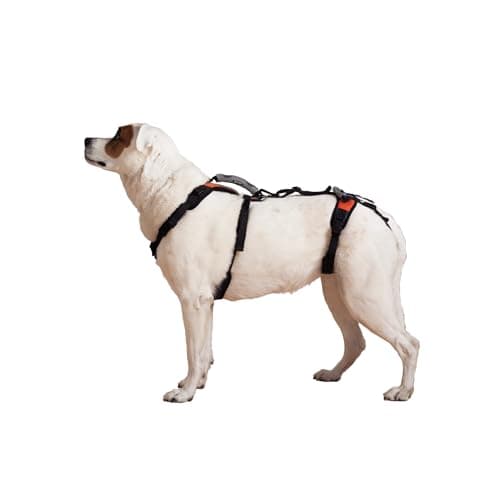
Help 'Em Up
Help 'Em Up Harness
Our score
$95–$155
Best for
Long-term mobility support for senior or post-surgical large dogs
If your dog needs help getting up multiple times a day for the foreseeable future — post-TPLO, advanced hip dysplasia, hindquarter weakness in giant-breed seniors — this is the one to buy. It supports the front and the back independently, as two halves you can lift separately, which is what a dog with a bad hip and a compensating shoulder actually needs. It is not the only design that does this, but it is the one whose sizing, returns and channel prices we have read most closely. Buy it from the manufacturer, not from Amazon: re-verified 3 October 2026, helpemup.com prices by size at $80 / $95 / $110 / $125 / $140 while Amazon runs $95 / $110 / $125 / $140 / $155 — a uniform $15 more at every size, every time we have checked.
Pros
- Two-piece (chest + hip) design lets you support either end independently
- Hip handle is purpose-built — not a converted car-seat-belt strap
- Padded chest plate distributes weight better than sling-only options
- Five sizes span 10 to 225 lb, and the rear half can be ordered a size smaller for a dog with muscle wasting
- Two hip-lift styles (Conventional and U-Band) so male dogs are not soiling the strap
Cons
- Amazon runs a uniform $15 above the maker's own price at every one of the five sizes, and the Amazon buy box is held by a third-party reseller (Veterinary Preferred) rather than by the brand — re-verified 18 August 2026
- The maker's own Mix & Match page prints two different starting prices, "From $80" and "FROM $95 USD", on the same page
- Direct pricing is no longer flat: since mid-August 2026 the maker charges $80 to $140 by size, so a giant-breed owner now pays $60 more than a terrier owner
- On 29 August 2026 the linked Amazon Medium (B0DK81SCG5) showed a future availability date rather than units on hand, while every size and style was in stock at helpemup.com the same day; on 9 September and again on 12 September 2026 the Amazon Medium still showed the future-date status at $125.00 with a maximum order of one and no ship date given, while all nine direct variants were in stock — two weeks of backorder on the channel we earn from, and one more reason the direct channel is the one to use. By 3 October 2026 it had spread: every Conventional-style Amazon listing we checked (X-Small, Small, Medium, Large) showed a future availability date, and only the Large and X-Large U-Band were in stock, while all nine direct variants were available. On 15 October 2026 the linked Medium was back In Stock on Amazon at $125.00 (maximum order 30) for the first time since 29 August, but X-Small, Small and Large Conventional still showed a future availability date with a maximum order of one
- Sizing is critical — measure twice, return is a hassle
- Rear straps can chafe the inner thigh if the harness is left tight while the dog lies down
- A dog filmed or gait-assessed while wearing it looks less lame than he is, because the harness offloads the limb you are trying to judge
- Bulkier than a quick-grab sling for short-term use
Amazon, 15 October 2026: the Medium this button links is In Stock at $125, the first time since 29 August it has not shown a future availability date. X-Small, Small and Large Conventional on Amazon still had no ship date. Every size and style was in stock direct the same day, $15 cheaper.
The second problem is not the dog's, it is yours. A 140-pound dog who needs help rising is a two-person job without leverage and a one-person job with it, and the reason we card this here rather than a sling is the weight band: the X-Large fits 125 to 225 pounds, which is one of the few honest options at Dane size. The two-piece design also lets you support the hind end alone, which is what a wobbler or arthritic Dane usually needs.
Free first: a rolled bath towel under the belly, in front of the hind legs, does the same job for a dog who needs an occasional hand up, and if that is enough then it is enough. The harness earns its price when the lifts become frequent enough to hurt your own back. Its real costs: a Great Dane is a Large ($125 direct) or an X-Large ($140 direct) on the maker's weight bands, Amazon charges a uniform $15 more at both, and on 3 October 2026 the Large Conventional on Amazon showed a future availability date rather than stock (we previously printed this as "$15 to $75 above an $80 direct price"; the flat $80 ended in mid-August 2026, see our corrections page), sizing is unforgiving and returns are a hassle, and the rear straps chafe the inner thigh if left tight while the dog lies down. One more caution specific to this page — a dog assessed or filmed while wearing it looks less lame than he is, because the harness is offloading the exact limb you are trying to judge. Our lift harness comparison covers the alternatives, and the mobility aids guide covers ramps and steps, which matter more in a breed this tall than most people expect.
What we are not going to recommend: a joint supplement to prevent developmental orthopedic disease in a Great Dane puppy. That evidence does not exist. Supplements have a place in managing established arthritis, which we cover in the joint supplement guide, and no place in the growth period discussed above.
Where to go next#
- Arthritis in dogs — the disease most of the above eventually becomes, and how it is actually managed.
- Hip dysplasia in dogs — grading, what a grade predicts, and treatment routes.
- Limping versus weakness — the single most useful distinction for a wobbling young Dane.
- Weak back legs in an older dog — where the hind end goes in the last two years.
- Questions to ask a veterinary orthopedic surgeon and is my dog too old for surgery — the two pages to read before any surgical decision in this breed.
What to do this week#
If you have a puppy: read the label on his food and read the label on everything else you put in his bowl. If anything you are adding contains calcium, stop, and ask your vet before you resume. Book a body condition score. And put runners down before he is big enough to injure himself falling.
If you have a dog between one and three: watch him turn a tight circle on grass, twice, and look at his hind feet. Then look at the tips of his hind nails. If either bothers you, ask specifically for a neurological examination, not a general check.
If you have a dog over five: any lameness that persists for more than a week and stays in one leg gets an X-ray, not a wait. In a breed with these osteosarcoma odds, that is not being dramatic, it is being proportionate.
And whatever age he is, the reason to do these things now rather than in the spring is the number this page opened with. In that Kennel Club and BSAVA survey, the median Great Dane died at six years and six months, against eleven years and three months for dogs in general.[7][19] Every month spent waiting to see how it goes is a larger fraction of this dog's life than it would be of almost any other dog's. That is the whole argument for moving early, and it is the only advantage an owner of this breed actually has.
Sources#
- Hedhammar A, Wu FM, Krook L, Schryver HF, de Lahunta A, Whalen JP, Kallfelz FA, Nunez EA, Hintz HF, Sheffy BE, Ryan GD. "Overnutrition and skeletal disease. An experimental study in growing Great Dane dogs." The Cornell Veterinarian. 1974;64(2 Suppl 5):5-160. PMID 4826273 — the founding experimental work linking overnutrition to skeletal disease in this breed. Cited here for its existence and subject; we have not read the full monograph and quote no figures from it.
- Goedegebuure SA, Hazewinkel HA. "Morphological findings in young dogs chronically fed a diet containing excess calcium." Veterinary Pathology. 1986;23(5):594-605. doi:10.1177/030098588602300508 — Great Dane pups fed three times recommended calcium versus controls; articular and physeal cartilage irregularities with disturbed endochondral ossification "comparable to osteochondrotic lesions"; retarded maturation and remodelling of trabecular and cortical bone; decreased osteoclast numbers.
- Schoenmakers I, Hazewinkel HA, Voorhout G, Carlson CS, Richardson D. "Effects of diets with different calcium and phosphorus contents on the skeletal development and blood chemistry of growing great danes." The Veterinary Record. 2000;147(23):652-660. PMID 11131552 — three groups of Great Danes fed control, high calcium, or high calcium plus phosphorus from early weaning to 17 weeks, then normalised for 10 weeks; high calcium without proportional phosphorus caused hypercalcaemia, hypophosphataemia and rickets-type disturbance; rickets lesions resolved after normalisation but osteochondrotic lesions then appeared; the high calcium-phosphorus group showed retarded growth and osteochondrosis-like changes that only partly improved.
- Nap RC, Hazewinkel HA, Voorhout G, Van den Brom WE, Goedegebuure SA, Van 'T Klooster AT. "Growth and skeletal development in Great Dane pups fed different levels of protein intake." The Journal of Nutrition. 1991;121(11 Suppl):S107-13. doi:10.1093/jn/121.suppl_11.s107 — 17 Great Dane pups from 7 weeks of age, 18 weeks, isoenergetic diets at 31.6%, 23.1% and 14.6% protein on a dry matter basis; no difference in height at the shoulder; "the differences in protein intake per se had no demonstrable consequences for calcium metabolism and skeletal development"; "a causative role for dietary protein in the development of osteochondrosis in dogs is unlikely."
- AAFCO Pet Food Committee. "PFC Proposed Revisions to the AAFCO Dog and Cat Food Nutrient Profiles," 2013 Annual Meeting, Appendix C. aafco.org — "Because of concerns for excess calcium to produce detrimental effects in growing dogs of large and giant breeds, the 2007 CNES deemed that additional restriction to the maximum limit for calcium was warranted and lowered the maximum calcium concentration to 1.8% DM"; the committee then set 1.8% DM as the maximum calcium for all dog foods formulated to meet the Growth and Reproduction profile, retaining 2.5% for adult maintenance.
- Salt C, Morris PJ, German AJ, Wilson D, Lund EM, Cole TJ, Butterwick RF. "Growth standard charts for monitoring bodyweight in dogs of different sizes." PLoS ONE. 2017;12(9):e0182064. doi:10.1371/journal.pone.0182064 — usable curves produced for five size categories up to 40 kg; "the most common breeds in size category VI (e.g. Great Dane, Mastiff and Rottweiler) had widely varying growth trajectories and, consequently, it was not possible to create a growth curve model for this category."
- Kennel Club / British Small Animal Veterinary Association Scientific Committee. "Summary results of the Purebred Dog Health Survey for Great Danes" (2004). Full survey PDF — 72 of 360 forms returned (20.0% response), 225 live dogs, 171 deaths; median age at death 6 years 6 months (min 4 months, max 14 years 2 months) against 11 years 3 months overall; causes of death led by gastrointestinal 39 (22.8%, commonest specific GDV), cardiac 23 (13.5%), cancer 21 (12.3%, commonest specific osteosarcoma), old age 17 (9.9%), neurologic 12 (7.0%, commonest specific wobbler syndrome); morbidity 74 of 225 dogs with at least one condition, 122 conditions total, musculoskeletal the largest category at 19 (15.6%) with OCD (shoulder > elbow, stifle), hip dysplasia and arthritis named in descending order; median age at diagnosis across all conditions 2 years. The report carries its own warning that breed-specific analyses should be interpreted with caution.
- Adams VJ, Evans KM, Sampson J, Wood JLN. "Methods and mortality results of a health survey of purebred dogs in the UK." Journal of Small Animal Practice. 2010;51(10):512-524. doi:10.1111/j.1748-5827.2010.00974.x — the peer-reviewed methods and mortality paper for the survey above: 13,741 questionnaires covering 15,881 deaths, overall response rate 24%, overall median age at death 11 years 3 months.
- Robertson AL, Black VL, Villedieu E, et al. "Presenting signs and clinical outcome in dogs with metaphyseal osteopathy: 39 cases (2009–2018)." Journal of Small Animal Practice. 2023;64(1):35-42. doi:10.1111/jsap.13554 — median age at presentation 14 weeks (range 8 to 32); pyrexia in 87.2%, lethargy 82.1%, pain 76.9%; 17 of 39 (43.6%) non-ambulatory at presentation; relapse in 8 of 25 (32.0%) with follow-up; all 39 survived to discharge. The commonest breeds were border collie (15.3%), Weimaraner (12.8%) and Labrador retriever (12.8%) — Great Danes were not among the top breeds in this UK referral cohort.
- Munjar TA, Austin CC, Breur GJ. "Comparison of risk factors for hypertrophic osteodystrophy, craniomandibular osteopathy, and canine distemper virus infection." Veterinary and Comparative Orthopaedics and Traumatology. 1998;11:37-43. — Veterinary Medical Database records 1980–1989; 131 HOD cases; dogs less than six months of age at greatest risk. Breed-specific rates per 100,000 from this dataset are widely quoted in later reviews; we were unable to read the primary table and therefore do not reproduce those figures here.
- Engdahl K, Höglund O, Hedhammar Å, Hanson J, Bergström A. "The epidemiology of osteochondrosis in an insured Swedish dog population." Preventive Veterinary Medicine. 2024;228:106229. doi:10.1016/j.prevetmed.2024.106229 — Agria data 2011–2016; appendicular osteochondrosis incidence 3.77 per 10,000 dog-years; stifle 0.64 and tarsal 0.43 per 10,000 dog-years; all breeds at increased risk were large or giant; male dogs 1.76 times the risk of females.
- Gasper JA, Rylander H, Stenglein JL, Waller KR. "Osseous-associated cervical spondylomyelopathy in dogs: 27 cases (2000-2012)." Journal of the American Veterinary Medical Association. 2014;244(11):1309-1318. doi:10.2460/javma.244.11.1309 — 15 Great Danes, 3 Mastiffs, 3 Newfoundlands and 6 other large-breed dogs; median age 2 years; dorsolateral compression in 22 and lateral compression in 5; 7 medically managed dogs median survival 43 months, 20 surgically treated dogs median survival 60 months, 15 of 19 improved at 4 to 8 weeks with good to excellent long-term outcome. Surgical dogs had worse initial neurological grades (median 3) than medical dogs (median 2), so the two groups are not directly comparable.
- Vansteenkiste D, Martin-Vaquero P, Bonelli M, da Costa LB, da Costa RC. "Long-term computed tomography follow-up in great Danes with or without signs of osseous-associated cervical spondylomyelopathy." BMC Veterinary Research. 2019;15:90. doi:10.1186/s12917-019-1835-7 — 12 Great Danes, 6 affected and 6 clinically normal; median age at onset of clinical signs 1.3 years (range 0.7 to 3), median age at initial evaluation 1.7 years; over a median follow-up of about 2 years, progression of vertebral canal stenosis in 4 of 12 dogs, with most dogs developing no new sites of stenosis.
- Martin-Vaquero P, da Costa RC, Lima CG. "Cervical spondylomyelopathy in Great Danes: a magnetic resonance imaging morphometric study." The Veterinary Journal. 2014;201(1):64-71. doi:10.1016/j.tvjl.2014.04.011 — 30 client-owned Great Danes, 15 clinically normal and 15 CSM-affected; affected dogs had larger caudal articular process areas, significantly smaller vertebral canal and spinal cord areas at C5-C6 and C6-C7, narrower canal width at C6-C7 and C7-T1, and smaller middle foraminal heights from C3-C4 through C7-T1.
- O'Neill DG, Edmunds GL, Urquhart-Gilmore J, Church DB, Rutherford L, Smalley MJ, Brodbelt DC. "Dog breeds and conformations predisposed to osteosarcoma in the UK: a VetCompass study." Canine Medicine and Genetics. 2023;10(1):8. doi:10.1186/s40575-023-00131-2 — 905,552 dogs, 331 confirmed osteosarcoma cases, one-year period prevalence 0.037% (95% CI 0.033–0.041); Great Dane annual prevalence 0.87% (95% CI 0.43–1.55) and multivariable odds ratio 34.24 (95% CI 17.81–65.83) versus crossbred dogs; median age at diagnosis across the study 9.64 years (IQR 7.97–11.41); dolichocephalic skull conformation OR 2.72 (95% CI 2.06–3.58).
- Ward MP, Patronek GJ, Glickman LT. "Benefits of prophylactic gastropexy for dogs at risk of gastric dilatation-volvulus." Preventive Veterinary Medicine. 2003;60(4):319-329. doi:10.1016/s0167-5877(03)00142-9 — "Lifetime risk (95% CI) of GDV in these breeds ranged from 3.9% (0-11.2%) for Rottweiler to 36.7% (25.2-44.6%) for Great Dane."
- Orthopedic Foundation for Animals. "Hip Dysplasia." ofa.org — seven grades: Excellent, Good and Fair within normal limits, then Borderline, Mild, Moderate and Severe; "for dogs that are between 4 months and 23 months of age, preliminary screenings are available"; normal grades are published while dysplastic results are closed unless the owner opts into the open database.
- Hart BL, Hart LA, Thigpen AP, Willits NH. "Assisting Decision-Making on Age of Neutering for 35 Breeds of Dogs: Associated Joint Disorders, Cancers, and Urinary Incontinence." Frontiers in Veterinary Science. 2020;7:388. doi:10.3389/fvets.2020.00388 — 353 Great Danes (90 intact males, 69 intact females, 103 neutered males, 91 neutered females); joint disorders in 1% of intact males and 2% of intact females with no evident increase in neutered dogs at any age; guideline: "Lacking a noticeable occurrence of increased joint disorders or cancers in neutered males or females, those wishing to neuter should decide on the appropriate age. However, given the large body size, and physiology of late musculoskeletal development, neutering well-beyond year 1 should be considered."
- McMillan KM, Bielby J, Williams CL, Upjohn MM, Casey RA, Christley RM. "Longevity of companion dog breeds: those at risk from early death." Scientific Reports. 2024;14:531. doi:10.1038/s41598-023-50458-w — 584,734 dogs across 155 breeds; median survival 12.5 years overall, 12.7 for small dogs and 11.9 for large. A breed-specific Great Dane life expectancy from this dataset is held in the supplementary tables, which we could not access, so the breed figure quoted on this page comes from source 7 rather than from here.
- American Kennel Club. "Official Standard of the Great Dane." images.akc.org — "The male shall not be less than 30 inches at the shoulders, but it is preferable that he be 32 inches or more... The female shall not be less than 28 inches at the shoulders, but it is preferable that she be 30 inches or more." The standard specifies no weight, and requires the dog to be square in the ratio between length and height.
- Merck Veterinary Manual. "Developmental Osteopathies in Dogs and Cats." merckvetmanual.com — hypertrophic osteodystrophy affects young growing dogs of large or giant breed with bilateral metaphyseal pain and swelling, most commonly in the distal radius and ulna, often with fever and anorexia; panosteitis affects rapidly growing large- and giant-breed dogs at 6 to 16 months with acute and cyclical lameness and "is a self-limiting condition [that] typically resolves when the dog reaches skeletal maturity."
The breed portrait on this page is a generated illustration of typical breed type, not a photograph of a real dog, and it should not be used to judge size or conformation. This article is educational and does not replace veterinary advice. A lame Great Dane puppy with a fever, a young Dane with an unsteady hind end, or an adult Dane with a persistent single-leg lameness all need to be examined rather than managed from a web page.
Frequently asked
- Do I really need large-breed puppy food for a Great Dane?
- You need a food that does not overload him with calcium, and that is what a large-breed growth food is for. The evidence behind this is unusually strong and it was collected in Great Danes specifically: puppies fed roughly three times the recommended calcium developed lesions in their growth cartilage comparable to osteochondrosis, along with delayed bone maturation and remodelling. A later Great Dane trial found that high calcium without matching phosphorus produced rickets-type changes, and that when calcium was brought back to normal the rickets resolved but osteochondrotic lesions then appeared. AAFCO now caps calcium at 1.8 percent of dry matter in any food carrying a growth statement, which is the protection that actually does the work. The bigger practical risk is not the bag you buy but what you add to it — calcium supplements, cottage cheese, bone meal and eggshell powder on top of a complete food are exactly the scenario those studies modelled.
- Should I restrict my Great Dane puppy's food to slow his growth?
- Feed him lean, not hungry, and do it with your vet watching. Keeping a growing giant-breed dog at a body condition where you can feel ribs easily is sound and it is free. Formally restricting a Great Dane puppy's calories to slow his growth curve is a different and riskier proposition, and it is worth knowing that there is no validated growth chart to restrict him against — the largest study that built canine growth standards could not model dogs over 40 kg at all, and named the Great Dane as one of the breeds whose growth trajectories varied too widely. Anyone quoting you a precise weight your Dane should be at 22 weeks is quoting something that has not been published. Ask your vet to body-condition-score him at every visit instead.
- What is wobbler syndrome and how early does it show up in Great Danes?
- Wobbler syndrome, properly cervical spondylomyelopathy, is compression of the spinal cord in the neck. Great Danes typically get the bony form, where the vertebral joints and arches overgrow and squeeze the canal, and the striking thing is how young they are. In a study of 27 dogs with the bony form — 15 of them Great Danes — the median age was two years. A separate Great Dane series put the median age at onset of signs at 1.3 years, with the youngest at about eight months. The early picture is a wobbling, wide, drunken-looking hind end, scuffed hind nails, and a front end that later becomes short and choppy. It is not an old dog's disease in this breed.
- Why is my Great Dane puppy suddenly limping and running a fever?
- A lame puppy with a fever is not a training problem or growing pains, and it should be seen the same day. Metaphyseal osteopathy, still widely called hypertrophic osteodystrophy or HOD, produces hot painful swelling just above the wrists in growing large-breed dogs, and in a series of 39 affected dogs 87 percent had a fever, 82 percent were lethargic and 44 percent could not walk at presentation. Median age was 14 weeks. Panosteitis, the other classic growing-dog cause, shifts from leg to leg and is generally not accompanied by that degree of systemic illness. Both need a vet rather than a wait, because the pain is real and treatable and because the same picture can be infection.
- How long do Great Danes live, and does that change what I should do about arthritis?
- It changes almost everything. In the Kennel Club and BSAVA purebred health survey, 171 reported Great Dane deaths gave a median age at death of six years and six months, against eleven years and three months for the survey overall. That is not a reason to despair, it is a reason to compress your timeline. A year of watching and waiting is a much larger share of this dog's life than it would be in a Labrador, and a surgical decision deferred at seven in a Dane is not the same deferral as at seven in a spaniel. Screen early, treat pain early, and have the surgery conversation sooner than feels necessary.