Buying Guide
The Best Lift & Support Harnesses for Senior Dogs (2026)
The right dog lift harness depends on when your dog needs help: all-day support, mid-walk sagging, or budget rear lift. The three worth buying, compared.

These three products are not three competitors — they are three different tools. The Help 'Em Up is an all-day support system for dogs that need help standing several times a day. The GingerLead is a walk-time sling for dogs that sag mid-walk or are fresh out of surgery. The Walkin' Buddy Up Rear is the budget harness for chronic rear-end weakness. Buy the one that matches your dog's failing moment. Prices on this page were re-verified against each manufacturer's own store on 14 August 2026, and two of ours were wrong — the corrections are stated in the open below rather than quietly edited.
Affiliate disclosure: Dog Orthopedic is reader-supported. When you buy through links on our site we earn a commission at no extra cost to you — about 3% on most pet products, and the same rate on every product we compare, so no pick earns us more than another. Prescription medication earns us nothing, and seeing your vet earns us nothing; we recommend both anyway. Learn more.
Imagery: Lifestyle photographs on this site are licensed from Pexels (royalty-free) and credited per image. Pexels imagery illustrates conditions and contexts — it does not depict the specific dogs or test sessions described in the text. Product photographs come from Amazon's Creators API. Breed portraits are illustrations of typical breed type rather than photographs of individual dogs, and are not drawn to scale against one another.
Which type of dog lift harness do you need?#
Skip the spec sheets for a second and answer one question: when does your dog need the help?
| When your dog needs help | The right type | Why it wins there | Our pick | Price direct, 14 Aug 2026 |
|---|---|---|---|---|
| Several times a day, every day — standing up, stairs, car | All-day wearable full-body harness with handles | Always on, so every assist is one grab away; lifts front or rear independently | Help 'Em Up | $80–$140 by size |
| Only on walks, or for 4–6 weeks after surgery | Walk-time rear sling | On and off in seconds; padded; integrated leash | GingerLead | $69.95 (M/L unisex) |
| Chronic rear-end weakness, and budget matters | Daily rear-support harness | Built for repeated wear, not quick trips; keeps pressure off belly and groin | Walkin' Buddy Up Rear | $59.95 (Large) |
Sources for that price column, all re-verified on 14 August 2026: Help 'Em Up's own store,[1] GingerLead's own store,[2] and the Amazon listing for the Walkin' harness.[3]
A correction we owe you, right here at the top#
Until today this table said the Help 'Em Up cost $130–$180, and elsewhere on this page we told you it was a flat $80 direct. Both were wrong, and they were wrong in opposite directions, which is worse than either error alone.
What the manufacturer's own variant list actually says: the price is tiered by size. X-Small $80, Small $95, Medium $110, Large $125, X-Large $140 — and the U-Band hip-lift style costs exactly the same as the Conventional at every size, with X-Small not offered in U-Band at all.[1] The $80 we had been repeating is the "from" price the page displays, which is the X-Small — a harness for a 10 to 25 lb dog, and almost nobody reading this page owns that dog.
The practical consequence for the comparison below: for a 60 lb dog, the harness is $110 and the sling is $69.95. That is a $40 gap, not the $10 we published and not the "half the price" we published before that.
Two edge cases. If both ends are failing — front legs buckling as well as rear — only the two-piece Help 'Em Up supports the whole dog. And if your dog's rear no longer bears weight at all even with support, you are past harness territory and into wheelchair territory; start with our guide to senior dogs with weak back legs and a rehab vet, not a shopping cart.
The three, compared#
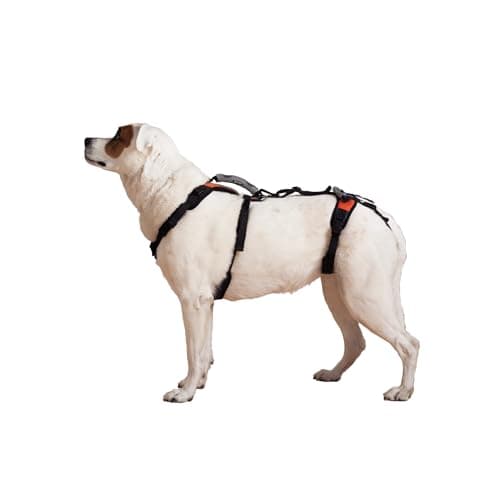
Help 'Em Up
Help 'Em Up Harness

GingerLead
GingerLead Dog Support and Rehabilitation Harness

Walkin' Pets
Walkin' Buddy Up Rear Harness
| Product | Score | Best for | Price | |
|---|---|---|---|---|
Help 'Em Up Help 'Em Up Harness | 9.5 | Long-term mobility support for senior or post-surgical large dogs | $95–$155 | View |
GingerLead GingerLead Dog Support and Rehabilitation Harness | 8.3 | Short-term post-surgical assistance and rear-end weakness | $32–$70 | View |
Walkin' Pets Walkin' Buddy Up Rear Harness | 6.8 | A dog with stable, non-progressive hind-end weakness whose front legs are sound — advanced hip arthritis, a healed spinal injury — where the rear half is all you will ever need. No longer the right buy for degenerative myelopathy | $39.95–$59.95 | View |
#1 — Help 'Em Up Harness: the all-day support system#
#1 Pick
Help 'Em Up
Help 'Em Up Harness
Our score
$95–$155
Best for
Long-term mobility support for senior or post-surgical large dogs
If your dog needs help getting up multiple times a day for the foreseeable future — post-TPLO, advanced hip dysplasia, hindquarter weakness in giant-breed seniors — this is the one to buy. It is the only harness in the category that supports the front and the back independently, which is what a dog with a bad hip and a compensating shoulder actually needs. Buy it from the manufacturer, not from Amazon: re-verified 18 August 2026, helpemup.com prices by size at $80 / $95 / $110 / $125 / $140 while Amazon runs $95 / $110 / $125 / $140 / $155 — a uniform $15 more at every size, every time we have checked.
Pros
- Two-piece (chest + hip) design lets you support either end independently
- Hip handle is purpose-built — not a converted car-seat-belt strap
- Padded chest plate distributes weight better than sling-only options
- Five sizes span 10 to 225 lb, and the rear half can be ordered a size smaller for a dog with muscle wasting
- Two hip-lift styles (Conventional and U-Band) so male dogs are not soiling the strap
Cons
- Amazon runs a uniform $15 above the maker's own price at every one of the five sizes, and the Amazon buy box is held by a third-party reseller (Veterinary Preferred) rather than by the brand — re-verified 18 August 2026
- The maker's own Mix & Match page prints two different starting prices, "From $80" and "FROM $95 USD", on the same page
- Direct pricing is no longer flat: since mid-August 2026 the maker charges $80 to $140 by size, so a giant-breed owner now pays $60 more than a terrier owner
- On 29 August 2026 the linked Amazon Medium (B0DK81SCG5) showed a future availability date rather than units on hand, while every size and style was in stock at helpemup.com the same day; on 9 September and again on 12 September 2026 the Amazon Medium still showed the future-date status at $125.00 with a maximum order of one and no ship date given, while all nine direct variants were in stock — two weeks of backorder on the channel we earn from, and one more reason the direct channel is the one to use
- Sizing is critical — measure twice, return is a hassle
- Rear straps can chafe the inner thigh if the harness is left tight while the dog lies down
- A dog filmed or gait-assessed while wearing it looks less lame than he is, because the harness offloads the limb you are trying to judge
- Bulkier than a quick-grab sling for short-term use
The Help 'Em Up is the answer to a problem the other two don't try to solve: a dog that needs help many times a day, indefinitely. It is a two-piece system — a padded, neoprene-lined chest plate up front and a separate hip piece behind — each with its own purpose-built handle. That means front-end help for a dog that can't push up, hip support for stairs, or both hands for a full lift into the car, without repositioning anything.
Because it is a fitted harness rather than a sling, the practical rhythm is: on in the morning, off at bedtime. Help is then always one grab away — which changes how often you actually give it. Owners with slings tend to ration assists because of the hassle; owners with handles just help.
Two claims we have deleted from this section. We used to say it "was designed in collaboration with veterinary rehab specialists" and that it "is the harness rehab vets most often prescribe." We have no source for either. Both were removed from the product page in July when we last audited it, and they should have come off this page the same day. Nobody publishes prescribing data for dog harnesses, so nobody — including us — can tell you which one rehab vets reach for most. If your dog is recovering from a cruciate surgery, it pairs naturally with the rest of our TPLO recovery guide, and your surgeon's actual instructions outrank anything on this page.
Sizing is where this product is won and lost, and the manufacturer publishes two rules almost nobody follows. First: sizing is by bodyweight, in five bands — X-Small 10–25 lb, Small 25–45, Medium 45–80, Large 80–125, X-Large 125–225. Second, and counter-intuitive: "If your dog's weight is between sizes, we recommend sizing down."[1] Most owners guess up, and a harness that is slightly too big is a harness that slides and chafes.
Then the choice between the two hip-lift styles, for which the maker gives an unusually concrete test: "If the tip of your dog's penis is not visible from a side view (see diagram), a U-Band is recommended."[1] Conventional is correct for every female dog. Get this wrong and the strap is soiled on every walk, which is how an expensive harness ends up in a cupboard.
If your dog has lost muscle over the back end — which is the usual reason people arrive at this page — the Mix & Match option lets you order the rear half a size smaller than the front. It is a separate SKU starting at $95, so on a Medium dog it is a $15 premium over the matched harness rather than the same price.[4] Usually still worth paying, because a rear half that hangs supports nothing.
Where to buy it, and this one runs against our own interest. Our Amazon link for the Medium is $125 from a third-party reseller called Veterinary Preferred rather than from Help 'Em Up, and on 14 August 2026 it was not showing as in stock at all.[5] The same harness is $110 direct. We earn a commission on the Amazon link and nothing on the manufacturer's site, and we would still rather you saved the fifteen dollars and bought from someone who has it.
The honest downsides: it is the most expensive option here, it is bulkier than a grab-and-go sling, and the rear straps can chafe the inner thigh if the harness is left tight while the dog lies down — the maker's own advice is to loosen them then.
There is also a cost to this product that has nothing to do with money. A dog wearing it does not walk like himself. If you are filming your dog's gait to track whether he is improving, or showing your vet a video, take the harness off for those ninety seconds — a hand on the hip handle offloads the exact limb you are trying to judge, and the improvement you record will belong to the equipment.
#2 — GingerLead: the walk-time sling#
#2 Pick
GingerLead
GingerLead Dog Support and Rehabilitation Harness
Our score
$32–$70
Best for
Short-term post-surgical assistance and rear-end weakness
The right tool for one specific job: a dog whose back end has failed while his front end is still working. In the first four to six weeks after hip or stifle surgery, or for a senior who can get his front paws onto the sill of a car but cannot follow through, it is faster to fit than a full harness and it costs less. It is not a general mobility aid — it does nothing for the front half of the dog, and the maker expects you to buy a chest harness separately for older dogs. Size it with the towel test before you order, because the 10-day return window is short for a product whose commonest failure is sizing. If your dog needs help at both ends, or will need help for more than a couple of months, buy the Help 'Em Up Harness instead — though note that is no longer a $10 decision: Help 'Em Up prices by size direct ($80 XS to $140 XL, re-verified 18 Aug 2026), so the medium-to-large dog this sling fits pays $110 or $125 there against $69.95 here.
Pros
- Single-piece sling — fast to put on for bathroom trips
- Cutout in the support pad clears male anatomy, so it can be left in position without soiling
- Integrated leash takes one accessory off your hands, and detaches if you don't want it
- Machine washable and dryable, which matters more than it sounds on a post-surgical dog
- No Amazon markup — $69.95 on Amazon and $69.95 direct from the manufacturer, re-verified 12 September 2026 (Amazon via the Creators API, direct from the Med/Lg product page)
- The maker sells reconditioned units — inspected, laundered and re-packaged, "Save up to 45%". We have never observed the reconditioned price itself, so treat this as arithmetic rather than a quote: 45% off the $69.95 Medium/Large is about $38 at the maximum discount, and less at anything below it. (Corrected 2026-09-05 — we previously printed "roughly $45", which was the Amazon behind-the-buy-box offer of $44.95 conflated with the direct discount.)
- Manufacturer publishes a free towel test that sizes the sling before you spend anything
- Credit where it is due: as of 1 September 2026 the Amazon listing carries "CHEST HARNESS NOT INCLUDED" in capitals in its first feature bullet and in the retail title. This was the single most commonly missed thing about the product and the maker now says it before you click buy
- Stay-on straps are included, which is what stops the sling sliding backwards on a dog with wasted hindquarters
Cons
- Rear-end only — not the right tool if a dog also needs front support
- Chest harness is not included, and the maker's own copy recommends clipping the leash to one for older dogs
- Only a 10-day clean return window; days 11–30 carry a $10 restocking fee and nothing is refunded after 30
- Long-term use can rub thighs without careful fitment
- Strap-end handles are less ergonomic than padded handles
- Sized by pad width and by the dog's sex, not by a simple size ladder — easy to order wrong
- The Amazon listing contradicts itself on the weight floor — one bullet says "FEMALE dogs over 45 lbs and MALE dogs over 60 lbs", another says "dogs weighing over 45 pounds" flat (both live 19 Aug 2026)
- On Amazon the cheaper of the maker's two offers on this ASIN is not the one in the buy box, so the default click costs $25 more — and as of 1 September 2026 that cheaper $44.95 offer is no longer straightforwardly buyable: the same merchant now returns it as AVAILABLE_DATE with an empty message (backorder), where on 19 August it showed 7 units in stock. Corrects our own earlier advice — opening the other-offers panel is still worth doing, but it may no longer save you anything today
The GingerLead solves the mid-walk problem: a dog that starts strong and then sags in the last third, or a post-surgical dog that needs steadying for bathroom trips. It is a single padded sling that slips under the rear in seconds, with an integrated leash so you are not juggling three straps and a dog.
Two details show how well this product understands its job. It comes in separate male and female versions, with the padding shaped around anatomy so the dog can relieve itself without soiling the sling. And it is easy to wash — which matters more than any spec sheet admits when you are supporting a wobbly dog in the yard at dawn.
The free sizing method, which is the most useful thing the company publishes. Sizing is by support-pad width, not by a size ladder, and GingerLead tells you how to test it with a bath towel before you spend anything. For a male dog: fold a towel to 5.5 inches wide to simulate the Medium/Large, and sling it under the belly in front of the penis; if that is too wide, refold to 3.5 inches for the Small Male. For a female: start at 7.5 inches for the Large Female, then 5.5, then 4.[6] Two of their own rules go with it: barrel-chested dogs commonly downsize, and a dog between sizes takes the smaller one because the pads do not bunch.
Two things the listing does not lead with. The chest harness is not included — the maker's FAQ says so outright, and its own copy expects the integrated leash to clip "to a chest harness for older dogs needing additional support," which describes most buyers of this product.[7] Budget for a second purchase.
And the return window is 10 days, which is short for a product whose commonest failure is sizing: a refund inside 10 days less shipping, a $10 restocking fee on days 11–30, and nothing after 30. Two conditions inside that policy cut in opposite directions and both deserve printing. In the buyer's favour, and unusually decent: returned components must be undamaged, and GingerLead explicitly states "we do not consider hair or if it's a little soiled as damage" — you are allowed to have actually used it. Against the buyer, and important given where our link points: the refund policy applies to purchases "made through www.gingerlead.com," so an Amazon order is outside it.[8] There is a separate 60-day warranty against material and workmanship defects, which excludes damage caused by your pet.
Its limits are the flip side of its simplicity: it supports the rear only, the strap-end handles are less comfortable in the hand than padded ones during long sessions, and worn daily for months it can rub the thighs without careful fitting. So the verdict is time-based rather than price-based — and note that the price argument for it is weaker than we used to claim. At $69.95 direct, matched exactly by Amazon, where GingerLead itself holds the buy box, it is about $40 below a Medium Help 'Em Up, not half the price.[9] For the first 4–6 weeks after surgery, or for a dog that only needs walk-time support, it is still the right tool. When "temporary" turns into "the new normal," step up. One more thing worth knowing if money is tight: GingerLead sells reconditioned slings on the same listing at $44.95, described by them as inspected, laundered and re-packaged.[9]
#3 — Walkin' Buddy Up Rear Harness: the budget daily rear harness#
#3 Pick
Walkin' Pets
Walkin' Buddy Up Rear Harness
Our score
$39.95–$59.95
Best for
A dog with stable, non-progressive hind-end weakness whose front legs are sound — advanced hip arthritis, a healed spinal injury — where the rear half is all you will ever need. No longer the right buy for degenerative myelopathy
We can no longer recommend this for a progressive disease, and that is a reversal of what this page used to say. The harness itself is sound and the cart compatibility is still the best reason in the category to choose it — but Walkin' Pets has stopped selling the line, the front half you were told to add later cannot be bought, and what remains on Amazon is a reseller working through stock. For a dog with a stable rear-end problem who needs a good harness now and will never need a second one, at $40–$60 it is still a fair buy. For a dog with degenerative myelopathy, buy a two-piece system that will still exist in a year.
Pros
- Built for chronic rear support rather than short post-op trips, with a top handle you guide and lift from rather than a strap you hold under the belly
- Attaches to a Walkin' Wheels cart, which matters enormously for a progressive disease — most rear-support gear does not, and a harness that cannot connect to the cart your dog ends up in is a purchase you make twice
- Sized on abdomen girth as well as bodyweight, which is the dimension that actually decides fit on a barrel-chested or a wasted dog
- Neoprene contact surfaces, and it stays on between lifts
Cons
- Walkin' Pets no longer sells this harness. As of 14 August 2026 the word "Buddy Up" appears nowhere in the manufacturer's 69-product store feed or its 70-URL product sitemap, and the old product URLs return 404. What is left on Amazon is reseller stock
- The companion front harness — the one the maker's own listing tells you to "pair with... for full body support" — cannot be found on sale anywhere we looked, including a descriptive Amazon search that surfaces all three remaining sizes of the rear. The modularity this product was sold on is gone, and the Amazon bullets still advertise it
- The maker has now answered the question itself. On 4 September 2026 walkinpets.com/products/buddy-up-harness-rear — the Buddy Up rear product URL, which returned 404 on 14 August — resolves to the **Help 'Em Up Harness** page instead. A redirect to a different product is a manufacturer telling you what to buy in its place, and it is the clearest discontinuation receipt we have
- The Amazon buy box is held by a third-party reseller, "Veterinary Preferred," not by Walkin' Pets. There is no manufacturer behind your purchase in the ordinary way, and no replacement path when the neoprene wears out
- Walkin' Pets publishes no warranty at all — its site carries a refund policy and a privacy policy and nothing else. And its returns terms are harsh for exactly this buyer: no exchanges of any kind, a restocking fee of 8–12%, and a harness returned "heavily soiled with strong pet odors, embedded fur [or] visible stains" is graded ineligible for any refund
- Less padded than the Help 'Em Up, which tells against it for a dog wearing it most of the day
- Not suitable as front-end support on its own
- Determined dogs back out of it without close fitment — measure before ordering
A naming correction first, because it could cost you money. This page previously called this product the "Walkin' Lift Combo." That is a different Walkin' Pets product. What we recommend and card here is the Buddy Up Rear Harness, and the variant our link resolves to is the Large, rated 65–95 lb with a 22–27 inch abdomen girth, at $59.95.[3] Buy by that girth measurement, not by the weight.
It sits deliberately between the other two: built for chronic, daily rear-end support like the Help 'Em Up, priced closer to the GingerLead. It is the pick when rear weakness is the long-term problem — degenerative myelopathy progression, advanced hip arthritis — but the front end is fine and the budget is real. We have also corrected its price band here: we used to print $60–$110, and the real range across the sizes we could verify is $39.95 Small, $49.95 Medium, $59.95 Large.
Its design gets two things right for daily wear: it distributes pressure away from the belly and groin, and the leash-style handle lets you support the dog while standing upright instead of stooping. Deleted from this section: we used to claim "Walkin' Pets has the largest sizing chart in the category." Nobody has counted that, we certainly have not, and it would tell a buyer nothing even if it were true.
Trade-offs: it is less padded than the Help 'Em Up, so long sessions can rub; a determined dog can back out of a sloppy fit; and the one that matters most for a progressive disease is stated by the maker itself — the listing tells you to "pair with our Buddy Up Front Harness for full body support," so for a dog whose weakness is climbing forward this is the first of two purchases, where the Help 'Em Up two-piece is one.
How should a lift harness actually fit?#
Where the weight lands is the difference between a support and an injury:
- Front support belongs on the sternum and ribcage — a padded plate across the chest, never pressure on the throat.
- Rear support belongs under the pelvis, cradling the area between hip and thigh. It should never press into the soft belly, and it should sit clear of the groin so the dog can pee normally.
- Lift vertically and gently. Take up just enough weight that the dog stops sagging, and let the legs keep working. Hoisting the rear high — the "wheelbarrow" — throws load onto the front end and defeats the point.
Check three chafe zones daily for the first week: behind the elbows (front pieces), the inner thighs (rear supports), and anywhere a strap edge meets thin belly skin. Redness or thinning hair means adjust the fit, add wear breaks, or size differently. Dogs that live in a harness all day should still sleep out of it.
And measure before you order. Every one of these brands publishes a chart keyed to specific measurements — girth, not weight, is what determines fit, and eyeballing is the number-one cause of returns.

The part nobody mentions: your back#
A pull-up aid for a large dog with arthritis is also a piece of equipment for you, and this is the one part of the page where there is a published standard to point at rather than an opinion.
Veterinary researchers have already made the connection. In the introduction to a study measuring dogs jumping out of car boots, the authors note that lifting "an animate and unpredictable object (such as a dog, weighing up to 50 kg) scores highly in a workplace manual handling risk assessment particularly when twisting/stooping postures are employed," and conclude that "from a health and safety perspective lifting larger dogs should preferably be avoided."[10]
The UK Health and Safety Executive publishes the grid behind that. How much weight counts as low-risk depends almost entirely on where your hands are:[11]
| Hand height | Close to the body | Arms extended |
|---|---|---|
| Elbow to knuckle height | 25 kg men / 16 kg women | 15 kg / 10 kg |
| Knuckle to mid lower leg | 20 kg / 13 kg | 10 kg / 7 kg |
| Below mid lower leg | 10 kg / 5 kg | 5 kg / 3 kg |
Read the bottom-left corner, because that is a dog on the floor: 10 kg for a man, 5 kg for a woman. Hoisting a 30 kg Labrador from a stoop is not a borderline lift by this filter, it is several times outside it. Move the same dog up to knuckle height and close to your body — which is exactly what a hip handle on a fitted harness does — and the filter rises to 20 and 13.
That is the whole mechanical case for a harness with handles, and it is worth being precise about what it means: the harness does not make your dog lighter. It moves the same weight into a row of the grid where the risk is lower.
Three cautions, all of which the HSE states itself. The guidelines are explicitly "not 'safe limits' for lifting and carrying" — they are a filter for deciding which tasks need a proper assessment, so nobody is claiming 11 kg injures you and 9 kg does not. The grid assumes "the load is easily grasped with both hands and is handled in reasonable working conditions, with the worker in a stable body position," which a struggling dog is not. And it tells you to reassess as soon as "the handling involves torso twisting," which lifting a dog beside you always does.[11]
So: the Help 'Em Up's foam-padded handles sit where you can lift with a straight back. The Walkin' Buddy Up Rear's leash-style handle exists specifically to keep you upright on walks. The GingerLead's integrated leash keeps one hand free. If you have back trouble yourself, weight the padded-handle and long-handle options heavily — the best harness is the one that keeps both of you off the injured list. Round out the setup with the rest of our recovery gear list if you are heading into a surgical rehab, and if the real problem is getting into the car rather than off the floor, our guide to getting a dog into a car does this arithmetic against a tailgate.
When a harness isn't the answer#
A lift harness supports function that still exists. It is the wrong tool when:
- The rear legs no longer bear weight at all, even with steadying — that is a wheelchair conversation, had with a rehab professional who can do the fitting, not an impulse purchase.
- The weakness appeared suddenly, or comes with dragging, knuckling, or incontinence — that is an emergency exam, today. Our weak back legs guide covers the red flags.
- The real problem is the environment. A dog that only struggles on the hallway floor needs traction fixes; a dog that only struggles at the car needs a ramp.
The bottom line#
Buy the Help 'Em Up if your dog needs help several times a day for the foreseeable future — and buy it direct, where a Medium is $110 against the $125 our own Amazon link charges through a third-party reseller. We earn a commission on that link and nothing on the manufacturer's site, and we would still rather you saved the fifteen dollars. Buy the GingerLead for walk-time sagging or the first 4–6 weeks after surgery, understanding that it saves you about $40 on a mid-size dog rather than half the price, and that its refund policy only covers purchases made on its own site. Buy the Walkin' Buddy Up Rear if chronic rear support is the need and even that is not in the budget — measuring the abdomen girth, not weighing the dog.
We earn the same affiliate rate on all three. Nothing changes for us whichever you pick, which is exactly why we can tell you that two of the prices on this page were wrong until today.
Whichever you choose: measure before ordering, check the chafe points for the first week, lift just enough and no more — and start before the third fall, not after it.
Frequently asked
- What is the best lift harness for a senior dog?
- It depends on when the dog needs help. For assistance several times a day, every day, the Help 'Em Up is the standard — a two-piece harness with padded handles at the chest and hips that stays on all day. Correction, August 2026: we used to describe it as a flat $80 direct. It is not flat, it is tiered by size, and we were wrong. Direct prices verified 14 August 2026 are X-Small $80, Small $95, Medium $110, Large $125, X-Large $140. For dogs that only sag on walks, the GingerLead sling is $69.95 and goes on and off in seconds. For chronic rear-end weakness on a budget, the Walkin' Buddy Up Rear runs $39.95–$59.95. So for a mid-size dog the harness is about $40 more than the sling, not double it.
- How long can a dog wear a lift harness each day?
- A fitted full-body harness like the Help 'Em Up can stay on through the waking day — on in the morning, off at night, with a daily check of the contact points for rubbing, especially behind the elbows and around the thighs. Slings like the GingerLead are worn minutes at a time, for a walk or a bathroom trip. Any redness or hair loss under a strap means the fit needs adjusting.
- Can my dog still pee while wearing a support harness?
- Yes — if the fit is right. This is a real design problem, and the good products solve it: the GingerLead comes in separate male and female versions with the pad shaped to avoid soiling, and the Walkin' Buddy Up Rear routes pressure away from the belly and groin. On the Help 'Em Up, the maker gives a concrete test for which hip-lift style a male dog needs: if the tip of your dog's penis is not visible from a side view, order the U-Band rather than the Conventional. With a bath towel or a generic sling, soiling is common — one of the main reasons purpose-built supports are worth the money.
- Is a lift harness better than a towel under the belly?
- For more than a day or two, yes — though be clear that no study has compared them, so this is reasoning rather than evidence. A towel concentrates pressure on the belly instead of the pelvis, gives you no control over where the lift lands, soaks up urine, and forces you to walk bent over. That last one is the part with a standard behind it: the UK Health and Safety Executive's lifting filter drops sharply once your hands are low and your arms are extended, which is exactly the towel posture. A purpose-built rear support costs $40–$70 and fixes all four problems. Use the towel first anyway, for a day, because it tells you free of charge which end of your dog actually needs holding.
- Do lift harnesses work for recovery after TPLO or hip surgery?
- Yes — post-surgical support is one of the most common uses. A rear sling like the GingerLead covers the first 4–6 weeks of recovery, when a dog needs steadying on stairs and bathroom trips. For large dogs, long recoveries, or dogs facing surgery on both knees over time, the Help 'Em Up two-piece is easier to live with because it stays on. Follow your surgeon's activity restrictions either way.