Owner's Guide
How Do I Get My Dog Into the Car When He Can't Jump and I Can't Lift Him?
The bumper is four problems wearing one coat. How to tell which one you have, what the published lifting guidelines say about the crouch you do six times a week, and why the way out matters most.

You are crouched at the bumper with both arms under a dog who used to do this himself, and you are trying to work out whether the problem is his hips, his nerve, or your back. It is worth separating those, because "he can't get in the car" is four different problems with four different answers. Before you buy anything: measure the sill height from the ground where your dog actually stands, and watch which end of him fails. If his front legs reach the sill and the rest does not follow, that is a hindquarter problem and a boost fixes it. If he will not attempt it at all, that is a different conversation. And whatever you decide about getting him in, plan the way out first — that is the half with the measured load on it.
Affiliate disclosure: Dog Orthopedic is reader-supported. When you buy through links on our site we earn a commission at no extra cost to you — about 3% on most pet products, and the same rate on every product we compare, so no pick earns us more than another. Prescription medication earns us nothing, and seeing your vet earns us nothing; we recommend both anyway. Learn more.
Imagery: Lifestyle photographs on this site are licensed from Pexels (royalty-free) and credited per image. Pexels imagery illustrates conditions and contexts — it does not depict the specific dogs or test sessions described in the text. Product photographs come from Amazon's Creators API. Breed portraits are illustrations of typical breed type rather than photographs of individual dogs, and are not drawn to scale against one another.
First, which of the four problems do you actually have?#
Everyone arrives at this question with one worry and a shopping tab open. There are four failures at the tailgate, they look similar from two feet away, and they need different things.
| What you see | What has failed | What fixes it |
|---|---|---|
| Front paws reach the sill, the back end does not follow | Hindquarter power — the push comes from behind | A boost under the belly, timed to his effort |
| He gathers himself, then doesn't commit | Confidence, or the surface underfoot | Traction and training, not more strength |
| He gets in fine and lands hard coming out | Forelimb tolerance of the drop | A ramp, or a controlled lift down |
| He can do it, but you have started lifting him anyway | Nothing about the dog. Your capacity, or your nerve about his | An honest look at the lift you are doing |
The fourth row is the one nobody writes down, and it is the one that quietly decides what happens next. A household that has started lifting a 70 lb dog by hand has taken on a daily task with a real cost attached, and that cost lands on a person who did not consent to it in any formal way. It is worth pricing.

What the published guidance says about the lift you are already doing#
There is a standard that governs how much a person should lift at work, and it has been applied to exactly this. In the introduction to the study that measured dogs jumping out of cars, the authors write that lifting "an animate and unpredictable object (such as a dog, weighing up to 50 kg) scores highly in a workplace manual handling risk assessment particularly when twisting/stooping postures are employed," and conclude that "from a health and safety perspective lifting larger dogs should preferably be avoided."[2]
That is a veterinary paper telling you not to do the thing you are doing six times a week. It is worth seeing the arithmetic behind it, because the numbers are smaller than anyone expects.
The UK Health and Safety Executive publishes a filter for lifting and lowering. It is a grid: how much weight is low-risk depends entirely on where your hands are.[3]
| Where your hands are | Guideline weight, men | Guideline weight, women |
|---|---|---|
| Knuckle height, close to the body | 25 kg (55 lb) | 16 kg (35 lb) |
| Elbow height, close to the body | 20 kg (44 lb) | 13 kg (29 lb) |
| Knuckle height, at arm's length | 15 kg (33 lb) | 10 kg (22 lb) |
| Mid lower leg height, at arm's length | 10 kg (22 lb) | 7 kg (15 lb) |
| Near the floor, at arm's length | 5 kg (11 lb) | 3 kg (7 lb) |
The last two rows are the crouch at the bumper. Your hands are low, because the dog is on the ground — somewhere between mid lower leg height and the floor itself. They are extended, because you cannot get your feet under a dog. And the HSE is explicit that the whole grid assumes "the load is easily grasped with both hands and is handled in reasonable working conditions, with the worker in a stable body position," and that you need a fuller assessment as soon as "the handling involves torso twisting" — which loading a car always does, because the car is beside you and not in front of you.[3]
The American equivalent, the revised NIOSH lifting equation, gets to the same place by a different route. It starts from a load constant of 23 kg (51 lb) and multiplies it down for reach, height, travel, twist, frequency and grip quality.[4][5] Put in the tailgate: hands 40 cm out from your ankles, starting 20 cm off the ground, travelling 55 cm up, with a 30-degree twist, a few times a day, on a load you cannot get a proper grip on. The multipliers come out at 0.63, 0.84, 0.90, 0.90, 1.00 and 0.90, and the recommended weight limit is about 8.9 kg — roughly 20 lb.
Two independent filters, built by different agencies from different data, landing in the same territory: NIOSH's illustration comes out around 20 lb, and the HSE grid puts hands this low and this extended at 7 to 22 lb depending on exactly where they are. Every one of those numbers is a fraction of the weight of the dogs this article is about — and the NIOSH figure, remember, is our own arithmetic on inputs we chose, applied to a task the equation's authors exclude, as the sources note explains.
Be careful how you read that, because both documents are careful about it themselves. The HSE says outright that the Regulations "do not set specific weight limits, so the guidelines are not 'safe limits' for lifting and carrying" — they are a screen for identifying which tasks need a proper assessment.[3] Nobody is telling you that 23 lb injures you and 21 lb does not. What both filters are telling you is that this lift, at this geometry, has fallen outside the range where anyone is willing to call it low-risk without looking at it properly.
And there is a part that matters more than either number. NIOSH does not merely say the lift is heavy; it says the equation does not apply to lifting "with one hand," "in a restricted work space," or "objects that are unstable."[6] Every one of those exclusions describes what you are doing at the bumper: one hand on the dog and one on the tailgate, wedged between the car and the kerb, holding something that can shift its own weight without warning.
You are not weak, and you have not been doing it wrong. You are performing, several times a week, a lift that the standard written to assess lifts declines to assess.

The technique, and an honest note about where it comes from#
The lifting mechanics below are well-established and come from occupational safety guidance rather than from canine biomechanics — nobody has run a trial comparing ways of picking a dog up. What follows is convention applied carefully, and it is worth saying so plainly rather than dressing it as evidence.
Occupational-safety training material written for veterinary practices — published by an insurer that sells loss-prevention training to clinics, not by a veterinary body, which is worth knowing before you weigh it — sets the threshold for a two-person lift at 40 lb for animals. That is far lower than most owners would guess, and lower than most of the dogs this article is about.[7] The same guidance is specific about how a two-person lift goes wrong: one person must be in charge, the lift must start on an audible count, and if either person is losing their grip they say so and both put the dog down together rather than one of them fighting it.[7]
If you are lifting anyway:
- Clear the path before you touch the dog. Boot open, blanket down, nothing to step over, nothing to trip on, and somewhere clear to put him down. Deciding where he goes while you are holding him is how backs go.
- Get close before you get low. Distance costs you more than weight does — that is the whole shape of the HSE grid above.
- Bend the knees, not the back, feet apart with one foot forward, and tighten your stomach before you take the weight.
- Bring him to your chest first, then straighten. The lift and the carry are two movements. Doing them as one is how you end up straightening with the load out in front of you, which is the worst position in the table.
- Put him down on the sill, not in the boot. Reaching across the sill to place a dog on the far side turns a bad lift into a bad lift with a long horizontal reach on the end of it. Land him on the edge and let him walk in, or slide him.
- Turn with your feet. Do not twist your spine under load. If the car is behind you, step round.
- Two people for anything over 40 lb, with one person calling it.
For the dog's end of it: support the chest and the hindquarters at the same time, keep his spine level rather than letting the back end hang, and never lift a dog by hooking under his front legs — his whole weight ends up on two shoulder joints and a spine with nothing under the middle. If your dog has a diagnosed back problem or has had spinal or orthopedic surgery, ask the surgical team how they want him handled, because the answer is procedure-specific and it is not ours to guess.
“Because your dog can't tell you how much pain he or she is in.”
The half nobody plans: getting him out#
Almost every conversation about this is about getting the dog in. The measured load is on the way out.
Fifteen healthy adult dogs jumped from platforms set at 0.55, 0.65 and 0.75 m, heights chosen to represent common vehicle boot sills, onto a force plate. Peak vertical force through the pair of front limbs was 27.35 ± 4.14 N/kg from the lowest platform, 30.84 ± 3.66 from the middle, and 34.12 ± 3.63 from the highest, every step significant at P = 0.001. Across the full 8-inch range the increase was 24.8%.[2] Those front limbs already carry a mean of 60.4% of a dog's mass while he is just standing there.[8]
| Sill height | Peak force through both front legs | Roughly, in body weights |
|---|---|---|
| 0.55 m / 22 in | 27.35 N/kg | 2.8× |
| 0.65 m / 26 in | 30.84 N/kg | 3.1× |
| 0.75 m / 30 in | 34.12 N/kg | 3.5× |
Four honest qualifications, because this number gets quoted badly.
It measured loading, not injuries. The authors state that the study "did not attempt to investigate the consequences of vGRF on joints and soft tissues" and that no evidence can be provided linking the increased force to injury.[2] Nobody can tell you your dog's odds.
Force does not scale as fast as height. Going up 18% in height bought only a 12.8% rise in force. The relationship is real and it is gentler than intuition suggests.
And in a different context, lowering the height did nothing measurable at all. Nine Border Collies jumping a hurdle at 20 inches versus 16 inches showed no significant difference in peak forelimb landing force — 266.4% of body weight against 260.9%, p = 0.4228. (Those are per-forelimb figures, so do not set them beside the car study's numbers, which are for the pair; the point here is the null result, not the magnitude.)[9] That is a running horizontal jump over an obstacle rather than a standing drop out of a boot, and nine dogs of one breed, so it does not overturn the car study. But it is a fair warning against believing that shaving a few inches off a height is automatically doing something.
The dogs in the car study were set up to succeed, and yours is not. They were healthy, screened for lameness that morning, warmed up for five minutes, and jumped from a sit on a non-slip surface onto more non-slip surface. The authors themselves note that a dog jumping from a vehicle "may have undergone an extended period of recumbency meaning that they lack the warm up that is essential for injury prevention."[2] Your dog has been folded up in the back for forty minutes, is stiff, is excited, and lands on wet tarmac.
So: the number is softer than the internet says, and the situation is harder. If you are going to change one thing about your dog's week, the jump down from the car is a reasonable thing to pick — not because it is proven to injure him, but because it is a large repeated load that costs almost nothing to remove.
Where you park is a free adjustment, and most people never make it#
Before any purchase, three things cost nothing and change the geometry more than most equipment does.
Measure the sill from where the dog's feet will be. Not from the pavement by the driver's door. If you reverse onto a driveway that falls away toward the road, the slope is added to your sill height. Park nose-down on that same driveway instead and you get it back. How much that is worth depends entirely on your driveway, which is exactly why the instruction is to measure it rather than to assume it.
Give the ramp somewhere to land. This is the constraint to check before a ramp is ordered rather than after it arrives, and the arithmetic is simple: a ramp of length L reaching a sill of height h needs √(L² − h²) of clear ground behind the car.
| Ramp length | To a 22 in sill | To a 26 in sill | To a 30 in sill |
|---|---|---|---|
| 42 in | 35.8 in run, 31.6° | 33.0 in run, 38.2° | 29.4 in run, 45.6° |
| 62 in | 58.0 in run, 20.8° | 56.3 in run, 24.8° | 54.3 in run, 28.9° |
| 71 in | 67.5 in run, 18.0° | 66.1 in run, 21.5° | 64.3 in run, 25.0° |
One thing to say before you use that table: there is no published veterinary threshold for a safe ramp angle for dogs. Nobody has run the study. We use a practical working ceiling of about 20–25 degrees across this site, and it is a convention rather than a finding — useful for comparing one setup against another, not a line that means anything on its own.
With that said, read the right-hand column twice. A 71-inch ramp to a 30-inch SUV floor sits at 25 degrees — and needs five feet four inches of clear floor behind the tailgate to do it. In a parallel parking space with a car behind you, or in a garage with a wall four feet back, you do not have that. This is geometry rather than a study, and you can check it with a tape measure in the place you actually park, which is the only place the answer matters. Our ramp guide has the fuller version of the angle question.
Fix the footing at both ends. A dog stepping onto wet tarmac from a boot is doing the same thing that makes him skid on your kitchen floor, and the fix is the same: something with grip where the paws land. A bath mat with a rubber backing, thrown down where he steps off, costs nothing extra and removes the variable that turns a controlled descent into a scramble. We go through the whole traction question in why your dog slips on the floor.
The equipment, in the order it is worth buying#
Start from the fact that most readers here need a ramp and not a lifting device, and that the free adjustments above come first.
The ramp, if you have the ground for it#
#1 Pick

Pet Gear
Pet Gear Tri-Fold Pet Ramp
Our score
$85–$120
Best for
Hesitant and refusing dogs, indoor steps, couches, and cars up to about a 30-inch sill
The ramp we reach for first when a dog has already refused one. The extra width and the raised side edges do more for acceptance than any other feature at this price, and the carpet tread solves the surface problem that stops most dogs before height is ever the issue. It is heavier than its "portable" billing suggests, and the 200 lb ceiling rules it out for giant breeds. Buy it for the hesitant dog, not for the hiking-and-rain dog. Two corrections we owe you before you click: the warranty is 30 days, not the year this page used to print, and Pet Gear now sells the same 71-inch frame with a removable washable supertraX mat instead of fixed carpet — if your dog goes out in the wet, pay the extra sixteen dollars for it.
Pros
- 19.5 inches wide — roughly 3.5 inches wider than most ramps in this price band, which is the difference between a stiff dog placing four feet confidently and refusing
- Raised edges along both sides give a dog a boundary he can feel without looking down
- Carpet-textured skid-resistant tread, so a nail-scraping dog will walk it without you having to cover it with a towel
- 71 inches long — a 25-degree incline to a 30-inch SUV floor, within an inch of what a fully extended telescoping ramp achieves
- Safety tether and rubber base grippers included; attached carry handle
- Rated to 200 lb
Cons
- The warranty is 30 days, not a year — Pet Gear's own listing field reads "30 day non-transferrable limited warranty" on every 71-inch variant we checked on 11 August 2026. We had published a 1-year warranty since this page was created and it was wrong
- Heavy — 25.2 lb on Amazon's own figure for the reflective 71-inch sibling and 27 lb for the supertraX version. The 15 lb figure floating around the range belongs to the 16-inch-wide Travel Lite, a different ramp. Two-hand carry
- Carpet absorbs water and stays damp — not the ramp for a dog who goes out in the rain daily. The newer supertraX variant has a removable washable mat and solves this for about $16 more
- 200 lb rating is a real ceiling for giant breeds, and for anyone who wants to walk up alongside their dog
- Fixed 71-inch length: there is no shortening it for a 16-inch couch, so it is a large object to store and to swing around a hallway
- The Titanium variant (9300TI) that this page linked until 29 August 2026 read "Only 4 left in stock (more on the way)" on six consecutive checks (30 July, 11, 15, 23 and 29 August, 17 September and 5 October, by which point the same four units had cost $99.46) — a standing availability problem, not a blip — so our link now goes to the reflective sibling (AM9300RF), the same 71 × 19.5 × 4 inch frame, 200 lb rating and 30-day warranty, which was cleanly in stock at $89.50 on 29 August 2026, $4.70 cheaper than the Titanium that day
The reason this is rank one is not the tread or the weight rating; it is that a ramp removes the load from both ends of the journey, and a lifting aid only changes the geometry of a lift you are still doing yourself. He walks up, and — the half that matters — he walks down.
The specific thing to check before you order — and it is not a number the listing will hand you — is the run-out. This is the 71-inch model, and at a 30-inch sill it needs about 64 inches of clear ground behind the tailgate. Go and stand where you actually park and measure that. If you park nose-in in a garage, or parallel on a street, or in a bay with a wall behind, the ramp may be geometrically correct and physically impossible, and no amount of training fixes that. A shorter ramp is not the answer either, because the same table shows a 42-inch ramp reaching the same sill at 45.6 degrees, which is a slide.
Who should not buy this one. A dog who needs a ramp to a 16-inch couch — the fixed 71-inch length cannot be shortened, and this is where an adjustable telescoping ramp genuinely wins. A household where the person deploying it cannot manage the carry weight; the manufacturer's spec sheet for this range and the retailer listings disagree with each other about that weight, quoting figures from around 16 lb up to 26 lb, and we publish the disagreement rather than pick a side. And a dog with a diagnosed forelimb problem, for whom the descent down a ramp is still a descent, just a longer one. One more, for exactly this article's readers: the 200 lb rating is the combined load, so a very heavy dog plus your steadying hand pressing down on his back is closer to that ceiling than it looks.
Before you spend anything: if your dog only struggles with one specific car and you have a second, lower vehicle in the household, use that one. It is not a clever answer, but it is free and it works from tonight.
The rear boost, if his front end is fine#
#2 Pick

GingerLead
GingerLead Dog Support and Rehabilitation Harness
Our score
$32–$70
Best for
Short-term post-surgical assistance and rear-end weakness
The right tool for one specific job: a dog whose back end has failed while his front end is still working. In the first days to weeks after hip or stifle surgery (for as long as he cannot yet steady himself on a hard floor, which after a pelvic osteotomy is often only days), or for a senior who can get his front paws onto the sill of a car but cannot follow through, it is faster to fit than a full harness and it costs less. It is not a general mobility aid — it does nothing for the front half of the dog, and the maker expects you to buy a chest harness separately for older dogs. Size it with the towel test before you order, because the 10-day return window is short for a product whose commonest failure is sizing. If your dog needs help at both ends, or will need help for more than a couple of months, buy the Help 'Em Up Harness instead — though note that is no longer a $10 decision: Help 'Em Up prices by size direct ($80 XS to $140 XL, re-verified 18 Aug 2026), so the medium-to-large dog this sling fits pays $110 or $125 there against $69.95 here.
Pros
- Single-piece sling — fast to put on for bathroom trips
- Cutout in the support pad clears male anatomy, so it can be left in position without soiling
- Integrated leash takes one accessory off your hands, and detaches if you don't want it
- Machine washable and dryable, which matters more than it sounds on a post-surgical dog
- No Amazon markup — $69.95 on Amazon and $69.95 direct from the manufacturer, re-verified 12 September 2026 (Amazon via the Creators API, direct from the Med/Lg product page); Amazon re-read through the Creators API on 19 October 2026, $69.95 in stock, unchanged
- The maker sells reconditioned units — inspected, laundered and re-packaged, "Save up to 45%". On 8 October 2026 we observed a reconditioned price for the first time: the $44.95 second offer on the Amazon listing we link, from the maker's own storefront, is listed as Used / Like New with the note "A reconditioned GingerLead dog sling may have only been used a few times." That is 36% off the $69.95 new unit. (Corrected 2026-09-05 — we had printed "roughly $45" as the direct discount before we could tell what the $44.95 offer was; it is the reconditioned unit.)
- Manufacturer publishes a free towel test that sizes the sling before you spend anything
- Credit where it is due: as of 1 September 2026 the Amazon listing carries "CHEST HARNESS NOT INCLUDED" in capitals in its first feature bullet and in the retail title. This was the single most commonly missed thing about the product and the maker now says it before you click buy
- Stay-on straps are included, which is what stops the sling sliding backwards on a dog with wasted hindquarters
Cons
- Rear-end only — not the right tool if a dog also needs front support
- Chest harness is not included, and the maker's own copy recommends clipping the leash to one for older dogs
- Only a 10-day clean return window; days 11–30 carry a $10 restocking fee and nothing is refunded after 30
- Long-term use can rub thighs without careful fitment
- Strap-end handles are less ergonomic than padded handles
- Sized by pad width and by the dog's sex, not by a simple size ladder — easy to order wrong
- The Amazon listing contradicts itself on the weight floor — one bullet says "FEMALE dogs over 45 lbs and MALE dogs over 60 lbs", another says "dogs weighing over 45 pounds" flat (both live 19 Aug 2026)
- On Amazon the cheaper of the maker's two offers on this ASIN is not the one in the buy box, so the default click costs $25 more. The cheaper offer comes and goes: 7 units on 19 August, a backorder (AVAILABLE_DATE) on 1 and 23 September, back in stock with 7 left on 8 October 2026, when the listing data showed it as Used / Like New, a reconditioned unit. Open the other-offers panel and check the condition before you rely on it
This is for one specific dog: the one whose front paws reach the sill and whose back end does not follow. He does not need lifting; he needs a hand under the belly at the moment he pushes, so that his own effort is enough. That timing is the whole skill — you are adding to his push, not replacing it, and a boost delivered a second late is a boost that does nothing.
Do the free version first, and it happens to be the manufacturer's own recommended sizing method. GingerLead publishes a towel test. For a male dog: fold a bath towel to 5.5 inches wide to simulate the Medium/Large, sling it under his belly in front of his penis, and if that is too wide, re-fold to 3.5 inches for the Small Male. For a female: start at 7.5 inches for the Large Female and step down through 5.5 for the Medium/Large to 4 inches for the Small Female. For barrel-chested dogs, they say, "downsizing is common." That test costs nothing, and it answers two questions at once: whether a rear boost is actually the fix, and which size you would need if it is.
Two honest costs. The linked variant is the M/LG unisex with the cutout, which the manufacturer says typically fits female dogs over 45 lb and male dogs over 60 lb, with a 5.5-inch pad — and the chest harness is not included. GingerLead's own listing says the integrated leash may be clipped "to a collar for younger dogs recovering from orthopedic surgery or to a chest harness for older dogs needing additional support," which means the older dog most likely to need this is also the dog who needs something else bought alongside it. And the return window is short: 10 days from delivery for a clean refund less shipping, a $10 restocking fee from day 11 to day 30, nothing after that, with return postage on you. On a product the manufacturer sizes by pad width and sex rather than a simple size ladder — and whose own sizing page exists to stop people ordering wrong — a 10-day window is a real cost, which is exactly why the towel test is worth ten minutes before you order.
The full harness, if the lifting is going to continue#
#3 Pick
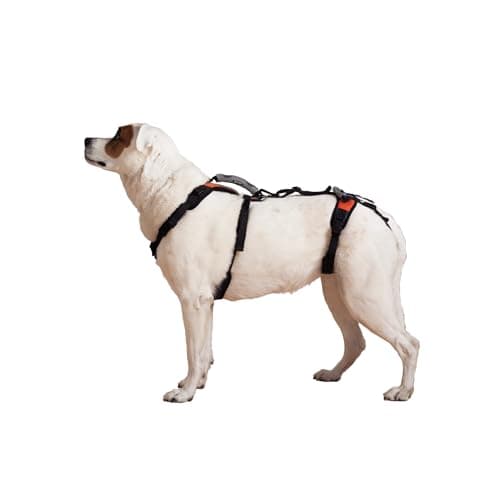
Help 'Em Up
Help 'Em Up Harness
Our score
$95–$155
Best for
Long-term mobility support for senior or post-surgical large dogs
If your dog needs help getting up multiple times a day for the foreseeable future — post-TPLO, advanced hip dysplasia, hindquarter weakness in giant-breed seniors — this is the one to buy. It supports the front and the back independently, as two halves you can lift separately, which is what a dog with a bad hip and a compensating shoulder actually needs. It is not the only design that does this, but it is the one whose sizing, returns and channel prices we have read most closely. Buy it from the manufacturer, not from Amazon: re-verified 3 October 2026, helpemup.com prices by size at $80 / $95 / $110 / $125 / $140 while Amazon runs $95 / $110 / $125 / $140 / $155 — a uniform $15 more at every size, every time we have checked.
Pros
- Two-piece (chest + hip) design lets you support either end independently
- Hip handle is purpose-built — not a converted car-seat-belt strap
- Padded chest plate distributes weight better than sling-only options
- Five sizes span 10 to 225 lb, and the rear half can be ordered a size smaller for a dog with muscle wasting
- Two hip-lift styles (Conventional and U-Band) so male dogs are not soiling the strap
Cons
- Amazon runs a uniform $15 above the maker's own price at every one of the five sizes, and the Amazon buy box is held by a third-party reseller (Veterinary Preferred) rather than by the brand — re-verified 18 August 2026
- The maker's own Mix & Match page prints two different starting prices, "From $80" and "FROM $95 USD", on the same page
- Direct pricing is no longer flat: since mid-August 2026 the maker charges $80 to $140 by size, so a giant-breed owner now pays $60 more than a terrier owner
- On 29 August 2026 the linked Amazon Medium (B0DK81SCG5) showed a future availability date rather than units on hand, while every size and style was in stock at helpemup.com the same day; on 9 September and again on 12 September 2026 the Amazon Medium still showed the future-date status at $125.00 with a maximum order of one and no ship date given, while all nine direct variants were in stock — two weeks of backorder on the channel we earn from, and one more reason the direct channel is the one to use. By 3 October 2026 it had spread: every Conventional-style Amazon listing we checked (X-Small, Small, Medium, Large) showed a future availability date, and only the Large and X-Large U-Band were in stock, while all nine direct variants were available. On 15 October 2026 the linked Medium was back In Stock on Amazon at $125.00 (maximum order 30) for the first time since 29 August, but X-Small, Small and Large Conventional still showed a future availability date with a maximum order of one
- Sizing is critical — measure twice, return is a hassle
- Rear straps can chafe the inner thigh if the harness is left tight while the dog lies down
- A dog filmed or gait-assessed while wearing it looks less lame than he is, because the harness offloads the limb you are trying to judge
- Bulkier than a quick-grab sling for short-term use
Amazon, 15 October 2026: the Medium this button links is In Stock at $125, the first time since 29 August it has not shown a future availability date. X-Small, Small and Large Conventional on Amazon still had no ship date. Every size and style was in stock direct the same day, $15 cheaper.
The case for this one, in the context of this article specifically, is a row in the HSE table above.
Look again at the grid. Hands low and extended — the crouch, both arms under a dog on the ground — sits in the bottom rows, 3 to 10 kg depending on exactly how low. Hands at knuckle height and close to your body — standing beside the dog, holding a handle at your own hip — sits in the 16–25 kg zone. A well-fitted harness with handles over the shoulders and hips does not make your dog lighter. What it does is move the same weight from the worst row in that table to the best one, and it lets you use two hands on the dog instead of one hand on the dog and one on the car.
Be clear about what it does not solve. It does not shorten the horizontal reach across the sill, which is a real part of this task. It does not turn a 70 lb dog into a one-person lift; that dog is over the 40 lb threshold for a two-person lift regardless of what he is wearing. And it is not the first purchase for a household whose only problem is the car — that is the ramp. This is the right buy when the lifting is happening indoors as well: up off the kitchen floor, up the back step, into the boot. We covered the everyday version of that in helping a senior dog with weak back legs.
The cheaper thing first, as always: a rolled bath towel under the belly, held at both ends, does one or two lifts a day for nothing. It stops being enough when the lifts get frequent enough to hurt your back, when you need to control the front end as well as the back, or when there is no longer enough muscle on the hindquarters for a towel to grip — which is its own signal, and the tape-measure protocol for checking it lives in why is my dog's muscle wasting on one back leg.
The known downside stands: the rear straps can chafe the inner thigh if the harness is left tight while the dog lies down, and the manufacturer's own instruction is to loosen them every time he settles. Worth knowing before you buy, too, re-read on 3 October 2026: Help 'Em Up sells direct at $80 to $140 by size while Amazon runs a uniform $15 more ($95 to $155), and on that date the Amazon Medium we link showed a future availability date rather than stock while every size was in stock direct. For a dog whose hindquarters have wasted, the halves are sold separately at half the matched price, so a smaller rear costs less, not more: a Medium front with a Small hip lift is $102.50 against $110 matched. Until 3 October 2026 this paragraph said $80 for every size and a $95 starting price for split sizing; the flat price ended in mid-August and the split-sizing figure was our misreading, both logged on our corrections page.
When the answer is that he cannot do it, and that is the information#
There is a version of this problem where all the equipment in the world is beside the point. A dog who could manage a shallow ramp last month and cannot this month has not become less willing. A dog whose back legs cross over, scuff, or knuckle on flat ground is not describing a jumping problem. A dog who has stopped attempting the car entirely, having been happy to before, has learned something — either that it hurts, or that something went wrong there once.
Those are all appointments, not purchases. The distinction between a dog who cannot and a dog who will not is the one that decides which, and we work through it in is my dog limping, or is it something else and in my dog won't use the ramp, which is the article for the will-not case and covers five separate reasons that get filed as stubbornness.
If your dog is post-operative, the rules here are not general. Ask the surgical team specifically how the dog gets into a car during the restricted period, because "no jumping" is a clear instruction and "how, then?" is the part that routinely goes unanswered. Our TPLO recovery guide has the week-by-week picture.
What to do this week#
Tonight, take a tape measure to the car. Two numbers: the height of the loading sill from the ground where your dog stands, and the clear distance from the back of the car to whatever is behind it. Write both down. Nearly every decision after this is downstream of those two figures.
Tomorrow, watch one loading and one unloading properly, without helping. Which end of him fails going in? What does he land on coming out, and does he land on both front feet or favour one? That is thirty seconds of attention and it sorts you into one of the four rows in the first table.
This week, make the free changes. Park facing the other way. Put a rubber-backed mat where his feet land. Stop letting whoever is in a hurry let him jump down — that is the load the whole exercise exists to remove, and it is nobody's decision because nobody has ever said it out loud in your house.
And be careful about the story this problem tells about itself. It presents as a question about a dog, and half of it is a question about a person: how many more months can the household keep lifting, and what happens on the day it cannot. That day arrives without an announcement. What the equipment buys is not really the dog's dignity, it is the option to still be doing this in two years without having wrecked your own back — because the thing that actually gets a dog into a car is not a ramp or a harness. It is a person deciding, several times a day, for as long as it takes. Everything on this page only determines whether that person can keep going.
The delay is the injury. Here it hides inside something that looks like devotion: you are managing, so nothing needs to change. Managing is not the same as it being handled, and your dog cannot tell you which one this is.
Sources#
- Olby NJ, Moore SA, Brisson B, Fenn J, Flegel T, Kortz G, Lewis M, Tipold A. "ACVIM consensus statement on diagnosis and management of acute canine thoracolumbar intervertebral disc extrusion." Journal of Veterinary Internal Medicine. 2022;36(5):1570-1596. doi:10.1111/jvim.16480 — panel of 8 experts; most recommendations supported by a low or moderate level of evidence; areas identified as needing further study include "better understanding of the ideal timing for surgical decompression."
- Pardey D, Tabor G, Oxley JA, Wills AP. "Peak forelimb ground reaction forces experienced by dogs jumping from a simulated car boot." Veterinary Record. 2018;182(25):716. doi:10.1136/vr.104788 — 15 healthy adult dogs, 13.8–33.2 kg, aged 2–9 years, chondrodystrophic breeds excluded; three platform heights of 0.55, 0.65 and 0.75 m "represented common vehicle boot sill heights"; peak forelimb vGRF 27.35 ± 4.14, 30.84 ± 3.66 and 34.12 ± 3.63 N/kg respectively, all pairwise differences P = 0.001, overall increase 24.80%; no significant difference in mediolateral or craniocaudal forces. The introduction states that lifting "an animate and unpredictable object (such as a dog, weighing up to 50 kg) scores highly in a workplace manual handling risk assessment particularly when twisting/stooping postures are employed" and that "from a health and safety perspective lifting larger dogs should preferably be avoided." Limitations stated by the authors: the study "did not attempt to investigate the consequences of vGRF on joints and soft tissues within the kinetic chain"; only healthy dogs were used; dogs received a five-minute warm-up, whereas a dog leaving a vehicle "may have undergone an extended period of recumbency meaning that they lack the warm up."
- Health and Safety Executive. Manual handling at work: A brief guide (INDG143rev4). hse.gov.uk — Figure 1, the lifting and lowering risk filter: men 25 kg / women 16 kg at knuckle height close to the body, 15 kg / 10 kg at knuckle height at arm's length, 20 kg / 13 kg at elbow height close to the body, 10 kg / 7 kg at mid lower leg height at arm's length, 5 kg / 3 kg near the floor at arm's length. The guide states the figure "assumes that the load is easily grasped with both hands and is handled in reasonable working conditions, with the worker in a stable body position," that the Regulations "do not set specific weight limits, so the guidelines are not 'safe limits'," and that a fuller assessment is needed where "the handling involves torso twisting."
- Occupational Safety and Health Administration. OSHA Technical Manual (OTM), Section VII, Chapter 1: Back Disorders and Injuries. osha.gov — revised NIOSH lifting equation; load constant 51 pounds; RWL = LC × HM × VM × DM × AM × FM × CM; the Lifting Index is "the weight of the load lifted divided by the recommended weight limit," a value above 1.0 indicating the load exceeds the RWL and above 3.0 indicating a lift that "exceeds the capacity to safely lift for most of the population." States that the guidelines do not apply to "one-handed lifts, lifting while seated or kneeling, lifting in a constrained or restricted work space, lifting unstable loads, wheelbarrows and shovels."
- Canadian Centre for Occupational Health and Safety. "NIOSH Lifting Equation — Calculating Recommended Weight Limit (RWL)." ccohs.ca — load constant 23 kg, and the multiplier value tables from which the worked example in this article is calculated. The algebraic forms of the multipliers (HM = 25/H, VM = 1 − 0.003|V − 75|, DM = 0.82 + 4.5/D, AM = 1 − 0.0032A) are from the NIOSH Applications Manual for the Revised NIOSH Lifting Equation (Waters, Putz-Anderson, Garg, 1994), not from this page. Our worked example is our own arithmetic applied to a task the equation's authors exclude, and is presented as an illustration rather than a valid assessment.
- Canadian Centre for Occupational Health and Safety. "NIOSH Lifting Equation — Assessing Relevant Handling Factors." ccohs.ca — the equation does not apply when lifting or lowering "with one hand," "for over 8 hours," "while seated or kneeling," "in a restricted work space," "objects that are unstable (such as buckets or containers of liquids)," "while pushing or pulling," "with high speed motion," "extremely hot or cold objects," or "with poor foot/floor coupling."
- Safehold Special Risk, Inc. Safe lifting in the veterinary setting — trainer's guide and employee handout, 2022. safehold.com — "Use tandem lifts with all animals over 40 lbs"; one person must be in charge of the lift; the lift begins on an audible count; "If one person is losing his or her grip, then let the lifting partner know and immediately start putting down the animal or object together." Note on the source: this is insurer-published occupational training material for veterinary practices, not peer-reviewed research.
- Fish FE, Sheehan MJ, Adams DS, Tennett KA, Gough WT. "A 60:40 split: differential mass support in dogs." The Anatomical Record. 2021;304(1):78-89. doi:10.1002/ar.24407 — 552 dogs across 123 breeds; grand mean 60.4% of body mass supported by the forelimbs while standing, individual range 47.6–74.4%.
- Pogue J, Zink C, Kieves NR. "Effects of jump height on forelimb landing forces in border collies." Frontiers in Veterinary Science. 2022;9:1006990. doi:10.3389/fvets.2022.1006990 — 9 adult Border Collies, mean 15.9 ± 1.9 kg; peak forelimb force 266.4% of body weight jumping at 20 inches versus 260.9% at 16 inches, p = 0.4228; no significant difference in active landing forces between heights when velocity was controlled. Note the different task: a running jump over a hurdle, not a standing drop from a height.
GingerLead pricing and policies were checked on 6 August 2026, the Help 'Em Up direct and Amazon prices on 5 August 2026, and the Pet Gear ramp's price and stock on 30 July 2026; all of them move constantly. This article is educational and does not replace veterinary advice. The lifting technique described here is drawn from occupational manual-handling guidance rather than from canine biomechanical research, and it is not specific to any diagnosis. A dog who has suddenly lost the ability to jump, who is dragging or knuckling a hind paw, or who is unsteady on his feet needs to be seen rather than assisted.
Frequently asked
- What is the safest way to lift a large dog into a car?
- The honest answer is that for most large dogs there is no way to do it by hand every day that the published guidance is willing to call low-risk. The UK Health and Safety Executive's lifting filter puts the guideline weight for a two-handed lift at knuckle height, held close to the body, at 25 kg for men and 16 kg for women — but that drops to 10 kg and 7 kg once your hands are low and at arm's length, and lower still with hands at floor level, which is exactly where they are when you scoop a dog off the ground. Both figures assume no twisting, and loading a car always involves a twist. If you must lift, get the dog high and tight against your chest before you straighten, keep your back straight and your feet apart, lift on a count with a second person for anything over 40 lb, and set him down on the sill rather than reaching into the boot. For a dog you lift more than once a day, a ramp is the answer and a lifting technique is not.
- How high is a car boot, and does it matter?
- It matters a great deal, and the difference between vehicles is bigger than most owners assume. The canine study that measured this used platform heights of 0.55, 0.65 and 0.75 m — about 22, 26 and 30 inches — chosen to represent common vehicle boot sill heights. Peak force through the front legs on landing rose from 27.35 N/kg at the lowest to 34.12 N/kg at the highest, a 24.8% increase across an 8-inch difference in height. Measure your own sill from the ground where your dog will actually be standing, not from the pavement beside the driver's door, because a sloped driveway or a kerb quietly adds inches to the number.
- Is it bad for my dog to jump out of the car?
- The measured version is that a healthy dog jumping down from about 30 inches lands with roughly 3.5 times his body weight through the front limbs, and from about 22 inches with roughly 2.8 times. Front limbs already carry a mean of 60.4% of a dog's mass standing still. Nobody has shown that this causes a specific injury — the study measured loading, not outcomes, and the authors say so. But two details are worth knowing. The dogs in that study were healthy, and they had a five-minute warm-up first. Your dog has been lying still in the back for forty minutes and jumps the instant the tailgate opens.
- My dog gets his front legs up but can't get the rest of himself in. What do I do?
- That is a specific and common problem, and it has its own fix. A dog who can reach the sill with his front end but cannot follow through has lost hindquarter power, not confidence — the push comes from the back legs, and that is the part that goes first with hip arthritis, cruciate disease or muscle wasting. What he needs is a boost under the belly just in front of the hind legs, timed to his own effort rather than replacing it. Try a folded bath towel first: it costs nothing and it tells you within an afternoon whether a rear boost is the whole answer. If it is, a rear support sling does the same job with a handle and without you bending as far.
- Should I get a ramp or a lifting harness?
- A ramp, in most cases, and it is not close. A ramp removes the load from both ends of the trip — he walks up and he walks down — while a harness only changes the geometry of a lift you are still performing with your own spine. Buy the harness instead of the ramp when your dog cannot manage a shallow incline at all, when the ramp will not physically fit where you park, or when you need help getting him up off the kitchen floor as well as into the car, in which case the harness is doing a job the ramp never could. Plenty of households end up with both, and the correct order is usually ramp first.