Owner's Guide
Why Is My Dog's Muscle Wasting on One Back Leg?
One hind leg thinner than the other usually means the body has been offloading a painful joint for months. Unlike a limp, it is measurable at home. Here is the protocol, and when it is neurologic instead.

A hind leg that has gone thinner than its partner almost always means one thing: your dog has been putting less weight through it for months, and the muscle has shrunk from disuse. The pain came first. The wasting is the receipt. The important question is not how to rebuild the muscle — it is whether the cause is a sore joint or a damaged nerve, because those need different specialists and different urgency. You can measure the gap yourself tonight with a piece of string and a ruler, and the measurement is worth taking before the appointment, not after.
Affiliate disclosure: Dog Orthopedic is reader-supported. When you buy through links on our site we earn a commission at no extra cost to you — about 3% on most pet products, and the same rate on every product we compare, so no pick earns us more than another. Prescription medication earns us nothing, and seeing your vet earns us nothing; we recommend both anyway. Learn more.
Imagery: Lifestyle photographs on this site are licensed from Pexels (royalty-free) and credited per image. Pexels imagery illustrates conditions and contexts — it does not depict the specific dogs or test sessions described in the text. Product photographs come from Amazon's Creators API. Breed portraits are illustrations of typical breed type rather than photographs of individual dogs, and are not drawn to scale against one another.
Why does one leg lose muscle when the other doesn't?#
Muscle is expensive to keep. A body that stops asking a muscle to do work stops paying to maintain it, and the fibres shrink. That is all disuse atrophy is, and it is the reason one hind leg goes thin while the other stays full.
The sequence is worth spelling out, because owners usually meet it in the wrong order. Something in the leg starts to hurt — a stifle, a hip, sometimes a foot. The dog shifts weight off it. He does not limp dramatically, because dogs are extremely good at redistributing load in ways that look almost normal; he simply stands a little more on the other side, pushes off a little less hard, and takes a fraction less of his weight through that leg. A fraction, on every step, for months. The muscle around that joint quietly goes.
Which brings us to the thing worth carrying out of this article. A limp is a behaviour, and a dog can mask it. Muscle is a record, and he cannot. A limp tells you about today — about this morning, this surface, whether he is warmed up, whether he is pleased to see the vet. A thigh that has lost bulk is telling you about the weeks and months behind you, and it goes on telling you that on the days your dog is having a good one. It is the closest thing an owner has to an objective instrument, and it is free.

That last point is not our opinion, though it does need one honest qualification. A Finnish group ranked fourteen physiotherapeutic evaluation methods against the standards used to judge stifle function in dogs, and manual assessment of muscle atrophy came out on top — the only method with a significant association with all of the standards tested, with sensitivity between 80.0% and 87.5%.[1]
The qualification: those were a veterinary physiotherapist's hands, on dogs with surgically treated cruciate disease, scored against force plates and radiographs. Nobody has tested whether an owner at home gets the same result, and we are not going to pretend otherwise. What the study establishes is that feeling for asymmetry is a genuinely informative test rather than a folk one — which is a good reason to start there, and not a reason to stop there.
Is it the joint or the nerve?#
This is the question the article is really about, and it is the one that changes what happens next.
Disuse atrophy follows pain. It is gradual, it tracks a joint, and the dog is usually reluctant rather than unable — he can do the thing, he would rather not. It goes with stiffness after rest, a shortened stride, difficulty with stairs or the car.
Neurogenic atrophy follows nerve damage. This is the important difference: when a muscle loses its nerve supply it wastes regardless of what the dog wants. Willingness stops being the variable. A dog with a sore hip is choosing, on some level, not to load the leg; a dog with a damaged nerve has no such choice, and no amount of encouragement or better flooring changes the arithmetic. The signs that come with it are different in kind, not degree: paws that knuckle over or drag, nail tips worn flat on one side, a leg that crosses under the body or scuffs on the turn, loss of coordination rather than loss of willingness.
Degenerative myelopathy is the version that catches people out, because it does not hurt. It begins with asymmetric loss of coordination and weakness in the hind limbs — so it can look exactly like a one-sided orthopedic problem — and owners often notice the scuffed nails first. Dogs affected by it seem not to show pain during the course of the disease, and affected dogs often progress to being unable to walk within about eleven months of the first signs.[2] A dog whose leg is wasting and who is not in pain is not a reassuring picture. It is a different appointment.
| Points to the joint | Points to the nerve | |
|---|---|---|
| Onset | Gradual, often over months | Can be gradual or sudden |
| Pain | Usually present somewhere | Often absent entirely |
| Paw placement | Normal — he puts the foot down right way up | Knuckling, dragging, scuffing |
| Nails | Wear evenly | Tips worn flat, often on one side |
| Coordination | Preserved — he is unwilling, not unsteady | Wobbly, crossing over, ataxic |
| After rest | Stiff, loosens up with movement | Unchanged or worse with distance |
| What drives the wasting | The dog is choosing not to load the leg | The muscle wastes whether he chooses to or not |
There is a third pattern that is neither: loss on both sides at once. That points away from a single painful joint and toward something systemic — age-related muscle loss, chronic illness, or a spinal problem affecting both hind limbs. It also hides well. Lean body mass lost with age is often replaced by fat, so total weight does not change and can even rise, which means a dog can be visibly overweight and still have substantial muscle loss.[3] The scale will not catch that. Your hands will.
“Because your dog can't tell you how much pain he or she is in.”
How to measure it at home#
The protocol below is not something we made up. It is the one used in canine rehabilitation research, and every specification in it comes from a study that tested that specification against the alternatives.
You need something you can wrap round a thigh — a cloth sewing tape, or a piece of string you then lay against a ruler. Which one matters less than you would think, and the reason is worth knowing, because it is the difference between a number that means something and a number that does not.
When four measuring devices were compared across four sites on the canine limb, they did not agree with each other: plain and retractable tape measures read significantly smaller at every site than the two tension-controlled tapes. But every device was equally precise on repeat measurements — each one disagreed with the others, and each one agreed with itself.[4]
So there is no home tape that gives you the "true" circumference, and chasing one is a waste of an evening. What there is, is a tape that gives you a number you can compare with your own number a fortnight from now. Pick one, and then never change it — a reading taken on a new tape is not comparable with the readings before it, and swapping mid-way silently destroys the only thing your measurements were good for.
- Lie your dog on his side, calm, on the floor. The leg you are measuring is the upper one.
- Straighten the knee. Gently extend the stifle. This is not fussiness — of the three knee positions tested, full extension gave the most reliable readings.[5]
- Find your two landmarks. The top one is the point of the hip — the bony crest you can feel on the outside of the hip. The bottom one is a small bony knot on the outer side of the knee. Measure the distance between them. That is the thigh length.
- Go 70% of the way down from the hip toward the knee, and mark that spot with a dab of cornflour or a hair clip.
- Wrap the tape around the thigh there. Snug against the coat, firm enough not to sag, not tight enough to dent the muscle. Read the number.
- Repeat on the other side, same landmarks, same position, same tension.
- Write both numbers down with the date. This is the step people skip and it is the one that makes the exercise worth anything.
Do it fortnightly. Same person, same tape, same time of day.
| What | The specification | Why it matters |
|---|---|---|
| Site | 70% of thigh length below the hip point | Highest measured repeatability |
| Knee position | Fully extended | Most reliable of three positions tested |
| Dog position | Lying on his side | Removes standing muscle tension as a variable |
| Tape | Any wrappable tape or string — then never change it | Devices disagree with each other but agree with themselves |
| Measurer | The same person, every time | Two people disagree 3.6× more than one person with themselves[4] |
| Interval | Every two weeks | Trend is the signal; a single reading is not |
How big a difference is real?#
Here is where most home measurement goes wrong, and it is worth being honest about the limits.
In the study that established the protocol, two observers measuring the same dogs agreed to within 3.5% across every category tested, and their dogs' thighs measured around 30 cm.[5] So on a medium-sized dog, roughly a centimetre of apparent difference can be two people measuring slightly differently rather than muscle that is not there.
We should be even-handed about how large that effect is, because the same study is kinder to the two-observer case than we have just made it sound: at the 70% site with the knee extended, agreement between the two observers came out at 0.981, against 0.993 and 0.994 for each observer with themselves. Those are all high. The gap is real but modest, and the cleaner statement of it is the one from the device study — disagreement between two people ran 3.6 times larger than one person's disagreement with themselves.[4]
The practical lesson survives either way: you do not need to be good at this, you need to be consistent at it. Your measurement compared with your own measurement a fortnight ago is worth more than your measurement compared with the vet's.
One more limit, and this one is a caution about the tape rather than a finding about your dog's leg. Wasting muscle is not simply removed, leaving less of the same thing behind — it can be infiltrated with fat, and fat occupies space that a tape cannot distinguish from muscle.
The clearest canine demonstration of that is in the wrong muscle group, and we would rather say so than dress it up. Researchers imaged the back muscles of large-breed dogs with spinal disease and compared chronic compressive disc disease against sudden non-compressive injury. The chronic group had significantly more fat infiltration on every measurement, and fat infiltration correlated with age and with how long the clinical signs had been running. Cross-sectional area was smaller in the chronic group too, though only for the multifidi (p = 0.015) and the two muscles combined (p = 0.016) — the longissimus alone came in at p = 0.070, which is not significant, and we mention it because a study's own null results are the part that never makes it into the summary.[6]
That is thoracolumbar muscle in spinal disease, not thigh muscle in a sore hip, and nobody has run the equivalent study on the hind limb. So treat it as a reason for humility about the number rather than as a measurement of your dog: a circumference reading may flatter a leg in which fat has moved into the space muscle vacated, and the tape is a good instrument for detecting change over time rather than a good one for telling you how much working muscle is left.
The number that should change how you read the gap#
There is a finding buried in a trial about something else entirely that reframes this whole exercise.
A hundred dogs undergoing TPLO surgery for cruciate rupture were randomised, double-blind, to a muscle supplement or placebo, with thigh circumference measured at weeks 0, 8 and 12. In the placebo group, the operated leg lost 1.21 cm over the first eight weeks. The un-operated leg lost 2.04 cm.[7]
Both legs shrank. The healthy one shrank more.
Two caveats before that number does any work. The trial was funded by the supplement's manufacturer, which we mention because we mention it every time. And while both losses were individually significant, the paper does not report a test of the gap between them, so treat "more" as what was observed rather than as a proven difference.
The implication survives the caveats, and it is this: eight weeks of enforced rest costs muscle everywhere, not just in the leg that hurts. Which means the side-to-side difference you measure understates the total loss, because you are comparing a shrinking leg with another shrinking leg. Your dog can be losing muscle across his whole back end while your tape reports a stable one-centimetre gap and you conclude nothing is happening.
It also gives you something to expect after surgery that a discharge sheet may not: a dog can look thinner all over at week eight than he did at week two, and that is the restriction doing what restriction does rather than a sign the operation failed. Rest is not neutral. It is a treatment with a cost, and the cost is paid in muscle. This is exactly why the exercise half of a recovery plan is not optional garnish — we made the same argument from the other direction in how much walking is right for a dog with arthritis.
What the vet will do with your numbers#
Bring the numbers. A dated list showing a gap that has widened over three months is more useful than anything you can say in the consulting room, and it is the kind of evidence that gets a short appointment pointed in the right direction fast.
Expect an orthopedic and a neurologic examination — the vet is answering the same joint-or-nerve question you were, with better tools. That means checking each joint through its range for pain and instability, testing whether your dog knows where his foot is when it is placed the wrong way up, and checking reflexes. Radiographs may follow. If the picture is neurologic, advanced imaging and a neurologist are the next step rather than more X-rays.
If it turns out to be a cruciate problem, one number is worth knowing in advance, because it changes how you think about the good leg. In a study following 380 dogs with unilateral non-contact cruciate rupture, 204 of them — 54% — went on to rupture the other side, with a median survival for the second ligament of 947 days.[8] That is a coin flip over roughly two and a half years. It is largely because the underlying disease is bilateral rather than because the good leg is being overworked, and we want to be precise about that: nothing you buy prevents it. But it does mean the leg currently doing the extra work deserves protecting, and it means a second opinion on the whole dog rather than the one joint.
Our guides to telling a limp from weakness and to weak back legs in senior dogs cover the examination in more depth, and hip dysplasia covers the other common one-sided culprit.
What actually rebuilds the muscle#
Nothing on this page rebuilds muscle. It is worth being blunt, because this is the point at which the internet will try to sell you something.
What rebuilds muscle is controlled, progressive, load-bearing exercise, prescribed against a specific diagnosis, once the reason your dog stopped using the leg is being treated. Asking a dog to work a joint that still hurts does not build muscle; it teaches him to compensate harder. That is a rehabilitation veterinarian's job, and for a dog with measurable one-sided wasting it is the single highest-value referral available. No supplement, brace, bed, or harness substitutes for it.

What gear can do is stop the second injury while the first one is being sorted out, and there are two honest jobs for it.
Keeping the good leg under him#
Before spending anything: trim the nails, clip the fur growing over the pads, and lay rubber-backed runners along the four or five routes your dog actually walks. That is most of the traction problem solved for well under a hundred pounds or dollars, one time. Our floor traction guide has the room-by-room version.
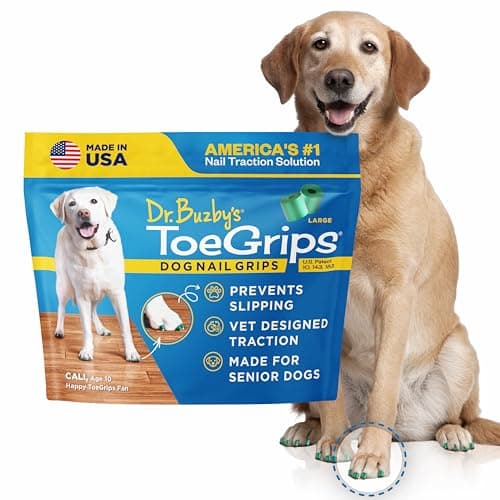
For the floors you cannot carpet — kitchen tile, the vet's waiting room, someone else's house — grips on the nails are the best dog-mounted fix there is.
#1 Pick
Dr. Buzby's
Dr. Buzby's ToeGrips for Dogs
Our score
$34–$40
Best for
Senior dogs slipping on hardwood, tile, or laminate floors
The best dog-mounted traction fix there is, and the one to buy once rugs have taken you as far as they can. Nothing touches the paw pad, which is why dogs tolerate these where they refuse socks and boots. Go in knowing the real cost: this is not a $40 purchase but a $240–$320 a year habit, so lay runners along your dog's actual routes first and buy grips for the floors you cannot cover.
Pros
- Veterinarian-developed; in clinical use for over a decade
- Slip onto each toenail — no socks, booties, or adhesives required
- Restores traction immediately, especially on hard floors
- Nothing touches the paw pad, so dogs accept them where they refuse boots
- Amazon and the manufacturer both charge $39.99 — no retailer markup
- 20 grips per bag against the 16 a dog wears, so a set includes four spares
Cons
- The only two published studies of nail grips both tested this exact product, and both were null: Roush 2017 (Front Vet Sci 4:111 — 15 sound dogs, kinetic changes "unlikely to be clinically relevant") and Repac 2022 (Animals 12(18):2312 — 30 dogs two weeks post-TPLO vs sham, no difference in weight bearing or limb function, including the owner question that asked specifically about slippery floors). Fair caveats: small samples, one used healthy dogs, the other a single early post-op timepoint — but "no positive trial exists" is the honest label, and we say it while still recommending the product for the mechanism and the owner-reported traction stories it was never tested against (verified 2026-08-14).
- A recurring cost, not a one-off. The maker publishes two different bag lives — "1–2 months" on its store page and "1-3 months, two months on average" in its FAQ (both read 2026-09-05) — which spans $160–$480 a year at $39.99. Plan on $240–$320, the two surfaces' central figures
- The Amazon listing markets specifically to dogs with "ACL injuries" — the one population where a randomised trial has been run, and where it found nothing (Repac 2022). The same bullets carry three claims with no source we could find: "more than 250,000 paws," "America's #1 nail traction solution," and "recommended by thousands of veterinarians worldwide" (listing copy verified 2026-08-17). Re-read 2026-08-31: a fourth unsourced superlative has been added to the top bullet on all four Amazon sizes — "The Only Toenail Grips for Dogs With GripZone Technology" — and the Large listing's title now leads with "Instant Traction on Wood/Hardwood Floors."
- The maker sells Scotch Super Glue Gel at $4.99 on its own store, listed as an "Alternate ToeGrips Application Method" (shop.toegrips.com, 2026-08-31). Read that as what it is: the company's own answer to the grips coming off, priced separately and not mentioned on the Amazon listing you are most likely to buy from.
- Application needs isopropyl rubbing alcohol, which is not in the box
- Initial application takes 15–20 minutes for a full set
- Some dogs chew them off in the first week
- Amazon carries only four of the seven sizes; XS, XXL and XXXL dogs have to buy direct
- Sizing by weight chart alone often misses — the accurate method needs dental floss and a ruler
We are recommending these here for a reason we have not used before: the dog in this article is standing on three good legs and one that has been quietly failing for months, and a splay-legged slip is precisely the acute injury a compensating hind end is set up for. Nothing touches the paw pad, which is why dogs accept these where they refuse socks and boots.
Now the part the listing will not tell you. A bag is $39.99 — the same at Amazon and direct from the manufacturer, which is genuinely to their credit and not true of most things we recommend — but the maker's own copy says a bag lasts one to two months. That is $240 to $480 a year. This is a subscription, not a purchase, and it is why runners come first. Two more things worth knowing before the first attempt: you need isopropyl rubbing alcohol to get them on and it is not in the box, and the accurate sizing method is not the weight chart but a piece of dental floss wrapped around the nail and measured in millimetres. And do not size down because your dog has lost condition — nails do not shrink with the leg.
Getting him up without wrecking your own back#
If the wasting has reached the point where your dog struggles to rise, the honest first move costs nothing: a rolled bath towel under the belly, in front of the hind legs. Try that before you spend anything, because for a dog who needs a hand up occasionally it may be the end of the problem. It stops being enough when the lifts become frequent enough to hurt your own back, or when the towel starts slipping because there is no longer much muscle for it to sit against — and both of those are things you will notice without needing us to put a number on them.
#2 Pick
Help 'Em Up
Help 'Em Up Harness
Our score
$95–$155
Best for
Long-term mobility support for senior or post-surgical large dogs
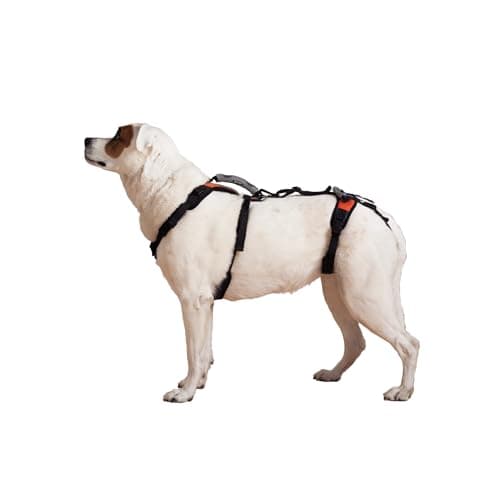
If your dog needs help getting up multiple times a day for the foreseeable future — post-TPLO, advanced hip dysplasia, hindquarter weakness in giant-breed seniors — this is the one to buy. It supports the front and the back independently, as two halves you can lift separately, which is what a dog with a bad hip and a compensating shoulder actually needs. It is not the only design that does this, but it is the one whose sizing, returns and channel prices we have read most closely. Buy it from the manufacturer, not from Amazon: re-verified 3 October 2026, helpemup.com prices by size at $80 / $95 / $110 / $125 / $140 while Amazon runs $95 / $110 / $125 / $140 / $155 — a uniform $15 more at every size, every time we have checked.
Pros
- Two-piece (chest + hip) design lets you support either end independently
- Hip handle is purpose-built — not a converted car-seat-belt strap
- Padded chest plate distributes weight better than sling-only options
- Five sizes span 10 to 225 lb, and the rear half can be ordered a size smaller for a dog with muscle wasting
- Two hip-lift styles (Conventional and U-Band) so male dogs are not soiling the strap
Cons
- Amazon runs a uniform $15 above the maker's own price at every one of the five sizes, and the Amazon buy box is held by a third-party reseller (Veterinary Preferred) rather than by the brand — re-verified 18 August 2026
- The maker's own Mix & Match page prints two different starting prices, "From $80" and "FROM $95 USD", on the same page
- Direct pricing is no longer flat: since mid-August 2026 the maker charges $80 to $140 by size, so a giant-breed owner now pays $60 more than a terrier owner
- On 29 August 2026 the linked Amazon Medium (B0DK81SCG5) showed a future availability date rather than units on hand, while every size and style was in stock at helpemup.com the same day; on 9 September and again on 12 September 2026 the Amazon Medium still showed the future-date status at $125.00 with a maximum order of one and no ship date given, while all nine direct variants were in stock — two weeks of backorder on the channel we earn from, and one more reason the direct channel is the one to use. By 3 October 2026 it had spread: every Conventional-style Amazon listing we checked (X-Small, Small, Medium, Large) showed a future availability date, and only the Large and X-Large U-Band were in stock, while all nine direct variants were available. On 15 October 2026 the linked Medium was back In Stock on Amazon at $125.00 (maximum order 30) for the first time since 29 August, but X-Small, Small and Large Conventional still showed a future availability date with a maximum order of one
- Sizing is critical — measure twice, return is a hassle
- Rear straps can chafe the inner thigh if the harness is left tight while the dog lies down
- A dog filmed or gait-assessed while wearing it looks less lame than he is, because the harness offloads the limb you are trying to judge
- Bulkier than a quick-grab sling for short-term use
Amazon, 15 October 2026: the Medium this button links is In Stock at $125, the first time since 29 August it has not shown a future availability date. X-Small, Small and Large Conventional on Amazon still had no ship date. Every size and style was in stock direct the same day, $15 cheaper.
The reframe worth having is that a support harness is not really a mobility aid — it is what makes whatever your vet prescribes physically possible for the person who has to deliver it, twice a day, for months. Nobody has tested a harness against muscle loss and we are not going to imply otherwise; what a harness changes is not the dog's physiology but whether the plan survives contact with a tired human at 6am. Kit that lives on the dog gets used. Kit that hangs by the door gets fetched on the good days only.
That is the whole claim, and it is deliberately smaller than the one this category usually makes. Nobody has measured how many prescribed walks get completed with a harness versus without one, so we are not going to put a number on it. We are saying only that the plan you can physically deliver beats the plan you cannot, and that this is the axis on which a harness earns its price or fails to.
The costs, plainly. Amazon runs $95 to $155 depending on size, while the manufacturer's own site now prices by size — $80 X-Small up to $140 X-Large, read off its live variant feed on 14 August 2026; the flat-$80-for-every-size pricing we verified twice in early August is over. Direct still undercuts Amazon on the sizes most buyers need (Medium $110 direct vs $125 on Amazon) — we would rather you paid the lower one even though we earn nothing when you do. The rear straps can chafe the inner thigh if the harness is left tight while the dog lies down — loosen them, as the manufacturer says to. And for a dog with hindquarter wasting specifically, the Mix & Match option lets you order a smaller rear half than front, which is worth knowing before you buy a matched set that gapes at the back; the halves are sold separately at half the matched price, so a smaller rear half makes the order cheaper, not dearer: a Medium front with a Small hip lift is $102.50 against $110 for a matched Medium, re-read on 3 October 2026. Until 3 October 2026 this paragraph said split sizing started at $95, a $15 premium; that was our misreading of a headline figure on the maker's ordering page, now logged on our corrections page.
What to do this week#
Tonight, put both hands on both thighs at the same height and feel for the difference. In a physiotherapist's hands that check outranked thirteen other methods; in yours it is untested, free, and takes ten seconds, which is a good enough trade to run it before bed.
Then take the measurement — string, ruler, 70% of the way down from the hip point, knee straight, both sides, written down with today's date. Do it again in a fortnight. Even if you do nothing else on this page, you will arrive at your next appointment with the one piece of evidence your vet cannot generate retrospectively.
Then book the appointment, and lead with the joint-or-nerve question rather than with the leg. If your dog is knuckling, dragging a paw, wearing his nail tips flat, or wasting without any sign of pain, say so first and ask for a neurologic examination specifically.
A wasted thigh is not the beginning of a problem. It is the visible end of one that has been running for months, which is the whole reason we would rather you measured it tonight than noticed it next spring. The muscle went somewhere while everyone was reading it as him slowing down. The measurement is how you stop reading it that way.
Sources#
- Hyytiäinen HK, Mölsä SH, Junnila JT, Laitinen-Vapaavuori OM, Hielm-Björkman AK. "Ranking of physiotherapeutic evaluation methods as outcome measures of stifle functionality in dogs." Acta Veterinaria Scandinavica. 2013;55(1):29. doi:10.1186/1751-0147-55-29 — 14 evaluation methods ranked; manual evaluation of muscle atrophy ranked first overall, the only method with significant associations with all standards tested; sensitivity 80.0–87.5%.
- University of Missouri Veterinary Health Center. "Degenerative Myelopathy." vhc.missouri.edu — onset is an asymmetric loss of coordination and spastic weakness in the hind limbs; owners frequently notice nail or toe scuffing first; "dogs seem not to show pain during the course of the disease"; affected dogs often progress to non-ambulatory within 11 months of initial signs.
- Freeman LM. "Cachexia and Sarcopenia: Emerging Syndromes of Importance in Dogs and Cats." Journal of Veterinary Internal Medicine. 2012;26(1):3-17. doi:10.1111/j.1939-1676.2011.00838.x — sarcopenia is progressive, generalised lean body mass loss occurring in the absence of disease; loss of lean mass is often accompanied by an increase in fat mass so total weight may not change, masking it; an animal can be obese and still have substantial muscle loss.
- Baker SG, Roush JK, Unis MD, Wodiske T. "Comparison of four commercial devices to measure limb circumference in dogs." Veterinary and Comparative Orthopaedics and Traumatology. 2010;23(6):406-410. doi:10.3415/vcot-10-03-0032 — five dogs, three observers, measurements in triplicate at four sites; plain and retractable tape measures gave significantly smaller values at each site than ergonomic and circumference tapes; interobserver variation 3.6× intraobserver variation; sequential measurements should be made by the same individual using the same device.
- McCarthy DA, Millis DL, Levine D, Weigel JP. "Variables Affecting Thigh Girth Measurement and Observer Reliability in Dogs." Frontiers in Veterinary Science. 2018;5:203. doi:10.3389/fvets.2018.00203 — 10 dogs with unilateral cruciate transection; sites at 50% and 70% of thigh length measured from the greater trochanter to the lateral fabella; full stifle extension gave the highest reliability; inter-observer ICC 0.981 and intra-observer ICC 0.993 and 0.994 at 70% extended; difference between observers 3.5% or less for each category assessed.
- Boström AF, Parzefall B, Blutke A, Davies ES. "Epaxial muscle atrophy is more evident in large dogs with intervertebral disc disease than in dogs with ischaemic myelopathy." Research in Veterinary Science. 2022;146:60-69. doi:10.1016/j.rvsc.2022.03.011 — 17 large-breed dogs with compressive IVDD versus 13 with non-compressive ANNPE or FCE; cross-sectional area significantly smaller in compressive IVDD for the multifidi (p = 0.015) and both muscles combined (p = 0.016); fat infiltration significantly higher in all measurements; significant positive correlation between age, duration of clinical signs and fat infiltration.
- White DA, Harkin KR, Roush JK, Renberg WC, Biller D. "Fortetropin inhibits disuse muscle atrophy in dogs after tibial plateau leveling osteotomy." PLoS ONE. 2020;15(4):e0231306. doi:10.1371/journal.pone.0231306 — 100 client-owned dogs, prospective randomised double-blinded placebo-controlled; placebo group showed significant reduction in thigh circumference from week 0–8 of 1.21 cm in the affected limb and 2.04 cm in the unaffected limb. Funded by the manufacturer, MYOS RENS Technology Inc. The paper does not report a statistical test of the difference between the two limbs.
- Muir P, Schwartz Z, Malek S, et al. "Contralateral Cruciate Survival in Dogs with Unilateral Non-Contact Cranial Cruciate Ligament Rupture." PLoS ONE. 2011;6(10):e25331. doi:10.1371/journal.pone.0025331 — 204 of 380 dogs (54%) developed subsequent contralateral rupture; median survival time for the contralateral ligament 947 days.
This article is educational and does not replace veterinary advice. Measurable muscle loss in one limb is a reason to be examined, not a diagnosis. A dog who is knuckling, dragging a paw, or losing muscle without any sign of pain needs a neurologic examination rather than a rehabilitation plan.
Frequently asked
- Why is one of my dog's back legs smaller than the other?
- In most cases because he has been quietly putting less weight through it, for longer than you think. A joint that hurts gets offloaded, the muscle around it is used less, and unused muscle shrinks. That is disuse atrophy, and it is the commonest explanation by a wide margin — the usual culprits being cruciate disease, hip dysplasia, and osteoarthritis. The second explanation is neurologic: if the nerve supply to a muscle is damaged, the muscle wastes whether or not the dog wants to use it, so better flooring and gentler surfaces change nothing. The two need different urgency and different specialists, which is why the distinction below matters more than the measurement itself.
- How do I measure my dog's thigh circumference at home?
- Lay your dog on his side with the upper leg straightened out, find the bony point of the hip and the small bony knot on the outer side of the knee, and measure the distance between them. Take 70% of that distance down from the hip, and wrap a soft tape around the thigh there — snug against the coat, not tight enough to dent the muscle. Do both legs the same way. In the study that tested this, the site 70% of the way down with the knee held straight gave near-perfect repeatability, with an intra-observer correlation of 0.993. Use the same tape and the same person every time; a separate study found disagreement between two people was 3.6 times larger than one person's disagreement with themselves.
- How much difference between legs is normal?
- Some difference is measurement noise rather than muscle. Across two observers measuring the same dogs, readings varied by up to 3.5%, which on a 30 cm thigh is about a centimetre. So a single half-centimetre gap measured once, by comparing your number to a number someone else took, tells you very little. What tells you a great deal is the same person measuring the same way every fortnight and watching the gap widen. Trend beats snapshot here, and the tape is far better at detecting change over time than at judging a single reading.
- Can muscle wasting in a dog's leg be reversed?
- Disuse atrophy is often substantially reversible, but only if the reason the dog stopped using the leg is treated. Rebuilding muscle around a joint that still hurts does not work, and no supplement, brace, or bed does it for you — what rebuilds muscle is controlled, progressive, load-bearing exercise prescribed for the specific diagnosis, which is what a rehabilitation veterinarian does. Atrophy from nerve damage is a different matter, because recovery there depends on whether the nerve itself recovers rather than on how well the exercise plan is delivered. That is one of several reasons the orthopedic-versus-neurologic question needs answering before you start any exercise plan.
- Should I be worried if both my dog's back legs are wasting?
- Symmetrical loss across both hind legs points away from a single painful joint and toward something more general: age-related muscle loss, weight loss, chronic illness, or a spinal problem affecting both sides. It is worth taking seriously rather than filing under old age. Muscle loss is routinely hidden by body fat — a dog can be overweight and still be losing substantial muscle, and the scale will not show it because fat replaces what the muscle gave up. If both legs are thinning, that is a conversation with your vet about what is driving it, not a training problem.