Owner's Guide
Is My Dog Limping, or Is It Something Else?
Limping, stiffness, weakness, and wobbling look alike from across a room and mean very different things. How to sort your dog into the right category, and which one is an emergency.

Owners bring one word to the vet — limping — and it is covering four different problems. Lameness is pain. Stiffness is usually pain on both sides at once, which is why it does not look like a limp. Weakness is the leg not answering. Ataxia is the leg not knowing where it is. They look almost identical from across a kitchen, they point at completely different diagnoses, and only one of them is an emergency tonight. This guide is how to sort your dog into the right box before the appointment, and what to film so the vet does not have to take your word for it.
Affiliate disclosure: Dog Orthopedic is reader-supported. When you buy through links on our site we earn a commission at no extra cost to you — about 3% on most pet products, and the same rate on every product we compare, so no pick earns us more than another. Prescription medication earns us nothing, and seeing your vet earns us nothing; we recommend both anyway. Learn more.
Imagery: Lifestyle photographs on this site are licensed from Pexels (royalty-free) and credited per image. Pexels imagery illustrates conditions and contexts — it does not depict the specific dogs or test sessions described in the text. Product photographs come from Amazon's Creators API. Breed portraits are illustrations of typical breed type rather than photographs of individual dogs, and are not drawn to scale against one another.
Start with the number that should unsettle everyone#
In 2005, researchers at Washington State University looked at 369 dogs referred to their teaching hospital because a veterinarian had diagnosed hip dysplasia or hip pain. When those dogs were worked up properly, 32% of them turned out to have a ruptured cranial cruciate ligament as the primary cause of the hind-limb lameness.[1] Not a hip. A knee.
Hold that next to a second finding. When 500 dogs attending routine appointments, none of them previously diagnosed with arthritis, were screened with a simple owner questionnaire, 188 of them — 38% — turned out to have osteoarthritis on physical or radiographic examination.[2]
Read together, those two studies say something worth sitting with. Getting the category wrong is not an amateur mistake. It happens in the profession, on the way to a referral hospital. And the single thing that most improves the odds of getting it right is a better description of what the dog is actually doing — which is the part only you can supply, because you are the one who watches this dog walk every day.
The four things owners call limping#
| What you see | What it is | The tell | Usually points to |
|---|---|---|---|
| Head bobs, one leg favored, stride shortened on one side | Lameness — a pain response | The leg is carried, held up, put down deliberately | Cruciate tear, arthritis, elbow or hip disease, an injured foot, bone tumor |
| No limp, but slow to rise, short choppy steps, front-heavy | Stiffness — usually pain on both sides at once | Worst on rising, eases over the first few minutes of a walk | Bilateral hip or elbow arthritis, bilateral cruciate disease, lumbosacral pain |
| Leg gives way, knuckles over, drags, scuffs | Weakness (paresis) — the signal is not getting through | The leg is dragged, not carried. Nails wear unevenly | IVDD, degenerative myelopathy, lumbosacral disease, nerve injury |
| Wobbling, swaying, wide-based stance, crossing feet | Ataxia — the leg does not know where it is | Present whether rested or warmed up. Often worse turning | Spinal cord disease, vestibular disease, cerebellar disease |
The Merck Veterinary Manual puts the core distinction in one clean sentence: a painfully lame limb is carried, whereas "a paretic limb is often dragged."[3] Carried versus dragged is the most useful four-word test in this whole article, and you can apply it tonight in a hallway.
The same source flags the trap in the row beneath it: "Patients with bilateral limb pain may not walk at all or may have a short-strided, stilted gait, which can mimic neurologic disease."[3] A dog with two equally sore hips does not limp. He gets stiff. And stiff is the word owners use right before they use the words old age.
Which leg is it? Watch the head and the hips, not the legs#
Owners stare at the legs. The legs are the hardest place to see it. The compensations happen at the ends of the dog.
For a front leg, the rule is down on sound. As Merck describes it, "with forelimb lameness, the head might be elevated (head bob) during weight bearing on the painful limb and might move down during weight bearing on the sound limb."[4] The head lifts to unload the leg that hurts.
For a back leg, the equivalent is the hip hike: "the hips often move higher when the painful limb hits the ground and drop lower when the sound limb bears weight."[4]
Now the part that explains why you have been squinting. A Swedish group induced a mild, reversible lameness in ten sound dogs by strapping a 200-gram weight above one wrist or one hock, then measured how far the head and pelvis moved on a treadmill. With a front-leg lameness, head displacement asymmetry ran to roughly 20 to 29 mm. With a back-leg lameness, pelvic asymmetry was roughly 9 to 11 mm.[5]
That is a lameness model in healthy dogs rather than real disease, so treat the exact millimeters loosely. The ratio is the point: the visual signal from a bad back leg is roughly a third to a half the size of the signal from a bad front leg. Hind-limb lameness is not subtler because it is milder. It is subtler because the physics gives you less to look at.
Two practical consequences. First, film it: flat non-slip ground, at a trot rather than a walk, once from the side and once coming straight at you, then watch it back at half speed. Second, know the classic false positive — a severe hind-limb lameness makes the head drop during weight-bearing on the bad rear leg, and that reads convincingly as a front-leg problem to everyone in the room.
The three home checks that separate pain from weakness#
None of these replace a neurologic exam. All three are things you can look at before you call.
1. Carried or dragged. Covered above, and it is still the best one.
2. The nails. Look at all four feet in good light. A dog whose paw is not being placed cleanly wears the nails down on one side, or scuffs the tops of the toes. Scuffed nails and irregular wear patterns are listed among the findings that point toward neurologic weakness rather than a painful joint.[6] Uneven nail wear is a physical record of a problem that has been running for weeks, which is exactly the kind of evidence a fifteen-minute appointment cannot generate on its own.

3. What rest and movement do to it. Orthopedic pain typically warms out — worst on rising, better after a few minutes of gentle movement, worse again after hard exercise. Neurologic signs tend to be present the whole time and largely indifferent to whether the dog has just got up or has been walking for ten minutes.[6] Watch on two separate mornings before you decide.
One more shape to recognize, because it is different from all of the above: a wide-based stance with a swaying gait is the description of sensory ataxia, and a high-stepping, overreaching gait points toward the cerebellum rather than the joints.[3] Neither of those is a limp, and neither should be watched at home for two weeks.
Why a dog with two bad hips does not limp#
This is the quietest failure mode on the list, and the one that costs the most months.
Merck describes bilateral hind-limb disease as producing "a bilaterally shortened stride in the rear, along with attempts to shift weight onto the more comfortable thoracic limbs."[4] A 2024 study put numbers on that shift. Forty-six dogs walked over a pressure-sensitive walkway: 20 normal, 15 with bilateral hind-limb lameness and clean neurologic exams, and 11 with hind-limb ataxia and clean orthopedic exams.[7]
The dogs with two sore back legs moved their body weight forward. Each front limb carried about 32% of body weight against roughly 28 to 29% in normal dogs, while each back limb dropped to about 18% from roughly 21%. The ataxic dogs did not do this — their weight distribution was not significantly different from normal. What they did instead was leave the front feet on the ground longer, with a forelimb-to-hindlimb stance time asymmetry of 16.7% against 5.65% in normal dogs, effectively propping up an unsteady back end.
Two problems wearing the same costume, solving it two different ways. Neither one produces the head-bobbing limp that owners are watching for. Both produce a dog who looks front-heavy and, in the word every owner reaches for, stiff.
“Because your dog can't tell you how much pain he or she is in.”
The compensation is also the reason the second injury exists. A dog who has been quietly loading the front end for eight months is a dog whose elbows and shoulders have been doing a job they were not built for, and whose hindquarter muscle has been thinning the entire time.
Which of these is actually an emergency#
Most limps are not emergencies. These are.
| Sign | Why it is urgent |
|---|---|
| Sudden inability to stand, dragging both back legs, knuckling, loss of bladder or bowel control | Possible acute IVDD or other spinal cord compression |
| Crying out when the back or neck is touched | Spinal pain; often precedes the neurologic signs above |
| A leg held completely off the ground after any trauma | Fracture, luxation, complete ligament rupture |
| A limb that is hot, swollen, and painful | Septic joint, cellulitis, bite wound, or a tumor with pathologic fracture |
| Sudden non-weight-bearing lameness in a large or giant breed over about seven | Possible pathologic fracture through a bone tumor |
| Fever alongside lameness that moves between legs | Immune-mediated or infectious joint disease |
That last row deserves a sentence of its own, because the reflex is to assume a sprain. The American College of Veterinary Surgeons describes the usual presentation of an appendicular bone tumor as "a slow, insidious onset of a mild to moderate weight-bearing lameness," but notes that "an acute, non-weight-bearing lameness is possible if a fracture occurs where a tumor has weakened the bone."[8] In a big older dog, a limp that has been mild for a few weeks and then suddenly becomes total is a radiograph, not a rest week.
On spinal emergencies, here is the honest state of the evidence, because the internet is confidently wrong in both directions. A retrospective study of 1,501 dogs operated on for acute thoracolumbar disc extrusion found that time from onset of signs to surgery was significantly associated with the overall outcome: 92.1% good outcomes when surgery happened on the day signs began, against 86.6% when it happened more than five days later.[9] That is a real difference and a small one. Pulling the other way, a study of non-ambulatory dogs that still had deep pain sensation found that neither the delay before presentation nor the wait between presentation and surgery was associated with how quickly they recovered the ability to walk. What did predict it was the neurologic grade they arrived with.[10] That study is not a license to wait, though: only 14.5% of its dogs had a delay of six and a half hours or more, so it tells you very little about what happens overnight.
What is not in dispute is the thing you cannot check yourself: whether the dog still has deep pain sensation in the affected legs. That single finding separates an excellent prognosis from a guarded one, it is what the second study was selecting for, and it can be lost during the delay rather than before it. Go tonight for the exam, not because a stopwatch is running on the surgery, but because you do not currently know which category your dog is in. Our IVDD guide and the dachshund-specific version cover what happens next.
The other categories worth knowing before you walk in#
Young, large, and lame in a different leg each week. Panosteitis is a self-limiting bone-marrow disease of growing dogs, typically between five and twelve months, with German Shepherds and males overrepresented. It causes the classic shifting-leg lameness, with episodes lasting two to five weeks in each affected bone, and it resolves on its own.[11] It still needs diagnosing rather than assuming, because it is not the only thing that does this.
Middle-aged, heavy, and suddenly lame behind after normal play. Think cruciate before you think hip. That is the whole lesson of the 369-dog study, and a partial tear that improves with rest and returns with activity is the most commonly missed version. Our arthritis and hip dysplasia guides cover how the two get confused.
Old, stiff, and never actually lame. These are the 188 dogs from the screening study — the ones whose owners answered a questionnaire and discovered arthritis nobody had named. If your dog has stopped doing one specific thing, taking the stairs, jumping onto the bed, greeting you at the door, that is the finding. It counts even without a limp, and our guide to the pain signs owners miss is the longer checklist.

What to do before the appointment, cheapest first#
Nothing on this list is a treatment, and you should not buy anything to fix a limp you cannot yet name. The first two cost nothing at all.
Film it. Side-on and head-on, at a trot, on flat non-slip ground, thirty seconds each. Clinic floors are slick and adrenaline masks lameness, so dogs routinely look better at the vet than at home.
Write the timeline. When you first noticed, morning or evening, which leg or legs, whether it has moved, what makes it worse, and the last date you are certain your dog did the thing he has now stopped doing.
Take stairs off the menu until you have an answer. This is the one place where the waiting period can turn a manageable problem into a surgical one. Stairs are the highest-force activity a limping dog performs repeatedly indoors, and a partially torn cruciate finishing its tear on a staircase is a common story. If the opening has a door, close it, and you are done for free. If it does not, a gate is the honest fix, because watching him is a plan that fails the first time the doorbell rings.
#1 Pick

Regalo
Regalo Easy Step Extra Wide Safety Gate, 29–49 in.
Our score
$49.99
Best for
Blocking the bottom of a staircase while a limping dog is on activity restriction
Not a mobility aid and not a treatment — a way to enforce the activity restriction your vet is about to ask for. Stairs are the highest-force thing a limping dog does repeatedly in a house, and "I'll just watch him" fails the first time the doorbell rings. Everything Regalo claims about the size, the box contents and the hardware checked out. Two things to hold onto: it must never go at the top of the stairs, which is Regalo's own instruction, and at 30 inches a large athletic dog can clear it — a point on which Regalo's own two listings disagree with each other. A closed door does this job for free; buy the gate when the opening has no door.
Pros
- Every dimension on this page is confirmed against both the live Amazon listing and Regalo's own product page for the identical SKU on 2026-08-14 — Amazon's model field reads "1164 EB DS" and Regalo's store SKU reads "1164 EB DS", which is SKU-level proof the two listings are the same gate
- Both extensions really are in the box, and so is the hardware. Regalo's stated contents: the gate, an instruction manual, one 4-inch extension kit, one 12-inch extension kit, four pressure-mounted spindle rods and four wall cups. Nothing here is sold separately later
- "Sturdy, all-metal frame" in Regalo's own words — not a plastic frame that flexes when a 70 lb dog leans on it
- A 16-inch walk-through door, which is the difference between a gate you use for eight weeks and a gate you start stepping around by week two
- Cheaper on Amazon than from the manufacturer, by $11, and in stock on Amazon while Regalo's own store shows it unavailable
Cons
- "To prevent falls, never use at top of stairs." That is Regalo's sentence, published verbatim on both their own page and the Amazon listing. This is a pressure-mounted gate. It is a bottom-of-stairs and doorway gate only, and if what you need is a top-of-stairs gate you need a hardware-mounted one instead
- Regalo tells you two different things about your dog depending on which listing you read. Their own product page says the gate "can also be used for medium to large dogs." The Amazon listing for the same SKU scopes it to "babies 6–24 months and small to medium pets." Same gate, same day, opposite guidance. At 30 inches tall, our own read is the Amazon one: a determined athletic large dog goes over this
- Six-month limited warranty — short for a $50 safety product, and previously missing from this page entirely. It is confirmed from two independent sources: Regalo's page says "backed by a manufacturer's limited 6-month warranty" and the Amazon listing's warranty field reads "6 month limited." Added 2026-08-14
- Three dead zones in the fit range, and only Amazon tells you about them. The Amazon listing publishes "DOES NOT FIT OPENINGS: 32–34", 36.5–41.5", 44.5–46.5"." Regalo's own product page publishes the four fit configurations and no statement of the gaps between them. Measure your opening before you order, and do not rely on the maker's page to warn you
- The wall cups are not optional. Regalo's install instruction is explicit: "Wall cups must be used to keep the gate securely in place." That means four small screws into your trim, on a product most people buy believing it is purely pressure-mounted
- We cannot tell you what the safety certification means. Regalo claims certification by the "Baby Safety Alliance (BSA)" and that the gate "meets the safety standards set by the American Society for Testing and Materials (ASTM)" — but no ASTM standard number is quoted on either the Amazon listing or Regalo's page, and the Baby Safety Alliance website returned errors to every request we made on 2026-08-14. So we have the claim and no way to check what it covers. Reported as a claim, not as a verification
- Regalo publishes no reviews of its own for this SKU. Their store runs a Yotpo review widget; on 2026-08-14 it returned zero reviews and no star distribution for this gate
- "Designed in the USA" is Regalo's phrase. Country of manufacture is not published on the listing or on their page, and those are different questions
- The low step-over bar in the doorway is inherent to the design — it is why it is called Easy Step — and it is a genuine trip hazard on a night trip to the bathroom
The Regalo spans 29 to 49 inches with the two included extensions, has a metal frame rather than plastic, and comes with the wall cups instead of selling them separately. The limitations are real and worth reading before you order. Regalo's own instruction is that it must never be installed at the top of stairs, which is exactly where some owners want one, so this blocks the dog from going up rather than protecting a dog already at the top. It is 30 inches tall, so an athletic large dog who genuinely wants over it will get over it. And it has dead zones: it does not fit openings of 32 to 34, 36.5 to 41.5, or 44.5 to 46.5 inches. Measure first.

#2 Pick
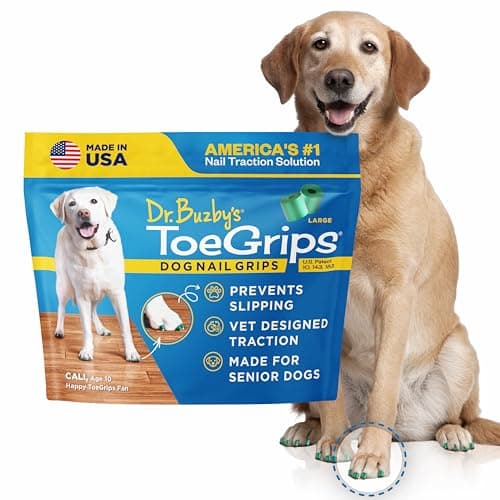
Dr. Buzby's
Dr. Buzby's ToeGrips for Dogs
Our score
$34–$40
Best for
Senior dogs slipping on hardwood, tile, or laminate floors
The best dog-mounted traction fix there is, and the one to buy once rugs have taken you as far as they can. Nothing touches the paw pad, which is why dogs tolerate these where they refuse socks and boots. Go in knowing the real cost: this is not a $40 purchase but a $240–$320 a year habit, so lay runners along your dog's actual routes first and buy grips for the floors you cannot cover.
Pros
- Veterinarian-developed; in clinical use for over a decade
- Slip onto each toenail — no socks, booties, or adhesives required
- Restores traction immediately, especially on hard floors
- Nothing touches the paw pad, so dogs accept them where they refuse boots
- Amazon and the manufacturer both charge $39.99 — no retailer markup
- 20 grips per bag against the 16 a dog wears, so a set includes four spares
Cons
- The only two published studies of nail grips both tested this exact product, and both were null: Roush 2017 (Front Vet Sci 4:111 — 15 sound dogs, kinetic changes "unlikely to be clinically relevant") and Repac 2022 (Animals 12(18):2312 — 30 dogs two weeks post-TPLO vs sham, no difference in weight bearing or limb function, including the owner question that asked specifically about slippery floors). Fair caveats: small samples, one used healthy dogs, the other a single early post-op timepoint — but "no positive trial exists" is the honest label, and we say it while still recommending the product for the mechanism and the owner-reported traction stories it was never tested against (verified 2026-08-14).
- A recurring cost, not a one-off. The maker publishes two different bag lives — "1–2 months" on its store page and "1-3 months, two months on average" in its FAQ (both read 2026-09-05) — which spans $160–$480 a year at $39.99. Plan on $240–$320, the two surfaces' central figures
- The Amazon listing markets specifically to dogs with "ACL injuries" — the one population where a randomised trial has been run, and where it found nothing (Repac 2022). The same bullets carry three claims with no source we could find: "more than 250,000 paws," "America's #1 nail traction solution," and "recommended by thousands of veterinarians worldwide" (listing copy verified 2026-08-17). Re-read 2026-08-31: a fourth unsourced superlative has been added to the top bullet on all four Amazon sizes — "The Only Toenail Grips for Dogs With GripZone Technology" — and the Large listing's title now leads with "Instant Traction on Wood/Hardwood Floors."
- The maker sells Scotch Super Glue Gel at $4.99 on its own store, listed as an "Alternate ToeGrips Application Method" (shop.toegrips.com, 2026-08-31). Read that as what it is: the company's own answer to the grips coming off, priced separately and not mentioned on the Amazon listing you are most likely to buy from.
- Application needs isopropyl rubbing alcohol, which is not in the box
- Initial application takes 15–20 minutes for a full set
- Some dogs chew them off in the first week
- Amazon carries only four of the seven sizes; XS, XXL and XXXL dogs have to buy direct
- Sizing by weight chart alone often misses — the accurate method needs dental floss and a ruler
The second cheap intervention is traction, and it matters more once you understand the weight shift described above. A dog already redistributing load has less margin to catch a slip. Rugs and runners along the routes your dog actually walks fix most of this for nothing, and secondhand runners work as well as new. ToeGrips address the part rugs cannot, which is the moment of standing up off a hard floor. They need replacing every one to three months as the nails grow, the first application takes fifteen to twenty minutes, and a minority of dogs chew them off in week one. If your floors are carpeted, skip them entirely. The room-by-room version is in our guide to dogs slipping on floors, and if the back end is already failing rather than just sore, support harnesses are the right category instead.
What to do this week#
Tonight: check the emergency list at the top of this page. If anything on it matches, stop reading and go.
Tomorrow morning: film thirty seconds of your dog trotting, before the first walk, while he is stiffest. Then film thirty seconds again in the evening. The difference between those two clips is diagnostic information that no examination can reproduce.
This week: look at all four sets of nails in daylight. Answer the carried-or-dragged question. Write the timeline. Book the exam and bring both videos. If the opening at the bottom of the stairs has no door, close it some other way until you have an answer.
The delay is the injury. Not the limp, and usually not the diagnosis either — the months between the first quiet sign and the day someone finally names it. Your dog has one word for all four of these problems, and it is silence. Thirty seconds of video is how you get a second one.
Sources#
- Powers MY, Martinez SA, Lincoln JD, Temple CJ, Arnaiz A. Prevalence of cranial cruciate ligament rupture in a population of dogs with lameness previously attributed to hip dysplasia: 369 cases (1994-2003). Journal of the American Veterinary Medical Association. 2005;227(7):1109-1111. PMID 16220671
- Wright A, Amodie DM, Cernicchiaro N, Lascelles BDX, Pavlock AM, Roberts C, Bartram DJ. Identification of canine osteoarthritis using an owner-reported questionnaire and treatment monitoring using functional mobility tests. Journal of Small Animal Practice. 2022;63(8):609-618. doi:10.1111/jsap.13500
- Merck Veterinary Manual. The Neurologic Examination of Animals.
- Merck Veterinary Manual. Orthopedic Examination in Small Animals.
- Bergh A, Gómez Álvarez CB, Rhodin M, Gustås P. Head and pelvic vertical displacement in dogs with induced swinging limb lameness: an experimental study. Acta Veterinaria Scandinavica. 2018;60:81. doi:10.1186/s13028-018-0435-z
- Martinez SA, Gilbert PJ. Gait Abnormality: Musculoskeletal or Neurologic Condition? Today's Veterinary Practice. November/December 2018. Article
- Park C, Sawyere DM, Pancotto TE, Lanz OI, Werre SR. Characterization of spatiotemporal and kinetic gait variables in dogs with hindlimb ataxia and bilateral hindlimb lameness. BMC Veterinary Research. 2024;20:405. doi:10.1186/s12917-024-04265-8
- American College of Veterinary Surgeons. Bone Tumors in Cats and Dogs.
- Immekeppel A et al. Investigation of timing of surgery and other factors possibly influencing outcome in dogs with acute thoracolumbar disc extrusion: a retrospective study of 1501 cases. Acta Veterinaria Scandinavica. 2021;63:30. doi:10.1186/s13028-021-00596-w
- Vicens Zanoguera F et al. Does surgical timing affect the rapidity of recovery in deep pain-entire non-ambulatory dogs with thoracolumbar intervertebral disk extrusion? Journal of Small Animal Practice. 2023. doi:10.1111/jsap.13570
- Bergh MS. Panosteitis. Clinician's Brief. August 2015. Article
This article is educational and does not replace veterinary advice. Diagnosis of a limping dog, and any medication decision, belongs to your veterinarian.
Frequently asked
- How can I tell which leg my dog is limping on?
- Watch the head and the hips, not the legs. With a sore front leg, the head lifts as that leg takes weight and drops when the good leg lands — vets call it down on sound. With a sore back leg, the hip on the painful side rises as that leg lands, the hip hike. One trap: a severe hind-leg lameness drops the head during weight-bearing on the bad rear leg, which reads convincingly as a front-leg problem. Film your dog trotting toward you and from the side, then watch it back at half speed.
- Is my dog limping or is it weakness?
- A dog in pain usually carries the leg, holds it up, and puts it down carefully. A weak or neurologically affected leg tends to get dragged, scuffed, or placed knuckled over on the top of the paw. Two more tells: check the nails on all four feet for uneven wear on one side, and notice what happens after rest. Arthritis pain is usually worst on rising and eases as the dog moves. Neurologic problems tend to look about the same whether the dog has been asleep or walking for ten minutes.
- When is a limping dog an emergency?
- Go now, not tomorrow, for any of these: a dog that suddenly cannot stand or is dragging both back legs, paws knuckling so the tops scrape the ground, loss of bladder or bowel control, crying out when the back or neck is touched, a limb held completely off the ground after any trauma, or a limb that is hot and swollen. In a large or giant breed over about seven, a sudden refusal to bear weight after minor trauma also needs same-day imaging rather than rest and a wait.
- My dog is limping but does not seem to be in pain. Is that possible?
- Lameness is usually a pain response, so the more likely explanation is that the pain is real and your dog is not showing it in a way you recognize. Dogs with chronic orthopedic pain rarely cry. They shorten the stride, shift weight forward, and get on with the day. The exception worth knowing is genuine weakness without pain, which is the hallmark of some spinal cord diseases such as degenerative myelopathy. That is precisely why the pain-versus-weakness question is one to answer at an exam rather than at home.
- Should I rest my dog for a few days first, or go straight to the vet?
- A mild limp in an otherwise well adult dog, with no red flags and no trauma, is reasonable to rest and watch for two to three days with short leash walks only, no stairs and no jumping. Anything that is worsening, that has lasted more than a few days, that involves both back legs, or that comes with any of the emergency signs above should be seen. Rest is not a diagnosis, and a limp that improves on rest and returns on activity is a very common description of a partially torn cruciate ligament.
- What should I bring to the appointment?
- A phone video of your dog walking and trotting on a flat non-slip surface, filmed from the side and head-on, plus a short written timeline: when you first noticed it, whether it is worse in the morning or the evening, whether it has moved between legs, and what activity makes it worse. Consulting-room floors are slick and adrenaline masks lameness, so a dog will often look better at the clinic than at home. Your video is frequently the most useful thing in the room.