Condition Guide
Arthritis in Dogs: Signs, Treatment, and What Actually Helps at Home
How to spot arthritis in dogs early, what veterinary treatment looks like, and the weight, exercise, and home changes that actually reduce pain.

Arthritis — osteoarthritis, in clinical terms — is one of the most common causes of chronic pain in adult dogs, and one of the most underdiagnosed, because dogs are built to hide pain. It cannot be cured, but it responds well to a system: a lean body, veterinary pain control, honestly chosen supplements, and a home that is easier on sore joints. Here is how to catch it early and what actually helps.
Affiliate disclosure: Dog Orthopedic is reader-supported. When you buy through links on our site we earn a commission at no extra cost to you — about 3% on most pet products, and the same rate on every product we compare, so no pick earns us more than another. Prescription medication earns us nothing, and seeing your vet earns us nothing; we recommend both anyway. Learn more.
Imagery: Lifestyle photographs on this site are licensed from Pexels (royalty-free) and credited per image. Pexels imagery illustrates conditions and contexts — it does not depict the specific dogs or test sessions described in the text. Product photographs come from Amazon's Creators API. Breed portraits are illustrations of typical breed type rather than photographs of individual dogs, and are not drawn to scale against one another.
What are the early signs of arthritis in dogs?#
Nobody misses end-stage arthritis. The disease gets missed early, because early arthritis does not look like limping — it looks like aging. A dog in joint pain edits its own life quietly: skips the jump onto the bed, turns for home a block earlier, stops following you upstairs. Owners file each change under "getting older" and the pain goes untreated for years.
There is a number that shows exactly how wide that gap is. The Merck Veterinary Manual states that up to 40% of dogs aged eight months to four years already have osteoarthritis, while clinical signs are generally not identified until dogs are five to thirteen years old.[1] Read that twice. The disease and the diagnosis are separated by years, in a species that lives about a decade. Nothing on this page matters more than closing that gap in your own house.
| Sign (subtle → obvious) | What it looks like | What owners usually assume |
|---|---|---|
| Hesitating at stairs | Pauses at the bottom, rushes up in a burst, or takes steps one at a time | "He's being stubborn" |
| Shorter walks | Turns toward home earlier, lags on the back half of the loop | "She's just slowing down" |
| Slow to rise | Several seconds of effort to stand after rest, worst in the morning, better once moving | "Normal stiffness — it works itself out" |
| Giving up jumps | Stops jumping into the car or onto furniture | "He finally grew out of it" |
| Licking one joint | Repeated licking over a wrist, elbow, or knee, sometimes staining light fur | "Some skin thing" |
| Behavior changes | Irritable when touched near the hips, sleeps away from the family, greets you less at the door | "Old dogs get grumpy" |
| Visible limp or head bob | Obvious lameness, offloading one leg | Finally recognized as pain — but this is a late sign, not an early one |
The pattern worth memorizing: stiffness that is worst after rest and "warms out" as the dog gets moving is joint pain until proven otherwise. A dog that loosens up after five minutes has not proven it is fine. Merck's description of hip dysplasia lameness puts the pattern plainly — it is "more pronounced after exercise" or "shortly after rest."[2]
And "slowing down" is not a diagnosis. It is what chronic pain looks like from the outside. This is not our opinion; it is the opening premise of the profession's own senior-care guidance, which begins by stating that veterinary professionals are taught to recognize that "old age is not a disease."[3] If you are unsure what you are seeing, start with our full guide to the signs of pain owners miss.

“Because your dog can't tell you how much pain he or she is in.”
How do vets diagnose arthritis?#
There is no blood test for osteoarthritis. Diagnosis is built from three pieces: your history (which is why your observations matter so much), an orthopedic exam (watching the gait, then palpating each joint for thickening, reduced range of motion, and pain response), and radiographs. On film, what a vet is looking for is joint effusion, soft-tissue swelling around the joint, osteophytes, sclerosis of the bone under the cartilage, and sometimes a narrowed joint space.[1] Radiographs also rule out the things arthritis can imitate: cruciate injury, disc disease, bone infection, and in the worst cases bone cancer.
Two honest caveats about that process. First, X-ray severity does not track pain one-to-one. Merck states the principle directly: "treatment should be based on clinical signs rather than radiographic findings."[1] Good vets treat the dog, not the film. Second, in large breeds much of what we call arthritis is secondary to a developmental disease like hip dysplasia or elbow dysplasia, and knowing the underlying cause can change the options on the table.
If your vet talks about a "stage" rather than just a diagnosis, that is the COAST system — an international consensus tool that stages canine osteoarthritis and then matches treatment to the stage.[4] It is a good sign. It means the plan is being built for the dog in front of them.
Two things you can bring that genuinely improve the visit: a short phone video of your dog rising from a nap and doing stairs at home (dogs perk up in the exam room, and the limp you see daily often vanishes at the clinic), and honest answers to the lifestyle questions. Many practices will also ask you to fill out the Canine Brief Pain Inventory, an owner questionnaire validated to detect whether treatment is actually working.[5]
Fill it in honestly, including on the good days, and here is why that matters more than it sounds. In the placebo arm of an FDA-approved trial, owners judged their own dog's lameness to have improved 39.7% of the time while a force plate showed the dogs had not changed at all. Veterinarians watching the same dogs walk did it 44.8% of the time. Of 58 dogs, 46 had ground reaction forces that did not move.[6] Loving a dog makes you want to see improvement. A scored questionnaire, repeated over weeks, is how you and your vet catch yourselves.
How is arthritis in dogs treated?#
The profession's own pain guidelines frame this as multimodal and preemptive rather than reactive — several moderate interventions that stack, ordered by a tiered decision tree that puts the most effective options first.[7] In practice it comes down to a four-part system. Dogs do best when all four parts are working at once.
1. Weight — the highest-leverage thing you control#
Forty-eight Labrador Retrievers were paired within their litters at six weeks old and randomly assigned so that one of each pair ate 25% less food, for life. Same food, only the quantity differed.[8] The two-decade summary of that colony reports the result in one line: 1.8 years longer median lifespan in the restricted dogs, with delayed onset of late-life disease, especially osteoarthritis.[9] The hips were radiographed too, and lifelong restriction reduced the radiographic evidence of hip osteoarthritis.[10]
No supplement and no drug on this page has produced anything close to that, which is why Merck calls weight optimization "the primary preventive method to slow development of OA in dogs."[1] Two caveats you deserve: 48 dogs is a small colony, all one breed, and the dogs were lean from puppyhood rather than slimmed down late. It is the best evidence we have and it is not a promise about your ten-year-old.
Be honest about body condition. You should be able to feel ribs easily with a flat hand and see a waist from above. The reason your eye may be miscalibrated is that heavy has become normal: across 4.93 million dogs seen at US primary-care practices between 2020 and 2023, 44.5% of adult dogs were overweight and a further 8.4% obese, rising to 50.1% and 12.6% at the mature life stage.[11] Roughly three in five middle-aged American dogs are carrying extra weight. Ask your vet for a body condition score and a target weight, and if you have a Lab, read our Labrador arthritis guide, because this breed combines high arthritis risk with a legendary appetite.
2. What your vet can prescribe#
Prescription NSAIDs made for dogs are the first-line treatment for arthritis pain. Merck is unusually direct about their standing: NSAIDs "are the most predictably effective treatment for OA."[1] They are prescription-only for a reason: your vet will typically run periodic bloodwork to confirm the liver and kidneys are tolerating long-term use.
Beyond NSAIDs there is Librela (bedinvetmab), approved by the FDA on 5 May 2023 as the first monoclonal antibody licensed for dogs. It binds canine nerve growth factor, which is elevated in dogs with osteoarthritis, and prevents the pain signal reaching the brain. It is given by subcutaneous injection once a month, dosed by weight band to a minimum of 0.5 mg/kg, and the two field studies behind the approval measured success with the same Canine Brief Pain Inventory your vet may hand you.[12]
Here is the part most articles leave out, and you should hear it from us rather than from a forum at midnight. On 16 December 2024 the FDA published a Dear Veterinarian Letter reporting that its evaluation of adverse events in dogs treated with Librela identified ataxia, seizures, and other neurologic signs including paresis, recumbency and urinary incontinence, plus increased drinking and urinating. It states that "in some cases, death (including euthanasia) was reported as an outcome of these adverse events." The same letter notes that the FDA's Center for Veterinary Medicine "does not currently have the authority to mandate safety-related labeling changes."[13]
Read that carefully, in both directions. These are voluntary post-market reports. They cannot establish that the drug caused anything, and hundreds of thousands of dogs have had the injection without incident. But it is a real signal that the FDA thought worth a letter, and it deserves a real conversation with your vet about your particular dog — especially an older dog who is already a little wobbly behind, where a new neurologic sign would be easy to file under "she's just getting older." For breakthrough pain, vets can also layer in additional prescription analgesics.
3. Supplements — useful, with honest expectations#
This page used to tell you glucosamine and chondroitin had "mixed evidence" and were a reasonable low-risk addition. The evidence has moved, and so have we. Here is what it now says.
A 2022 systematic review and meta-analysis, registered in advance on PROSPERO, screened 1,578 publications and analysed 72 trials across nine categories of natural health product in dogs and cats with osteoarthritis. Its conclusion is one of the bluntest sentences in the veterinary literature: clear analgesic efficacy for omega-3-enriched diets and omega-3 supplements, weak efficacy for collagen, and "a very marked non-effect of chondroitin-glucosamine nutraceuticals, which leads us to recommend that the latter products should no longer be recommended for pain management in canine and feline osteoarthritis."[14] Merck's own osteoarthritis page reaches the same place, reporting that a systematic review "found no evidence of a beneficial effect."[1]
Omega-3, by contrast, keeps working when it is measured properly. In a randomised, blinded trial, 38 dogs with osteoarthritis were fed either a normal food or one containing 3.5% fish oil omega-3s and walked over a force plate. At 90 days, peak vertical force had improved 5.6% in the fish-oil group against 0.4% in the controls, and 82% of fish-oil dogs improved on that measure versus 38% of controls.[15] A companion multicentre trial found that dogs on the omega-3 food needed less carprofen.[16] Merck puts the working range at 50 to 100 mg/kg of EPA daily by mouth.[1] Take that to your vet rather than to a calculator, and note the honest limitation: the strongest omega-3 results come from therapeutic diets, not from a bottle poured over ordinary kibble. A dosed liquid is the closest an owner can get without changing foods, and it is not the same thing.
Nutramax
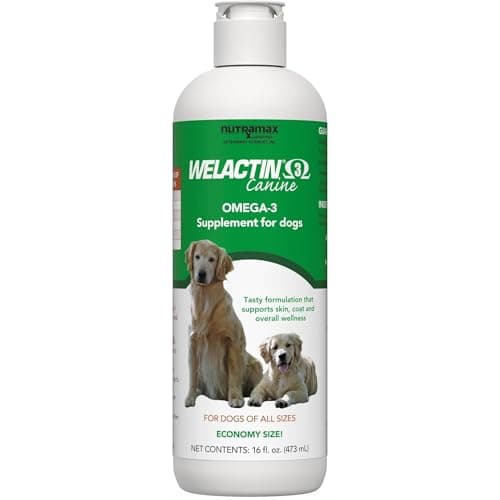
Welactin Canine Omega-3 Liquid
Our score
$22–$58
Best for
Households where a fish-oil-enriched therapeutic diet is closed off — multi-dog kitchens, elimination or kidney diets, dogs who refuse the food — and owners who want a dose they can compute and score against
The omega-3 we recommend when a fish-oil-enriched therapeutic diet is not an option, on one honest basis: the omega-3 trials in arthritic dogs were run on a diet, not on this bottle, none of them separated from control on a force plate, and the two placebo-controlled bottle trials disagree — so a dosed liquid with a published guaranteed analysis is the honest hardware for pursuing the same mechanism at a dose you and your vet chose, not a proven duplicate of anything (corrected 14 September 2026; we previously called the diet trial "the strongest evidence" and compared it as a head-to-head). Welactin earns the slot on concentration per dollar and on being made by Nutramax — not on the "#1 vet recommended" line, which is the brand's claim, not ours — and whose footnote, read 19 August 2026, defines its universe as vets "who recommended omega-3 supplements." Score lowered 8.6 to 8.4 on 19 August 2026, not because the oil changed but because a fine-print pass found the printed chart delivers under half the EPA+DHA that Colorado State's canine osteoarthritis chart calls for, that Nutramax prints the joint dose on its Advanced product and not on this one, that a retailer and the maker publish different guaranteed analyses for the same bottle, and that no calorie figure exists on any surface. It remains a cheap, concentrated, well-made oil. It is not a product you can dose for arthritis by reading its own label.
Pros
- High concentration: 1,330 mg combined EPA+DHA per 6 mL scoop on the manufacturer's guaranteed analysis
- Liquid over food scales to any body weight — no chew-splitting arithmetic
- Manufactured by Nutramax, the same company as Cosequin and Dasuquin
- Runs about $0.58/day for a 60 lb dog at the verified Amazon price — cheap for the category
Cons
- Smells fishy, and a bowl-refuser can start refusing dosed food
- Dosing hardware changed: current bottles pour by measuring scoop, not the pump our older copy described — dose accuracy now depends on you levelling a scoop
- A 6 mL scoop is coarse for small dogs — the label drops to half-scoop every-other-day under 10 lb
- Amazon's listing now leads with "Skin & Coat," not joints — the joint claim is the softer half of the marketing
- The printed chart is a skin-and-coat dose, not a joint dose, and Nutramax says so without giving a number: welactin.com's administration note read "Veterinarians may recommend increased amounts for enhanced joint health support" on 19 August 2026, and by 25 August 2026 had been reworded to "Your veterinarian may recommend to increase this amount for maximum joint health benefits" — the wording moved, the missing number stayed missing. At the chart's 1½ scoops, a 75 lb dog gets 1,995 mg of EPA+DHA against the 4,374 mg Colorado State's published canine osteoarthritis chart calls for at that weight — about 46%. Nutramax's own Welactin Advanced 3TA prints a separate "Joint Health" column at exactly double its broad-spectrum dose; this product prints one column and a footnote
- Retailer panels and the maker's panel disagree. On 19 August 2026 welactin.com published 1,610 mg total omega-3 and 1,330 mg EPA+DHA per 6 mL scoop, while a veterinary supply retailer's page for the same 16 oz bottle published 1,770 mg total, 870 mg EPA and 570 mg DHA (1,440 mg EPA+DHA) per the same 6 mL scoop. We use the maker's figures. If you are computing a dose against a study, read the panel on the bottle in your hand
- No calorie figure is published anywhere we could find — not on welactin.com and not on the Amazon listing, verified absent 19 August 2026. Fish oil is the most calorie-dense thing you can add to a bowl, and weight is the largest modifiable factor in canine osteoarthritis, so this is the number the category should print and does not
- Fish, obviously — which disqualifies it for any dog on a fish-based novel protein elimination diet, and doubles up on any dog already eating a fish-based food
- No use-within-after-opening period, no refrigeration instruction and no full ingredient list are published on the maker's product page, verified absent 9 September 2026. A 16 oz bottle lasts a 20–44 lb dog about 11 weeks and a 10–19 lb dog about 22 weeks, and fish oil oxidises once opened, so the buyer of the small dog is being sold five months of exposure with no stated shelf life. Follow whatever the bottle in your hand says; the website does not say
If you add one supplement, make it fish oil. Welactin earns the slot on concentration per dollar: its manufacturer's guaranteed analysis states 1,610 mg total omega-3 and 1,330 mg combined EPA and DHA per 6 mL scoop, at $29.99 for the 16 oz bottle when we last verified it.[17] It pours by measuring scoop, not the pump older packaging used, so levelling the scoop is now your job. It smells like fish, and a bowl-refuser can start refusing dosed food.

Nutramax
Dasuquin with MSM Soft Chews
Our score
$50–$135
Best for
Step-up from Cosequin for dogs with diagnosed osteoarthritis or post-surgical recovery
The joint supplement to buy when you have decided to buy one and the dog has real, diagnosed osteoarthritis. The ASU component is what separates it from Cosequin and the only reason to pay the premium, and the honest framing is that the supporting evidence is strongest in the laboratory and weakest in blinded canine trials — which is true of the entire category. Buy one product, run it properly for 4–6 weeks, and judge the result against something you measured before you started. Score lowered 9.2 to 8.8 on 2026-08-13: the product has not changed, but we read the trial that tested it by name and found it did not separate from placebo on a force plate, and a second blinded trial by a different group using activity monitors reached the same answer. It stays a defensible first purchase because it is inexpensive, well tolerated and unusually well disclosed. It is no longer a product we can describe as well evidenced.
Pros
- Adds ASU (avocado/soybean unsaponifiables) to the glucosamine/chondroitin base — the ingredient that separates it from Cosequin, with laboratory and animal-model evidence for cartilage protection
- Same FCHG49 glucosamine and TRH122 chondroitin as Cosequin
- Soft chew form factor most dogs eat as a treat
- Genuinely a veterinary-channel line, not just marketed as one — the Advanced tier is sold through clinics rather than retail. Note that the box's "#1 veterinarian recommended" rests on an unnamed survey. dasuquin.com's own footnote, read 2026-09-08, gives the source as a "survey conducted among small animal veterinarians who recommended animal supplements" — so the denominator is vets who already recommend a supplement, not vets. No sample size, date or sponsor is published
- Published per-chew analysis — you can see exactly what a chew contains, which most competitors do not publish to the same standard — including, unusually, an omega-3 line the equivalent chewable tablet does not carry
Cons
- 30–40% pricier than Cosequin DS
- Soft chews can stick together in heat
- Only meaningful upgrade if diagnosed OA — for healthy dogs Cosequin is enough
- The canine clinical evidence for ASU is thinner than the marketing: the strongest data is laboratory and animal-model work, not blinded trials in pet dogs. No joint supplement has evidence in the same class as an NSAID
- This exact product was the glucosamine arm of a blinded, placebo-controlled force-plate trial and it did not separate from placebo. Kampa et al. 2023 (Front Vet Sci, DOI 10.3389/fvets.2023.1033188) names "DASUQUIN with MSM Soft Chews, Nutramax" and reports a week-4 change in peak vertical force of −0.05 against placebo's +0.08, while two green-lipped mussel lipid extracts and carprofen all improved significantly. Two fair caveats: small arms — 16 dogs in the glucosamine group, 14 to 15 in the others — and the trial ran maintenance dosing (about 30 mg/kg) through the window this label says to double.
- Contains no manganese, unlike both of its Nutramax siblings — Cosequin prints 3 mg per tablet and Dasuquin Advanced prints 3 mg per large-dog chew, while this tier has no manganese row on the panel and none in the other-ingredients list (all three panels read 19 August 2026). Whether that matters is genuinely unclear, since manganese's role here is a cofactor claim rather than a tested effect. We list it as a con because the maker sells it as an active in the tier above and the buyer of this tier is never told it is absent
- No calorie figure on the panel, on dasuquin.com or on the Amazon listing (verified absent 19 August 2026) — two chews a day is two treats a day for a dog whose weight is the strongest lever anyone has
We are keeping Dasuquin with MSM on this page, and we are no longer going to pretend it is a treatment. Two things you should know before you spend $84.99 on a tub.[18] First, this exact product was the glucosamine arm of a blinded, placebo-controlled force-plate trial and it did not separate from placebo — the paper names "DASUQUIN with MSM Soft Chews, Nutramax Laboratories Consumer Care, Inc." by name, while two green-lipped mussel lipid extracts and carprofen did separate.[19] Second, an independent group at a different institution ran 30 dogs against 30 placebo for 97 days on activity monitors and found no difference in activity counts, while owner scores improved equally in both arms.[20]
We have also cut a sentence that used to sit here claiming ASU (avocado/soybean unsaponifiables) "has cartilage research behind it that plain glucosamine products lack." The canine clinical evidence for ASU is thinner than that sentence implied, and we should not have written it.
So why is the card still here? Because the trials above are small, ran at roughly maintenance dosing rather than the label's loading dose, and were powered to detect a different product's effect — and because a large number of owners will try a joint chew regardless, in which case buying the one whose exact formulation has actually been through a blinded trial is more defensible than buying one that has not. If you try it, give it six to eight weeks, tell your vet everything your dog takes, and read our full joint supplement guide and the Dasuquin vs. Cosequin comparison first. And if you would rather put that $85 toward a body-condition consult and a better bed, that is the choice the evidence supports.
4. The home environment#
An arthritic dog's day is defined by a few dozen hard transitions: getting up, lying down, stairs, the car, the slick kitchen floor. Each one is fixable.

Big Barker
Big Barker 7-inch Pillow Top
Our score
$250–$460
Best for
Large and giant breeds with hip, elbow, or arthritis pain
The bed every senior-large-breed owner eventually buys, and the one we still recommend first for a dog over about 80 lb — because seven inches of foam is the only thing that reliably keeps a heavy dog's hip off the floor plane overnight. (It is not one solid slab, as we used to say: the maker's own copy describes a 3-layer build, a 2" base under a 3" support layer under a 2" comfort top.) It is also the only bed in the category with a clinical study attached, and we would rather you knew what that study is: forty dogs, no control group, no blinding, and outcomes scored by the owners who had just been given a free bed. That is a reason to be interested, not a reason to be convinced. Buy on the foam depth and the ten-year warranty, which are facts. On where to buy: the price is the same either way, so buy direct for the 180-night sleep trial, which Amazon's return window does not match. The two editions both sell on both channels at identical prices, re-verified 6 September 2026 — flat Large $249.95, Headrest Large $289.95. We have published two wrong things about this in the past, a $40 Amazon markup and a direct-only cheap edition; both are retired, and the honest version is that the channel decides your trial, not your price.
Pros
- Seven inches of foam — a 3-layer build (2" base, 3" support, 2" top comfort) deep enough that a 100 lb dog's hip does not reach the floor plane, which is the whole job
- 10-year warranty — foam must retain at least 90% of its original shape and support, or it is replaced
- The only bed in the category with a published clinical study behind it, even though that study is a single-arm pilot
- Made in the USA
- Microfiber cover unzips and machine-washes
Cons
- Premium price
- Editions, not channels, are what the price difference is. Both are on Amazon and both are on bigbarker.com at identical prices, re-verified 2026-09-06: the flat headrest-free Large is $249.95 (B0GRBXBPXH) and the Headrest Large is $289.95 (B0GRBX5TBL), both In Stock with the buy box held by Big Barker itself, both matching the maker's own site. We previously misread this as a $40 Amazon markup, and then as the cheap edition being direct-only. Both claims are retired
- Bulky — measure your space, not just your dog
- Cover-only style isn't bolstered (consider Sofa edition for nesters)
- The clinical study everyone cites is open-label, single-arm, and owner-scored, with no control group
The reason a bed is worth real money is measurable. When researchers laid dogs on four different surfaces and mapped the pressure, the same three points came up as risk zones every time — the shoulder joint, the greater trochanter of the hip, and the thirteenth rib — and the thinnest dogs, with the least muscle left to pad those points, recorded the highest peak pressures on every surface tested.[21] The arthritic senior who has lost muscle over her hips is exactly that dog.
The Big Barker is the one bed with a published canine study attached to it, and you should know precisely what that study is before it persuades you. Its own Study Design section calls it "a single center, open-label, proof of concept study": 40 dogs over 70 lb with radiologist-confirmed osteoarthritis, 28 days, no control group and no blinding, with the headline improvements all coming from owner-completed questionnaires and tested at an unusual α = 0.02 threshold. The one objective measurement was the collar accelerometer, which found that half the dogs had at least a 13% drop in night-time activity and a quarter had at least a 33% drop. The report also states that the remaining statistical tests did not reject the null hypothesis.[22]
Set that against the 39.7% caregiver placebo rate above and the owner questionnaires stop being persuasive on their own. Buy this bed for the seven inches of foam and the ten-year warranty, which you can verify with your hands, and treat the percentages as a reason someone should run the controlled trial. Our orthopedic bed roundup covers alternatives at other budgets, and a good bed matters most for a big dog on a hard floor.
Dr. Buzby's
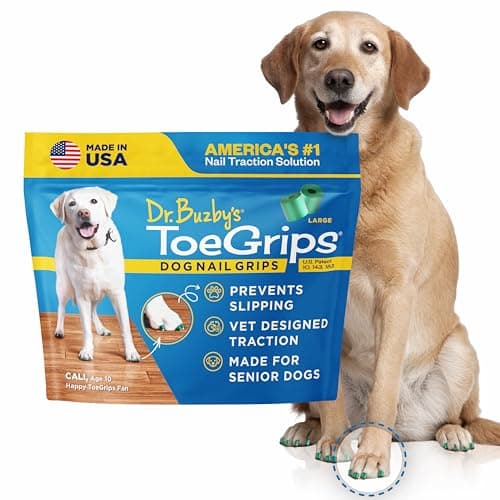
Dr. Buzby's ToeGrips for Dogs
Our score
$34–$40
Best for
Senior dogs slipping on hardwood, tile, or laminate floors
The best dog-mounted traction fix there is, and the one to buy once rugs have taken you as far as they can. Nothing touches the paw pad, which is why dogs tolerate these where they refuse socks and boots. Go in knowing the real cost: this is not a $40 purchase but a $240–$320 a year habit, so lay runners along your dog's actual routes first and buy grips for the floors you cannot cover.
Pros
- Veterinarian-developed; in clinical use for over a decade
- Slip onto each toenail — no socks, booties, or adhesives required
- Restores traction immediately, especially on hard floors
- Nothing touches the paw pad, so dogs accept them where they refuse boots
- Amazon and the manufacturer both charge $39.99 — no retailer markup
- 20 grips per bag against the 16 a dog wears, so a set includes four spares
Cons
- The only two published studies of nail grips both tested this exact product, and both were null: Roush 2017 (Front Vet Sci 4:111 — 15 sound dogs, kinetic changes "unlikely to be clinically relevant") and Repac 2022 (Animals 12(18):2312 — 30 dogs two weeks post-TPLO vs sham, no difference in weight bearing or limb function, including the owner question that asked specifically about slippery floors). Fair caveats: small samples, one used healthy dogs, the other a single early post-op timepoint — but "no positive trial exists" is the honest label, and we say it while still recommending the product for the mechanism and the owner-reported traction stories it was never tested against (verified 2026-08-14).
- A recurring cost, not a one-off. The maker publishes two different bag lives — "1–2 months" on its store page and "1-3 months, two months on average" in its FAQ (both read 2026-09-05) — which spans $160–$480 a year at $39.99. Plan on $240–$320, the two surfaces' central figures
- The Amazon listing markets specifically to dogs with "ACL injuries" — the one population where a randomised trial has been run, and where it found nothing (Repac 2022). The same bullets carry three claims with no source we could find: "more than 250,000 paws," "America's #1 nail traction solution," and "recommended by thousands of veterinarians worldwide" (listing copy verified 2026-08-17). Re-read 2026-08-31: a fourth unsourced superlative has been added to the top bullet on all four Amazon sizes — "The Only Toenail Grips for Dogs With GripZone Technology" — and the Large listing's title now leads with "Instant Traction on Wood/Hardwood Floors."
- The maker sells Scotch Super Glue Gel at $4.99 on its own store, listed as an "Alternate ToeGrips Application Method" (shop.toegrips.com, 2026-08-31). Read that as what it is: the company's own answer to the grips coming off, priced separately and not mentioned on the Amazon listing you are most likely to buy from.
- Application needs isopropyl rubbing alcohol, which is not in the box
- Initial application takes 15–20 minutes for a full set
- Some dogs chew them off in the first week
- Amazon carries only four of the seven sizes; XS, XXL and XXXL dogs have to buy direct
- Sizing by weight chart alone often misses — the accurate method needs dental floss and a ruler
Slick floors make arthritic dogs splay, scramble, and avoid whole rooms. ToeGrips are rubber rings that sit on the toenails so the nail, rather than the pad, meets the floor. At $39.99 they are the cheapest intervention on this list, and unusually for our core products there is no Amazon markup — the maker charges the same.[23] We have no controlled trial showing they change outcomes, and free runners on the walking routes do much of the same job. Finally, eliminate jumping: a ramp for the car and furniture removes the highest-impact moments in an arthritic dog's day.
How much exercise should an arthritic dog get?#
The instinct to rest an arthritic dog is understandable and wrong. Rested dogs lose muscle, and muscle is what stabilizes a compromised joint, so extended rest makes the arthritis functionally worse. Movement also seems to blunt the pain itself: Merck notes that "exercise elicits hypoalgesia through a variety of mechanisms."[1] The rehab shorthand is "motion is lotion," which is a slogan rather than a finding — but the direction it points is the right one.
The rules that matter:
- Short and frequent beats long and occasional. Two or three 15-minute leash walks daily are far better than an hour on Saturday. The weekend-warrior pattern produces Sunday flare-ups.
- Consistency. Roughly the same amount of activity every day, on level ground, on leash.
- Warm up. A few minutes of slow walking before anything brisker, especially in cold weather.
- Swim if you can. Water supports the dog's weight while the muscles work — the best strength-to-joint-load ratio available.

After a flare — a stiff, sore day following too much activity — give a day or two of relative rest and short leash-only outings. If a flare does not settle within a couple of days, call your vet rather than waiting it out.
When should I call the vet?#
Book a routine appointment for any of the early signs in the table above. Call the same day — do not wait — for any of these:
- Sudden lameness where the dog will not put weight on a leg at all
- Dragging a back leg, scuffing or knuckling a paw — possible spinal problem, covered in our IVDD guide
- Crying out when standing, moving, or being touched
- A hot, swollen joint, especially with lethargy or appetite loss
- A dog that cannot get up at all
The bottom line#
Arthritis in dogs is not curable, and it is also not a reason to watch a dog decline. The system works: get a real diagnosis, get the weight down, use prescription pain relief as directed, add fish oil and a researched joint supplement, and rebuild the home — supportive bed, traction, ramps, short frequent walks. Every part is ordinary; together they change how a dog moves through the day.
The most important step is the first one — deciding that "slowing down" is a symptom, not a life stage. The earlier arthritis is treated, the more muscle, mobility, and good years there are left to protect. Start with the vet visit.
Frequently asked
- What are the first signs of arthritis in dogs?
- The earliest signs are subtle: hesitating at the bottom of stairs, shorter walks before wanting to turn home, taking longer to stand up after rest, licking one joint, and giving up favorite jumps onto the bed or into the car. Limping is a late sign. If your dog has simply slowed down over months, treat that as a symptom worth a vet visit, not as normal aging.
- Can arthritis in dogs be cured?
- No. Osteoarthritis is progressive, and the cartilage damage is not reversible. It is very manageable, though. Weight control, prescription pain relief from your vet, omega-3 and joint supplements, low-impact exercise, and a home set up for traction and soft landings keep most arthritic dogs comfortable and active for years. The goal is a comfortable dog, not a normal X-ray.
- What can I give my dog for arthritis pain?
- Nothing from your own medicine cabinet. Ibuprofen, naproxen, and acetaminophen are toxic to dogs and cause poisonings every year. Dogs need canine-specific NSAIDs, which are prescription-only, or newer options like the monthly Librela injection — both through your vet. Over the counter, the one addition with consistent evidence behind it is omega-3 fish oil. The 2022 systematic review of this whole category found clear analgesic efficacy for omega-3 and none at all for glucosamine-chondroitin, so treat fish oil as the supplement worth adding and everything else as optional.
- How can I help a dog with arthritis at home?
- Four things matter most: keep your dog lean, which is the single highest-leverage factor you control; keep walks short and frequent instead of long and occasional; add traction on slick floors; and provide a supportive bed plus ramps for the car and furniture. None of this replaces veterinary pain management — it works alongside it.
- Is my dog slowing down from old age or from arthritis?
- Old age is not a disease. When a senior dog slows down, the most common hidden reason is musculoskeletal pain, and osteoarthritis is the most common cause of that pain. Veterinarians treat slowing down as a screening sign, not a normal finding. An exam can usually sort it out in one visit, and arthritis is treatable at every stage.
- What is the new monthly injection for dog arthritis?
- Librela (bedinvetmab) is a monoclonal antibody that blocks nerve growth factor, one of the drivers of osteoarthritis pain. The FDA approved it on 5 May 2023 as a once-monthly injection given at the clinic. You should also know that in December 2024 the FDA published a Dear Veterinarian Letter after reviewing adverse-event reports that included ataxia, seizures, other neurologic signs such as weakness and incontinence, and in some cases death. Those are voluntary reports, not proof the drug caused them — but they are the reason this is a real conversation with your veterinarian rather than a formality.