Nutramax
Welactin Canine Omega-3 Liquid
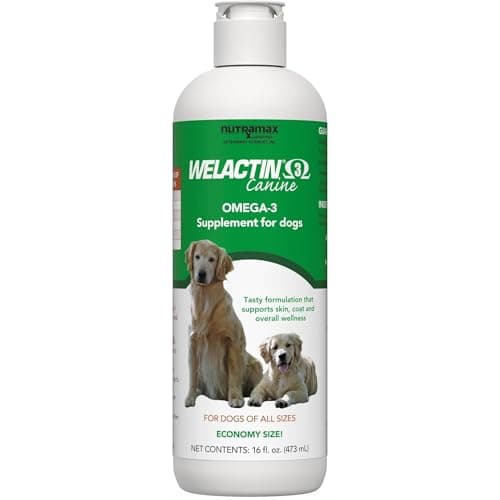
$22–$58
Check price on AmazonWe earn a commission if you buy through this link. It does not change what we recommend or how we score it — see our affiliate disclosure.
Best for
Households where a fish-oil-enriched therapeutic diet is closed off — multi-dog kitchens, elimination or kidney diets, dogs who refuse the food — and owners who want a dose they can compute and score against
The omega-3 we recommend when a fish-oil-enriched therapeutic diet is not an option, on one honest basis: the omega-3 trials in arthritic dogs were run on a diet, not on this bottle, none of them separated from control on a force plate, and the two placebo-controlled bottle trials disagree — so a dosed liquid with a published guaranteed analysis is the honest hardware for pursuing the same mechanism at a dose you and your vet chose, not a proven duplicate of anything (corrected 14 September 2026; we previously called the diet trial "the strongest evidence" and compared it as a head-to-head). Welactin earns the slot on concentration per dollar and on being made by Nutramax — not on the "#1 vet recommended" line, which is the brand's claim, not ours — and whose footnote, read 19 August 2026, defines its universe as vets "who recommended omega-3 supplements." Score lowered 8.6 to 8.4 on 19 August 2026, not because the oil changed but because a fine-print pass found the printed chart delivers under half the EPA+DHA that Colorado State's canine osteoarthritis chart calls for, that Nutramax prints the joint dose on its Advanced product and not on this one, that a retailer and the maker publish different guaranteed analyses for the same bottle, and that no calorie figure exists on any surface. It remains a cheap, concentrated, well-made oil. It is not a product you can dose for arthritis by reading its own label.
What works
- High concentration: 1,330 mg combined EPA+DHA per 6 mL scoop on the manufacturer's guaranteed analysis
- Liquid over food scales to any body weight — no chew-splitting arithmetic
- Manufactured by Nutramax, the same company as Cosequin and Dasuquin
- Runs about $0.58/day for a 60 lb dog at the verified Amazon price — cheap for the category
What doesn't
- Smells fishy, and a bowl-refuser can start refusing dosed food
- Dosing hardware changed: current bottles pour by measuring scoop, not the pump our older copy described — dose accuracy now depends on you levelling a scoop
- A 6 mL scoop is coarse for small dogs — the label drops to half-scoop every-other-day under 10 lb
- Amazon's listing now leads with "Skin & Coat," not joints — the joint claim is the softer half of the marketing
- The printed chart is a skin-and-coat dose, not a joint dose, and Nutramax says so without giving a number: welactin.com's administration note read "Veterinarians may recommend increased amounts for enhanced joint health support" on 19 August 2026, and by 25 August 2026 had been reworded to "Your veterinarian may recommend to increase this amount for maximum joint health benefits" — the wording moved, the missing number stayed missing. At the chart's 1½ scoops, a 75 lb dog gets 1,995 mg of EPA+DHA against the 4,374 mg Colorado State's published canine osteoarthritis chart calls for at that weight — about 46%. Nutramax's own Welactin Advanced 3TA prints a separate "Joint Health" column at exactly double its broad-spectrum dose; this product prints one column and a footnote
- Retailer panels and the maker's panel disagree. On 19 August 2026 welactin.com published 1,610 mg total omega-3 and 1,330 mg EPA+DHA per 6 mL scoop, while a veterinary supply retailer's page for the same 16 oz bottle published 1,770 mg total, 870 mg EPA and 570 mg DHA (1,440 mg EPA+DHA) per the same 6 mL scoop. We use the maker's figures. If you are computing a dose against a study, read the panel on the bottle in your hand
- No calorie figure is published anywhere we could find — not on welactin.com and not on the Amazon listing, verified absent 19 August 2026. Fish oil is the most calorie-dense thing you can add to a bowl, and weight is the largest modifiable factor in canine osteoarthritis, so this is the number the category should print and does not
- Fish, obviously — which disqualifies it for any dog on a fish-based novel protein elimination diet, and doubles up on any dog already eating a fish-based food
- No use-within-after-opening period, no refrigeration instruction and no full ingredient list are published on the maker's product page, verified absent 9 September 2026. A 16 oz bottle lasts a 20–44 lb dog about 11 weeks and a 10–19 lb dog about 22 weeks, and fish oil oxidises once opened, so the buyer of the small dog is being sold five months of exposure with no stated shelf life. Follow whatever the bottle in your hand says; the website does not say
Specifications
- Materials
- Fish oil with vegetable oil, mixed tocopherols, rosemary and green tea extract as preservatives. Maker's guaranteed analysis: total omega-3 1,610 mg, combined EPA+DHA 1,330 mg per 6 mL scoop (welactin.com, 19 August 2026)
- Sizes
- 16 oz (480 mL)
- Warranty
- No satisfaction guarantee we can verify. Nutramax's published returns policy is the same across its line: report within 10 business days of receipt; between 10 and 30 business days a return is accepted only if unopened, unmarked, undamaged and with a year left before expiry. An opened bottle you have been dosing for a month is not returnable (policy re-read 19 August 2026)
- Made in
- USA
What changed on this page, and why
We re-verified this product against its Amazon listing and the manufacturer's own guaranteed analysis in August 2026, and the biggest correction is ours to own: our earlier copy described a pump bottle delivering EPA 200 mg and DHA 130 mg per pump. The bottle Nutramax sells today doses with a 6 mL measuring scoop, and the guaranteed analysis reads 1,610 mg total omega-3 and 1,330 mg combined EPA+DHA per scoop. If you are following an old dosing note — ours or anyone's — against a current bottle, you could be off by several fold. Use the chart printed on your bottle.
The dosing chart, and the real running cost
| Dog's weight | Daily amount | 16 oz bottle lasts | Cost per day at $29.99 |
|---|---|---|---|
| 10–19 lb | ½ scoop | ~22 weeks | ~$0.19 |
| 20–44 lb | 1 scoop | ~11 weeks | ~$0.38 |
| 45–79 lb | 1½ scoops | ~7 weeks | ~$0.58 |
| 80–114 lb | 2 scoops | ~5.5 weeks | ~$0.77 |
| 115 lb + | 2½ scoops | ~4.5 weeks | ~$0.96 |
Dogs of 5–9 lb get half a scoop every other day, which is the chart's own admission that a 6 mL scoop is coarse hardware for a small dog. Prices are the August 2026 Amazon price, sold by Amazon.com itself — no reseller markup pattern here.
The chart on the bottle is not the joint dose
This is the finding that matters most on this page, and it took reading two of Nutramax's own products side by side to see it.
Welactin Canine's administration chart has one column. Underneath it sits a single sentence: "Veterinarians may recommend increased amounts for enhanced joint health support." No number. That is the entire guidance an owner buying this bottle for an arthritic dog receives.
Now put a number on it.
| Dog | Welactin label dose | EPA+DHA delivered | CSU canine OA chart | Label as % of OA dose |
|---|---|---|---|---|
| 50 lb (22.7 kg) | 1½ scoops | 1,995 mg | 3,227 mg | 62% |
| 75 lb (34.1 kg) | 1½ scoops | 1,995 mg | 4,374 mg | 46% |
| 100 lb (45.5 kg) | 2 scoops | 2,660 mg | 5,427 mg | 49% |
The right-hand column comes from Colorado State University's published canine fish-oil dosing chart, which works from 310 mg/kg^0.75 of EPA+DHA per day for dogs with osteoarthritis (read 19 August 2026). Note the middle row: a 75 lb dog on the label sits at 1½ scoops because the band runs 45–79 lb, so the larger the dog inside a band, the further under he falls.
And Nutramax is not unaware of this. Its Welactin Advanced 3TA — a concentrated version sold alongside this one — prints a chart with two columns, "Broad Spectrum" and "Joint Health," and the joint column is exactly double the broad-spectrum one at every weight. For a 68–77 lb dog that is 5 scoops of 2 mL, about 4,400 mg of EPA+DHA a day, which is essentially the CSU figure. The same company publishes the joint dose on one product and a footnote on the other.
Do not simply double the scoop yourself. CSU's own note is that the maximum dose is not tolerated by all animals, and recommends beginning at roughly a quarter of it and titrating up while watching for loose stool and vomiting. The useful thing this page can do is hand you both numbers so the conversation with your vet starts with arithmetic instead of "a squirt on his dinner."
Two panels, two answers
On 19 August 2026 the maker's site published 1,610 mg total omega-3 and 1,330 mg combined EPA+DHA per 6 mL scoop. On the same day, a veterinary supply retailer's page for the same 16 oz bottle published 1,770 mg total omega-3, 870 mg EPA and 570 mg DHA — 1,440 mg EPA+DHA — per the same 6 mL scoop. Both were live simultaneously; the retailer's numbers are higher on both counts.
We use the maker's figures throughout this page and in the table above, and we are printing the disagreement rather than quietly picking a side. If you are computing a dose against a published study, read the panel on the bottle in front of you, not any page on the internet including this one.
Two more absences worth naming, both verified today. Neither surface publishes a calorie figure for a scoop of this oil. Fish oil is the most calorie-dense thing an owner can add to a bowl, and body weight is the largest modifiable factor in canine osteoarthritis, so a joint supplement that will not tell you what it adds to the day's intake is working against the intervention that has the best evidence of all. And the "#1 veterinarian recommended omega-3 supplement brand" line on the listing carries a footnote on welactin.com reading "Survey conducted among small animal veterinarians who recommended omega-3 supplements" — a universe drawn around vets who already recommend the category, with no year, no sample size and no named surveyor.
What the evidence is, and what it is not
The most-cited omega-3 result in arthritic dogs is a randomized, double-blinded, controlled JAVMA trial (Roush et al., 2010;236:67–73): 38 client-owned dogs with osteoarthritis, the test group fed a food containing 3.5% fish oil omega-3s. Over 90 days the test group's mean peak vertical force — measured on a force plate, not scored by eye — rose 5.6%, and 82% of test dogs improved against 38% of controls. Corrected 14 September 2026: that 5.6% is a within-group change (the test group against its own baseline; the control group's 0.4% was not significant). The abstract does not report a significant difference between the diet and the control food, and the Helsinki group that later ran the largest independent trial read the full paper the same way. We had printed the two percentages side by side as though they were a head-to-head result. They are not.
Read the asterisk before you buy: that was a therapeutic diet, not a bottle of fish oil added to ordinary food, and Welactin itself has never been trialled. Two placebo-controlled trials of other fish oils over ordinary food do exist, and they pull in opposite directions. The un-commissioned University of Helsinki trial (Hielm-Björkman et al., BMC Vet Res 2012;8:157) gave 77 dogs about 110 mg/kg/day of EPA+DHA for 16 weeks and found no significant difference from corn oil on force plate, pain index or NSAID use. A 2016 US trial (Mehler et al., Prostaglandins Leukot Essent Fatty Acids 2016;109:1–7) gave 78 dogs an average of 69 mg/kg/day for 84 days and found all three clinician exam scores improved against a mineral-oil placebo; it used no force plate and the trade report describes it as industry-associated. The full reconciliation, with every dose priced for a 75 lb dog, is in Hill's j/d vs adding fish oil. A dosed liquid is a sensible way to pursue the same mechanism without changing foods, and that is the honest ceiling of the claim. The listing's "#1 vet recommended omega 3 supplement brand" line is the brand's survey, not evidence about your dog.
The trial doses, translated into this scoop
The label chart is a skin-and-coat dose. If you and your vet decide to dose for a joint instead, the two bottle trials above and Colorado State's canine osteoarthritis chart are the only published waypoints, and none of them is printed on the bottle. Here is each one as scoops of this product (1,330 mg EPA+DHA per 6 mL scoop, maker's guaranteed analysis), with the label dose for comparison. Calories use the veterinary literature's ~42 kcal per 5 mL, since Nutramax publishes none.
| Dog | Label chart | 69 mg/kg (Mehler 2016) | 110 mg/kg (Helsinki 2012) | CSU OA chart |
|---|---|---|---|---|
| 30 lb (13.6 kg) | 1 scoop, 1,330 mg | ~0.7 scoop, ~940 mg | ~1.1 scoops, ~1,500 mg | ~1.7 scoops, ~2,200 mg (computed from 310 mg/kg^0.75) |
| 50 lb (22.7 kg) | 1½ scoops, 1,995 mg | ~1.2 scoops, ~1,570 mg | ~1.9 scoops, ~2,500 mg | ~2.4 scoops, 3,227 mg |
| 75 lb (34.1 kg) | 1½ scoops, 1,995 mg | ~1.8 scoops, ~2,350 mg | ~2.8 scoops, ~3,750 mg | ~3.3 scoops, 4,374 mg |
| 100 lb (45.5 kg) | 2 scoops, 2,660 mg | ~2.4 scoops, ~3,140 mg | ~3.8 scoops, ~5,000 mg | ~4.1 scoops, 5,427 mg |
Three things to take from the table. For a dog under about 40 lb the label scoop already exceeds the only placebo-beating bottle dose, so "more" has no trial behind it at that size. For a large dog the label is the lowest number on the row and the bottle lasts far less time than the chart suggests — at the 69 mg/kg dose a 75 lb dog empties the 480 mL bottle in about 45 days, not 7 weeks, and at the CSU figure in about 24 days. And the highest dose in the table is the one that failed to separate from placebo in the only independent trial, so the argument for going up is not "the trial dose works"; it is that a dose you chose, wrote down and scored against is the only kind you can learn from. Every figure above the label is a vet conversation, with a ramp and a food reduction to pay for the calories, not a pour.
Head-to-head: this bottle or Welactin Advanced 3TA?
Nutramax's own sibling product is the obvious alternative for an arthritis buyer, because it is the one whose label admits what you are dosing for. The comparison, on the numbers, is closer than the two labels suggest — all figures read 25 August 2026.
| Welactin Canine (this page) | Welactin Advanced 3TA | |
|---|---|---|
| Bottle | 16 oz (~78 six-mL scoops) | 8 fl oz (~118 two-mL scoops) |
| EPA+DHA per scoop | 1,330 mg | 880 mg (530 EPA + 350 DHA, plus 10 mg ETA) |
| EPA+DHA per bottle | ~103,700 mg | ~103,800 mg |
| Joint dose printed on the label? | No — a footnote with no number | Yes — a second "Joint Health" column, double the base column at every weight |
| Where you can buy it | Amazon ($29.99, sold by Amazon.com) and general retail | Vet-channel retail; we could not find an Amazon listing (searched 25 August 2026) and found it from $31.59 to $42.77 across vet storefronts the same day |
| Calorie figure published | No | No |
Read the second-to-last rows together and the choice sorts itself. Per bottle, the two products carry almost exactly the same total EPA+DHA, so at the cheapest vet-retail price we found the cost per milligram is effectively a wash — and at the top of the vet-channel spread, 3TA costs about a third more for the same omega-3s. What 3TA actually sells is not concentration. It is the label: a printed two-column chart you can follow without doing any of this page's arithmetic, and a finer 2 mL scoop that makes a gradual titration easier to measure, especially under 40 lb. What it costs you is channel: no Amazon listing, a price that varied 35% across the vet storefronts we checked on one day, and a "3TA" marketing story whose third omega-3, ETA, amounts to 10 mg a scoop next to 880 mg of EPA+DHA. If your vet practice sells 3TA near the low end of that spread and your dog is on a joint titration, it is a reasonable buy for the label alone. If you are price-checking on Amazon, this bottle is the same omega-3s — you are just carrying the arithmetic yourself, which is what the table above is for. We earn nothing on 3TA either way.
The cheaper thing first
If your dog already eats a fish-based or veterinary joint diet, you may be buying omega-3s he is already getting — check the bag's guaranteed analysis for EPA+DHA before adding a bottle, and ask your vet where the ceiling is. Plain sardines in water are the folk alternative; they work out cheaper only for small dogs, and you give up the measured dose, which is most of what you are paying Welactin for.
Who should not buy it
- Dogs on anticoagulants, with clotting disorders, or with surgery scheduled — tell your surgeon the exact daily EPA+DHA before the pre-anesthetic visit.
- Dogs with a history of pancreatitis — added dietary fat needs a vet's sign-off first.
- Households that free-feed. The dose rides on a meal being eaten while the oil is fresh; a grazer's bowl with oil on it sits out for hours.
- Owners who want the strongest-evidence version of this bet and are open to changing foods: the trial evidence belongs to enriched diets, and your vet can name one.
Frequently asked
- How much Welactin do I give my dog?
- By the chart on the bottle, using the 6 mL scoop in the box: half a scoop every other day for 5–9 lb, half a scoop daily for 10–19 lb, one scoop for 20–44 lb, one and a half for 45–79 lb, two for 80–114 lb, and two and a half over 115 lb. The manufacturer notes vets may recommend more for joint support — ask yours before exceeding the chart, especially if your dog is on other medication or already eats a fish-based diet.
- How long does a bottle last, and what does it really cost?
- The 16 oz bottle holds about 480 mL — roughly 78 scoops. That is about 11 weeks for a 20–44 lb dog on one scoop a day, about 7 weeks for a 45–79 lb dog, and about 5.5 weeks for an 80–114 lb dog. At the $29.99 we verified on Amazon in August 2026, a 60 lb dog costs about $0.58 a day, or around $210 a year.
- Does fish oil actually help arthritic dogs?
- The best evidence is real but comes with an asterisk. In a randomized, double-blinded JAVMA trial of 38 dogs with osteoarthritis, dogs fed a food enriched with fish oil omega-3s improved their measured peak vertical force by 5.6% over 90 days against 0.4% on the control food, with 82% of dogs on the fish-oil diet improving versus 38% of controls. That trial used a therapeutic diet, not a bottled supplement — no equivalent trial exists for this product. Adding a measured liquid to the current food is a reasonable way to chase the same mechanism, not a proven duplicate of it.
- Is Welactin a pump bottle?
- Not anymore, as far as we can verify. The current Amazon listing and the manufacturer's page both describe a measuring scoop you fill and pour over food; our own earlier copy described a pump with EPA 200 mg and DHA 130 mg per pump. If your bottle has a pump, dose by your bottle's own label rather than any chart online — the per-delivery amounts differ by several fold.
- Is the dose on the bottle enough for arthritis?
- Probably not, and Nutramax half-says so. The printed chart is written for skin and coat, and the maker's own administration note adds only "Veterinarians may recommend increased amounts for enhanced joint health support" with no figure attached (welactin.com, read 19 August 2026). Put a number on it: at 1½ scoops, a 75 lb dog gets 1,995 mg of EPA+DHA a day. Colorado State's published canine fish-oil chart, built on 310 mg/kg^0.75 of EPA+DHA, calls for 4,374 mg at that weight — so the label dose is about 46% of it. Nutramax clearly knows the difference, because its Welactin Advanced 3TA product prints a two-column chart, "Broad Spectrum" and "Joint Health," with the joint column exactly double; at 68–77 lb that is 5 scoops, about 4,400 mg of EPA+DHA, essentially the CSU figure. Do not simply double it yourself. CSU's own guidance is that the maximum dose is not tolerated by every dog, and advises starting near a quarter of it and titrating up while watching for loose stool and vomiting. Take the two numbers to your vet and let her set the dose.
- What are the side effects of overdoing fish oil?
- The common one is soft stool or diarrhea, and it is also the usual sign you have overshot the dose. Fishy breath and coat smell are cosmetic. High doses can affect platelet function, which is one reason to tell your vet the exact daily amount before any surgery — including the orthopedic surgery this site writes about.
Where we recommend it
The articles this product earns a place in, and the context it earns it for.

supplements
Hill's j/d vs Adding Fish Oil to the Food: Where the Trial Evidence Actually Lives, and What Each Route Delivers
The omega-3 trials in arthritic dogs were run on a therapeutic food, not a bottle, and read closely they are smaller than the bag says. Five doses and three routes priced for a 75 lb dog, every figure read at source.

supplements
How Much Fish Oil for an Arthritic Dog? The Colorado State Chart, and Why Your Bottle Is Lower
Colorado State's teaching hospital publishes a canine fish-oil chart for osteoarthritis. The bottle's chart is a skin-and-coat dose — about 46% of it for a 75 lb dog. Both numbers, and how to close the gap safely.

conditions
Arthritis in Dogs: Signs, Treatment, and What Actually Helps at Home
How to spot arthritis in dogs early, what veterinary treatment looks like, and the weight, exercise, and home changes that actually reduce pain.

supplements
Cheaper Alternatives to Cosequin and Dasuquin That Aren't Junk
There is no true generic Cosequin — but good Cosequin alternatives exist. How to match the actives, price them per gram, spot underdosed blends, and when the smarter budget move is fish oil.

supplements
Joint Supplement Dosage by Dog Weight: One Table, 5 lb to 120 lb
Every label's loading and maintenance dose for Cosequin, Dasuquin and Zesty Paws, by dog weight, in one table. Including which of them publishes no weight chart at all — verified against the packaging.

breeds
Arthritis in Labradors: The Weight Connection Nobody Wants to Hear About
Labrador arthritis runs on three rails: joint genetics, a famous appetite, and extra pounds. The lifetime feeding study is worth 1.8 years, not two — here is what it actually showed, and what to do with it.

supplements
Best Joint Supplements for Dogs: Dasuquin vs Cosequin vs YuMOVE
Dasuquin, Cosequin, YuMOVE's green-lipped mussel, or a budget soft chew? What the blinded canine trials actually found, which brand fits which dog, and what each costs per day at prices verified in August 2026.