Diet or bottle
Hill's j/d vs Adding Fish Oil to the Food: Where the Trial Evidence Actually Lives, and What Each Route Delivers
The omega-3 trials in arthritic dogs were run on a therapeutic food, not a bottle, and read closely they are smaller than the bag says. Five doses and three routes priced for a 75 lb dog, every figure read at source.

Start with what nobody can tell you: no trial has ever compared a fish-oil-enriched therapeutic diet with a scoop of fish oil over ordinary food in arthritic dogs. Both sides borrow the same evidence and the evidence is thinner than either bag or bottle says. Read at source, the Hill's-affiliated diet trials show improvement inside the test-food group and on owner and vet scores, but the force-plate paper does not report a significant difference between the diet and the control food; the one un-commissioned university trial of a bottle with a force plate found no significant difference from corn oil; and the one bottle trial that beat placebo on every measure used exam scores, not a force plate. So this is not a decision about proof. It is a decision about dose, calories and whether a whole-ration diet fits your household, and those you can actually compute.
Affiliate disclosure: Dog Orthopedic is reader-supported. When you buy through links on our site we earn a commission at no extra cost to you — about 3% on most pet products, and the same rate on every product we compare, so no pick earns us more than another. Prescription medication earns us nothing, and seeing your vet earns us nothing; we recommend both anyway. Learn more.
Imagery: Lifestyle photographs on this site are licensed from Pexels (royalty-free) and credited per image. Pexels imagery illustrates conditions and contexts — it does not depict the specific dogs or test sessions described in the text. Product photographs come from Amazon's Creators API. Breed portraits are illustrations of typical breed type rather than photographs of individual dogs, and are not drawn to scale against one another.
Why this question has no clean answer#
Every fish oil bottle in the aisle, including the one we recommend, is sold on the back of trials it was never in. The trials were run on a food. The bottle borrows them because the ingredient is the same, and the food's maker borrows them because it paid for them. Neither is lying. Both are handing you a receipt for something you are not holding.
So before a single number, here is the boundary of what is known. Veterinary omega-3 trials in dogs with osteoarthritis fall into two families: therapeutic diets fed as the whole ration, and oils added to whatever the dog already eats. There are placebo-controlled trials in each family. There is none across them. The Canine Arthritis Resources and Education summary puts the state of play plainly: results for the diets are "generally positive," while "there is currently limited evidence with fish oil supplements."[1] That is a fair summary of the volume of work. It is not a fair summary of what the work found, because the diet trials, read past the abstract, are smaller than the word "proven" on the bag.
What the diet trials actually report#
Hill's sells j/d as "clinically proven to improve dog's ability to run, jump, and play in as little as 3 weeks." The product page carries no citation for the claim, verified 14 September 2026.[2] The papers behind it exist. All four share a co-author group whose corresponding author lists Hill's Pet Nutrition Inc, Topeka, as their affiliation on two of them, and the Helsinki group that later ran the largest un-commissioned trial notes that all four "were also supported by an international pet food company."[4] Here is each one at source.
The force-plate trial. Thirty-eight client-owned dogs at two university clinics, randomized and double-blinded, fed either a typical commercial food or a test food "containing 3.5% fish oil omega-3 fatty acids" for 90 days. The abstract reports that the change in mean peak vertical force "was significant for the test-food group (5.6%) but not for the control-food group (0.4%)," and that 82% of test-food dogs improved against 38% of controls.[3] Read that sentence again. It is a within-group result: the diet group improved from its own baseline and the control group did not. It is not a statement that the diet beat the control food. The Helsinki group that later ran the largest independent trial read the full paper and described it this way: "no significant differences between treatment and placebo groups but one could see a slightly greater reduction of lameness over time, only within the treatment group, indicating a small effect."[4] We have quoted the 5.6% figure on this site before without that qualifier. The qualifier belongs on it.
The multicenter owner-score trial. One hundred and twenty-seven dogs at 18 private practices, six months, a test food with "a 31-fold increase in total omega-3 fatty acid content" over the control. Owners reported improved ability to rise and play at six weeks and to walk at 12 and 24 weeks; the paper's own conclusion is that the food "appeared to improve the arthritic condition."[5] The Helsinki authors' tally of the same paper: significant change in "4/39 variables, possibly indicating a very small treatment effect – or statistical chance."[4]
The carprofen trial. This is the cleanest result the diet has. One hundred and thirty-one dogs at 33 practices, all standardized onto carprofen, then randomized to the fish-oil food or a low-omega-3 control; over 12 weeks the carprofen dose "decreased significantly faster among dogs fed the supplemented diet," and that is a between-group finding.[6] If you want one sentence for why a vet reaches for the diet, it is this one: it let clinicians taper the drug faster.
The dose-titration trial, which is the one to read twice. One hundred and seventy-seven dogs were fed either "the baseline therapeutic food (0.8% eicosopentanoic acid [EPA] + docosahexaenoic acid [DHA])" or experimental foods at roughly two and three times that concentration. Lameness, weight bearing, overall condition and progression improved significantly between the baseline food and the 3× food, "but not between the baseline and the 2× EPA+DHA foods."[7] The abstract calls the 0.8% food "the baseline therapeutic food" and the higher ones "experimental foods." We read that as the product on sale against test formulations, but the abstract does not say so, and Hill's does not print a combined EPA+DHA figure for the food on sale that would let you check. We could not find a Hill's product sold at the 3× concentration, and the j/d page today publishes an EPA figure of 0.411%, which is consistent with the 0.8% combined figure only if DHA makes up the rest, a number Hill's does not print.[2]
A second diet trial, with the diet and its funder unnamed in the abstract and the full text paywalled, is 30 dogs, 13 weeks, force plate. The diet group's peak vertical force rose significantly from its own baseline, and the between-group comparison of that change was 3.5 ± 6.8% of body weight against 0.5 ± 6.1%, p = 0.211.[8] Same shape as the Hill's force-plate paper: real movement inside the diet group, no significant separation from control.

What the bottle trials actually report#
The un-commissioned one. Seventy-seven client-owned dogs at the University of Helsinki, randomized, double-blinded, 16 weeks. The oil was 450 mg EPA and 100 mg DHA per mL, dosed at 1 mL per 5 kg, which the authors calculate as about 110 mg of omega-3 per kg of body weight per day, "predominantly EPA and DHA." The placebo was corn oil with a fish smell. The lead investigator proposed the study to the oil's maker and "was not compensated"; a Finnish foundation funded it; and the maker paid for more than the product — in the paper's words, "the dogs' radiographs and blood samples for inclusion, the serum fatty acid analysis before and after the trial, the dogs' foods, the treatment units to be tested and their identical placebo," with "no input on study design, data collection or analysis." Un-commissioned, then, but not unfunded by industry. The result, in the authors' words: "Differences between treatment groups were not significant for any of the four main outcome variables (force platform variables PVF and impulse, the HCPI and rescue NSAIDs)." Between-group p for peak vertical force was 0.388. Within the fish oil group, peak vertical force did rise from baseline (p = 0.021), and 65.7% of fish-oil owners were happy with the treatment against 38.9% of placebo owners.[4] This is the one un-commissioned trial of a fish oil bottle in arthritic dogs we found, it used the same instrument as the Hill's force-plate paper, and it landed in the same place: the dogs on oil improved against their own baseline and did not separate from the dogs on placebo.
The one that beat placebo. Seventy-eight dogs, 74 completing, randomized and double-blind, 84 days, a triglyceride fish oil at an average of 69 mg EPA+DHA per kg per day against a mineral-oil placebo. "All clinical outcomes for measuring discomfort, lameness, and joint severity at day 84 … significantly (p<0.05) improved compared with placebo."[9] The outcomes were three clinician-scored scales from a blinded examiner, not a force plate.[10] The trade report of the trial states it was partially funded by a supplement company and that the lead author was compensated for serving on its scientific advisory board; the full paper is paywalled and we could not read the disclosure ourselves, so treat that as reported rather than verified.[11]
So the honest ledger is this. Five trials of a diet — four Hill's-affiliated, one with its diet and funder unnamed in the abstract — one un-commissioned trial of a bottle with the maker paying direct costs, and one industry-associated trial of a bottle. Three of the seven abstracts report a within-group change, and in all three the treated dogs improved against their own baseline; the other four report only comparisons against control. The between-group wins are the diet's carprofen taper, the diet's owner questionnaire, the 3× experimental food over the 0.8% baseline food, and the bottle's exam scores. No trial in either family reports a significant between-group difference on a force plate. That is where the evidence actually lives, and it does not live on one side.
| Trial | What was fed | Dogs | Length | Instrument | Beat control? | Who paid |
|---|---|---|---|---|---|---|
| Roush 2010, force plate[3] | Diet, 3.5% fish oil omega-3 | 38 | 90 d | Force plate | Within-group only | Hill's-affiliated authors |
| Roush 2010, multicenter[5] | Diet, 31× total omega-3 | 127 | 6 mo | Owner + vet scores | Yes, on some items | Hill's-affiliated authors |
| Fritsch 2010, carprofen[6] | Diet vs low-omega-3 control | 131 | 12 wk | Carprofen dose | Yes | Hill's-affiliated authors |
| Fritsch 2010, titration[7] | Diet at 0.8% vs 2× vs 3× EPA+DHA | 177 | 90 d | Vet scores | 3× vs baseline only | Hill's-affiliated authors |
| Moreau 2013[8] | Diet, high omega-3 | 30 | 13 wk | Force plate + CSOM | PVF p = 0.211 | Not stated in abstract |
| Hielm-Björkman 2012[4] | Oil, 110 mg/kg, over own food | 77 | 16 wk | Force plate, HCPI, NSAIDs | No, on all four | Foundation; oil maker paid direct costs; un-commissioned |
| Mehler 2016[9] | Oil, 69 mg/kg, over own food | 78 | 84 d | Three exam scales | Yes, on all three | Industry-associated (reported) |
What the bag delivers, in milligrams#
Now the part you can hold. Hill's publishes the j/d dry nutrient table on a dry-matter basis: total omega-3 fatty acids 3.6%, EPA 0.411%. It does not publish DHA. It does not publish moisture. The ingredient list runs whole grain wheat, whole grain corn, flaxseed, chicken meal, corn protein meal, chicken fat, chicken liver flavor, fish oil.[2] Flaxseed third and fish oil eighth suggests that a large share of the 3.6% total omega-3 is plant-source ALA, which dogs convert to EPA inefficiently, a point the Helsinki authors make explicitly.[4] The published number that bears on a joint is the EPA line, one ninth of the headline figure, and DHA is not printed at all. The Helsinki authors note the literature argues both ways on which of the two matters more, with the case for EPA made "especially for OA patients," so the missing line may or may not be the more important one; the point is that you cannot tell.
The feeding guide lists 4 cups (395 g) at 70 lb and 4½ cups (445 g) at 80 lb, so call a 75 lb dog roughly 420 g a day, at 3,670 kcal/kg about 1,540 kcal.[2] Dry pet food "is typically 10 to 12 percent moisture," per the FDA,[16] so 420 g as fed is about 370–378 g of dry matter; we use the 10% figure below. At 0.411% EPA that is about 1,550 mg of EPA a day, plus an unpublished amount of DHA. If the food on sale matches the 0.8% EPA+DHA "baseline therapeutic food" of the titration trial, the combined figure would be about 3,000 mg a day.[7] We are showing both because Hill's prints one and the trial prints the other, and nothing on the product page connects them.
A 27.5 lb bag is 12.47 kg, so at 420 g a day it lasts about 30 days. PetSmart listed it at $134.99 with "Vet authorization required" on 14 September 2026.[12] That is roughly $1,660 a year. It is not $1,660 on top of anything: it replaces the food bill you already pay, so the cost of the diet route is the difference between j/d and your current bag, which only you can compute.

What the bottle delivers, at every dose that has a name#
We use Welactin Canine as the reference bottle because its maker publishes a guaranteed analysis we can compute against: 1,330 mg of combined EPA+DHA per 6 mL scoop, re-read 9 September 2026, at $29.99 for a 480 mL bottle on Amazon the same week.[13] The label chart gives a 75 lb dog 1½ scoops, which is 1,995 mg. Our dosing article established that this is a skin-and-coat dose sitting at about 46% of Colorado State's osteoarthritis chart. The trials above add two more waypoints between those figures, and they change the picture: the bottle dose that beat placebo on exam scores was 69 mg/kg, which is closer to the label than to the chart.
Here is a 75 lb (34 kg) dog at every dose with a source behind it. Calories use the veterinary literature's figure of about 42 kcal per 5 mL of fish oil, because Welactin does not publish one.[14]
| Route and dose for a 75 lb dog | EPA+DHA per day | Scoops / mL | Added kcal | Cost per year | Evidence attached to this dose |
|---|---|---|---|---|---|
| Welactin, label chart | 1,995 mg | 1½ / 9 mL | ~76 | ~$205 | None in arthritic dogs |
| Welactin at the Mehler trial dose, 69 mg/kg[9] | ~2,350 mg | 1¾ / 10.6 mL | ~89 | ~$240 | Exam scores beat placebo, 84 d |
| Hill's j/d, published EPA only[2] | ~1,550 mg EPA, DHA not published | whole ration, ~420 g | 0 added (~1,540 kcal total) | ~$1,660, replacing current food | Owner scores, carprofen taper, within-group force plate |
| Hill's j/d if it is the 0.8% baseline food[7] | ~3,000 mg | whole ration | 0 added | as above | Outperformed only by the 3× experimental food |
| Welactin at the Helsinki trial dose, 110 mg/kg[4] | ~3,750 mg | 2¾ / 16.9 mL | ~142 | ~$385 | No separation from corn oil, 16 wk |
| Welactin at the Colorado State chart[15] | 4,374 mg | 3¼ / 19.7 mL | ~165 | ~$450 | Chart maximum; "not tolerated by all animals" |
Two things fall out of that table that no label tells you. First, the diet and the bottle overlap almost completely on dose. The bag's published EPA sits below the label scoop, and the bag's trial-paper figure sits between the two bottle trials. Whatever you are buying with the prescription, it is not a larger dose of the active ingredient. Second, the bottle's only placebo-beating result came at a dose you can reach with a quarter scoop more than the label, for about $35 a year more, and the dose that failed to separate from placebo was higher still. More is not the argument. Measured is the argument.
Which route fits which household#
This is where the decision actually gets made, and it has nothing to do with proof.
The diet route is the right call when one dog eats one food, your vet is already part of the plan, the dog will eat it, and you would rather have the dose and the calories arrive as one measured ration than as a scoop you have to remember and a food you have to cut back to pay for it. The carprofen result is real, it is between-group, and if the goal is tapering an NSAID under supervision it is the most directly relevant trial in either family.[6] The diet also removes the titration problem: nobody works up to a kibble.
The diet route fails when any of the following is true, and these are common:
- More than one dog shares the bowl. A therapeutic diet is all-or-nothing, and a free-fed multi-dog kitchen cannot run it.
- The dog is on an elimination diet, or on another therapeutic food. j/d is chicken, wheat and corn.[2] A dog on a hydrolysed or novel-protein diet for allergy, or a kidney diet, cannot switch, and the bottle is the only route left.
- The dog will not eat it. Every diet trial had dogs that ate the test food; a dog who picks around it is a dog on no dose at all.
- You cannot see the DHA number. If you are the kind of owner who wants to compute a dose, the bag does not let you, and the bottle does.
The bottle route is the right call when any of those apply, or when you want to run this as a measured experiment: a dose you chose, a start date, a score you took beforehand, and a review date. That is exactly what a liquid with a guaranteed analysis is for, and it is the one honest reason to prefer it over a food that does not print its combined figure.
What neither route should be: a second thing added on top of the first. If your vet puts the dog on j/d, do not pour a scoop of oil over it "to be safe." At the bag's trial-paper figure plus the label scoop you would be at about 5,000 mg a day, some 14% over the Colorado State maximum, without anyone having decided that, with the tolerance problems the chart warns about, and you would have lost the ability to say which change did what. Our stacking article exists because this is the most common way owners spend six weeks and learn nothing.
#1 Pick
Nutramax
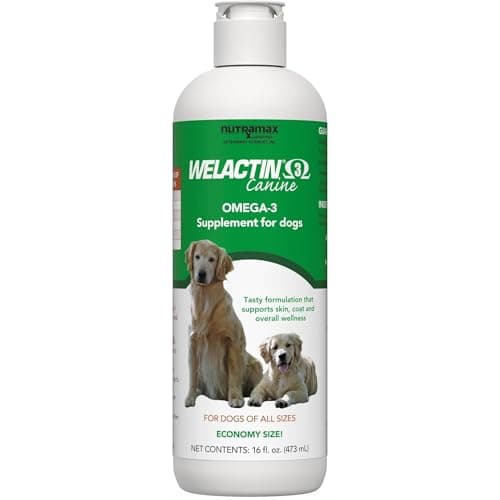
Welactin Canine Omega-3 Liquid
Our score
$22–$58
Best for
Households where a fish-oil-enriched therapeutic diet is closed off — multi-dog kitchens, elimination or kidney diets, dogs who refuse the food — and owners who want a dose they can compute and score against
The omega-3 we recommend when a fish-oil-enriched therapeutic diet is not an option, on one honest basis: the omega-3 trials in arthritic dogs were run on a diet, not on this bottle, none of them separated from control on a force plate, and the two placebo-controlled bottle trials disagree — so a dosed liquid with a published guaranteed analysis is the honest hardware for pursuing the same mechanism at a dose you and your vet chose, not a proven duplicate of anything (corrected 14 September 2026; we previously called the diet trial "the strongest evidence" and compared it as a head-to-head). Welactin earns the slot on concentration per dollar and on being made by Nutramax — not on the "#1 vet recommended" line, which is the brand's claim, not ours — and whose footnote, read 19 August 2026, defines its universe as vets "who recommended omega-3 supplements." Score lowered 8.6 to 8.4 on 19 August 2026, not because the oil changed but because a fine-print pass found the printed chart delivers under half the EPA+DHA that Colorado State's canine osteoarthritis chart calls for, that Nutramax prints the joint dose on its Advanced product and not on this one, that a retailer and the maker publish different guaranteed analyses for the same bottle, and that no calorie figure exists on any surface. It remains a cheap, concentrated, well-made oil. It is not a product you can dose for arthritis by reading its own label.
Pros
- High concentration: 1,330 mg combined EPA+DHA per 6 mL scoop on the manufacturer's guaranteed analysis
- Liquid over food scales to any body weight — no chew-splitting arithmetic
- Manufactured by Nutramax, the same company as Cosequin and Dasuquin
- Runs about $0.58/day for a 60 lb dog at the verified Amazon price — cheap for the category
Cons
- Smells fishy, and a bowl-refuser can start refusing dosed food
- Dosing hardware changed: current bottles pour by measuring scoop, not the pump our older copy described — dose accuracy now depends on you levelling a scoop
- A 6 mL scoop is coarse for small dogs — the label drops to half-scoop every-other-day under 10 lb
- Amazon's listing now leads with "Skin & Coat," not joints — the joint claim is the softer half of the marketing
- The printed chart is a skin-and-coat dose, not a joint dose, and Nutramax says so without giving a number: welactin.com's administration note read "Veterinarians may recommend increased amounts for enhanced joint health support" on 19 August 2026, and by 25 August 2026 had been reworded to "Your veterinarian may recommend to increase this amount for maximum joint health benefits" — the wording moved, the missing number stayed missing. At the chart's 1½ scoops, a 75 lb dog gets 1,995 mg of EPA+DHA against the 4,374 mg Colorado State's published canine osteoarthritis chart calls for at that weight — about 46%. Nutramax's own Welactin Advanced 3TA prints a separate "Joint Health" column at exactly double its broad-spectrum dose; this product prints one column and a footnote
- Retailer panels and the maker's panel disagree. On 19 August 2026 welactin.com published 1,610 mg total omega-3 and 1,330 mg EPA+DHA per 6 mL scoop, while a veterinary supply retailer's page for the same 16 oz bottle published 1,770 mg total, 870 mg EPA and 570 mg DHA (1,440 mg EPA+DHA) per the same 6 mL scoop. We use the maker's figures. If you are computing a dose against a study, read the panel on the bottle in your hand
- No calorie figure is published anywhere we could find — not on welactin.com and not on the Amazon listing, verified absent 19 August 2026. Fish oil is the most calorie-dense thing you can add to a bowl, and weight is the largest modifiable factor in canine osteoarthritis, so this is the number the category should print and does not
- Fish, obviously — which disqualifies it for any dog on a fish-based novel protein elimination diet, and doubles up on any dog already eating a fish-based food
- No use-within-after-opening period, no refrigeration instruction and no full ingredient list are published on the maker's product page, verified absent 9 September 2026. A 16 oz bottle lasts a 20–44 lb dog about 11 weeks and a 10–19 lb dog about 22 weeks, and fish oil oxidises once opened, so the buyer of the small dog is being sold five months of exposure with no stated shelf life. Follow whatever the bottle in your hand says; the website does not say
Who should not buy this bottle: the single-dog household whose vet has just recommended the diet and can afford it. For that owner the oil adds a variable, some calories and a chore, and no evidence that is not already attached to the food. Buy it if the diet route is closed to you, and buy it as the hardware for a dose you and your vet chose, not for the chart on the side. The maker's chart is a skin-and-coat dose, the maker does not publish calories, and a 480 mL bottle at the trial dose lasts a 75 lb dog about 45 days, not the 11 weeks its small-dog buyers see.
What the evidence does not say, stated plainly#
- It does not say the diet beats the bottle. Nobody has tested it.
- It does not say either route beats placebo on a force plate. Two diet trials and one bottle trial used one, and none reports a significant between-group difference.[3][4][8]
- It does not say the bag on sale is the food that outperformed in the titration trial. The winner there was the 3× "experimental" food; the 0.8% "baseline therapeutic food" was the comparator, and whether that is the bag on sale is our reading, not the abstract's statement.[7]
- It does not tell you the DHA in j/d. Hill's does not print it, verified 14 September 2026.[2]
- It does not tell you how a healthy-weight, otherwise untreated dog does on either route long term. The longest trial in either family is six months.[5]
What it does say is modest and useful: in every trial that reported a within-group change, treated dogs on both routes improved against their own baselines; owners noticed; and in one trial vets could taper a drug faster. That is a reasonable thing to pay for. It is not a thing to pay for twice, and it is not a thing to feed without a number written down, which is why the limp-scoring method belongs in this plan before either purchase. If fish oil is one option on a longer list, our supplement roundup puts it beside the others by evidence, and the green-lipped mussel comparison covers the one other marine ingredient with blinded force-plate trials of its own.

What to do this week#
- Weigh the dog and write it down. Every figure above scales from it, and the vet-visit weight from spring is not this week's weight.
- Decide which route is even open to you before you compare them: count the dogs at the bowl, check for an elimination or kidney diet, and ask whether a vet appointment is already in the plan. For many households that closes one route in a minute and the comparison is over.
- If it is the diet, ask your vet two questions in the room: what the combined EPA+DHA per day is for your dog's ration, and whether the plan is to taper anything. Take the answer home in writing.
- If it is the bottle, take the table above to the appointment and come home with one dose, not a range, plus the food reduction that pays for its calories, and a ramp to it if it is above the label.
- Take a score before the first scoop or the first bowl. Six weeks later, take it again. That is the only instrument in the house, and it is the one both families of trials would have told you to use.
The delay this shortens is a quiet one. It is the year a dog can spend on a bag or a bottle that everyone in the house believes is being handled, while the number that would have told you whether it was doing anything was never written down. The trials could not settle which route is better. Every one of them measured the dog before and after, and that is the one part of their method you can copy at home. Do that part yourself.
Sources#
- Canine Arthritis Resources and Education (CARE). "Overview of omega-3 fatty acids for OA." caninearthritis.org — read 14 September 2026: results for therapeutic diets "generally positive"; "there is currently limited evidence with fish oil supplements"; suggested dose "around 100 mg/kg total EPA/DHA," range 50–220 mg/kg.
- Hill's Pet Nutrition. "Prescription Diet j/d Dry Dog Food," product page. hillspet.com — read 14 September 2026: nutrient table on a dry-matter basis, Total Omega-3 FA 3.6%, EPA 0.411%, no DHA row, no moisture row; 364 kcal/cup, 3,670 kcal/kg; feeding guide 4 cups (395 g) at 70 lb, 4½ cups (445 g) at 80 lb; ingredients open whole grain wheat, whole grain corn, flaxseed, chicken meal, corn protein meal, chicken fat, chicken liver flavor, fish oil; "Clinically proven to improve dog's ability to run, jump, and play in as little as 3 weeks," no citation on the page.
- Roush JK, Cross AR, Renberg WC, Dodd CE, Sixby KA, Fritsch DA, Allen TA, Jewell DE, Richardson DC, Leventhal PS, Hahn KA. "Evaluation of the effects of dietary supplementation with fish oil omega-3 fatty acids on weight bearing in dogs with osteoarthritis." Journal of the American Veterinary Medical Association. 2010;236(1):67–73. doi:10.2460/javma.236.1.67 — abstract re-read 14 September 2026 via Europe PMC: 38 dogs, randomized, double-blinded; test food "containing 3.5% fish oil omega-3 fatty acids"; PVF change "significant for the test-food group (5.6%) but not for the control-food group (0.4%)"; 82% vs 38% improved.
- Hielm-Björkman A, Roine J, Elo K, Lappalainen A, Junnila J, Laitinen-Vapaavuori O. "An un-commissioned randomized, placebo-controlled double-blind study to test the effect of deep sea fish oil as a pain reliever for dogs suffering from canine OA." BMC Veterinary Research. 2012;8:157. doi:10.1186/1746-6148-8-157 — full text read 14 September 2026 via Europe PMC (PMC3514349): 77 dogs, 16 weeks; oil 450 mg EPA / 100 mg DHA per mL at 1 mL per 5 kg, "110.25 mg … predominantly EPA and DHA … per dogs' kg BW"; corn-oil placebo; "Differences between treatment groups were not significant for any of the four main outcome variables"; Table 2 between-group PVF p = 0.388, HCPI p = 0.335; within-group PVF p = 0.021; owner satisfaction 65.7% vs 38.9%; funding Helvi Knuuttila Foundation, product from Nutraceuticoils, lead author "not compensated"; the discussion's readings of refs 13–16 quoted in the text.
- Roush JK, Dodd CE, Fritsch DA, Allen TA, Jewell DE, Schoenherr WD, Richardson DC, Leventhal PS, Hahn KA. "Multicenter veterinary practice assessment of the effects of omega-3 fatty acids on osteoarthritis in dogs." Journal of the American Veterinary Medical Association. 2010;236(1):59–66. doi:10.2460/javma.236.1.59 — abstract re-read 14 September 2026: 127 dogs, 18 clinics, 6 months, "31-fold increase in total omega-3 fatty acid content"; owner-reported improvements at 6, 12 and 24 weeks.
- Fritsch DA, Allen TA, Dodd CE, Jewell DE, Sixby KA, Leventhal PS, Brejda J, Hahn KA. "A multicenter study of the effect of dietary supplementation with fish oil omega-3 fatty acids on carprofen dosage in dogs with osteoarthritis." Journal of the American Veterinary Medical Association. 2010;236(5):535–539. doi:10.2460/javma.236.5.535 — abstract re-read 14 September 2026: 131 dogs, 33 hospitals, 12 weeks; "carprofen dosage decreased significantly faster among dogs fed the supplemented diet."
- Fritsch D, Allen TA, Dodd CE, Jewell DE, Sixby KA, Leventhal PS, Hahn KA. "Dose-titration effects of fish oil in osteoarthritic dogs." Journal of Veterinary Internal Medicine. 2010;24(5):1020–1026. doi:10.1111/j.1939-1676.2010.0572.x — abstract re-read 14 September 2026: 177 dogs; "the baseline therapeutic food (0.8% eicosopentanoic acid [EPA] + docosahexaenoic acid [DHA])" vs ~2× and ~3×; improvements "between the baseline and 3X EPA+DHA foods (P=.04, .03, .001, .0008, respectively) but not between the baseline and the 2X EPA+DHA foods."
- Moreau M, Troncy E, Del Castillo JR, Bédard C, Gauvin D, Lussier B. "Effects of feeding a high omega-3 fatty acids diet in dogs with naturally occurring osteoarthritis." Journal of Animal Physiology and Animal Nutrition. 2013;97(5):830–837. doi:10.1111/j.1439-0396.2012.01325.x — abstract re-read 14 September 2026: 30 dogs, 13 weeks; within-group PVF p < 0.001; between-group change 3.5 ± 6.8 vs 0.5 ± 6.1 %BW, p = 0.211; CSOM decreased only in the diet group (p = 0.047). Full text paywalled; the diet and funder are not named in the abstract.
- Mehler SJ, May LR, King C, Harris WS, Shah Z. "A prospective, randomized, double blind, placebo-controlled evaluation of the effects of eicosapentaenoic acid and docosahexaenoic acid on the clinical signs and erythrocyte membrane polyunsaturated fatty acid concentrations in dogs with osteoarthritis." Prostaglandins, Leukotrienes and Essential Fatty Acids. 2016;109:1–7. doi:10.1016/j.plefa.2016.03.015 — abstract read 14 September 2026 via Europe PMC: 78 enrolled, 74 completed; "an average dose of 69mg EPA+DHA/kg/day"; "All clinical outcomes … significantly (p<0.05) improved compared with placebo." Full text paywalled.
- OmegaQuant. "Increasing blood omega-3 levels helps relieve arthritis symptoms in older dogs." omegaquant.com — read 14 September 2026: placebo n = 33, treatment n = 41; mineral-oil placebo; outcomes "Lameness Severity Score, Lameness/Discomfort Score, and the Total Joint Score" from a blinded veterinarian; assessments at baseline, day 42 and day 84. OmegaQuant's president is a co-author of the paper.
- dvm360. "Omega-3s significantly improved canine arthritis in double-blind clinical trial." dvm360.com — the page refused our fetch on 14 September 2026 (HTTP 403); the funding and advisory-board statement is quoted from the search-engine excerpt of the article and is flagged in the text as reported, not verified at source.
- PetSmart. "Hill's Prescription Diet j/d Joint Care Adult Dog Food – Chicken," 27.5 lb. petsmart.com — read 14 September 2026: $134.99; "Vet authorization required."
- Nutramax Laboratories. "Welactin Canine Omega-3 Supplement, liquid," guaranteed analysis. welactin.com — 1,610 mg total omega-3 and 1,330 mg EPA+DHA per 6 mL scoop, re-read 9 September 2026; Amazon B001FB6ECQ $29.99 in stock, buy box Amazon.com, re-checked 14 September 2026 via the Creators API.
- Lenox CE, Bauer JE. "Potential adverse effects of omega-3 fatty acids in dogs and cats." Journal of Veterinary Internal Medicine. 2013;27(2):217–226. doi:10.1111/jvim.12033 — the ~42 kcal per 5 mL fish oil figure used for the calorie column.
- Colorado State University Veterinary Teaching Hospital. "Canine fish oil dosing chart." csuveterinaryhealth.org — re-read 14 September 2026: "310 mg/kg^0.75 of EPA/DHA per day" for osteoarthritis; 50 lb 3,227 mg, 75 lb 4,374 mg, 100 lb 5,427 mg; "The maximum dose is not tolerated by all animals, and a lower dose may be preferable."
- US Food and Drug Administration. "Complete and Balanced Pet Food." fda.gov — read 14 September 2026: "dry pet food is typically 10 to 12 percent moisture"; AAFCO profiles are expressed on a dry-matter basis and label guarantees on an as-fed basis.
Frequently asked
- Is Hill's j/d better than just adding fish oil to my dog's food?
- Nobody has tested that. There is no trial comparing a fish-oil-enriched therapeutic diet against a fish oil supplement in arthritic dogs, so any confident answer either way is an opinion. What exists is a set of trials on each route separately, and read at source they are closer than the marketing suggests: the Hill's-affiliated diet trials report improvements inside the test-food group and on owner and vet scores, but the force-plate paper does not report a significant difference between the diet and the control food; the one un-commissioned university trial of a bottle with a force plate found no significant difference from corn oil on any main outcome; and the one bottle trial that beat placebo on every measure used exam scores rather than a force plate. Choose by dose delivered, calories, and whether a whole-ration diet fits your household, not by which side claims the stronger proof.
- How much EPA and DHA does Hill's j/d actually contain?
- Hill's publishes EPA at 0.411% and total omega-3 at 3.6% on a dry-matter basis for the dry food, and does not publish a DHA figure or a moisture figure on the product page, verified 14 September 2026. Flaxseed is the third ingredient and fish oil the eighth, which suggests a large share of that 3.6% total is plant-source ALA rather than EPA and DHA. For a 75 lb dog eating the feeding guide's roughly 420 g a day, the published EPA works out to about 1,550 mg a day if the kibble is around 10% moisture. The dose-titration trial from the same Hill's group describes its baseline therapeutic food as 0.8% EPA+DHA, which would be roughly 3,000 mg a day at that ration, but Hill's does not print that combined number for the food on sale.
- What dose of fish oil was used in the dog arthritis trials?
- Two placebo-controlled bottle trials published their dose per kilogram. The Helsinki university trial gave about 110 mg of EPA+DHA per kg per day, 1 mL of a 450 mg EPA / 100 mg DHA oil per 5 kg, for 16 weeks, and found no significant difference from corn oil on force plate, pain index or NSAID use. The 2016 US trial gave an average of 69 mg per kg per day for 84 days and found all three clinician exam scores improved against a mineral-oil placebo. For a 75 lb (34 kg) dog those are about 3,750 mg and 2,350 mg a day. Colorado State's osteoarthritis chart lists 4,374 mg for that weight. The label dose on the fish oil we recommend delivers 1,995 mg, below every one of them.
- Does Hill's j/d require a prescription?
- It is sold under veterinary authorization. PetSmart's product page states 'Vet authorization required' and Hill's own page says to consult your veterinarian, verified 14 September 2026. In practice you need a vet relationship to buy it, which is one reason the diet route only makes sense if a vet appointment is already part of the plan.
- How much does Hill's j/d cost per year compared with fish oil?
- For a 75 lb dog fed the Hill's feeding guide, a 27.5 lb bag lasts about 30 days, which at PetSmart's $134.99 on 14 September 2026 is roughly $1,660 a year. That replaces the food bill you already have rather than adding to it, so the true comparison is the difference between j/d and your current food, not the whole figure. Welactin at its label dose costs about $205 a year on top of the current food; at the 69 mg/kg trial dose about $240; at the Colorado State chart dose about $450, plus 75 to 165 calories a day that the maker does not print.