The Dosing Question
How Much Fish Oil for an Arthritic Dog? The Colorado State Chart, and Why Your Bottle Is Lower
Colorado State's teaching hospital publishes a canine fish-oil chart for osteoarthritis. The bottle's chart is a skin-and-coat dose — about 46% of it for a 75 lb dog. Both numbers, and how to close the gap safely.

There is a real number, it is published by a veterinary teaching hospital, and it is probably two to three times what your bottle's chart is giving your dog. Colorado State University's canine fish-oil chart for osteoarthritis works from 310 mg of combined EPA+DHA per kilogram of metabolic body weight per day — 3,227 mg for a 50 lb dog, 4,374 mg at 75 lb — while the label dose on the bottle we checked delivers 46–62% of that, because the chart printed on it is a skin-and-coat chart. Do not fix this by pouring more tonight: CSU's own page says the maximum is not tolerated by every dog and advises starting near a quarter of it and working up slowly, and there is a published safe upper limit not far above the target. What this page can do is hand you the arithmetic — what your bottle delivers, what the published chart says, and the questions in between — so the conversation with your vet starts from two numbers instead of a squirt on his dinner.
Affiliate disclosure: Dog Orthopedic is reader-supported. When you buy through links on our site we earn a commission at no extra cost to you — about 3% on most pet products, and the same rate on every product we compare, so no pick earns us more than another. Prescription medication earns us nothing, and seeing your vet earns us nothing; we recommend both anyway. Learn more.
Imagery: Lifestyle photographs on this site are licensed from Pexels (royalty-free) and credited per image. Pexels imagery illustrates conditions and contexts — it does not depict the specific dogs or test sessions described in the text. Product photographs come from Amazon's Creators API. Breed portraits are illustrations of typical breed type rather than photographs of individual dogs, and are not drawn to scale against one another.
What the bottle actually tells you#
Take the bottle off the counter and read the chart. On Welactin Canine — the fish oil we recommend, so it is the one we will hold up to the light — the chart runs from half a scoop every other day for a 5–9 lb dog to two and a half scoops above 115 lb. Directly underneath it sits one sentence: "Your veterinarian may recommend to increase this amount for maximum joint health benefits."[1]
No number. That sentence is the entire joint-dosing guidance an owner buying this bottle for an arthritic dog receives, and it is not a fine-print accident — we first flagged it on 19 August, and when we re-read the page for this article the maker had reworded the sentence (from "Veterinarians may recommend increased amounts for enhanced joint health support") without adding a figure to it. The wording moves. The missing number stays missing.
This is the pattern our supplement dosing guide keeps finding across the category, and it matters more here than anywhere else, because fish oil is the rare supplement where a genuinely useful target dose has been published by someone with no bottle to sell.

The number that reframes it#
Colorado State University's veterinary teaching hospital publishes a canine fish-oil dosing chart specifically for osteoarthritis. It is built on 310 mg/kg^0.75 of EPA+DHA per day — metabolic body weight, not straight weight — and CSU frames it as a maximum, with its own cautions attached, which we will get to.[2]
Put the label and the chart side by side. Welactin's maker publishes a guaranteed analysis of 1,330 mg of combined EPA+DHA per 6 mL scoop.[1] The rest is multiplication.
| Dog | Label dose | EPA+DHA delivered | CSU osteoarthritis chart | Label as % of the OA figure |
|---|---|---|---|---|
| 20 lb | 1 scoop | 1,330 mg | 1,623 mg | 82% |
| 50 lb | 1½ scoops | 1,995 mg | 3,227 mg | 62% |
| 75 lb | 1½ scoops | 1,995 mg | 4,374 mg | 46% |
| 100 lb | 2 scoops | 2,660 mg | 5,427 mg | 49% |
Two things are worth noticing before you do anything about it. The gap widens as the dog gets bigger — a 20 lb dog's label dose lands reasonably close to the published figure, while a 75 lb dog's label dose is under half of it. That is partly the weight bands: a 75 lb dog gets the same 1½ scoops as a 45 lb dog, because the band runs 45–79 lb, so the bigger the dog inside a band, the further under he falls. And the dogs this site is mostly written for — the Labradors, Shepherds and Goldens whose hips and knees fail — are exactly the dogs deepest in the gap.
If you have been measuring the label dose faithfully every night for a year, you have not been doing it wrong. You have been following the only instructions anyone gave you. The instructions were for his coat.
“Because your dog can't tell you how much pain he or she is in.”
The company knows the number. It prints it on the bottle next door.#
Here is the detail that turns a missing number into a choice. Nutramax — Welactin's maker — sells a second fish oil alongside this one, Welactin Advanced 3TA, and that product's chart has two columns: "Broad Spectrum" and "Joint Health." The joint column is exactly double the broad-spectrum column at every one of its fourteen weight rows.[3]
Run its numbers: the Advanced scoop is 2 mL carrying 880 mg of EPA+DHA (530 EPA + 350 DHA, maker's analysis), and the Joint Health column for a 68–77 lb dog reads 5 scoops — 4,400 mg a day. Colorado State's chart for a 75 lb dog reads 4,374 mg. The maker's own joint column, on the product where it deigns to print one, is essentially the CSU figure.
So the joint dose is not a secret, and it is not a matter of scientific dispute between the manufacturer and the academics. The same company publishes a joint column on one label and a footnote on the other. If you own the ordinary Welactin, the number your bottle is missing is printed next door on the shelf.
Why you should not just triple the scoop tonight#
The gap is real. The fix is a titration with your vet, not arithmetic at the counter, for three published reasons.
Tolerance. CSU's chart page says it plainly: the maximum dose "is not tolerated by all animals, and a lower dose may be preferable." Its advice is to start with approximately a quarter of the maximum and increase slowly while watching for loose stools and vomiting.[2] For a 75 lb dog that starting point is roughly 1,100 mg — less than the label dose. The path to the target runs over weeks, on a schedule someone writes down.
The ceiling is close. The National Research Council's safe upper limit for dogs is 370 mg of EPA+DHA per kilogram of metabolic body weight per day — only about 19% above CSU's maximum.[4] The target and the ceiling are near neighbours, which is exactly the geometry in which dosing by feel goes wrong. The same review catalogues nine categories of potential adverse effect: altered platelet function (the canine studies were inconsistent, with changes the review says may not be immediately clinically relevant — your surgeon should still know the daily amount before any operation), gastrointestinal upset, effects on wound healing, lipid peroxidation, nutrient excess and toxin exposure, weight gain, altered immune function, effects on glycemic control and insulin sensitivity, and drug interactions.
The calories are real and nobody prints them. No Welactin surface — not the maker's page, not the listing — publishes a calorie figure, which we verified again today. The veterinary literature does: about 42 kcal per teaspoon (5 mL) of fish oil.[4] At that figure, a 75 lb dog's full CSU dose — about 3.3 scoops, 20 mL — adds something like 170 kcal a day, roughly a sixth of that dog's resting energy requirement of about 990 kcal by the standard 70 × kg^0.75 formula. Excess weight is a modifiable driver of osteoarthritis pain, so a joint dose that quietly adds a sixth again to the day's resting calories without a matching cut in food is one treatment working against another. When your vet sets the dose, ask her to set the food adjustment in the same sentence.

Which panel do you even compute against?#
One more wrinkle, because it changes the multiplication above. On the day we wrote this, the maker's site published a guaranteed analysis of 1,610 mg total omega-3 and 1,330 mg EPA+DHA per 6 mL scoop[1] — while two veterinary retailers' pages for the same 16 oz bottle published 1,770 mg total, 870 mg EPA and 570 mg DHA (1,440 mg EPA+DHA) per the same scoop.[5][6]
Both sets were live simultaneously today. The likeliest explanation is a label revision that the retail copy never caught up with — but we cannot verify which panel matches the bottle currently shipping, and neither can any web page. So the rule, for this product and every product: compute against the panel printed on the bottle in your hand. The tables on this page use the maker's figures; if your label reads differently, your label wins.
The honest hardware for the job#
If the plan that comes out of your vet appointment is a titrated liquid dose, a bottle with a guaranteed analysis and a measuring scoop is the right hardware — and this is the one place a liquid genuinely beats every chew and capsule format. A titration needs a dose you can move in small steps: quarter-dose to start, up a fraction every week or two, back down a step if stools loosen. A scoop does that. A chew is a fixed step — you cannot give 1.3 chews — and human capsules turn a big dog's dose into a count: the 2013 adverse-effects review works an example of 12–20 capsules a day just for a 10 kg dog on published recommendations for dogs with cancer — a different indication, but the same arithmetic problem.[4] Read the EPA+DHA on your capsule's own label, divide it into the CSU figure for your dog's weight, and ask yourself whether that count gets swallowed every single night for a year.
#1 Pick
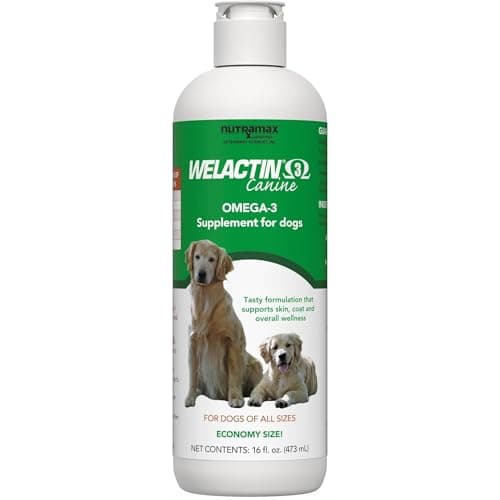
Nutramax
Welactin Canine Omega-3 Liquid
Our score
$22–$58
Best for
Households where a fish-oil-enriched therapeutic diet is closed off — multi-dog kitchens, elimination or kidney diets, dogs who refuse the food — and owners who want a dose they can compute and score against
The omega-3 we recommend when a fish-oil-enriched therapeutic diet is not an option, on one honest basis: the omega-3 trials in arthritic dogs were run on a diet, not on this bottle, none of them separated from control on a force plate, and the two placebo-controlled bottle trials disagree — so a dosed liquid with a published guaranteed analysis is the honest hardware for pursuing the same mechanism at a dose you and your vet chose, not a proven duplicate of anything (corrected 14 September 2026; we previously called the diet trial "the strongest evidence" and compared it as a head-to-head). Welactin earns the slot on concentration per dollar and on being made by Nutramax — not on the "#1 vet recommended" line, which is the brand's claim, not ours — and whose footnote, read 19 August 2026, defines its universe as vets "who recommended omega-3 supplements." Score lowered 8.6 to 8.4 on 19 August 2026, not because the oil changed but because a fine-print pass found the printed chart delivers under half the EPA+DHA that Colorado State's canine osteoarthritis chart calls for, that Nutramax prints the joint dose on its Advanced product and not on this one, that a retailer and the maker publish different guaranteed analyses for the same bottle, and that no calorie figure exists on any surface. It remains a cheap, concentrated, well-made oil. It is not a product you can dose for arthritis by reading its own label.
Pros
- High concentration: 1,330 mg combined EPA+DHA per 6 mL scoop on the manufacturer's guaranteed analysis
- Liquid over food scales to any body weight — no chew-splitting arithmetic
- Manufactured by Nutramax, the same company as Cosequin and Dasuquin
- Runs about $0.58/day for a 60 lb dog at the verified Amazon price — cheap for the category
Cons
- Smells fishy, and a bowl-refuser can start refusing dosed food — the complaint Amazon's own review summary quoted on 15 October 2026: "Smell is horrible and my dog refuses to eat her food with this poured on it"
- Dosing hardware changed: current bottles pour by measuring scoop, not the pump our older copy described — dose accuracy now depends on you levelling a scoop
- A 6 mL scoop is coarse for small dogs — the label drops to half-scoop every-other-day under 10 lb
- Amazon's listing now leads with "Skin & Coat," not joints — the joint claim is the softer half of the marketing
- The printed chart is a skin-and-coat dose, not a joint dose, and Nutramax says so without giving a number: welactin.com's administration note read "Veterinarians may recommend increased amounts for enhanced joint health support" on 19 August 2026, and by 25 August 2026 had been reworded to "Your veterinarian may recommend to increase this amount for maximum joint health benefits" — the wording moved, the missing number stayed missing. At the chart's 1½ scoops, a 75 lb dog gets 1,995 mg of EPA+DHA against the 4,374 mg Colorado State's published canine osteoarthritis chart calls for at that weight — about 46%. Nutramax's own Welactin Advanced 3TA prints a separate "Joint Health" column at exactly double its broad-spectrum dose; this product prints one column and a footnote
- Retailer panels and the maker's panel disagree. On 19 August 2026 welactin.com published 1,610 mg total omega-3 and 1,330 mg EPA+DHA per 6 mL scoop, while a veterinary supply retailer's page for the same 16 oz bottle published 1,770 mg total, 870 mg EPA and 570 mg DHA (1,440 mg EPA+DHA) per the same 6 mL scoop. On 15 October 2026 the disagreement reached the listing we link to: Amazon's "Important information" panel for this ASIN prints the higher set as minimums (min 1,770 mg total, min 870 mg EPA, min 570 mg DHA per 6 mL scoop), while welactin.com still printed 1,610 and 1,330 the same day. We use the maker's figures. If you are computing a dose against a study, read the panel on the bottle in your hand
- No calorie figure is published anywhere we could find — not on welactin.com and not on the Amazon listing, verified absent 19 August 2026 and again on 15 October 2026. Fish oil is the most calorie-dense thing you can add to a bowl, and weight is the largest modifiable factor in canine osteoarthritis, so this is the number the category should print and does not
- Fish, obviously — which disqualifies it for any dog on a fish-based novel protein elimination diet, and doubles up on any dog already eating a fish-based food
- No use-within-after-opening period, no refrigeration instruction, no oxidation (peroxide) data and no full ingredient list are published on the maker's product page, verified absent 9 September 2026 and again on 15 October 2026 — the page's "Ingredients" tab holds only the guaranteed analysis, and its one handling instruction is "Securely close cap after each use." The ingredient line exists only on the Amazon listing, and it names neither the fish nor the "vegetable oil"; Nutramax's own leaflet on that listing says only "cold-water fish." A 16 oz bottle lasts a 20–44 lb dog about 11 weeks and a 10–19 lb dog about 22 weeks, and fish oil oxidises once opened, so the buyer of the small dog is being sold five months of exposure with no stated shelf life. Follow whatever the bottle in your hand says; the website does not say
Be clear-eyed about the cost of the real dose, because it is not the label's cost. At the $29.99 we verified this month, the label dose for a 75 lb dog runs about $0.58 a day. The CSU dose at that weight — roughly 3.3 scoops — runs about $1.27 a day, call it $460 a year, and empties a 16 oz bottle in under a month. Whether that spend is worth it against the same money on weight loss, analgesia or a supplement with force-plate evidence is exactly the conversation to have with your vet — and the reason to run the trial properly and measure whether it worked instead of re-buying on hope. And read the Welactin card above before you buy: the downsides are real, including the fishy-bowl refusal problem and the fact that no calorie figure is published anywhere.
The cheapest version of this evidence is a food, not a bottle#
One honesty that belongs on any fish-oil page: the strongest omega-3 result in arthritic dogs did not come from a bottle. In a randomized, double-blinded, controlled JAVMA trial, 38 client-owned dogs with osteoarthritis were fed either a typical commercial food or a food containing 3.5% fish oil omega-3s. Over 90 days the fish-oil group's mean peak vertical force — measured on a force plate — rose 5.6% from its own baseline, a change the abstract reports as significant, while the control group's 0.4% was not; 82% of the fish-oil dogs improved against 38% of controls. Correction, 14 September 2026: we first printed those two percentages as a head-to-head result. They are within-group changes, and the paper does not report a significant difference between the diet and the control food.[7]
That was a therapeutic diet, formulated and fed as the whole ration. Two placebo-controlled trials of oil over ordinary food do exist and they disagree — the independent Helsinki trial at about 110 mg/kg found no significant difference from corn oil on a force plate, and a 2016 US trial at 69 mg/kg beat placebo on clinician exam scores — so adding a measured liquid is a reasonable way to pursue the same mechanism, not a proven duplicate of the diet result. We have put every one of those trials, and every dose priced, side by side in Hill's j/d vs adding fish oil. So before you buy anything: if a diet change is on the table at your appointment, the fish-oil-enriched therapeutic diet is the evidence-backed version of this intervention, with the dose built in and the calories already counted. And check the bag you currently feed — some joint and fish-based diets already carry meaningful EPA+DHA on their guaranteed analysis, in which case you may be topping up a tank that is partly full, and your vet needs that number too. Our joint supplement roundup covers where fish oil sits against the rest of the evidence, and why stacking products on top of each other is the one move that guarantees you learn nothing.
What to do this week#
The whole failure mode on this page is that the joint dose arrives in your house as a sentence — "vets may recommend more" — instead of as a number with a review date. Every other part of an arthritis plan gets a number. Give this one its number too.
- Weigh the dog. Not the last vet-visit weight, this week's weight — the whole chart runs off it.
- Read the panel on your bottle — EPA+DHA per scoop, from the bottle in your hand, not from this page.
- Write down both dailies: what the label dose delivers, and what the CSU chart lists for his weight. For most dogs over 40 lb they will be far apart.
- Book the conversation, not the pour. Take both numbers to your vet and come home with three things in writing: the target dose, the ramp to it, and the food adjustment that pays for its calories. Ask whether the enriched-diet route makes more sense for your dog before you commit to a year of bottles.
- Put a review date on it — six to eight weeks out, scored against something you measured before starting, because a dose without a review date decays into a squirt.
The delay this shortens is a quiet one: not the months before a diagnosis, but the year a well-loved dog can spend on a faithful nightly dose that was never the dose — while everyone in the house reasonably believes the joints are being handled. The bottle was never lying. It just answered a different question, and nobody handed you the number for yours. Now you have it.
Frequently asked
- How much fish oil should I give my dog for arthritis?
- There is a published number, and it is almost certainly not the one on your bottle. Colorado State University's veterinary teaching hospital publishes a canine fish-oil dosing chart for osteoarthritis built on 310 mg of combined EPA+DHA per kilogram of metabolic body weight (kg to the 0.75 power) per day — 3,227 mg for a 50 lb dog, 4,374 mg for a 75 lb dog, 5,427 mg at 100 lb. CSU calls this the maximum, states plainly that not every dog tolerates it, and advises starting at roughly a quarter of it and increasing slowly while watching for loose stool and vomiting. That titration is a plan to build with your vet, not a label to follow — take your dog's weight and both numbers (the label's and CSU's) to the appointment and let your vet set the dose, especially if your dog is on any medication, has had pancreatitis, or has surgery ahead.
- Is the dose on the fish oil bottle enough for joint support?
- On the bottle we checked, no — and the maker very nearly says so. Welactin Canine's printed chart delivers 1,995 mg of EPA+DHA to a 75 lb dog (1½ scoops at 1,330 mg per scoop, maker's guaranteed analysis), which is about 46% of the 4,374 mg Colorado State's canine osteoarthritis chart lists at that weight. Underneath its chart the maker adds one sentence — 'Your veterinarian may recommend to increase this amount for maximum joint health benefits' (welactin.com, read 25 August 2026) — with no number attached. The same company prints the joint number on its sibling product: Welactin Advanced 3TA carries a two-column chart, 'Broad Spectrum' and 'Joint Health,' with the joint column exactly double at every weight.
- Can I just give my dog more scoops of the fish oil I already have?
- Not on your own arithmetic. The gap between the label dose and the osteoarthritis dose is real, but the path between them is a titration, not a jump: CSU's own guidance is to start at roughly a quarter of the maximum and increase slowly while watching for loose stools and vomiting, and its chart page states that the maximum is not tolerated by all animals. There is also a ceiling — the National Research Council's safe upper limit for dogs is 370 mg of EPA+DHA per kilogram of metabolic body weight per day, which sits only about 19% above the CSU maximum, so freelancing past the chart has little headroom. And fish oil is food: at roughly 42 kcal per teaspoon, a full joint dose for a 75 lb dog adds something like 170 kcal a day with no calorie figure printed on the bottle to warn you, at the same time as your vet is probably asking the dog to lose weight. Bring the numbers to your vet and agree the dose, the calories and a review date.
- Can I use human fish oil capsules instead?
- You can, with two honest problems. The first is arithmetic: read the EPA+DHA per softgel on your capsule's own label and divide it into the CSU figure for your dog's weight, and for a large dog the answer is a daily count, not a couple of capsules — the 2013 review of omega-3 adverse effects in dogs works an example of 12–20 capsules a day just for a 10 kg dog on published recommendations for dogs with cancer, and a count that high is a dose that tends not to survive real life. The second is the rest of the capsule: CSU's dosing page warns that other ingredients in certain fish-oil formulations may be harmful for pets, and advises choosing a product with third-party purity testing that can produce a certificate of analysis. If you go the human-capsule route, bring the exact product label to your vet first.
- Does fish oil have side effects in dogs?
- Yes, mostly mild and dose-related, and one review has catalogued them properly: Lenox and Bauer (Journal of Veterinary Internal Medicine, 2013) list nine categories — altered platelet function, gastrointestinal upset, detrimental effects on wound healing, lipid peroxidation, nutrient excess and toxin exposure, weight gain, altered immune function, effects on glycemic control and insulin sensitivity, and nutrient-drug interactions. In dogs specifically the platelet studies were inconsistent, with changes the review says may not be immediately clinically relevant — which is precisely why your vet, and your surgeon before any orthopedic procedure, should know the exact daily EPA+DHA your dog gets. The common practical signal is loose stool, which is also the usual sign the dose has been raised too fast.