Dosing Reference
Joint Supplement Dosage by Dog Weight: One Table, 5 lb to 120 lb
Every label's loading and maintenance dose for Cosequin, Dasuquin and Zesty Paws, by dog weight, in one table. Including which of them publishes no weight chart at all — verified against the packaging.

Every joint supplement doses by body weight, every brand bands the weights differently, and every tub assumes you read the fine print about loading versus maintenance. This page puts the label patterns for Cosequin, Dasuquin, Zesty Paws, and Welactin in one table — 5 lb chihuahuas to 120 lb Danes — with the arithmetic for what each band actually costs. One rule outranks everything here: the label on your tub wins, and your vet outranks the label.
Affiliate disclosure: Dog Orthopedic is reader-supported. When you buy through links on our site we earn a commission at no extra cost to you — about 3% on most pet products, and the same rate on every product we compare, so no pick earns us more than another. Prescription medication earns us nothing, and seeing your vet earns us nothing; we recommend both anyway. Learn more.
Imagery: Lifestyle photographs on this site are licensed from Pexels (royalty-free) and credited per image. Pexels imagery illustrates conditions and contexts — it does not depict the specific dogs or test sessions described in the text. Product photographs come from Amazon's Creators API. Breed portraits are illustrations of typical breed type rather than photographs of individual dogs, and are not drawn to scale against one another.
The master dosing table#
Format: loading dose → maintenance dose. "Loading" is the initial administration period, about 4–6 weeks on the Nutramax labels; consumer brands like Zesty Paws typically print one ongoing serving with no loading phase.
| Dog's weight | Cosequin Chewable Tablets with MSM | Dasuquin with MSM (soft chews) | Zesty Paws Hip & Joint Bites |
|---|---|---|---|
| Under 10 lb | ½ tablet daily → ½ every other day (label's smallest band is "up to 15 lb") | Not dosed. Label footnote: "For dogs under 10 lbs. chewable tablets are recommended" | Not published |
| 10–30 lb | Up to 15 lb: ½ daily → ½ every other day. 16–30 lb: 1 daily → ½ | Small/Medium, 10–29 lb: 1 chew daily → 1 every other day | Not published |
| 31–60 lb | 2 tablets daily → 1 daily | Small/Medium, 30–59 lb: 2 chews daily → 1 daily | Not published |
| 61–100 lb | Over 60 lb: 3 tablets daily → 1–2 daily | Large, 60–120 lb: 2 chews daily → 1 daily | Not published |
| Over 120 lb | Same "over 60 lb" band: 3 daily → 1–2 daily; ask your vet about giants | No published band — the label's table ends at 120 lb | Not published |
The two Nutramax columns were read directly off the manufacturers' own charts on 14 August 2026, cell by cell.[1][2]
Welactin (fish oil) is deliberately absent from the table: it doses by measuring scoop over food, by a weight chart printed on the bottle, and we would rather you use that chart than a reproduction. For the record, the manufacturer's published chart runs ½ scoop every other day at 5–9 lb, ½ at 10–19, 1 at 20–44, 1½ at 45–79, 2 at 80–114 and 2½ over 115 lb, and the guaranteed analysis is 1,610 mg total omega-3 including 1,330 mg combined EPA+DHA per 6 mL scoop.[5] Older bottles used a pump delivering far less per stroke, which is exactly why the bottle in your hand outranks any reproduction.
Notice three structural things. First, the brands disagree about where bands begin and end — a 28 lb dog is "one tablet" territory at Cosequin and sits in Dasuquin's 1-chew band. Second, labels flatten at the extremes: a 105 lb Dane gets the same printed dose as a 65 lb pointer on both Nutramax labels. Third, and least known, Dasuquin's published table simply stops at 120 lb. If you own a giant breed, there is no manufacturer instruction for your dog — do not extrapolate one, ask your vet.
Loading vs maintenance: what the labels are doing#
The Nutramax products front-load: a higher daily amount for the first 4–6 weeks, then a reduced maintenance dose — commonly around half, or in label language, the lowest amount that maintains the response. Glucosamine-class supplements act slowly if they act at all, so the loading phase exists to get a fair trial done in a defined window.
Does one bottle actually survive its own loading phase?#
This is the arithmetic nobody runs before buying, and it decides whether your first purchase is the right size. Every figure below is the label's own loading dose divided into the bottle count, at prices verified 14 August 2026.
| Bottle | Dog | Loading dose | Bottle lasts | Covers the 4–6 week loading phase? |
|---|---|---|---|---|
| Cosequin MSM tablets, 132 ct, $34.91[6] | 31–60 lb | 2/day | 66 days | Yes, comfortably |
| Cosequin MSM tablets, 132 ct, $34.91 | Over 60 lb | 3/day | 44 days | Yes |
| Cosequin MSM & HA, 75 ct, $24.99[7] | Over 60 lb | 3/day | 25 days | No |
| Dasuquin with MSM Large, 84 ct, $52.79[8] | 60–120 lb | 2/day | 42 days | Only just — exactly six weeks |
| Dasuquin with MSM Large, 150 ct, $84.99[9] | 60–120 lb | 2/day | 75 days | Yes |
| Zesty Paws, 90 ct, $32.97[4] | mid-size, assumed 2/day | n/a — no loading phase published | 45 days | n/a |
Two rows there are worth stopping on. A 75-count bottle of the Cosequin variant with hyaluronic acid is 25 days for a big dog — you will run out mid-trial and conclude nothing. And the Dasuquin 84-count is precisely 42 days, so it covers the six-week loading phase with not one chew spare. If you are starting a big dog, buy the larger count.
Practical consequences:
- Budget for the loading phase. Your first tub disappears roughly twice as fast as the steady state suggests.
- Judge at week 8, not week 2. Track one concrete thing — time to stand after a nap, willingness on stairs. If nothing moves by eight weeks, stop or change approach; our ranking of the best joint supplements for dogs covers the switching logic — including when to move between Cosequin, Dasuquin, and a different mechanism like green-lipped mussel.
- Do not re-run loading on a whim. Ran out for a weekend? Resume at maintenance. Restart loading only after a long gap, and confirm with your vet.
- Check the refund window against the loading phase before you buy. Nutramax's published return policy has no satisfaction guarantee, and beyond 10 business days it accepts only unopened product. The label asks for a 4–6 week trial. Those two facts do not fit together, and the smaller bottle is the cheaper way to find out whether your dog is a responder.
#1 Pick

Nutramax
Cosequin Plus MSM & HA Joint Health Supplement (Chewable Tablets)
Our score
$25–$63
Best for
First-line joint supplementation for dogs of any size
If you're going to put a dog on one supplement, this is still the one we'd start with: the FCHG49/TRH122 forms are the ones that have actually been put in trials rather than assumed into them, and the DS tablet delivers them at full strength for well under a dollar a day even in a large dog. Two honesty notes. The evidence for the whole category is modest and the caregiver placebo effect is not — so start it, give it six weeks, and judge it against something you measured before you began. And the listing's "#1 vet recommended brand" line is a marketing survey claim, not a clinical one; buy on the ingredient forms and the price per tablet, which you can verify.
Pros
- Contains FCHG49 glucosamine and TRH122 chondroitin — the specific patented forms that have actually been put in trials, rather than generic glucosamine. Corrected 31 August 2026: this line previously said "the patented forms used in published canine studies," which reads as support the record does not give. The positive placebo-controlled trial of these forms was in human knees (Das and Hammad 2000); the one blinded, placebo-controlled canine force-plate trial to test them — inside Dasuquin with MSM — found no significant advantage over placebo (Kampa 2023)
- The linked tablet adds 6 mg sodium hyaluronate (HA) per tablet over the classic Plus MSM formula. Corrected 19 August 2026: this line previously said it also added 3 mg of manganese. It does not — the classic Plus MSM tablet carries the same 3 mg of manganese ascorbate, re-verified on cosequin.com that day. HA is the only difference
- Maximum-strength (DS) dosing — 600 mg glucosamine per tablet
- Chewable tablet, palatable for most dogs
- Wide count range across the tablet line (60 to 250), so per-tablet price drops meaningfully if you buy the larger bottles
Cons
- Tablets are large; some small dogs need them split
- Slow onset — give it 4–6 weeks to evaluate effect
- A big dog eats through a small bottle fast: over 60 lb, the loading dose is 3 tablets a day, so the linked 75-count is 25 days of loading
- The linked 75-count with-HA variant costs more per tablet (~$0.33) than the plain-MSM 132-count (~$0.26) — the HA is 6 mg, and whether that is worth the premium is genuinely unclear
- Supplement effects in this category are small enough that the measured 39.7% caregiver placebo rate can swamp them — judge it against a measurement, not an impression
- Not vegan-friendly (chondroitin is animal-derived)
- Nutramax publishes no inactive-ingredient list on either tablet line's own product page (verified absent again on cosequin.com 31 August 2026). We previously printed the base here as brewers dried yeast, dextrose and natural & artificial flavors, sourced to retailer label reproductions; on 31 August 2026 we could not re-reach any retailer carrying that list (Chewy 429, Petco 403, Drugs.com 403), so treat it as unverified. The checkable finding stands and is the one that matters: the base is not published, and a base you cannot read cannot be cleared for a dog on a strict elimination diet
#2 Pick

Nutramax
Dasuquin with MSM Soft Chews
Our score
$50–$135
Best for
Step-up from Cosequin for dogs with diagnosed osteoarthritis or post-surgical recovery
The joint supplement to buy when you have decided to buy one and the dog has real, diagnosed osteoarthritis. The ASU component is what separates it from Cosequin and the only reason to pay the premium, and the honest framing is that the supporting evidence is strongest in the laboratory and weakest in blinded canine trials — which is true of the entire category. Buy one product, run it properly for 4–6 weeks, and judge the result against something you measured before you started. Score lowered 9.2 to 8.8 on 2026-08-13: the product has not changed, but we read the trial that tested it by name and found it did not separate from placebo on a force plate, and a second blinded trial by a different group using activity monitors reached the same answer. It stays a defensible first purchase because it is inexpensive, well tolerated and unusually well disclosed. It is no longer a product we can describe as well evidenced.
Pros
- Adds ASU (avocado/soybean unsaponifiables) to the glucosamine/chondroitin base — the ingredient that separates it from Cosequin, with laboratory and animal-model evidence for cartilage protection
- Same FCHG49 glucosamine and TRH122 chondroitin as Cosequin
- Soft chew form factor most dogs eat as a treat
- Genuinely a veterinary-channel line, not just marketed as one — the Advanced tier is sold through clinics rather than retail. Note that the box's "#1 veterinarian recommended" rests on an unnamed survey. dasuquin.com's own footnote, read 2026-09-08, gives the source as a "survey conducted among small animal veterinarians who recommended animal supplements" — so the denominator is vets who already recommend a supplement, not vets. No sample size, date or sponsor is published
- Published per-chew analysis — you can see exactly what a chew contains, which most competitors do not publish to the same standard — including, unusually, an omega-3 line the equivalent chewable tablet does not carry
Cons
- 30–40% pricier than Cosequin DS
- Soft chews can stick together in heat
- Only meaningful upgrade if diagnosed OA — for healthy dogs Cosequin is enough
- The canine clinical evidence for ASU is thinner than the marketing: the strongest data is laboratory and animal-model work, not blinded trials in pet dogs. No joint supplement has evidence in the same class as an NSAID
- This exact product was the glucosamine arm of a blinded, placebo-controlled force-plate trial and it did not separate from placebo. Kampa et al. 2023 (Front Vet Sci, DOI 10.3389/fvets.2023.1033188) names "DASUQUIN with MSM Soft Chews, Nutramax" and reports a week-4 change in peak vertical force of −0.05 against placebo's +0.08, while two green-lipped mussel lipid extracts and carprofen all improved significantly. Two fair caveats: small arms — 16 dogs in the glucosamine group, 14 to 15 in the others — and the trial ran maintenance dosing (about 30 mg/kg) through the window this label says to double.
- Contains no manganese, unlike both of its Nutramax siblings — Cosequin prints 3 mg per tablet and Dasuquin Advanced prints 3 mg per large-dog chew, while this tier has no manganese row on the panel and none in the other-ingredients list (all three panels read 19 August 2026). Whether that matters is genuinely unclear, since manganese's role here is a cofactor claim rather than a tested effect. We list it as a con because the maker sells it as an active in the tier above and the buyer of this tier is never told it is absent
- No calorie figure on the panel, on dasuquin.com or on the Amazon listing (verified absent 19 August 2026) — two chews a day is two treats a day for a dog whose weight is the strongest lever anyone has
Small dogs: why halving a big chew is a bad plan#
The under-25 lb rows hide most of the dosing mistakes we see, and chihuahua owners have the worst options of anyone.
- Soft chews do not split cleanly. They are not scored, they crumble, and "half a chew" quietly becomes 40% one day and 70% the next. Over months, that drift is your dog's entire dose precision.
- Labels bottom out above the smallest dogs. Cosequin's smallest printed band is "under 15 lb" — a 5 lb chihuahua and a 14 lb terrier get the same ½ tablet. Dasuquin's Small/Medium chew label starts at 10 lb. Below these lines you are off-label, which is vet territory, not guesswork territory.
- A daily chew is also a daily treat. For a 6 lb dog, flavored chews are a meaningful share of the calorie budget. Lean body weight does more for joints than any supplement, so do not trade one for the other.
What to buy instead: the Small/Medium-specific SKU rather than a split large chew; a scored tablet you can halve cleanly; or a liquid like fish oil that scales down by scoop fractions. Small breeds get real joint disease — luxating patellas are a small-dog signature — so the answer for a stiff chihuahua is a properly scaled product and a pain-signs check, not a shaved-down Dane chew.
#3 Pick

Zesty Paws
Zesty Paws Hip & Joint Bites (formerly Mobility Bites)
Our score
$33–$70
Best for
Palatable everyday joint chew for young and early-stage dogs
The right choice when palatability and availability are the gating factors and your dog is young/early-stage. The ingredient list looks similar to Dasuquin on the label, but the underlying glucosamine is not the patented form, so don't expect equivalent results in dogs with diagnosed OA — and at July 2026 tub prices it is no longer meaningfully cheaper per day than the vet lines.
Pros
- Soft chews most dogs eat as a treat
- Very wide retail availability
- No loading phase — same serving from day one, so the tub lasts a predictable 45 days for a 70 lb dog
Cons
- The actives sit inside a single 1,510 mg proprietary blend, so the glucosamine and chondroitin amounts are not disclosed and cannot be checked against any published dose. That is a choice the manufacturer made, and it is the main reason this scores below the products that publish their numbers.
- The one active that does get a number is contradicted by its own maker — 500 mg OptiMSM per 2 chews on zestypaws.com, 400 mg on the Zesty Paws Amazon listing. First caught 2026-08-10; both surfaces re-read 2026-08-14 and the disagreement still stands.
- The chondroitin source changes with the flavor — bovine in Bacon, porcine in Duck (manufacturer's own ingredient panels, read 2026-08-14). If your dog is on a restricted-protein plan, the flavor choice is an ingredient choice.
- Not the budget option any more. At verified prices it runs about $0.73/day and $267/yr for a 70 lb dog, against roughly $207/yr for Dasuquin with MSM at maintenance — so the cheaper-alternative framing is now backwards.
- Glucosamine source is generic; no FCHG49-equivalent clinical evidence
- Glucosamine is shellfish-derived, and the chew base includes pea, tapioca and garbanzo flour — relevant for a dog on an elimination diet
- Some lots have variable smell/texture
Giant breeds: the chews-per-month math#

Over 100 lb you are at the top band of every label that has one — and past 120 lb, Dasuquin's label runs out entirely. The arithmetic, at prices verified 14 August 2026, for a 100–120 lb dog:
| Product | Daily amount | Tub lasts | Monthly cost |
|---|---|---|---|
| Cosequin MSM tablets, 132 ct at $34.91 | 3 tablets | 44 days | ≈ $24 |
| Dasuquin with MSM Large, 150 ct at $84.99 | 2 chews loading → 1 maintenance | 75 days loading | ≈ $34 loading; ≈ $17 maintenance |
| Dasuquin with MSM Large, 84 ct at $52.79 | 2 chews loading | 42 days | ≈ $38 loading |
| Zesty Paws, 90 ct at $32.97 | 3 chews (assumed — no band published) | 30 days | ≈ $33 |
Three things fall out of that at current prices, and one of them is a correction.
The correction first. An earlier version of this section said Zesty Paws "now runs about $37" three paragraphs after correctly stating $32.97, and described Cosequin as "burning a 60-count every three weeks" when the bottle in the table is a 132-count. Both were leftovers from older copy. The verified figures are the ones above.
Cosequin's tablets are the quiet value play for giants — the cheapest column at maintenance and at loading, and by a wide margin.
The consumer chew is not the budget option. At an assumed 3-chew serving Zesty Paws costs about $33 a month, ongoing and with no taper, against Dasuquin's ~$17 a month once the loading phase ends. Note the assumption doing work there: Zesty Paws publishes no weight band, so the giant-breed serving is our inference from the tub size and nothing more.
The Dasuquin loading-phase reality stands regardless, and it is what surprises owners: buy the 84-count and you are back at the shop in six weeks. Whether the premium is worth it is the subject of our Dasuquin vs Cosequin breakdown; if the answer is no, the budget alternatives guide has the cost-per-gram method and one cheaper product we earn nothing on.
Giant and large breeds are also the dogs where supplements are most likely to be part of a bigger plan — Shepherd hip dysplasia, Labrador arthritis, and post-surgical protocols like TPLO recovery all lean on weight control and pressure-relieving rest (an orthopedic bed earns its keep here) at least as much as on any chew.
What about fish oil doses by weight?#
#4 Pick
Nutramax
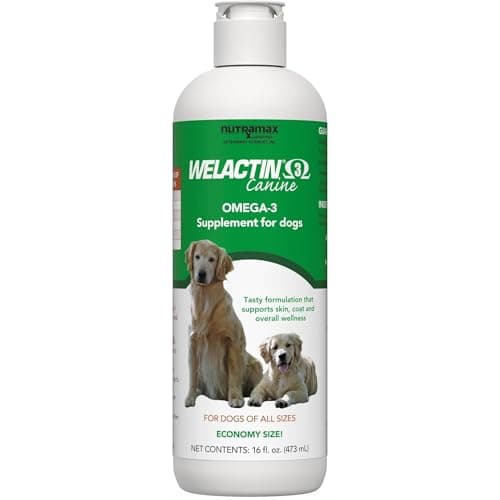
Welactin Canine Omega-3 Liquid
Our score
$22–$58
Best for
Households where a fish-oil-enriched therapeutic diet is closed off — multi-dog kitchens, elimination or kidney diets, dogs who refuse the food — and owners who want a dose they can compute and score against
The omega-3 we recommend when a fish-oil-enriched therapeutic diet is not an option, on one honest basis: the omega-3 trials in arthritic dogs were run on a diet, not on this bottle, none of them separated from control on a force plate, and the two placebo-controlled bottle trials disagree — so a dosed liquid with a published guaranteed analysis is the honest hardware for pursuing the same mechanism at a dose you and your vet chose, not a proven duplicate of anything (corrected 14 September 2026; we previously called the diet trial "the strongest evidence" and compared it as a head-to-head). Welactin earns the slot on concentration per dollar and on being made by Nutramax — not on the "#1 vet recommended" line, which is the brand's claim, not ours — and whose footnote, read 19 August 2026, defines its universe as vets "who recommended omega-3 supplements." Score lowered 8.6 to 8.4 on 19 August 2026, not because the oil changed but because a fine-print pass found the printed chart delivers under half the EPA+DHA that Colorado State's canine osteoarthritis chart calls for, that Nutramax prints the joint dose on its Advanced product and not on this one, that a retailer and the maker publish different guaranteed analyses for the same bottle, and that no calorie figure exists on any surface. It remains a cheap, concentrated, well-made oil. It is not a product you can dose for arthritis by reading its own label.
Pros
- High concentration: 1,330 mg combined EPA+DHA per 6 mL scoop on the manufacturer's guaranteed analysis
- Liquid over food scales to any body weight — no chew-splitting arithmetic
- Manufactured by Nutramax, the same company as Cosequin and Dasuquin
- Runs about $0.58/day for a 60 lb dog at the verified Amazon price — cheap for the category
Cons
- Smells fishy, and a bowl-refuser can start refusing dosed food
- Dosing hardware changed: current bottles pour by measuring scoop, not the pump our older copy described — dose accuracy now depends on you levelling a scoop
- A 6 mL scoop is coarse for small dogs — the label drops to half-scoop every-other-day under 10 lb
- Amazon's listing now leads with "Skin & Coat," not joints — the joint claim is the softer half of the marketing
- The printed chart is a skin-and-coat dose, not a joint dose, and Nutramax says so without giving a number: welactin.com's administration note read "Veterinarians may recommend increased amounts for enhanced joint health support" on 19 August 2026, and by 25 August 2026 had been reworded to "Your veterinarian may recommend to increase this amount for maximum joint health benefits" — the wording moved, the missing number stayed missing. At the chart's 1½ scoops, a 75 lb dog gets 1,995 mg of EPA+DHA against the 4,374 mg Colorado State's published canine osteoarthritis chart calls for at that weight — about 46%. Nutramax's own Welactin Advanced 3TA prints a separate "Joint Health" column at exactly double its broad-spectrum dose; this product prints one column and a footnote
- Retailer panels and the maker's panel disagree. On 19 August 2026 welactin.com published 1,610 mg total omega-3 and 1,330 mg EPA+DHA per 6 mL scoop, while a veterinary supply retailer's page for the same 16 oz bottle published 1,770 mg total, 870 mg EPA and 570 mg DHA (1,440 mg EPA+DHA) per the same 6 mL scoop. We use the maker's figures. If you are computing a dose against a study, read the panel on the bottle in your hand
- No calorie figure is published anywhere we could find — not on welactin.com and not on the Amazon listing, verified absent 19 August 2026. Fish oil is the most calorie-dense thing you can add to a bowl, and weight is the largest modifiable factor in canine osteoarthritis, so this is the number the category should print and does not
- Fish, obviously — which disqualifies it for any dog on a fish-based novel protein elimination diet, and doubles up on any dog already eating a fish-based food
- No use-within-after-opening period, no refrigeration instruction and no full ingredient list are published on the maker's product page, verified absent 9 September 2026. A 16 oz bottle lasts a 20–44 lb dog about 11 weeks and a 10–19 lb dog about 22 weeks, and fish oil oxidises once opened, so the buyer of the small dog is being sold five months of exposure with no stated shelf life. Follow whatever the bottle in your hand says; the website does not say
Omega-3 (EPA/DHA) has the better evidence base of anything in this category for canine osteoarthritis — a randomised, double-blinded, controlled trial in 38 arthritic dogs measured weight-bearing on a force plate over 90 days and found the fish-oil-enriched food improved it where the control food did not.[11] One asterisk that matters for a dosing page: that trial tested a therapeutic diet, not a bottle of oil, so no bottle inherits its dose.
We are deliberately not printing a mg-per-pound table. The right number for your dog depends on diet (fish-based kibble already contributes), other medications, and GI tolerance, and your vet can give it to you in one sentence.
What we can say from the bottle: current Welactin delivers 1,610 mg total omega-3, including 1,330 mg combined EPA+DHA, per 6 mL scoop, poured over food, with a weight chart on the label — ½ scoop every other day at 5–9 lb, up to 2½ scoops over 115 lb.[5] At a scoop and a half a day, a 16 oz bottle runs about seven weeks for a 60 lb dog.
And here is the thing worth taking to your vet, which almost nobody knows. Nutramax's concentrated veterinary-exclusive fish oil publishes two dosing columns on the same chart — "Broad Spectrum" and "Joint Health" — and the joint-health column is exactly double the broad-spectrum one at every weight band.[5] The manufacturer is telling you, in a table, that a joint dose of omega-3 is not a skin-and-coat dose. If you are giving fish oil for arthritis and following a general chart, that is a one-sentence question for your next appointment. Ask rather than adjust on your own: fish oil affects platelet function, which matters before any surgery, and overshooting shows up as soft stool.
The bottom line#
Dose by the band on your tub, expect a 4–6 week loading phase on the Nutramax labels, and taper to maintenance once you see a response. Buy the SKU built for your dog's size instead of splitting chews — especially under 25 lb — and run the tubs-per-month math before committing a giant breed to a premium product. Keep this page bookmarked as orientation, but let the label and your vet make the final call: formulations change, and your dog's weight, diet, and medications are facts no reference table can see.
Frequently asked
- How much glucosamine should a 60 lb dog get?
- There is no official canine glucosamine dose — follow the label of the product you bought. As a benchmark, the Cosequin Chewable Tablets with MSM chart, re-read on the manufacturer's own site on 14 August 2026, gives a dog in the 31–60 lb band 2 tablets a day (1,200 mg glucosamine HCl, 600 mg chondroitin, 500 mg MSM) for the initial 4–6 weeks, then 1 tablet a day. A dog over 60 lb gets 3 tablets, then 1–2. Formulations change, so confirm against your tub and your vet.
- Can I give my 8 lb chihuahua half of a large-dog chew?
- It is imprecise and we do not recommend it as a plan. Soft chews are not scored and do not split into equal halves, so your dog's daily dose drifts. Better options for dogs under 10 lb: a Small/Medium-specific SKU, a scored tablet you can halve cleanly, or a liquid like fish oil that scales down by fractions of a measuring scoop. For a 5–10 lb dog, ask your vet before starting anything — most labels simply do not go that small.
- Do I keep giving the loading dose forever?
- No. The Nutramax labels (Cosequin, Dasuquin) run a higher initial dose for about 4–6 weeks, then drop to a maintenance dose — typically around half, or the lowest amount that maintains the response. Zesty Paws publishes no loading phase, and in fact publishes no weight-banded serving chart at all in the text of its product page or its Amazon listing, which we verified on 14 August 2026 — so for that product the tub in your hand is the only source. Judge any product at 8 weeks: if nothing has improved, stop or switch rather than continuing indefinitely. And before you buy the big tub, check that the bottle count actually covers the loading phase the label prescribes — several do not.
- What happens if my dog eats a whole tub of joint chews?
- Joint supplements are generally well tolerated, and the most common outcome of an overdose is GI upset — vomiting, soft stool, a rough day. It is still a call-your-vet event, especially for a small dog and a large tub, because flavored chews are formulated to be eaten like treats and dogs will finish the container. Store tubs like medication, not like biscuits, and keep the count in mind for giant breeds eating 3 per day.
- How much fish oil should I give by weight?
- Current Welactin bottles dose with a 6 mL measuring scoop poured over food — 1,330 mg combined EPA+DHA per scoop on the manufacturer's guaranteed analysis — by the weight chart on the bottle. Older bottles used a pump delivering far less per stroke, so dose by your own bottle's label, not by a chart online. We deliberately do not publish a universal mg-per-pound figure: veterinary nutritionists commonly target a combined EPA+DHA dose scaled to body weight, and your vet can give you the number for your dog — it matters more if your dog is on other medications or a fish-based diet. Overshooting shows up as soft stool.
- When should I start a joint supplement — by age or by weight?
- Weight and breed matter more than the calendar. Large and giant breeds (Labs, Shepherds, Danes) and breeds with known joint disease in the line are the usual early-start candidates, often around age 4–5 or after any orthopedic diagnosis at any age. A 5 lb chihuahua with healthy knees can wait. A limping dog of any size is not a supplement decision at all — that is an exam.