Breed Guide
German Shepherd Hip Dysplasia: Signs by Age, Odds, and What Actually Helps
About one in four German Shepherds screened in Sweden graded dysplastic. Here are the signs at every age, what OFA and PennHIP each actually measure, and the weight and surgery numbers that decide how it ends.

About one German Shepherd in four screened in Sweden graded dysplastic, and hind-end weakness is the classic way the breed ages. Here is the honest version: you cannot change your dog's genetics, but screening at the right age, lean weight, and hindquarter muscle change how the story ends — and most dysplastic Shepherds live full lives without ever needing a surgeon. This guide covers what to watch for at each age, what the two screening systems each actually measure, and the numbers behind the things you will be asked to buy or consent to.
Affiliate disclosure: Dog Orthopedic is reader-supported. When you buy through links on our site we earn a commission at no extra cost to you — about 3% on most pet products, and the same rate on every product we compare, so no pick earns us more than another. Prescription medication earns us nothing, and seeing your vet earns us nothing; we recommend both anyway. Learn more.
Imagery: Lifestyle photographs on this site are licensed from Pexels (royalty-free) and credited per image. Pexels imagery illustrates conditions and contexts — it does not depict the specific dogs or test sessions described in the text. Product photographs come from Amazon's Creators API. Breed portraits are illustrations of typical breed type rather than photographs of individual dogs, and are not drawn to scale against one another.
Why are German Shepherds so prone to hip problems?#
Three things stack up against this breed.
Genetics. Hip dysplasia is inherited — not through one gene but through many small ones that together build a hip where the ball sits loosely in the socket. German Shepherds have been among the world's most popular breeds for a century, and for most of that century nobody screened hips before breeding.
The number to hold is this one. In the Swedish Kennel Club's screening scheme between 2007 and 2016, 12,335 German Shepherds were radiographed for hips and 25.6% graded C to E, the dysplastic range on the international scale — 39.5% graded A, 34.9% B, 17.6% C and 7.9% D or E.[1] Roughly one Shepherd in four, in a population-based dataset large enough to trust.
Two things about that figure. The authors say plainly that severe cases may be under-represented, because dogs showing clinical signs young may never be presented for screening at all[1] — every voluntary scheme has this problem, in the same direction, and an analysis of 760,455 OFA hip scores put it more bluntly still, describing the voluntary reports as severely biased against exposing dogs with problems.[2] So the true rate is worse than 25.6%, not better.
And a note on why we are quoting Sweden rather than the Orthopedic Foundation for Animals, which is the figure most American readers expect. OFA does publish German Shepherd hip statistics, and you should go and read them at ofa.org. We are not reproducing them, for two reasons: the statistics load from a database view we could not read on 14 August 2026, and OFA states on its own pages that all information displayed on its website, including database search results, is its copyrighted property and that any public reproduction is prohibited without express permission.[3] An earlier version of this page quoted "roughly one in five" and credited it to OFA screening statistics. We could not verify that figure this year from a source we were able to open, so it has been removed and replaced with one we could.
Size and growth rate. A Shepherd puppy goes from about a pound at birth to fifty-plus pounds inside a year. A joint that is slightly loose while all that weight arrives gets damaged by the ordinary business of growing up.
The loop feeds itself. A loose hip wears its cartilage abnormally, the wear becomes arthritis, arthritis makes the dog move less, and moving less shrinks the muscle that was stabilizing the hip. Every part of managing this disease is about interrupting that loop. For the full mechanics — diagnosis, grades, medication, surgery — see our hip dysplasia master guide. For the rest of the skeleton, including the lumbosacral spine that gets mistaken for hips in middle age, see German Shepherd joint problems. This page is about the hip specifically.
What are the signs at each age?#
| Age | What owners notice | What is actually going on |
|---|---|---|
| Puppy, 4–12 months | Bunny-hopping at a run (both back legs pushing together), a narrow or wobbly rear stance, flopping into a sit, quitting play early | Loose hips moving abnormally in the socket — some dysplastic puppies show it this early, many show nothing |
| Adolescent, 1–2 years | Signs often fade; maybe mild stiffness after a big day | Scar tissue and maturing muscle temporarily stabilize the joint. Quiet is not cured |
| Adult, 2–6 years | Slow, careful rising; hesitating at stairs or the tailgate; shorter walks; thinning thigh muscle | Arthritis building in a joint that never fit right |
| Senior, 7 and up | Visibly weak back legs, a swaying gait, sliding on hard floors, struggling to squat | Advanced arthritis and real muscle loss, each making the other worse |
Three cautions on reading that table.
First, Shepherds are stoic working dogs that hide pain until it is significant — our guide to the subtle signs a dog is hurting is worth ten minutes.
Second, weak back legs in an older Shepherd are not automatically hips. The breed is one of five in which degenerative myelopathy was first tied to a variant in the SOD1 gene[4], and that disease looks different from arthritis in one decisive way: it starts as an asymmetric loss of coordination with nail or toe scuffing, onset near nine years, and dogs seem not to show pain at any stage, with many becoming unable to walk within about eleven months of the first signs.[5] A back end failing without pain is the one presentation that should not be managed as arthritis while you wait and see. Hind-end weakness deserves a proper exam, not a guess.
Third — and this one surprises people — sudden hind-leg lameness in a Shepherd is less likely to be a torn cruciate than you would assume from the breed's size. In a UK primary-care study of 1,000 unilateral cruciate rupture cases against 500,000 non-cases, the breeds singled out as predisposed were the Rottweiler, Bichon Frise and West Highland White Terrier; the German Shepherd was not among them.[6] The Royal Veterinary College's own summary of that study puts the German Shepherd in the lowest-risk group at 0.43 times the odds of crossbred dogs, against the Rottweiler's 3.66.[7] Being a big working dog is not the risk factor. Being a Rottweiler is. It still needs examining — it just should not close the file before the hips and the lower back have been looked at.
“Because your dog can't tell you how much pain he or she is in.”
Is the sloped back to blame?#
The show-line silhouette — steep croup, dramatic rear angulation, hocks low to the ground — gets blamed for the breed's hips constantly, and the truth needs holding steady from both ends.
Angulation and dysplasia are different things. One is a conformation trait breeders select for; the other is a joint-laxity disease diagnosed on an X-ray. A Shepherd with a level topline can have terrible hips, and a heavily angulated show dog can have OFA-good hips. Buying a straight-backed puppy does not exempt you from any of this.
Someone has measured it, though, and the result points the opposite way from the folk theory. Sixty German Shepherds were assessed with three-dimensional motion capture and pressure data, grouped by the slope and curvature of their backs. Dogs with more back slope had a greater contact area under the forelimbs and stood with the front feet closer together; at trot they generated greater vertical force through the forelimbs and more mid-thoracic flexion, along with greater asymmetry at the stifle and hock. Slope changed the mechanics; curvature did not.[8]
The measured consequence of a sloped back was more load on the front end, not the back. And the authors said explicitly that further research is needed to determine whether those differences correspond to a higher risk of musculoskeletal disease.[8] That is a finding about mechanics, not about disease.
So neither of the two positions you will be offered on a forum is right. Conformation is not purely cosmetic — it demonstrably changes how the dog loads its limbs. And nobody has yet run the study connecting that to a diagnosis. What it means for you is simpler: in this breed, you cannot eyeball hips. Screening exists precisely because looks do not answer the question.
How do I find out for sure — OFA or PennHIP?#

| OFA | PennHIP | |
|---|---|---|
| What you get | A grade in one of seven categories — Excellent, Good, Fair, Borderline, Mild, Moderate, Severe — of which the first three are within normal limits[3] | A number — the distraction index — measuring how loose each hip actually is[9] |
| Who reads it | Radiographs of dogs 24 months or older are independently evaluated by three randomly selected board-certified radiologists from a pool of 20 to 25[10] | A trained, certified veterinarian takes the views; the index is measured, not judged |
| Sedation | Not required by OFA, but chemical restraint to the point of muscle relaxation is recommended[10] | Heavy sedation was used in the validation work[9] |
| Best for | Certifying an adult dog and comparing breeding stock | Getting an early answer while juvenile surgical options are still open |
The reason early timing favours the number over the grade is not marketing. In a three-year prospective study of 142 large-breed dogs radiographed at 4, 6, 12, 24 and 36 months, the distraction index was substantially more consistent from one age to the next than the subjective seven-point scheme — intraclass correlation 0.55 to 0.91 for the index against 0.06 to 0.39 for the subjective score — and the authors wrote that the large error associated with the subjective scheme questions its predictive use, particularly prior to the age of two years.[9]
The two schemes also disagree about the same dogs more than most owners expect. When 439 dogs had both tests on the same day, 80% of the ones OFA graded Fair to Excellent had a distraction index of 0.30 or higher, the level PennHIP treats as the start of osteoarthritis risk, and half of the OFA Excellents did.[20] For this breed the number has to be read against a German Shepherd threshold: in the 15,742-dog PennHIP analysis, German Shepherds had the tightest mean hips of four breeds, 0.41 against 0.48 to 0.53, and still carried 4.95 times the probability of radiographic joint disease, with no joint disease seen below a distraction index of 0.28.[21] The full comparison, the age-by-age reliability of an OFA preliminary, the fees, the breed data as one table, and what a screening record does to a pet-insurance claim are in our PennHIP vs OFA decision guide.
If you have a puppy from untested or unknown lines and want to know what you are dealing with, ask your vet about PennHIP — the early timing is the point, because the juvenile surgical window closes fast (more below). If you mainly want an adult dog's status on record, an OFA evaluation at two years is the standard route.
What actually helps, stage by stage?#
Puppy to 18 months: protect the growth window#
You cannot fix genetics, but growth is the one period where environment clearly moves the needle. Keep a growing Shepherd lean — ribs easy to feel — and feed a large-breed puppy formula. The reason is specific rather than marketing: the Merck Veterinary Manual's guidance for growing dogs is that excessive calorie intake and excessive dietary supplementation, including calcium, phosphorus and vitamin D, should be avoided.[19] Over-supplementing a large-breed puppy is one of the few ways an owner can actively make the growing year worse. Skip forced exercise too: no jogging on pavement, no repetitive ball-launcher sessions, no stair marathons. Free play on grass, on the puppy's own schedule, is exactly right. And put down runners if your floors are slick — a growing dog scrambling on hardwood is joint load with no benefit; see traction fixes that work.
Adult years: weight and muscle are the whole game#
Two things decide most of a dysplastic Shepherd's middle age: body condition and hindquarter muscle.
Weight has the best numbers on this page, and they are more specific than "keep him lean." In fourteen obese dogs with osteoarthritis fed a restricted diet over sixteen weeks, lameness scores fell significantly from a weight loss of 6.10% onward, with force-plate gait analysis confirming the improvement from 8.85% onward.[11] An earlier trial in nine dogs with hip osteoarthritis found lameness significantly reduced after losses of 11 to 18% of body weight.[12] For a 38 kg Shepherd, 6.1% is about 2.3 kg. That is a number you can put on a calendar, and both trials were small and open-label, so treat them as the direction of an effect rather than a dose-response curve.
The lifespan side is worth stating honestly too, because it cuts the other way. Across 50,787 client-owned dogs, overweight body condition shortened life in all twelve breeds studied — but the German Shepherd had the smallest effect of the twelve: hazard ratio 1.35 (99.79% CI 1.05–1.73), with median lifespan 12.5 years in normal condition against 12.1 overweight.[13] About five months. So keep him lean for the lameness, which is measurable within months, rather than for a promise of years.
Build muscle with consistent low-impact work: leashed hill walks, swimming where available, controlled trotting on grass. A joint supplement is a reasonable optional layer, and we would rather you knew what it is and is not:

Nutramax
Dasuquin with MSM Soft Chews
Our score
$50–$135
Best for
Step-up from Cosequin for dogs with diagnosed osteoarthritis or post-surgical recovery
The joint supplement to buy when you have decided to buy one and the dog has real, diagnosed osteoarthritis. The ASU component is what separates it from Cosequin and the only reason to pay the premium, and the honest framing is that the supporting evidence is strongest in the laboratory and weakest in blinded canine trials — which is true of the entire category. Buy one product, run it properly for 4–6 weeks, and judge the result against something you measured before you started. Score lowered 9.2 to 8.8 on 2026-08-13: the product has not changed, but we read the trial that tested it by name and found it did not separate from placebo on a force plate, and a second blinded trial by a different group using activity monitors reached the same answer. It stays a defensible first purchase because it is inexpensive, well tolerated and unusually well disclosed. It is no longer a product we can describe as well evidenced.
Pros
- Adds ASU (avocado/soybean unsaponifiables) to the glucosamine/chondroitin base — the ingredient that separates it from Cosequin, with laboratory and animal-model evidence for cartilage protection
- Same FCHG49 glucosamine and TRH122 chondroitin as Cosequin
- Soft chew form factor most dogs eat as a treat
- Genuinely a veterinary-channel line, not just marketed as one — the Advanced tier is sold through clinics rather than retail. Note that the box's "#1 veterinarian recommended" rests on an unnamed survey. dasuquin.com's own footnote, read 2026-09-08, gives the source as a "survey conducted among small animal veterinarians who recommended animal supplements" — so the denominator is vets who already recommend a supplement, not vets. No sample size, date or sponsor is published
- Published per-chew analysis — you can see exactly what a chew contains, which most competitors do not publish to the same standard — including, unusually, an omega-3 line the equivalent chewable tablet does not carry
Cons
- 30–40% pricier than Cosequin DS
- Soft chews can stick together in heat
- Only meaningful upgrade if diagnosed OA — for healthy dogs Cosequin is enough
- The canine clinical evidence for ASU is thinner than the marketing: the strongest data is laboratory and animal-model work, not blinded trials in pet dogs. No joint supplement has evidence in the same class as an NSAID
- This exact product was the glucosamine arm of a blinded, placebo-controlled force-plate trial and it did not separate from placebo. Kampa et al. 2023 (Front Vet Sci, DOI 10.3389/fvets.2023.1033188) names "DASUQUIN with MSM Soft Chews, Nutramax" and reports a week-4 change in peak vertical force of −0.05 against placebo's +0.08, while two green-lipped mussel lipid extracts and carprofen all improved significantly. Two fair caveats: small arms — 16 dogs in the glucosamine group, 14 to 15 in the others — and the trial ran maintenance dosing (about 30 mg/kg) through the window this label says to double.
- Contains no manganese, unlike both of its Nutramax siblings — Cosequin prints 3 mg per tablet and Dasuquin Advanced prints 3 mg per large-dog chew, while this tier has no manganese row on the panel and none in the other-ingredients list (all three panels read 19 August 2026). Whether that matters is genuinely unclear, since manganese's role here is a cofactor claim rather than a tested effect. We list it as a con because the maker sells it as an active in the tier above and the buyer of this tier is never told it is absent
- No calorie figure on the panel, on dasuquin.com or on the Amazon listing (verified absent 19 August 2026) — two chews a day is two treats a day for a dog whose weight is the strongest lever anyone has
Be clear-eyed about the evidence here. In a blinded, placebo-controlled trial of 75 dogs with hip osteoarthritis in which the glucosamine arm was this product by name, peak vertical force in the glucosamine group did not separate from placebo at four weeks, while green-lipped-mussel lipid extracts and carprofen did.[14] A separate 60-dog placebo-controlled trial using activity monitors found no difference in activity counts either, while owner-reported pain scores improved equally in both arms — the signature of a caregiver placebo effect.[15] Both trials had roughly 15 to 30 dogs per arm and were not powered to exclude a small benefit, and neither ran the manufacturer's higher loading dose. It is safe, it is affordable, and the honest position is that the best-designed trials did not find it working. Give it six weeks, judge it, and drop it if you see nothing. Our Dasuquin vs Cosequin breakdown covers the formula difference; weight and muscle come first regardless.
Senior years: run the full gear stack#

An old Shepherd with failing hips needs three things from the house: a surface that does not hurt, floors that do not slip, and a way for you to help with the hard moments.

Big Barker
Big Barker 7-inch Pillow Top
Our score
$250–$460
Best for
Large and giant breeds with hip, elbow, or arthritis pain
The bed every senior-large-breed owner eventually buys, and the one we still recommend first for a dog over about 80 lb — because seven inches of foam is the only thing that reliably keeps a heavy dog's hip off the floor plane overnight. (It is not one solid slab, as we used to say: the maker's own copy describes a 3-layer build, a 2" base under a 3" support layer under a 2" comfort top.) It is also the only bed in the category with a clinical study attached, and we would rather you knew what that study is: forty dogs, no control group, no blinding, and outcomes scored by the owners who had just been given a free bed. That is a reason to be interested, not a reason to be convinced. Buy on the foam depth and the ten-year warranty, which are facts. On where to buy: the price is the same either way, so buy direct for the 180-night sleep trial, which Amazon's return window does not match. The two editions both sell on both channels at identical prices, re-verified 6 September 2026 — flat Large $249.95, Headrest Large $289.95. We have published two wrong things about this in the past, a $40 Amazon markup and a direct-only cheap edition; both are retired, and the honest version is that the channel decides your trial, not your price.
Pros
- Seven inches of foam — a 3-layer build (2" base, 3" support, 2" top comfort) deep enough that a 100 lb dog's hip does not reach the floor plane, which is the whole job
- 10-year warranty — foam must retain at least 90% of its original shape and support, or it is replaced
- The only bed in the category with a published clinical study behind it, even though that study is a single-arm pilot
- Made in the USA
- Microfiber cover unzips and machine-washes
Cons
- Premium price
- Editions, not channels, are what the price difference is. Both are on Amazon and both are on bigbarker.com at identical prices, re-verified 2026-09-06: the flat headrest-free Large is $249.95 (B0GRBXBPXH) and the Headrest Large is $289.95 (B0GRBX5TBL), both In Stock with the buy box held by Big Barker itself, both matching the maker's own site. We previously misread this as a $40 Amazon markup, and then as the cheap edition being direct-only. Both claims are retired
- Bulky — measure your space, not just your dog
- Cover-only style isn't bolstered (consider Sofa edition for nesters)
- The clinical study everyone cites is open-label, single-arm, and owner-scored, with no control group
We used to say here that a dysplastic dog spends more than half its life lying down. We could not find a published figure for how many hours a day a dog with hip arthritis lies down, so we have cut the claim rather than keep a number nobody can check. The argument for the bed does not need it: a painful hip presses through whatever is under it, and a sore dog who will not settle is a sore dog losing sleep. Our beds-for-bad-hips guide goes deeper on what to look for, including the cheaper options — and if the bed you own still springs back under a knuckle pressed at the hip spot, you do not need a new one yet.
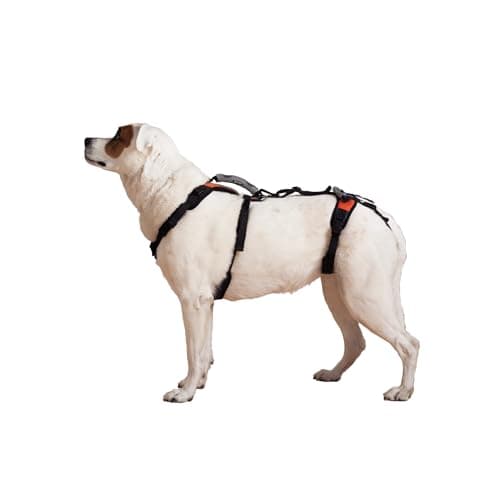
Help 'Em Up
Help 'Em Up Harness
Our score
$95–$155
Best for
Long-term mobility support for senior or post-surgical large dogs
If your dog needs help getting up multiple times a day for the foreseeable future — post-TPLO, advanced hip dysplasia, hindquarter weakness in giant-breed seniors — this is the one to buy. It is the only harness in the category that supports the front and the back independently, which is what a dog with a bad hip and a compensating shoulder actually needs. Buy it from the manufacturer, not from Amazon: re-verified 18 August 2026, helpemup.com prices by size at $80 / $95 / $110 / $125 / $140 while Amazon runs $95 / $110 / $125 / $140 / $155 — a uniform $15 more at every size, every time we have checked.
Pros
- Two-piece (chest + hip) design lets you support either end independently
- Hip handle is purpose-built — not a converted car-seat-belt strap
- Padded chest plate distributes weight better than sling-only options
- Five sizes span 10 to 225 lb, and the rear half can be ordered a size smaller for a dog with muscle wasting
- Two hip-lift styles (Conventional and U-Band) so male dogs are not soiling the strap
Cons
- Amazon runs a uniform $15 above the maker's own price at every one of the five sizes, and the Amazon buy box is held by a third-party reseller (Veterinary Preferred) rather than by the brand — re-verified 18 August 2026
- The maker's own Mix & Match page prints two different starting prices, "From $80" and "FROM $95 USD", on the same page
- Direct pricing is no longer flat: since mid-August 2026 the maker charges $80 to $140 by size, so a giant-breed owner now pays $60 more than a terrier owner
- On 29 August 2026 the linked Amazon Medium (B0DK81SCG5) showed a future availability date rather than units on hand, while every size and style was in stock at helpemup.com the same day; on 9 September and again on 12 September 2026 the Amazon Medium still showed the future-date status at $125.00 with a maximum order of one and no ship date given, while all nine direct variants were in stock — two weeks of backorder on the channel we earn from, and one more reason the direct channel is the one to use
- Sizing is critical — measure twice, return is a hassle
- Rear straps can chafe the inner thigh if the harness is left tight while the dog lies down
- A dog filmed or gait-assessed while wearing it looks less lame than he is, because the harness offloads the limb you are trying to judge
- Bulkier than a quick-grab sling for short-term use
The two-piece harness earns its price the first morning your dog cannot get up from tile without help. Worth staging before the day you need it — see our full lift harness guide for alternatives.
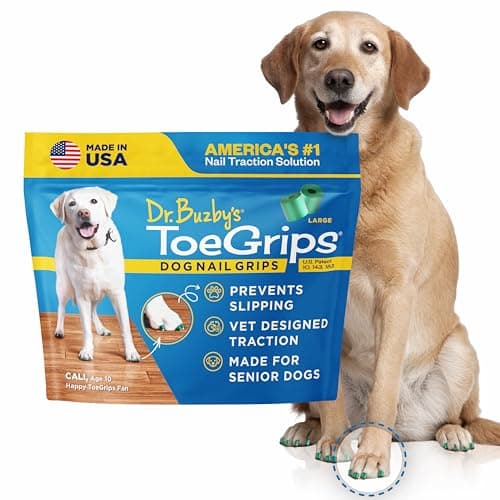
Dr. Buzby's
Dr. Buzby's ToeGrips for Dogs
Our score
$34–$40
Best for
Senior dogs slipping on hardwood, tile, or laminate floors
The best dog-mounted traction fix there is, and the one to buy once rugs have taken you as far as they can. Nothing touches the paw pad, which is why dogs tolerate these where they refuse socks and boots. Go in knowing the real cost: this is not a $40 purchase but a $240–$320 a year habit, so lay runners along your dog's actual routes first and buy grips for the floors you cannot cover.
Pros
- Veterinarian-developed; in clinical use for over a decade
- Slip onto each toenail — no socks, booties, or adhesives required
- Restores traction immediately, especially on hard floors
- Nothing touches the paw pad, so dogs accept them where they refuse boots
- Amazon and the manufacturer both charge $39.99 — no retailer markup
- 20 grips per bag against the 16 a dog wears, so a set includes four spares
Cons
- The only two published studies of nail grips both tested this exact product, and both were null: Roush 2017 (Front Vet Sci 4:111 — 15 sound dogs, kinetic changes "unlikely to be clinically relevant") and Repac 2022 (Animals 12(18):2312 — 30 dogs two weeks post-TPLO vs sham, no difference in weight bearing or limb function, including the owner question that asked specifically about slippery floors). Fair caveats: small samples, one used healthy dogs, the other a single early post-op timepoint — but "no positive trial exists" is the honest label, and we say it while still recommending the product for the mechanism and the owner-reported traction stories it was never tested against (verified 2026-08-14).
- A recurring cost, not a one-off. The maker publishes two different bag lives — "1–2 months" on its store page and "1-3 months, two months on average" in its FAQ (both read 2026-09-05) — which spans $160–$480 a year at $39.99. Plan on $240–$320, the two surfaces' central figures
- The Amazon listing markets specifically to dogs with "ACL injuries" — the one population where a randomised trial has been run, and where it found nothing (Repac 2022). The same bullets carry three claims with no source we could find: "more than 250,000 paws," "America's #1 nail traction solution," and "recommended by thousands of veterinarians worldwide" (listing copy verified 2026-08-17). Re-read 2026-08-31: a fourth unsourced superlative has been added to the top bullet on all four Amazon sizes — "The Only Toenail Grips for Dogs With GripZone Technology" — and the Large listing's title now leads with "Instant Traction on Wood/Hardwood Floors."
- The maker sells Scotch Super Glue Gel at $4.99 on its own store, listed as an "Alternate ToeGrips Application Method" (shop.toegrips.com, 2026-08-31). Read that as what it is: the company's own answer to the grips coming off, priced separately and not mentioned on the Amazon listing you are most likely to buy from.
- Application needs isopropyl rubbing alcohol, which is not in the box
- Initial application takes 15–20 minutes for a full set
- Some dogs chew them off in the first week
- Amazon carries only four of the seven sizes; XS, XXL and XXXL dogs have to buy direct
- Sizing by weight chart alone often misses — the accurate method needs dental floss and a ruler
Splaying out on hardwood is both painful and frightening for a weak-hipped dog, and fear of floors shrinks a senior's world fast. Traction is the cheapest quality-of-life fix on this page.
When is surgery on the table?#
At both ends of life, and the windows at the young end are narrower than most owners realise.
Juvenile pubic symphysiodesis (JPS) closes a growth plate at the bottom of the pelvis so that the hip socket grows to cover the ball more fully. The American College of Veterinary Surgeons states that puppies as young as ten weeks can be accurately assessed for abnormal joint laxity, and that puppies less than 18 weeks of age must have the procedure performed — that is, before about four months, not five.[16] Double or triple pelvic osteotomy (DPO/TPO) rotates the pelvic segments to improve coverage, and is described as an option for immature dogs ideally under eight to ten months old with no visible radiographic arthritis.[16] Those windows are the strongest argument for early screening in this breed, and they are the reason a measured laxity number at sixteen weeks is worth more than a grade at two years if you might act on it.
At the other end, when pain can no longer be controlled medically, total hip replacement is the reconstructive option for a full-size Shepherd. Here are the real numbers rather than the brochure ones. In 219 cementless total hip replacements performed on 183 dogs, full return to function was achieved in 88.1% of procedures at a median 42 months of follow-up — alongside a total complication rate of 31.1%, made up of 8.2% catastrophic, 9.6% major and 13.2% minor complications, most of them intraoperative or perioperative.[17] The commonest were femoral fissures during surgery.
And one finding that belongs on this page and almost nowhere else. In a review of 255 total hip replacements using a lateral-bolt stem, German Shepherds were specifically associated with postoperative femoral fracture, despite the stem design intended to prevent it, and the authors suggested prophylactic cerclage wire could be considered in this breed.[18] If your Shepherd is being worked up for a hip replacement, that is a fair and specific question to ask the surgeon.
Femoral head ostectomy (FHO) is the lower-cost salvage option, though outcomes are more of a compromise in dogs this size — our guide to FHO surgery recovery covers what the months afterward ask of you. Our total hip replacement explainer walks through costs, recovery, and how surgeons decide. None of this is a decision to make from an article — it is a conversation with a board-certified surgeon, with your dog's X-rays on the screen.
The bottom line#
Own a German Shepherd long enough and hips will be on your mind; roughly one in four screened Shepherds grades dysplastic, and the true figure is higher than that. The playbook is not complicated.
Screen instead of guessing, and early if the lines are unknown — the subjective grade is unreliable before two years, the surgical windows close before eighteen weeks and eight to ten months, and a measured laxity number is what fits inside them. Ask for the elbow paperwork as well as the hips; the two traits are barely correlated. Keep the dog lean, and aim at something concrete: a 6% loss measurably reduced lameness in the trial that looked. Build and keep hindquarter muscle with boring, consistent, low-impact exercise. Stage the gear before the crisis: bed, traction, harness. And know that a hip replacement returns roughly nine dogs in ten to full function, at the price of a real complication rate you should hear stated out loud before you consent.
A dysplastic Shepherd is not a tragedy. It is a dog with a manageable chronic condition — and, now, an owner who knows the plan.
Sources#
- Engdahl K, Malm Persson S, Andersson L, Ringmark S, Bjørnvad CR, Hedhammar Å, Höglund K. "Prevalence of hip and elbow dysplasia in young adult dogs in Sweden." Veterinary Record. 2026;198(12):e560-e573. doi:10.1002/vetr.70224 — Swedish Kennel Club screening 2007–2016, dogs 12–24 months; 114,568 dogs screened for hips and 78,504 for elbows. German Shepherd Dog hips: 12,335 screened — A 4,876 (39.5%), B 4,305 (34.9%), C 2,175 (17.6%), D–E 979 (7.9%), C–E 3,154 (25.6%). German Shepherd Dog elbows: 12,309 screened — ED 0 10,232 (83.1%), ED 1 1,384 (11.2%), ED 2 383 (3.1%), ED 3 310 (2.5%), ED 1–3 2,077 (16.9%). Authors state severe cases may be under-represented because dogs with clinical signs at a young age might never be screened.
- Hou Y, Wang Y, Lu X, Zhang X, Zhao Q, Todhunter RJ, Zhang Z. "Monitoring Hip and Elbow Dysplasia Achieved Modest Genetic Improvement of 74 Dog Breeds over 40 Years in USA." PLoS ONE. 2013;8(10):e76390. doi:10.1371/journal.pone.0076390 — OFA registry 1974–2009; 760,455 hip and 135,409 elbow scores across 74 breeds; genetic improvement 16.4% of a phenotypic standard deviation for hips and 1.1% for elbows; heritability 0.22 hips and 0.17 elbows; genetic correlation between the traits 0.12; authors state the voluntary reports "have been severely biased against exposing dogs with problems, especially at beginning period."
- Orthopedic Foundation for Animals. "Hip Dysplasia." ofa.org — read 14 August 2026: hips classified into seven categories, Excellent, Good and Fair being within normal limits, then Borderline, Mild, Moderate and Severe; breed statistics are offered through a separate database view which did not load for us on that date. OFA states that all information displayed on its website, including database search results, is its copyrighted property and that any type of public reproduction is strictly prohibited without express permission — which is why no OFA breed figure is reproduced on this page.
- Awano T, Johnson GS, Wade CM, et al. "Genome-wide association analysis reveals a SOD1 mutation in canine degenerative myelopathy that resembles amyotrophic lateral sclerosis." Proceedings of the National Academy of Sciences USA. 2009;106(8):2794-2799. doi:10.1073/pnas.0812297106 — SOD1 E40K missense mutation; homozygosity for the A allele associated with degenerative myelopathy in Pembroke Welsh corgi, Boxer, Rhodesian ridgeback, German Shepherd dog and Chesapeake Bay retriever; typical onset at 8 years or older.
- University of Missouri Veterinary Health Center. "Degenerative Myelopathy." vhc.missouri.edu — read 14 August 2026: onset near 9 years of age; asymmetric loss of coordination and spastic weakness in the hind limbs; owners frequently report nail or toe scuffing first; "Dogs seem not to show pain during the course of the disease"; affected dogs often progress to non-ambulatory within 11 months of initial signs; no treatment exists.
- Pegram C, Brodbelt DC, Diaz-Ordaz K, Chang Y, von Hekkel AF, Church DB, O'Neill DG. "Risk factors for unilateral cranial cruciate ligament rupture diagnosis and for clinical management in dogs under primary veterinary care in the UK." The Veterinary Journal. 2023;292:105952. doi:10.1016/j.tvjl.2023.105952 — 1,000 incident unilateral CCL rupture cases against 500,000 non-cases from 2019; dogs aged 6 to <9 years, neutered dogs of both sexes, insured dogs, and Rottweiler, Bichon Frise and West Highland White terrier breeds in particular had increased odds. The German Shepherd Dog is not among the predisposed breeds named.
- Royal Veterinary College VetCompass. "New research finds Rottweilers at greatest risk of cranial cruciate ligament rupture," published 1 February 2023, reporting Pegram et al. 2023. rvc.ac.uk — read 14 August 2026: "the breeds at most risk of CCL rupture, compared with crossbreeds, were Rottweiler (x 3.66 times risk), Bichon Frise (x 2.09), West Highland White Terrier (x 1.80) and Golden Retriever (x 1.69). Conversely, the breeds with the lowest risk were Cockapoo (x 0.26), Chihuahua (x 0.31), Shih-tzu (x 0.41) and German Shepherd Dog (x 0.43)."
- Humphries A, Shaheen AF, Gómez Álvarez CB. "Different conformations of the German shepherd dog breed affect its posture and movement." Scientific Reports. 2020;10(1):16924. doi:10.1038/s41598-020-73550-x — 60 German Shepherds assessed by 3D motion capture and pressure data, grouped by back slope and curvature; greater slope associated with greater forelimb contact area, narrower forelimb stance, greater forelimb vertical force at trot and greater mid-thoracic flexion, plus greater stifle and hock asymmetry; slope affected biomechanics, curvature did not; authors state further research is required to determine whether these differences relate to increased susceptibility to musculoskeletal disorders.
- Smith GK, Gregor TP, Rhodes WH, Biery DN. "Coxofemoral joint laxity from distraction radiography and its contemporaneous and prospective correlation with laxity, subjective score, and evidence of degenerative joint disease from conventional hip-extended radiography in dogs." American Journal of Veterinary Research. 1993;54(7):1021-1042. doi:10.2460/ajvr.1993.54.07.1021 — 3-year prospective study of 142 large-breed dogs of 14 breeds radiographed under heavy sedation at 4, 6, 12, 24 and 36 months in both the hip-extended and the compression/distraction positions; intraclass correlation over time 0.55–0.91 for the distraction index against 0.06–0.39 for the subjective OFA-style score; "The associated large error questions the predictive use of the 7-point, subjective hip-scoring scheme, particularly prior to the age of 2 years."
- Orthopedic Foundation for Animals. "Hip Screening Procedures." ofa.org — read 14 August 2026: "Radiographs of animals 24 months of age or older are independently evaluated by three randomly selected, board-certified veterinary radiologists from a pool of 20 to 25 consulting radiologists"; chemical restraint is not required by OFA but restraint to the point of muscle relaxation is recommended; radiography of females in oestrus or pregnant should be avoided due to possible increased joint laxity.
- Marshall WG, Hazewinkel HA, Mullen D, De Meyer G, Baert K, Carmichael S. "The effect of weight loss on lameness in obese dogs with osteoarthritis." Veterinary Research Communications. 2010;34(3):241-253. doi:10.1007/s11259-010-9348-7 — 14 obese client-owned dogs with clinical and radiographic osteoarthritis, restricted-calorie diet over 16 weeks, open prospective trial; significant decrease in lameness from a weight loss of 6.10% onwards, supported by kinetic gait analysis from 8.85% onwards.
- Impellizeri JA, Tetrick MA, Muir P. "Effect of weight reduction on clinical signs of lameness in dogs with hip osteoarthritis." Journal of the American Veterinary Medical Association. 2000;216(7):1089-1091. doi:10.2460/javma.2000.216.1089 — 9 client-owned dogs 11–12% above ideal weight, fed at 60% of maintenance; dogs lost 11–18% of initial body weight; body weight, body condition score and severity of hind limb lameness all significantly decreased. Non-blinded prospective clinical trial.
- Salt C, Morris PJ, Wilson D, Lund EM, German AJ. "Association between life span and body condition in neutered client-owned dogs." Journal of Veterinary Internal Medicine. 2019;33(1):89-99. doi:10.1111/jvim.15367 — 50,787 middle-aged neutered dogs at around 900 North American hospitals, 1,811 German Shepherds; hazard ratio for death in overweight versus normal body condition, German Shepherd 1.35 (99.79% CI 1.05–1.73), the lowest of the twelve breeds studied; median life span 12.5 years normal (99.79% CI 12.2–12.9) versus 12.1 overweight (11.8–12.4).
- Kampa N, Kaenkangploo D, Jitpean S, Srithunyarat T, Seesupa S, Hoisang S, Yongvanit K, Kamlangchai P, Tuchpramuk P, Lascelles BDX. "Study of the effectiveness of glucosamine and chondroitin sulfate, marine based fatty acid compounds (PCSO-524 and EAB-277), and carprofen for the treatment of dogs with hip osteoarthritis." Frontiers in Veterinary Science. 2023;10:1033188. doi:10.3389/fvets.2023.1033188 — prospective, block-randomised, double-blinded, placebo-controlled trial; 75 pet dogs with hip osteoarthritis in five arms of 15. At 4 weeks the change in peak vertical force was significant and greater than placebo for PCSO-524, EAB-277 and carprofen, but not for glucosamine/chondroitin (−0.05 ± 6.34 against placebo 0.08 ± 1.90); at 6 weeks the glucosamine group's change (1.08 ± 5.49) lay between placebo and the other treatments. Subjective orthopaedic assessment scores did not change significantly in any group, including carprofen. Funded by Pharmalink International Ltd, which owns the EAB-277 and Antinol trademarks.
- Scott RM, Evans R, Conzemius MG. "Efficacy of an oral nutraceutical for the treatment of canine osteoarthritis. A double-blind, randomized, placebo-controlled prospective clinical trial." Veterinary and Comparative Orthopaedics and Traumatology. 2017;30(5):318-323. doi:10.3415/vcot-17-02-0020 — 30 dogs on glucosamine/chondroitin plus an additional ingredient against 30 on placebo, activity monitors worn continuously over 97 days; no difference between groups in daily activity counts; owner-assessed pain interference and pain severity improved over 90 days in both groups with no difference between them, which the authors attribute to a caregiver placebo effect.
- American College of Veterinary Surgeons. "Canine Hip Dysplasia." acvs.org — read 14 August 2026: puppies as early as 10 weeks old can be accurately diagnosed with abnormal joint laxity; juvenile pubic symphysiodesis "puppies less than 18 weeks of age must have it performed"; double or triple pelvic osteotomy is "another option for immature dogs (ideally less than 8–10 months old) with CHD but no visible radiographic arthritic changes."
- Kidd SW, Preston CA, Moore GE. "Complications of porous-coated press-fit cementless total hip replacement in dogs." Veterinary and Comparative Orthopaedics and Traumatology. 2016;29(5):402-408. doi:10.3415/vcot-15-07-0116 — 219 total hip replacement procedures in 183 dogs; total complication rate 31.1% (68/219), catastrophic 8.2%, major 9.6%, minor 13.2%; commonest complications intraoperative femoral fissure (46), diaphyseal femoral fracture (15) and coxofemoral luxation (9); full return to function achieved in 88.1% of procedures at a median follow-up of 42 months; most complications occurred intraoperatively or perioperatively.
- Kokkinos P, Parsons K, Belch A, Barthelemy N. "The influence of age at total hip replacement on perioperative complications associated with a press-fit cementless stem with lateral bolt in dogs." Veterinary Surgery. 2025;54(3):581-593. doi:10.1111/vsu.14203 — 197 client-owned dogs, 255 total hip replacements, 2017–2022; intraoperative stem complication rate 8.6% and early postoperative 2%; juveniles at increased risk of intraoperative fissures; "German shepherd dogs were associated with postoperative fractures"; authors suggest prophylactic cerclage application could be considered in juvenile and German Shepherd dogs.
- Merck Veterinary Manual. "Developmental Osteopathies in Dogs and Cats." merckvetmanual.com — read 14 August 2026: "Excessive calorie and dietary supplementation, including calcium, phosphorus, and vitamin D, in young, growing dogs should be avoided." The same entry covers panosteitis in dogs 6–16 months old, which is a common alternative explanation for lameness in a growing German Shepherd and is genetically suspected in this breed in particular.
- Powers MY, Karbe GT, Gregor TP, McKelvie P, Culp WT, Fordyce HH, Smith GK. "Evaluation of the relationship between Orthopedic Foundation for Animals' hip joint scores and PennHIP distraction index values in dogs." Journal of the American Veterinary Medical Association. 2010;237(5):532-541. doi:10.2460/javma.237.5.532 — 439 dogs; 80% of OFA-normal dogs had a distraction index of 0.30 or higher.
- Smith GK, Mayhew PD, Kapatkin AS, McKelvie PJ, Shofer FS, Gregor TP. "Evaluation of risk factors for degenerative joint disease associated with hip dysplasia in German Shepherd Dogs, Golden Retrievers, Labrador Retrievers, and Rottweilers." Journal of the American Veterinary Medical Association. 2001;219(12):1719-1724. doi:10.2460/javma.2001.219.1719 — 15,742 dogs; mean distraction index 0.41 in German Shepherds; 4.95-fold probability of joint disease; breed threshold 0.28.
This article is educational and does not replace veterinary advice. Screening choices, surgical timing and pain medication are decisions to make with your own vet and, where surgery is on the table, a board-certified surgeon with your dog's radiographs on the screen.
Frequently asked
- How common is hip dysplasia in German Shepherds?
- Common enough to plan for. In the Swedish Kennel Club's screening records for 2007–2016, 12,335 German Shepherds were radiographed and 25.6% graded C to E — the dysplastic range on the international scale. That is about one in four. The same dataset put 16.9% of 12,309 screened Shepherd elbows at grade 1 or worse. Both figures almost certainly understate the breed, because voluntary screening schemes under-represent the dogs with obvious problems. That does not doom any individual dog. It means screening, lean weight, and muscle-building habits matter more in this breed than in most.
- What are the first signs of hip problems in a German Shepherd?
- Early signs are subtle: bunny-hopping at a run (both rear legs pushing together), hesitation before stairs or the car, a narrow or wobbly rear stance, sitting down mid-walk, and slow, careful rising after rest. Obvious limping usually comes late. Some dysplastic puppies show signs at five to twelve months, then seem to improve as scar tissue temporarily stabilizes the joint — apparent recovery is not a reason to skip screening.
- Does the sloped back cause hip dysplasia in German Shepherds?
- Not directly — they are different things. The sloped topline and steep rear angulation of some show lines are conformation traits; hip dysplasia is an inherited joint-laxity disease diagnosed on X-ray. Level-backed working dogs can have bad hips, and heavily angulated dogs can have good ones. The legitimate concern is that extreme angulation changes gait and can mask or mimic hip pain — one more reason formal screening, not eyeballing, answers the question.
- Should I choose OFA or PennHIP screening?
- Both are legitimate, and they answer different questions. OFA gives a grade: radiographs of dogs 24 months or older are read independently by three randomly selected board-certified radiologists drawn from a pool of 20 to 25. PennHIP gives a number — the distraction index — measuring how loose the joint actually is. The reason the number matters early is that the subjective hip-extended grade is unreliable in young dogs: in a three-year prospective study of 142 dogs radiographed at 4, 6, 12, 24 and 36 months, the distraction index was far more consistent over time than the seven-point subjective scheme, and the authors wrote that the large error in that scheme questions its predictive use, particularly before two years of age. So for an early answer on a puppy while juvenile surgical windows are open, ask about PennHIP; to put an adult's status on record, OFA is the standard.
- Can a German Shepherd with hip dysplasia live a normal life?
- Most do. The majority of dysplastic dogs are managed for life without surgery: lean body weight, consistent low-impact exercise to hold hindquarter muscle, vet-prescribed pain control when needed, and home adjustments — traction on floors, an orthopedic bed, a lift harness for the later years. Surgery does work when it is needed: in a series of 219 total hip replacements in 183 dogs, full return to function was achieved in 88.1% of procedures at a median 42 months of follow-up. That same series recorded a total complication rate of 31.1%, with 8.2% classed as catastrophic — so it is a good operation with a real downside, not a formality.
- What can I give my German Shepherd for hip pain?
- Nothing from a human medicine cabinet. Ibuprofen, naproxen, and acetaminophen are toxic to dogs — single doses can cause ulcers, kidney damage, or liver failure. Pain control should come from your vet: canine NSAIDs and other prescription options are effective and monitored. What you control at home is everything that reduces the need for medication, and the order matters: lean weight first — a 6.1% loss significantly reduced lameness in the trial that measured it — then muscle, traction and supportive bedding. Joint supplements come last and honestly: in the two best-designed placebo-controlled trials, glucosamine and chondroitin did not separate from placebo on force plate or on activity monitors.