Tested picks
The Best Dog Beds for Hip Dysplasia (2026)
The best dog bed for hip dysplasia gives real pressure relief across the hip socket and a firm surface to push up from. Our tested picks, from the Big Barker down to a budget option.

The bed question for a dog with hip dysplasia comes down to what happens during the hours they spend lying on it. Our pick for most dysplastic dogs is the Big Barker 7-inch Pillow Top: firm enough to push up from, thick enough that a heavy dog's hip never reaches bottom, and the only bed in our pool with any clinical study behind it — though that study is much weaker than the marketing suggests, and we go through exactly why below. If your dog leans into a bolster, or the budget stops near $100, there's a right answer for that too. And if the bed you own still passes the fist test, the right answer is to buy nothing.
Affiliate disclosure: Dog Orthopedic is reader-supported. When you buy through links on our site we earn a commission at no extra cost to you — about 3% on most pet products, and the same rate on every product we compare, so no pick earns us more than another. Prescription medication earns us nothing, and seeing your vet earns us nothing; we recommend both anyway. Learn more.
Imagery: Lifestyle photographs on this site are licensed from Pexels (royalty-free) and credited per image. Pexels imagery illustrates conditions and contexts — it does not depict the specific dogs or test sessions described in the text. Product photographs come from Amazon's Creators API. Breed portraits are illustrations of typical breed type rather than photographs of individual dogs, and are not drawn to scale against one another.
Our picks at a glance#

Big Barker
Big Barker 7-inch Pillow Top

K9 Ballistics
K9 Ballistics Tough Ripstop Orthopedic Crate Bed
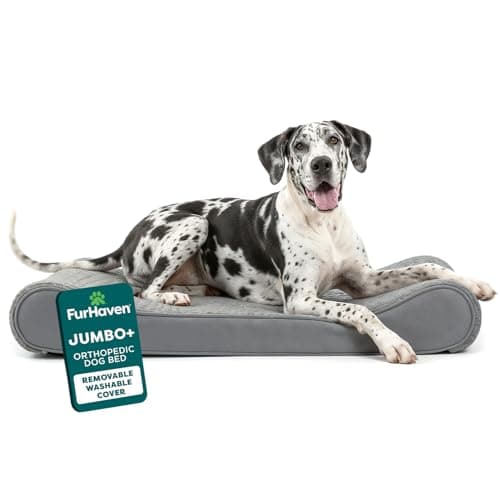
Furhaven
Furhaven Ultra Plush Luxe Lounger
| Product | Score | Best for | Price | |
|---|---|---|---|---|
Big Barker Big Barker 7-inch Pillow Top | 9.4 | Large and giant breeds with hip, elbow, or arthritis pain | $250–$460 | View |
K9 Ballistics K9 Ballistics Tough Ripstop Orthopedic Crate Bed | 8.4 | Diggers, scratchers and light chewers that shred ordinary bed covers | $149–$320 | View |
Furhaven Furhaven Ultra Plush Luxe Lounger | 8.1 | Budget-conscious owners of light and medium dogs, and nesting sleepers who like a low step-on entry | $34.60 | View |
All four come from the same test pool as our master orthopedic bed roundup, scored with the same weights — here's the full methodology. What changes on this page is the filter: we re-ranked for what dysplastic hips specifically need, and we're blunt about which beds fall short for heavier dogs.
What does a dog with bad hips actually need from a bed?#
Hip dysplasia begins in growth and "results in instability or a loose fit (laxity) of the hip joint," and the long-term response to that laxity is "the progressive loss of cartilage, the development of scar tissue around the joint, and the formation of osteophytes (bone spurs)."[1] It is common enough to be worth taking seriously: across the entire Orthopedic Foundation for Animals hip registry — 921,046 unique dogs — 15.56% were dysplastic, with dogs in the AKC working group carrying nearly twice the odds of hounds.[2]
By the time you're shopping for a bed, the joint is usually inflamed, the muscle around it is thinner than it should be, and the hardest single motion in your dog's day is standing up from lying down. That sets the spec:
Real pressure relief across the hip socket, for hours at a time. This is measurable, and it has been measured. Cadaver dogs of differing body condition were laid on their sides across four support surfaces and mapped with a pressure mat for four hours. Regardless of the dog or the surface, three zones came up as recurrent pressure-risk sites — the shoulder joint, the greater trochanter of the hip, and the thirteenth rib — and the thinnest dogs produced the highest peak pressures on every surface tested.[3] The greater trochanter is the bony point of the hip — the exact joint you are shopping for, and a dysplastic dog with wasted muscle over it is the dog in that study who fared worst.
The depth thresholds we derive in do orthopedic dog beds actually work apply here with no exceptions: at least 4 inches of total foam from 40 pounds up, and 5–7 inches once past 80 — one band up again if the muscle over the hip has visibly wasted.
What we deleted from this section, and why. This page used to open with "dysplastic dogs spend 12–14 hours a day lying down" and specify "a support layer of at least 1.8 lb/cu ft density." Both are gone. We could find no published figure for how many hours a dysplastic dog spends recumbent, so we will not invent one — and of the premium bed brands we track, only one publishes a foam density figure at all, which makes a density rule unusable at the point of purchase.
What is measured is the direction. When dogs with osteoarthritis pain wore activity collars alongside healthy dogs for 14 days, the OA dogs had lower overall activity counts and spent less time standing; the healthy dogs spent more time at higher activity levels.[4] Less standing means more lying. That is the true version of the sentence we were reaching for, and it does not need a made-up number.
A firm surface to push up from. Watch a dysplastic dog stand up on a soft, pillowy bed: front feet scrabbling, rear legs churning through foam that gives way under every push. Firm therapeutic-grade foam is not a comfort compromise — it's what makes rising one motion instead of a scramble.
Low, open entry. A tall bolster wall between floor and sleeping surface is one more obstacle for stiff hips. Either a flat bed, or a bolster bed with one open, low side.
And the nuance most lists miss: many hip dogs love a bolster. Dogs with hip pain often deliberately post their head or their hindquarters against a raised edge — it takes load off the joint and helps them settle. That's the case for the PetFusion below, and it's why "flat firm slab" isn't automatically the whole answer for every dog.

One honest note before the picks, and it outranks everything below. A bed is management, not treatment. The ACVS puts the priority plainly: "All dogs with CHD should be kept very slim from the outset, from very young to old age. It is the most effective least expensive long term method of keeping them as comfortable as possible."[1] Nothing on this page competes with that sentence. Our hip dysplasia guide covers the full medical picture.
#1 — Big Barker 7-inch Pillow Top: the best bed for most dogs with hip dysplasia#
#1 Pick
Big Barker
Big Barker 7-inch Pillow Top
Our score
$250–$460
Best for
Large and giant breeds with hip, elbow, or arthritis pain
The bed every senior-large-breed owner eventually buys, and the one we still recommend first for a dog over about 80 lb — because seven inches of foam is the only thing that reliably keeps a heavy dog's hip off the floor plane overnight. (It is not one solid slab, as we used to say: the maker's own copy describes a 3-layer build, a 2" base under a 3" support layer under a 2" comfort top.) It is also the only bed in the category with a clinical study attached, and we would rather you knew what that study is: forty dogs, no control group, no blinding, and outcomes scored by the owners who had just been given a free bed. That is a reason to be interested, not a reason to be convinced. Buy on the foam depth and the ten-year warranty, which are facts. On where to buy: the price is the same either way, so buy direct for the 180-night sleep trial, which Amazon's return window does not match. The two editions both sell on both channels at identical prices, re-verified 6 September 2026 — flat Large $249.95, Headrest Large $289.95. We have published two wrong things about this in the past, a $40 Amazon markup and a direct-only cheap edition; both are retired, and the honest version is that the channel decides your trial, not your price.
Pros
- Seven inches of foam — a 3-layer build (2" base, 3" support, 2" top comfort) deep enough that a 100 lb dog's hip does not reach the floor plane, which is the whole job
- 10-year warranty — foam must retain at least 90% of its original shape and support, or it is replaced
- The only bed in the category with a published clinical study behind it, even though that study is a single-arm pilot
- Made in the USA
- Microfiber cover unzips and machine-washes
Cons
- Premium price
- Editions, not channels, are what the price difference is. Both are on Amazon and both are on bigbarker.com at identical prices, re-verified 2026-09-06: the flat headrest-free Large is $249.95 (B0GRBXBPXH) and the Headrest Large is $289.95 (B0GRBX5TBL), both In Stock with the buy box held by Big Barker itself, both matching the maker's own site. We previously misread this as a $40 Amazon markup, and then as the cheap edition being direct-only. Both claims are retired
- Bulky — measure your space, not just your dog
- Cover-only style isn't bolstered (consider Sofa edition for nesters)
- The clinical study everyone cites is open-label, single-arm, and owner-scored, with no control group
The Big Barker is the bed we recommend for nearly every dysplastic dog over 50 pounds, and the reasoning is specific to this disease: seven inches of foam means a heavy dog's hip point never reaches bottom, and the surface stays firm enough that pushing up to stand works on the first try.
Be exact about the build, because we were not. The maker's own description, on its Amazon listing and its site, is a three-layer system — a 2-inch base layer, a 3-inch support layer and a 2-inch top comfort layer.[5] This page previously described a "5-inch H-Brick base under a 2-inch convoluted comfort layer." That was our error, not the maker's, and it is corrected here and in the FAQ above.
The prices were also wrong, and by a lot. We printed "$229 for a Large and $429 for a Giant." Read off Big Barker's own live variant feed today, the flat Sleek edition runs $249.95 Large (48 × 30 × 7), $299.95 XL (52 × 36 × 7) and $359.95 Giant (60 × 48 × 7); the Headrest edition is $289.95 Large and $339.95 XL. One price applies across all ten cover colours, which is unusual in this category and to the brand's credit.[6]
The 10-year warranty is the strongest instrument here and the real reason to pay the price: the foam must retain at least 90% of its original shape and support, which on a 7-inch mattress means a claim opens at roughly 0.7 inches of loss. That is the strictest flatten threshold in the premium tier, and it covers most of this disease's timeline. The honest cost of that strictness, which we cover in full in Big Barker vs Furhaven: the brand asks you to register the bed but publishes no claim protocol — no measurement standard, no photo requirement.
Now the clinical study, because you will see it quoted everywhere and it does not say what the marketing implies. This page used to state that "a 2018 University of Pennsylvania pilot study documented measurable improvement in joint metrics after 28 days on this bed." A study exists. Here is what it actually is. The maker's own study page reports improvements of 17.6% in joint function, 21.6% in pain severity, 12.5% in joint stiffness, 9.6% in gait and 15.1% in quality of life across forty dogs over three years old and over 70 lb — and attributes them, in its own words, to what "Owners reported." The page does not mention a control group, blinding, or the study's own self-description.[7] The full report calls itself "a single center, open-label, proof of concept study": no control group, no blinding, every headline outcome an owner-completed weekly questionnaire, and not peer-reviewed.[8]
Set that against the number that governs every owner-scored result in this field. In the placebo arm of a blinded, randomised trial with a force plate running alongside, owners judged their own dog's lameness improved 39.7% of the time.[9] An unblinded, uncontrolled, owner-scored study cannot separate the foam from the hope.
So: it remains the only bed in our pool with any study attached to it, and that is a real if small point in its favour. It is not evidence that the bed reduces pain. Buy it for the seven inches and the ten-year no-flatten warranty, which are physical, checkable facts.
A related trap worth naming. If you plan to judge whether the bed worked by watching your dog, know that in 56 dogs with vet-diagnosed osteoarthritis wearing activity collars for 49 days, total activity counts were not correlated with pain scored by veterinarians, or with pain intensity or severity scored by owners.[10] What you can see and what the dog feels come apart in this disease more than owners expect. Watch the morning rise, not the afternoon.
Two caveats on the bed itself: at $249.95 and up it's a real investment, and the standard model has no bolster — if your dog is a committed leaner, Big Barker's Sofa edition adds one, or look at the PetFusion next. If your dysplastic dog is a German Shepherd — the breed we hear about most — sizing and setup have some breed-specific wrinkles; see our German Shepherd hip dysplasia guide.
The bolster pick we can no longer card: PetFusion Ultimate, out of stock#
The PetFusion Ultimate is the answer to the bolster nuance. It's bolstered on three sides with an open front, so a dysplastic dog walks straight on without climbing a wall, then posts its head or hips against the raised edges once it's down. Under the bolsters sits a solid slab of CertiPUR-US memory foam — not shredded fill — with a water-resistant liner underneath the removable, washable cover. For anxious dogs, the enclosed shape genuinely helps them settle.
Three corrections, and one of them may change whether you buy it at all. First, the foam depth is not uniform across the range: it is 4 inches on the Large and X-Large, and roughly 2.5 inches on the Small — so the orthopedic claim really belongs to the two big sizes, which are the ones a dysplastic case needs anyway. Second, the warranty is 24 months, not the three years this page carried; that is what the live listing's warranty field says. Third, and most important: as of our check on 14 August 2026 the X-Large we link is orderable at $226.45 but shows "usually ships within 1 to 2 months."[11] For a dog who is struggling to rise this week, a bed that arrives in October is not an answer. Check the current dispatch estimate before you order, and if it still reads in months, buy something else and come back to this one later. Update, 16 August 2026: our weekly stock check now finds the listing out of stock outright, so the card is gone from this page — we do not card beds you cannot buy. The bolster case stands, and if the listing returns in a sane dispatch window, so will the card. Until then, a rolled towel or wedge pillow against the wall side of a flat bed reproduces most of what a posting dog is looking for.
The other honest limits: memory foam runs warm, so think twice for a thick-coated dog in a hot room, and it contours more than the Big Barker's foam, which costs a very heavy dog some of that firm push-off surface. That's why we hold this pick to dogs under 80 pounds.
#2 — K9 Ballistics Tough Ripstop: for the dysplastic dog that destroys beds#
#2 Pick
K9 Ballistics
K9 Ballistics Tough Ripstop Orthopedic Crate Bed
Our score
$149–$320
Best for
Diggers, scratchers and light chewers that shred ordinary bed covers
The right bed for a dog who digs, scratches and roughhouses his bedding into the bin, and a genuinely good crate mattress at 4 inches with a warranty against flattening. Be precise about which problem you have, because we were not precise enough here until August 2026: this is the Tough Ripstop line, built for digging, scratching and occasional light chewing, and on this bed the chew warranty — 1 year, 365 days, re-verified 2026-09-06 — covers the cover only. A dog who has actually eaten three beds needs K9 Ballistics' separate Chew Proof Armored line, where the guarantee replaces the whole bed. Buy the right line and this is excellent. Buy this one for a determined chewer and you will be disappointed by a product that never claimed to do that job.
Pros
- Ripstop ballistic cover genuinely survives digging and scratching, which is what kills most bed covers
- Replaceable covers sold separately — repair, don't replace
- Carries a 10-year won't-flatten warranty as well as the chew guarantee, and it is defined concretely: more than 2 inches of flattening in 10 years and they replace the mattress once
- Foam is CertiPUR-US certified and made in the USA
- Corner anchor loops let you zip-tie the pad to a wire crate floor
Cons
- Cover texture is less plush than memory-foam beds
- Heavy at larger sizes — awkward to move around
- Premium price for the durable construction
- Not the bed for a determined chewer — the Tough Ripstop line is rated for digging, scratching and occasional light chewing only, and on this bed the 1-year chew warranty replaces the cover only, with the mattress excluded
- The Amazon listing contradicts itself on the foam: one bullet says CertiPUR-US shredded foam, another says a 4-inch solid foam mattress
- The 10-year won't-flatten warranty explicitly excludes chewing, scratching and water damage, so on a bed sold for rough dogs the two guarantees do not overlap
- The listing's marketing outruns its own warranty: a bullet claims the mattress "won't flatten over time, even for the biggest and heaviest of breeds" and is "designed to last decades," while the brand's warranty defines acceptable performance as up to 2 inches of flattening in 10 years — half the mattress. The enforceable promise is the 2-inch threshold, not the bullet (listing re-read 25 August 2026)
Hip dysplasia doesn't switch off a dog's digging and shredding instincts, and nothing wastes money like putting therapeutic foam under a dog that eats it by Friday. The K9 Ballistics Tough Ripstop solves part of that problem without faking the orthopedics: under the ballistic ripstop cover is genuine CertiPUR-US foam, not a tough shell over polyester fill.
But we have to correct this section fairly hard, because the version we published oversold the guarantee and invented a size.
We wrote that "the 120-day chew-proof guarantee means something — the company replaces beds that lose to a destructive dog." Read off the maker's own warranty page today, the 120-Day Chew Proof Warranty provides "a one-time replacement of the cover or bed (dependent on product type)" — and on this line, the Tough Ripstop, it is the cover that is covered, with the mattress excluded. The separate 10 Year Won't Flatten Warranty replaces the mattress once if it "flattens more than 2 inches within 10 years of receipt," which on a 4-inch mattress is a threshold of half the bed — far looser than Big Barker's 90%-retention promise.[12]
And this is not, by the brand's own rating, a chew-proof bed. K9 Ballistics publishes numeric durability scores on the product itself: Chew Proof 6/10, "recommended for light to mild chewers only," Scratch Proof 8/10, Waterproof 8/10 with the note that "seams can be a point of entry for fluid." Its own copy routes the serious cases elsewhere: "For more determined or aggressive chewers that treat their beds like a rawhide bone, our Chew Proof Armored style dog beds will be a much better fit."[13] If your dysplastic dog has actually eaten two beds, buy the Armored line, not this one.
We also claimed sizes "run up to 60 × 42 inches." No variant in this line is that size. The maker's own feed lists Small 24 × 18 × 3, Medium 33 × 27 × 5, Large 40 × 34 × 5, XL 54 × 38 × 5 and XXL 68 × 40 × 5 inches, at $120 to $325 direct.[13] Note also that the variant we link is a crate bed, 47 × 29 × 4, which is a different shape again — check which one you are adding to the basket.
What survives all that is still worth buying for the right dog: a digger or scratcher with sore hips, whose beds keep dying at the cover rather than the core, gets a repairable bed here — replacement covers are sold separately, so years from now you repair instead of rebuying.
#3 — Furhaven Luxe Lounger: the budget pick, with honest limits#
#3 Pick
Furhaven
Furhaven Ultra Plush Luxe Lounger
Our score
$34.60
Best for
Budget-conscious owners of light and medium dogs, and nesting sleepers who like a low step-on entry
If Big Barker is out of budget, this is the bed we recommend for a dog under about 50 lb — solid orthopedic foam, a low step-on entry, and a washable cover at a price that is a tenth of the premium picks. Its foam is budget-density and it will mat down; the honest way to own one is to expect that, test it with your fist monthly, and spend $25.99 (Large) on a replacement core when it fails rather than pretending it won't. Under a heavy dog, buy depth and density once instead.
Pros
- The cheapest genuinely solid-foam orthopedic bed we track — $34.60 for the Large on Amazon and $34.99 base price direct from Furhaven, re-checked 2026-09-06
- Replacement foam cores are sold as spare parts priced by size — $13.99 Small to $69.99 Giant, $25.99 for the Large we link (verified against Furhaven's variant feed 2026-08-13) — so the bed's one predictable failure, the foam matting down, costs $25.99 to fix on this size rather than a whole new bed. The $13.99 figure is the Small's core and we have quoted it here as though it were this bed's; corrected 2026-09-06
- Contoured step-on lounger shape with no wall to climb — the low entry is a real feature for a stiff dog, and the contour supports a dog who sleeps with his head posted on an edge
- Removable, machine-washable cover with CertiPUR-US certified foam core
- Five sizes, Medium through Giant, in three core types (orthopedic foam, memory foam top, cooling gel top)
Cons
- Budget-density foam. Reviewers report cores matting down flat inside 18 months under bigger dogs, and the 10-year no-flatten warranties on premium beds exist precisely because this failure mode is real — plan on replacing the core (a $25.99 spare for the Large) on a schedule, not on faith
- Thinner in the middle than the photos suggest — reviewers measuring the foam report roughly 4.5 inches at the center against taller contoured edges, and "much thinner than what the pictures show" is a recurring complaint
- Furhaven rates sizes far above what this foam supports. The Jumbo Plus listing claims dogs up to 150 lb and the Large claims up to 38 lb; at this foam density we would not put a dog anywhere near 150 lb on it long term, and we treat the Large's 38 lb as the honest ceiling for the Large
- Cover fit is loose on some sizes per reviews, and the faux-fur top pills with washing
- The Amazon listing's fourth bullet opens "True Orthopedic Support: Stop buying beds that flatten" (read 2026-09-15), and nothing on Furhaven's own warranty page backs that sentence: the 90-day warranty covers fabric, sewing, gluing, stapling and zipper defects only, excludes "damage inflicted on products by animals", and there is no flatten term, threshold or remedy anywhere. Read the bullet as copy, not as a promise
- Amazon availability moves by size. The Jumbo Plus ASIN (B07PYYJV11) went from "15 left" on 2026-08-18 to "Currently unavailable" on 2026-08-28 and was still dead on 2026-09-06, so our link now goes to the Large (B073PZHJZY, 36 × 24 × 5.5 in, rated to 38 lb, $34.60, sold by Amazon). That is a smaller bed than the one this page used to point at — check the size selector against your dog before you check out. Furhaven's own site still sells the whole line direct ($34.99–$180.99 across sizes when we checked 2026-08-22)
The Furhaven is genuinely solid orthopedic foam at a fraction of the others' price, and the contoured chaise shape gives a lighter dog the same lean-and-post comfort as a full bolster, with a low step-on lip rather than a wall. For a 30-pound dysplastic senior, it's a reasonable buy, and the cover is removable and machine-washable.
Price it by colour as well as size, because almost nobody does and this brand charges differently for identical foam. Direct from Furhaven today, the orthopedic core runs $34.99 for a Medium in Cream but $42.99 in Chocolate or Gray; $49.99 for a Large in Cream but $64.99 in Chocolate or Gray; Jumbo $68.99 Cream against $96.99 otherwise.[14] The figures this page printed before — "$49.99 for a Large, $34.99 for the Medium" — were right, but only for the Cream, and we did not say so.
The limit is physics. The foam is solid — we previously called it egg-crate, and that was our error, not Furhaven's — but it is budget-density, and reviewers report cores matting down inside 18 months under bigger dogs, fastest exactly where the hips land. There is also no flatten warranty of any kind: 90 days on defects in material and workmanship, with the terms explicitly excluding "damage inflicted on products by animals."
For a diagnosed hip dog we draw the line around 50 pounds. Below it, know that Furhaven sells replacement foam cores as spare parts, priced by size — $13.99 Small, $19.99 Medium, $25.99 Large, $37.99 Jumbo, $53.99 Jumbo Plus, $69.99 Giant[15] — so the failure, when it comes, costs a part rather than a bed. (A correction from August 2026: we previously printed a flat $13.99, which is only the Small's price.) Run that math honestly against a bed warrantied for 10 years and it genuinely holds up for a light dog. Above 50 pounds, the money saved up front buys foam that stops working while the disease does not.

Where should the bed go — and what goes around it?#
Placement does real work for a hip dog:
- Ground floor, no stairs between dog and bed. If your household lives on two floors, a second inexpensive bed beats a nightly stair climb.
- Traction from the bed to everywhere. The stand-up scramble on hardwood undoes what the bed provides — a dysplastic dog needs its rear feet to grip the instant it pushes up. Put the bed on carpet or surround it with rugs, and fix the slick routes the dog walks most; our guide to dogs slipping on floors covers the options from runners to toe grips.
- Out of drafts, but not out of the family. Dogs rest more when they can see their people. A corner of the living room beats the laundry room.
- Not in a doorway or walk path, where the dog gets startled into standing fast — the exact motion that hurts.
What size should you buy?#
Measure your dog nose to base of tail while they're sleeping stretched out, then add 8–12 inches in each direction. Most owners size down because the bed looks too big in the room — don't. A too-small bed forces tight curling, which is exactly what stiff hips can't afford. Our full orthopedic bed size chart maps weight, breed, and sleeping style to specific sizes in these exact beds, and Big Barker vs Furhaven has the cross-brand translation table, because a "Large" means very different things to these two companies.

One thing a screening number does not mean. A high laxity score is a risk factor, not a sentence. In 399 Pembroke Welsh Corgis, every single dog had a distraction index above 0.30 — the threshold above which dogs are considered susceptible to osteoarthritis — with a mean of 0.66, and yet only 6.8% had osteoarthritis.[17] Laxity is breed-dependent. If a number on a report frightens you, that study is the reason to ask your vet what it means for your breed before you spiral — and before you buy anything.
The bottom line#
Buy the Big Barker if your dysplastic dog is over 50 pounds — the firmness, the seven inches of foam and the strictest flatten warranty in the category all point at exactly this disease, and $249.95 across a warranted decade is not a bad number. Buy the PetFusion if your dog is under 80 pounds and leans into a bolster, but check the dispatch estimate first. Buy the K9 Ballistics if your dog is a digger and a scratcher, knowing the brand rates its own chew resistance 6 out of 10. Buy the Furhaven if budget decides — sized honestly, priced by colour, and re-cored on schedule rather than on faith.
Buy nothing if the bed you own still passes the fist test tonight.
Then put whichever bed you choose on a floor the dog can grip, keep the weight off, and let it do its quiet work. Your dog cannot tell you that the foam under his hip died eighteen months ago. He lies down on it anyway, a little more carefully each month, and the household reads the caution as age. The thirty seconds with your fist is what closes that gap — and the gap is where the damage happens.
Sources#
Every source below was opened and read on 14 August 2026. Five claims that previously appeared on this page were corrected or removed: the "12–14 hours a day lying down" figure (unsourceable, removed), the "1.8 lb/cu ft" minimum foam density (unusable, removed — almost no manufacturer publishes a density), the Big Barker's foam architecture (it is a 2+3+2 three-layer build, not a 5-inch base under a 2-inch top), the Big Barker prices ($229/$429 were both wrong), the K9 Ballistics 120-day guarantee (it replaces the cover on this line, not the bed) and its size range ("up to 60 × 42 inches" matches no variant). The PetFusion warranty was corrected from 3 years to 24 months and a shipping-delay warning added. Each change is stated in the text above rather than made silently.
- American College of Veterinary Surgeons. "Canine Hip Dysplasia." acvs.org — read 14 August 2026: CHD "begins in dogs as they grow and results in instability or a loose fit (laxity) of the hip joint"; "continual abnormal movement of the femoral head (ball) deforms the acetabulum (socket). The long-term response to this joint laxity is the progressive loss of cartilage, the development of scar tissue around the joint, and the formation of osteophytes (bone spurs)"; "hereditary (genetics) is the biggest single risk factor"; "All dogs with CHD should be kept very slim from the outset, from very young to old age. It is the most effective least expensive long term method of keeping them as comfortable as possible."
- Loder RT, Todhunter RJ. "The Demographics of Canine Hip Dysplasia in the United States and Canada." Journal of Veterinary Medicine. 2017;2017:5723476. doi:10.1155/2017/5723476 (PMID 28386583) — entire OFA hip registry, 921,046 unique records; overall prevalence 15.56%; higher odds in females (OR 1.05), spring and winter births, southern latitudes (2.12); AKC working group OR 1.882 with hounds as reference. A registry of dogs whose owners chose to screen them, so not a random sample of all dogs.
- Caraty J, De Vreught L, Cachon T, Moissonnier P, Bongartz A, Viguier E, Carozzo C. "Comparison of the different supports used in veterinary medicine for pressure sore prevention." Journal of Small Animal Practice. 2019;60(10):623-630. doi:10.1111/jsap.13061 (PMID 31364781) — three cadaver dogs of differing body condition scores, lateral recumbency across four supports, pressures mapped over four hours with a TexiSense mat. Recurrent risk zones at the scapulohumeral articulation, greater trochanter and thirteenth rib regardless of body condition or support; the thinnest dogs produced the highest peak pressures on every surface. Three cadavers — a mechanism, not an incidence.
- Rowlison de Ortiz A, Belda B, Hash J, Enomoto M, Robertson J, Lascelles BDX. "Initial exploration of the discriminatory ability of the PetPace collar to detect differences in activity and physiological variables between healthy and osteoarthritic dogs." Frontiers in Pain Research. 2022;3:949877. doi:10.3389/fpain.2022.949877 (PMID 36147035) — observational, non-interventional; healthy dogs and dogs with OA pain wore a PetPace collar and a validated Actical monitor simultaneously for 14 days. OA-pain dogs had lower overall activity counts and spent less time standing; healthy dogs spent more time at higher activity levels. Exploratory study; the collars correlated only moderately with each other (R² = 0.56).
- Amazon listing B0GRBX5TBL, "Barker Beds Large Orthopedic Dog Bed — 7" Pillow Top with Headrest — 50-70 lbs — 48x30x7 — Stormcloud Linen." amazon.com — retrieved via the Amazon Creators API 14 August 2026: $289.95, In Stock, buy box held by Big Barker. Feature bullet: "7 inches of orthopedic foam: Engineered with a 3-layer system including a 2" base layer, a 3" support layer, and a 2" top comfort layer."
- Barker Beds. "Original Orthopedic Dog Bed," live variant feed. bigbarker.com — read 14 August 2026: Sleek edition Large 48 × 30 × 7 $249.95, XL 52 × 36 × 7 $299.95, Giant 60 × 48 × 7 $359.95; Headrest edition Large $289.95, XL $339.95. Identical price across all ten cover colours. No foam density figure is published.
- Barker Beds. "Clinical Study" page. bigbarker.com — read 14 August 2026: "forty dogs — each at least three-years-old and weighing 70+ pounds"; University of Pennsylvania School of Veterinary Medicine; 17.6% joint function, 21.6% pain severity reduction, 12.5% joint stiffness reduction, 9.6% gait, 15.1% quality of life; 50% of dogs at least 13% down in night-time activity, 25% at least 33%; attributed to what "Owners reported," alongside collar activity monitors. The page states no control group, no blinding and no study design.
- Mengel GA (principal investigator). A Pilot Study to Evaluate the Big Barker Therapeutic Mattress in Dogs with Osteoarthritis — Final Study Report Summary. University of Pennsylvania School of Veterinary Medicine, Veterinary Clinical Investigations Center. Full report PDF, read 14 August 2026 — Study Design section verbatim: "This clinical trial was a single center, open-label, proof of concept study." Forty dogs, 38 days enrolled with day 28 the primary endpoint, no control group, no blinding, instruments "completed by the owners weekly." Significance level set at α = 0.02, with one exception (Pacing, p = 0.0456) reported as significant at α = 0.05. Not a peer-reviewed publication.
- Conzemius MG, Evans RB. "Caregiver placebo effect for dogs with lameness from osteoarthritis." JAVMA. 2012;241(10):1314-1319. doi:10.2460/javma.241.10.1314 (PMID 23113523) — placebo arm of a prospective, randomised, double-blinded, placebo-controlled multicentre trial, 58 dogs, force platform alongside; owners judged lameness improved 39.7% of the time, veterinarians 43.1–44.8%.
- Lee AH, Detweiler KB, Harper TA, Knap KE, de Godoy MRC, Swanson KS. "Physical activity patterns of free living dogs diagnosed with osteoarthritis." Journal of Animal Science. 2021;99(8):skab204. doi:10.1093/jas/skab204 (PMID 34216471) — 56 client-owned dogs with clinical signs and veterinary diagnosis of OA (mean age 7.8 yr, mean BCS 6.1) wearing activity collars continuously for 49 days. 24-hour activity spiked twice daily, morning and afternoon, with greater activity at weekends. Total activity counts and activity type were not correlated with pain scored by veterinarians, or with pain intensity or severity scored by owners. The authors note the lack of controls and of information on individual living conditions produced high variability.
- PetFusion Ultimate Memory Foam Dog Bed, Amazon listing B07VBWN862 — our own listing check, 14 August 2026: X-Large orderable at $226.45, seller Amazon.com, listing warranty field 24 months, dispatch estimate "usually ships within 1 to 2 months." Foam is 4 inches on the Large and X-Large and roughly 2.5 inches on the Small. Availability has been unreliable on this listing since mid-2026; check the current estimate before ordering.
- K9 Ballistics. "Built to Last Promise / Warranty Coverage." k9ballistics.com — read 14 August 2026: "120 Day Chew Proof Warranty — If your dog damages their bed within 120 days after receiving it, we will provide you with a one-time replacement of the cover or bed (dependent on product type)"; "10 Year Won't Flatten Warranty — If your bed mattress flattens more than 2 inches within 10 years of receipt, we will replace it once free of charge"; plus a 1-year manufacturer's warranty on defects. One claim per eligible item; warranty replacements carry no warranty of their own.
- K9 Ballistics. "Tough Ripstop Rectangle Orthopedic Dog Bed," live product feed. k9ballistics.com — read 14 August 2026: sizes Small 24 × 18 × 3 in, Medium 33 × 27 × 5, Large 40 × 34 × 5, XL 54 × 38 × 5, XXL 68 × 40 × 5; prices $120/$175/$230/$275/$315 in Obsidian Black, $10 more in premium finishes. Published durability scores Chew Proof 6/10 "Recommended for light to mild chewers only," Scratch Proof 8/10, Waterproof 8/10 "Seams can be a point of entry for fluid"; "For more determined or aggressive chewers that treat their beds like a rawhide bone, our Chew Proof Armored style dog beds will be a much better fit."
- Furhaven. "Luxe Lounger Contour Dog Bed — Ultra Plush," live variant feed. furhaven.com — read 14 August 2026: orthopedic-core direct prices by size and colour: Medium $34.99 Cream / $42.99 Chocolate and Gray; Large $49.99 Cream / $64.99 Chocolate and Gray; Jumbo $68.99 Cream / $96.99; Jumbo Plus $118.99 Gray / $122.99 Cream and Chocolate; Giant $142.99. No flatten warranty published; the 90-day limited warranty covers defects in material and workmanship and excludes "damage inflicted on products by animals."
- Furhaven. "Foam for Luxe Lounger Beds," live variant feed. furhaven.com — read 14 August 2026: replacement orthopedic cores $13.99 Small, $19.99 Medium, $25.99 Large, $37.99 Jumbo, $53.99 Jumbo Plus, $69.99 Giant.
- Orthopedic Foundation for Animals. "Hip Dysplasia." ofa.org — the registry whose complete dataset (921,046 dogs) was analysed in source 2, and the body that issues the hip evaluations owners are offered alongside PennHIP.
- Karbe GT, Biery DN, Gregor TP, Giger U, Smith GK. "Radiographic hip joint phenotype of the Pembroke Welsh Corgi." Veterinary Surgery. 2012;41(1):34-41. doi:10.1111/j.1532-950X.2011.00938.x (PMID 23253037) — 399 Pembroke Welsh Corgis; all had a distraction index above 0.30 (mean 0.66), yet only 6.8% had osteoarthritis, 18% subluxation and 22.3% caudolateral curvilinear osteophytes. Higher DI increased the odds of subluxation and hip dysplasia but not of osteoarthritis in this breed.
What we could not verify. No published figure exists, that we could find, for how many hours a day a dysplastic dog spends lying down — so this page no longer prints one. Neither Big Barker, K9 Ballistics nor Furhaven publishes a foam density, so no article can compare their foams directly, and any that claims to is guessing. And no controlled trial has tested whether any orthopedic dog bed reduces pain in dogs with hip dysplasia; the only bed study that exists is uncontrolled, unblinded, owner-scored, and in osteoarthritic dogs rather than dysplastic ones specifically.
This article is educational and does not replace veterinary advice. A dog who has become slower to rise over the last three months needs examining before he needs new equipment — the bed is the second purchase, not the first.
Frequently asked
- What kind of bed is best for a dog with hip dysplasia?
- A genuinely orthopedic bed: enough total foam depth that a fist pressed where the hip lands does not reach the floor plane — in practice at least 4 inches from 40 pounds up, and 5–7 inches once past 80. Firmness matters as much as depth, because the dog has to push up off the surface to stand, and soft beds turn rising into a scramble. Two things this page used to say and no longer does: we quoted a minimum foam density of 1.8 lb/cu ft, which almost no manufacturer publishes and you therefore cannot check, and we said dysplastic dogs lie down 12–14 hours a day, which we could not source. Buy on depth, firmness and warranty terms — the three things that are actually printed.
- Should a dog with hip dysplasia have a bolster bed?
- Many dogs with hip pain deliberately rest their head or hindquarters against a bolster, so a three-sided bolster like the PetFusion Ultimate is a genuinely useful shape, not decoration. The caveat is entry: choose a bed with one open, low side so the dog never climbs over a raised edge. For dogs over 80 pounds, we still pick the flat 7-inch Big Barker first.
- Is memory foam or firm foam better for hip dysplasia?
- Firm, high-density foam wins for most dysplastic dogs. Memory foam contours nicely but runs warm and gives way under the push-up motion — exactly the motion a dog with bad hips struggles with. The Big Barker's build, in the maker's own words, is a three-layer system: a 2-inch base, a 3-inch support layer and a 2-inch top comfort layer. We used to describe it as a 5-inch base under a 2-inch top, which was our error and not the maker's.
- How thick should an orthopedic bed be for a large dog with bad hips?
- At least 4 inches of total foam from 40 pounds up — anything thinner bottoms out, and the point of the hip effectively rests on the floor. Past 80 pounds the band moves to 5–7 inches, which in practice means builds like the 7-inch Big Barker. To test an existing bed, press your fist into it where the hips rest: if the imprint doesn't recover within 30 seconds, the foam has failed. That test is free, takes ten seconds, and for a good share of readers it ends the question entirely.
- Where should I put a bed for a dog with hip dysplasia?
- Ground floor, out of drafts, near the family, and with non-slip footing on every approach. A dysplastic dog scrambling for traction on hardwood as it stands undoes what the bed provides, so place the bed on carpet or surround it with rugs or a traction mat. Keep it out of walkways so the dog is never startled into standing quickly — the exact motion that hurts.