Sizing Guide
Orthopedic Dog Bed Size Chart: By Weight, Breed, and Sleeping Style
Our orthopedic dog bed size chart maps weight, breed, and sleeping style to minimum bed dimensions and foam thickness — plus how to measure your dog so you don't size down by mistake.

Measure your dog nose to base of tail while they're sleeping stretched out, add 8–12 inches in each direction, and buy the bed whose sleeping surface covers that number — that's the entire method. The chart below turns it into weight bands, minimum dimensions, minimum foam thickness, and the specific sizes we'd order in the beds we've tested.
Affiliate disclosure: Dog Orthopedic is reader-supported. When you buy through links on our site we earn a commission at no extra cost to you — about 3% on most pet products, and the same rate on every product we compare, so no pick earns us more than another. Prescription medication earns us nothing, and seeing your vet earns us nothing; we recommend both anyway. Learn more.
Imagery: Lifestyle photographs on this site are licensed from Pexels (royalty-free) and credited per image. Pexels imagery illustrates conditions and contexts — it does not depict the specific dogs or test sessions described in the text. Product photographs come from Amazon's Creators API. Breed portraits are illustrations of typical breed type rather than photographs of individual dogs, and are not drawn to scale against one another.
The orthopedic dog bed size chart#
Dimensions are minimums for the sleeping surface — the flat area the dog actually lies on. The example picks come from our tested orthopedic bed roundup; the foam thresholds are the same ones we hold every bed to (how we test).
| Dog weight | Typical nose-to-tail-base measurement | Minimum sleeping surface | Minimum foam thickness | Example breeds | Sizes we'd order from our test pool |
|---|---|---|---|---|---|
| Under 25 lb | 18–24 in | 28 × 20 in | 2 in | Chihuahua, Yorkie, Shih Tzu, Miniature Dachshund, Cavalier | Furhaven Medium · PetFusion Small · Casper Small |
| 25–50 lb | 24–32 in | 36 × 26 in | 3 in — 4 in from 40 lb up | Beagle, Corgi, Border Collie, Australian Shepherd, French Bulldog | Furhaven Large · PetFusion Medium or Large |
| 50–90 lb | 32–40 in | 44 × 32 in | 4 in — 5–7 in past 80 lb | Labrador, Golden Retriever, German Shepherd, Boxer, Standard Poodle | Big Barker Large (48 × 30 × 7) · PetFusion X-Large (44 × 34) · Furhaven Jumbo |
| 90+ lb | 40–50 in | 52 × 36 in | 5–7 in — 7 in over 110 lb | Great Dane, Mastiff, Great Pyrenees, Newfoundland, Saint Bernard | Big Barker XL or Giant · Furhaven Jumbo Plus (51 × 36 × 8, budget, short-term only) |
Reading notes, because the edge cases are where orders go wrong:
- The measurement beats the chart. The weight bands assume typical proportions. A leggy 60-pound hound can out-measure a stocky 85-pound bulldog type — if your dog's measurement says the next band up, believe the tape.
- Bolstered beds list the outer footprint. The PetFusion's three-sided bolster and the Furhaven's chaise walls sit inside the listed dimensions, so the flat interior is smaller than the box says. Compare your measurement to the sleeping surface, never the outer edge.
- The PetFusion X-Large is 44 × 34 × 10 inches over a solid 4-inch memory foam core, verified on its own listing 14 August 2026.[1] We printed "tops out at 50 × 40 inches" on this page for months. That was wrong, it appeared in three places, and it is corrected here — a 6-inch error on one axis and a 10-inch error on the other is exactly the size of mistake that makes a dog hang off the edge.
- Big Barker's Large is 48 × 30 × 7 and its own listing rates it 50–70 lb, built as a three-layer stack of a 2-inch base, a 3-inch support layer and a 2-inch comfort top.[2]
- The Casper is a design bed, and the number that proves it is not on the size label. The Medium we link is listed at 25 × 33 × 6 inches — but its own feature bullet gives the inner sleep area as 25 × 17 × 2 inches.[3] Two inches of foam over a 25 × 17 inch flat area does not meet this chart's own floor for any dog over 25 pounds, and we have moved it down the chart accordingly. Right for a design-first home with a healthy small dog; wrong for a dog with diagnosed joint disease.
- Giant and destructive dogs: we used to say the largest beds in our roundup run to 60 × 42 inches. The K9 Ballistics variant we actually link and can verify is the X-Large crate bed at 47 × 29 × 4 inches, sized for a 48-inch wire crate.[4] The brand sells larger sizes across the range, but we have not verified one, so size a giant breed off the Big Barker XL or Giant instead and treat 60 × 42 as unconfirmed.
- Two bonded dogs on one bed: size for the combined sprawl. In practice that means the largest bed a maker offers, or — usually better and usually cheaper — two beds, because two dogs on one mattress means one of them is on the edge.
How do I actually measure my dog?#
- Wait for a stretched-out nap. Measure from nose to the base of the tail — where tail meets body, not the tail tip — while the dog is sleeping stretched on its side. A standing measurement runs short, and a curled one is useless.
- Add 8–12 inches in each direction. That's the minimum sleeping surface. Add toward 12 for sprawlers and for any dog still growing.
- Compare against the flat interior, not the listed outer footprint, on any bed with bolsters.
- Between sizes, go up. Nobody has ever returned a bed for being one size too supportive.
Weight is the skimming shortcut; the tape measure is the decision. If you don't have a soft tape, a phone charging cable and a ruler get you close enough.
How does sleeping style change the size?#
Watch how your dog actually sleeps for two or three nights before ordering:
| Sleeping style | What it looks like | Sizing adjustment |
|---|---|---|
| Sprawler | Flat on the side, legs fully extended | Sprawlers need the diagonal: if measurement plus 8 inches only fits corner-to-corner, that's the floor, not comfort. Go up one size so the straight edge covers it. |
| Curler | Nose tucked toward tail, tight circle | Can size down one step — unless the dog is a senior. |
| Senior, any style | Slow to settle, repositions often through the night | Never undersize. A tight curl all night aggravates stiff joints — if there's arthritis in the picture, oversize on purpose. |
| Leaner / pillow-user | Head or hips posted on any raised edge | Choose a bolstered bed and size by the flat interior only. |

Why do people order the wrong size?#
Five patterns account for most wrong-size orders we hear about:
- The it-looks-huge-in-the-room effect. A correctly sized bed for a Labrador is a piece of furniture, and in the box it looks absurd. Most owners size down at exactly this moment — don't. The bed is for the dog stretched out at 3 a.m., not for the room.
- Measuring a standing or curled dog. Standing posture compresses the spine's sleeping length; curled tells you nothing.
- Buying by the size label instead of inches. "Large" is not a standard, and the gap between brands is not a rounding error. A Furhaven Large is 36 × 24 × 5.5 inches and its own listing rates it to 38 lb; a Big Barker Large is 48 × 30 × 7 and its listing states 50–70 lb.[2] Same word, one bed for a Beagle and one for a Labrador. Compare listed dimensions, always.
- Trusting the maker's stated weight rating. It is a marketing number, not a tested one. The Furhaven Jumbo Plus claims 150 lb on a foam we would not put a 60 lb dog on as his only bed.[5] Use it as a ceiling you stay well under, never as a target.
- Forgetting the bolster. The outer footprint sells the bed; the interior is what the dog gets.
- Replacing an old bed like-for-like. If the old bed was flattened, it probably was also too small. Re-measure the dog, not the old bed.

What about a specific dimension search, like a 38x46x6 dog bed?#
Dimension-first searches usually mean one of two things: you're replacing a bed whose size worked, or you're fitting a specific corner, crate, or piece of furniture. Two rules before matching numbers: match your dog's measurement first and the space second, and never round down to make a spot work — move the spot.
For the 46 × 38 × 6 case specifically: that's a large-band footprint with premium-thickness foam, and the honest answer is that nothing we carry matches it on all three axes. The PetFusion X-Large is 44 × 34 × 10 inches over 4 inches of solid memory foam — two inches short on length, four short on width.[1] If the 6-inch height is the real requirement — usually it is, for a heavy or arthritic dog — the Big Barker Large runs 7 inches of foam at 48 × 30 × 7, so you gain two inches of length and a full inch of foam but give up 8 inches of width.[2] Decide which axis your dog actually needs: for a sprawler, width; for a long-backed dog, length; for a heavy or arthritic one, foam depth every time.
If neither fits, the widest surface in the pool is the Furhaven Jumbo Plus at 51 × 36 × 8 inches, whose listing rates it to 150 lb.[5] We would not put a dog anywhere near 150 lb on that foam as his only bed — our working ceiling for it is about 50 lb, from reviewers reporting cores matting flat inside 18 months under bigger dogs — but as a footprint it is the biggest sleeping surface here.
Which beds should you actually size into?#
The four beds we size people into most often, with the sizing logic for each:

Big Barker
Big Barker 7-inch Pillow Top
Our score
$250–$460
Best for
Large and giant breeds with hip, elbow, or arthritis pain
The bed every senior-large-breed owner eventually buys, and the one we still recommend first for a dog over about 80 lb — because seven inches of foam is the only thing that reliably keeps a heavy dog's hip off the floor plane overnight. (It is not one solid slab, as we used to say: the maker's own copy describes a 3-layer build, a 2" base under a 3" support layer under a 2" comfort top.) It is also the only bed in the category with a clinical study attached, and we would rather you knew what that study is: forty dogs, no control group, no blinding, and outcomes scored by the owners who had just been given a free bed. That is a reason to be interested, not a reason to be convinced. Buy on the foam depth and the ten-year warranty, which are facts. On where to buy: the price is the same either way, so buy direct for the 180-night sleep trial, which Amazon's return window does not match. The two editions both sell on both channels at identical prices, re-verified 6 September 2026 — flat Large $249.95, Headrest Large $289.95. We have published two wrong things about this in the past, a $40 Amazon markup and a direct-only cheap edition; both are retired, and the honest version is that the channel decides your trial, not your price.
Pros
- Seven inches of foam — a 3-layer build (2" base, 3" support, 2" top comfort) deep enough that a 100 lb dog's hip does not reach the floor plane, which is the whole job
- 10-year warranty — foam must retain at least 90% of its original shape and support, or it is replaced
- The only bed in the category with a published clinical study behind it, even though that study is a single-arm pilot
- Made in the USA
- Microfiber cover unzips and machine-washes
Cons
- Premium price
- Editions, not channels, are what the price difference is. Both are on Amazon and both are on bigbarker.com at identical prices, re-verified 2026-09-06: the flat headrest-free Large is $249.95 (B0GRBXBPXH) and the Headrest Large is $289.95 (B0GRBX5TBL), both In Stock with the buy box held by Big Barker itself, both matching the maker's own site. We previously misread this as a $40 Amazon markup, and then as the cheap edition being direct-only. Both claims are retired
- Bulky — measure your space, not just your dog
- Cover-only style isn't bolstered (consider Sofa edition for nesters)
- The clinical study everyone cites is open-label, single-arm, and owner-scored, with no control group
The default for any dog over 50 pounds and for anything with a diagnosis. The Large is 48 × 30 × 7 and its listing rates it 50–70 lb; the foam is a three-layer stack — 2-inch base, 3-inch support, 2-inch comfort top — rather than the single slab the word "7-inch" suggests.[2] The line starts at Large, so there is nothing here for a small dog. If bad hips are the reason you're here, our hip dysplasia bed guide ranks the field for that job specifically.
The PetFusion Ultimate — sized here, but not carded this week. It has been our bolstered pick for dogs under 80 pounds, and the sizing facts still belong on this page: the X-Large is 44 × 34 × 10 inches with a solid 4-inch memory foam core, which is not the 50 × 40 this page claimed until 14 August 2026.[1] Size by the flat interior, because the three-sided bolster sits inside that footprint. We have pulled its buy card while its availability is unreliable — on the day we verified it the listing read $226.45 with "usually ships within 1 to 2 months," and it has been unstable since mid-2026. Sizing advice does not expire; a link to a checkout that may not deliver for two months does.
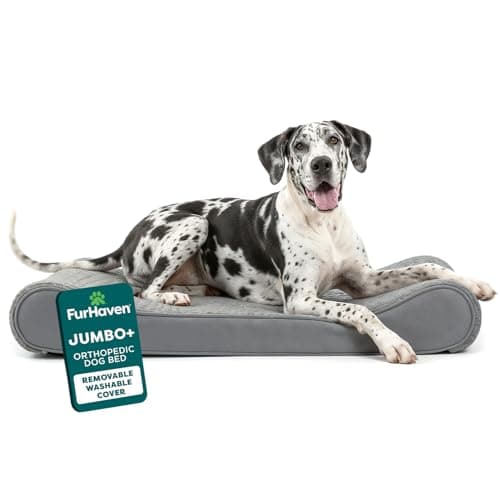
Furhaven
Furhaven Ultra Plush Luxe Lounger
Our score
$34.60
Best for
Budget-conscious owners of light and medium dogs, and nesting sleepers who like a low step-on entry
If Big Barker is out of budget, this is the bed we recommend for a dog under about 50 lb — solid orthopedic foam, a low step-on entry, and a washable cover at a price that is a tenth of the premium picks. Its foam is budget-density and it will mat down; the honest way to own one is to expect that, test it with your fist monthly, and spend $25.99 (Large) on a replacement core when it fails rather than pretending it won't. Under a heavy dog, buy depth and density once instead.
Pros
- The cheapest genuinely solid-foam orthopedic bed we track — $34.60 for the Large on Amazon and $34.99 base price direct from Furhaven, re-checked 2026-09-06
- Replacement foam cores are sold as spare parts priced by size — $13.99 Small to $69.99 Giant, $25.99 for the Large we link (verified against Furhaven's variant feed 2026-08-13) — so the bed's one predictable failure, the foam matting down, costs $25.99 to fix on this size rather than a whole new bed. The $13.99 figure is the Small's core and we have quoted it here as though it were this bed's; corrected 2026-09-06
- Contoured step-on lounger shape with no wall to climb — the low entry is a real feature for a stiff dog, and the contour supports a dog who sleeps with his head posted on an edge
- Removable, machine-washable cover with CertiPUR-US certified foam core
- Five sizes, Medium through Giant, in three core types (orthopedic foam, memory foam top, cooling gel top)
Cons
- Budget-density foam. Reviewers report cores matting down flat inside 18 months under bigger dogs, and the 10-year no-flatten warranties on premium beds exist precisely because this failure mode is real — plan on replacing the core (a $25.99 spare for the Large) on a schedule, not on faith
- Thinner in the middle than the photos suggest — reviewers measuring the foam report roughly 4.5 inches at the center against taller contoured edges, and "much thinner than what the pictures show" is a recurring complaint
- Furhaven rates sizes far above what this foam supports. The Jumbo Plus listing claims dogs up to 150 lb and the Large claims up to 38 lb; at this foam density we would not put a dog anywhere near 150 lb on it long term, and we treat the Large's 38 lb as the honest ceiling for the Large
- Cover fit is loose on some sizes per reviews, and the faux-fur top pills with washing
- The Amazon listing's fourth bullet opens "True Orthopedic Support: Stop buying beds that flatten" (read 2026-09-15), and nothing on Furhaven's own warranty page backs that sentence: the 90-day warranty covers fabric, sewing, gluing, stapling and zipper defects only, excludes "damage inflicted on products by animals", and there is no flatten term, threshold or remedy anywhere. Read the bullet as copy, not as a promise
- Amazon availability moves by size. The Jumbo Plus ASIN (B07PYYJV11) went from "15 left" on 2026-08-18 to "Currently unavailable" on 2026-08-28 and was still dead on 2026-09-06, so our link now goes to the Large (B073PZHJZY, 36 × 24 × 5.5 in, rated to 38 lb, $34.60, sold by Amazon). That is a smaller bed than the one this page used to point at — check the size selector against your dog before you check out. Furhaven's own site still sells the whole line direct ($34.99–$180.99 across sizes when we checked 2026-08-22)
The budget line and the widest size run in the pool: the Jumbo Plus is 51 × 36 × 8 inches, and the listing claims dogs up to 150 lb.[5] Treat that number with suspicion — our working ceiling is about 50 lb, from reviewers reporting cores matting flat inside 18 months under bigger dogs. The budget-density foam is the trade-off, so plan on swapping the replacement core Furhaven sells ($13.99 Small up to $69.99 Giant — $25.99 for a Large, verified August 2026; not the flat $13.99 we previously printed) rather than trusting it, and don't put a heavy dog on it long term. Two more sizing traps specific to this bed: the height figures include the contoured bolster rather than the sleeping surface, so a bed listed at 8 inches is a raised rim around a thinner middle; and the price changes with colour as well as size on this line, sometimes by tens of dollars for identical foam, so price every colourway before you buy.

Casper
Casper Dog Bed
Our score
$139–$249
Best for
Owners who want the polished Casper aesthetic in a dog bed
Buy this if you've already had a Casper mattress and want a coordinated piece of furniture, not a clinical orthopedic bed. The foam is honestly described and the look is excellent. It is not the right bed if your dog has diagnosed joint disease — not because the foam is bad, but because the sleeping surface inside the bolsters is small and shallow, and because a one-year limited warranty with no flattening threshold is the weakest promise in a category where the good beds guarantee a measurable number of inches for a decade.
Pros
- Two-layer foam construction Casper publishes in plain terms — "Visco Elastic Memory Foam and Polyurethane Support Foam" — rather than the unnamed "high-density foam" most of the category hides behind
- Foam bolsters on three sides, so a dog who sleeps with his head posted on something has somewhere to put it
- Removable microfiber cover, machine washable cold, tumble dry low
- Looks like furniture, not a pet bed
- Amazon has matched or beaten the direct price every time we have checked — exact parity at $169 on 14 August 2026, then $152.10 on Amazon against $169 direct on 21 August. Either way, no channel penalty
Cons
- The bed is 6 inches thick but the dog does not sleep on 6 inches. The usable flat area is the "inner sleep area" inside the bolsters, and on the Medium that is 25 × 17 inches of foam — a footprint smaller than many 40 lb dogs
- Casper's own two sales channels disagree about how deep that sleep area is. Casper.com says 3.5 inches for every size; the Amazon listing's feature bullet says 2 inches for the same Medium. We are not picking one for them
- No foam density figure is published anywhere — not on Casper.com, not on the listing. Density is what predicts whether a bed flattens, and it is the one number this category has quietly agreed not to disclose
- One year of warranty, and Casper's term for it is "Limited." Purpose-built orthopedic brands write ten- and twenty-year foam-flattening warranties with a stated threshold in inches
- Premium for the design rather than the foam
Sized and styled like furniture, and this is the one place on the page where the size label is actively misleading. The Medium is listed at 25 × 33 × 6 inches, but its own listing gives the inner sleep area as 25 × 17 × 2 inches.[3] Measure that against this chart's own floors and it does not clear the bar for any dog over 25 pounds — which is most of the dogs a "Medium" label attracts. Fine for a healthy small dog in a design-first home. For post-surgical or arthritic dogs, use the after-surgery guide instead — firmness requirements change the answer, and so does entry height.
The bottom line#
Measure nose to base of tail during a stretched-out nap, add 8–12 inches each way, and compare that number to the sleeping surface — not the outer footprint, not the size label, and not the maker's weight rating. Hold the foam to the same floor every time: 2 inches under 25 pounds, 3 inches from 25 to 40, 4 inches from 40 to 80, 5–7 inches past 80. On density we would like 1.8 lb/cu ft or better in the support layer, and you should know that essentially no dog-bed maker publishes the figure, so it is a standard you cannot currently shop by.
Why bother with foam depth at all, given that? Because of where a lying dog's weight actually concentrates. When pressure was measured under laterally recumbent dogs across four support surfaces, the same three sites came up every time — the shoulder joint, the greater trochanter of the hip, and the thirteenth rib — and the thinnest dogs produced the highest peak pressures on every surface tested.[6] An old dog who has lost condition over a sore hip is that dog. Depth is the crude proxy the category gives you for keeping those three points off the floor.
And when the right size looks too big in the room, that's not a sign to size down. That's what correct looks like. An 80-pound Lab that can finally stretch flat without hanging off the edge — stiff elbows and all — will settle the argument for you the first night.
Sources#
- Amazon listing B07VBWN862, "PetFusion Extra Large Dog Bed w/ Solid 4" Memory Foam, Waterproof Liner, & YKK Premium Zippers, X-Large (44x34"), Sandstone." amazon.com — retrieved via the Amazon Creators API on 14 August 2026: $226.45, availability "Usually ships within 1 to 2 months," sold by Amazon.com; model PF-IBXL3; dimensions 44 × 34 × 10 in, 19.6 lb. Feature bullets: "Solid, supportive memory foam"; "Water-resistant removable and washable cover"; "Waterproof inner liner to protect memory foam." No foam density figure is published. This listing is what retires the "50 × 40 inches" figure this page carried in three places.
- Amazon listing B0GRBXBPXH, "Barker Beds Large Orthopedic Dog Bed — 7in Memory Foam Mattress — 50-70 lbs — 48x30x7 — Stormcloud Linen." amazon.com — retrieved via the Amazon Creators API on 14 August 2026: $249.95, In Stock, buy box held by Big Barker; dimensions 48 × 30 × 7 in, size Large. Feature bullet: "7 inches of orthopedic foam: Engineered with a 3-layer system including a 2" base layer, a 3" support layer, and a 2" top comfort layer." CertiPUR-US certified; 10-Year No-Flatten Warranty. No foam density figure is published.
- Amazon listing B07BMHVWQK, "Casper Dog Bed, Plush Memory Foam, Medium, Gray, 25.0"L x 33.0"W x 6.0"Th." amazon.com — retrieved via the Amazon Creators API on 14 August 2026: $169.00, In Stock, sold by Amazon.com; model 950-000058-002; listed dimensions 25 × 33 × 6 in. Feature bullet: "Pressure-relieving memory foam and durable support foam to create a bed that loves Fido back. Inner Sleep Area-25 x 17 x 2 inches." No foam density figure is published.
- Amazon listing B0BK2HQG18, "K9 Ballistics Tough Ripstop Orthopedic Crate Bed, 47 x 29, Obsidian Black." amazon.com — retrieved via the Amazon Creators API on 14 August 2026: $175.00, In Stock, buy box held by K9 Ballistics, Inc.; X-Large 47 × 29 × 4 in, sized for a 48-inch wire crate. This is the variant we link; the 60 × 42 figure this page previously carried describes no listing we have verified.
- Amazon listing B07PYYJV11, "Furhaven Orthopedic Dog Bed for Large Dogs… For Dogs Up to 150 lbs — Ultra Plush Faux Fur & Suede Luxe Lounger Contour Mattress — Gray, Jumbo Plus/XXL." amazon.com — retrieved via the Amazon Creators API on 14 August 2026: $64.99, "Only 14 left in stock," sold by Amazon.com; model 31635087; dimensions 51 × 36 × 8 in. Feature bullets describe a "solid orthopedic foam slab" and "solid, high-density memory foam" with no density figure given. The 150 lb claim is the manufacturer's; our working ceiling of roughly 50 lb comes from reviewer reports of cores matting flat inside 18 months, which is an owner-reported working figure rather than a measured standard.
- Caraty J, De Vreught L, Cachon T, Moissonnier P, Bongartz A, Viguier E, Carozzo C. "Comparison of the different supports used in veterinary medicine for pressure sore prevention." Journal of Small Animal Practice. 2019;60(10):623-630. doi:10.1111/jsap.13061 (PMID 31364781) — three cadaver dogs of differing body condition score in lateral recumbency across four supports, pressures measured over 4 hours with a TexiSense pressure mat; the scapulohumeral articulation, greater trochanter and thirteenth rib were the recurrent pressure-risk sites regardless of body condition or support used. Cadaver study measuring pressure-sore risk, not comfort or clinical outcome.
The weight bands, minimum sleeping-surface dimensions and minimum foam thicknesses in the chart above are our own thresholds, not a veterinary standard — no published standard for canine bed sizing or foam depth exists. The measure-and-add-8-to-12-inches method is likewise our own protocol. The dimensions, weight ratings and prices attributed to specific beds are all from the live listings cited above, read on 14 August 2026.
This article is educational and does not replace veterinary advice. A dog who has recently become slower to lie down or slower to rise needs examining before he needs a new bed.
Frequently asked
- What size orthopedic bed does a 70-pound dog need?
- Most dogs in the 50–90 pound range measure 32–40 inches from nose to base of tail stretched out, which means a bed at least 44 inches long with a minimum of 4 inches of foam — 5–7 inches once you pass 80 pounds. In our pool that's a Big Barker Large (48 × 30 × 7, and its listing states 50–70 lb), a PetFusion X-Large (44 × 34 × 10 over 4 inches of foam), or a Furhaven Jumbo. All three verified against their live listings on 14 August 2026. Measure your own dog first — the chart is the starting point, the tape measure is the answer.
- How do I measure my dog for an orthopedic bed?
- Measure nose to base of tail while your dog is sleeping stretched out — not standing, and not curled. Add 8–12 inches in each direction. That number is the minimum sleeping surface, so on a bolstered bed compare it against the flat interior area, not the outer footprint. If your dog lands between two sizes, buy the larger one.
- Can an orthopedic dog bed be too big?
- Functionally, almost never — dogs sleep well on oversized surfaces, and sprawlers use every inch. Too big only becomes a problem for small dogs with a strong nesting instinct that want walls to curl against, or when the bed physically won't fit the room or crate. Too small is the mistake with consequences: a senior forced to curl tightly all night wakes up stiffer.
- What size bed does a dog that sleeps curled up need?
- Curlers can usually size down one step from the chart — a 45-pound curler is often fine on a bed sized for the 25–50 pound band. Two exceptions: senior dogs should never be undersized, because tight curling aggravates stiff joints, and most dogs change position several times a night. When in doubt, buy the bigger size.
- What does a 38x46x6 dog bed search actually match?
- A 46 × 38 inch footprint with 6-inch foam sits at the large end of the market, and the honest answer is that nothing in our pool matches it exactly. The PetFusion X-Large is 44 × 34 × 10 inches over a solid 4-inch memory foam core — we printed '50 × 40' here for months and it was wrong, corrected 14 August 2026. If the 6-inch height is the part you care about, the Big Barker line runs 7 inches of foam and its Large is 48 × 30 × 7, so you gain height and length but lose 8 inches of width against your search.
- How thick does orthopedic foam actually need to be?
- Our own floors are at least 2 inches of foam under 25 pounds, 3 inches from 25 to 40, 4 inches from 40 to 80, and 5–7 inches past 80. Those are our thresholds, derived from the bottoming-out principle, not a veterinary standard — nobody has published one. On density, we hold beds to 1.8 lb/cu ft or better in the support layer, and here is the uncomfortable part: you almost certainly cannot check it. Of the beds on this page, not one publishes a foam density figure — Big Barker publishes its layer depths but no density, Furhaven and PetFusion and Casper say 'high-density' or 'supportive' with no number at all. Density predicts compression set, which is how a bed actually dies, and it is the one spec the category has quietly agreed not to disclose. Use thickness and the maker's stated weight rating, and treat any brand that does print a density number as having earned a point.