Condition guide
Hip Dysplasia in Dogs: Signs, Treatment, and Why to Ask for a PennHIP Number
An OFA grade and a PennHIP distraction index are not the same test — one sorts hips into seven categories, the other measures laxity as a number. What the disease is, how to catch it early, and what actually helps.

Hip dysplasia is one of the most common developmental orthopedic diseases in dogs: across the entire Orthopedic Foundation for Animals registry — 921,046 unique dogs — 15.56% were dysplastic, with working breeds carrying nearly twice the odds of hounds.[1] The good news is that most dogs do not need surgery. This guide walks through what's actually happening in the joint, what the evidence supports at each stage, and the equipment that makes daily life easier — with the honest ranking of which interventions are actually proven and which are mostly sold.
Affiliate disclosure: Dog Orthopedic is reader-supported. When you buy through links on our site we earn a commission at no extra cost to you — about 3% on most pet products, and the same rate on every product we compare, so no pick earns us more than another. Prescription medication earns us nothing, and seeing your vet earns us nothing; we recommend both anyway. Learn more.
Imagery: Lifestyle photographs on this site are licensed from Pexels (royalty-free) and credited per image. Pexels imagery illustrates conditions and contexts — it does not depict the specific dogs or test sessions described in the text. Product photographs come from Amazon's Creators API. Breed portraits are illustrations of typical breed type rather than photographs of individual dogs, and are not drawn to scale against one another.
What's actually happening in the joint#

Hip dysplasia starts as joint laxity in puppyhood: the ball of the femur does not sit tightly in the socket of the pelvis. Over months and years, the abnormal motion causes microscopic damage to the cartilage, which the body repairs with scar tissue and bone — i.e. osteoarthritis.
The timeline here is better documented than most owners are told, because one group of 48 Labradors was radiographed yearly from puppyhood until natural death. Two findings from that cohort are worth carrying around. First, the looseness shows up early and then stops changing: subluxation visible on a hip-extended radiograph appeared by two years of age and not afterwards.[2] Second, the arthritis shows up much later, and how late depends on how you feed the dog: a circumferential femoral head osteophyte — one of the earliest visible signs of the arthritis to come — appeared at a median age of 9 years in the diet-restricted dogs and 3 years in the ones fed freely.[3]
That gap — three years against nine, in dogs with the same genetics, on the same food, differing only in portion size — is the most important number on this page. The looseness is your dog's inheritance. The arthritis timetable is substantially yours.
Pain comes from two sources: the ongoing cartilage damage and the soft-tissue inflammation around an unstable joint. This matters because it tells you what the treatment options actually do — they target one or both of those mechanisms.
Diagnosis#
The definitive test is a hip radiograph (X-ray) read by a veterinary radiologist. Two grading systems are common in the U.S., and they do not measure the same thing — which is the part almost nobody explains.
- OFA (Orthopedic Foundation for Animals) — seven categories: Excellent, Good, Fair (all within normal limits), Borderline, then Mild, Moderate or Severe. It is a subjective read of a hip-extended radiograph. OFA offers preliminary screening for dogs between 4 and 23 months of age.[4]
- PennHIP — measures joint laxity as a number, the distraction index, from a distraction radiograph taken under sedation.
Here is why the distinction matters to you rather than to a breeder. When 439 dogs were screened both ways, 80% of the dogs OFA rated fair, good or excellent had a distraction index of 0.30 or higher — the threshold above which dogs are considered susceptible to osteoarthritis. Among dogs graded excellent, 52% were above it.[5] A hip-extended film graded normal is not a clean bill of health; it is one instrument, read subjectively, missing a lot of laxity.
The lifetime Labrador cohort makes the same point from the other end: 55% of dogs graded normal at two years old were radiographically dysplastic by the end of life, and 92% of those "normal" dogs had osteoarthritis on post-mortem examination.[2]
The honest caveat in the other direction. A high distraction index does not sentence a dog to arthritis. In 399 Pembroke Welsh Corgis, every single dog had a distraction index above 0.30, with a mean of 0.66 — and only 6.8% had osteoarthritis.[6] Laxity is a risk factor, breed-dependent, not a diagnosis. If a number frightens you, that Corgi study is the reason to ask your vet what it means for your breed before you spiral.
One more thing worth knowing if you are reading breed statistics anywhere: published prevalence figures from voluntary registries are biased downward, because owners of dogs with bad films often decline to submit them. When researchers screened 200 clinically normal Golden Retrievers and 140 Rottweilers themselves rather than waiting for submissions, they documented exactly that submission bias.[7] The real rates in high-risk breeds are higher than the registry says.
If you have a high-risk breed (Labrador, Golden, Shepherd, Pyrenees, Saint Bernard, Newfoundland, Bernese), screen — and ask about distraction-index measurement rather than accepting a hip-extended view as the whole answer.
The medical-management toolkit#
Most dogs with mild-to-moderate dysplasia never need surgery. The pillars of medical management:
1. Weight management#
This is the intervention with the best evidence behind it, and the numbers are more encouraging than "get the weight off" suggests, because the threshold is low.
In an open trial of 14 obese dogs with radiographically confirmed osteoarthritis fed a restricted-calorie diet for 16 weeks, lameness scores fell significantly from 6.10% body-weight loss onward, with kinetic gait analysis confirming the improvement from 8.85% onward.[8] For an 80 lb retriever, 6.10% is under 5 lb. That is one biscuit a day for a season, not a transformation.
Two caveats we should raise ourselves: 14 dogs is a small trial, and it had no control group, so some of the improvement could be the passage of time or the owners' hope. The reason to believe it anyway is that a completely different study design points the same way. In the Purina lifetime study, 48 Labradors were paired with a littermate and one of each pair was fed 25% less for life. At eight years, radiographic osteoarthritis affecting multiple joints was significantly more common in the freely-fed dogs, with hip lesions in 15 of 22 control dogs.[9] The same cohort, followed to death, showed a significantly longer median life span in the food-restricted dogs and later onset of chronic disease.[10] The hip-specific analysis of that cohort is published separately.[11]
And the effect is visible at population scale. In 114,568 young adult dogs of 72 breeds screened by the Swedish Kennel Club, higher body weight within a breed was associated with a more severe hip dysplasia grade, significantly so in 13 of the 21 breeds analysed.[12]
Body condition score 4–5 on the standard 9-point scale. Ribs palpable but not visible. Visible waist from above.
2. Joint supplementation — with the evidence stated plainly#
This section used to tell you to start here. It was wrong, and correcting it costs us money, so read the correction rather than our old sentence.
Glucosamine and chondroitin have now failed twice under objective measurement. In a blinded, placebo-controlled trial of 75 dogs with hip osteoarthritis measured on a force plate, the glucosamine and chondroitin arm did not separate from placebo at four or six weeks, while green-lipped mussel lipid extracts and carprofen both did.[13] An independent group at a different institution ran 30 dogs against 30 placebo dogs for 97 days with continuous activity monitors and found no difference in daily activity counts — while owner-reported pain scores improved equally in both arms.[14]
That last clause is the whole problem with this category. The same research group measured how often owners judge their own dog's lameness to have improved when the dog is on a placebo, with a force plate running alongside them: 39.7% of the time.[15] Veterinarians examining the same dogs did it 43–45% of the time. Nobody is lying. You are reading a dog you love and hoping.
The fair defences, which we should raise because they are real. The force-plate trial had 15 dogs per arm and was powered to detect the mussel-extract effect, not to exclude a smaller glucosamine one. It ran roughly a maintenance dose for all six weeks — nobody has run the trial at the loading dose the labels prescribe. And in that trial the subjective orthopedic scores did not move in any group, including the carprofen group the force plate showed working.
So: a joint supplement is a reasonable thing to try, cheap relative to everything else here, and safe. It is not the foundation of the plan, and if you have limited money and attention this month, weight and omega-3 come first.

Nutramax
Cosequin Plus MSM & HA Joint Health Supplement (Chewable Tablets)
Our score
$25–$63
Best for
First-line joint supplementation for dogs of any size
If you're going to put a dog on one supplement, this is still the one we'd start with: the FCHG49/TRH122 forms are the ones that have actually been put in trials rather than assumed into them, and the DS tablet delivers them at full strength for well under a dollar a day even in a large dog. Two honesty notes. The evidence for the whole category is modest and the caregiver placebo effect is not — so start it, give it six weeks, and judge it against something you measured before you began. And the listing's "#1 vet recommended brand" line is a marketing survey claim, not a clinical one; buy on the ingredient forms and the price per tablet, which you can verify.
Pros
- Contains FCHG49 glucosamine and TRH122 chondroitin — the specific patented forms that have actually been put in trials, rather than generic glucosamine. Corrected 31 August 2026: this line previously said "the patented forms used in published canine studies," which reads as support the record does not give. The positive placebo-controlled trial of these forms was in human knees (Das and Hammad 2000); the one blinded, placebo-controlled canine force-plate trial to test them — inside Dasuquin with MSM — found no significant advantage over placebo (Kampa 2023)
- The linked tablet adds 6 mg sodium hyaluronate (HA) per tablet over the classic Plus MSM formula. Corrected 19 August 2026: this line previously said it also added 3 mg of manganese. It does not — the classic Plus MSM tablet carries the same 3 mg of manganese ascorbate, re-verified on cosequin.com that day. HA is the only difference
- Maximum-strength (DS) dosing — 600 mg glucosamine per tablet
- Chewable tablet, palatable for most dogs
- Wide count range across the tablet line (60 to 250), so per-tablet price drops meaningfully if you buy the larger bottles
Cons
- Tablets are large; some small dogs need them split
- Slow onset — give it 4–6 weeks to evaluate effect
- A big dog eats through a small bottle fast: over 60 lb, the loading dose is 3 tablets a day, so the linked 75-count is 25 days of loading
- The linked 75-count with-HA variant costs more per tablet (~$0.33) than the plain-MSM 132-count (~$0.26) — the HA is 6 mg, and whether that is worth the premium is genuinely unclear
- Supplement effects in this category are small enough that the measured 39.7% caregiver placebo rate can swamp them — judge it against a measurement, not an impression
- Not vegan-friendly (chondroitin is animal-derived)
- Nutramax publishes no inactive-ingredient list on either tablet line's own product page (verified absent again on cosequin.com 31 August 2026). We previously printed the base here as brewers dried yeast, dextrose and natural & artificial flavors, sourced to retailer label reproductions; on 31 August 2026 we could not re-reach any retailer carrying that list (Chewy 429, Petco 403, Drugs.com 403), so treat it as unverified. The checkable finding stands and is the one that matters: the base is not published, and a base you cannot read cannot be cleared for a dog on a strict elimination diet

Nutramax
Dasuquin with MSM Soft Chews
Our score
$50–$135
Best for
Step-up from Cosequin for dogs with diagnosed osteoarthritis or post-surgical recovery
The joint supplement to buy when you have decided to buy one and the dog has real, diagnosed osteoarthritis. The ASU component is what separates it from Cosequin and the only reason to pay the premium, and the honest framing is that the supporting evidence is strongest in the laboratory and weakest in blinded canine trials — which is true of the entire category. Buy one product, run it properly for 4–6 weeks, and judge the result against something you measured before you started. Score lowered 9.2 to 8.8 on 2026-08-13: the product has not changed, but we read the trial that tested it by name and found it did not separate from placebo on a force plate, and a second blinded trial by a different group using activity monitors reached the same answer. It stays a defensible first purchase because it is inexpensive, well tolerated and unusually well disclosed. It is no longer a product we can describe as well evidenced.
Pros
- Adds ASU (avocado/soybean unsaponifiables) to the glucosamine/chondroitin base — the ingredient that separates it from Cosequin, with laboratory and animal-model evidence for cartilage protection
- Same FCHG49 glucosamine and TRH122 chondroitin as Cosequin
- Soft chew form factor most dogs eat as a treat
- Genuinely a veterinary-channel line, not just marketed as one — the Advanced tier is sold through clinics rather than retail. Note that the box's "#1 veterinarian recommended" rests on an unnamed survey. dasuquin.com's own footnote, read 2026-09-08, gives the source as a "survey conducted among small animal veterinarians who recommended animal supplements" — so the denominator is vets who already recommend a supplement, not vets. No sample size, date or sponsor is published
- Published per-chew analysis — you can see exactly what a chew contains, which most competitors do not publish to the same standard — including, unusually, an omega-3 line the equivalent chewable tablet does not carry
Cons
- 30–40% pricier than Cosequin DS
- Soft chews can stick together in heat
- Only meaningful upgrade if diagnosed OA — for healthy dogs Cosequin is enough
- The canine clinical evidence for ASU is thinner than the marketing: the strongest data is laboratory and animal-model work, not blinded trials in pet dogs. No joint supplement has evidence in the same class as an NSAID
- This exact product was the glucosamine arm of a blinded, placebo-controlled force-plate trial and it did not separate from placebo. Kampa et al. 2023 (Front Vet Sci, DOI 10.3389/fvets.2023.1033188) names "DASUQUIN with MSM Soft Chews, Nutramax" and reports a week-4 change in peak vertical force of −0.05 against placebo's +0.08, while two green-lipped mussel lipid extracts and carprofen all improved significantly. Two fair caveats: small arms — 16 dogs in the glucosamine group, 14 to 15 in the others — and the trial ran maintenance dosing (about 30 mg/kg) through the window this label says to double.
- Contains no manganese, unlike both of its Nutramax siblings — Cosequin prints 3 mg per tablet and Dasuquin Advanced prints 3 mg per large-dog chew, while this tier has no manganese row on the panel and none in the other-ingredients list (all three panels read 19 August 2026). Whether that matters is genuinely unclear, since manganese's role here is a cofactor claim rather than a tested effect. We list it as a con because the maker sells it as an active in the tier above and the buyer of this tier is never told it is absent
- No calorie figure on the panel, on dasuquin.com or on the Amazon listing (verified absent 19 August 2026) — two chews a day is two treats a day for a dog whose weight is the strongest lever anyone has
If you do try one, give it 6–8 weeks before judging — and know that the return window on most of these is shorter than the loading period the label itself prescribes, so check that before you buy rather than after.
3. Omega-3 fatty acids#
Better evidence than glucosamine, and it is worth knowing exactly how much better.
Three randomised trials in the same programme. In 38 dogs measured by force plate, mean peak vertical force improved 5.6% in the fish-oil group against 0.4% in controls at 90 days, with 82% of the supplemented dogs improving against 38% of controls.[16] In a larger multicentre trial, 127 dogs across 18 private practices were fed a high-omega-3 food for six months.[17] And in 131 dogs across 33 hospitals, all standardised onto carprofen first, the omega-3 group's carprofen dosage could be reduced relative to controls.[18]
The caveat you will not find in supplement marketing: all three of those trials were run on a therapeutic food by the company that makes it, and the authors include its employees. That is not a reason to dismiss them — they are randomised and one used a force plate, which is the hard instrument — but it is a reason to weigh them as industry-funded. Dose by weight, and ask your vet, because fish oil at high doses affects clotting and interacts with other medications.
4. Low-impact exercise#
The instinct to "let the dog rest" is wrong, and there is a measurement that shows how fast rest costs you. In the placebo arm of a 100-dog trial of dogs recovering from knee surgery, thigh circumference fell 1.21 cm in the operated leg and 2.04 cm in the un-operated one over the first eight weeks of restricted activity.[19] The leg that had nothing wrong with it lost more muscle than the leg that had surgery. That is what enforced stillness does to a dog, and it is why "rest him" is the wrong instinct for a chronic hip.
The right answer is consistent low-impact activity: leashed walks on level ground (avoid stairs), swimming if available, gentle play. No fetch, no off-leash high-speed turns. Our how much walking an arthritic dog needs guide has the specifics, and muscle wasting in one back leg shows you how to measure the loss at home with a tape.
5. Orthopedic bedding#

Big Barker
Big Barker 7-inch Pillow Top
Our score
$250–$460
Best for
Large and giant breeds with hip, elbow, or arthritis pain
The bed every senior-large-breed owner eventually buys, and the one we still recommend first for a dog over about 80 lb — because seven inches of foam is the only thing that reliably keeps a heavy dog's hip off the floor plane overnight. (It is not one solid slab, as we used to say: the maker's own copy describes a 3-layer build, a 2" base under a 3" support layer under a 2" comfort top.) It is also the only bed in the category with a clinical study attached, and we would rather you knew what that study is: forty dogs, no control group, no blinding, and outcomes scored by the owners who had just been given a free bed. That is a reason to be interested, not a reason to be convinced. Buy on the foam depth and the ten-year warranty, which are facts. On where to buy: the price is the same either way, so buy direct for the 180-night sleep trial, which Amazon's return window does not match. The two editions both sell on both channels at identical prices, re-verified 6 September 2026 — flat Large $249.95, Headrest Large $289.95. We have published two wrong things about this in the past, a $40 Amazon markup and a direct-only cheap edition; both are retired, and the honest version is that the channel decides your trial, not your price.
Pros
- Seven inches of foam — a 3-layer build (2" base, 3" support, 2" top comfort) deep enough that a 100 lb dog's hip does not reach the floor plane, which is the whole job
- 10-year warranty — foam must retain at least 90% of its original shape and support, or it is replaced
- The only bed in the category with a published clinical study behind it, even though that study is a single-arm pilot
- Made in the USA
- Microfiber cover unzips and machine-washes
Cons
- Premium price
- Editions, not channels, are what the price difference is. Both are on Amazon and both are on bigbarker.com at identical prices, re-verified 2026-09-06: the flat headrest-free Large is $249.95 (B0GRBXBPXH) and the Headrest Large is $289.95 (B0GRBX5TBL), both In Stock with the buy box held by Big Barker itself, both matching the maker's own site. We previously misread this as a $40 Amazon markup, and then as the cheap edition being direct-only. Both claims are retired
- Bulky — measure your space, not just your dog
- Cover-only style isn't bolstered (consider Sofa edition for nesters)
- The clinical study everyone cites is open-label, single-arm, and owner-scored, with no control group
A lying dog does not spread its weight evenly. When pressure was mapped across four support surfaces, the recurrent pressure-risk points were the shoulder joint, the greater trochanter of the hip, and the thirteenth rib — and the thinnest dogs, with least muscle padding those points, produced the highest peak pressures on every surface tested.[20] The greater trochanter is the bony point of the hip. A dysplastic, muscle-wasted senior is precisely the dog that study describes.
Now the part we previously overstated. This page used to tell you the Big Barker was "the only bed with a published canine clinical trial showing measurable joint-score improvement." The study is real. That sentence oversold it, and the document says so itself. Its own Study Design section reads: "This clinical trial was a single center, open-label, proof of concept study." Forty dogs over three years old and over seventy pounds, osteoarthritis confirmed by a radiologist at Penn's Ryan Small Animal Hospital, 38 days enrolled with day 28 the primary endpoint — no control group, no blinding, and the assessment tools "were completed by the owners weekly."[21] It has not been published in a peer-reviewed journal.
Set that design against the 39.7% caregiver placebo rate measured in this exact population[15] and an unblinded owner-scored trial cannot separate the foam from the hope.
There is one more detail in that report worth a paragraph, because it is checkable in a single click and nobody quotes it. The Data Summary sets its own significance level at α = 0.02. It then states that "the remainder of the statistical tests did not result in rejections of the null hypotheses" — with one exception, Pacing, reported at 83% improvement with a z-statistic of 1.999 and a p-value of 0.0456, "which is statistically significant at the α = 0.05 significance level."[21] That is the report moving its own goalposts, in its own words, for one result out of many.
None of this means the bed does nothing. Seven inches of foam under a 90 lb dog is a physical fact, and so is a ten-year no-flatten warranty. Buy it for those. Do not buy it for the percentages.
Before you spend anything: press your existing bed hard with your fist where the hip lands. If your knuckles reach the floor, so does the hip — and if they don't, you don't need a new bed this month.
When to consider surgery#
Surgery is on the table when:
- Pain is not controlled with medical management.
- Quality of life is meaningfully impaired (won't walk, can't navigate the house).
- Your dog is young (under 8) and the long-term trajectory is bad.
Three procedures are common:
- FHO (femoral head ostectomy). Removes the femoral head; the body forms a fibrous "false joint." Less expensive than THR and widely available. The largest long-term series — 132 dogs and 51 cats, re-examined an average of four years later — rated function good in 38%, satisfactory in 20%, and poor in 42%, while 96% of owners were satisfied. Gait analysis in that series found the pain relief came at the cost of functional deficits in small breeds as well as large ones, deficits that simply were not visible to the eye at speed.[22] We used to write that FHO outcomes are "best in smaller dogs." That series does not support it. Our FHO surgery recovery timeline covers the recovery, which is unlike any other orthopedic surgery — controlled movement from the first days rather than weeks of crate rest.
- Total hip replacement (THR). Prosthetic, and the best mechanical result available for a large dog. We have removed the "95%+ success rate" this page used to carry, because we could not find a source for it. What is published is complication data: in 255 consecutive cementless procedures, stem-related complications ran 8.6% intraoperatively and 2% early postoperatively,[23] and in a separate series of 177 procedures the overall intra- and postoperative complication rate was 13.6%.[24] Most dogs do very well. "Most" is the honest word, not "95%."
- TPO / DPO (triple or double pelvic osteotomy). Reposition the pelvis to correct underlying laxity, in young dogs without significant arthritis yet. A related early procedure, juvenile pubic symphysiodesis, has been compared against conservative management in 217 puppies assessed at 14–22 weeks: 43.2% of the treated puppies showed regression or lack of progression of dysplasia.[25] The window for all of these closes early, which is the practical argument for screening a high-risk puppy rather than waiting.
Your surgeon will guide the choice. We recommend a board-certified surgeon (DACVS) for any of these, and our list of questions to ask a veterinary orthopedic surgeon is written for exactly this appointment.
The mobility tools that help every dysplasia case#


PetSafe
Solvit Deluxe Telescoping Pet Ramp
Our score
$99–$160
Best for
Loading large dogs into SUVs and pickup beds
The most capable vehicle ramp we recommend, and the one to buy for a large dog and a high sill: 72 inches fully extended gets you to about 24.6 degrees at a 30-inch SUV cargo floor, and it is rated to 400 lb, which is more than any other PetSafe ramp we can find and 200 lb more than the Pet Gear tri-fold. Use it fully extended every time — the adjustability that makes it fit any car is also the easiest way to accidentally give your dog a 50-degree slide. Two honest deductions since July: the warranty is one year rather than the five we had printed, and the manufacturer's guide rules out the thing many owners instinctively do, which is walk up the ramp alongside a hesitant dog. For a dog who has already refused a ramp, the wider carpet-treaded tri-fold is the better first attempt.
Pros
- Extends from 39 to 72 inches — works for SUV, pickup, and tall sedan
- Rated to 400 lb — re-verified 14 August 2026 on PetSafe's live Canadian product page (SKU PTV17-16898); the highest rating of any PetSafe ramp
- High-traction surface holds up in rain
- At 14.7 lb it is the lightest capable vehicle ramp we recommend — the Pet Gear 71-inch weighs 25 lb
- Folds and stows under most rear seats
Cons
- The manufacturer's warranty is 1 year, not the 5 we printed here until 12 August 2026 — see the correction below
- Listed at 14.7 lb — light for what it is, but still awkward to carry one-handed with a dog on a lead
- PVC surface gets hot in direct summer sun
- Long footprint when fully extended; needs clear approach space
- Adjustable length means whoever deploys it sets the angle. Collapsed to 39 inches it is a 31-degree incline to a 20-inch bed and 50 degrees to a 30-inch SUV floor — a hidden cause of a dog refusing a ramp he used happily before
- Narrower than the 19.5-inch Pet Gear tri-fold, and PVC is harsher underfoot than carpet tread for a nail-scraping senior
- The manufacturer's own guide says the ramp is not intended to carry humans and that doing so voids the warranty — so you cannot walk up beside a dog who stalls halfway
- Sold under at least three names and four variants; the cheapest-looking PetSafe telescoping ramp is not the one to buy
- As of 14 August 2026 this standard/Deluxe model no longer appears in PetSafe's US catalog — only the Compact and Extra-Long remain there, both rated 300 lb — so the Amazon listing may be last-generation stock
A vehicle ramp ends the worst single load on hip joints in daily life: the SUV jump-down. Dogs that have never used a ramp need a few sessions of leashed practice; once they get it they prefer the ramp.
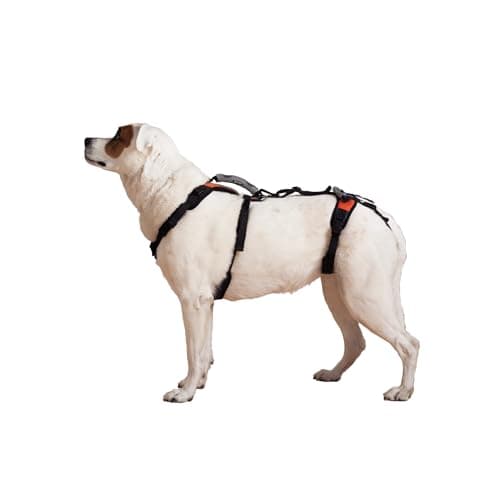
Help 'Em Up
Help 'Em Up Harness
Our score
$95–$155
Best for
Long-term mobility support for senior or post-surgical large dogs
If your dog needs help getting up multiple times a day for the foreseeable future — post-TPLO, advanced hip dysplasia, hindquarter weakness in giant-breed seniors — this is the one to buy. It is the only harness in the category that supports the front and the back independently, which is what a dog with a bad hip and a compensating shoulder actually needs. Buy it from the manufacturer, not from Amazon: re-verified 18 August 2026, helpemup.com prices by size at $80 / $95 / $110 / $125 / $140 while Amazon runs $95 / $110 / $125 / $140 / $155 — a uniform $15 more at every size, every time we have checked.
Pros
- Two-piece (chest + hip) design lets you support either end independently
- Hip handle is purpose-built — not a converted car-seat-belt strap
- Padded chest plate distributes weight better than sling-only options
- Five sizes span 10 to 225 lb, and the rear half can be ordered a size smaller for a dog with muscle wasting
- Two hip-lift styles (Conventional and U-Band) so male dogs are not soiling the strap
Cons
- Amazon runs a uniform $15 above the maker's own price at every one of the five sizes, and the Amazon buy box is held by a third-party reseller (Veterinary Preferred) rather than by the brand — re-verified 18 August 2026
- The maker's own Mix & Match page prints two different starting prices, "From $80" and "FROM $95 USD", on the same page
- Direct pricing is no longer flat: since mid-August 2026 the maker charges $80 to $140 by size, so a giant-breed owner now pays $60 more than a terrier owner
- On 29 August 2026 the linked Amazon Medium (B0DK81SCG5) showed a future availability date rather than units on hand, while every size and style was in stock at helpemup.com the same day; on 9 September and again on 12 September 2026 the Amazon Medium still showed the future-date status at $125.00 with a maximum order of one and no ship date given, while all nine direct variants were in stock — two weeks of backorder on the channel we earn from, and one more reason the direct channel is the one to use
- Sizing is critical — measure twice, return is a hassle
- Rear straps can chafe the inner thigh if the harness is left tight while the dog lies down
- A dog filmed or gait-assessed while wearing it looks less lame than he is, because the harness offloads the limb you are trying to judge
- Bulkier than a quick-grab sling for short-term use
For severe cases or post-surgical recovery, a two-piece harness with a hip handle is what saves your back and your dog's dignity on the ten assists a day nobody warns you about. We have removed the line claiming rehab vets "recommend it by name" — we have no survey or source for that, and it was doing sales work rather than information work. Buy it for the hip handle and the load spread; don't substitute a converted seatbelt strap, which concentrates force exactly where a dysplastic dog cannot take it.
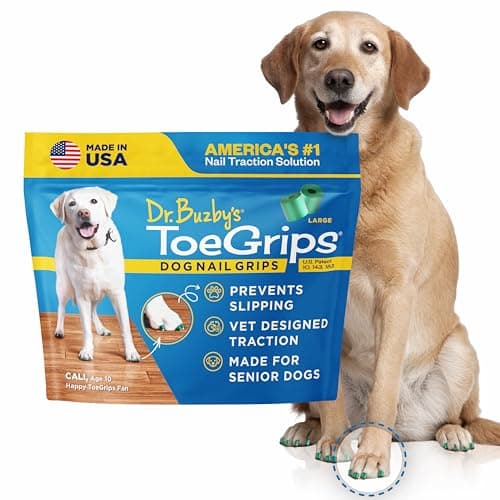
Dr. Buzby's
Dr. Buzby's ToeGrips for Dogs
Our score
$34–$40
Best for
Senior dogs slipping on hardwood, tile, or laminate floors
The best dog-mounted traction fix there is, and the one to buy once rugs have taken you as far as they can. Nothing touches the paw pad, which is why dogs tolerate these where they refuse socks and boots. Go in knowing the real cost: this is not a $40 purchase but a $240–$320 a year habit, so lay runners along your dog's actual routes first and buy grips for the floors you cannot cover.
Pros
- Veterinarian-developed; in clinical use for over a decade
- Slip onto each toenail — no socks, booties, or adhesives required
- Restores traction immediately, especially on hard floors
- Nothing touches the paw pad, so dogs accept them where they refuse boots
- Amazon and the manufacturer both charge $39.99 — no retailer markup
- 20 grips per bag against the 16 a dog wears, so a set includes four spares
Cons
- The only two published studies of nail grips both tested this exact product, and both were null: Roush 2017 (Front Vet Sci 4:111 — 15 sound dogs, kinetic changes "unlikely to be clinically relevant") and Repac 2022 (Animals 12(18):2312 — 30 dogs two weeks post-TPLO vs sham, no difference in weight bearing or limb function, including the owner question that asked specifically about slippery floors). Fair caveats: small samples, one used healthy dogs, the other a single early post-op timepoint — but "no positive trial exists" is the honest label, and we say it while still recommending the product for the mechanism and the owner-reported traction stories it was never tested against (verified 2026-08-14).
- A recurring cost, not a one-off. The maker publishes two different bag lives — "1–2 months" on its store page and "1-3 months, two months on average" in its FAQ (both read 2026-09-05) — which spans $160–$480 a year at $39.99. Plan on $240–$320, the two surfaces' central figures
- The Amazon listing markets specifically to dogs with "ACL injuries" — the one population where a randomised trial has been run, and where it found nothing (Repac 2022). The same bullets carry three claims with no source we could find: "more than 250,000 paws," "America's #1 nail traction solution," and "recommended by thousands of veterinarians worldwide" (listing copy verified 2026-08-17). Re-read 2026-08-31: a fourth unsourced superlative has been added to the top bullet on all four Amazon sizes — "The Only Toenail Grips for Dogs With GripZone Technology" — and the Large listing's title now leads with "Instant Traction on Wood/Hardwood Floors."
- The maker sells Scotch Super Glue Gel at $4.99 on its own store, listed as an "Alternate ToeGrips Application Method" (shop.toegrips.com, 2026-08-31). Read that as what it is: the company's own answer to the grips coming off, priced separately and not mentioned on the Amazon listing you are most likely to buy from.
- Application needs isopropyl rubbing alcohol, which is not in the box
- Initial application takes 15–20 minutes for a full set
- Some dogs chew them off in the first week
- Amazon carries only four of the seven sizes; XS, XXL and XXXL dogs have to buy direct
- Sizing by weight chart alone often misses — the accurate method needs dental floss and a ruler
If your dog is splaying out on hardwood, ToeGrips restore traction immediately. The cheapest, fastest improvement to daily comfort for an arthritic dog living with slick floors.
What we'd skip#
- "Hip and joint" treats with sub-therapeutic doses. Read the active ingredient mg per chew. The force-plate trial above ran glucosamine at roughly 30 mg per kg of body weight per day;[13] if the chew has 100 mg of glucosamine, a 32 kg dog is getting about a tenth of that. Our dosing by weight page does the arithmetic per brand.
- CBD as primary management. Don't replace NSAIDs with it. We have not done the citation work on canine CBD to a standard we would publish, so treat this line as our opinion rather than a sourced finding.
- Massage chairs / vibration platforms / "stim" devices. We found no canine clinical evidence. Save the money.
- Cold laser / PEMF at home. We are not able to point you at consumer-grade home-device evidence in dogs. Clinic-administered versions are a question for your vet, not for us.
When to escalate#
Call your vet (don't wait for the next routine appointment) if:
- Sudden non-weight-bearing lameness in either rear leg.
- Dog cannot rise from a down position despite assistance.
- Significant decrease in appetite combined with pain.
- Crying out when standing or moving.
Sudden severe lameness in a dysplastic dog can indicate a cruciate ligament rupture, an acute disc problem, or a fracture — and telling a limp apart from weakness is the first fork in that road, which our limping vs weakness guide walks through.
A claim we have removed from this page. We used to write that "the contralateral cruciate goes within 12 months in many dysplastic dogs because of compensation patterns." That conflated two different populations and we could not source it. The contralateral-rupture figures in the literature describe dogs that have already ruptured one cruciate, not dogs with hip dysplasia: in 831 medium-to-large dogs aged eight or older at their first cruciate rupture, 19.1% ruptured the other side, a median of 12.9 months later.[26] In a separate longitudinal study of 380 dogs, median survival of the second cruciate was 947 days.[27] We have no data at all on second-cruciate risk specifically in dysplastic dogs.
The bottom line#
Most dogs with hip dysplasia live full lives on medical management. But the interventions are not equal, and this page used to present them as if they were. Ranked by the strength of the evidence behind them, not by what is easiest to sell:
| Intervention | Best available evidence | Strength |
|---|---|---|
| Weight control | Lameness improved from 6.10% weight loss; 25% lifetime restriction delayed hip arthritis from a median of 3 years to 9 | Strongest — randomised paired-feeding cohort plus a clinical trial |
| Omega-3 fatty acids | Force-plate peak vertical force +5.6% vs +0.4%; carprofen dose reduced | Good — randomised, blinded, but industry-funded |
| Low-impact exercise | Disuse costs 1–2 cm of thigh circumference in eight weeks | Indirect — measured in surgical recovery, not in dysplasia |
| Orthopedic bedding | Hip pressure concentrates at the greater trochanter; the bed trial itself is open-label and owner-scored | Weak evidence, sound physics |
| Glucosamine / chondroitin | Did not separate from placebo on a force plate; no difference on activity monitors | Two negative trials, small arms |
If your dog has just been diagnosed: don't panic, and don't start by buying things. Weigh him this week. Ask your vet for a target and a body condition score. Those two acts have better evidence behind them than everything else on this page combined, and they cost nothing.
The dog you've had for ten years can still have ten more good ones. What shortens that is not the diagnosis — it is the eighteen months between when the joint started hurting and when somebody noticed. The delay is the injury.
Sources#
Every source below was opened and read on 14 August 2026. Where a claim on this page previously had no source and none could be found, the claim was cut and the removal is stated in the text rather than hidden.
- Loder RT, Todhunter RJ. "The Demographics of Canine Hip Dysplasia in the United States and Canada." Journal of Veterinary Medicine. 2017;2017:5723476. doi:10.1155/2017/5723476 (PMID 28386583) — entire OFA hip registry, 921,046 unique records; overall CHD prevalence 15.56%; odds higher in females (OR 1.05), spring (1.14) and winter (1.13) births, southern latitudes (2.12); AKC working group OR 1.882 vs hounds; FCI pinscher/molossoid group OR 4.168.
- Smith GK, Lawler DF, Biery DN, et al. "Chronology of hip dysplasia development in a cohort of 48 Labrador retrievers followed for life." Veterinary Surgery. 2012;41(1):20-33. doi:10.1111/j.1532-950X.2011.00935.x (PMID 23253036) — subluxation on hip-extended radiographs appeared by 2 years and not thereafter; 55% of dogs scored "normal" at 2 years were radiographically dysplastic by end of life; 92% of those had histopathologic osteoarthritis; distraction index predicted all 48 dogs susceptible.
- Szabo SD, Biery DN, Lawler DF, et al. "Evaluation of a circumferential femoral head osteophyte as an early indicator of osteoarthritis characteristic of canine hip dysplasia in dogs." JAVMA. 2007;231(6):889-892. doi:10.2460/javma.231.6.889 (PMID 17867972) — CFHO in 41/48 dogs at median 5.4 years; median 9 years in diet-restricted vs 3 years in control-fed dogs.
- Orthopedic Foundation for Animals. "Hip Dysplasia." ofa.org — read 14 August 2026: grades are "Excellent, Good, Fair (all within Normal limits), Borderline, and then Mild, Moderate, or Severe"; "For dogs that are between 4 months and 23 months of age, preliminary screenings are available."
- Powers MY, Karbe GT, Gregor TP, et al. "Evaluation of the relationship between Orthopedic Foundation for Animals' hip joint scores and PennHIP distraction index values in dogs." JAVMA. 2010;237(5):532-541. doi:10.2460/javma.237.5.532 (PMID 20807130) — 439 dogs screened both ways; 52% of OFA-excellent, 82% of OFA-good and 94% of OFA-fair hips had a distraction index ≥0.30; 80% of all fair-to-excellent hips were above the threshold.
- Karbe GT, Biery DN, Gregor TP, Giger U, Smith GK. "Radiographic hip joint phenotype of the Pembroke Welsh Corgi." Veterinary Surgery. 2012;41(1):34-41. doi:10.1111/j.1532-950X.2011.00938.x (PMID 23253037) — 399 Corgis, all with distraction index >0.30 (mean 0.66), yet only 6.8% had osteoarthritis.
- Paster ER, LaFond E, Biery DN, et al. "Estimates of prevalence of hip dysplasia in Golden Retrievers and Rottweilers and the influence of bias on published prevalence figures." JAVMA. 2005;226(3):387-392. doi:10.2460/javma.2005.226.387 (PMID 15702688) — 200 clinically normal Goldens and 140 Rottweilers screened prospectively; OFA submission rate of a separate group of 93 dogs measured directly to quantify submission bias.
- Marshall WG, Hazewinkel HA, Mullen D, De Meyer G, Baert K, Carmichael S. "The effect of weight loss on lameness in obese dogs with osteoarthritis." Veterinary Research Communications. 2010;34(3):241-253. doi:10.1007/s11259-010-9348-7 (PMID 20237844) — 14 obese client-owned dogs, open prospective trial, 16 weeks; significant lameness reduction from 6.10% body-weight loss onward, kinetic gait analysis supporting from 8.85%. No control group.
- Kealy RD, Lawler DF, Ballam JM, et al. "Evaluation of the effect of limited food consumption on radiographic evidence of osteoarthritis in dogs." JAVMA. 2000;217(11):1678-1680. doi:10.2460/javma.2000.217.1678 (PMID 11110459) — 48 Labradors paired by sex and weight within litters, randomised to control-fed or 25% limit-fed; at 8 years hip lesions in 15/22 control-fed dogs, multi-joint osteoarthritis significantly more common in control-fed group.
- Kealy RD, Lawler DF, Ballam JM, et al. "Effects of diet restriction on life span and age-related changes in dogs." JAVMA. 2002;220(9):1315-1320. doi:10.2460/javma.2002.220.1315 (PMID 11991408) — same cohort followed to death; median life span significantly longer in food-restricted dogs, onset of chronic disease generally delayed.
- Smith GK, Paster ER, Powers MY, et al. "Lifelong diet restriction and radiographic evidence of osteoarthritis of the hip joint in dogs." JAVMA. 2006;229(5):690-693. doi:10.2460/javma.229.5.690 (PMID 16948575) — the hip-specific analysis of the same 48-dog paired-feeding cohort, radiographs scored by a board-certified radiologist blinded to group.
- Andersson L, Engdahl K, Ringmark S, et al. "Association between body weight and hip dysplasia screening results in young adult dogs of different breeds in Sweden." Scientific Reports. 2026;16(1):17144. doi:10.1038/s41598-026-55816-y (PMID 42236888) — 114,568 young adult dogs, 72 breeds, Swedish Kennel Club screening 2007–2016 without preselection; higher within-breed body weight associated with more severe HD grade, significant in 13 of 21 breeds analysed.
- Kampa N, Kaenkangploo D, Jitpean S, et al. "Study of the effectiveness of glucosamine and chondroitin sulfate, marine based fatty acid compounds (PCSO-524 and EAB-277), and carprofen for the treatment of dogs with hip osteoarthritis: A prospective, block-randomized, double-blinded, placebo-controlled clinical trial." Frontiers in Veterinary Science. 2023;10:1033188. doi:10.3389/fvets.2023.1033188 (PMID 36816197) — 75 dogs, five arms of 15. At week 4 the glucosamine/chondroitin group's change in peak vertical force was −0.05 ± 6.34 against placebo 0.08 ± 1.90, while PCSO-524 (3.90), EAB-277 (4.17) and carprofen (3.08) were significant and significantly greater than both. Subjective orthopaedic scores did not change in any group, including carprofen. Funded by Pharmalink International Ltd, which owns the EAB-277 and Antinol trademarks; the senior author discloses paid consultancy for VetzPetz Asia. Dosing ~30 mg/kg/day.
- Scott RM, Evans R, Conzemius MG. "Efficacy of an oral nutraceutical for the treatment of canine osteoarthritis. A double-blind, randomized, placebo-controlled prospective clinical trial." VCOT. 2017;30(5):318-323. doi:10.3415/VCOT-17-02-0020 (PMID 28763523) — 30 dogs vs 30 placebo, 97 days, continuous activity monitors; no difference in daily activity counts between groups; owner-completed Canine Brief Pain Inventory improved in both.
- Conzemius MG, Evans RB. "Caregiver placebo effect for dogs with lameness from osteoarthritis." JAVMA. 2012;241(10):1314-1319. doi:10.2460/javma.241.10.1314 (PMID 23113523) — placebo arm of a prospective, randomised, double-blinded, placebo-controlled multicentre trial, 58 dogs, force platform running alongside; owners judged lameness improved 39.7% of the time, veterinarians 43.1–44.8%.
- Roush JK, Cross AR, Renberg WC, et al. "Evaluation of the effects of dietary supplementation with fish oil omega-3 fatty acids on weight bearing in dogs with osteoarthritis." JAVMA. 2010;236(1):67-73. doi:10.2460/javma.236.1.67 (PMID 20043801) — 38 client-owned dogs, randomised and blinded, force-plate analysis; mean peak vertical force change day 0 to 90 of 5.6% (test food) vs 0.4% (control); improvement in 82% vs 38% of dogs.
- Roush JK, Dodd CE, Fritsch DA, et al. "Multicenter veterinary practice assessment of the effects of omega-3 fatty acids on osteoarthritis in dogs." JAVMA. 2010;236(1):59-66. doi:10.2460/javma.236.1.59 (PMID 20043800) — 127 client-owned dogs, 18 private practices, randomised double-blinded controlled, 6 months.
- Fritsch DA, Allen TA, Dodd CE, et al. "A multicenter study of the effect of dietary supplementation with fish oil omega-3 fatty acids on carprofen dosage in dogs with osteoarthritis." JAVMA. 2010;236(5):535-539. doi:10.2460/javma.236.5.535 (PMID 20187817) — 131 client-owned dogs, 33 hospitals, all standardised to ~4.4 mg/kg/day carprofen before randomisation. Studies 16–18 evaluate a commercial therapeutic food and include employees of its manufacturer among the authors.
- White DA, Harkin KR, Roush JK, Renberg WC, Biller D. "Fortetropin inhibits disuse muscle atrophy in dogs after tibial plateau leveling osteotomy." PLoS ONE. 2020;15(4):e0231306. doi:10.1371/journal.pone.0231306 — 100 client-owned dogs, prospective randomised double-blinded placebo-controlled; placebo group lost 1.21 cm of thigh circumference in the operated limb and 2.04 cm in the unaffected limb from week 0 to 8. Funded by the manufacturer, MYOS RENS Technology Inc. The paper does not report a statistical test of the difference between the two limbs.
- Caraty J, De Vreught L, Cachon T, et al. "Comparison of the different supports used in veterinary medicine for pressure sore prevention." Journal of Small Animal Practice. 2019;60(10):623-630. doi:10.1111/jsap.13061 (PMID 31364781) — cadaver dogs of differing body condition scores in lateral recumbency across four supports, pressures mapped over 4 hours; recurrent risk zones at the scapulohumeral articulation, greater trochanter and thirteenth rib.
- Mengel GA (principal investigator). A Pilot Study to Evaluate the Big Barker Therapeutic Mattress in Dogs with Osteoarthritis — Final Study Report Summary. University of Pennsylvania School of Veterinary Medicine, Veterinary Clinical Investigations Center. Full report PDF, read in full 14 August 2026. Study Design section verbatim: "This clinical trial was a single center, open-label, proof of concept study." Dogs >3 years and >70 lb, osteoarthritis confirmed by a veterinary radiologist at the Ryan Small Animal Hospital; enrolled 38 days (10 days prior to randomization, 28 days following), day 28 the primary endpoint; assessment tools (COI, CBPI, CSAS, GAC, LOI) "were completed by the owners weekly." Results reported for 40 dogs in an "open label single arm study." Improvements to mean score: Pain 19.9%, Pain Severity 21.6%, Pain Interference 14.3%, Joint Stiffness 12.5%, Joint Function 17.6%, Gait 9.6%, Quality of Life 15.1%. Accelerometer: 50% of dogs had at least a 13% decrease in night-time activity, 25% at least 33%. Significance level set at α = 0.02; "The remainder of the statistical tests did not result in rejections of the null hypotheses," with the exception of Pacing (83% improvement, z = 1.999, p = 0.0456) reported as significant "at the α = 0.05 significance level." Statistics performed by an independent statistician unaffiliated with Big Barker or the University of Pennsylvania. Not a peer-reviewed journal publication.
- Off W, Matis U. "Excision arthroplasty of the hip joint in dogs and cats." VCOT. 2010;23(5):297-305. doi:10.1055/s-0037-1617478 (PMID 20945541) — 132 dogs and 51 cats operated 1978–1989 at Ludwig-Maximilians University, Munich; 81 (44%) re-examined at an average of four years, gait analysis in 17. Function good 38%, satisfactory 20%, poor 42%; 96% of owners satisfied; kinetic and kinematic deficits in small as well as large breeds, not visible during rapid movement.
- Kokkinos P, Parsons K, Belch A, Barthelemy N. "The influence of age at total hip replacement on perioperative complications associated with a press-fit cementless stem with lateral bolt in dogs." Veterinary Surgery. 2025;54(4):581-593. doi:10.1111/vsu.14203 (PMID 39815446) — 197 client-owned dogs, 255 THRs; intraoperative stem complication rate 8.6%, early postoperative 2%.
- Low D, Treharne R, Rutherford S. "Subsidence of the BFX standard stem after canine total hip replacement: A case series of 177 consecutive procedures." Veterinary Surgery. 2026;55(6):763-770. doi:10.1111/vsu.70084 (PMID 41660743) — 177 procedures in 145 dogs; 24/177 (13.6%) intra- and postoperative complications, 11/177 (6.2%) stem-related.
- Vezzoni A, Dravelli G, Vezzoni L, et al. "Comparison of conservative management and juvenile pubic symphysiodesis in the early treatment of canine hip dysplasia." VCOT. 2008;21(3):267-279. doi:10.1055/s-0037-1617372 (PMID 18536855) — 217 puppies assessed at 14–22 weeks completed the study, 81 treated with JPS and 76 managed conservatively plus 60 normal-hip controls; 43.2% of the JPS group showed regression or lack of progression of dysplasia.
- Murphy CL, Niles J, Radasch RM. "The Prevalence and Risk Factors of Contralateral Cranial Cruciate Ligament Rupture in Medium-to-Large (≥15kg) Breed Dogs 8 Years of Age or Older." VCOT. 2024;37(1):8-12. doi:10.1055/s-0043-1771350 (PMID 37487534) — 831 client-owned dogs, median follow-up 112.7 months; 19.1% (159/831, 95% CI 16.6–22.0%) ruptured the contralateral cruciate at a median of 12.9 months.
- Muir P, Schwartz Z, Malek S, et al. "Contralateral cruciate survival in dogs with unilateral non-contact cranial cruciate ligament rupture." PLoS ONE. 2011;6(10):e25331. doi:10.1371/journal.pone.0025331 (PMID 21998650) — baseline population of 380 dogs; median contralateral cruciate survival 947 days; increasing tibial plateau angle shortened survival, increasing age at diagnosis lengthened it.
- Berg JA, Sævik BK, Trangerud C, Madsen P, Lingaas F. "Genetic analyses of lumbosacral transitional vertebra and hip dysplasia in nine dog breeds in Norway." Acta Veterinaria Scandinavica. 2025;67(1):25. doi:10.1186/s13028-025-00810-z (PMID 40420218) — heritability estimates for canine hip dysplasia 0.254–0.580 across nine breeds. Cited in the FAQ.
- Leighton EA, Holle D, Biery DN, et al. "Genetic improvement of hip-extended scores in 3 breeds of guide dogs using estimated breeding values." PLoS ONE. 2019;14(2):e0212544. doi:10.1371/journal.pone.0212544 (PMID 30794614) — 5,201 German Shepherd Dogs, 4,987 Labradors and 2,308 Golden Retrievers; heritability of the hip-extended score 0.76, 0.72 and 0.41, and of distraction index 0.60, 0.66 and 0.59. Cited in the FAQ.
This article is educational and does not replace veterinary advice. Diagnosis, medication and surgical decisions for your dog belong to your veterinarian or a board-certified veterinary surgeon. If your dog is suddenly non-weight-bearing, cannot rise, or is crying out, that is a same-day call, not a reading assignment.
Frequently asked
- Is hip dysplasia genetic or caused by injury?
- Largely genetic, and the size of that 'largely' has been measured. A 2025 Norwegian genetic analysis across nine breeds put the heritability of canine hip dysplasia at 0.254 to 0.580 — moderate to high — and a study of 12,496 guide dogs found heritability of 0.41 to 0.76 for the hip-extended score depending on breed. Hip dysplasia begins as joint laxity in puppyhood: the femoral head doesn't sit tightly in the socket, and the resulting abnormal motion leads to osteoarthritis over years. Large and working breeds carry the most risk — in the 921,046-record Orthopedic Foundation for Animals registry, working-group dogs had 1.88 times the odds of hip dysplasia compared with hounds. Diet and growth rate in puppyhood measurably change how that genetic predisposition plays out: in the Purina lifetime study, Labradors fed 25% less than their littermates developed hip arthritis later and less often. But you do not 'cause' hip dysplasia by letting your dog run.
- What are the early signs?
- The classic early signs: bunny-hopping when running (using both rear legs together instead of alternating), hesitation on stairs, shorter walks before tiring, difficulty rising from a down position. There is no published figure for how advanced the disease usually is when owners first notice a limp — we would like one and it does not exist — but there is a hard number for the screening question, and it is uncomfortable. In the 48-Labrador lifetime cohort, 55% of dogs graded 'normal' on hip-extended radiographs at two years of age were radiographically dysplastic by the end of life. A clean two-year film is much weaker reassurance than it sounds. If you have a high-risk breed, screen — but ask specifically about distraction-index (PennHIP) measurement rather than a hip-extended view alone.
- What's the surgery decision tree?
- Three main options. **Femoral head ostectomy (FHO)**: removes the femoral head, body forms a 'false joint' over time. It removes pain reliably; the largest long-term series, 132 dogs and 51 cats followed an average of four years, rated function poor in 42% while 96% of owners were satisfied — and gait analysis found deficits in small breeds as well as large ones, so 'FHO is fine for little dogs' is not what the data say. **Total hip replacement (THR)**: prosthetic, the best mechanical result for a large dog. Published complication rates in modern cementless series run around 8.6% intraoperative and 2% early postoperative for stem-related problems in one 255-procedure series, and 13.6% overall in another of 177. **Triple/double pelvic osteotomy (TPO/DPO)**: only for young dogs (<10 months) without arthritis yet. Your surgeon will recommend based on age, weight, and existing arthritis. We do not publish a price range for these; ask two practices for written estimates, because regional spread is wider than any number we could quote.
- Can my dog avoid surgery?
- Yes — many dogs with hip dysplasia live well into senior years on medical management alone. The pillars, ranked by how good the evidence actually is: weight management (best evidence by a distance — measurable lameness improvement from about 6% body-weight loss onward), omega-3 fatty acids (three randomised trials, including force-plate confirmation), NSAIDs as prescribed by your vet, low-impact exercise, and orthopedic bedding. Glucosamine and chondroitin sit lower than their shelf presence suggests: in a blinded force-plate trial they did not separate from placebo, and an independent activity-monitor trial found the same nothing.
- What's the prognosis?
- Variable, and honestly less predictable than most guides imply. Mild dysplasia caught early with weight management can mean a normal-length life with mild stiffness in old age. We have no published figure for how often untreated severe dysplasia becomes disabling by a given age, so we will not invent one. What is measured: in the Purina lifetime study, restricting food by 25% delayed the onset of hip osteoarthritis by years and lengthened median life span. Surgery has good outcomes when chosen appropriately — but the '95% success' figure repeated across the internet for total hip replacement has no source we could find, and we have removed it from this page.