Recovery guide
FHO Surgery Recovery in Dogs: A Realistic Timeline
Most dogs put weight on the leg within days of FHO surgery and reach function in three to four months — crate rest is what ruins it. The realistic timeline, and how serious an FHO really is.

FHO recovery is faster than most owners expect and slower than most owners are told. Your dog will likely touch the leg down within days, use it reliably somewhere between one and three months, and reach her functional plateau around three to four months, with symmetry still improving to about six. The thing that matters most is counterintuitive: after an FHO, the goal is controlled movement starting almost immediately, not rest. This is the one orthopedic surgery where confining your dog is how you get a bad result.
Affiliate disclosure: Dog Orthopedic is reader-supported. When you buy through links on our site we earn a commission at no extra cost to you — about 3% on most pet products, and the same rate on every product we compare, so no pick earns us more than another. Prescription medication earns us nothing, and seeing your vet earns us nothing; we recommend both anyway. Learn more.
Imagery: Lifestyle photographs on this site are licensed from Pexels (royalty-free) and credited per image. Pexels imagery illustrates conditions and contexts — it does not depict the specific dogs or test sessions described in the text. Product photographs come from Amazon's Creators API. Breed portraits are illustrations of typical breed type rather than photographs of individual dogs, and are not drawn to scale against one another.
What an FHO removes, and what grows back in its place#
A femoral head ostectomy — also written FHO, or femoral head and neck excision, FHNE — removes the ball at the top of the thigh bone and the narrow neck beneath it. Nothing is put in to replace it. No implant, no plate, no artificial socket.
What fills the space is your dog's own tissue. Over the following weeks the body lays down fibrous scar tissue between the cut femur and the empty socket, and that tissue becomes a false joint, a pseudarthrosis. It is not a hip. It is a padded, muscle-supported hinge that does most of a hip's job without the bone-on-bone grinding that was causing pain.
This is why FHO is called a salvage procedure. It does not repair the joint. It removes the joint, and with it the pain.
That mechanism explains almost everything else about the recovery. There is no osteotomy waiting to knit, no screws to work loose. The thing being built is soft tissue, and soft tissue organizes itself in response to being used.
Why FHO recovery is the opposite of TPLO recovery#
If you have been through a TPLO with another dog, or read about one, set those instructions aside. TPLO is a bone cut held together with a plate, and the eight weeks of strict restriction exist to protect that repair while the bone heals. Doing too much too soon is the main way a TPLO fails.
FHO has no such repair to protect. Leaving the leg unused does not make the false joint stronger. It makes it tighter, thinner, and more painful to move, while the surrounding muscle wastes at exactly the moment your dog needs it most.

In the clinical study with the most detailed protocol reporting, flexion and extension of the hip, stifle, and hock were performed 20 to 30 times, two to three times a day, beginning on the first postoperative day.[1] Not week three. Day one.
That does not mean letting your dog do whatever she wants. Controlled is doing as much work in that sentence as movement. It means short, slow, on-leash walks on surfaces with grip, gentle passive range-of-motion done by you, and no stairs, no jumping, no slick floors, and no off-leash bursts. Your surgeon will give you a specific protocol. Follow theirs over anything you read here, including this article, because they know what they found once they were inside the joint.
The realistic timeline#
The honest version of this timeline comes from two studies that measured rather than eyeballed. One followed 30 dogs weighing 2.5 to 34 kg through the early recovery.[1] The other put 27 dogs weighing roughly 12 to 39 kg on a force plate at 1, 2, 3, 4, 5, 6, 9, and 12 months.[2]
| Stage | When | What you should actually see |
|---|---|---|
| First weight-bearing | 1–25 days (best-managed group averaged ~1.8 days) | Toe-touching, then brief loading. Highly dependent on pain control. |
| Consistent use of the leg | 30–90 days (best-managed group ~33 days) | The leg is part of normal walking, though still favored. |
| Functional recovery | Median 3–4 months | Normal-looking gait at a walk and trot; muscle rebuilding. |
| Weight-bearing symmetry | ~6 months | Force-plate symmetry indices approach zero. |
| Measured plateau | 12 months | Operated limb carrying roughly 72–73% of body weight in peak vertical force, comparable to the other side. |
Two things to take from that table. The first is the spread. One to twenty-five days is an enormous range for the same operation, and the variable that moved it most was not the dog's size or age. The second is that the finish line is later than the milestone that makes you relax. Your dog will look recovered months before the measurements agree, which is exactly when owners quietly stop doing the rehab.

Pain control is what sets the clock#
This is the finding that should change what you do on Monday morning.
In that 30-dog study, the dogs were split by how their pain was managed. The group that received a combination of approaches — preoperative epidural morphine, ropivacaine injected at the ostectomy site during surgery, and postoperative tramadol alongside an anti-inflammatory — began bearing weight at an average of 1.8 days and were using the leg consistently at about 33 days. Across the full study population, first weight-bearing ranged out to 25 days and consistent use out to 90. The authors concluded that multimodal analgesia resulted in faster limb weight-bearing.[1]
The mechanism is not mysterious. A dog in pain will not put weight on the leg. A leg that is not used does not build the fibrous joint or the muscle around it. Undertreated pain in the first week does not just make that week worse, it slows the thing the whole surgery depends on.
Which gives you a specific, concrete question to ask before the operation, not after: what is the multimodal pain plan for the first two weeks, and what do I do if it is not enough? Do not accept a vague answer, and do not adjust medication on your own or add anything from the cupboard. Human anti-inflammatories are dangerous to dogs, and dosing is your veterinarian's decision. Your job is to report honestly and quickly when your dog is still hurting.
Does your dog's size decide the outcome?#
For decades the teaching was that FHO works well in dogs under about 20 kg and poorly above it. That belief is softening, and the reason is worth knowing if a surgeon has told you your dog is too big.
The 2025 force-plate study found satisfactory restoration of symmetrical weight-bearing in both its size groups, with operated limbs reaching roughly 72 to 73% of body weight in peak vertical force at twelve months in dogs both under and over 20 kg — a result the authors framed as challenging the recommendation to limit the procedure to smaller breeds. Counterintuitively, the heavier group reached functional recovery at a median of three months versus four in the lighter group.[2] Twenty-seven dogs is a small cohort and that particular reversal should be treated as a curiosity rather than a finding, but it does not support the idea that big dogs are doomed.
A 2018 study went looking for why large dogs sometimes do badly. Four dogs weighing 27 to 35 kg with long-term unsatisfactory outcomes were examined with CT. What the scans showed was not a weight problem. It was incomplete or excessive bone removal leaving unacceptable bone-on-bone contact, and the authors concluded that bone contact, which interrupts formation of a pseudarthrosis, is the main cause for poor outcome. They noted explicitly that the body-weight explanation for poorer results in large dogs remains unproven.[3]
The practical translation: for a large dog, who does the surgery matters more than what your dog weighs. It is a reasonable thing to ask how many your surgeon has performed, and a reasonable reason to ask for a referral to a board-certified surgeon. If a total hip replacement is affordable and appropriate, that is a genuinely different conversation with a different mechanical outcome — but FHO being the budget option does not make it the wrong one.
The part nobody tells you: comfortable is not the same as normal#
Here is the most useful number in the entire FHO literature, and it comes from the largest long-term series — 132 dogs and 51 cats operated on at a university clinic in Munich, re-examined an average of four years later with gait analysis and radiographs.
Functional results were rated good in 38%, satisfactory in 20%, and poor in 42%. And 96% of owners were satisfied with the outcome.[4]
Read those two figures together. They are not contradictory and neither one is wrong. FHO is very good at what owners care about — the dog stops hurting — and imperfect at what a force plate cares about. The same work found measurable deficits in small breeds as well as large ones, and, tellingly, that those deficits were not visible during rapid movement.
That last detail is the one to hold onto. Your dog will run across the yard looking completely sound, and the leg will still be doing less work than the other one. She will not tell you. She will simply distribute the load and get on with it, the way dogs do.
“Because your dog can't tell you how much pain he or she is in.”
This is not a reason to be discouraged about the surgery. It is a reason to keep doing the rehab after your dog looks fine, to keep her lean, and to keep an eye on the other hip and the lower back, which are now taking a share of the work for the rest of her life. A more recent multi-hospital review of 68 FHO cases found that dogs operated on for chronic hip disease and dogs operated on after acute trauma ended up with equivalent long-term disability and quality-of-life scores, despite arriving at surgery in very different states.[5] Where your dog started matters less than what happens afterward.
What actually helps at home, cheapest first#
Start with what you already own. A rolled bath towel passed under your dog's belly, held at both ends, is a perfectly good sling for the first few days of bathroom trips. Plenty of dogs never need anything else. Every rug and runner in the house should come out of the closet and go onto the slick floors, because a dog who slips once on a fresh FHO learns to stop trying with that leg, and that lesson is expensive to undo.
If the towel is not working — if your dog is large, if you have stairs to negotiate, or if your own back is the limiting factor — a purpose-built sling is the upgrade that earns its money.
#1 Pick

GingerLead
GingerLead Dog Support and Rehabilitation Harness
Our score
$32–$70
Best for
Short-term post-surgical assistance and rear-end weakness
The right tool for one specific job: a dog whose back end has failed while his front end is still working. In the first four to six weeks after hip or stifle surgery, or for a senior who can get his front paws onto the sill of a car but cannot follow through, it is faster to fit than a full harness and it costs less. It is not a general mobility aid — it does nothing for the front half of the dog, and the maker expects you to buy a chest harness separately for older dogs. Size it with the towel test before you order, because the 10-day return window is short for a product whose commonest failure is sizing. If your dog needs help at both ends, or will need help for more than a couple of months, buy the Help 'Em Up Harness instead — though note that is no longer a $10 decision: Help 'Em Up prices by size direct ($80 XS to $140 XL, re-verified 18 Aug 2026), so the medium-to-large dog this sling fits pays $110 or $125 there against $69.95 here.
Pros
- Single-piece sling — fast to put on for bathroom trips
- Cutout in the support pad clears male anatomy, so it can be left in position without soiling
- Integrated leash takes one accessory off your hands, and detaches if you don't want it
- Machine washable and dryable, which matters more than it sounds on a post-surgical dog
- No Amazon markup — $69.95 on Amazon and $69.95 direct from the manufacturer, re-verified 12 September 2026 (Amazon via the Creators API, direct from the Med/Lg product page)
- The maker sells reconditioned units — inspected, laundered and re-packaged, "Save up to 45%". We have never observed the reconditioned price itself, so treat this as arithmetic rather than a quote: 45% off the $69.95 Medium/Large is about $38 at the maximum discount, and less at anything below it. (Corrected 2026-09-05 — we previously printed "roughly $45", which was the Amazon behind-the-buy-box offer of $44.95 conflated with the direct discount.)
- Manufacturer publishes a free towel test that sizes the sling before you spend anything
- Credit where it is due: as of 1 September 2026 the Amazon listing carries "CHEST HARNESS NOT INCLUDED" in capitals in its first feature bullet and in the retail title. This was the single most commonly missed thing about the product and the maker now says it before you click buy
- Stay-on straps are included, which is what stops the sling sliding backwards on a dog with wasted hindquarters
Cons
- Rear-end only — not the right tool if a dog also needs front support
- Chest harness is not included, and the maker's own copy recommends clipping the leash to one for older dogs
- Only a 10-day clean return window; days 11–30 carry a $10 restocking fee and nothing is refunded after 30
- Long-term use can rub thighs without careful fitment
- Strap-end handles are less ergonomic than padded handles
- Sized by pad width and by the dog's sex, not by a simple size ladder — easy to order wrong
- The Amazon listing contradicts itself on the weight floor — one bullet says "FEMALE dogs over 45 lbs and MALE dogs over 60 lbs", another says "dogs weighing over 45 pounds" flat (both live 19 Aug 2026)
- On Amazon the cheaper of the maker's two offers on this ASIN is not the one in the buy box, so the default click costs $25 more — and as of 1 September 2026 that cheaper $44.95 offer is no longer straightforwardly buyable: the same merchant now returns it as AVAILABLE_DATE with an empty message (backorder), where on 19 August it showed 7 units in stock. Corrects our own earlier advice — opening the other-offers panel is still worth doing, but it may no longer save you anything today
The GingerLead is the right shape for this specific job: rear-end only, which is all an FHO dog needs, and fast enough to put on that you will actually use it at 6am. The integrated leash means one less thing in your hands. Its limitation is genuine, though — it supports the back end and nothing else, so if your dog also needs help at the front, or you are going to be lifting for months rather than weeks, the two-piece Help 'Em Up is the better buy. It is no longer the near-price upgrade it briefly was: the maker now prices by size, $80 X-Small up to $140 X-Large ($110 for the Medium most buyers need, checked 14 August 2026), against the GingerLead's $69.95 — so the two-piece design costs real extra money, and earns it only if the front end needs holding too. Sling straps can also rub the inner thighs on a thin dog; check the skin daily for the first week.
#2 Pick
Dr. Buzby's
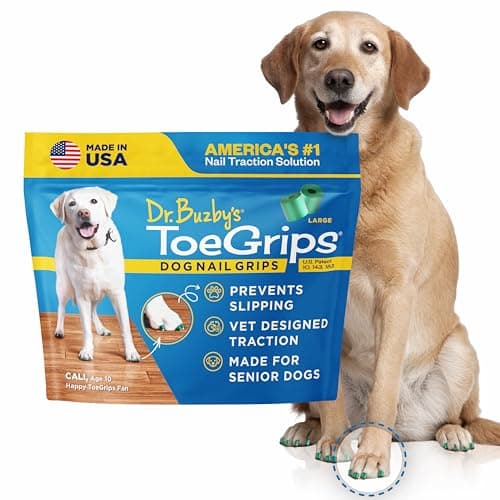
Dr. Buzby's ToeGrips for Dogs
Our score
$34–$40
Best for
Senior dogs slipping on hardwood, tile, or laminate floors
The best dog-mounted traction fix there is, and the one to buy once rugs have taken you as far as they can. Nothing touches the paw pad, which is why dogs tolerate these where they refuse socks and boots. Go in knowing the real cost: this is not a $40 purchase but a $240–$320 a year habit, so lay runners along your dog's actual routes first and buy grips for the floors you cannot cover.
Pros
- Veterinarian-developed; in clinical use for over a decade
- Slip onto each toenail — no socks, booties, or adhesives required
- Restores traction immediately, especially on hard floors
- Nothing touches the paw pad, so dogs accept them where they refuse boots
- Amazon and the manufacturer both charge $39.99 — no retailer markup
- 20 grips per bag against the 16 a dog wears, so a set includes four spares
Cons
- The only two published studies of nail grips both tested this exact product, and both were null: Roush 2017 (Front Vet Sci 4:111 — 15 sound dogs, kinetic changes "unlikely to be clinically relevant") and Repac 2022 (Animals 12(18):2312 — 30 dogs two weeks post-TPLO vs sham, no difference in weight bearing or limb function, including the owner question that asked specifically about slippery floors). Fair caveats: small samples, one used healthy dogs, the other a single early post-op timepoint — but "no positive trial exists" is the honest label, and we say it while still recommending the product for the mechanism and the owner-reported traction stories it was never tested against (verified 2026-08-14).
- A recurring cost, not a one-off. The maker publishes two different bag lives — "1–2 months" on its store page and "1-3 months, two months on average" in its FAQ (both read 2026-09-05) — which spans $160–$480 a year at $39.99. Plan on $240–$320, the two surfaces' central figures
- The Amazon listing markets specifically to dogs with "ACL injuries" — the one population where a randomised trial has been run, and where it found nothing (Repac 2022). The same bullets carry three claims with no source we could find: "more than 250,000 paws," "America's #1 nail traction solution," and "recommended by thousands of veterinarians worldwide" (listing copy verified 2026-08-17). Re-read 2026-08-31: a fourth unsourced superlative has been added to the top bullet on all four Amazon sizes — "The Only Toenail Grips for Dogs With GripZone Technology" — and the Large listing's title now leads with "Instant Traction on Wood/Hardwood Floors."
- The maker sells Scotch Super Glue Gel at $4.99 on its own store, listed as an "Alternate ToeGrips Application Method" (shop.toegrips.com, 2026-08-31). Read that as what it is: the company's own answer to the grips coming off, priced separately and not mentioned on the Amazon listing you are most likely to buy from.
- Application needs isopropyl rubbing alcohol, which is not in the box
- Initial application takes 15–20 minutes for a full set
- Some dogs chew them off in the first week
- Amazon carries only four of the seven sizes; XS, XXL and XXXL dogs have to buy direct
- Sizing by weight chart alone often misses — the accurate method needs dental floss and a ruler
Traction deserves more attention than it gets in FHO recovery, because the whole protocol rests on the dog being willing to load the leg. On hardwood or tile, she will not. Rugs solve most of this for free. ToeGrips solve the part rugs cannot, which is the moment of standing up, and they are the cheaper intervention by a wide margin compared with re-flooring a hallway. They are not permanent — they need replacing every one to three months as the nails grow — and a minority of dogs will chew them off in the first week. If your floors are already carpeted, skip them. Our guide to dogs slipping on floors covers the room-by-room version.
One thing worth spending on that is not a product: rehabilitation. Formal physiotherapy, including underwater treadmill work, appears throughout the FHO literature as a normal part of the protocol rather than a luxury add-on.

What to do this week#
If surgery has not happened yet: ask your surgeon for the written pain plan for the first fourteen days, ask how many FHOs they have done if your dog is over 20 kg, and get the rugs down before you bring her home.
If you are in the first week: give the pain medication exactly as prescribed and on schedule rather than waiting for signs of pain, do the range-of-motion work every single day, keep walks short, slow, and frequent, and call the practice if she is not attempting to touch the leg down. Twenty-five days to first weight-bearing was the far end of the published range, not a target to accept quietly.
If you are at week six and she looks great: this is the week most recoveries quietly stall, because the rehab stops when the limp does. Keep going for another two months. Keep her lean. The false joint you are building is still organizing itself, and the difference between the 38% rated good and the 42% rated poor is largely made in the weeks after your dog stops looking like a patient.
The delay is the injury — in the months before a diagnosis, and again in the months after surgery when everyone relaxes too early. Your dog cannot tell you which one she is in. The rehab calendar can.
Sources#
- Krystalli A, Sideri A, Kazakos GM, Anatolitou A, Prassinos NN. Contribution to the Study of Perioperative Factors Affecting the Restoration of Dog's Mobility after Femoral Head and Neck Excision: A Clinical Study in 30 Dogs. Animals (Basel). 2023;13(14):2295. doi:10.3390/ani13142295
- Tuchpramuk P, et al. Force Plate Gait Analysis in Dogs After Femoral Head and Neck Excision. Veterinary Sciences. 2025;12(5):469. doi:10.3390/vetsci12050469
- Ober C, Pestean C, Bel L, et al. Use of clinical and computed tomography findings to assess long-term unsatisfactory outcome after femoral head and neck ostectomy in four large breed dogs. Acta Veterinaria Scandinavica. 2018;60:28. doi:10.1186/s13028-018-0382-8
- Off W, Matis U. Excision arthroplasty of the hip joint in dogs and cats. Veterinary and Comparative Orthopaedics and Traumatology. 2010. doi:10.1055/s-0037-1617478 (an earlier version of this entry carried PMID 21274500, which is a one-page comment on the paper, not the paper — identifier corrected 14 Aug 2026; the figures were always from the correct study) was PMID 21274500 — long-term series of 132 dogs and 51 cats from the Ludwig-Maximilians University, Munich.
- Acute canine coxofemoral disease and chronic canine coxofemoral disease were associated with similar long-term functional outcomes following femoral head ostectomy. Journal of the American Veterinary Medical Association. 2025;263(9). Article
This article is educational and does not replace veterinary advice. Surgical and medication decisions for your dog belong to your veterinarian or board-certified surgeon.
Frequently asked
- Is it normal that my dog is still limping in the third week after an FHO?
- Usually, yes, provided the direction is right. In the 30-dog study behind this timeline, first weight-bearing ranged from 1 to 25 days, and the leg becoming part of ordinary walking came somewhere between 30 and 90 days, so a limp at week three sits inside the expected course. The question to ask is not whether she limps but whether she limps less than last week: more toe-touching, longer stretches of loading, fewer strides with the leg held up. Two things are not normal and warrant a call the same day — a dog who has not tried to put the foot down at all by day 25, and a dog who was using the leg and is now using it less, particularly with swelling, heat, or a new reluctance to be touched over the hip. Do not stop the range-of-motion work because the limp is still there; the motion is what is building the false joint, and week three is when it is doing the most work.
- How long after FHO surgery before my dog puts weight on the leg?
- Days, not weeks, in a well-managed recovery. In a clinical study of 30 dogs, first weight-bearing ranged from 1 to 25 days — but the subgroup given multimodal pain control (preoperative epidural morphine, ropivacaine at the ostectomy site, and postoperative tramadol with an anti-inflammatory) averaged 1.8 days. Expect toe-touching first, then brief loading, then the leg becoming part of normal walking somewhere between 30 and 90 days. The variable that moves this most is not your dog's size or age, it is how well her pain is controlled. If she is not attempting to touch the leg down, call the practice rather than waiting — 25 days was the far end of the published range, not a target to accept quietly.
- Is FHO surgery serious?
- It is permanent and it is major, but it is not a high-drama operation, and that combination confuses people. FHO removes the ball at the top of the thigh bone and the neck beneath it, and puts nothing back — the joint is gone for good and your dog's own fibrous scar tissue becomes a false joint in its place. That is why it is called a salvage procedure: it does not repair the hip, it removes the hip and the pain with it. What it does not require is an implant or a specialist-only theatre, which is why many general practices offer it. Where the seriousness actually sits is in the weeks afterward. This is the one orthopedic surgery where confining your dog produces the bad result, and the difference between a good outcome and a poor one is largely made by pain control in the first week and rehab in the months after your dog stops looking like a patient.
- FHO vs total hip replacement — which one should my dog have?
- They solve the same pain in genuinely different ways. A total hip replacement removes the diseased ball and socket and replaces both with implants, producing a true artificial joint — the gold-standard surgical treatment for severe hip dysplasia, typically around $5,500–$8,000 or more per hip in the US, and offered at fewer centres because it needs dedicated implant systems and additional surgeon training. FHO needs no implant, costs a fraction of that, and is widely available. The trade is mechanical: FHO reliably removes pain but never fully restores normal mechanics, and in the largest long-term series objective function was rated poor in 42% of animals even though 96% of owners were satisfied. The old rule that FHO is only for cats and small dogs is softening — a 2025 force-plate study found satisfactory symmetrical weight-bearing in dogs both under and over 20 kg, and a 2018 CT study of large dogs with poor outcomes traced the problem to bone-on-bone contact left by the resection rather than to the dog's weight. For a large dog, who performs the surgery matters more than what your dog weighs. If THR is affordable and appropriate, it is the better mechanical result; FHO being the budget option does not make it the wrong one.
- How long does it take a dog to recover from FHO surgery?
- Most dogs touch the operated leg down within the first few days, and in a study of 30 dogs the range for first weight-bearing was 1 to 25 days depending largely on how aggressively pain was controlled. Reliable, consistent use of the leg took 30 to 90 days in that same group. Objective gait measurement puts full functional recovery at a median of three to four months, with weight-bearing symmetry continuing to improve out to about six months.
- Should I crate rest my dog after FHO?
- No, and this is the single most important difference between FHO and other orthopedic surgeries. There is no bone cut to heal and no implant to protect. The joint your dog is building is fibrous scar tissue, and that tissue forms in response to controlled motion. Confinement is how you end up with a stiff, painful, poorly used leg. Your surgeon will give you a specific protocol, but expect gentle range-of-motion work and short leash walks from the first days, not weeks of a crate.
- Is FHO only for small dogs?
- That was the conventional teaching and the evidence has moved. A 2025 force-plate study of 27 dogs weighing up to about 39 kg found satisfactory, symmetrical weight-bearing regardless of size. A 2018 CT study of large dogs with poor outcomes found the culprit was usually surgical technique leaving bone-on-bone contact, not the dog's weight. Size matters less than the quality of the resection and the quality of the rehab.
- Will my dog limp forever after an FHO?
- Many dogs look completely normal at a trot and still show measurable differences in a gait lab. In the largest long-term series, objective function was rated poor in 42% of animals even though 96% of owners were satisfied with the result. That gap is real and worth understanding: FHO reliably removes pain, and it does not perfectly restore mechanics. A dog can be comfortable, happy, and active while still loading that leg a little less than the other one.
- How much does FHO cost compared to a hip replacement?
- FHO is substantially cheaper than total hip replacement because it needs no implant, and it is offered by many general practices rather than only by board-certified surgeons. Costs vary widely by region and by whether rehabilitation is included, so ask for a written estimate that specifies whether pain management, the recheck exams, and any rehab sessions are part of the quoted price. Those line items are where estimates diverge most.