Surgery Guide
TPLO vs Total Hip Replacement: Different Joints, Different Surgeries
TPLO vs total hip replacement: one repairs a torn knee ligament, the other replaces the hip joint with an implant. What the published outcome data actually say, and which conversation your dog is in.

No — a TPLO is not a hip replacement. TPLO treats a torn cranial cruciate ligament in the knee by cutting and rotating the top of the tibia so the joint is stable without the ligament; a total hip replacement (THR) removes a diseased hip's ball and socket and replaces them with implants. These treat different diseases, so the honest version of this comparison is not "which is better." It is: which conversation is your dog actually in, and what do the published numbers say once you get there.
Affiliate disclosure: Dog Orthopedic is reader-supported. When you buy through links on our site we earn a commission at no extra cost to you — about 3% on most pet products, and the same rate on every product we compare, so no pick earns us more than another. Prescription medication earns us nothing, and seeing your vet earns us nothing; we recommend both anyway. Learn more.
Imagery: Lifestyle photographs on this site are licensed from Pexels (royalty-free) and credited per image. Pexels imagery illustrates conditions and contexts — it does not depict the specific dogs or test sessions described in the text. Product photographs come from Amazon's Creators API. Breed portraits are illustrations of typical breed type rather than photographs of individual dogs, and are not drawn to scale against one another.
Why do people mix these up?#
The confusion is reasonable. Both are major orthopedic surgeries on a dog's back leg, both are quoted in the thousands of dollars, both come with roughly two-month activity restrictions, and both get recommended for large breeds that showed up at the vet with a rear-leg limp. Search results blur them further, because gear, recovery advice, and cost questions overlap almost completely.
But they are answers to two unrelated problems. A dog is recommended a TPLO because a ligament in the knee failed. A dog is recommended a THR because the hip joint itself — the ball and socket — is malformed or worn out. Understanding which problem your dog has tells you which surgery conversation you're actually in.
What does a TPLO actually do?#
The cranial cruciate ligament (CCL) — the canine equivalent of the human ACL — stops the femur from sliding backward off the top of the tibia every time the dog bears weight. Unlike the human ACL, it usually fails by slow degeneration rather than one bad landing: the ACVS describes rupture as "the result of subtle, slow degeneration that has been taking place over a period of time rather than the result of a sudden trauma to an otherwise healthy ligament (which is very rare)."[1]
It is also not evenly distributed. In UK primary-care records, 1,000 confirmed unilateral cruciate cases were compared against 500,000 dogs without: the raised-risk groups after adjustment were dogs aged 6 to under 9 years, neutered dogs of both sexes, and Rottweilers, Bichon Frise and West Highland White Terriers in particular. Dogs of 20 kg or more had increased odds of being managed surgically rather than medically.[2] Worth holding onto: the size of the dog changes what gets offered, not only what is needed.
The TPLO's insight is that you don't have to rebuild the ligament — you can make it unnecessary. The surgeon makes a semicircular cut around the top of the tibia and rotates it until the sloped plateau sits nearly level, then fixes it with a plate and screws, which "renders the knee more stable in the absence of the CrCL."[1] Nothing artificial replaces the joint; the dog keeps its own knee, plus a plate that usually stays in for life.
The cost of that stability is a bone cut that needs about eight weeks to knit, which is what drives the strict recovery — the full arc is in our TPLO recovery guide.
What does a total hip replacement actually do?#
THR is exactly what the name says. The hip is a ball-and-socket joint, and in dogs with hip dysplasia the joint develops loose and misshapen, grinding itself into painful arthritis over years. That disease is common: across the entire Orthopedic Foundation for Animals registry — 921,046 unique dogs — 15.56% were dysplastic, and dogs in the AKC working group carried nearly twice the odds of hounds.[3]
When medical management stops working, THR removes the diseased joint entirely: the femoral head and neck come off and are replaced with a metal stem and head, and the acetabulum is reamed out and fitted with a cup that the new ball rides in.[4]
A note on the phrase "gold standard," which we used to use here. The ACVS's own wording is more careful than that, and worth quoting exactly: THR, "based on evidence based medicine via multiple peer reviewed publications is the second surgical method that provides the most normal pain free function in dogs with CHD," and it "results in an excellent chance of markedly improved limb function." Note what is absent — the ACVS publishes no success percentage for THR anywhere on that page. It does list the complications plainly: "infection, hip dislocation, 'loosening' of the implants over time, nerve injury, and femur fracture." And on restriction, it says activity should be limited to leash exercise and indoor confinement "until the procedures are deemed healed (via examination and X-rays), generally six and eight weeks respectively" for pelvic osteotomy and THR.[4] Candidates also need skeletal maturity — the page says at least a year old.

The number that got deleted from this page, and what replaced it#
This article used to carry a row claiming surgeons quote "90%+ good-to-excellent outcomes" for TPLO and "around 90–95% of dogs returning to normal or near-normal function" for THR. We could not source either figure, and both are gone. The same "95% success" claim was removed from our hip dysplasia guide on the same day.
Here is what is actually published, and it is more useful than the number it replaced.
For THR, there is a real 95% — but it measures something else. The British Veterinary Orthopaedic Association's Canine Hip Registry collated surgeon and owner reports across 2010–2012. Surgeon-reported complications ran 8.2% and owner-reported complications 4.3%. And "in 95 per cent of cases, owner satisfaction with the outcome of THR was 'very good' or 'good'."[5] That is owner satisfaction, not function, and the difference is the single most useful thing on this page — we come back to it below.
Two modern implant series give the complication picture. In 255 consecutive cementless procedures using a press-fit stem with a lateral bolt, stem-related complications ran 8.6% intraoperatively and 2% early postoperatively.[6] In a separate series of 177 consecutive procedures in 145 dogs, the overall intra- and postoperative complication rate was 13.6%, with 6.2% stem-related.[7]
And there is one objective functional measure. Thirty-five dogs having cementless THR were assessed on a pressure-sensitive walkway before surgery and at 3, 6 and 12 months. Standing bodyweight distribution to the operated limb increased to normal by three months — while the unoperated limb stayed significantly lower than the operated one at every timepoint out to a year.[8] Read that second half twice. It is the quiet argument for looking at the other hip.
For TPLO, the equivalents. Across 1,519 TPLO procedures, the total complication rate was 11.4% — 3.1% major, 8.3% minor — with higher odds in German Shepherd Dogs (3.2), tibial plateau angle over 30° (1.6), and every 4.5 kg of body weight (1.10).[9] On function, force-plate work found TPLO dogs loading the operated limb indistinguishably from never-injured control dogs by six months to a year after surgery.[10] And a systematic review that screened 444 papers and included 34 concluded the evidence most strongly supports TPLO for returning dogs to normal function.[11]
Do not read the 3-month THR figure against the 6-to-12-month TPLO figure as a race. They are different measurements — static standing weight distribution in one, dynamic force-plate symmetry at walk and trot in the other — on different diseases in different joints. Nobody has run the head-to-head, because there is no clinical reason to.
TPLO vs THR, side by side#
| TPLO | Total hip replacement (THR) | |
|---|---|---|
| Joint | Stifle (knee) | Hip |
| Problem it treats | Torn or partially torn cranial cruciate ligament | Hip dysplasia with arthritis, severe hip osteoarthritis, some fractures and luxations |
| What the surgeon does | Cuts and rotates the top of the tibia to level the plateau, fixes it with a plate and screws | Removes the femoral head and neck, implants a stem, head, and socket cup |
| What's implanted | Bone plate and screws — the dog keeps its own joint | A full prosthetic ball and socket — an artificial joint |
| Typical US cost | No published pricing survey exists that we could find. Get two written estimates | No published pricing survey exists that we could find, and THR is generally the dearer of the two |
| Published complication rate | 11.4% total, 3.1% major, across 1,519 procedures | 8.2% surgeon-reported / 4.3% owner-reported in a national registry; 13.6% overall in one 177-procedure series |
| Named risk factors | German Shepherd Dog (OR 3.2), plateau angle over 30° (1.6), body weight (1.10 per 4.5 kg) | Prosthesis type: one 2012-era cementless cup/stem carried 4.48× the complication odds of the cemented equivalent |
| Objective function measure | Force-plate symmetry equal to uninjured controls at 6–12 months | Standing weight distribution to the operated limb normal by 3 months |
| Typical restriction window | About 8 weeks strict, off-leash play around week 12 (typical protocols) | Leash-only and indoor confinement until films confirm healing, "generally… eight weeks" per the ACVS |
| Availability | Very widely performed by board-certified surgeons | Fewer centers; requires specialized training and implant systems |
| The "other side" risk | 19.1% of medium-to-large dogs aged 8+ ruptured the opposite cruciate, at a median of 12.9 months | Hip dysplasia is usually bilateral; the unoperated limb stayed under-loaded out to a year in walkway testing |
The contralateral cruciate figure deserves its own note, because this page used to state it as "roughly 40–50% within about 18 months." We could not source that and have retired it, as we retired it from the TPLO recovery guide. The published figure comes from 831 medium-to-large dogs who were eight or older at their first rupture: 19.1% ruptured the contralateral side, at a median of 12.9 months, and the authors note explicitly that this is lower than previously reported and that the risk falls as dogs age.[12] One in five is a real risk to plan for. It is not the coin flip this page implied.
Which one does my dog actually need?#
Not your call to make from the couch, and not diagnosable from a limp video — rear-leg lameness looks remarkably similar across causes. What you can do is bring good observations to the exam: when the limp is worst, whether rising is the hard part, whether your dog sits square or kicks a leg out, what stairs look like. Our guide to telling if your dog is in pain covers what's worth writing down.
From there, it's the vet's job. Knee: palpation tests for instability (cranial drawer, tibial thrust), joint effusion, and radiographic signs. Hip: pain on extension, laxity, and radiographs that show the dysplastic remodeling. Sedated radiographs are common and worth saying yes to — a relaxed dog gives diagnostic films.
One thing worth internalizing: the same big breeds are over-represented in both diseases, and plenty of dysplastic dogs tear a CCL. That's why the diagnosis, not the breed reputation, has to drive the plan. It's also why a dog can genuinely need both surgeries in one lifetime, staged months apart, most painful joint first.
What if a THR isn't in the budget?#
There's an established fallback: femoral head ostectomy (FHO). The surgeon removes the femoral head and neck and does not replace them; over the following weeks, scar tissue forms a "false joint" between femur and pelvis. The grinding bone-on-bone contact is gone, so the pain relief is real.
But we have to correct what this page used to say about who it suits. We wrote that FHO "works best in cats and smaller dogs, where less mass rides on the false joint," and that large-breed results are more variable. The largest long-term series does not support that. In 132 dogs and 51 cats operated at Ludwig-Maximilians University and re-evaluated an average of four years later, function was rated good in 38%, satisfactory in 20%, and poor in 42% — while 96% of owners were satisfied. Kinetic and kinematic measurements showed that although the surgery relieved pain, it left functional deficits "in small as well as large breed dogs," deficits that were not visible during rapid movement.[13]
Now put those two satisfaction numbers side by side, because this is the most useful thing on this page. THR owners rated the outcome good or very good 95% of the time. FHO owners were satisfied 96% of the time — with legs that objective gait analysis rated poor in more than four cases in ten. The satisfaction figures are effectively identical. The legs are not.
That is not a reason to distrust owners. It is a reason to understand what an owner satisfaction score measures: a dog who is no longer in obvious pain, in a household that adapted. It is a genuine and important outcome. It is simply not the same measurement as function, and when a surgeon quotes you a percentage, the question worth asking out loud is "is that a satisfaction number or a function number?" Nearly every impressive percentage in this field is the former.
FHO is also available at most general practices and asks something very different of you afterward: no crate weeks, controlled movement from the first days, and a false joint that only forms properly if the leg gets used — our FHO surgery recovery guide covers what that actually looks like, including when to expect weight-bearing.
Between surgery and nothing, there's also structured medical management — weight control, pain medication, physical rehab, and joint supplements, in roughly that order of evidence. It doesn't fix the joint, but it's how many dysplastic dogs live comfortably for years; see our joint supplement rankings for an honest read on which parts of that are actually supported.
The recovery gear overlaps almost completely#
Whichever surgery your dog has, the home setup is nearly identical: confinement, traction, no stairs or jumping, and a way for you to assist a big dog's rear end without wrecking your back. Two items do the heaviest lifting in both recoveries.
#1 Pick

GingerLead
GingerLead Dog Support and Rehabilitation Harness
Our score
$32–$70
Best for
Short-term post-surgical assistance and rear-end weakness
The right tool for one specific job: a dog whose back end has failed while his front end is still working. In the first four to six weeks after hip or stifle surgery, or for a senior who can get his front paws onto the sill of a car but cannot follow through, it is faster to fit than a full harness and it costs less. It is not a general mobility aid — it does nothing for the front half of the dog, and the maker expects you to buy a chest harness separately for older dogs. Size it with the towel test before you order, because the 10-day return window is short for a product whose commonest failure is sizing. If your dog needs help at both ends, or will need help for more than a couple of months, buy the Help 'Em Up Harness instead — though note that is no longer a $10 decision: Help 'Em Up prices by size direct ($80 XS to $140 XL, re-verified 18 Aug 2026), so the medium-to-large dog this sling fits pays $110 or $125 there against $69.95 here.
Pros
- Single-piece sling — fast to put on for bathroom trips
- Cutout in the support pad clears male anatomy, so it can be left in position without soiling
- Integrated leash takes one accessory off your hands, and detaches if you don't want it
- Machine washable and dryable, which matters more than it sounds on a post-surgical dog
- No Amazon markup — $69.95 on Amazon and $69.95 direct from the manufacturer, re-verified 12 September 2026 (Amazon via the Creators API, direct from the Med/Lg product page)
- The maker sells reconditioned units — inspected, laundered and re-packaged, "Save up to 45%". We have never observed the reconditioned price itself, so treat this as arithmetic rather than a quote: 45% off the $69.95 Medium/Large is about $38 at the maximum discount, and less at anything below it. (Corrected 2026-09-05 — we previously printed "roughly $45", which was the Amazon behind-the-buy-box offer of $44.95 conflated with the direct discount.)
- Manufacturer publishes a free towel test that sizes the sling before you spend anything
- Credit where it is due: as of 1 September 2026 the Amazon listing carries "CHEST HARNESS NOT INCLUDED" in capitals in its first feature bullet and in the retail title. This was the single most commonly missed thing about the product and the maker now says it before you click buy
- Stay-on straps are included, which is what stops the sling sliding backwards on a dog with wasted hindquarters
Cons
- Rear-end only — not the right tool if a dog also needs front support
- Chest harness is not included, and the maker's own copy recommends clipping the leash to one for older dogs
- Only a 10-day clean return window; days 11–30 carry a $10 restocking fee and nothing is refunded after 30
- Long-term use can rub thighs without careful fitment
- Strap-end handles are less ergonomic than padded handles
- Sized by pad width and by the dog's sex, not by a simple size ladder — easy to order wrong
- The Amazon listing contradicts itself on the weight floor — one bullet says "FEMALE dogs over 45 lbs and MALE dogs over 60 lbs", another says "dogs weighing over 45 pounds" flat (both live 19 Aug 2026)
- On Amazon the cheaper of the maker's two offers on this ASIN is not the one in the buy box, so the default click costs $25 more — and as of 1 September 2026 that cheaper $44.95 offer is no longer straightforwardly buyable: the same merchant now returns it as AVAILABLE_DATE with an empty message (backorder), where on 19 August it showed 7 units in stock. Corrects our own earlier advice — opening the other-offers panel is still worth doing, but it may no longer save you anything today
The GingerLead's single-piece design is the fast assist for the early weeks — under the belly in seconds for bathroom trips, with an integrated leash. Rear-end support is what both TPLO and THR dogs need. Two caveats specific to a fresh THR: ask your surgeon to demonstrate assisted walking first, because early hip patients need controlled, aligned support rather than enthusiastic lifting, and the ACVS lists hip dislocation among the recognised complications of the procedure.[4] Also note the chest harness the maker's own copy suggests clipping the leash to is not included, and the clean return window is ten days.
#2 Pick
Help 'Em Up
Help 'Em Up Harness
Our score
$95–$155
Best for
Long-term mobility support for senior or post-surgical large dogs
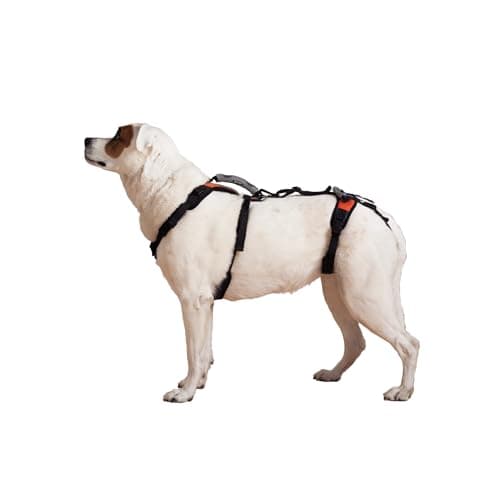
If your dog needs help getting up multiple times a day for the foreseeable future — post-TPLO, advanced hip dysplasia, hindquarter weakness in giant-breed seniors — this is the one to buy. It is the only harness in the category that supports the front and the back independently, which is what a dog with a bad hip and a compensating shoulder actually needs. Buy it from the manufacturer, not from Amazon: re-verified 18 August 2026, helpemup.com prices by size at $80 / $95 / $110 / $125 / $140 while Amazon runs $95 / $110 / $125 / $140 / $155 — a uniform $15 more at every size, every time we have checked.
Pros
- Two-piece (chest + hip) design lets you support either end independently
- Hip handle is purpose-built — not a converted car-seat-belt strap
- Padded chest plate distributes weight better than sling-only options
- Five sizes span 10 to 225 lb, and the rear half can be ordered a size smaller for a dog with muscle wasting
- Two hip-lift styles (Conventional and U-Band) so male dogs are not soiling the strap
Cons
- Amazon runs a uniform $15 above the maker's own price at every one of the five sizes, and the Amazon buy box is held by a third-party reseller (Veterinary Preferred) rather than by the brand — re-verified 18 August 2026
- The maker's own Mix & Match page prints two different starting prices, "From $80" and "FROM $95 USD", on the same page
- Direct pricing is no longer flat: since mid-August 2026 the maker charges $80 to $140 by size, so a giant-breed owner now pays $60 more than a terrier owner
- On 29 August 2026 the linked Amazon Medium (B0DK81SCG5) showed a future availability date rather than units on hand, while every size and style was in stock at helpemup.com the same day; on 9 September and again on 12 September 2026 the Amazon Medium still showed the future-date status at $125.00 with a maximum order of one and no ship date given, while all nine direct variants were in stock — two weeks of backorder on the channel we earn from, and one more reason the direct channel is the one to use
- Sizing is critical — measure twice, return is a hassle
- Rear straps can chafe the inner thigh if the harness is left tight while the dog lies down
- A dog filmed or gait-assessed while wearing it looks less lame than he is, because the harness offloads the limb you are trying to judge
- Bulkier than a quick-grab sling for short-term use
For big dogs and longer recoveries, the Help 'Em Up two-piece harness stays on all day and gives you a purpose-built hip handle, which is worth the price for a bilateral-disease dog you'll be assisting for months. We previously called it "the tool rehab practices reach for with 80-pound-plus patients"; we have no survey behind that and it is gone. The design argument stands on its own. One thing to know before clicking: the Amazon buy box is currently held by a third-party reseller at a real premium over the manufacturer's own direct price. More options in our lift harness guide.
The rest of the kit — firm low bed, gates, ramp, cone — is covered in the TPLO recovery gear checklist, and the same list serves a THR household. So do the stair rules, which THR surgeons enforce just as firmly.

The bottom line#
TPLO and total hip replacement aren't competing options — they're different repairs for different joints. If your dog's problem is a torn cruciate, the conversation is TPLO. If the problem is a worn-out, dysplastic hip, the conversation is THR, with FHO as the budget-conscious fallback that trades measurable function for accessible pain relief.
On odds, the honest summary is this. Both are well-established procedures with published complication rates around one in ten — 11.4% across 1,519 TPLOs, 8.2% surgeon-reported in a national THR registry — and most dogs do well. "Most" is the defensible word. The 90-something-per-cent figures that circulate for both surgeries are, when you chase them down, either unsourceable or measuring owner satisfaction rather than the leg.
The part you control is the same either way: the questions you bring to the consult, the home you set up before surgery day, and eight-plus disciplined weeks on the other side. And one question to write down now, whichever surgery you are heading into — "what does the other side look like on the films you have already taken?" It costs nothing, and for both of these diseases it is the question that predicts the next year.
Sources#
Every source below was opened and read on 14 August 2026. Three claims that previously appeared on this page were removed because no source could be found for them: the "90%+ good-to-excellent outcomes" figure for TPLO, the "90–95% returning to normal or near-normal function" figure for THR, and the "roughly 40–50% of dogs tear the opposite CCL within about 18 months" figure. Two more were corrected: the dollar ranges are no longer presented as sourced figures, and the claim that FHO "works best in cats and smaller dogs" is contradicted by the largest published series. Each change is stated in the text rather than made silently.
- American College of Veterinary Surgeons. "Cranial Cruciate Ligament Disease." acvs.org — read 14 August 2026. Rupture "is a result of subtle, slow degeneration… rather than the result of a sudden trauma to an otherwise healthy ligament (which is very rare)"; TPLO involves "making a semicircular cut around the top of the shin bone and rotating this to a predetermined location," which "renders the knee more stable in the absence of the CrCL"; "activity must be restricted for several weeks after surgery."
- Pegram C, Brodbelt DC, Diaz-Ordaz K, et al. "Risk factors for unilateral cranial cruciate ligament rupture diagnosis and for clinical management in dogs under primary veterinary care in the UK." The Veterinary Journal. 2023;292:105952. doi:10.1016/j.tvjl.2023.105952 (PMID 36708945) — 1,000 unilateral CCL rupture cases against a random 500,000 non-cases, VetCompass, 2019. Increased odds of diagnosis in dogs aged 6 to under 9 years, neutered males and females, insured dogs, and Rottweiler, Bichon Frise and West Highland White Terrier. Increased odds of surgical management in insured dogs and dogs ≥20 kg; reduced odds in dogs ≥9 years and those with a non-orthopaedic comorbidity.
- Loder RT, Todhunter RJ. "The Demographics of Canine Hip Dysplasia in the United States and Canada." Journal of Veterinary Medicine. 2017;2017:5723476. doi:10.1155/2017/5723476 (PMID 28386583) — entire OFA hip registry, 921,046 unique records; overall prevalence 15.56%; AKC working group OR 1.882 against hounds as reference; FCI pinscher/molossoid group OR 4.168.
- American College of Veterinary Surgeons. "Canine Hip Dysplasia — Total Hip Replacement." acvs.org — read 14 August 2026. "THR, based on evidence based medicine via multiple peer reviewed publications is the second surgical method that provides the most normal pain free function in dogs with CHD"; "THR results in an excellent chance of markedly improved limb function"; "Potential complications after THR include infection, hip dislocation, 'loosening' of the implants over time, nerve injury, and femur fracture"; activity restricted to leash exercise and indoor confinement "until the procedures are deemed healed (via examination and X-rays), generally six and eight weeks respectively"; dogs "must be managed medically until they are mature enough for THR, at least a year old." The page states no success percentage.
- Henderson ER, Wills A, Torrington AM, et al. "Evaluation of variables influencing success and complication rates in canine total hip replacement: results from the British Veterinary Orthopaedic Association Canine Hip Registry (collation of data: 2010-2012)." The Veterinary Record. 2017;181(1):18. doi:10.1136/vr.104036 (PMID 28386028) — surgeon-reported complication incidence 8.2%, owner-reported 4.3%; "in 95 per cent of cases, owner satisfaction with the outcome of THR was 'very good' or 'good'"; complications 4.48× more likely with the BioMedtrix BFX cup/stem than the CFX cup/stem (P=0.002) and 2.85× more likely than a hybrid (P=0.046).
- Kokkinos P, Parsons K, Belch A, Barthelemy N. "The influence of age at total hip replacement on perioperative complications associated with a press-fit cementless stem with lateral bolt in dogs." Veterinary Surgery. 2025;54(3):581-593. doi:10.1111/vsu.14203 (PMID 39815446) — 197 client-owned dogs, 255 THRs (139 unilateral, 58 bilateral); intraoperative stem complication rate 8.6%, early postoperative 2%.
- Low D, Treharne R, Rutherford S. "Subsidence of the BFX standard stem after canine total hip replacement: A case series of 177 consecutive procedures." Veterinary Surgery. 2026;55(4):763-770. doi:10.1111/vsu.70084 (PMID 41660743) — 177 procedures in 145 dogs; 24/177 (13.6%) intra- and postoperative complications, 11/177 (6.2%) stem-related; eight stem complications were intraoperative femoral fissures, one of which progressed to a postoperative femoral fracture.
- Lascelles BD, Freire M, Roe SC, DePuy V, Smith E, Marcellin-Little DJ. "Evaluation of functional outcome after BFX total hip replacement using a pressure sensitive walkway." Veterinary Surgery. 2010;39(1):71-77. doi:10.1111/j.1532-950X.2009.00607.x (PMID 20210948) — 35 dogs, prospective clinical study; standing bodyweight distribution to the operated limb increased and was normal by 3 months (P<.0001), while distribution to the unoperated limb was significantly less than the operated limb at 3, 6 and 12 months. Greater proximal femoral canal fill correlated negatively with the change.
- Coletti TJ, Anderson M, Gorse MJ, Madsen R. "Complications associated with tibial plateau leveling osteotomy: a retrospective of 1519 procedures." The Canadian Veterinary Journal. 2014;55(3):249-254. PMID 24587508 — 943 dogs unilateral, 288 staged bilateral; total complication rate 11.4% (95% CI 9.8–13.2%), major 3.1%, minor 8.3%. German Shepherd Dog OR 3.2; tibial plateau angle over 30° OR 1.6; OR increased 1.10 for every 4.5 kg.
- Nelson SA, Krotscheck U, Rawlinson J, Todhunter RJ, Zhang Z, Mohammed H. "Long-term functional outcome of tibial plateau leveling osteotomy versus extracapsular repair in a heterogeneous population of dogs." Veterinary Surgery. 2013;42(1):38-50. doi:10.1111/j.1532-950X.2012.01052.x (PMID 23153073) — 79 normal controls, 38 dogs with unilateral CCL disease (TPLO n=15, extracapsular n=23); force-plate symmetry indices of the TPLO group were no different from controls by 6 months to 1 year. Treatment was not randomised.
- Bergh MS, Sullivan C, Ferrell CL, Troy J, Budsberg SC. "Systematic review of surgical treatments for cranial cruciate ligament disease in dogs." JAAHA. 2014;50(5):315-321. doi:10.5326/JAAHA-MS-6356 (PMID 25028440) — 444 manuscripts reviewed, 34 met inclusion criteria (2 level 1, 6 level 2, 6 level 3, 20 level 4); TPLO n=14 studies, lateral extracapsular suture n=13, TTA n=6.
- Murphy CL, Niles J, Radasch RM. "The Prevalence and Risk Factors of Contralateral Cranial Cruciate Ligament Rupture in Medium-to-Large (≥15kg) Breed Dogs 8 Years of Age or Older." VCOT. 2024;37(1):8-12. doi:10.1055/s-0043-1771350 (PMID 37487534) — 831 client-owned dogs, median follow-up 112.7 months; 19.1% ruptured the contralateral cruciate at a median of 12.9 months. Authors state the prevalence is lower than previously reported and risk decreases with age.
- Off W, Matis U. "Excision arthroplasty of the hip joint in dogs and cats. Clinical, radiographic, and gait analysis findings from the Department of Surgery, Veterinary Faculty of the Ludwig-Maximilians-University of Munich, Germany. 1997." VCOT. 2010;23(5):297-305. doi:10.1055/s-0037-1617478 (PMID 20945541) — 132 dogs and 51 cats, 1978–1989; clinical and radiographic re-evaluation an average of four years post-operatively in 81 animals (44%), gait analysis in 17. Function rated good 38%, satisfactory 20%, poor 42%; 96% of owners satisfied; kinetic and kinematic measurements showed functional deficits "in small as well as large breed dogs," not visible during rapid movement.
What we could not verify. No published national survey of canine TPLO or THR pricing exists that we could find, so this page no longer prints dollar ranges as if they were measured. The complication figures above come from different countries, eras, implant systems and reporting standards, and are not directly comparable to one another — a registry that collects owner reports and a single-centre consecutive series are counting different things. And no study has compared TPLO against THR head to head, because they treat different diseases and no such trial would be meaningful.
This article is educational and does not replace veterinary advice. Which surgery your dog needs is a diagnosis, made by a board-certified surgeon from an examination and radiographs. Dosing, anaesthetic risk, and the decision to operate belong to that team.
Frequently asked
- Is a TPLO the same thing as a total hip replacement?
- No. A TPLO is knee surgery: it treats a torn cranial cruciate ligament by cutting and rotating the top of the tibia so the knee is stable without the ligament — nothing is replaced. A total hip replacement removes the ball and socket of the hip and replaces them with implants. Different joint, different disease, different hardware. They are not competing options, and no surgeon chooses between them; the diagnosis chooses.
- Which costs more, a TPLO or a dog hip replacement?
- Total hip replacement, generally — but we want to be straight about the quality of that answer. We could find no published national survey of canine orthopedic surgery pricing for either procedure, so any dollar range you read online, including the ones we used to print here, is collected from practice quotes and owner reports rather than measured. Get two written estimates and check whether radiographs, follow-up visits and the recheck films are inside or outside the quoted number, because that is where estimates diverge most. THR is offered at fewer centers, which is the part that is verifiable: it requires dedicated implant systems and additional surgeon training.
- Can a dog need both a TPLO and a hip replacement?
- Yes — they treat different joints, and the populations overlap. Hip dysplasia runs at 15.56% across the entire Orthopedic Foundation for Animals registry of 921,046 dogs, with working breeds carrying nearly twice the odds of hounds; the breeds over-represented for cruciate rupture in UK primary-care records include Rottweilers. Surgeons stage the procedures, addressing the most painful joint first, with full recovery between them. A dog with both knee and hip disease needs a board-certified surgeon to sequence treatment — not two surgeries at once.
- What is the cheaper alternative to a total hip replacement?
- Femoral head ostectomy (FHO). The surgeon removes the femoral head and the body forms a fibrous false joint. It is widely available and it reliably takes away bone-on-bone pain, but be clear-eyed about function. In the largest long-term series — 132 dogs and 51 cats re-examined an average of four years later — function was rated good in 38%, satisfactory in 20% and poor in 42%, while 96% of owners were satisfied. Gait analysis in that series found the deficits appeared in small breeds as well as large ones, so 'FHO is fine for little dogs' is not what the data show. Discuss both options with a surgeon.
- How do I know if my dog's back-leg limp is the knee or the hip?
- You usually can't tell from watching — that's the exam's job. Suggestive patterns: a cruciate dog often sits with the sore leg kicked out to the side and limps worse after rest; hip dysplasia more often shows as bunny-hopping, trouble rising, and reluctance on stairs. Vets confirm with palpation tests and radiographs, sometimes under sedation. Don't self-diagnose a rear-leg limp, and don't let breed reputation decide — the same big breeds are over-represented in both diseases.