Owner's Guide
How to Tell If Your Dog Is in Pain: The Signs Owners Miss
How to tell if your dog is in pain: the movement, posture, sleep, and facial changes dogs show instead of crying, and what to do once you spot them.

You can tell if your dog is in pain by watching for change — in how they move, stand, sleep, groom, eat, and greet you — not by listening for crying, because dogs are wired to hide pain. This guide is the checklist we wish every owner had: the quiet signs by category, the two myths that keep dogs hurting, and exactly what to do once you see something.
Affiliate disclosure: Dog Orthopedic is reader-supported. When you buy through links on our site we earn a commission at no extra cost to you — about 3% on most pet products, and the same rate on every product we compare, so no pick earns us more than another. Prescription medication earns us nothing, and seeing your vet earns us nothing; we recommend both anyway. Learn more.
Imagery: Lifestyle photographs on this site are licensed from Pexels (royalty-free) and credited per image. Pexels imagery illustrates conditions and contexts — it does not depict the specific dogs or test sessions described in the text. Product photographs come from Amazon's Creators API. Breed portraits are illustrations of typical breed type rather than photographs of individual dogs, and are not drawn to scale against one another.
Why dogs hide pain#
Dogs are honest about almost everything. Pain is the exception. The Merck Veterinary Manual says the quiet part out loud: "dogs may wag their tails and greet observers despite being in pain," and clinical signs of pain "may be masked by behavior that is stereotypical of the species."[1] A dog can be in significant daily pain and still eat, still wag, still come when called.
You will read everywhere that the reason is evolutionary — that an animal advertising weakness invited predators and rivals, so the concealers survived and our dogs inherited the instinct. We find that story persuasive. We also cannot point you at anyone who has tested it in dogs, so we are going to stop stating it as a fact and tell you the part that is measured instead.
Here is that part. Up to 40% of dogs aged eight months to four years already have osteoarthritis, and clinical signs are generally not identified until dogs are five to thirteen years old.[2] That gap — years wide, in an animal that lives about a decade — is not a theory about wolves. It is the size of the problem this page exists to shrink, and the burden of closing it falls on you, because the signs are quiet ones.
“Because your dog can't tell you how much pain he or she is in.”
Our founder watched her own old dog spend his last years in pain he could never tell her about. Nearly every longtime dog owner, looking back honestly, has a version of that story. The point of this page is to make sure you catch it in the present tense, while there is still time to act.
The pain checklist: signs by category#
The signal is change from your dog's own baseline. You know that baseline better than anyone — including your vet, who sees your dog for twenty adrenalized minutes a year. Here is what to watch for, category by category.
| Category | Sign | What it can mean |
|---|---|---|
| Movement | Slow or effortful rising, worst after rest | Joint pain — arthritis, hips, elbows |
| Movement | Hesitating at stairs, taking them one at a time, or refusing | Joint or back pain |
| Movement | Shortened stride, lagging on walks, turning home early | Musculoskeletal pain, fatigue from pain |
| Movement | Bunny-hopping (both back legs pushing together) | Classic hip sign — hip dysplasia, hip arthritis |
| Movement | No longer jumping onto furniture or into the car | Joint or spinal pain |
| Posture | Hunched, roached back; rigid stance | Back pain or abdominal pain |
| Posture | Prayer position — chest down, rear end up | Classic abdominal pain sign; also seen with back pain — same-day vet call |
| Posture | Head carried low, reluctance to turn the neck | Neck pain |
| Behavior | Withdrawing, hiding, sleeping in another room | Chronic pain, feeling unwell |
| Behavior | Irritability or snapping when touched in one spot | Localized pain — that spot |
| Behavior | Not greeting you at the door anymore | Often pain-related in a formerly social dog |
| Sleep | Restlessness, repeated repositioning, circling before lying down | Cannot find a comfortable position |
| Sleep | Sleeping noticeably more overall | Chronic pain, illness |
| Grooming | Licking one joint or spot repeatedly, sometimes to a sore | Pain beneath the lick — treated as an orthopedic clue until ruled out |
| Appetite | Eating less, dropping food, chewing on one side | Mouth or dental pain; general pain |
| Face and breathing | Squinting or tight eyes, ears pinned back, tense face | Discomfort — subtle but real |
| Face and breathing | Panting at rest, in a cool room, unprovoked | Common and commonly missed pain sign |
Two patterns are worth pulling out of the table. First: anything that is worst after rest and eases as the dog warms up points at joint pain, most often arthritis. Merck describes hip lameness the same way, as "more pronounced after exercise" or "shortly after rest," and names the bunny-hopping gait as a sign in its own right.[3] Second: a change in personality — the grump who was never a grump, the greeter who stopped greeting — is a body signal at least as often as it is an aging brain.
The two rows in that table that a collar can now confirm are the sleep rows, and they are the ones owners most often talk themselves out of. When researchers fitted healthy dogs and dogs with osteoarthritis pain with activity monitors for fourteen days, the painful dogs recorded lower overall activity counts, spent less time standing, and spent less time at higher activity levels.[4] And when osteoarthritic dogs were crossed over between a real anti-inflammatory and a placebo, the accelerometer picked up better night-time resting and more daytime activity on the drug — matching what the owners said about their dogs' sleep, which earlier analyses of the same kind of data had failed to detect.[5]
So the restless dog who circles four times and cannot settle is not being fussy, and the dog who has started sleeping more is not simply getting old. Night is when the signal is loudest, because there is nothing left to distract from the pain. If you take one behaviour from this table to your vet, take the one that happens at 2 a.m.

The two myths that keep dogs in pain#
Myth one: "He would cry if something hurt." Vocalizing is the rarest pain sign there is. Dogs may yelp at a sudden injury, but chronic pain — the arthritis kind, the disc kind, the hip dysplasia kind — is almost perfectly quiet. A dog will wag at you through it.[1] If you take one sentence from this page: silence is not comfort.
Myth two: "She's just getting old." This is not us being contrarian. The profession's senior-care guidelines open by stating that veterinary professionals are taught to recognize that "old age is not a disease," and that owners often believe the opposite — that decline in an older dog is simply unavoidable.[6] "Slowing down" is a finding, not a diagnosis. The current pain guidelines push in the same direction, arguing for proactive, preemptive pain management rather than a reactive, damage-control approach.[7] The saddest cases in any clinic are the dogs who spent years "just being old" and turned out to be one prescription away from acting young again.

How vets put a number on pain#
Pain in dogs is measurable — not with a lab test, but with instruments that were built and validated the way psychological questionnaires are built, turning behavior into a score. There are four names worth knowing, and knowing them lets you ask for one by name.
- CMPS-SF, the short form of the Glasgow Composite Measure Pain Scale. For acute pain, usually after surgery. Developed and validated psychometrically for dogs, and a review of the literature found 114 prospective studies using it.[8]
- CBPI, the Canine Brief Pain Inventory. An owner questionnaire for chronic pain, validated specifically for its ability to detect whether a treatment is working.[9] It is the instrument the FDA field studies for the monthly arthritis injection used as their outcome measure.
- HCPI, the Helsinki Chronic Pain Index. The other validated owner questionnaire for chronic pain, psychometrically tested in owners of dogs with osteoarthritis.[10] Merck names CBPI and HCPI together as the two validated owner-completed questionnaires for canine osteoarthritis.[1]
- COAST, the Canine OsteoArthritis Staging Tool. Not a pain score but a staging system, developed by an international group so that treatment can be matched to the stage of disease.[11]
If your vet asks you to fill one out repeatedly over weeks, that is good medicine, and here is the uncomfortable reason it is necessary. In the placebo arm of an FDA-approved trial, owners believed their dog's lameness had improved 39.7% of the time while a force plate showed no change at all; veterinarians watching the same dogs walk did it 44.8% of the time, and the effect grew stronger the longer the study ran.[12] Nobody in that study was careless. They were hopeful, which is worse, because hope is not something you can decide to stop doing about your own dog.
That is what the scoring sheet is for. So is the camera. Film your dog at home — clinic adrenaline routinely erases the limp, the stiffness, and the hesitation you see every morning, and thirty seconds of phone video of the real thing is worth more than your best verbal description. A score and a video are two ways of getting a second opinion on your own eyes.
What to do next: preparing for the vet visit#
This article's job is to get you to a vet with good evidence — not to diagnose. Here is the prep list that makes that appointment count:
- Film the behavior. Rising after a nap, the stairs, the walk filmed from behind, the specific thing that worried you.
- Write a timeline. When you first noticed, whether it is steady or comes in flares, what makes it better or worse — time of day, weather, exercise.
- List everything the dog takes. Medications, supplements, doses. Bring the labels if in doubt.
- Note the life changes. New floors, a move, weight gain, less activity — context helps.
- Bring questions. Is this pain, and where is it coming from; what are the treatment options; what does improvement look like; when do we recheck.
Making home easier while you get answers#
Seeing the pain is step one; the reason this site exists is step two — doing something about it. Alongside whatever your vet prescribes, the home setup does real work, and two pieces of gear carry most of the load for a painful dog.

Big Barker
Big Barker 7-inch Pillow Top
Our score
$250–$460
Best for
Large and giant breeds with hip, elbow, or arthritis pain
The bed every senior-large-breed owner eventually buys, and the one we still recommend first for a dog over about 80 lb — because seven inches of foam is the only thing that reliably keeps a heavy dog's hip off the floor plane overnight. (It is not one solid slab, as we used to say: the maker's own copy describes a 3-layer build, a 2" base under a 3" support layer under a 2" comfort top.) It is also the only bed in the category with a clinical study attached, and we would rather you knew what that study is: forty dogs, no control group, no blinding, and outcomes scored by the owners who had just been given a free bed. That is a reason to be interested, not a reason to be convinced. Buy on the foam depth and the ten-year warranty, which are facts. On where to buy: the price is the same either way, so buy direct for the 180-night sleep trial, which Amazon's return window does not match. The two editions both sell on both channels at identical prices, re-verified 6 September 2026 — flat Large $249.95, Headrest Large $289.95. We have published two wrong things about this in the past, a $40 Amazon markup and a direct-only cheap edition; both are retired, and the honest version is that the channel decides your trial, not your price.
Pros
- Seven inches of foam — a 3-layer build (2" base, 3" support, 2" top comfort) deep enough that a 100 lb dog's hip does not reach the floor plane, which is the whole job
- 10-year warranty — foam must retain at least 90% of its original shape and support, or it is replaced
- The only bed in the category with a published clinical study behind it, even though that study is a single-arm pilot
- Made in the USA
- Microfiber cover unzips and machine-washes
Cons
- Premium price
- Editions, not channels, are what the price difference is. Both are on Amazon and both are on bigbarker.com at identical prices, re-verified 2026-09-06: the flat headrest-free Large is $249.95 (B0GRBXBPXH) and the Headrest Large is $289.95 (B0GRBX5TBL), both In Stock with the buy box held by Big Barker itself, both matching the maker's own site. We previously misread this as a $40 Amazon markup, and then as the cheap edition being direct-only. Both claims are retired
- Bulky — measure your space, not just your dog
- Cover-only style isn't bolstered (consider Sofa edition for nesters)
- The clinical study everyone cites is open-label, single-arm, and owner-scored, with no control group
The surface a dog lies on is a high-hours intervention, which is the honest case for spending money on a bed. The Big Barker is the one with a published University of Pennsylvania study attached, and because this article is about not fooling yourself, here is exactly what that study is: a single-centre, open-label, proof-of-concept trial in 40 dogs over 70 lb, 28 days, no control group and no blinding, with the headline improvements all coming from owner questionnaires. Its one objective measure was the collar accelerometer, and that is where it connects to everything above — half the dogs dropped their night-time activity by at least 13%, and a quarter by at least 33%.[13]
Given the 39.7% figure above, treat the owner-reported percentages with suspicion and the accelerometer numbers as a promising pilot nobody has yet repeated against a control bed. Buy it for the seven inches of foam and the ten-year warranty, which are physical facts. It was $289.95 on Amazon and the same price direct when we last checked.[14] Smaller dogs and other budgets are covered in our orthopedic bed guide.
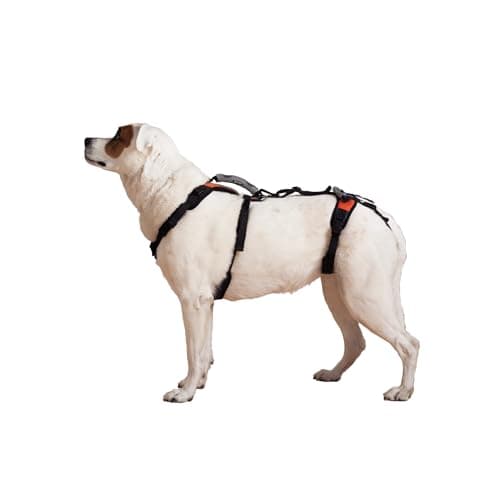
Help 'Em Up
Help 'Em Up Harness
Our score
$95–$155
Best for
Long-term mobility support for senior or post-surgical large dogs
If your dog needs help getting up multiple times a day for the foreseeable future — post-TPLO, advanced hip dysplasia, hindquarter weakness in giant-breed seniors — this is the one to buy. It is the only harness in the category that supports the front and the back independently, which is what a dog with a bad hip and a compensating shoulder actually needs. Buy it from the manufacturer, not from Amazon: re-verified 18 August 2026, helpemup.com prices by size at $80 / $95 / $110 / $125 / $140 while Amazon runs $95 / $110 / $125 / $140 / $155 — a uniform $15 more at every size, every time we have checked.
Pros
- Two-piece (chest + hip) design lets you support either end independently
- Hip handle is purpose-built — not a converted car-seat-belt strap
- Padded chest plate distributes weight better than sling-only options
- Five sizes span 10 to 225 lb, and the rear half can be ordered a size smaller for a dog with muscle wasting
- Two hip-lift styles (Conventional and U-Band) so male dogs are not soiling the strap
Cons
- Amazon runs a uniform $15 above the maker's own price at every one of the five sizes, and the Amazon buy box is held by a third-party reseller (Veterinary Preferred) rather than by the brand — re-verified 18 August 2026
- The maker's own Mix & Match page prints two different starting prices, "From $80" and "FROM $95 USD", on the same page
- Direct pricing is no longer flat: since mid-August 2026 the maker charges $80 to $140 by size, so a giant-breed owner now pays $60 more than a terrier owner
- On 29 August 2026 the linked Amazon Medium (B0DK81SCG5) showed a future availability date rather than units on hand, while every size and style was in stock at helpemup.com the same day; on 9 September and again on 12 September 2026 the Amazon Medium still showed the future-date status at $125.00 with a maximum order of one and no ship date given, while all nine direct variants were in stock — two weeks of backorder on the channel we earn from, and one more reason the direct channel is the one to use
- Sizing is critical — measure twice, return is a hassle
- Rear straps can chafe the inner thigh if the harness is left tight while the dog lies down
- A dog filmed or gait-assessed while wearing it looks less lame than he is, because the harness offloads the limb you are trying to judge
- Bulkier than a quick-grab sling for short-term use
For the dog that struggles to rise or needs steadying on stairs, the Help 'Em Up is a two-piece harness with real handles at the shoulders and hips, so you can assist either end without hauling on the neck or scruff. It stays on all day, which matters for a dog that needs help four times before lunch. We used to describe this as "what rehab professionals reach for." We have no survey of rehab professionals, so that line is gone; the case for it is the two-piece design, not a claim about who uses it.
One thing to buy it from the right place: it is $80 flat direct in every size, while Amazon ran $95 to $155 depending on size when we verified both channels, with the Amazon buy box held by a third-party reseller rather than the brand.[15] We link Amazon because that is the programme that funds this site. Buy it direct anyway.
From there, the fixes are condition-specific: traction for slick floors, support gear for weak back legs, and the full mobility aid roundup for ramps, steps, and slings.
The bottom line#
Your dog cannot tell you how much pain he or she is in. But dogs do show it — in shortened walks, slow mornings, skipped jumps, a lick spot, a changed greeting at the door. Trust the change you see, refuse the two myths, film it, and book the exam. Pain in dogs is measurable, and far more often than owners expect, it is treatable — at every age, at every stage.
The worst outcome is not a scary diagnosis. It is a dog who hurt for years while everyone around him called it getting old. You have read the checklist; you will not be that house.
Frequently asked
- How can I tell if my dog is in pain?
- Watch for change, not crying. The reliable signs are quiet: slower to stand, hesitating at stairs, shorter walks, licking one joint, a hunched posture, restlessness at night, panting at rest, irritability when touched, and withdrawing from the family. Any change in movement or behavior that persists more than a few days deserves a vet visit rather than wait-and-see.
- Do dogs cry or whine when they are in pain?
- Rarely, and usually only with sudden, severe pain. Chronic pain — arthritis, back pain, hip dysplasia — is almost always quiet. The Merck Veterinary Manual makes the point starkly: dogs may wag their tails and greet observers despite being in pain. Waiting for a yelp before acting means missing months or years of treatable pain. Silence tells you nothing about comfort.
- Why do dogs hide pain?
- The usual explanation is inherited survival behavior — that an animal advertising weakness invited predators and rivals, so the concealers survived. That story is plausible and it is not something anyone has tested in dogs, so we will not present it as fact. What is documented is the behavior itself: pain in animals is routinely masked by species-typical behavior, and dogs will greet you and wag while hurting. Whatever the reason, the practical consequence is the same. The burden of noticing falls on you.
- What can I give my dog for pain at home?
- Nothing from a human medicine cabinet. Ibuprofen, naproxen, and acetaminophen are toxic to dogs — even a tablet or two can cause stomach ulcers, kidney failure, or liver damage, and these poisonings kill dogs every year. Safe, effective canine pain medication exists, but it is prescription-only. Call your vet, or an emergency clinic after hours if your dog is in real distress.
- Is my dog slowing down just because of old age?
- Old age is not a disease — that is a core principle of senior veterinary care. When an older dog slows down, the most common hidden cause is musculoskeletal pain, usually osteoarthritis, and it is treatable at every stage. Book an exam before accepting a slower dog as the new normal; many owners say their dog acts years younger once pain is controlled.
- How do vets actually measure pain in dogs?
- With validated scoring tools, not guesswork. The Glasgow Composite Measure Pain Scale scores acute pain from observed behavior, and the Canine Brief Pain Inventory is a validated owner questionnaire for chronic pain such as arthritis. Your observations at home feed both — which is why a short phone video of the behavior that worries you is one of the most useful things you can bring to an appointment.