Mobility Guide
Senior Dog With Weak Back Legs: How to Help Them Stand, Walk, and Keep Going
A senior dog with weak back legs needs a vet visit to find the cause, then the right support harness, traction at home, and a smarter walk routine. The full plan.

A senior dog with weak back legs usually needs four things: a vet visit to find out why, a support harness matched to the moment the legs fail, traction on every slick floor, and shorter, more frequent walks to protect the muscle that's left. The first question to answer is whether it hurts, because painful weakness and painless weakness are different diseases with different plans. Most of what helps is small fixes that stack, not equipment.
Affiliate disclosure: Dog Orthopedic is reader-supported. When you buy through links on our site we earn a commission at no extra cost to you — about 3% on most pet products, and the same rate on every product we compare, so no pick earns us more than another. Prescription medication earns us nothing, and seeing your vet earns us nothing; we recommend both anyway. Learn more.
Imagery: Lifestyle photographs on this site are licensed from Pexels (royalty-free) and credited per image. Pexels imagery illustrates conditions and contexts — it does not depict the specific dogs or test sessions described in the text. Product photographs come from Amazon's Creators API. Breed portraits are illustrations of typical breed type rather than photographs of individual dogs, and are not drawn to scale against one another.
Why do a senior dog's back legs go first?#
You notice it in small ways before you let yourself name it. The sit that has become a controlled fall. The extra try it takes to get up off the kitchen tile. The back paws that slide out sideways in the hallway, and the look your dog gives you afterward — as if he did something wrong. He didn't. His back end is doing what aging hind ends do, and there is more you can do about it than most owners realize.
Three things gang up on the hindquarters at once:
- Arthritis settles in the rear. Hips, knees, and the lower spine absorb a lifetime of running and jumping, so that is where cartilage wears and pain concentrates. Merck describes hip lameness as worst "after exercise" or "shortly after rest," and names the bunny-hopping gait as a sign in its own right.[1] A dog in hind-end pain shifts weight forward and quietly stops using the rear.
- Age strips muscle. This has been measured. When healthy old Labradors (over eight) were compared with healthy young ones matched for body condition, the old dogs had significantly less epaxial muscle — the muscle running along the spine — on ultrasound, which is the syndrome called sarcopenia.[2] Two honest limits on that study: nine young dogs against ten old ones, all one breed, and it did not measure the thigh muscles owners actually notice. It is the best direct evidence that old dogs lose muscle while looking the same weight on the scale.
- The two feed each other. Pain leads to less use, less use melts muscle, less muscle means less stability, and less stability makes every slip more likely. By the time weakness is visible, that spiral has usually been running quietly for months. This is also why "he's just old" is the expensive answer: the profession's own senior-care guidance opens by reminding vets that "old age is not a disease."[3]
The front end is a dog's steering; the rear end is the engine. When the engine fades, the specific failures owners report are predictable: standing up from the floor, stairs, the car, and the last third of the walk.

“Because your dog can't tell you how much pain he or she is in.”
See a vet to find out why — before you buy anything#
Weak back legs is a symptom, not a diagnosis. Several very different conditions look nearly identical from across a room:
- Osteoarthritis and hip dysplasia — the most common causes, and the most treatable. Painful, gradual, and responsive to weight control, prescription pain relief, and the tools below.
- Degenerative myelopathy (DM) — a progressive, noninflammatory degeneration of the spinal cord. The hallmark is weakness without pain: wobbling, legs crossing, paws knuckling over. It is caused by a mutation in the SOD1 gene, inherited in an autosomal recessive pattern with incomplete penetrance, affects German Shepherds, Pembroke Welsh Corgis, Boxers, Rhodesian Ridgebacks and Chesapeake Bay Retrievers among others, and usually starts after age eight.[4][5] Merck states plainly that there is "no specific treatment" and "no evidence that glucocorticoids, other drugs, or supplements alter the course of the disease," and that most dogs are euthanized because of disability within one to three years of diagnosis.[4] Our full guide is here.
- Intervertebral disc disease (IVDD) — a slipped or ruptured disc pressing on the spinal cord, and the most common cause of sudden hind-limb weakness or paralysis in dogs.[6] Often painful, sometimes sudden, and in severe cases a true surgical emergency.
- Degenerative lumbosacral stenosis — nerve compression where the spine meets the pelvis, a recognised cause of pain and hind-limb signs in older large-breed dogs.[7] It is worth knowing that this one often responds to non-surgical care: in a series of dogs treated medically with restricted exercise plus anti-inflammatory and analgesic drugs, 17 of the 31 available for follow-up (55%) were managed successfully, while 10 went on to surgery.[8]
- Cruciate ligament tears — a partial tear in each knee can read as vague "hind end weakness" rather than a limp. This is commoner than owners expect once one knee has gone: in 831 dogs of 15 kg or more that blew a cruciate at eight years or older, 19.1% ruptured the other side, at a median of 12.9 months later.[9] Note the direction of that finding: it is lower than the 40–50% figure that circulates online, and the risk fell rather than rose with age.
One more that belongs on this list and almost never appears on it. If your dog is receiving Librela (bedinvetmab), the monthly arthritis injection, tell your vet when the weakness started relative to the injections. In December 2024 the FDA published a Dear Veterinarian Letter reporting adverse events in treated dogs that included ataxia, paresis, recumbency and urinary incontinence, with death reported as an outcome in some cases.[10] These are voluntary reports and cannot show the drug caused anything — but this is exactly the population where a new neurologic sign gets filed under "she's getting older," and the timing is information only you have.
These are treated completely differently, which is why the exam comes before the shopping. A vet will watch your dog walk, test paw placement reflexes, flex the joints, and tell you whether you are managing arthritis, a spine problem, or both. The single most useful thing you can report is whether it hurts: painful and gradual points toward arthritis, painless and progressive points toward degenerative myelopathy, painful and sudden points toward a disc. Gear bought for the wrong problem wastes money at best; at worst it hides a condition that needed treatment this week.

One more reason to go: dogs hide pain well, and under-treated pain masquerades as "just slowing down." Our guide to how to tell if your dog is in pain covers the subtle signs, but the short version is that a vet can find pain you cannot.
The toolkit: match the aid to the moment that fails#
Mobility aids for senior dogs with failing back legs sort themselves out quickly once you stop shopping by category and start shopping by the specific moment your dog fails. Fix that moment. Skip the rest.
"My dog can't get up from the floor"#
This is the job for a full-time harness with handles — one your dog wears all day, so help is always one grab away and a 3 a.m. bathroom trip doesn't start with wrestling gear onto a tired dog. The Help 'Em Up is a two-piece design with a padded chest plate and a separate hip piece, so you can lift the front, the rear, or both independently. We used to call it "the one rehab vets prescribe." We have no survey of rehab vets and have cut the line; the case for it is the two-piece design, which is what a dog failing at the back and overloading the front actually needs.
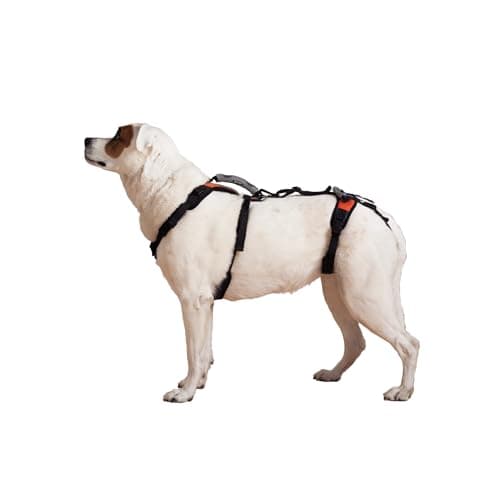
Help 'Em Up
Help 'Em Up Harness
Our score
$95–$155
Best for
Long-term mobility support for senior or post-surgical large dogs
If your dog needs help getting up multiple times a day for the foreseeable future — post-TPLO, advanced hip dysplasia, hindquarter weakness in giant-breed seniors — this is the one to buy. It is the only harness in the category that supports the front and the back independently, which is what a dog with a bad hip and a compensating shoulder actually needs. Buy it from the manufacturer, not from Amazon: re-verified 18 August 2026, helpemup.com prices by size at $80 / $95 / $110 / $125 / $140 while Amazon runs $95 / $110 / $125 / $140 / $155 — a uniform $15 more at every size, every time we have checked.
Pros
- Two-piece (chest + hip) design lets you support either end independently
- Hip handle is purpose-built — not a converted car-seat-belt strap
- Padded chest plate distributes weight better than sling-only options
- Five sizes span 10 to 225 lb, and the rear half can be ordered a size smaller for a dog with muscle wasting
- Two hip-lift styles (Conventional and U-Band) so male dogs are not soiling the strap
Cons
- Amazon runs a uniform $15 above the maker's own price at every one of the five sizes, and the Amazon buy box is held by a third-party reseller (Veterinary Preferred) rather than by the brand — re-verified 18 August 2026
- The maker's own Mix & Match page prints two different starting prices, "From $80" and "FROM $95 USD", on the same page
- Direct pricing is no longer flat: since mid-August 2026 the maker charges $80 to $140 by size, so a giant-breed owner now pays $60 more than a terrier owner
- On 29 August 2026 the linked Amazon Medium (B0DK81SCG5) showed a future availability date rather than units on hand, while every size and style was in stock at helpemup.com the same day; on 9 September and again on 12 September 2026 the Amazon Medium still showed the future-date status at $125.00 with a maximum order of one and no ship date given, while all nine direct variants were in stock — two weeks of backorder on the channel we earn from, and one more reason the direct channel is the one to use
- Sizing is critical — measure twice, return is a hassle
- Rear straps can chafe the inner thigh if the harness is left tight while the dog lies down
- A dog filmed or gait-assessed while wearing it looks less lame than he is, because the harness offloads the limb you are trying to judge
- Bulkier than a quick-grab sling for short-term use
Buy it direct. It is $80 flat in every size from the manufacturer, while Amazon ran $95 to $155 depending on size when we checked both, with the Amazon buy box held by a third-party reseller rather than the brand.[11] We link Amazon because that is the affiliate programme that funds this site, and we would rather tell you it is cheaper elsewhere than pretend otherwise.
Sizing is the one place people go wrong — measure twice before ordering, because returns are a hassle, and note that the Mix & Match option most wasted-hindquarter dogs need (a smaller rear than front) starts at $95 direct, a $15 premium nobody discloses.[11] One caveat worth knowing before you film your dog for the vet: a dog wearing this harness looks less lame than he is, because it offloads the limb you are trying to assess. Take the video with it off. A rolled towel under the belly works for a weekend; it does not work for months of daily lifts, for your dog's comfort or for your back.
"My dog starts the walk strong, then the back end sags"#
If your dog stands and potters fine but fades mid-walk, you don't need all-day equipment — you need walk-time support you can put on in seconds. The GingerLead is a padded rear sling with an integrated leash, made in male and female versions so it doesn't interfere with peeing. To support a senior dog walking on a fading rear, you hold the sling handle lightly and let the dog do the work, taking up slack only when the hips dip. It was $69.95 on Amazon and the same price direct, the chest harness is not included, and the return window is 10 days clean.[12]

GingerLead
GingerLead Dog Support and Rehabilitation Harness
Our score
$32–$70
Best for
Short-term post-surgical assistance and rear-end weakness
The right tool for one specific job: a dog whose back end has failed while his front end is still working. In the first four to six weeks after hip or stifle surgery, or for a senior who can get his front paws onto the sill of a car but cannot follow through, it is faster to fit than a full harness and it costs less. It is not a general mobility aid — it does nothing for the front half of the dog, and the maker expects you to buy a chest harness separately for older dogs. Size it with the towel test before you order, because the 10-day return window is short for a product whose commonest failure is sizing. If your dog needs help at both ends, or will need help for more than a couple of months, buy the Help 'Em Up Harness instead — though note that is no longer a $10 decision: Help 'Em Up prices by size direct ($80 XS to $140 XL, re-verified 18 Aug 2026), so the medium-to-large dog this sling fits pays $110 or $125 there against $69.95 here.
Pros
- Single-piece sling — fast to put on for bathroom trips
- Cutout in the support pad clears male anatomy, so it can be left in position without soiling
- Integrated leash takes one accessory off your hands, and detaches if you don't want it
- Machine washable and dryable, which matters more than it sounds on a post-surgical dog
- No Amazon markup — $69.95 on Amazon and $69.95 direct from the manufacturer, re-verified 12 September 2026 (Amazon via the Creators API, direct from the Med/Lg product page)
- The maker sells reconditioned units — inspected, laundered and re-packaged, "Save up to 45%". We have never observed the reconditioned price itself, so treat this as arithmetic rather than a quote: 45% off the $69.95 Medium/Large is about $38 at the maximum discount, and less at anything below it. (Corrected 2026-09-05 — we previously printed "roughly $45", which was the Amazon behind-the-buy-box offer of $44.95 conflated with the direct discount.)
- Manufacturer publishes a free towel test that sizes the sling before you spend anything
- Credit where it is due: as of 1 September 2026 the Amazon listing carries "CHEST HARNESS NOT INCLUDED" in capitals in its first feature bullet and in the retail title. This was the single most commonly missed thing about the product and the maker now says it before you click buy
- Stay-on straps are included, which is what stops the sling sliding backwards on a dog with wasted hindquarters
Cons
- Rear-end only — not the right tool if a dog also needs front support
- Chest harness is not included, and the maker's own copy recommends clipping the leash to one for older dogs
- Only a 10-day clean return window; days 11–30 carry a $10 restocking fee and nothing is refunded after 30
- Long-term use can rub thighs without careful fitment
- Strap-end handles are less ergonomic than padded handles
- Sized by pad width and by the dog's sex, not by a simple size ladder — easy to order wrong
- The Amazon listing contradicts itself on the weight floor — one bullet says "FEMALE dogs over 45 lbs and MALE dogs over 60 lbs", another says "dogs weighing over 45 pounds" flat (both live 19 Aug 2026)
- On Amazon the cheaper of the maker's two offers on this ASIN is not the one in the buy box, so the default click costs $25 more — and as of 1 September 2026 that cheaper $44.95 offer is no longer straightforwardly buyable: the same merchant now returns it as AVAILABLE_DATE with an empty message (backorder), where on 19 August it showed 7 units in stock. Corrects our own earlier advice — opening the other-offers panel is still worth doing, but it may no longer save you anything today
For dogs whose rear-end weakness is chronic and progressing — degenerative myelopathy, advanced hip arthritis — the Walkin' Buddy Up rear harness is built for daily long-term rear support rather than quick trips, and it costs less than the Help 'Em Up. It was $59.95 for the Large; we previously printed a $60–$110 range on this page, which was too high.[13]
Its real argument for a progressive disease is not the price: it attaches to a Walkin' Wheels cart, which most rear-support gear does not, so the harness you buy today still works the day your dog needs wheels. Its real drawback is that it is a module rather than a system — the manufacturer's own listing tells you to pair it with a front harness for full body support, so for an ascending disease this is the first of two purchases. It is also less padded than the Help 'Em Up, which counts against it for a dog wearing it most of the day.

Walkin' Pets
Walkin' Buddy Up Rear Harness
Our score
$39.95–$59.95
Best for
A dog with stable, non-progressive hind-end weakness whose front legs are sound — advanced hip arthritis, a healed spinal injury — where the rear half is all you will ever need. No longer the right buy for degenerative myelopathy
We can no longer recommend this for a progressive disease, and that is a reversal of what this page used to say. The harness itself is sound and the cart compatibility is still the best reason in the category to choose it — but Walkin' Pets has stopped selling the line, the front half you were told to add later cannot be bought, and what remains on Amazon is a reseller working through stock. For a dog with a stable rear-end problem who needs a good harness now and will never need a second one, at $40–$60 it is still a fair buy. For a dog with degenerative myelopathy, buy a two-piece system that will still exist in a year.
Pros
- Built for chronic rear support rather than short post-op trips, with a top handle you guide and lift from rather than a strap you hold under the belly
- Attaches to a Walkin' Wheels cart, which matters enormously for a progressive disease — most rear-support gear does not, and a harness that cannot connect to the cart your dog ends up in is a purchase you make twice
- Sized on abdomen girth as well as bodyweight, which is the dimension that actually decides fit on a barrel-chested or a wasted dog
- Neoprene contact surfaces, and it stays on between lifts
Cons
- Walkin' Pets no longer sells this harness. As of 14 August 2026 the word "Buddy Up" appears nowhere in the manufacturer's 69-product store feed or its 70-URL product sitemap, and the old product URLs return 404. What is left on Amazon is reseller stock
- The companion front harness — the one the maker's own listing tells you to "pair with... for full body support" — cannot be found on sale anywhere we looked, including a descriptive Amazon search that surfaces all three remaining sizes of the rear. The modularity this product was sold on is gone, and the Amazon bullets still advertise it
- The maker has now answered the question itself. On 4 September 2026 walkinpets.com/products/buddy-up-harness-rear — the Buddy Up rear product URL, which returned 404 on 14 August — resolves to the **Help 'Em Up Harness** page instead. A redirect to a different product is a manufacturer telling you what to buy in its place, and it is the clearest discontinuation receipt we have
- The Amazon buy box is held by a third-party reseller, "Veterinary Preferred," not by Walkin' Pets. There is no manufacturer behind your purchase in the ordinary way, and no replacement path when the neoprene wears out
- Walkin' Pets publishes no warranty at all — its site carries a refund policy and a privacy policy and nothing else. And its returns terms are harsh for exactly this buyer: no exchanges of any kind, a restocking fee of 8–12%, and a harness returned "heavily soiled with strong pet odors, embedded fur [or] visible stains" is graded ineligible for any refund
- Less padded than the Help 'Em Up, which tells against it for a dog wearing it most of the day
- Not suitable as front-end support on its own
- Determined dogs back out of it without close fitment — measure before ordering
We compare all three in detail — fit, chafe points, wear time — in our lift harness roundup.
"My dog slips and splays on the smooth floors"#
Slick floors are where weak hind legs actually fail. A young dog catches a small slide; a weak senior goes down, and one bad splay-legged fall can injure a joint and leave lasting fear of a whole room. The two-part fix is traction on the dog and traction on the floor: ToeGrips on the nails, rug runners along the routes your dog actually walks. ToeGrips were $39.99, and unusually there is no Amazon markup — the maker charges the same.[14] We have no controlled trial showing they change outcomes, and the free half of this fix — runners on the routes your dog actually uses — does much of the same work. Do the runners first.
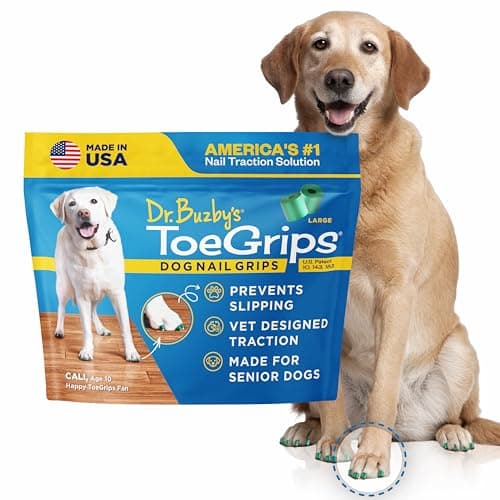
Dr. Buzby's
Dr. Buzby's ToeGrips for Dogs
Our score
$34–$40
Best for
Senior dogs slipping on hardwood, tile, or laminate floors
The best dog-mounted traction fix there is, and the one to buy once rugs have taken you as far as they can. Nothing touches the paw pad, which is why dogs tolerate these where they refuse socks and boots. Go in knowing the real cost: this is not a $40 purchase but a $240–$320 a year habit, so lay runners along your dog's actual routes first and buy grips for the floors you cannot cover.
Pros
- Veterinarian-developed; in clinical use for over a decade
- Slip onto each toenail — no socks, booties, or adhesives required
- Restores traction immediately, especially on hard floors
- Nothing touches the paw pad, so dogs accept them where they refuse boots
- Amazon and the manufacturer both charge $39.99 — no retailer markup
- 20 grips per bag against the 16 a dog wears, so a set includes four spares
Cons
- The only two published studies of nail grips both tested this exact product, and both were null: Roush 2017 (Front Vet Sci 4:111 — 15 sound dogs, kinetic changes "unlikely to be clinically relevant") and Repac 2022 (Animals 12(18):2312 — 30 dogs two weeks post-TPLO vs sham, no difference in weight bearing or limb function, including the owner question that asked specifically about slippery floors). Fair caveats: small samples, one used healthy dogs, the other a single early post-op timepoint — but "no positive trial exists" is the honest label, and we say it while still recommending the product for the mechanism and the owner-reported traction stories it was never tested against (verified 2026-08-14).
- A recurring cost, not a one-off. The maker publishes two different bag lives — "1–2 months" on its store page and "1-3 months, two months on average" in its FAQ (both read 2026-09-05) — which spans $160–$480 a year at $39.99. Plan on $240–$320, the two surfaces' central figures
- The Amazon listing markets specifically to dogs with "ACL injuries" — the one population where a randomised trial has been run, and where it found nothing (Repac 2022). The same bullets carry three claims with no source we could find: "more than 250,000 paws," "America's #1 nail traction solution," and "recommended by thousands of veterinarians worldwide" (listing copy verified 2026-08-17). Re-read 2026-08-31: a fourth unsourced superlative has been added to the top bullet on all four Amazon sizes — "The Only Toenail Grips for Dogs With GripZone Technology" — and the Large listing's title now leads with "Instant Traction on Wood/Hardwood Floors."
- The maker sells Scotch Super Glue Gel at $4.99 on its own store, listed as an "Alternate ToeGrips Application Method" (shop.toegrips.com, 2026-08-31). Read that as what it is: the company's own answer to the grips coming off, priced separately and not mentioned on the Amazon listing you are most likely to buy from.
- Application needs isopropyl rubbing alcohol, which is not in the box
- Initial application takes 15–20 minutes for a full set
- Some dogs chew them off in the first week
- Amazon carries only four of the seven sizes; XS, XXL and XXXL dogs have to buy direct
- Sizing by weight chart alone often misses — the accurate method needs dental floss and a ruler
Traction deserves its own plan — our guide to dogs slipping on hardwood floors covers the room-by-room layout and what to skip.
"My dog can't manage the stairs anymore"#
Don't push through it; stairs are the highest-consequence surface in the house for a weak rear end. Put a baby gate at the top for unsupervised hours, spot your dog with the hip handle of a support harness on the way down, and read our full guide to helping a senior dog with stairs for the ramp, carry, and rebuild options.
"My dog can't get into the car"#
End the jump — the jump down out of an SUV is one of the hardest single loads normal life puts on sore joints. A vehicle ramp fixes it for good, and shallower is better; our dog ramp guide includes the incline math by vehicle height.
What should change in the daily routine?#
Items to help senior dogs walk better matter less than how you use the day. Five adjustments compound:
- Shorter, more frequent walks. Two or three 5–15 minute outings beat one long march. The goal is muscle maintenance and sniffing, not distance. There is one study that speaks to this directly, and it is worth knowing both what it found and how weak it is: in 50 dogs with degenerative myelopathy, those given intensive daily physiotherapy survived a mean of 255 days from diagnosis, against 130 days with moderate physiotherapy and 55 days with none, and stayed walking longer.[15] Now the caveats, because a fivefold survival difference is the kind of number that gets quoted without them: the title itself says suspected degenerative myelopathy, meaning most cases were not confirmed at post-mortem; only 22 of the 50 dogs received any physiotherapy at all; the groups were nine, six and seven dogs; owners were not randomised, so the families who could manage daily physiotherapy may simply have been the families with more time, money and a more determined dog. Take it as a real reason to keep your dog moving, not as a promise about months.
- Warm up first. A few minutes of slow indoor walking before the real walk helps a stiff dog start moving comfortably, especially on cold mornings.
- Rearrange the floors. Runners along the routes between bed, bowl, and door. Food and water on a non-slip mat, on the ground floor.
- Upgrade the sleeping surface. A supportive, firm orthopedic bed is easier to stand up from than a soft pillowy one — pushing up out of a marshmallow is its own workout.
- Keep weight and nails down. Every extra pound rides on the weak joints, and overgrown nails make slipping worse.
When weakness starts a bigger conversation#
Sometimes the honest answer is that the tools are no longer enough. If your dog needs full support for every stand, falls even with help, can no longer control bladder or bowels, or has stopped enjoying the things that made him him — meals, greetings, the sunny spot — it is time for a longer conversation with your vet about pain control, and eventually about quality of life.
Two things help that conversation stay clear-eyed. First, keep a simple journal of good days and bad days; trends are easier to see on paper than in the fog of daily caretaking. Second, ask your vet for a structured quality-of-life scale to score at home — having numbers to revisit each week is kinder than deciding from a single bad night.
The gear in this guide is not about denying that ending. It is about making sure the road to it is longer, safer, and more comfortable — and that the days in between are still good ones.
The bottom line#
- Vet first. Weak back legs has a cause, and the cause decides the plan. Emergency signs — sudden collapse, dragging, incontinence — mean the ER now.
- Match the harness to the failing moment. All-day handles (Help 'Em Up) for dogs that can't rise; a walk-time sling (GingerLead) for dogs that sag; a budget rear harness (Walkin' Lift Combo) for chronic rear weakness.
- Fix the floors. ToeGrips plus runners turn the most dangerous surfaces in the house back into safe ones.
- Walk shorter, more often. Movement is the medicine you control.
- Stay honest. Track the good days, treat the pain, and let the tools buy your dog the time they are designed to buy.
Frequently asked
- Why is my senior dog's back end getting weak?
- The three common causes are osteoarthritis, age-related muscle loss (sarcopenia) that hits the large hindquarter muscles hardest, and neurologic disease such as degenerative myelopathy, IVDD, or lumbosacral disease. From across a room they look alike — wobbling, sagging, trouble rising — but they are treated completely differently. That is why the order of operations is a veterinary exam first, gear second.
- When are weak back legs in a dog an emergency?
- Go to an emergency vet immediately if your dog suddenly cannot stand, drags one or both back legs, knuckles the paws so the tops scrape the ground, cries out when touched near the spine, or loses bladder or bowel control. These signs can mean a spinal cord problem such as a herniated disc, and the window for the best treatment outcome can be a matter of hours, not days.
- What is the best harness for a senior dog with weak back legs?
- Match the harness to the moment of failure. For a dog that needs help many times a day, the Help 'Em Up ($80 flat direct in every size, $95–$155 on Amazon as of 5 August 2026) stays on all day and has padded handles at the shoulders and hips. For weakness that only shows up on walks, the GingerLead sling ($69.95, same price in both channels) goes on and off in seconds. The Walkin' Buddy Up rear harness ($59.95 for the Large on 11 August 2026 — we previously printed $60–$110, which was too high) is the budget option for chronic rear-end support, and it attaches to a Walkin' Wheels cart, which matters if the disease is progressive.
- Can a dog regain strength in weak back legs?
- Sometimes, and it depends entirely on the cause. When arthritis pain is the driver, veterinary pain control plus short, frequent walks and traction at home lets many dogs rebuild real muscle. Weakness from degenerative myelopathy does not reverse; management there is about support gear and quality of life. Either way, keeping the dog moving safely preserves strength — full rest makes almost every cause worse.
- Should I still walk a senior dog with weak back legs?
- Yes, unless your vet has said otherwise. Movement preserves the muscle that keeps your dog upright; total rest speeds the decline. Swap one long daily walk for two or three short ones of 5–15 minutes, keep the pace slow and sniffy, avoid steep hills, and use a rear sling on days the back end sags. Stop for the day if the rear paws start scuffing or dragging.
- Can I give my dog ibuprofen for weak back legs?
- No. Ibuprofen, naproxen (Aleve), and acetaminophen (Tylenol) are toxic to dogs — a single 200 mg ibuprofen tablet can be dangerous for a small dog, and repeated doses cause stomach ulcers and kidney damage in dogs of any size. If pain is behind the weakness, your vet can prescribe an NSAID that is actually tested and dosed for dogs. Never share your own medication.