Dr. Buzby's
Dr. Buzby's ToeGrips for Dogs
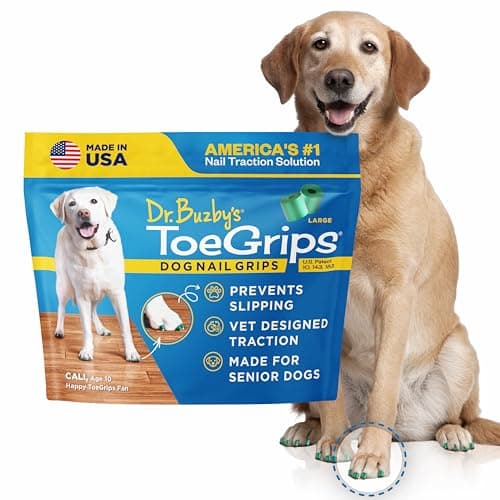
$34–$40
Check price on AmazonWe earn a commission if you buy through this link. It does not change what we recommend or how we score it — see our affiliate disclosure.
Best for
Senior dogs slipping on hardwood, tile, or laminate floors
The best dog-mounted traction fix there is, and the one to buy once rugs have taken you as far as they can. Nothing touches the paw pad, which is why dogs tolerate these where they refuse socks and boots. Go in knowing the real cost: this is not a $40 purchase but a $240–$320 a year habit, so lay runners along your dog's actual routes first and buy grips for the floors you cannot cover.
What works
- Veterinarian-developed; in clinical use for over a decade
- Slip onto each toenail — no socks, booties, or adhesives required
- Restores traction immediately, especially on hard floors
- Nothing touches the paw pad, so dogs accept them where they refuse boots
- Amazon and the manufacturer both charge $39.99 — no retailer markup
- 20 grips per bag against the 16 a dog wears, so a set includes four spares
What doesn't
- The only two published studies of nail grips both tested this exact product, and both were null: Roush 2017 (Front Vet Sci 4:111 — 15 sound dogs, kinetic changes "unlikely to be clinically relevant") and Repac 2022 (Animals 12(18):2312 — 30 dogs two weeks post-TPLO vs sham, no difference in weight bearing or limb function, including the owner question that asked specifically about slippery floors). Fair caveats: small samples, one used healthy dogs, the other a single early post-op timepoint — but "no positive trial exists" is the honest label, and we say it while still recommending the product for the mechanism and the owner-reported traction stories it was never tested against (verified 2026-08-14).
- A recurring cost, not a one-off. The maker publishes two different bag lives — "1–2 months" on its store page and "1-3 months, two months on average" in its FAQ (both read 2026-09-05) — which spans $160–$480 a year at $39.99. Plan on $240–$320, the two surfaces' central figures
- The Amazon listing markets specifically to dogs with "ACL injuries" — the one population where a randomised trial has been run, and where it found nothing (Repac 2022). The same bullets carry three claims with no source we could find: "more than 250,000 paws," "America's #1 nail traction solution," and "recommended by thousands of veterinarians worldwide" (listing copy verified 2026-08-17). Re-read 2026-08-31: a fourth unsourced superlative has been added to the top bullet on all four Amazon sizes — "The Only Toenail Grips for Dogs With GripZone Technology" — and the Large listing's title now leads with "Instant Traction on Wood/Hardwood Floors."
- The maker sells Scotch Super Glue Gel at $4.99 on its own store, listed as an "Alternate ToeGrips Application Method" (shop.toegrips.com, 2026-08-31). Read that as what it is: the company's own answer to the grips coming off, priced separately and not mentioned on the Amazon listing you are most likely to buy from.
- Application needs isopropyl rubbing alcohol, which is not in the box
- Initial application takes 15–20 minutes for a full set
- Some dogs chew them off in the first week
- Amazon carries only four of the seven sizes; XS, XXL and XXXL dogs have to buy direct
- Sizing by weight chart alone often misses — the accurate method needs dental floss and a ruler
Specifications
- Materials
- Natural rubber
- Sizes
- XS (yellow) — 0–7 lb · S (red) — 8–14 lb · M (blue) — 15–39 lb · L (green) — 40–74 lb · XL (purple) — 75–99 lb · XXL (orange) — 100–124 lb · XXXL (navy) — 125 lb and up
- Warranty
- 30-day money-back guarantee (manufacturer)
- Made in
- USA
What you are actually buying, and what it costs
The pitch on this product is a $40 fix. The truth is that it is a subscription, and we would rather you knew that before the first bag than after the fourth.
A bag is $39.99, and that is the price at both Amazon and the manufacturer's own store — worth saying plainly, because two of the other products we recommend most carry a substantial Amazon markup over buying direct and this one does not. The manufacturer's subscription is $33.99.
What is not on the box is how fast you go through them. Dr. Buzby's own copy says a bag lasts one to two months, and that individual grips last one to three months with two months typical. So:
| Per bag | 1 bag every 2 months | 1 bag every month | |
|---|---|---|---|
| Amazon or direct, one-time | $39.99 | $240 / year | $480 / year |
| Manufacturer subscription | $33.99 | $204 / year | $408 / year |
That is the number that should drive the decision, and it is not on the box. It does not make ToeGrips a bad buy — it makes them the second purchase. Rug runners along the four or five routes your dog actually walks are a one-time cost of well under $100 and they fix the floors your dog spends most of his life crossing. Grips are for the surfaces you cannot cover: the kitchen tile, the hallway at the vet, the friend's polished floor at Christmas.
Sizing: the five-minute method that prevents the common failure
A bag contains 20 grips. A dog wears 16 — four per paw, dewclaws excluded — so a correctly sized bag is one full application plus four spares. A wrongly sized bag is $40 you cannot use.
There are seven sizes, not the four Amazon stocks:
| Size | Colour | Ideal bodyweight |
|---|---|---|
| XS | Yellow | 0–7 lb |
| S | Red | 8–14 lb |
| M | Blue | 15–39 lb |
| L | Green | 40–74 lb |
| XL | Purple | 75–99 lb |
| XXL | Orange | 100–124 lb |
| XXXL | Navy | 125 lb and up |
Two practical notes that matter more than the chart. First, the weight band is a shortcut, and nail thickness does not track bodyweight as tightly as the chart implies. The manufacturer's accurate method costs nothing: wrap dental floss around the midshaft of the toenail, mark across both strands with a fine marker where they overlap, stretch the floss flat, and measure between the marks in millimetres. Do all four nails on one front paw and one hind paw, and read them individually rather than averaging — the company says outright that some dogs need a combination of two sizes, which the weight chart can never tell you. If your dog is overweight, size to his ideal weight.
Second, size to the dog you have today. A dog with muscle wasting or weight loss still has the nails he always had; nails do not shrink with the leg. Do not size down because he has lost condition.
The linked ASIN here is the Large (green, 40–74 lb) variant specifically. When we searched Amazon this week, only Small, Medium, Large and X-Large came back — if your dog is under 7 lb or over 99 lb, order from the manufacturer, because the size you need does not appear to be on Amazon at all.
The application step that decides whether the first attempt works
The first attempt fails for one of two reasons, and both are avoidable.
You need isopropyl rubbing alcohol, and it is not in the box. The manufacturer's instructions are to wet each grip in alcohol before pushing it onto the nail. Dry, they will not go on, and people conclude they bought the wrong size.
Snug is correct. Dr. Buzby's own wording is that properly sized ToeGrips fit snugly like Spanx rather than sliding on like Cinderella's slipper. Resistance is the product working as designed, not evidence of a sizing error.
Then the positioning: push the top and sides onto the nail until the nail tip is exposed, and leave the bottom band alone. That lower band is the part that contacts the floor. Push it up the nail and you have installed a decoration. Budget 15–20 minutes for the first full set of 16.
Longevity: what actually ends a set
They do not wear out so much as walk off. Grips migrate as the nail grows out beneath them, which is why the replacement interval tracks nail growth rather than mileage — a dog whose nails are trimmed every three weeks will hold a set longer than one whose nails are left long. The rubber itself also polishes smooth on abrasive outdoor surfaces faster than it does indoors.
The four spares in each bag exist because you will lose individual grips before you lose the set. Check the count once a week; a dog wearing eleven of sixteen has lost the traction on the feet where they came off, which is generally the ones taking the most load.
The post-surgical claim, adjudicated
The listing's own bullets name the buyer directly: "Age, arthritis, ACL injuries, bad hips, hind end weakness causing back legs to give out." That is a large share of the people who arrive on this page, and it is the one group for whom a trial exists — so it deserves a straight answer rather than a sales paragraph.
Thirty dogs were randomised to nail grips (n = 13) or sham grips (n = 17) for the first two weeks after a TPLO, and assessed by blinded observers on day 1 and day 14. Visual lameness scores and total pressure index showed no difference between the groups on day 14 or at any timepoint (p = 0.44 and p = 0.59). Neither did the client-specific outcome measures — walking on slippery flooring (p = 0.78), ability to rise (p = 0.80), and consistent use of the surgical limb on a five-minute walk (p = 0.63). The authors' own summary: the study "did not demonstrate a benefit for dogs wearing nail grips during the first two weeks after TPLO," though the grips were well tolerated and further studies are warranted.
The fair reading is narrow in both directions. It is one early timepoint, in a small sample, and it measured limb function — how much weight the dog put through the operated leg — rather than whether a dog slipped on the kitchen floor and re-injured himself. Nobody has run that second study. So we do not tell post-surgical buyers that grips will improve the leg, because the only trial says they will not. We do say that keeping a dog with a healing bone cut from splaying out on tile is worth doing, and that rug runners along the bed-to-door-to-garden route do it once for well under $100 while grips do it monthly.
Three of the listing's claims we could not substantiate at all and are not repeating as fact: "more than 250,000 paws," "America's #1 nail traction solution," and "recommended by thousands of veterinarians worldwide." Verified present in the listing copy on 17 August 2026; no supporting source published that we could find.
Who should not buy this
- Dogs that chew their feet. A determined chewer strips a set in days and turns a $40 bag into a weekly expense. Solve the chewing first.
- Dogs whose slipping is new, one-sided, or getting worse fast, or who knuckle over, drag a paw, or wear the tips of their nails flat. That is a neurologic presentation and grips will make the floor safer while the underlying problem advances unexamined. Book the appointment, then buy traction.
- Households that can simply lay runners. If the routes are coverable, cover them. Grips are for what is left over.
The cheaper things, first
In order of value per dollar, and the first two cost almost nothing:
- Trim the nails every 2–4 weeks. If you can hear clicking on hardwood, the nails are long enough to tip weight off the pads, and that alone accounts for a surprising share of slipping.
- Clip the fur growing over the paw pads on furry breeds. Ten minutes a month restores skin-to-floor contact.
- Rubber-backed runners along the routes your dog actually walks, with no gaps in the middle of a slick hallway.
- Then ToeGrips, for the floors you cannot carpet.
We have the full ranking, including why socks, boots, and paw wax lose indoors, in our guide to dogs slipping on hardwood floors.
Frequently asked
- How much do ToeGrips actually cost per year?
- More than the sticker suggests, and this is the number to decide on. A bag is $39.99 at both Amazon and toegrips.com. The manufacturer says a bag lasts one to two months, and that individual grips last one to three months with two months being typical. Across both, the running cost for one dog spans $160 to $480 a year, and the two surfaces' central figures — six weeks and two months — give $320 and $240, so plan on $240–$320, or $204–$272 on the manufacturer's own 15% subscription at $33.99 a bag. One instruction lowers it, published in the FAQ and on no retail listing: take the grips off periodically, bin the badly worn ones and reapply any less than 20% worn, rotated to new positions, which the maker says extends their life. None of that makes them a bad product — it makes them a product to buy after rug runners rather than instead of them, because runners are a one-time cost of well under $100 and they cover the routes your dog walks most.
- What size ToeGrips does my dog need?
- There are seven sizes, keyed by colour: XS yellow 0–7 lb, S red 8–14 lb, M blue 15–39 lb, L green 40–74 lb, XL purple 75–99 lb, XXL orange 100–124 lb, XXXL navy 125 lb and up. The weight chart is a shortcut and it misses often, because nail thickness does not track bodyweight reliably. The manufacturer's accurate method takes five minutes: wrap dental floss around the midshaft of the toenail, mark both strands where they overlap with a fine marker, then stretch the floss flat and measure between the marks in millimetres. Measure all four nails on one front paw and one hind paw, and use the individual readings rather than an average — the company notes some dogs genuinely need two different sizes. If your dog is over- or underweight, size to his ideal weight, not his current one.
- Why won't the ToeGrips go on my dog's nails?
- Almost always because you are applying them dry, or because you have assumed a snug fit means the wrong size. The manufacturer's instructions call for wetting each grip in isopropyl rubbing alcohol first, which is not supplied in the box and is the single most common reason a first attempt fails. On sizing, their own guidance is blunt: properly sized ToeGrips are meant to fit snugly like Spanx, not slide on like Cinderella's slipper, so resistance is expected rather than a signal to size up. Push the top and sides onto the nail until the tip is exposed, and do not push the bottom of the grip up the nail — that lower band is the part that has to touch the floor to do anything.
- Do ToeGrips work better than nail caps or adhesive paw pads?
- For most dogs, yes, and the reason is where they sit. ToeGrips are rubber sleeves on the nail tip, so nothing is stuck to the paw pad and nothing changes how the pad feels the ground. The main alternatives take the opposite approach: Dr. McHenry's Toe Treads and the various anti-slip paw stickers are adhesives applied to the pad or the weight-bearing nails, and adhesive products tend to fail on damp, hairy, or greasy pads and have to be cleaned off and redone. Grip socks and boots lose on a different axis — they rotate, fall off overnight, and mute the paw's feel for the floor, which some seniors dislike more than the slipping. Where ToeGrips lose is running cost and the chewing problem.
- Should I buy ToeGrips for a dog recovering from cruciate surgery?
- Buy them for the eight weeks of restriction, not for the surgical leg — and know that the evidence for the second use is negative. Thirty dogs were randomised to nail grips or sham grips for the first two weeks after a TPLO and assessed by blinded observers. There was no difference in visual lameness score or total pressure index at day 14 or at any timepoint, and no difference on the owner-scored outcomes, including the one that asked specifically about walking on slippery flooring (p = 0.78). The grips were well tolerated and the authors call for further study, but nothing in that trial supports the idea that grips improve how a post-surgical dog uses the operated limb. What they can still do is reduce the chance of a splay-legged slip on a hard floor while an osteotomy is healing, which is a household-safety argument rather than a limb-function one, and rug runners along the routes he will actually walk do the same job for a one-time cost. Note also that the Amazon listing markets to dogs with "ACL injuries" by name — that is the exact population the null trial studied.
- Who should not buy ToeGrips?
- Three groups. Dogs that chew at their feet, because a determined chewer will strip a $40 set in a week and you are buying an expensive habit. Dogs whose slipping came on suddenly, is worsening quickly, or comes with knuckling, dragging, or scuffed nail tips — that pattern points at a neurologic problem and traction hardware treats the symptom while the cause advances. And owners whose floors can simply be covered: if the routes your dog walks are three hallways you can put runners down in this afternoon, buy the runners. ToeGrips earn their place on the floors you cannot carpet — the kitchen tile, the vet's waiting room, someone else's house.
Where we recommend it
The articles this product earns a place in, and the context it earns it for.

surgery
TPLO vs TTA: The Decision Your Surgeon Already Made
TPLO vs TTA for a torn cruciate: what each osteotomy does, what the comparative literature actually found, and why the choice is usually made before you walk in — plus the questions that do change the outcome.

conditions
My Dog's DM Test Came Back "At Risk." What Does That Actually Mean?
An at-risk SOD1 result is not a diagnosis and not a forecast. What the three DM genotypes mean, what the 60% figure actually counted, and what the result is genuinely good for.

breeds
Boxer Joint Problems: The Knee, the Spinal Cord, and the Heat Problem Nobody Plans For
The Boxer's lameness is usually the knee, its scariest hind-leg disease is painless, and the heat limits of a short-faced dog quietly rewrite the whole arthritis exercise plan.
breeds
Why Does My Bulldog Move Like That? Bulldog Joint Problems, Ranked by Odds
In a peer-reviewed analysis of 921,046 OFA hip records, the Bulldog had the highest hip dysplasia prevalence of any breed. Here is what the build costs, and why most Bulldogs still never limp.

conditions
My Dog's Back Legs Are Giving Out and He Isn't in Pain — What Is Degenerative Myelopathy?
Painless, progressive hind-leg weakness in a dog over eight points at degenerative myelopathy. What the disease is, how it is diagnosed, what the published evidence says about slowing it, and why it gets named late.
breeds
Pembroke Welsh Corgi Joint Problems: The Back, the Hips, and the One That Doesn't Hurt
A Corgi is built to a written specification: a back 40 percent longer than the dog is tall. Here is what that costs, and why failing back legs in an older Corgi are two completely different diagnoses.

conditions
Why Is My Dog's Muscle Wasting on One Back Leg?
One hind leg thinner than the other usually means the body has been offloading a painful joint for months. Unlike a limp, it is measurable at home. Here is the protocol, and when it is neurologic instead.

conditions
Is My Dog Limping, or Is It Something Else?
Limping, stiffness, weakness, and wobbling look alike from across a room and mean very different things. How to sort your dog into the right category, and which one is an emergency.

surgery
FHO Surgery Recovery in Dogs: A Realistic Timeline
Most dogs put weight on the leg within days of FHO surgery and reach function in three to four months — crate rest is what ruins it. The realistic timeline, and how serious an FHO really is.

conditions
Arthritis in Dogs: Signs, Treatment, and What Actually Helps at Home
How to spot arthritis in dogs early, what veterinary treatment looks like, and the weight, exercise, and home changes that actually reduce pain.

tools
Dog Slipping on Hardwood Floors: Traction Fixes That Actually Work
A dog slipping on hardwood floors needs traction, not luck: rug runner routes, ToeGrips, nail and paw care, and the fixes to skip. Ranked by value.

breeds
German Shepherd Hip Dysplasia: Signs by Age, Odds, and What Actually Helps
About one in four German Shepherds screened in Sweden graded dysplastic. Here are the signs at every age, what OFA and PennHIP each actually measure, and the weight and surgery numbers that decide how it ends.

tools
How to Help a Senior Dog With Stairs: Assist Him Down, Not Up
If you only help in one direction, help him down. Across 552 dogs the forelegs carried a mean 60.4% of standing weight, and descending loads that same front end while he brakes. Assist, adapt, or bypass.

tools
Senior Dog With Weak Back Legs: How to Help Them Stand, Walk, and Keep Going
A senior dog with weak back legs needs a vet visit to find the cause, then the right support harness, traction at home, and a smarter walk routine. The full plan.

surgery
Stairs After TPLO: None for Two Weeks, Sling-Assisted Through Week 8
Stairs after TPLO, week by week: none for weeks 0–2, sling-assisted and only-if-unavoidable through week 8, gradual return after recheck X-rays confirm healing.

recovery
TPLO Recovery Gear: What You Actually Need at Home (2026)
The complete TPLO recovery gear checklist, organized by phase — what's essential in weeks 0–2, what can wait until walks start, and what to skip entirely.

tools
The Best Mobility Aids for Senior Dogs (2026)
Harnesses, ramps, stairs and traction grips — the daily-use mobility tools that keep aging dogs confident on their feet, with every price, size band and load rating verified 14 August 2026.

conditions
Hip Dysplasia in Dogs: Signs, Treatment, and Why to Ask for a PennHIP Number
An OFA grade and a PennHIP distraction index are not the same test — one sorts hips into seven categories, the other measures laxity as a number. What the disease is, how to catch it early, and what actually helps.