Owner's Guide
My Dog's DM Test Came Back "At Risk." What Does That Actually Mean?
An at-risk SOD1 result is not a diagnosis and not a forecast. What the three DM genotypes mean, what the 60% figure actually counted, and what the result is genuinely good for.

An at-risk DM result means your dog carries two copies of a variant in the SOD1 gene. It does not mean he has degenerative myelopathy, and it does not mean he will get it — not all dogs with two copies develop the disease, and the one published figure — 60% — counted owner-reported signs in 30 dogs rather than lifetime penetrance. What the result changes is the shortlist: if this dog's back legs start to fail at nine, degenerative myelopathy moves to the top of the differential instead of sitting fourth behind hips, knees and discs. That is genuinely worth having. It is also all you have bought, and the useful work starts after the email arrives.
Affiliate disclosure: Dog Orthopedic is reader-supported. When you buy through links on our site we earn a commission at no extra cost to you — about 3% on most pet products, and the same rate on every product we compare, so no pick earns us more than another. Prescription medication earns us nothing, and seeing your vet earns us nothing; we recommend both anyway. Learn more.
Imagery: Lifestyle photographs on this site are licensed from Pexels (royalty-free) and credited per image. Pexels imagery illustrates conditions and contexts — it does not depict the specific dogs or test sessions described in the text. Product photographs come from Amazon's Creators API. Breed portraits are illustrations of typical breed type rather than photographs of individual dogs, and are not drawn to scale against one another.
The result answered a question next to the one you asked#
You went looking because of something: a breeder's paperwork, a scuffing back paw, a nine-year-old Shepherd who has started to wobble, or simply the fact that a panel you bought for something else came back with a line on it you did not expect.
The question in your head was about the next three years. The question the swab answered was about the genome, and it answered that one very well. Those are not the same question, and the gap between them has no number in it.
This matters because the result does not arrive looking like a partial answer. It arrives as a bolded phrase — At Risk — on a document from a laboratory, and it reads like a verdict. It is not one. It is a change to a list.
Everything below is about what to do with a changed list.
What the three results actually say#
The Orthopedic Foundation for Animals reports the SOD1 test in three genotypes, and its own descriptions are worth reading in full because they are more careful than most of what gets said about them.[1]
| Result | What the lab found | What it changes today |
|---|---|---|
| Normal (N/N or G/G) | Two normal copies | Very little, and that is the point. If this dog's hind end fails, DM drops a long way down the list and the investigation should go elsewhere |
| Carrier (A/N or A/G) | One mutated copy, one normal | Much lower risk than at-risk, but not zero — see below. Matters most for breeding |
| At Risk (A/A) | Two mutated copies | He is eligible for the disease. Not scheduled for it |
The mutation itself was mapped in 2009, from 38 affected Pembroke Welsh Corgis and 17 related normal controls. The team found a single G-to-A substitution in SOD1 producing an E40K missense mutation, and homozygosity for the A allele was associated with DM across five breeds: Pembroke Welsh Corgi, Boxer, Rhodesian Ridgeback, German Shepherd dog, and Chesapeake Bay Retriever. Spinal cords from affected dogs carried inclusions much like those in people with SOD1-mutation ALS, which is why the paper concludes that canine DM is "the first recognized spontaneously occurring animal model for ALS."[2]
Notice the word in the standard clinical review: the mutation "was found to be a risk factor for DM."[3] Not a cause. The laboratory that identified it says the same thing in owner-facing language: "not all dogs that have the mutation will develop DM so the mutation test is currently a test for risk."[4]
The carrier result is not quite the free pass it reads as#
This is the part almost nobody publishes, and it comes from the largest survey of the allele ever run. In 2014 a team retrospectively analysed genotypes from 33,747 dogs and examined spinal cord sections from 249 of them. The A allele turned out to be widespread — found in cross-bred dogs and in 124 different breeds — while a second variant, SOD1:c.52T, appeared only in Bernese Mountain Dogs.
Then the sentence that should be on every result sheet: most of the dogs with histopathologically confirmed degenerative myelopathy were homozygotes, but eight dogs with histopathologically confirmed DM were heterozygous carriers, with no other sequence variants in their SOD1 coding regions.[5]
Eight dogs out of a very large sample is a small number, and the authors' own conclusion is the one to carry: homozygotes are at much higher risk than heterozygotes. In the low-bias follow-up cohort described in the next section, carriers developed signs at 4% (2 of 55) against 6% (3 of 52) in dogs with two normal copies. The authors ran no significance test on that pair and neither will we, but two dogs against three is not a gap you can build anything on — which is why the honest word for a carrier's risk is lower, not low. But "much lower risk" is a different sentence from "cannot happen," and the difference matters at the exact moment it is being used to close down an investigation. A carrier whose back legs are failing still needs the examination.
The one number people quote at you, and what it actually counted#
The question every owner asks next is: what are the odds. There is a number in circulation, it is roughly 60%, and it is worth knowing exactly what it counted before you carry it around.
It comes from the same 2014 survey. The authors knew that most of their genotypes were badly biased — dogs get tested because somebody is worried — so they carved out the one subset that was not: dogs who had been clinically normal and under 8 years old when their sample was submitted, and who were over 10 years old when their owners were surveyed again years later. That cohort was 137 dogs across 17 breeds, and the result was this.[5]
| Genotype | Dogs in the cohort | Developed signs consistent with DM |
|---|---|---|
| At risk (A/A) | 30 | 18 — 60% |
| Carrier (A/G) | 55 | 2 — 4% |
| Normal (G/G) | 52 | 3 — 6% |
Read the bottom row before the top one. Three dogs with two entirely normal copies of the gene also developed signs consistent with degenerative myelopathy. They almost certainly did not have it. What that row measures is how many ten-year-old dogs develop a wobbly back end for reasons that have nothing to do with SOD1 — arthritis, discs, lumbosacral disease, an old injury — and it is the built-in control that tells you what the 60% is made of.
So the 60% is real, and it is not lifetime penetrance. It counts owner-reported signs, not histopathology. It rests on 30 dogs. Both of its known biases push the same way, upward: the denominator excludes every at-risk dog who died of something else before ten, and the numerator includes whatever the 6% row is picking up. If it is wrong, it is wrong high. The authors themselves drew only the comparative conclusion — that carriers sit close to normal dogs and far below homozygotes — and that comparison is what the data can carry.
Which is why the institutions decline to publish a headline figure. The OFA says research is ongoing to estimate what percentage of dogs testing A/A will develop DM within their lifespan.[1] Cornell's canine health centre goes further and says that even in a genetically predisposed dog, the overall chance of becoming clinically affected "may still be low."[6] Doing it properly needs a large group of homozygous dogs followed to the end of their lives with confirmation at the end, and that has not been done.
Two things make it harder still. The disease is late in onset — the OFA notes that some affected dogs did not begin to show signs until they were fifteen[1] — so a homozygous dog who dies of something else at eleven counts as "unaffected" in a way that quietly inflates the apparent good news. And DM cannot be confirmed in a living dog at all, which means the denominator and the numerator are both soft.
What does exist is a study that proves the variability is real rather than just unmeasured. In 2016 a genome-wide association analysis took Pembroke Welsh Corgis who were all homozygous for the SOD1 mutation and compared the ones who developed DM against the ones who did not — a study design that only makes sense if plenty of homozygous dogs never get the disease, and the paper says so in its abstract, up front: "not all dogs homozygous for this mutation develop disease." A haplotype within the SP110 gene was present in 40% of affected dogs compared with 4% of unaffected dogs (P = 1.5 × 10⁻⁵), and was associated with an increased probability of developing DM (P = 4.8 × 10⁻⁶) and an earlier onset (P = 1.7 × 10⁻⁵).[7]
Forty percent against four percent. Same disease, same two copies of SOD1, and a large part of what separated the corgis who got it from the corgis who did not was sitting in a completely different gene. That finding belongs to Pembroke Welsh Corgis and has not been shown to transfer — but it is a demonstration, in one breed, that an at-risk genotype is a statement about one locus in a system with more than one.
So should you test? Four readers, four answers#
You are choosing a mating. Yes, test, and this is the use the test was built for. The 2014 survey's own conclusion is that "breeding to avoid the production of SOD1:c.118A homozygotes is a rational strategy."[5] Note what that sentence does and does not say: avoid producing homozygotes, not avoid breeding carriers. The OFA is explicit that breeders should factor the result in but "should not over-emphasize the test results," and that an at-risk dog is a more serious fault than a carrier rather than an automatic exclusion.[1] In a breed where the allele is common, culling every carrier costs more genetic diversity than it buys.
You are buying a puppy. Ask the breeder for both parents' results rather than testing the puppy. Two clear parents cannot produce an at-risk puppy. One clear parent cannot either — a clear-to-carrier mating produces carriers at worst. It is carrier-to-carrier and anything-to-at-risk that can produce a homozygote. That is a question you can ask in an email before you have paid a deposit, and it costs nothing.
Your healthy middle-aged dog is a listed breed and you are curious. This one is a genuine judgement call and it depends on what you would do with the answer. There is no preventive treatment to start, no screening imaging worth doing, and nothing about a five-year-old's care that should change. What you would get is advance notice — and if you are the sort of person who would use that to establish a baseline now and to book an examination early rather than late, the sixty-five dollars is well spent. If you are the sort of person who would spend the next four years reading the result into every stumble, it is not.
Your dog's back legs are already going. Test, and expect it to be one input rather than the answer. It belongs alongside a neurologic examination, not instead of one. And be clear which result you are hoping for: the useful one is normal, because it argues for something else, and some of the something-elses can be treated.

Three tests called DM, at $65 each, and you probably need one#
Here is a piece of purchase intelligence nobody writes down. The fee for all OFA/University of Missouri DNA tests is $65 per test, taken on two buccal cheek swabs the OFA mails you, with automatic registration of the result in the OFA database included.[8] And the OFA lists three separate degenerative myelopathy tests.[9]
| Test | What it looks for | Who it is for | Cost |
|---|---|---|---|
| Degenerative Myelopathy | The common SOD1 variant | Any dog | $65 |
| Degenerative Myelopathy (DM2) | A second SOD1 mutation | Bernese Mountain Dogs only — the OFA says Bernese should be tested for both DM1 and DM2 | $65 |
| DM Risk Modifier (DMRM) | The SP110 haplotype | Pembroke Welsh Corgis only, and only those already homozygous for the SOD1 variant | $65 |
The DM2 variant is the one the 2014 survey found exclusively in Bernese Mountain Dogs.[5][10] If you own a Bernese, the standard DM test on its own is an incomplete answer and the second $65 is real. If you own anything else, it is $65 for information about a variant your dog's breed has never been shown to carry.
The risk modifier has the sharper trap in it, because the sequencing matters. It is sold for Pembroke Welsh Corgis who are already homozygous for the SOD1 mutation.[11] Order both at once for a corgi and you will spend $130; order the SOD1 test first and, if it comes back clear or carrier, you have saved the second $65 and learned everything the pair could have told you. For every other breed, including German Shepherds and Boxers, the modifier has not been shown to apply — the 2016 authors wrote that further study is warranted to clarify the effect across dog breeds, and that study has not yielded a second breed-specific test.[7]
We earn nothing on any of this. There is no affiliate link on a cheek swab from a university laboratory, which is one of the reasons this article can be blunt about which of the three you need.
“Because your dog can't tell you how much pain he or she is in.”
What the result is actually good for: a monitoring plan, and it is free#
Here is the reframe worth the price of the test. An at-risk result does not tell you what will happen. It tells you that if something starts happening, you already know which examination to ask for — and it hands you years of lead time to build the only thing an owner can bring to that appointment that nobody else can: a record.
That is the whole value, and the delay this site exists to shorten is made almost entirely of that lead time going unused. The months between the first quiet sign and the day someone names it are not lost to the disease. They are lost to nobody having written anything down.
So do this, once, this month, while the dog is well:
- Film ninety seconds of him walking away from you on a non-slip surface, in good light, from directly behind. Save it with the date in the filename. Asymmetry in the hind end is far easier to see against a two-year-old video than against a memory. Do it again every six months.
- Photograph both hind paws from behind, nails visible. Worn or flattened nail tips on one side are the physical evidence of a paw that is not clearing the ground, and it is one of the few signs of early DM that leaves a mark you can point at.
- Write down one dated sentence about what he can currently do: the stairs, the car, the length of the walk, how he gets up off a hard floor.
- Weigh him and write that down too. Weight is the one variable in an ageing dog's mobility that you fully control, and it matters whichever way the genotype goes.
None of that costs anything, and it converts a result you cannot act on into a baseline you can.
The signs to watch for are not the ones most owners expect. DM starts as unsteadiness rather than unwillingness, it is usually worse on one side first, and it does not hurt — which is exactly why it gets filed as "his hips." The full description of the disease and its stages is on its own page, and the distinction between a limp and a weakness is the single most useful thing to have straight in your head before the appointment. If you find yourself measuring rather than watching, thigh circumference is the most sensitive home measurement there is.

What to buy: probably nothing, and here is the exception#
For a healthy dog with an at-risk result, the honest answer is that you do not need to buy anything. There is no supplement, brace, bed or harness that changes the probability in that email, and anyone selling you one for that reason is selling you a feeling.
The free fix comes first and it is the rugs you already own. A dog who is unsteady behind — for any reason — loses confidence fastest on hard floors, and moving the household's existing runners onto the routes he actually walks costs nothing. Our flooring article has the specifics.
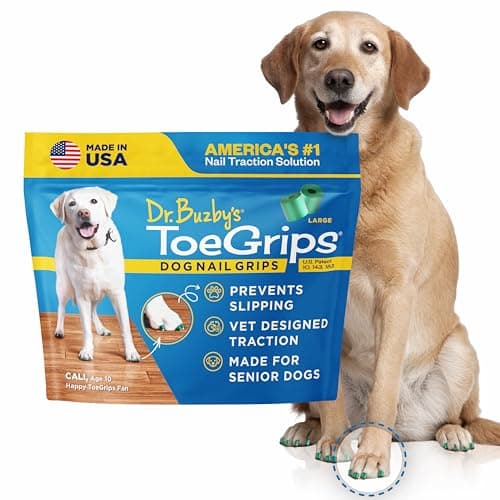
When rugs are not enough, the smallest useful purchase in this whole category is nail-grip sleeves.
#1 Pick
Dr. Buzby's
Dr. Buzby's ToeGrips for Dogs
Our score
$34–$40
Best for
Senior dogs slipping on hardwood, tile, or laminate floors
The best dog-mounted traction fix there is, and the one to buy once rugs have taken you as far as they can. Nothing touches the paw pad, which is why dogs tolerate these where they refuse socks and boots. Go in knowing the real cost: this is not a $40 purchase but a $240–$320 a year habit, so lay runners along your dog's actual routes first and buy grips for the floors you cannot cover.
Pros
- Veterinarian-developed; in clinical use for over a decade
- Slip onto each toenail — no socks, booties, or adhesives required
- Restores traction immediately, especially on hard floors
- Nothing touches the paw pad, so dogs accept them where they refuse boots
- Amazon and the manufacturer both charge $39.99 — no retailer markup
- 20 grips per bag against the 16 a dog wears, so a set includes four spares
Cons
- The only two published studies of nail grips both tested this exact product, and both were null: Roush 2017 (Front Vet Sci 4:111 — 15 sound dogs, kinetic changes "unlikely to be clinically relevant") and Repac 2022 (Animals 12(18):2312 — 30 dogs two weeks post-TPLO vs sham, no difference in weight bearing or limb function, including the owner question that asked specifically about slippery floors). Fair caveats: small samples, one used healthy dogs, the other a single early post-op timepoint — but "no positive trial exists" is the honest label, and we say it while still recommending the product for the mechanism and the owner-reported traction stories it was never tested against (verified 2026-08-14).
- A recurring cost, not a one-off. The maker publishes two different bag lives — "1–2 months" on its store page and "1-3 months, two months on average" in its FAQ (both read 2026-09-05) — which spans $160–$480 a year at $39.99. Plan on $240–$320, the two surfaces' central figures
- The Amazon listing markets specifically to dogs with "ACL injuries" — the one population where a randomised trial has been run, and where it found nothing (Repac 2022). The same bullets carry three claims with no source we could find: "more than 250,000 paws," "America's #1 nail traction solution," and "recommended by thousands of veterinarians worldwide" (listing copy verified 2026-08-17). Re-read 2026-08-31: a fourth unsourced superlative has been added to the top bullet on all four Amazon sizes — "The Only Toenail Grips for Dogs With GripZone Technology" — and the Large listing's title now leads with "Instant Traction on Wood/Hardwood Floors."
- The maker sells Scotch Super Glue Gel at $4.99 on its own store, listed as an "Alternate ToeGrips Application Method" (shop.toegrips.com, 2026-08-31). Read that as what it is: the company's own answer to the grips coming off, priced separately and not mentioned on the Amazon listing you are most likely to buy from.
- Application needs isopropyl rubbing alcohol, which is not in the box
- Initial application takes 15–20 minutes for a full set
- Some dogs chew them off in the first week
- Amazon carries only four of the seven sizes; XS, XXL and XXXL dogs have to buy direct
- Sizing by weight chart alone often misses — the accurate method needs dental floss and a ruler
The angle that belongs specifically to this article, and it cuts against the product: traction changes the thing you are monitoring.
Everything in the section above rests on nail wear as evidence. ToeGrips sit on the nail tip, which is precisely the surface that contacts the ground when a hind paw is not clearing it — and the manufacturer's own claim is that a bag lasts one to two months, which is another way of saying the grips are what wears. We have not tested this, and it follows from geometry rather than from a study, but the implication is clear enough to act on: once grips are on, your six-monthly nail photograph stops recording what it used to record.
The fix is free and takes a minute. Photograph the bare hind nails before the first set goes on, and after that photograph the grips instead — a set worn visibly flatter on one hind foot is the same evidence in a different material, and arguably a better one, because it accumulates over a known interval rather than over an unknown one.
The honest costs, none of which are small, and all of them from the manufacturer's own figures as recorded on our product page. At $39.99 a bag lasting one to two months, this is a $240–$480 a year running cost, not a $40 purchase — $204–$408 on the manufacturer's subscription price. Application needs isopropyl rubbing alcohol, which is not in the box and is the commonest reason a first attempt fails. And there is a mechanical limit specific to this disease: grips do nothing at all for the moment a knuckling dog puts weight on the top of the paw, because at that instant the nails are not touching the floor.
And the exclusion that matters most: our own product page says not to buy traction as a substitute for a diagnosis, and for a dog with new hind-end signs that stands absolutely. Book the examination first. The rugs cost nothing in the meantime.

What to do this week#
If the result is normal, put it in the folder and stop thinking about DM. If this dog's back end fails at ten, it will almost certainly be something else, and that is a useful thing to know in advance.
If the result is carrier, the same, with one asterisk: it lowers DM on the list rather than removing it, and it does not excuse skipping an examination if he ever starts to wobble.
If the result is at risk and he is well, spend twenty minutes this weekend on the baseline — the video, the paw photographs, the dated sentence, the weight. Then close the laptop. There is nothing else to do, and nothing you can buy that changes the odds.
If the result is at risk and something has already started, the swab has done its job by moving one name to the top of a list. Book a neurologic examination and take three things with you: the video, the paw photographs, and the sentence that separates this disease from the four things it gets mistaken for — he is unsteady, not unwilling, and I cannot find anything that hurts.
The delay this site was built around is not usually caused by a hard diagnosis. It is caused by months of a household explaining a quiet sign to itself. An at-risk result is one of the very few pieces of paper that can end that argument early, and that is worth more than the certainty it does not contain.
Frequently asked
- Does an at-risk DM result mean my dog will get degenerative myelopathy?
- No. The SOD1 test reports three genotypes — normal (N/N), carrier (A/N), and at-risk homozygote (A/A) — and the at-risk result means two copies of the risk variant, not disease. The Orthopedic Foundation for Animals states directly that not all dogs testing as A/A have shown clinical signs of DM, and that research is ongoing to estimate what percentage will develop it within their lifespan. The University of Missouri, whose lab identified the mutation, puts it more plainly still: not all dogs with the mutation develop DM, so the mutation test is currently a test for risk. Cornell's canine health centre adds that even a genetically predisposed dog's overall chance of becoming clinically affected may still be low. The closest thing to a figure comes from the 2014 breed-distribution study, which surveyed owners of 137 dogs that had been sampled while clinically normal under 8 years old and were over 10 at follow-up: 18 of the 30 at-risk homozygotes had developed signs consistent with DM, against 2 of 55 carriers. That 60% is the number most often quoted at owners, and it is not lifetime penetrance — it counts owner-reported signs rather than confirmed disease, in a cohort of 30 dogs, and in the same survey 3 of the 52 dogs with two entirely normal copies also reported compatible signs, which tells you how much else looks like this in a ten-year-old dog.
- How much does the DM DNA test cost, and where do I get it?
- The fee for all OFA/University of Missouri DNA tests is $65 per test, taken on two buccal (cheek) swabs the OFA mails you, and the price includes automatic registration of the result in the OFA database. What is worth knowing before you order is that the OFA lists three separate degenerative myelopathy tests at $65 each — DM, DM2, and the Degenerative Myelopathy Risk Modifier — and almost no dog needs more than one of them. DM2 is for Bernese Mountain Dogs. The risk modifier is for Pembroke Welsh Corgis who have already tested A/A.
- My dog came back a carrier. Is he safe?
- Much safer than an at-risk dog, but not immune, and this is the part most result sheets do not explain. In the 2014 breed-distribution study of 33,747 genotyped dogs, most dogs with histopathologically confirmed degenerative myelopathy were homozygotes — but eight confirmed cases were heterozygous carriers with no other variant in the SOD1 coding region. The authors' conclusion is the right one to hold: homozygotes are at much higher risk than heterozygotes. So a carrier result lowers DM on the differential list. It does not remove it, and it should never stop a neurologic examination in a dog whose back legs are failing.
- Is there any point testing a dog who already has symptoms?
- Yes, but for a narrower reason than owners expect. Degenerative myelopathy cannot be confirmed in a living dog — Cornell states there is no specific test to diagnose DM while a patient is living, and the workup exists to rule out the compressive spinal diseases that look similar and, unlike DM, can sometimes be treated. In that setting the genotype is one input among several: an at-risk result in a dog with the right age and the right signs supports a presumptive diagnosis, and a normal result argues strongly for looking elsewhere. It is the normal result that is most useful, because it can redirect an investigation toward something treatable.
- What is the Degenerative Myelopathy Risk Modifier test?
- It is the closest thing to an answer to the penetrance question, and it applies to one breed. In 2016 a genome-wide study compared Pembroke Welsh Corgis who were all homozygous for the SOD1 mutation, splitting them into those who developed DM and those who did not. A haplotype in a gene called SP110 was present in 40% of the affected dogs against 4% of the unaffected ones, and was associated with both a higher probability of developing DM and an earlier onset. The OFA now sells that as a test, for Pembroke Welsh Corgis only, and only for dogs already homozygous for the SOD1 variant. The authors said further study is warranted to clarify the effect across other breeds, and that work has not produced a comparable test for anyone else.
- Should I stop exercising a dog who tested at risk?
- No, and the evidence points the other way. There is no intervention known to prevent degenerative myelopathy in a dog who does not yet have it, and the only treatment with any survival signal in dogs who already have it is daily controlled physiotherapy. That signal comes from a 2006 study in the Journal of Veterinary Internal Medicine (Kathmann et al., 20(4):927-932) that followed 50 dogs with suspected degenerative myelopathy — the paper's own word, because it cannot be confirmed in a living dog — and compared physiotherapy in 22 of them: the 9 dogs receiving intensive physiotherapy survived a mean of 255 days, against 130 days for the 6 receiving moderate and 55 days for the 7 receiving none. Nine dogs in the best arm is a very small group, the study was not randomised, and owners able to deliver daily physiotherapy differ from owners who cannot in ways that are not measured. Treat it as the best available evidence rather than proof. Either way, restricting a healthy at-risk dog costs him muscle and condition he will need if the disease ever arrives, and buys nothing. Keep him lean, keep him moving, and put the effort into a written baseline you can compare against in two years.