Breed Guide
Bernese Mountain Dog Joint Problems: Why the Elbows Come First and Why Waiting Costs More
Bernese Mountain Dogs sit among the worst breeds for elbow dysplasia, and they get fewer years than most dogs to live with it. What that changes about screening, timing and treatment.

The Bernese Mountain Dog's joint story starts at the front end, not the back, and it starts young: this breed sits among the worst in the world for elbow dysplasia, and the arthritis that follows is often established before the dog's first birthday. What makes the breed different is not only the disease but the clock. A Swiss cohort put median life expectancy at 8.4 years against 11.23 for UK dogs generally, which means a year spent watching and waiting is a much larger fraction of this dog's whole life than it would be in a Labrador. The arithmetic of "let's see how he goes" changes when the dog has fewer years to spend.
Affiliate disclosure: Dog Orthopedic is reader-supported. When you buy through links on our site we earn a commission at no extra cost to you — about 3% on most pet products, and the same rate on every product we compare, so no pick earns us more than another. Prescription medication earns us nothing, and seeing your vet earns us nothing; we recommend both anyway. Learn more.
Imagery: Lifestyle photographs on this site are licensed from Pexels (royalty-free) and credited per image. Pexels imagery illustrates conditions and contexts — it does not depict the specific dogs or test sessions described in the text. Product photographs come from Amazon's Creators API. Breed portraits are illustrations of typical breed type rather than photographs of individual dogs, and are not drawn to scale against one another.
The build, and what it costs#
A Bernese is a draught dog. The breed was built to pull carts on Swiss farms, and the conformation reflects it: a deep, heavy chest, a broad front, substantial bone, and a body mass that arrives fast — a puppy of nine or ten pounds becomes an eighty to hundred-pound adult inside about eighteen months.
Two consequences follow from that, and they are the whole page.
The front end carries the load. In any dog, the forelimbs bear more than half the body weight, and in a heavy-chested, front-loaded breed the proportion is unforgiving. The elbow is a three-bone joint — humerus, radius and ulna — that only works if all three grow at exactly compatible rates. In a fast-growing heavy breed, small mismatches in that growth produce incongruity, and incongruity concentrates force onto a small piece of cartilage on the inner side of the joint. That piece of bone is the medial coronoid process of the ulna, and when it fractures away under load you get fragmented medial coronoid process — the commonest form of elbow dysplasia and the Bernese's signature orthopedic disease.
The damage is done during growth, not during old age. This is the part that catches owners out. Hip arthritis in a big dog is usually thought of as a problem of the senior years. Elbow dysplasia is a problem of the puppy year that then costs the dog every subsequent year. The welfare assessment maintained by Science for Animal Welfare, drawing on the veterinary literature, notes that osteoarthritis is often already present by four to six months of age in affected dogs, though it can appear later. [1]
If a paragraph on this page could be swapped onto a Labrador guide, it should not be here. This one could not: the Labrador's joint problem is a long, slow arthritis story that weight control genuinely delays. The Bernese's is a structural failure that has usually already happened by the time the dog is old enough to be called an adolescent.

What this breed actually gets, ranked#
1. Elbow dysplasia — the headline. In the largest published analysis of the Orthopedic Foundation for Animals database — 1,056,852 hip records and 275,129 elbow records across 60 breeds, spanning 1970 to 2015 — Oberbauer, Keller and Famula named the Chow Chow, Rottweiler, Bernese Mountain Dog, Newfoundland and German Shepherd Dog as the breeds with the highest elbow dysplasia prevalence. [2] A Dutch study that screened 2,693 Labrador Retrievers, 1,213 Golden Retrievers and 974 Bernese Mountain Dogs between 2002 and 2009 found fragmented medial coronoid process in 15 percent of the Bernese, against 6 percent of Labradors and 5 percent of Goldens. [3] Higher figures circulate — the Science for Animal Welfare summary cites a range of 36 to 70 percent for FMCP in this breed [1] — and the gap between 15 percent and 70 percent is not a contradiction so much as a warning about what each number is counting. Screening populations, referral populations and general populations are three different denominators, and nobody has screened a random sample of pet Bernese.
2. Hip dysplasia — real, but not the breed's distinguishing problem. Bernese are affected, and hips should be screened, but the breed is not where the hip statistics point. In the same OFA analysis, the highest hip dysplasia prevalence sat with the Newfoundland, Bloodhound, American Staffordshire Terrier, Bullmastiff and Rottweiler — the Bernese was not in that group, though it was in the elbow group. [2] That distinction has a practical edge to it. Owners who screen only the hips because hips are what everybody screens are testing the joint that is less likely to be the problem. Our hip dysplasia master guide covers the disease itself; the point here is which end of the dog deserves your attention first.
Genetically, the two are separate diseases in this breed and not two faces of one. A genome-wide study of 174 Bernese found no overlap between the chromosomal regions associated with hip dysplasia and those associated with elbow dysplasia, and no shared metabolic pathway between them; published heritability estimates in Bernese populations from Finland, Sweden and Germany ran 0.26 to 0.42 for hips and 0.17 to 0.38 for elbows. [4] Clean hips on a pedigree tell you very little about the elbows.
3. Cruciate disease — and an honest gap. Cruciate ligament rupture is the commonest cause of hind-limb lameness in large dogs, and Bernese are not exempt. But I could not find a published prevalence or incidence figure for cruciate rupture in this breed specifically. The largest breed-risk analysis available — 1,243,681 dogs reported to the Veterinary Medical Database between 1964 and 2003 — named the Newfoundland, Rottweiler, Labrador Retriever, Bulldog, Boxer, Chow Chow, American Staffordshire Terrier and Saint Bernard as having the highest odds of cruciate ligament deficiency. The Bernese Mountain Dog is not in that list. [5] That is not proof of low risk — absence from a top-eight list is not a rate — but it does mean that if someone quotes you a cruciate percentage for Bernese, ask them where it came from. As far as I can establish, the number is not published.
4. Degenerative joint disease as a cause of death. In the Swiss cohort of 389 Bernese followed from birth, degenerative joint disease was the recorded cause of death in 16 of 381 dogs — 4.2 percent — and spinal disorders in a further 13, or 3.4 percent. [6] Those are not large percentages. They are also not zero, and "cause of death" here usually means the joints got bad enough that euthanasia was the kind decision.
The part that is hard to read#
Cancer is why this breed's years are short, and any honest joint guide has to say so, because it changes every treatment decision on this page.
In the Swiss study — 389 dogs, 30.2 percent of all Bernese born in Switzerland in 2001 and 2002, followed to death — median life expectancy was 8.4 years: 8.8 years for females, 7.7 for males, a difference that reached statistical significance. Neoplasia accounted for 222 of 381 deaths, or 58.3 percent. [6] A Dutch study of the same question in a different national population found that at least 55.1 percent of Bernese deaths were tumour-associated, and that roughly one in seven of all Bernese die specifically of histiocytic sarcoma. [7] A review of breed cancer predispositions puts disseminated histiocytic sarcoma at up to 25 percent of deaths in the breed, and reports median survival from diagnosis in published series as short as 49 days. [8]
For scale: UK primary-care life tables built from 30,563 canine deaths between 2016 and 2020 put life expectancy at birth for dogs in general at 11.23 years. [9]
Two caveats before you carry those numbers anywhere. The Swiss cohort was born in 2001 and 2002, so it describes dogs bred a generation ago. And in that study 173 of the 222 tumour deaths were not confirmed by histology or cytology — the diagnosis was clinical. The direction of the finding is not in doubt; the precision of the sub-categories is.
Here is what it means in practice, and it is the reason this page exists. If your Bernese is likely to have somewhere around eight or nine years, then a year spent watching a mild front-end lameness is more than a tenth of his entire life. In a Labrador with twelve or thirteen years, the same year of watching is a smaller share of a longer story, and there is usually time to recover the ground. In a Bernese there often is not. The delay is not neutral. It is spent.
“Because your dog can't tell you how much pain he or she is in.”
When it shows up#
| Age | What owners typically notice | What is usually happening |
|---|---|---|
| 4–8 months | Sitting down mid-play, "lazy" for a puppy, front feet paddling outward at a trot, stiffness after a big day | Elbow incongruity and early coronoid damage. Arthritis may already be forming |
| 8–18 months | Intermittent front-limb lameness that improves with rest and returns with activity; reluctance to go down stairs | Established elbow dysplasia. This is the window in which surgical options are most often discussed |
| 2–5 years | Shortened front stride, a dog who lies down rather than stands, slower to rise from a cold floor | Elbow arthritis maturing. Hips and cruciates now in play too |
| 5–8 years | Visible loss of shoulder and thigh muscle, difficulty with the car, wide-based rear stance | Multi-joint arthritis compounded by disuse muscle loss |
| 8+ | Sudden, disproportionate decline; weight loss; lethargy out of keeping with the joints | Joint disease rarely does this. Sudden systemic decline in an older Bernese is a same-week vet appointment, not a mobility problem |
That last row is the one I would not want an owner to miss. Bernese owners get trained by years of joint management to read every change as arthritis. The breed's cancer burden means a decline that does not fit the joint story deserves a different appointment.
The earliest sign, in this breed specifically#
"Limping" is the wrong thing to watch for in a Bernese, and this is the most useful sentence on the page: elbow dysplasia in this breed is frequently bilateral, and a dog with two equally sore elbows does not limp. He has no good leg to shift onto. What he does instead is subtler and easy to file under personality:
- He sits down. Mid-walk, mid-play, at the top of the driveway. Not panting-hot sitting — just stopping.
- His front stride shortens. The back end still drives normally; the front just does not reach as far. From the side, the dog looks like he is walking uphill on flat ground.
- He paddles. At a trot, affected elbows are often held slightly away from the body with the front feet swinging outward and inward in a small arc. Breeders call it many things; on video at 30 frames a second it is unmistakable.
- He avoids down, not up. Descending stairs and jumping down from the car load the front limbs hard. A Bernese who bounds up the stairs and hesitates at the top of them is telling you where it hurts.
- He lies down to eat, or lies down instead of standing. Standing still is work for a sore front end.
None of that reads as an emergency, which is exactly the problem. Our guides to telling a limp from weakness and to spotting pain in dogs go through the distinctions in detail. In this breed, film it: thirty seconds of your dog trotting away from and back toward a phone held at knee height tells a vet more than any description you can give.

Screening, and what the numbers actually mean#
Both the OFA schemes and the European FCI schemes grade elbows on the degree of degenerative change visible on X-ray, and both are voluntary. That last word does most of the work.
What a grade tells you. An OFA elbow evaluation reports normal, or Grade I, II or III based on bone proliferation along the anconeal process; there is deliberately no grade for a normal elbow, only normal or not. It is an assessment of the joint in front of the radiologist on the day, and it is a real, useful piece of information.
What it does not tell you. Voluntary databases collect the X-rays people choose to submit. A breeder who takes a preliminary film, sees a bad elbow and does not send it in has not falsified anything — but every published prevalence figure drawn from that database is therefore a floor, not a rate. Oberbauer and colleagues' analysis of that database also found genuine improvement across 60 breeds over four decades, with reductions in estimated breeding values for both hip and elbow disease liability. [2] Selection works. It just works slowly, on a trait with heritability under 0.4.
If you are buying a puppy, ask for four things: elbow grades on both parents, hip grades on both parents, the grades on the grandparents if the breeder has them, and — the question almost nobody asks — how old the oldest dogs in that line lived to be. Given what the mortality data says about this breed, longevity in the pedigree is not a soft question.
If you already have the dog, a screening series is still worth doing before you need it. Knowing at fourteen months that both elbows are Grade I changes how you build the next eight years. Finding out at six, from a dog who has stopped wanting to walk, changes nothing you can still act on. Our list of questions to ask a veterinary orthopedic surgeon is worth reading before that appointment, not after.
One more decision that belongs in this section, because the breed-specific data is genuinely striking. In a 15-year record set from the UC Davis veterinary teaching hospital covering 235 Bernese Mountain Dogs, 4 percent of intact males had at least one joint disorder, compared with 23 to 24 percent of males neutered at any point before two years of age — around a six-fold difference, statistically significant at p<0.01. Intact females ran 11 percent; females spayed before six months ran over three times that, though that comparison did not reach significance. [10] This is a retrospective hospital record set, not a randomised trial: the dogs who came through that hospital are not a random sample of Bernese, and neutering decisions were not assigned. It is not a reason to refuse to neuter. It is a strong reason to have the timing conversation with your vet before the date is booked, and our guide on when to spay or neuter a dog covers the wider trade-offs, including the ones that push the other way.
What actually helps#
Lean body condition, first and free. It is the largest modifiable factor in canine joint disease and it costs nothing. In a front-loaded breed it does double duty, because every extra pound is disproportionately carried by the joints that are already failing. A correctly lean Bernese looks thinner than the show-ring picture in your head; run your flat hands over the ribs and expect to feel them under a thin layer, without pressing.
Surface, second. A heavy dog on a slick floor braces to stay upright, and bracing is loading. Runners on the routes the dog actually uses — bed to door, sofa to kitchen — do more than any supplement. Our guide to dogs slipping on floors covers the options, including the free ones.
Activity type, third. Consistency beats intensity, and for a sore front end, what matters is not distance but impact. Flat ground rather than hills. Sniffing walks rather than fetch. Swimming where you can get it. Descending stairs and jumping down from the tailgate are the two worst repeated impacts in an ordinary Bernese's week; a ramp removes one of them entirely. Our guide to how much walking an arthritic dog needs has the practical arithmetic.
Muscle, always. Muscle is what stabilises a failing joint, and it goes fast in a big dog who has started moving less. If you can see the shoulder blades or the thigh thinning, that is the loop starting — muscle wasting in one leg walks through what it means and what to do.
Pain control through your vet, when it is needed. Canine-specific NSAIDs and newer options exist and work. Nothing from a human medicine cabinet is safe for a dog.
Gear, and only where the build makes it different#
Most breed pages on this site should recommend nothing. This one recommends two things, and only because size changes the recommendation rather than the marketing.
#1 Pick
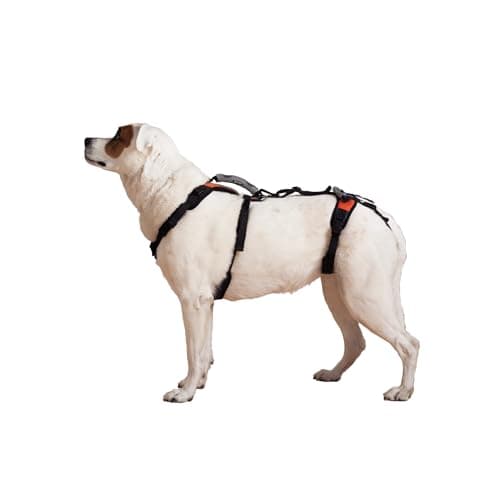
Help 'Em Up
Help 'Em Up Harness
Our score
$95–$155
Best for
Long-term mobility support for senior or post-surgical large dogs
If your dog needs help getting up multiple times a day for the foreseeable future — post-TPLO, advanced hip dysplasia, hindquarter weakness in giant-breed seniors — this is the one to buy. It supports the front and the back independently, as two halves you can lift separately, which is what a dog with a bad hip and a compensating shoulder actually needs. It is not the only design that does this, but it is the one whose sizing, returns and channel prices we have read most closely. Buy it from the manufacturer, not from Amazon: re-verified 3 October 2026, helpemup.com prices by size at $80 / $95 / $110 / $125 / $140 while Amazon runs $95 / $110 / $125 / $140 / $155 — a uniform $15 more at every size, every time we have checked.
Pros
- Two-piece (chest + hip) design lets you support either end independently
- Hip handle is purpose-built — not a converted car-seat-belt strap
- Padded chest plate distributes weight better than sling-only options
- Five sizes span 10 to 225 lb, and the rear half can be ordered a size smaller for a dog with muscle wasting
- Two hip-lift styles (Conventional and U-Band) so male dogs are not soiling the strap
Cons
- Amazon runs a uniform $15 above the maker's own price at every one of the five sizes, and the Amazon buy box is held by a third-party reseller (Veterinary Preferred) rather than by the brand — re-verified 18 August 2026
- The maker's own Mix & Match page prints two different starting prices, "From $80" and "FROM $95 USD", on the same page
- Direct pricing is no longer flat: since mid-August 2026 the maker charges $80 to $140 by size, so a giant-breed owner now pays $60 more than a terrier owner
- On 29 August 2026 the linked Amazon Medium (B0DK81SCG5) showed a future availability date rather than units on hand, while every size and style was in stock at helpemup.com the same day; on 9 September and again on 12 September 2026 the Amazon Medium still showed the future-date status at $125.00 with a maximum order of one and no ship date given, while all nine direct variants were in stock — two weeks of backorder on the channel we earn from, and one more reason the direct channel is the one to use. By 3 October 2026 it had spread: every Conventional-style Amazon listing we checked (X-Small, Small, Medium, Large) showed a future availability date, and only the Large and X-Large U-Band were in stock, while all nine direct variants were available. On 15 October 2026 the linked Medium was back In Stock on Amazon at $125.00 (maximum order 30) for the first time since 29 August, but X-Small, Small and Large Conventional still showed a future availability date with a maximum order of one
- Sizing is critical — measure twice, return is a hassle
- Rear straps can chafe the inner thigh if the harness is left tight while the dog lies down
- A dog filmed or gait-assessed while wearing it looks less lame than he is, because the harness offloads the limb you are trying to judge
- Bulkier than a quick-grab sling for short-term use
Amazon, 15 October 2026: the Medium this button links is In Stock at $125, the first time since 29 August it has not shown a future availability date. X-Small, Small and Large Conventional on Amazon still had no ship date. Every size and style was in stock direct the same day, $15 cheaper.
A rear-only sling is the standard suggestion for a wobbly senior dog, and for a Bernese it is often the wrong tool. This breed's trouble is at the front, and by the time an eight-year-old Bernese needs help, he frequently needs help getting the chest off the floor, not just the hips. A two-piece harness with a front handle is what that job requires. The honest downside: it is expensive, it stays on the dog most of the day, and some dogs find the chest section hot in summer — a real problem in a black double-coated breed. A cheaper route that works for short-term needs is a rear sling or a folded towel under the belly, and our lift harness comparison sets them side by side.

#2 Pick

Big Barker
Big Barker 7-inch Pillow Top
Our score
$250–$460
Best for
Large and giant breeds with hip, elbow, or arthritis pain
The bed we still recommend first for a dog over about 80 lb. Our reason is depth: seven inches, published layer by layer, is more than most beds we cover print, and for a heavy dog we would rather have the depth than not. That is our judgement; nobody has measured how far a hip sinks into this bed. (It is not one solid slab, as we used to say: the maker's own copy describes a 3-layer build, a 2" base under a 3" support layer under a 2" comfort top.) It is also the only bed we cover with a clinical study attached, and we would rather you knew what that study is: forty dogs, no control group, no blinding, and outcomes scored by the owners who had just been given a free bed. That is a reason to be interested, not a reason to be convinced. Buy on the foam depth and the ten-year warranty, which are facts. On where to buy: the price is the same either way, so buy direct for the 180-night sleep trial, which Amazon's return window does not match. Read its conditions first: no return in the first 30 days except size exchanges, the bed is donated to a shelter rather than shipped back, and one trial return per household (bigbarker.com refund policy, 2026-10-04). The two editions both sell on both channels at identical prices, re-verified 4 October 2026 — flat Large $249.95, Headrest Large $289.95. We have published two wrong things about this in the past, a $40 Amazon markup and a direct-only cheap edition; both are retired, and the honest version is that the channel decides your trial, not your price.
Pros
- Seven inches of foam in a 3-layer build (2" base, 3" support, 2" top comfort), printed on the maker's own page, which not every maker does
- 10-year warranty — foam must retain at least 90% of its original shape and support, or it is replaced
- The only bed we cover with a clinical study behind it, though it is the sponsor's single-arm pilot report, not a peer-reviewed paper
- Made in the USA
- Microfiber cover unzips and machine-washes
Cons
- Premium price
- Editions, not channels, are what the price difference is. Both are on Amazon and both are on bigbarker.com at identical prices, re-verified 2026-09-06: the flat headrest-free Large is $249.95 (B0GRBXBPXH) and the Headrest Large is $289.95 (B0GRBX5TBL), both In Stock with the buy box held by Big Barker itself, both matching the maker's own site. We previously misread this as a $40 Amazon markup, and then as the cheap edition being direct-only. Both claims are retired
- Bulky — measure your space, not just your dog
- Cover-only style isn't bolstered (consider Sofa edition for nesters)
- The clinical study everyone cites is open-label, single-arm, and owner-scored, with no control group
- The product page says the three layers "maintain proper spinal alignment and eliminate pressure points" (bigbarker.com, read 2026-10-04). Nobody has measured that on this bed, and the one canine pressure-mapping study we know of (Caraty 2019, three cadavers) found even memory foam generally not enough to keep the hip, shoulder and rib risk zones at safe pressures. It is the same unmeasured claim we criticise on elevated cots
Bed thickness is a size question, not a comfort question. An eighty to hundred-pound dog compresses foam that a forty-pound dog rests on, and once the foam bottoms out the dog is lying on the floor with a cover over it — which is exactly what a sore elbow cannot tolerate for the ten to fourteen hours a day a big dog spends lying down. Seven inches of support is a specification, not a luxury tier. The downside is the price, and it is a real one. A cheaper honest alternative is a good foam mattress topper cut to size and covered, and the full field including budget options is in our orthopedic bed roundup.
I would skip the joint supplements as a first move in this breed and spend the money on the screening X-rays instead. The supplements can come later, and our joint supplement guide is honest about how thin the evidence is.
Where to go next#
- Arthritis in dogs — the master guide to the disease that follows elbow dysplasia
- Hip dysplasia in dogs — grades, screening and treatment tiers
- Limping versus weakness — the distinction that changes the differential
- How much walking an arthritic dog needs — dose, not distance
- Questions to ask a veterinary orthopedic surgeon — before the elbow consult
- Is my dog's limp getting better? — how to judge a trend rather than a day
- Senior dog too old for surgery? — a question this breed's owners face earlier than most
What to do this week#
If your Bernese is under two: book the elbow films, whatever he looks like on a walk. If he is between two and six: film thirty seconds of him trotting toward and away from the camera, and take it to your vet with the specific question "are these elbows?" If he is over six and something has changed: get him weighed, get the floors sorted, and get the appointment — and if the change does not fit a joint story, say so out loud in the consulting room.
This breed does not give you the years to spend on waiting. That is the whole argument, and it is the only thing on this page I would ask you to remember.
Sources#
- Science for Animal Welfare. Bernese Mountain Dog — Elbow dysplasia (fragmented medial coronoid process), citing Lang J et al., Journal of Small Animal Practice 1998;39:169–174 and LaFond E, Breur GJ, Austin CC, Journal of the American Animal Hospital Association 2002;38:467–477. https://scienceforanimalwelfare.org/species/dog/bernese-mountain-dog/elbow-dysplasia-fragmented-medial-coronoid-process/
- Oberbauer AM, Keller GG, Famula TR. Long-term genetic selection reduced prevalence of hip and elbow dysplasia in 60 dog breeds. PLOS ONE 2017;12(2):e0172918. https://doi.org/10.1371/journal.pone.0172918
- Lavrijsen ICM, Heuven HCM, Voorhout G, et al. Phenotypic and genetic evaluation of elbow dysplasia in Dutch Labrador Retrievers, Golden Retrievers, and Bernese Mountain dogs. The Veterinary Journal 2012;193(2):486–492. https://www.sciencedirect.com/science/article/abs/pii/S1090023312000044
- Pfahler S, Distl O. Identification of quantitative trait loci (QTL) for canine hip dysplasia and canine elbow dysplasia in Bernese Mountain Dogs. PLoS One 2012;7(11):e49782. https://doi.org/10.1371/journal.pone.0049782
- Witsberger TH, Villamil JA, Schultz LG, Hahn AW, Cook JL. Prevalence of and risk factors for hip dysplasia and cranial cruciate ligament deficiency in dogs. JAVMA 2008;232(12):1818–1824. https://avmajournals.avma.org/view/journals/javma/232/12/javma.232.12.1818.xml
- Klopfenstein M, Howard J, Rossetti M, Geissbühler U. Life expectancy and causes of death in Bernese mountain dogs in Switzerland. BMC Veterinary Research 2016;12:153. https://doi.org/10.1186/s12917-016-0782-9
- Erich SA, Rutteman GR, Teske E. Causes of death and the impact of histiocytic sarcoma on the life expectancy of the Dutch population of Bernese mountain dogs and Flat-coated retrievers. The Veterinary Journal 2013;198(3):678–683. https://doi.org/10.1016/j.tvjl.2013.09.062
- Dobson JM. Breed-predispositions to cancer in pedigree dogs. ISRN Veterinary Science 2013;2013:941275. https://doi.org/10.1155/2013/941275
- Teng KT, Brodbelt DC, Pegram C, Church DB, O'Neill DG. Life tables of annual life expectancy and mortality for companion dogs in the United Kingdom. Scientific Reports 2022;12:6415. https://doi.org/10.1038/s41598-022-10341-6
- Hart BL, Hart LA, Thigpen AP, Willits NH. Assisting decision-making on age of neutering for 35 breeds of dogs: associated joint disorders, cancers, and urinary incontinence. Frontiers in Veterinary Science 2020;7:388. https://doi.org/10.3389/fvets.2020.00388
Frequently asked
- At what age do Bernese Mountain Dogs start showing elbow problems?
- Earlier than most owners expect. Fragmented medial coronoid process — the commonest form of elbow dysplasia in this breed — is a developmental disease of the growing joint, and the welfare summary maintained by Science for Animal Welfare notes that arthritis is often already present by four to six months of age, though signs can appear later. In practice, a Bernese puppy who is stiff after play, who paddles the front feet outward at a trot, or who is reluctant on stairs at six to ten months is an elbow case until X-rays say otherwise. This is not a wait-and-see age in this breed.
- How common is elbow dysplasia in Bernese Mountain Dogs?
- Common enough that it is the breed's defining orthopedic problem. In the largest published analysis of the Orthopedic Foundation for Animals database — over 275,000 elbow records across 60 breeds — the Bernese Mountain Dog was named among the five breeds with the highest elbow dysplasia prevalence, alongside the Chow Chow, Rottweiler, Newfoundland and German Shepherd Dog. A Dutch screening study of 974 Bernese found fragmented medial coronoid process in 15 percent, against 6 percent of Labradors and 5 percent of Golden Retrievers screened the same way.
- How long do Bernese Mountain Dogs live?
- Less time than almost any popular breed, and it is worth knowing honestly. A Swiss study that followed 389 Bernese born in 2001 and 2002 found a median life expectancy of 8.4 years — 8.8 for females, 7.7 for males. For comparison, UK primary-care life tables covering more than 30,000 deaths put life expectancy at birth for dogs generally at 11.23 years. Cancer is the reason: tumours accounted for 58.3 percent of deaths in the Swiss cohort, and a Dutch study found roughly one in seven Bernese die specifically of histiocytic sarcoma.
- Should I get my Bernese Mountain Dog's elbows screened even if he is not limping?
- Yes, and preferably before you need to know. Elbow dysplasia in this breed is frequently bilateral, which means both sides hurt equally and there is no good leg to limp on — the dog simply slows down, shortens his stride, and looks lazy. A screening X-ray series is the only way to separate 'lazy' from 'sore in both elbows'. If you are buying a puppy, ask to see elbow grades on both parents, not just hips: they are separate diseases with separate genetics in this breed.
- When should I neuter a Bernese Mountain Dog?
- This is a conversation to have with your vet before the surgery is booked, because the breed-specific data is unusual. In a 15-year UC Davis dataset of 235 Bernese Mountain Dogs, 4 percent of intact males had at least one joint disorder, against 23 to 24 percent of males neutered at any point before two years of age — roughly a six-fold difference. That is one hospital's record set, not a controlled trial, and it cannot tell you what to do for your individual dog. It is a strong enough signal to raise before the date is set rather than after.