Decision guide
Is My Dog Too Old for Orthopedic Surgery?
Age is a stand-in for the things that actually decide this. Here is what the anaesthetic risk really is by age and health status, and the four separate questions hiding inside "he's too old."

There is no age at which a dog becomes ineligible for orthopedic surgery, and we have not found a veterinary guideline that sets one. What the surgeon is actually assessing is health status, and health status is measurable in a way that age is not: in a study of 401 dogs, age predicted six-month mortality until a frailty score of 33 real clinical deficits was put in the model beside it, and then age stopped being significant at all. Get the real numbers before you decide. Anaesthetic death in UK primary-care practice runs at 0.14% of all events; a dog alive at ten has, on average, another 3.28 years to spend. The question is not whether your dog is old. It is what those years should feel like.
Affiliate disclosure: Dog Orthopedic is reader-supported. When you buy through links on our site we earn a commission at no extra cost to you — about 3% on most pet products, and the same rate on every product we compare, so no pick earns us more than another. Prescription medication earns us nothing, and seeing your vet earns us nothing; we recommend both anyway. Learn more.
Imagery: Lifestyle photographs on this site are licensed from Pexels (royalty-free) and credited per image. Pexels imagery illustrates conditions and contexts — it does not depict the specific dogs or test sessions described in the text. Product photographs come from Amazon's Creators API. Breed portraits are illustrations of typical breed type rather than photographs of individual dogs, and are not drawn to scale against one another.
What "too old" actually means when you say it#
Owners arrive at this question in one sentence and leave with four, because "he's too old" is four separate worries fused together. Separating them is most of the work, and each one has a different kind of answer.
- Will he survive the anaesthetic? A statistical question, with published numbers.
- Can he physically do the recovery? A question about your dog's other legs, his weight, and your house.
- Will he live long enough to collect the benefit? A question about remaining life expectancy, which is also published.
- Is the alternative actually kinder? The question people skip, because not operating doesn't feel like a decision.
Almost every owner who says "too old" is thinking about number one. In our reading, number two and number four are where the real decision lives.

The anaesthetic risk, in numbers you can actually hold#
Here is the largest relevant dataset. A VetCompass study of UK primary-care practice examined 157,318 dogs undergoing general anaesthesia or sedation between 2010 and 2013. There were 159 anaesthesia- or sedation-related deaths within 48 hours (0.10%) and 219 within two weeks (0.14%). For neutering alone — young, healthy dogs, routine procedure — it was 0.009%.[1]
Age raised the odds, and the paper is specific about how much. Compared with dogs aged 0.5 to 1.5 years, dogs aged 5 to 7 and 7 to 9 both had 4.9 times the odds of a related death within two weeks, and dogs over nine years had 12.8 times the odds.
Twelve times sounds enormous. Read what it is twelve times of. The reference group is dogs of six to eighteen months, and the paper does not print an absolute figure for each age band, so twelve times an unstated number is not a percentage you can carry into the consult. What you can carry is the second ladder the same study built: health status graded on the ASA scale. Dogs graded ASA III had 4.8 times the odds of those graded ASA I–II. Dogs graded ASA IV–V had 19.0 times the odds.
Read those two ladders side by side, because they are the argument of this article. In the middle of each scale, age and health move the odds by about the same amount: ASA III at 4.8 times, a dog of seven to nine at 4.9. At the top, the point estimates are 19.0 for the sickest grade and 12.8 for the oldest band; they are close enough, and imprecise enough, that we would not rank them. The birthday is a risk factor. The health grade is one too, of comparable size, and it is the only one of the two you can do anything about. Age is on the list. It is not alone at the top of it.
It was not the first time the pattern showed up, either. The earlier benchmark, the Confidential Enquiry into Perioperative Small Animal Fatalities, followed 98,036 dogs through 117 UK practices between 2002 and 2004 and put the overall risk of anaesthetic and sedation-related death at 0.17%, about one dog in 601. Split by the ASA grade, the standard one-to-five preoperative health score, healthy dogs (grades I and II) died at 0.05%, one in 1,849. Sick dogs (grades III to V) died at 1.33%, one in 75.[2] The enquiry's companion risk-factor paper, 148 dogs that died within 48 hours against 487 that did not, found the same two things the later study found: a higher physical-status grade raised the odds of death, and so did advancing age, alongside urgency, longer procedures and lower bodyweight.[3] So the two datasets, a decade apart, agree on the shape. Both the birthday and the health grade matter; only one of them can be improved before the operation. One more figure from that enquiry belongs in your consult. Forty-seven percent of the canine deaths happened after the procedure, in recovery, not on the table. Ask what the monitoring looks like for the first few hours afterwards, not only during.
Two honest caveats. These are odds ratios from primary-care practice covering everything from dentals to emergencies, not a clean estimate of your dog's risk at a referral hospital with a dedicated anaesthetist. And the dataset spans 2010–2013; monitoring standards have moved since. Ask your surgeon for their own ASA grade for your dog and their own numbers. Do not expect a practice to hand you an audited mortality rate of its own. What a specialist practice should be able to tell you is how your dog will be monitored, by whom, and for how long after he wakes up. If that question is unwelcome, that is information too.
What the pre-anaesthetic bloodwork is actually for#
The reason the surgeon wants bloods before an older dog goes under is not ritual, and it is not padding the bill. In a South African study of 101 dogs over seven years old, mean age just under eleven, a physical examination, a blood panel and a urinalysis run before anaesthesia turned up 30 new diagnoses the owners had not come in about. Neoplasia, chronic kidney disease and Cushing's disease were the most common. Thirteen of the 101 dogs did not go ahead with the anaesthetic as a result.[4]
Hold that number: roughly one older dog in eight had something found that changed the plan. It is a small, single-author study and it cannot tell you which test found what. But it is the honest reason to say yes when the clinic asks to run the panel, and the honest question to ask back is what each abnormal value would change. A kidney number that means a different fluid plan is not the same as a kidney number that means no surgery, and the clinic can tell you which it is.
The study that reframes the argument at the kitchen table#
The most useful research here is not about surgery at all.
In 2019, a group in Italy built a canine Frailty Index — 33 clinical health deficits, each scored absent or present, with a mild-or-severe gradation for some, summed and divided by 33 — and applied it to 401 dogs of various breeds, mean age 8.64 years. Dogs who survived the next six months had a mean index of 0.12. Dogs who died had a mean of 0.29. As a predictor of six-month mortality the index reached an area under the curve of 0.852. Dogs scoring above 0.4 had 18.06 times the hazard of death of the least frail group.[5]
And then the finding that reorganises this entire decision. Chronological age was significantly associated with mortality when it was examined on its own. When age and the frailty index went into the model together, age was no longer significant — the reported p value was 0.343.
Age is not a risk factor you can treat. It is a stand-in for the things that are, and when researchers measured those things directly and put both in the same model, age was no longer statistically significant. That is a 401-dog result, not a law; it is still the clearest evidence anyone has produced on this question.
That is not a licence to be cavalier about a fourteen-year-old dog. Frailty rises with age; that is why the proxy works well enough for everyday conversation. It is a licence to stop arguing about the number on the record and start asking what is actually accumulating: the heart murmur, the kidney values, the muscle he has lost, the two other legs that have been taking his weight.
“Because your dog can't tell you how much pain he or she is in.”
How much life is there left to spend?#
This is the question owners feel worst about asking and it is completely legitimate. A surgery that costs weeks of confinement to buy two good years is a different proposition from one that buys four months.
There is a real number. Life tables built from 30,563 UK dogs that died between 2016 and 2020 give life expectancy at birth as 11.23 years, and — more usefully — remaining life expectancy at each age after that.[6]
| Your dog's age today | Average remaining life expectancy | 95% CI |
|---|---|---|
| 8 years | 4.61 years | 4.58–4.64 |
| 10 years | 3.28 years | 3.25–3.31 |
| 12 years | 2.23 years | 2.20–2.25 |
Sit with the middle row. The ten-year-old dog most people would call "too old" has, on average, more than three years in front of him. The confinement after a TPLO is counted in weeks: the surgeons' college says "several weeks of confinement" and gives no number, and there is no evidence-based rehabilitation protocol to take one from, since a survey of 376 veterinarians performing cruciate surgery found most would welcome such guidelines. Until they exist, the number of weeks is your surgeon's.[7][8] Our TPLO recovery guide plans on roughly eight weeks and explains why the number is your surgeon's, not ours. Then, in one force-plate study of 15 TPLO dogs, the operated leg was loading like an uninjured dog's by six months to a year.[9] Call it one year of the three, generously. (An earlier version of this page said "roughly four months," which was neither the restriction phase nor the full recovery; corrected in place.) You are not deciding whether to put an old dog through surgery. You are deciding how the next three years feel.
Two caveats that matter. These are population averages across all breeds and sizes, and the same paper's breed tables show how far a breed can move the row: life expectancy at birth was 11.77 years for the Labrador Retriever and 10.16 for the German Shepherd, and the authors note that toy and small breeds outlive larger ones. A ten-year-old Great Dane and a ten-year-old terrier are not in the same row. And a dog who already has significant disease elsewhere is not an average dog. Ask your vet where yours actually sits; they have the bloodwork and you do not.
Do older dogs do worse on the table?#
Less than the folklore says, at least in the one place someone has looked at this directly and recently.
A 2025 study reviewed 255 total hip replacements in 197 dogs performed between 2017 and 2022, splitting them into juveniles (6–10 months), adults (10 months to 7 years) and older dogs (7 years and over — 41 procedures). Intraoperative stem complications occurred in 8.6% of cases and early postoperative stem complications in 2%. Age did influence intraoperative complications — and it was the juveniles who were at increased risk of bone fissures during surgery, not the seniors. Age group showed no association with postoperative stem complications.[10]
Be careful how far you carry that. This is one implant system, one set of referral surgeons, one procedure, and 41 older dogs is not many. It does not prove that seniors do as well as adults across orthopedic surgery generally. What it does is remove the assumption that older automatically means worse — which is exactly the assumption most "he's too old" conversations are resting on. If you are weighing the procedures themselves, our comparison of TPLO and total hip replacement covers what each one asks of a dog.
The question nobody asks out loud: what does not operating cost?#
Declining surgery is a legitimate choice and it is often the right one. But it is a decision with an outcome, and unlike surgery it never gets consented to, costed, or reviewed at six weeks. It simply becomes what happened.
For cruciate disease there is now a number on it. Researchers applied target trial emulation — a method that borrows the design logic of a randomised trial and applies it to observational records — to 615 surgically and 200 non-surgically managed dogs with unilateral cruciate rupture in the VetCompass database. The absolute risk of short-term lameness at three months was 25.7% lower in the surgical group (95% CI −36.7% to −15.9%), and the risk of long-term lameness at twelve months was 31.7% lower (95% CI −37.9% to −18.1%).[11]
The limitation is important and it cuts directly against our argument, so here it is plainly: that study only included dogs aged 1.5 to under 12 years, and dogs were not randomised to their treatment — the method adjusts for confounding, it does not eliminate it. It does not tell you what surgery does for a thirteen-year-old. Nobody has run that study.
What it does establish is that "manage it conservatively" is not a neutral option that costs nothing. It has a measurable lameness cost. If you choose it — and there are good reasons to — choose it deliberately, and give it the same structure you would give a surgical recovery: a written pain-control plan reviewed on a date, a weight target, traction on every floor he uses, and a way to get him up. Our guide to arthritis in dogs is where that plan starts.

Question two, which is really about your house#
The anaesthetic is a few hours. The confinement is "several weeks" in the surgeons' college's own words, with no number attached, so the schedule that counts is the one you are given in writing.[7] That phase, not the anaesthetic, is the part that actually disqualifies dogs.
Ask these before you say yes:
- What are the other three legs like? A dog with one bad stifle recovers on the other three. A dog with bilateral hip arthritis and an elbow does not have three good legs to lend. This is the single most underweighted item on the list, and it is why telling a limp from weakness matters before you book anything.
- Can you confine him for the length of the protocol? Not "will he tolerate it" — can your household actually deliver it, including the person who lets him on the sofa when you are at work.
- Can you lift him? Post-operatively, several times a day, on stairs, in the night, for as long as the protocol runs.
- Is your flooring survivable? A slip on laminate in week two undoes a lot. If your dog already scrabbles on your floors, fix that first regardless of what you decide.
- What is the honest weight situation? Every extra kilogram is carried by the repair. If your dog needs to lose weight, that project starts now, not at discharge, and it pays whichever way you decide. In an open trial of 14 obese dogs with osteoarthritis, lameness scores improved once the dogs had lost 6.10% of their body weight, and the force plate confirmed it at 8.85%.[12] Fourteen dogs and no control group, so treat those thresholds as a rough marker rather than a target. The direction is not in doubt. For a 40 kg dog, six percent is 2.4 kg.
If two or more of those are "no," that is a real argument against surgery — and a much better argument than his birthday.

The equipment that decides whether question two is a yes#
If the honest blocker is "I can't lift him," that is a solvable problem rather than a verdict, and it is worth solving before the consult so you know which answer you are giving.
Start with nothing. A rolled bath towel slung under the belly, held at both ends, costs nothing and will tell you in an afternoon whether your dog needs holding at the back, the front, or both. Do that first. For plenty of small and medium dogs it is also the whole answer.
#1 Pick
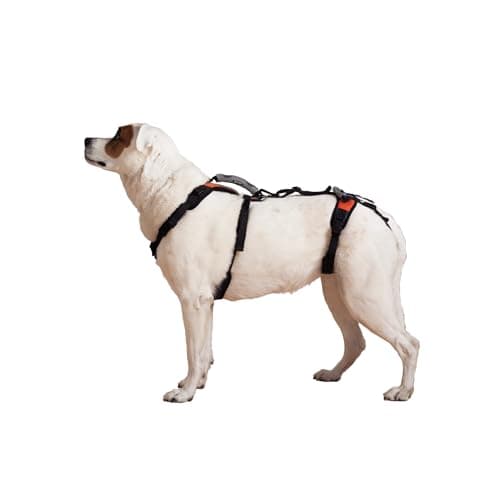
Help 'Em Up
Help 'Em Up Harness
Our score
$95–$155
Best for
Long-term mobility support for senior or post-surgical large dogs
If your dog needs help getting up multiple times a day for the foreseeable future — post-TPLO, advanced hip dysplasia, hindquarter weakness in giant-breed seniors — this is the one to buy. It is the only harness in the category that supports the front and the back independently, which is what a dog with a bad hip and a compensating shoulder actually needs. Buy it from the manufacturer, not from Amazon: re-verified 18 August 2026, helpemup.com prices by size at $80 / $95 / $110 / $125 / $140 while Amazon runs $95 / $110 / $125 / $140 / $155 — a uniform $15 more at every size, every time we have checked.
Pros
- Two-piece (chest + hip) design lets you support either end independently
- Hip handle is purpose-built — not a converted car-seat-belt strap
- Padded chest plate distributes weight better than sling-only options
- Five sizes span 10 to 225 lb, and the rear half can be ordered a size smaller for a dog with muscle wasting
- Two hip-lift styles (Conventional and U-Band) so male dogs are not soiling the strap
Cons
- Amazon runs a uniform $15 above the maker's own price at every one of the five sizes, and the Amazon buy box is held by a third-party reseller (Veterinary Preferred) rather than by the brand — re-verified 18 August 2026
- The maker's own Mix & Match page prints two different starting prices, "From $80" and "FROM $95 USD", on the same page
- Direct pricing is no longer flat: since mid-August 2026 the maker charges $80 to $140 by size, so a giant-breed owner now pays $60 more than a terrier owner
- On 29 August 2026 the linked Amazon Medium (B0DK81SCG5) showed a future availability date rather than units on hand, while every size and style was in stock at helpemup.com the same day; on 9 September and again on 12 September 2026 the Amazon Medium still showed the future-date status at $125.00 with a maximum order of one and no ship date given, while all nine direct variants were in stock — two weeks of backorder on the channel we earn from, and one more reason the direct channel is the one to use
- Sizing is critical — measure twice, return is a hassle
- Rear straps can chafe the inner thigh if the harness is left tight while the dog lies down
- A dog filmed or gait-assessed while wearing it looks less lame than he is, because the harness offloads the limb you are trying to judge
- Bulkier than a quick-grab sling for short-term use
The reason to step up to this specific harness in this specific situation is a design decision that almost nobody explains: it is two pieces, a chest harness and a hip harness, each with its own handle. Slings and most cheaper harnesses support one end. A senior orthopedic dog is very often failing at one end and compensating at the other — the hips go, the front end takes the load, and the compensating end is the next one to complain. A two-piece design lets you decide, on the morning, which end needs holding today, and lets the rear half be sized separately from the front, which matters once the hindquarters have wasted.
Who should not buy it: a dog who needs help for six weeks and then won't, a dog whose problem is purely rear-end and always will be, and a dog small enough to simply pick up. It is also genuinely fiddly to fit the first few times, which matters if the person doing the lifting has their own bad shoulder.
The honest costs. Sizing is by bodyweight and unforgiving, and the manufacturer's own instruction for a dog between sizes is to size down, which is the opposite of the instinct to size up.[13] The failure mode to watch for is the rear straps chafing the inner thigh, and the manufacturer's own FAQ anticipates it: loosen the straps when the dog lies down, watch for hot spots, take it off if he is bothered.[14] And the price, re-read on 12 September 2026: the manufacturer's site prices by size, $80 X-Small to $140 X-Large, with all nine size and style variants in stock. Amazon lists the Medium at $125 against $110 direct, its buy box is held by a third-party reseller rather than by the brand, and on every check since 29 August the Amazon listing has been on backorder with no ship date shown.[15] So the channel we earn from is, today, the one that cannot tell you when it will ship. We link Amazon, and we earn a commission when you use that link. Buy it direct anyway: it is cheaper, it ships, and you get the maker's 30-day return window and 14-day size exchange, which matters for a product whose commonest failure is sizing.
#2 Pick

GingerLead
GingerLead Dog Support and Rehabilitation Harness
Our score
$32–$70
Best for
Short-term post-surgical assistance and rear-end weakness
The right tool for one specific job: a dog whose back end has failed while his front end is still working. In the first four to six weeks after hip or stifle surgery, or for a senior who can get his front paws onto the sill of a car but cannot follow through, it is faster to fit than a full harness and it costs less. It is not a general mobility aid — it does nothing for the front half of the dog, and the maker expects you to buy a chest harness separately for older dogs. Size it with the towel test before you order, because the 10-day return window is short for a product whose commonest failure is sizing. If your dog needs help at both ends, or will need help for more than a couple of months, buy the Help 'Em Up Harness instead — though note that is no longer a $10 decision: Help 'Em Up prices by size direct ($80 XS to $140 XL, re-verified 18 Aug 2026), so the medium-to-large dog this sling fits pays $110 or $125 there against $69.95 here.
Pros
- Single-piece sling — fast to put on for bathroom trips
- Cutout in the support pad clears male anatomy, so it can be left in position without soiling
- Integrated leash takes one accessory off your hands, and detaches if you don't want it
- Machine washable and dryable, which matters more than it sounds on a post-surgical dog
- No Amazon markup — $69.95 on Amazon and $69.95 direct from the manufacturer, re-verified 12 September 2026 (Amazon via the Creators API, direct from the Med/Lg product page)
- The maker sells reconditioned units — inspected, laundered and re-packaged, "Save up to 45%". We have never observed the reconditioned price itself, so treat this as arithmetic rather than a quote: 45% off the $69.95 Medium/Large is about $38 at the maximum discount, and less at anything below it. (Corrected 2026-09-05 — we previously printed "roughly $45", which was the Amazon behind-the-buy-box offer of $44.95 conflated with the direct discount.)
- Manufacturer publishes a free towel test that sizes the sling before you spend anything
- Credit where it is due: as of 1 September 2026 the Amazon listing carries "CHEST HARNESS NOT INCLUDED" in capitals in its first feature bullet and in the retail title. This was the single most commonly missed thing about the product and the maker now says it before you click buy
- Stay-on straps are included, which is what stops the sling sliding backwards on a dog with wasted hindquarters
Cons
- Rear-end only — not the right tool if a dog also needs front support
- Chest harness is not included, and the maker's own copy recommends clipping the leash to one for older dogs
- Only a 10-day clean return window; days 11–30 carry a $10 restocking fee and nothing is refunded after 30
- Long-term use can rub thighs without careful fitment
- Strap-end handles are less ergonomic than padded handles
- Sized by pad width and by the dog's sex, not by a simple size ladder — easy to order wrong
- The Amazon listing contradicts itself on the weight floor — one bullet says "FEMALE dogs over 45 lbs and MALE dogs over 60 lbs", another says "dogs weighing over 45 pounds" flat (both live 19 Aug 2026)
- On Amazon the cheaper of the maker's two offers on this ASIN is not the one in the buy box, so the default click costs $25 more — and as of 1 September 2026 that cheaper $44.95 offer is no longer straightforwardly buyable: the same merchant now returns it as AVAILABLE_DATE with an empty message (backorder), where on 19 August it showed 7 units in stock. Corrects our own earlier advice — opening the other-offers panel is still worth doing, but it may no longer save you anything today
If your dog's answer is "six weeks after a TPLO and then we're done," this is the more sensible purchase: $69.95 on Amazon and direct alike, against $110 to $125 direct for the Medium and Large harness most of these dogs need, all re-read on 12 September 2026.[16] Its return window is the short one, though: ten days clean, then a $10 restocking fee to day 30, and nothing after, against the harness's 30 days.[17] It is rear-end only, which is exactly the point — a single piece you can have on the dog in seconds at 3am, with the leash already integrated. Its weaknesses are the mirror image of its strengths: nothing for the front end, strap-end handles rather than padded ones, and thigh rub if you leave it on a dog long-term. For the recovery timeline after an FHO, that trade is the right one.
What we don't know#
Worth saying plainly, because the confident version of this article would be a worse one.
- Nobody has run a trial of orthopedic surgery versus conservative management in dogs over twelve. The cruciate data above explicitly stops there.
- The anaesthetic figures come from primary-care practice across all procedure types. They are the best population estimate available and they are not a personalised risk.
- The frailty index has been validated against six-month mortality, not against surgical outcome. It is a strong argument that age is a proxy. It is not a preoperative screening tool your vet is likely to run.
- Nobody can tell you how many good months your individual dog has. Population life tables are not a prognosis.
- The odds ratios for age and health grade come from procedures done in 2010 to 2013, and the earlier enquiry from 2002 to 2004. Both are general-practice data, and both predate current monitoring guidance. The shape of the finding has held across both; the exact figures at a referral hospital today are the surgeon's to give you.
Anyone who gives you a clean percentage for your dog without an ASA grade attached to it is guessing.
What to do this week#
Book the consult you have been putting off, and go in with the four questions written down; our list of questions for the surgeon covers the rest. Ask specifically for your dog's ASA grade, and ask what the surgeon's own anaesthetic protocol is for a dog of that grade. Say yes to the pre-anaesthetic bloods, and ask what each abnormal result would change. That single question changes the conversation from "is he too old" to "what is his actual risk," and those are different questions with different answers.
Answer question two honestly before you go, so you are not deciding it in the room: the other three legs, the weeks of confinement, the lifting, the floors, the weight.
And if the answer turns out to be no — write down the conservative plan the same day, with a review date on it. Undecided is the only genuinely bad outcome here.
Because the thing that hurts a dog is rarely the choice. It is the six months in which nobody makes one, while the leg gets worse, the other three take up the slack, and the reason not to operate slowly becomes true. Waiting for certainty feels responsible. It is the one strategy that guarantees the dog gets older and sicker before anyone acts.
The delay is the injury. Your dog cannot tell you how much of it he is carrying — but if he is ten, the table above says he probably has three years left. That is what you are deciding about.
Sources#
- Shoop-Worrall SJW, O'Neill DG, Viscasillas J, Brodbelt DC. Mortality related to general anaesthesia and sedation in dogs under UK primary veterinary care. Veterinary Anaesthesia and Analgesia. 2022;49(5):433-442. PMID 35985925 — 157,318 dogs; 159 GA/sedation-related deaths within 48 hours (0.10%) and 219 within two weeks (0.14%); neutering 0.009%. Odds of related death within two weeks: 4.9× for ages 5–7 and 7–9 and 12.8× for over 9 years, versus 0.5–1.5 years; 4.8× for ASA III and 19.0× for ASA IV–V, versus ASA I–II.
- Brodbelt DC, Blissitt KJ, Hammond RA, Neath PJ, Young LE, Pfeiffer DU, Wood JLN. The risk of death: the Confidential Enquiry into Perioperative Small Animal Fatalities. Veterinary Anaesthesia and Analgesia. 2008;35(5):365-373. doi:10.1111/j.1467-2995.2008.00397.x — prospective cohort, 117 UK practices, June 2002 to June 2004; 98,036 dogs anaesthetised or sedated; overall risk of anaesthetic and sedation-related death 0.17% (1 in 601, 95% CI 0.14–0.19%); healthy dogs (ASA I–II) 0.05% (1 in 1,849, 95% CI 0.04–0.07%); sick dogs (ASA III–V) 1.33% (1 in 75, 95% CI 1.07–1.60%); postoperative deaths were 47% of canine fatalities.
- Brodbelt DC, Pfeiffer DU, Young LE, Wood JLN. Risk factors for anesthetic-related death in dogs: results of the confidential enquiry into perioperative small animal fatalities (CEPSAF). Journal of the American Veterinary Medical Association. 2008;233(7):1096-1104. doi:10.2460/javma.233.7.1096 — case-control study, 148 dogs that died or were euthanized within 48 hours of anaesthesia or sedation against 487 controls; increased odds of anaesthetic-related death associated with higher physical-status grade, procedure urgency, increasing age, longer intended procedure duration, lower bodyweight, and major versus minor procedures; the abstract gives no odds ratios.
- Joubert KE. Pre-anaesthetic screening of geriatric dogs. Journal of the South African Veterinary Association. 2007;78(1):31-35. doi:10.4102/jsava.v78i1.283 — 101 dogs older than 7 years, mean age 10.99 ± 2.44 years; screening by physical examination, a blood panel (alkaline phosphatase, alanine transferase, urea, creatinine, glucose, total protein) and urinalysis produced 30 new diagnoses, most commonly neoplasia, chronic kidney disease and Cushing's disease; 13 dogs did not undergo anaesthesia as a result.
- Banzato T, Franzo G, Di Maggio R, Nicoletto E, Burti S, Cesari M, Canevelli M. A Frailty Index based on clinical data to quantify mortality risk in dogs. Scientific Reports. 2019;9:16749. doi:10.1038/s41598-019-52585-9 — 401 dogs, mean age 8.64 years, 33 deficits; mean index 0.12 in survivors versus 0.29 in dogs that died; AUC 0.852 for six-month mortality; hazard ratio 18.06 for index above 0.4. Age was significant univariately but not when combined with the frailty index (p = 0.343).
- Teng KT, Brodbelt DC, Pegram C, Church DB, O'Neill DG. Life tables of annual life expectancy and mortality for companion dogs in the United Kingdom. Scientific Reports. 2022;12:6415. doi:10.1038/s41598-022-10341-6 — 30,563 dogs that died 2016–2020; life expectancy at age 0 of 11.23 years (95% CI 11.19–11.27); remaining life expectancy 4.61 years at age 8, 3.28 at age 10, 2.23 at age 12.
- American College of Veterinary Surgeons. Cranial Cruciate Ligament Disease. acvs.org — "Activity must be restricted for several weeks after surgery to ensure that there are no complications with implants or healing"; TPLO "requires several weeks of confinement to prevent complications" and TTA "several weeks of confinement while the bone heals"; the page gives no number of weeks; read 12 September 2026.
- Eiermann J, Kirkby-Shaw K, Evans RB, Knell SC, Kowaleski MP, Schmierer PA, Bergh MS, Bleedorn J, Cuddy LC, Kieves NR, Lotsikas P, Pozzi A. Recommendations for rehabilitation after surgical treatment of cranial cruciate ligament disease in dogs: A 2017 survey of veterinary practitioners. Veterinary Surgery. 2020;49(1):80-87. doi:10.1111/vsu.13294 — 376 respondents (13% response rate); 71% consistently recommended postoperative rehabilitation; most respondents would welcome evidence-based guidelines for rehabilitation protocols; the abstract gives no standard restriction duration.
- Nelson SA, Krotscheck U, Rawlinson J, Todhunter RJ, Zhang Z, Mohammed H. Long-term functional outcome of tibial plateau leveling osteotomy versus extracapsular repair in a heterogeneous population of dogs. Veterinary Surgery. 2013;42(1):38-50. doi:10.1111/j.1532-950X.2012.01052.x — 79 control dogs and 38 treated (15 TPLO, 23 extracapsular); force-plate symmetry indices measured preoperatively and at 2 weeks, 8 weeks, 6 months and 12 months; the TPLO group was not different from control dogs by 6 months to 1 year; surgeries were not randomised.
- Kokkinos P, Parsons K, Belch A, Barthelemy N. The influence of age at total hip replacement on perioperative complications associated with a press-fit cementless stem with lateral bolt in dogs. Veterinary Surgery. 2025;54(3):581-593. doi:10.1111/vsu.14203 — 197 dogs, 255 THRs, 2017–2022; 8.6% intraoperative and 2% early postoperative stem complications; juveniles at increased risk of intraoperative fissures (p = .024); no association between age group and postoperative stem complications.
- Pegram C, Diaz-Ordaz K, Brodbelt DC, Chang YM, von Hekkel AF, Wu CH, Church DB, O'Neill DG. Target Trial Emulation: Does surgical versus non-surgical management of cranial cruciate ligament rupture in dogs cause different outcomes? Preventive Veterinary Medicine. 2024;226:106165. doi:10.1016/j.prevetmed.2024.106165 — 615 surgical and 200 non-surgical cases, dogs aged 1.5 to under 12 years; risk difference for short-term lameness −25.7% (95% CI −36.7% to −15.9%) and for long-term lameness −31.7% (95% CI −37.9% to −18.1%).
- Marshall WG, Hazewinkel HAW, Mullen D, De Meyer G, Baert K, Carmichael S. The effect of weight loss on lameness in obese dogs with osteoarthritis. Veterinary Research Communications. 2010;34(3):241-253. doi:10.1007/s11259-010-9348-7 — open prospective trial, 14 obese client-owned dogs with clinical and radiographic osteoarthritis, 16 weeks; significant reduction in lameness at 6.10% body-weight loss on the clinical scales and at 8.85% on kinetic gait analysis; no control group.
- Help 'Em Up. Help 'Em Up Harness product page. helpemup.com — size chart by bodyweight (X-Small 10–25 lb to X-Large 125–225 lb); "If your dog's weight is between sizes, we recommend sizing down"; 1-year warranty and 14-day exchange period; live variant feed read 12 September 2026 at $80 / $95 / $110 / $125 / $140 with all nine size and style variants available.
- Help 'Em Up. Frequently Asked Questions. helpemup.com — "Loosen the straps when your dog wants to lie down in it to help prevent hot spots, chafing or overheating"; returns accepted within 30 days and exchanges within 14 days for orders shipped to the US and Canada; read 12 September 2026.
- Amazon. Help 'Em Up Dog Lift Harness, Full Support, Medium Conventional (45–80 lb), ASIN B0DK81SCG5. amazon.com — $125.00; availability returned as a future-date type with no date shown and a maximum order quantity of one; buy box held by third-party seller Veterinary Preferred, not the brand; retrieved via the Amazon Creators API 12 September 2026, the same state as on 29 August and 9 September.
- GingerLead. Med/Lg Male GingerLead Support Sling. gingerlead.com — $69.95, shown in stock (new or reconditioned); "Chest Harness Not Included"; money-back guarantee within 10 days of delivery less shipping and handling; read 12 September 2026.
- GingerLead. Guarantee, Warranty and Return Policy. gingerlead.com — refund within 10 days of delivery less shipping and handling; "All authorized returns postmarked after 10 days are subject to a $10 restocking fee"; "Returns received after 30 days are not eligible for a refund"; 60-day warranty against material defects in components and workmanship; read 12 September 2026.
Every source above was re-opened and read on 12 September 2026. Product prices and availability were re-read the same day from the maker's live variant feed and the Amazon Creators API, and they move constantly. This article is educational and does not replace veterinary advice. Decisions about anaesthesia and surgery for your individual dog belong with your veterinarian and, where one is involved, your board-certified surgeon.
Frequently asked
- Is there an age limit for orthopedic surgery in dogs?
- We have not found a published veterinary guideline that sets one, and the reason is that age turns out to be a proxy rather than a cause. In a study of 401 dogs, chronological age predicted six-month mortality when it was the only thing in the model — and stopped being statistically significant the moment a frailty index measuring 33 actual health deficits was added alongside it. What your surgeon is assessing is heart, kidneys, liver, bodyweight, comorbidities and how much reserve your dog has. Those things correlate with age. They are not the same as age, and they are measurable.
- How risky is anaesthesia for an older dog, in real numbers?
- A VetCompass study of 157,318 anaesthetic and sedation events in UK primary-care practice recorded 219 related deaths within two weeks, or 0.14% overall. Age raised the odds: dogs over nine years had 12.8 times the odds of a related death compared with dogs aged 0.5 to 1.5 years. And the sickest health grade mattered more than the oldest age band — dogs graded ASA IV–V had 19.0 times the odds of those graded ASA I–II, while ASA III at 4.8 times sat level with the seven-to-nine age band at 4.9. Those are odds ratios against the youngest, healthiest reference group, not an absolute risk for your dog, and multiplying them against the all-ages 0.14% would overstate it. The earlier CEPSAF enquiry gives the cleaner absolute split: 0.05% for healthy dogs (ASA I–II) against 1.33% for sick dogs (ASA III–V). Your dog's own figure is the surgeon's to give you, with his ASA grade in hand — and it is the number to weigh against months or years of pain.
- Will my old dog even live long enough for the surgery to be worth it?
- This is the fairest version of the question and it has a real answer. UK life tables built from 30,563 dogs give a dog alive at age 10 a remaining life expectancy of 3.28 years; at age 12, 2.23 years. That is what you are deciding about — not whether he is old, but whether three more years should be spent on a leg that hurts. Your own dog's number will differ by breed and size, and your vet can tell you roughly where he sits.
- Do older dogs do worse after orthopedic surgery?
- Not consistently, and one recent study points the other way. A 2025 review of 255 total hip replacements found that age influenced intraoperative complications — but it was the juveniles, not the seniors, who were at increased risk of bone fissures during surgery. Age group showed no association with postoperative stem complications. That is one implant system at a single referral hospital and it does not settle the question, but it does undercut the assumption that older automatically means worse.
- What if we decide not to operate?
- Then say so out loud, because it is a decision with an outcome and it usually gets made by drifting instead. In a target trial emulation of 815 dogs with cruciate rupture, dogs managed surgically had a 25.7% lower absolute risk of short-term lameness at three months and 31.7% lower at twelve months than dogs managed without surgery. Declining surgery is legitimate — for a genuinely frail dog, for a household that cannot deliver weeks of confinement, for a budget. It just needs to come with an actual plan: pain control reviewed on a schedule, a weight target, traction underfoot and a way to lift him.