Breed Guide
Pembroke Welsh Corgi Joint Problems: The Back, the Hips, and the One That Doesn't Hurt
A Corgi is built to a written specification: a back 40 percent longer than the dog is tall. Here is what that costs, and why failing back legs in an older Corgi are two completely different diagnoses.

A Pembroke Welsh Corgi is built to a written specification, and the specification is the problem: the breed standard asks for a body 40 percent longer than the dog is tall, on legs shortened by two copied genes that also change how discs age. That buys you early disc disease. Separately, this breed carries the degenerative myelopathy mutation at the second-highest frequency of any breed surveyed. Those two things look similar from across the room and could not be more different up close — one is painful and urgent, the other is painless and slow. Sorting them is the single most useful thing an owner of an older Corgi can do, and the first question is not "how bad is it" but "does it hurt."
Affiliate disclosure: Dog Orthopedic is reader-supported. When you buy through links on our site we earn a commission at no extra cost to you — about 3% on most pet products, and the same rate on every product we compare, so no pick earns us more than another. Prescription medication earns us nothing, and seeing your vet earns us nothing; we recommend both anyway. Learn more.
Imagery: Lifestyle photographs on this site are licensed from Pexels (royalty-free) and credited per image. Pexels imagery illustrates conditions and contexts — it does not depict the specific dogs or test sessions described in the text. Product photographs come from Amazon's Creators API. Breed portraits are illustrations of typical breed type rather than photographs of individual dogs, and are not drawn to scale against one another.
What is a Corgi actually built like, and what does the build cost?#
Start with the number, because it is written down. The AKC breed standard for the Pembroke Welsh Corgi asks for a dog 10 to 12 inches at the withers, not exceeding 30 pounds for dogs and 28 for bitches, and specifies proportion directly: "The distance from the withers to the base of the tail should be approximately 40 percent greater than the distance from the withers to the ground."[1]
That is not a description of a Corgi. It is a specification, and the spine is what pays for it.
The short legs are not a scaled-down version of normal legs. They come from an extra copy of a growth-factor gene that got reverse-transcribed back into the genome — a retrogene. Dogs have two of these. The one on chromosome 18 shortens the limbs. The one on chromosome 12 shortens them too, but it also causes what the researchers describe as premature degeneration and calcification of the intervertebral discs, and in the study that identified it, that single variant carried an odds ratio of 51.23 for intervertebral disc disease, with a 95 percent confidence interval of 46.69 to 56.20.[2]
Here is the part that matters for this breed specifically. Among the Pembroke Welsh Corgis genotyped in the follow-up study, the chromosome 18 retrogene was at an allele frequency of 1.00 and the chromosome 12 retrogene — the disc one — was at 0.92.[3]
Read that again slowly. The short-leg variant is fixed. The disc variant is very nearly fixed. This is not a risk factor that some Corgis have and others escape; it is close to being part of the definition of the breed. You cannot manage your way out of it, and no supplement touches it. What you can manage is load — how much weight sits on that lever, and how many times a day it gets shock-loaded.
The load half of that is not speculation either. A cross-sectional study of 700 dogs entering a UK referral hospital, of whom 79 were diagnosed with thoracolumbar disc extrusion, found that the ratio of back length to height at the withers was positively associated with risk — longer dogs, more extrusions — and that being overweight and being skeletally smaller each independently increased risk. The authors' practical conclusion was blunt: in higher-risk individuals, maintaining a lean body shape is particularly important.[4] That study was of a referral population across many breeds rather than a Corgi study, so treat it as the physics of long-and-low dogs rather than as a Corgi-specific measurement. The physics apply.

What does this breed actually get, and in what order of likelihood?#
Four things, and they are not equally well documented. Where the number does not exist, we say so rather than borrow one.
Intervertebral disc disease. This is the predictable consequence of the chromosome 12 retrogene, and it is the reason the breed appears in disc-disease research at all. What does not exist, as far as we can find, is a published lifetime incidence for the Pembroke Welsh Corgi comparable to the widely-quoted one-in-four-to-five figure for dachshunds. We looked and could not find one. Do not let anyone quote you a Corgi percentage without a source, because we could not locate the source.
Degenerative myelopathy. This is the breed's signature disease and the evidence base here is genuinely strong. The mutation was found in this breed: the genome-wide association study that identified the SOD1 mutation used DNA from 38 DM-affected Pembroke Welsh Corgis and 17 related normal controls.[5] In the largest breed survey since, 3,209 Pembroke Welsh Corgis were genotyped and the mutant c.118A allele frequency came out at 79 percent — the second-highest of 222 breeds, behind only the Wire Fox Terrier at 94 percent.[6]
Two honest qualifications on that 79 percent. Those samples were submitted for testing rather than drawn at random from the breed, so the figure describes the tested population, not necessarily your neighbourhood. And the Wire Fox Terrier's 94 percent rests on 79 dogs — the Corgi figure rests on 3,209, which is why the Corgi number is the one worth trusting.
Hip dysplasia — and this is where the breed surprises you. A study of 399 PennHIP-evaluated Pembroke Welsh Corgis found that every single dog had a distraction index above 0.30, with a mean of 0.66. In a Labrador, a laxity number like that predicts trouble. In these Corgis, 6.8 percent had radiographic osteoarthritis, 18 percent had subluxation, and 74.4 percent had circumferential femoral head osteophytes. The authors' conclusion was that Corgis had a low frequency of conventional osteoarthritis despite hip laxity that correlates with osteoarthritis in large breeds.[7] The OFA publishes its own hip statistics by breed, which are worth reading at the source rather than second-hand.
Obesity. Every Corgi article on the internet, including several that quote a specific percentage, tells you this breed is exceptionally prone to being overweight. We could not verify that. The largest UK primary-care study of overweight status examined 22,333 dogs, found a recorded prevalence of 7.1 percent, and identified eight breeds with increased odds compared with crossbreds — Pug, Beagle, Golden Retriever and English Springer Spaniel highest among them. The Pembroke Welsh Corgi was not among the named predisposed breeds.[8] That is not proof Corgis are lean — the study measured what vets recorded, and the authors themselves concluded overweight status is being under-reported. It means the number you have been quoted has no visible source. Keep your Corgi lean anyway, for the reason in the Packer study above; just do not let anyone sell you something on the back of a statistic nobody can point at.
When does each of these show up?#
| Age | What is happening | What to watch for |
|---|---|---|
| Puppy to 2 years | Discs are already degenerating and calcifying early — this is what the chromosome 12 retrogene does[2] | Nothing visible. This is the window for setting habits: lean weight, no sofa leaps, floor traction |
| 2 to 5 years | Hip laxity is measurable and, in this breed, usually silent[7] | Any episode of back pain, however brief, belongs in the record |
| 5 to 9 years | The disc window. Among Corgis in the FGF4 study who came to surgery, median age at surgery was 7.0 years[3] | Sudden reluctance, arched back, trembling, yelping on being lifted |
| 8 years and up | Degenerative myelopathy onset — typically 8 years or older[5], with a median onset around 11 in this breed | Painless, uneven scuffing of one hind foot. Not a limp |
| 10 to 13 | The DM course runs its length. In 21 Pembroke Welsh Corgis followed from diagnosis to euthanasia, median duration of clinical signs was 19 months and median age at euthanasia was 13 years[9] | Progression from one foot, to both, to non-ambulatory |
The Corgi surgical figure comes from 12 dogs, which is a small number and we would rather say so than present 7.0 years as a fact about the breed. The DM figures come from 21 dogs, prospectively followed to the end — small, but the follow-up is the kind you rarely get.
What does the first week of trouble look like in a Corgi specifically?#
This is the section that matters, because the two problems this breed is famous for present in almost opposite ways, and owners routinely read the wrong one as the better news.
A disc episode hurts. It usually arrives fast — over hours, or overnight. The dog is tense through the back, reluctant to turn his head or lower it to the bowl, unwilling to jump onto things he cleared yesterday, sometimes trembling, sometimes crying out when picked up under the ribs. He is not confused about where his feet are. He simply does not want to move them. That is pain, and in this breed it is an emergency until a vet says otherwise.
Degenerative myelopathy does not hurt, and it starts on one side. The University of Missouri's neurology service describes the onset as an asymmetric loss of coordination and spastic weakness in the hind limbs, and notes that owners often report their dogs scuffing their nails or toes during walking. It also states directly that dogs seem not to show pain during the course of the disease, and that affected dogs often progress to being unable to walk within 11 months of the first signs.[10]
So the first sign is often not something the dog does. It is something you find: the nails on one hind foot worn flat across the tips, while the other three are normal. Turn your Corgi over and look at all four sets of nails side by side tonight. That asymmetry is a five-second check and it is the earliest thing most owners have to go on.

Here is the sentence worth carrying out of this article. A Corgi whose back legs are failing and who is not in pain does not have the milder problem. He has the other one. Comfort is not reassurance here. It is a diagnostic clue pointing at the disease with no treatment.
| Disc extrusion | Degenerative myelopathy | Hip arthritis | |
|---|---|---|---|
| Onset | Hours to a day | Months, insidious | Months to years |
| Pain | Usually obvious | Absent | Present, worse after rest |
| Symmetry | Often both hind legs at once | Starts on one side | Often one side |
| Paw placement | Normal unless severe | Knuckling, scuffing, dragging | Normal |
| Nails | Wear evenly | Tips worn flat, one foot first | Wear evenly |
| Willingness | He won't | He can't | He would rather not |
| Urgency | Emergency | Appointment this month | Appointment this month |
Two cautions on that table. It sorts the typical cases, not every case — a slow, chronic disc protrusion can present without dramatic pain and mimic DM closely. And an older Corgi can have two of these at once; disc disease and arthritic hips do not exempt a dog from also being homozygous for the SOD1 mutation. The table tells you what to say first at the appointment. It does not substitute for the neurologic examination, which is the actual test. Our guide to telling a limp from weakness works through that distinction in more depth, and muscle wasting in one back leg covers the measurement you can take at home before you go.
“Because your dog can't tell you how much pain he or she is in.”
What do the tests actually tell you?#
The SOD1 test is a risk test. This is the most misunderstood result in the breed. The University of Missouri states it plainly: dogs homozygous for the mutant allele are at risk of developing DM, but not all dogs with the mutation will develop it, so the test is currently a test for risk.[10]
How much risk? The breed survey followed up a subset of dogs sampled with relatively low ascertainment bias — clinically normal and under 8 when sampled, 10 or older when their status was updated. Of the 30 homozygotes in that cohort, 60 percent had developed clinical signs consistent with DM, against 4 percent of 55 heterozygotes and 6 percent of 53 dogs homozygous for the normal allele.[6] That is a large difference resting on thirty dogs. Treat 60 percent as the right order of magnitude, not as a number to plan around.
Part of the reason some at-risk Corgis never develop DM has actually been mapped in this breed. Comparing DM-affected and unaffected Corgis who were all homozygous for the SOD1 mutation, researchers found a haplotype in the SP110 gene present in 40 percent of affected dogs against 4 percent of unaffected ones, associated with both a higher probability of developing DM and an earlier onset.[11] The practical meaning for an owner today is modest — it explains the variability rather than removing it — but it is why "at risk" genuinely is not "will."
A DNA test for disc risk tells a Corgi owner almost nothing. With the chromosome 12 retrogene sitting at an allele frequency of 0.92 in the breed,[3] testing an individual pet Corgi mostly confirms what the breed already is. It is a breeding tool, not a pet-owner tool, and anyone selling it to you as the latter is selling you a foregone conclusion.
What a breeder's paperwork does and does not tell you. SOD1 status of both parents is the one piece of paper that genuinely changes your dog's odds, and it is cheap and unambiguous, so its absence is informative. On hips, be careful how you read a Corgi's numbers: given that every one of 399 evaluated Corgis had a distraction index above 0.30 with a mean of 0.66, and only 6.8 percent had osteoarthritis,[7] a laxity figure that would alarm you in a German Shepherd is close to the breed norm here. Ask what the score means for this breed, not against the general population.
And it is worth knowing that breeding this out demonstrably works. In Japan, buccal swabs from 5,512 Pembroke Welsh Corgis submitted between 2017 and 2022 showed the proportion of SOD1 mutant homozygotes falling from 14.5 percent in 2019 to 2.9 percent in 2022, with no significant change in genome-wide inbreeding between the groups.[12] Three years, a disease allele largely selected against, and the breed's genetic diversity intact. That is a good argument to make to a breeder, and the same set of tradeoffs shows up whenever we talk about timing a spay or neuter.
What actually helps a Corgi?#
Lean weight, first and always#
It is the only item on this page that is free, that applies at every age, and that has evidence behind it. Being overweight independently raised disc-extrusion risk in the 700-dog referral study,[4] and in the long-running paired feeding study of 48 Labrador Retrievers, dogs fed 25 percent less than their pair-mates from 8 weeks of age had a significantly longer median lifespan and a delayed onset of chronic disease.[13] Those were Labradors, not Corgis, and 48 dogs is a small trial for a claim that large — but it remains the cleanest lifetime evidence in the species, and nothing since has contradicted it.
On a 27-pound dog with a back 40 percent longer than he is tall, two extra pounds is not two pounds. It is two pounds at the end of a lever. Our arthritis guide has the body-condition scoring method, and how much to walk an arthritic dog covers keeping the muscle on while doing less.
Height, and getting rid of it#
Before buying anything: move the best bed in the house onto the floor, and make the sofa off-limits or put a firm ottoman at the halfway point. Most of the repeated impact in a Corgi household is the jump down, and a landing surface at half the height removes most of it for nothing.
For a 10 to 12 inch dog, a full-length ramp is usually the wrong object indoors. A 71-inch ramp reaching an 18-inch sofa is a near-flat plank occupying a third of your living room, and the ramps that fold small enough to live there are too steep to be worth the money. Foam steps beat a ramp at sofa height, and honestly, blocking the sofa beats both.
Where the height genuinely earns a ramp is the car.
#1 Pick

Pet Gear
Pet Gear Tri-Fold Pet Ramp
Our score
$85–$120
Best for
Hesitant and refusing dogs, indoor steps, couches, and cars up to about a 30-inch sill
The ramp we reach for first when a dog has already refused one. The extra width and the raised side edges do more for acceptance than any other feature at this price, and the carpet tread solves the surface problem that stops most dogs before height is ever the issue. It is heavier than its "portable" billing suggests, and the 200 lb ceiling rules it out for giant breeds. Buy it for the hesitant dog, not for the hiking-and-rain dog. Two corrections we owe you before you click: the warranty is 30 days, not the year this page used to print, and Pet Gear now sells the same 71-inch frame with a removable washable supertraX mat instead of fixed carpet — if your dog goes out in the wet, pay the extra sixteen dollars for it.
Pros
- 19.5 inches wide — roughly 3.5 inches wider than most ramps in this price band, which is the difference between a stiff dog placing four feet confidently and refusing
- Raised edges along both sides give a dog a boundary he can feel without looking down
- Carpet-textured skid-resistant tread, so a nail-scraping dog will walk it without you having to cover it with a towel
- 71 inches long — a 25-degree incline to a 30-inch SUV floor, within an inch of what a fully extended telescoping ramp achieves
- Safety tether and rubber base grippers included; attached carry handle
- Rated to 200 lb
Cons
- The warranty is 30 days, not a year — Pet Gear's own listing field reads "30 day non-transferrable limited warranty" on every 71-inch variant we checked on 11 August 2026. We had published a 1-year warranty since this page was created and it was wrong
- Heavy — 25.2 lb on Amazon's own figure for the reflective 71-inch sibling and 27 lb for the supertraX version. The 15 lb figure floating around the range belongs to the 16-inch-wide Travel Lite, a different ramp. Two-hand carry
- Carpet absorbs water and stays damp — not the ramp for a dog who goes out in the rain daily. The newer supertraX variant has a removable washable mat and solves this for about $16 more
- 200 lb rating is a real ceiling for giant breeds, and for anyone who wants to walk up alongside their dog
- Fixed 71-inch length: there is no shortening it for a 16-inch couch, so it is a large object to store and to swing around a hallway
- The Titanium variant (9300TI) that this page linked until 29 August 2026 read "Only 4 left in stock (more on the way)" on six consecutive checks (30 July, 11, 15, 23 and 29 August, 17 September and 5 October, by which point the same four units had cost $99.46) — a standing availability problem, not a blip — so our link now goes to the reflective sibling (AM9300RF), the same 71 × 19.5 × 4 inch frame, 200 lb rating and 30-day warranty, which was cleanly in stock at $89.50 on 29 August 2026, $4.70 cheaper than the Titanium that day
The angle worth understanding for a chondrodystrophic dog is width, not length. This one is 19.5 inches wide, and width is what lets a short-legged dog place four feet without having to look down and shuffle — a narrow ramp makes a Corgi tightrope-walk, which is precisely the twisting movement you were trying to avoid. The tradeoffs are real: it is a two-hand carry, the published weight figures disagree, the carpet surface stays damp after rain, and the fixed 71-inch length means it does not shrink for indoor use. Buy it for the boot of the car and solve the sofa a different way. If nobody in your house can lift and site a ramp reliably, a well-fitted lift harness and a two-second lift is a better plan than a ramp that lives in the garage — and our mobility aids guide compares the categories.

Traction, for the dog who has started scuffing#
A Corgi who is knuckling or scuffing on a hard floor is one splayed slip away from an acute injury on top of whatever is already happening. Free first, and in this order: trim the nails short, clip the fur growing over the pads, and lay rubber-backed runners along the four or five routes your dog actually walks. Our floor traction guide has the room-by-room version. That is most of the problem solved once, for well under a hundred.
For the floors you cannot cover — kitchen tile, the vet's waiting room — nail grips are the best dog-mounted option.
#2 Pick
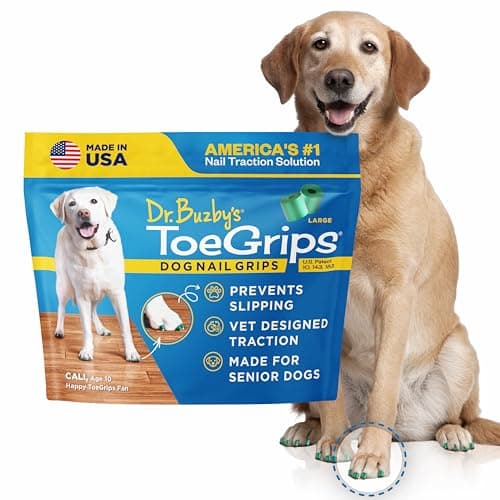
Dr. Buzby's
Dr. Buzby's ToeGrips for Dogs
Our score
$34–$40
Best for
Senior dogs slipping on hardwood, tile, or laminate floors
The best dog-mounted traction fix there is, and the one to buy once rugs have taken you as far as they can. Nothing touches the paw pad, which is why dogs tolerate these where they refuse socks and boots. Go in knowing the real cost: this is not a $40 purchase but a $240–$320 a year habit, so lay runners along your dog's actual routes first and buy grips for the floors you cannot cover.
Pros
- Veterinarian-developed; in clinical use for over a decade
- Slip onto each toenail — no socks, booties, or adhesives required
- Restores traction immediately, especially on hard floors
- Nothing touches the paw pad, so dogs accept them where they refuse boots
- Amazon and the manufacturer both charge $39.99 — no retailer markup
- 20 grips per bag against the 16 a dog wears, so a set includes four spares
Cons
- The only two published studies of nail grips both tested this exact product, and both were null: Roush 2017 (Front Vet Sci 4:111 — 15 sound dogs, kinetic changes "unlikely to be clinically relevant") and Repac 2022 (Animals 12(18):2312 — 30 dogs two weeks post-TPLO vs sham, no difference in weight bearing or limb function, including the owner question that asked specifically about slippery floors). Fair caveats: small samples, one used healthy dogs, the other a single early post-op timepoint — but "no positive trial exists" is the honest label, and we say it while still recommending the product for the mechanism and the owner-reported traction stories it was never tested against (verified 2026-08-14).
- A recurring cost, not a one-off. The maker publishes two different bag lives — "1–2 months" on its store page and "1-3 months, two months on average" in its FAQ (both read 2026-09-05) — which spans $160–$480 a year at $39.99. Plan on $240–$320, the two surfaces' central figures
- The Amazon listing markets specifically to dogs with "ACL injuries" — the one population where a randomised trial has been run, and where it found nothing (Repac 2022). The same bullets carry three claims with no source we could find: "more than 250,000 paws," "America's #1 nail traction solution," and "recommended by thousands of veterinarians worldwide" (listing copy verified 2026-08-17). Re-read 2026-08-31: a fourth unsourced superlative has been added to the top bullet on all four Amazon sizes — "The Only Toenail Grips for Dogs With GripZone Technology" — and the Large listing's title now leads with "Instant Traction on Wood/Hardwood Floors."
- The maker sells Scotch Super Glue Gel at $4.99 on its own store, listed as an "Alternate ToeGrips Application Method" (shop.toegrips.com, 2026-08-31). Read that as what it is: the company's own answer to the grips coming off, priced separately and not mentioned on the Amazon listing you are most likely to buy from.
- Application needs isopropyl rubbing alcohol, which is not in the box
- Initial application takes 15–20 minutes for a full set
- Some dogs chew them off in the first week
- Amazon carries only four of the seven sizes; XS, XXL and XXXL dogs have to buy direct
- Sizing by weight chart alone often misses — the accurate method needs dental floss and a ruler
A Corgi at 25 to 30 pounds sits inside the medium band, which is one of the four sizes stocked on Amazon rather than direct-only, so this is a breed the supply chain is kind to. Now the part the listing will not tell you: a bag is $39.99 and the manufacturer's own copy says a bag lasts one to two months, which makes this a $240 to $480 a year habit, not a $40 purchase. That is why runners come first. You also need isopropyl rubbing alcohol to fit them and it is not in the box, and the weight chart is the least accurate way to size them — dental floss around the nail, measured against a ruler, is the method that works.
If the diagnosis is degenerative myelopathy#
There is no treatment that stops it. Be suspicious of anyone who tells you otherwise, and that includes every supplement marketed at DM.
What there is, is one study — and we are going to be precise about how much weight it holds. Fifty dogs with DM were reviewed retrospectively; 22 had owner-reported follow-up. Mean survival was 255 days in the 9 dogs whose owners performed intensive daily physiotherapy, 130 days in the 6 who did moderate, and 55 days in the 7 who did none.[14]
Now the caveats, because they are substantial. It was retrospective and not randomised, so owners who did the most physiotherapy may have differed in every other way too — the authors say so themselves. Survival was time to euthanasia, an owner decision. Histology confirmed the diagnosis in only 4 of the 50. And the inclusion criteria required dogs over 20 kg, which means no Corgi was in this study. A 27-pound Corgi is less than half that weight.
So we will not tell you daily physiotherapy multiplies your Corgi's remaining walking time by four. What we will tell you is that this is the only controlled comparison that exists, that its direction is consistent, that the protocol is free, and that a veterinary rehabilitation referral is the highest-value appointment available for a DM diagnosis. The protocol the study used was short frequent walks of 5 to 20 minutes several times daily, passive joint movement three times daily, massage, and hydrotherapy weekly where available — all of it deliverable by an owner who has been shown how.
Which is where a harness stops being a gadget and starts being the thing that makes the plan physically possible.
#3 Pick

Walkin' Pets
Walkin' Buddy Up Rear Harness
Our score
$39.95–$59.95
Best for
A dog with stable, non-progressive hind-end weakness whose front legs are sound — advanced hip arthritis, a healed spinal injury — where the rear half is all you will ever need. No longer the right buy for degenerative myelopathy
We can no longer recommend this for a progressive disease, and that is a reversal of what this page used to say. The harness itself is sound and the cart compatibility is still the best reason in the category to choose it — but Walkin' Pets has stopped selling the line, the front half you were told to add later cannot be bought, and what remains on Amazon is a reseller working through stock. For a dog with a stable rear-end problem who needs a good harness now and will never need a second one, at $40–$60 it is still a fair buy. For a dog with degenerative myelopathy, buy a two-piece system that will still exist in a year.
Pros
- Built for chronic rear support rather than short post-op trips, with a top handle you guide and lift from rather than a strap you hold under the belly
- Attaches to a Walkin' Wheels cart, which matters enormously for a progressive disease — most rear-support gear does not, and a harness that cannot connect to the cart your dog ends up in is a purchase you make twice
- Sized on abdomen girth as well as bodyweight, which is the dimension that actually decides fit on a barrel-chested or a wasted dog
- Neoprene contact surfaces, and it stays on between lifts
Cons
- Walkin' Pets no longer sells this harness. As of 14 August 2026 the word "Buddy Up" appears nowhere in the manufacturer's 69-product store feed or its 70-URL product sitemap, and the old product URLs return 404. What is left on Amazon is reseller stock
- The companion front harness — the one the maker's own listing tells you to "pair with... for full body support" — cannot be found on sale anywhere we looked, including a descriptive Amazon search that surfaces all three remaining sizes of the rear. The modularity this product was sold on is gone, and the Amazon bullets still advertise it
- The maker has now answered the question itself. On 4 September 2026 walkinpets.com/products/buddy-up-harness-rear — the Buddy Up rear product URL, which returned 404 on 14 August — resolves to the **Help 'Em Up Harness** page instead. A redirect to a different product is a manufacturer telling you what to buy in its place, and it is the clearest discontinuation receipt we have
- The Amazon buy box is held by a third-party reseller, "Veterinary Preferred," not by Walkin' Pets. There is no manufacturer behind your purchase in the ordinary way, and no replacement path when the neoprene wears out
- Walkin' Pets publishes no warranty at all — its site carries a refund policy and a privacy policy and nothing else. And its returns terms are harsh for exactly this buyer: no exchanges of any kind, a restocking fee of 8–12%, and a harness returned "heavily soiled with strong pet odors, embedded fur [or] visible stains" is graded ineligible for any refund
- Less padded than the Help 'Em Up, which tells against it for a dog wearing it most of the day
- Not suitable as front-end support on its own
- Determined dogs back out of it without close fitment — measure before ordering
Free first: a rolled bath towel under the belly in front of the hind legs. For a dog needing occasional help, that may be the end of the problem, and a Corgi is light enough that it stays workable longer than it would for a big dog. It stops being enough when the lifts are frequent enough to hurt your own back, or when the towel slips because the hindquarter muscle it was resting against has gone.
The angle we would sell this on is not the dog's physiology — nobody has shown a harness changes the course of DM, and we are not going to imply it. It is that a rear-support harness is a front-end-free design, which matters here specifically: in DM the front end stays good for a long time, so a two-piece full-body harness is more equipment than the dog needs for most of the disease. The honest downsides: it is less padded than the two-piece alternatives, so long sessions can rub; it does nothing for a dog whose front end is also failing, which is where DM eventually goes; and a determined dog reverses out of a loose one. Fit it properly the first time.
For the wider picture on hind-end failure in older dogs, weak back legs in senior dogs covers the full differential, and hip dysplasia covers the orthopedic one this article has deliberately treated as the less likely answer in this breed.
What to do this week#
Tonight, turn your Corgi over and look at all four sets of nails together. Uneven wear on one hind foot is the earliest thing you can find without a vet, and it takes five seconds.
This week, put the best bed in the house on the floor and block the sofa jump. Not the ramp, not the supplement — the jump. It is the most repeated load this build takes and it is the cheapest one to remove.
If you have a Corgi under five, get the SOD1 status if you do not already have it, and get a body condition score from your vet with the number written down so next year's is comparable.
If you have a Corgi over eight whose back end has started to go, ask one question at the front of the appointment: does this hurt him? Say what you have observed about pain and about which foot went first, and ask for a neurologic examination specifically. That question is the fork in the road. Everything that happens next — imaging or not, surgery or not, rehabilitation or not — runs off the answer, and you are the only person who has been watching him long enough to give it.
Sources#
- American Kennel Club. "Official Standard of the Pembroke Welsh Corgi." Approved June 13, 1972; reformatted January 28, 1993. PDF — height 10 to 12 inches at the withers; weight not exceeding 30 lb for dogs and 28 lb for bitches, with preferred show weights of approximately 27 and 25 lb; "The distance from the withers to the base of the tail should be approximately 40 percent greater than the distance from the withers to the ground."
- Brown EA, Dickinson PJ, Mansour T, et al. "FGF4 retrogene on CFA12 is responsible for chondrodystrophy and intervertebral disc disease in dogs." Proceedings of the National Academy of Sciences USA. 2017;114(43):11476-11481. doi:10.1073/pnas.1709082114 — chondrodystrophy defined by dysplastic shortened long bones and premature degeneration and calcification of intervertebral discs; the FGF4 retrogene segregated with limb length and had an odds ratio of 51.23 (95% CI 46.69–56.20) for IVDD.
- Batcher K, Dickinson P, Giuffrida M, et al. "Phenotypic Effects of FGF4 Retrogenes on Intervertebral Disc Disease in Dogs." Genes. 2019;10(6):435. doi:10.3390/genes10060435 — 569 surgical IVDD cases across 61 breeds plus 127 mixed-breed dogs; among Pembroke Welsh Corgis genotyped, 12-FGF4RG allele frequency 0.92 and 18-FGF4RG 1.00, median age at surgery 7.0 years across 12 Corgi surgical cases; no significant difference in age at surgery between one and two copies of 12-FGF4RG (p = 0.266); two copies gave 2.46 times the odds of disc calcification versus one (95% CI 1.21–5.03, p = 0.013).
- Packer RMA, Hendricks A, Volk HA, Shihab NK, Burn CC. "How long and low can you go? Effect of conformation on the risk of thoracolumbar intervertebral disc extrusion in domestic dogs." PLoS ONE. 2013;8(7):e69650. doi:10.1371/journal.pone.0069650 — 700 dogs recruited from a UK referral population, 79 diagnosed with thoracolumbar IVDE; back length to height at withers ratio positively associated with IVDE risk; being overweight and skeletally smaller each significantly increased risk.
- Awano T, Johnson GS, Wade CM, et al. "Genome-wide association analysis reveals a SOD1 mutation in canine degenerative myelopathy that resembles amyotrophic lateral sclerosis." Proceedings of the National Academy of Sciences USA. 2009;106(8):2794-2799. doi:10.1073/pnas.0812297106 — DNA from 38 DM-affected Pembroke Welsh Corgi cases and 17 related clinically normal controls; SOD1 G to A transition causing an E40K missense mutation; homozygosity for the A allele associated with DM in Pembroke Welsh Corgi, Boxer, Rhodesian Ridgeback, German Shepherd Dog and Chesapeake Bay Retriever; onset typically at 8 years of age or older.
- Zeng R, Coates JR, Johnson GC, et al. "Breed distribution of SOD1 alleles previously associated with canine degenerative myelopathy." Journal of Veterinary Internal Medicine. 2014;28(2):515-521. doi:10.1111/jvim.12317 — 33,747 dogs genotyped across 222 breeds; Pembroke Welsh Corgi n = 3,209 with c.118A allele frequency 79% (220 G/G, 898 G/A, 2,091 A/A), second only to the Wire Fox Terrier at 94% on 79 dogs; in a low-ascertainment-bias follow-up cohort, 60% of 30 homozygotes developed clinical signs consistent with DM versus 4% of 55 heterozygotes and 6% of 53 c.118G homozygotes; eight heterozygotes had histopathologically confirmed DM; authors conclude breeding to avoid producing homozygotes is a rational strategy.
- Karbe GT, Biery DN, Gregor TP, Giger U, Smith GK. "Radiographic hip joint phenotype of the Pembroke Welsh Corgi." Veterinary Surgery. 2012;41(1):34-41. doi:10.1111/j.1532-950X.2011.00938.x — 399 Pembroke Welsh Corgis; all had distraction index above 0.30 (mean 0.66); 6.8% had osteoarthritis, 18% subluxation, 22.3% caudolateral curvilinear osteophytes, 74.4% circumferential femoral head osteophytes; conclusion that Corgis had a low frequency of conventional osteoarthritis despite hip laxity that correlates with osteoarthritis in large breeds.
- Pegram C, Raffan E, White E, et al. "Frequency, breed predisposition and demographic risk factors for overweight status in dogs in the UK." Journal of Small Animal Practice. 2021;62(7):521-530. doi:10.1111/jsap.13325 — 1,580 of 22,333 dogs recorded overweight during 2016, one-year period prevalence 7.1% (95% CI 6.7–7.4); eight breeds showed increased odds versus crossbreds, highest being Pug (OR 3.12), Beagle (2.67), Golden Retriever (2.58) and English Springer Spaniel (1.98). The Pembroke Welsh Corgi is not among the breeds named as predisposed; the authors note veterinary professionals appear to be under-reporting overweight status.
- Coates JR, March PA, Oglesbee M, et al. "Clinical characterization of a familial degenerative myelopathy in Pembroke Welsh Corgi dogs." Journal of Veterinary Internal Medicine. 2007;21(6):1323-1331. doi:10.1111/j.1939-1676.2007.tb01955.x — 21 Pembroke Welsh Corgis studied prospectively from diagnosis until euthanasia; median duration of clinical signs before euthanasia 19 months; median age at euthanasia 13 years; all dogs non-ambulatory paraparetic or paraplegic at euthanasia.
- University of Missouri Veterinary Health Center. "Degenerative Myelopathy." vhc.missouri.edu — "Common clinical signs include an asymmetric loss of coordination (ataxia) and spastic weakness in the hind limbs"; "Owners often report their dogs to be scuffing their nails or toes during walking"; "Dogs seem not to show pain during the course of the disease"; dogs often become non-ambulatory within 11 months of initial signs; homozygous dogs "have been shown to be at risk" but "not all dogs that have the mutation will develop DM so the mutation test is currently a test for risk."
- Ivansson EL, Megquier K, Kozyrev SV, et al. "Variants within the SP110 nuclear body protein modify risk of canine degenerative myelopathy." Proceedings of the National Academy of Sciences USA. 2016;113(22):E3091-E3100. doi:10.1073/pnas.1600084113 — genome-wide association within the Pembroke Welsh Corgi breed comparing DM-affected and unaffected dogs all homozygous for the SOD1 mutation; an SP110 haplotype was present in 40% of affected versus 4% of unaffected dogs (p = 1.5 × 10⁻⁵), associated with increased probability of developing DM (p = 4.8 × 10⁻⁶) and earlier onset (p = 1.7 × 10⁻⁵).
- Ukawa H, Akiyama N, Yamamoto F, et al. "Negative Selection on a SOD1 Mutation Limits Canine Degenerative Myelopathy While Avoiding Inbreeding." Genome Biology and Evolution. 2023;15(12):evad231. doi:10.1093/gbe/evad231 — buccal swabs from 5,512 Pembroke Welsh Corgis across Japan sampled 2017–2022; mutant homozygote frequency 14.5% (95/657) in 2019 falling to 2.9% (24/820) in 2022, with no significant difference in genome-wide inbreeding (F_ROH) between wild-type and mutant groups in either year; median onset of DM in Pembroke Welsh Corgis given as 11 years, citing Coates et al. 2007.
- Kealy RD, Lawler DF, Ballam JM, et al. "Effects of diet restriction on life span and age-related changes in dogs." Journal of the American Veterinary Medical Association. 2002;220(9):1315-1320. doi:10.2460/javma.2002.220.1315 — 48 Labrador Retrievers in a paired feeding study, one of each pair fed 25% less from 8 weeks of age until death; median life span significantly longer and onset of clinical signs of chronic disease generally delayed in food-restricted dogs. Labradors, not Corgis.
- Kathmann I, Cizinauskas S, Doherr MG, Steffen F, Jaggy A. "Daily controlled physiotherapy increases survival time in dogs with suspected degenerative myelopathy." Journal of Veterinary Internal Medicine. 2006;20(4):927-932. doi:10.1111/j.1939-1676.2006.tb01807.x — retrospective, non-randomised; 50 dogs with DM, follow-up available for 22; mean survival 255 days (SD 99.4) with intensive physiotherapy (n = 9), 130 days (SD 31.0) moderate (n = 6), 55 days (SD 31) none (n = 7); Cox regression risk of dying 5.8 times higher with moderate physiotherapy (p = 0.046) and 112 times higher with none (p < 0.001). Inclusion required middle-aged to older large-breed or mixed-breed dogs weighing more than 20 kg, so no Pembroke Welsh Corgis were included; histologic confirmation in only 4 of 50 dogs; survival was time to owner-elected euthanasia.
The breed portrait at the top of this page is a generated illustration of breed type, not a photograph of a real dog, and it should not be used to judge size or conformation quality.
This article is educational and does not replace veterinary advice. Sudden back pain, dragging or knuckling of a hind foot, or loss of bladder control in a Corgi is an emergency. Painless, gradual hind-limb weakness is not an emergency, but it is a reason to ask for a neurologic examination rather than a rehabilitation plan.
Frequently asked
- Is my Corgi's back leg problem IVDD or degenerative myelopathy?
- The fastest sorting question is pain. Disc disease hurts — a Corgi with a disc extrusion is usually tense, reluctant to move, sometimes vocal, and the change often arrives over hours or a day. Degenerative myelopathy does not hurt; the University of Missouri's neurology service states plainly that dogs seem not to show pain during the course of the disease, and it begins as an asymmetric loss of coordination with owners typically noticing scuffed nails or toes first. So a Corgi whose back end is failing and who is comfortable has not got the milder problem — he has the other one, and it needs a neurologic examination rather than rest and an anti-inflammatory. Only your vet can separate them properly, because a Corgi can have both at once.
- Should I get my Corgi DNA tested for degenerative myelopathy?
- It is worth doing, provided you understand what the result is. The SOD1 test is a risk test, not a diagnosis — the University of Missouri states that not all dogs with the mutation will develop DM. The mutant allele is very common in this breed: in the largest published survey, 3,209 Pembroke Welsh Corgis carried the c.118A allele at 79 percent, the second-highest frequency among 222 breeds. A clear result is genuinely reassuring because it makes DM unlikely; an at-risk result does not mean your dog will get it, and it does not diagnose a dog who is already wobbling. Its real value is for breeding decisions and for pointing a future work-up in the right direction.
- Do Corgis need a ramp for the sofa?
- Something at the sofa, yes — but a ramp is usually the wrong object for a 10 to 12 inch dog and an 18 inch sofa. The gradient a full-length ramp is designed for makes it enormous indoors, and most owners end up folding it away, which means it stops working. For sofa and bed height the honest answers are foam steps, a sturdy ottoman as a mid-point, or simply making the sofa off-limits and putting the best bed in the house on the floor. Save the ramp for the car, where the height difference genuinely needs one.
- Is hip dysplasia a real problem in Pembroke Welsh Corgis?
- It is more complicated than a yes or no, and the breed's own data is surprising. In a study of 399 PennHIP-evaluated Pembroke Welsh Corgis published in Veterinary Surgery, every single dog had a distraction index above 0.30 — a laxity level that predicts osteoarthritis in large breeds — with a mean of 0.66. Yet only 6.8 percent had radiographic osteoarthritis. So Corgi hips look alarming when graded against large-breed thresholds and mostly do not go on to behave that way. Hip pain in a Corgi is worth investigating, but it should not be assumed from a laxity number alone.
- What is the single most useful thing I can do for my Corgi's joints?
- Keep him lean, and start before there is a problem. In a cross-sectional study of 700 referral dogs, a longer back relative to height at the withers raised the risk of thoracolumbar disc extrusion, and being overweight independently raised it too — and the Corgi breed standard specifies a body 40 percent longer than the dog is tall, so the lever is built in. Weight is the one variable on that list you control, it costs nothing, and it is the only intervention here with evidence behind it that applies from puppyhood to the end. Everything else — ramps, traction, harnesses — is damage limitation around it.