Breed Guide
Boxer Joint Problems: The Knee, the Spinal Cord, and the Heat Problem Nobody Plans For
The Boxer's lameness is usually the knee, its scariest hind-leg disease is painless, and the heat limits of a short-faced dog quietly rewrite the whole arthritis exercise plan.

Three things make a Boxer's joints different from a generic large dog's. The knee is where the trouble usually starts — the breed sits on the short list for cruciate ligament rupture, while it is absent from the equivalent list for hip dysplasia. The hind-leg disease owners most fear in this breed, degenerative myelopathy, does not hurt at all, which makes pain the single most useful question you can bring to a vet. And because a Boxer is a short-faced dog, the heat limit, not the pain limit, is usually what caps the exercise that arthritis needs. Get those three straight and the rest of the plan writes itself.
Affiliate disclosure: Dog Orthopedic is reader-supported. When you buy through links on our site we earn a commission at no extra cost to you — about 3% on most pet products, and the same rate on every product we compare, so no pick earns us more than another. Prescription medication earns us nothing, and seeing your vet earns us nothing; we recommend both anyway. Learn more.
Imagery: Lifestyle photographs on this site are licensed from Pexels (royalty-free) and credited per image. Pexels imagery illustrates conditions and contexts — it does not depict the specific dogs or test sessions described in the text. Product photographs come from Amazon's Creators API. Breed portraits are illustrations of typical breed type rather than photographs of individual dogs, and are not drawn to scale against one another.
The build, and what it costs#
A Boxer is a compact, square, heavily muscled dog with a short face — a working bull-breed refined into an athlete. The conformation has three orthopedic consequences, and none of them are the ones people expect from a "big dog."
A short, powerful body with an explosive gait. Boxers do not jog. They accelerate, twist and stop. That movement pattern loads the stifle — the knee — through exactly the mechanism that tears a cranial cruciate ligament: rotation under load with the joint partly flexed. The classic canine cruciate story is not a single traumatic snap but a ligament that degenerates over months and finally gives way during something ordinary, and a dog built to change direction hard spends more of its life applying that particular force.
A shortened skull, which is not a joint problem until you try to treat the joints. This is the part that catches Boxer owners out. Every arthritis plan in veterinary medicine rests on consistent, moderate, low-impact exercise, because muscle is what stabilises a failing joint. A brachycephalic dog cools by panting through a shortened airway, which means the tool you most need to use is the tool the dog is worst equipped to tolerate. In a Labrador you titrate walks against soreness. In a Boxer you titrate them against soreness and temperature, and in July the temperature wins.
A long spinal cord in a breed carrying a known neurodegenerative risk allele. The Boxer's most feared hind-end disease is not in the joints at all. It is in the spinal cord, it is painless, and it is discussed in its own section below — because mistaking it for arthritis is the commonest and costliest error made in this breed.

What this breed actually gets, ranked#
1. Cranial cruciate ligament rupture — the headline. In the largest breed-risk analysis available, covering 1,243,681 dogs reported to the Veterinary Medical Database between 1964 and 2003, the breeds with the highest odds of cranial cruciate ligament deficiency were the Newfoundland, Rottweiler, Labrador Retriever, Bulldog, Boxer, Chow Chow, American Staffordshire Terrier and Saint Bernard. [2] The same study found that dogs over four years old were more likely to be diagnosed with cruciate deficiency, that dogs up to four were more likely to be diagnosed with hip dysplasia, and that neutered males and spayed females were significantly more likely than intact dogs to have cruciate disease.
Worth knowing honestly: breed risk lists do not agree perfectly across countries. The Royal Veterinary College's VetCompass analysis of UK primary-care records reported the Rottweiler at greatest risk of cruciate rupture. [3] The Rottweiler tops both lists; below that, referral populations and primary-care populations disagree, because they are counting different dogs. Take any single breed ranking as a signal, not a probability for your dog.
2. Hip dysplasia — present, but not this breed's defining problem. Boxers get hip dysplasia and hips are worth screening, but the breed is conspicuously absent from where the hip statistics point. In the 1.2-million-record analysis above, the highest hip dysplasia odds belonged to the Newfoundland, Saint Bernard, Old English Sheepdog, Rottweiler and German Shepherd Dog. [2] In the largest analysis of the Orthopedic Foundation for Animals database — 1,056,852 hip records and 275,129 elbow records across 60 breeds — the Boxer likewise did not appear among the breeds with the highest prevalence of either hip or elbow dysplasia. [4] Our hip dysplasia master guide covers the disease; the point for Boxer owners is that a hind-limb problem in this breed should not be assumed to be hips.
3. Degenerative myelopathy. Covered in full in the next section. It is not a joint disease, but it is the reason a Boxer's back legs stop working, and it is the differential that arthritis management keeps hiding.
4. Osteoarthritis, as the sequel. Most arthritis in this breed is secondary — the knee that ruptured at six is the joint that is arthritic at nine, whether or not it was operated on. Our arthritis master guide covers the treatment tiers.
5. Soft-tissue tumours as a lameness differential — and the honest correction. The assumption that a big square dog with a limp might have bone cancer does not survive the data. In a UK study of 905,552 dogs that identified 331 osteosarcoma cases, eleven breeds showed significantly increased odds against crossbreds — Scottish Deerhound, Leonberger, Great Dane and Rottweiler at the top — and the Boxer was not among them, showing no statistically significant association. Brachycephalic breeds as a group had roughly half the odds of mesocephalic breeds. [5]
What the Boxer is predisposed to is soft tissue. A review of breed cancer predispositions reports increased risk of mast cell tumours in Boxers — which in this breed tend to be lower grade and less aggressive — along with an increased relative risk of lymphoma, and notes that Boxers accounted for nearly half of the dogs with brain tumours presented for radiotherapy at the reporting institution. [6]
The practical translation is short: a new lump anywhere on a Boxer — including on a limb, including one you assume is a knock from the fence — gets a fine needle aspirate. Do not squeeze it, do not massage it, and do not give it a month.
The disease that does not hurt#
If you read only one section of this page, read this one.
The Boxer is one of the original breeds in which degenerative myelopathy was genetically characterised. The 2009 genome-wide association study that found the SOD1 c.118G>A mutation — a single letter change producing an E40K substitution in the superoxide dismutase 1 protein — reported that homozygosity for the risk allele was associated with degenerative myelopathy in five breeds: the Pembroke Welsh Corgi, Boxer, Rhodesian Ridgeback, German Shepherd Dog and Chesapeake Bay Retriever. Typical onset is at eight years or older, beginning as upper motor neuron weakness and loss of position sense in the hind limbs, and if the dog lives long enough the signs ascend. [7] Later work summarising breed distribution of the mutation places the Boxer among the breeds with the highest frequency of the risk allele. [8]
Two things about that need saying plainly, because the internet gets both wrong.
A positive test is not a diagnosis. The disease is inherited as an autosomal recessive with incomplete penetrance: dogs homozygous for the risk allele are at risk, and many never develop clinical disease. [7] A cheek-swab result saying "at risk" tells you something real about the population and very little about your individual dog's next five years. Degenerative myelopathy remains a diagnosis of exclusion in a living animal — the definitive confirmation is post-mortem examination of the spinal cord.
Pain is the distinguishing sign, and its absence is the tell. Here is the distinction that reorganises the whole problem:
| Arthritis / cruciate disease | Degenerative myelopathy | |
|---|---|---|
| Pain | Yes — sore on handling, worse after rest, worse after a big day | None. The dog is not uncomfortable |
| First sign | Limp, stiffness, reluctance to rise | Painless scuffing of one hind foot; nails worn on one side |
| Warming up | Improves after a few minutes of movement | No improvement; often looks the same all day |
| Foot placement | Normal — the dog knows where the foot is | Knuckling; the foot may be left turned over |
| Side | Often clearly one leg | Often asymmetrical at first, then both |
| Course | Fluctuates — good weeks and bad weeks | Steadily progressive over months |
A dog can have both at once, and many older Boxers do. But if you find yourself telling a vet "he's getting weak behind and he doesn't seem to mind," you have said something clinically important. Our guides to limping versus weakness and to weak back legs in senior dogs go through the separation in more detail, and how to tell if your dog is in pain covers the quiet signs a stoic breed hides.

When it shows up#
| Age | What owners typically notice | What is usually happening |
|---|---|---|
| 1–3 years | Nothing orthopedic, usually. Occasional soft-tissue strains from hard play | This is the window to build habits: lean weight, traction indoors, controlled turning games |
| 3–6 years | Sudden hind-leg lameness after play, often improving in days then returning; sitting with one leg out to the side | Partial cruciate tear. The "it got better" phase is the most expensive misread in this breed |
| 5–8 years | The other knee goes; stiffness after rest; loss of thigh muscle on one side | Completed cruciate disease and secondary osteoarthritis |
| 8+ | Painless scuffing, knuckling, wobble behind, nails wearing unevenly | Degenerative myelopathy enters the differential. Also the age at which the breed's cancer risk climbs |
| Any age, warm weather | Slowing on walks, heavy panting, wanting to lie on tile | Heat load, not joint pain — and a genuine emergency risk |
The earliest sign, in this breed specifically#
Generic "limping" is not the useful sign in a Boxer. Three things are.
The sit. A Boxer with an unhappy knee sits with the affected leg swung out to one side instead of tucked under. It is subtle, it happens fifty times a day in your kitchen, and it is often visible weeks before there is a limp worth calling a vet about.
The recovery that convinces you. Partial cruciate tears improve. The dog is three-legged on Saturday, sound on Wednesday, and everybody relaxes. Then it goes again after the next hard game. That pattern — lame, better, lame again — is not a dog getting over a knock. It is a ligament failing in stages, and every cycle adds meniscal damage and arthritis. Our guide to judging whether a limp is getting better is about exactly this trap.
The stoicism. Boxers are enthusiastic to a fault and will play through pain that would stop a more sensible dog. Enthusiasm is not evidence of comfort. Watch the day after the big day.
Screening, and what the numbers mean#
There is no screening X-ray for a cruciate ligament. That is the honest headline of this section, and it is why the Boxer's screening picture looks so different from a Bernese's or a German Shepherd's.
Hips and elbows. OFA and the equivalent European schemes exist and are worth using for breeding decisions, but both databases are voluntary — they collect the films people choose to submit, so every prevalence figure drawn from them is a floor rather than a rate. Given that the Boxer does not sit near the top of either the hip or elbow rankings, hip paperwork on a Boxer puppy is reassuring about a problem that was never the breed's main one. [4]
The SOD1 test. A cheek swab will tell you whether your dog carries zero, one or two copies of the risk allele. Given incomplete penetrance, a two-copy result means elevated risk, not a sentence. [7] It is genuinely useful for breeders and for owners who want to know what they might be watching for at eight. It should not change how you treat a five-year-old dog today.
Neuter timing. In a 15-year record set from the UC Davis veterinary teaching hospital covering 761 Boxers, joint disorders ran at about 2 percent in intact males and intact females, with no apparent increase associated with neutering at any age — a striking contrast with several other large breeds in the same dataset. Cancer, however, moved: 17 percent in intact males and 11 percent in intact females, against 32 percent in males neutered before two years of age, a statistically significant difference. [9] This is a retrospective referral-hospital dataset, not a randomised trial; the dogs in it are not a random sample of Boxers, and the joint-disorder rate of 2 percent is lower than most Boxer owners would guess, which is itself a reason to treat the numbers as a signal rather than a forecast. Our guide on when to spay or neuter a dog covers the full trade-off, including the arguments that push the other way.
What actually helps#
Lean body condition, first and free. The largest modifiable factor in canine joint disease, and in a muscular breed it is easy to misjudge — a heavy Boxer still looks solid rather than fat. Feel the ribs with flat hands and light pressure. If you have to press, there is too much on.
Traction, second. A dog who accelerates hard indoors and slips on the turn is loading a knee at exactly the worst angle. Runners along the routes the dog actually uses cost less than any of the gear below. Our guide to dogs slipping on floors covers the options.
Activity, third — and here is the breed-specific part. The exercise prescription for a Boxer with arthritis is not written by the joints alone. It is written by the thermometer.

UK primary-care data from 905,543 dogs recorded 395 confirmed heat-related illness events in a single year. Brachycephalic dogs had 2.10 times the odds of heat-related illness compared with mesocephalic dogs (95% CI 1.68–2.64). The Boxer specifically showed an odds ratio of 2.26 against the Labrador Retriever, but with a confidence interval of 0.95 to 5.34 — which crosses 1, meaning the study described it as trending towards increased odds without reaching statistical significance. Dogs over 50 kg had 3.42 times the odds of dogs under 10 kg, and dogs aged 12 and over had 1.75 times the odds of dogs under two. [1]
Read that carefully, because it is more honest than the version you will see elsewhere. The strong, statistically solid finding is about skull shape as a category, which a Boxer has. The Boxer-specific point estimate is elevated but did not reach significance in that dataset. And the age finding matters most of all here: the arthritic Boxer is by definition an older Boxer, which stacks two risk factors on the same dog on the same afternoon.
What that means for the walk:
- Move the walks, do not shorten the life. Dawn and dusk in warm months. The joints need the consistency; the airway needs the cool.
- Split the daily total. Two or three short outings beat one long one for stiff joints anyway, and each shorter piece gives the dog a chance to cool.
- Use the pavement test. Back of your hand on the surface for seven seconds. If you cannot hold it there, it is too hot for feet and too hot for a short-faced dog.
- Watch the recovery, not the walk. Panting that does not settle within a few minutes of stopping in shade is the signal to end the session — and if it does not settle at all, that is the emergency in the callout at the top of this page.
- Water work is the workaround. Swimming loads muscle without loading joints and cools at the same time. Not every Boxer takes to it; where one does, it solves both constraints at once.
Our guide to how much walking an arthritic dog needs has the general arithmetic, and how cold is too cold for an arthritic dog covers the other end of the year — which for a short-coated breed like this one is a real constraint too, in the opposite direction.
Pain control through your vet. Canine-specific NSAIDs and newer options work. Nothing from a human medicine cabinet is safe for a dog.
Surgery, when it is the knee. A completed cruciate rupture in a dog this size is usually a surgical conversation. Our TPLO recovery guide covers what the road back actually looks like, and the questions to ask a veterinary orthopedic surgeon are worth reading before the consult rather than after.
Gear, honestly#
Most Boxers need nothing bought. A Boxer with a sore knee needs a vet, a lean bodyweight, and rugs on the floor — in that order, and none of them are a purchase. There are exactly two situations in this breed where equipment genuinely changes the day.
#1 Pick

Walkin' Pets
Walkin' Buddy Up Rear Harness
Our score
$39.95–$59.95
Best for
A dog with stable, non-progressive hind-end weakness whose front legs are sound — advanced hip arthritis, a healed spinal injury — where the rear half is all you will ever need. No longer the right buy for degenerative myelopathy
We can no longer recommend this for a progressive disease, and that is a reversal of what this page used to say. The harness itself is sound and the cart compatibility is still the best reason in the category to choose it — but Walkin' Pets has stopped selling the line, the front half you were told to add later cannot be bought, and what remains on Amazon is a reseller working through stock. For a dog with a stable rear-end problem who needs a good harness now and will never need a second one, at $40–$60 it is still a fair buy. For a dog with degenerative myelopathy, buy a two-piece system that will still exist in a year.
Pros
- Built for chronic rear support rather than short post-op trips, with a top handle you guide and lift from rather than a strap you hold under the belly
- Attaches to a Walkin' Wheels cart, which matters enormously for a progressive disease — most rear-support gear does not, and a harness that cannot connect to the cart your dog ends up in is a purchase you make twice
- Sized on abdomen girth as well as bodyweight, which is the dimension that actually decides fit on a barrel-chested or a wasted dog
- Neoprene contact surfaces, and it stays on between lifts
Cons
- Walkin' Pets no longer sells this harness. As of 14 August 2026 the word "Buddy Up" appears nowhere in the manufacturer's 69-product store feed or its 70-URL product sitemap, and the old product URLs return 404. What is left on Amazon is reseller stock
- The companion front harness — the one the maker's own listing tells you to "pair with... for full body support" — cannot be found on sale anywhere we looked, including a descriptive Amazon search that surfaces all three remaining sizes of the rear. The modularity this product was sold on is gone, and the Amazon bullets still advertise it
- The maker has now answered the question itself. On 4 September 2026 walkinpets.com/products/buddy-up-harness-rear — the Buddy Up rear product URL, which returned 404 on 14 August — resolves to the **Help 'Em Up Harness** page instead. A redirect to a different product is a manufacturer telling you what to buy in its place, and it is the clearest discontinuation receipt we have
- The Amazon buy box is held by a third-party reseller, "Veterinary Preferred," not by Walkin' Pets. There is no manufacturer behind your purchase in the ordinary way, and no replacement path when the neoprene wears out
- Walkin' Pets publishes no warranty at all — its site carries a refund policy and a privacy policy and nothing else. And its returns terms are harsh for exactly this buyer: no exchanges of any kind, a restocking fee of 8–12%, and a harness returned "heavily soiled with strong pet odors, embedded fur [or] visible stains" is graded ineligible for any refund
- Less padded than the Help 'Em Up, which tells against it for a dog wearing it most of the day
- Not suitable as front-end support on its own
- Determined dogs back out of it without close fitment — measure before ordering
This is the degenerative myelopathy tool, and the reason it is rear-only rather than a full-body harness is the whole point: in this disease the front end stays strong for a long time, so a dog who needs the back half supported does not need the front half restricted. Bought early — while the dog is still walking and can learn it without stress — it buys months of ordinary garden and street walks that otherwise stop happening. The honest downsides: it is another thing to put on and take off several times a day, it does nothing for a dog whose problem is pain rather than weakness, and a rolled bath towel under the belly does the same job for free for short distances. Our lift harness comparison sets the options side by side, and best dog mobility aids covers what comes after a harness stops being enough.
#2 Pick
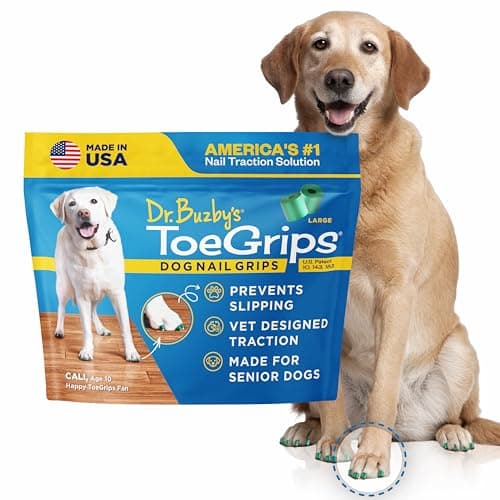
Dr. Buzby's
Dr. Buzby's ToeGrips for Dogs
Our score
$34–$40
Best for
Senior dogs slipping on hardwood, tile, or laminate floors
The best dog-mounted traction fix there is, and the one to buy once rugs have taken you as far as they can. Nothing touches the paw pad, which is why dogs tolerate these where they refuse socks and boots. Go in knowing the real cost: this is not a $40 purchase but a $240–$320 a year habit, so lay runners along your dog's actual routes first and buy grips for the floors you cannot cover.
Pros
- Veterinarian-developed; in clinical use for over a decade
- Slip onto each toenail — no socks, booties, or adhesives required
- Restores traction immediately, especially on hard floors
- Nothing touches the paw pad, so dogs accept them where they refuse boots
- Amazon and the manufacturer both charge $39.99 — no retailer markup
- 20 grips per bag against the 16 a dog wears, so a set includes four spares
Cons
- The only two published studies of nail grips both tested this exact product, and both were null: Roush 2017 (Front Vet Sci 4:111 — 15 sound dogs, kinetic changes "unlikely to be clinically relevant") and Repac 2022 (Animals 12(18):2312 — 30 dogs two weeks post-TPLO vs sham, no difference in weight bearing or limb function, including the owner question that asked specifically about slippery floors). Fair caveats: small samples, one used healthy dogs, the other a single early post-op timepoint — but "no positive trial exists" is the honest label, and we say it while still recommending the product for the mechanism and the owner-reported traction stories it was never tested against (verified 2026-08-14).
- A recurring cost, not a one-off. The maker publishes two different bag lives — "1–2 months" on its store page and "1-3 months, two months on average" in its FAQ (both read 2026-09-05) — which spans $160–$480 a year at $39.99. Plan on $240–$320, the two surfaces' central figures
- The Amazon listing markets specifically to dogs with "ACL injuries" — the one population where a randomised trial has been run, and where it found nothing (Repac 2022). The same bullets carry three claims with no source we could find: "more than 250,000 paws," "America's #1 nail traction solution," and "recommended by thousands of veterinarians worldwide" (listing copy verified 2026-08-17). Re-read 2026-08-31: a fourth unsourced superlative has been added to the top bullet on all four Amazon sizes — "The Only Toenail Grips for Dogs With GripZone Technology" — and the Large listing's title now leads with "Instant Traction on Wood/Hardwood Floors."
- The maker sells Scotch Super Glue Gel at $4.99 on its own store, listed as an "Alternate ToeGrips Application Method" (shop.toegrips.com, 2026-08-31). Read that as what it is: the company's own answer to the grips coming off, priced separately and not mentioned on the Amazon listing you are most likely to buy from.
- Application needs isopropyl rubbing alcohol, which is not in the box
- Initial application takes 15–20 minutes for a full set
- Some dogs chew them off in the first week
- Amazon carries only four of the seven sizes; XS, XXL and XXXL dogs have to buy direct
- Sizing by weight chart alone often misses — the accurate method needs dental floss and a ruler
The second situation is a hard-floored house and a dog who has started scuffing. Traction at the toenail helps a dog who is losing confidence on laminate — and the earlier problem it solves is behavioural, because a dog who slips once starts bracing, and bracing loads the knee. The honest downsides: they fall off and need replacing, they do nothing on carpet, and area rugs you already own solve the same problem better for less. Buy them for the rooms you cannot rug.
Where to go next#
- Arthritis in dogs — the disease that follows a cruciate rupture
- Hip dysplasia in dogs — what it is, and why it is not the Boxer's headline
- Limping versus weakness — the distinction this whole page turns on
- Weak back legs in a senior dog — where the myelopathy conversation usually starts
- How much walking an arthritic dog needs — dose, not distance
- How cold is too cold for an arthritic dog — the other end of the calendar
- TPLO recovery guide — if the knee goes to surgery
- Questions to ask a veterinary orthopedic surgeon — before you sit down in the consult
What to do this week#
Watch how your Boxer sits. If a back leg swings out to the side rather than tucking under, book the appointment now rather than after the next limp — a partial cruciate tear that "got better" is the single most expensive thing to ignore in this breed. Run your hands down both hind legs and ask yourself the one question that reorganises everything: does it hurt? If it clearly does, you are probably looking at a joint. If it clearly does not, and the foot is scuffing, say those exact words to your vet.
And if it is warm where you are, move tomorrow's walk to before breakfast. The joints do not care what time it is. The airway does.
Sources#
- Hall EJ, Carter AJ, O'Neill DG. Incidence and risk factors for heat-related illness (heatstroke) in UK dogs under primary veterinary care in 2016. Scientific Reports 2020;10:9128. https://doi.org/10.1038/s41598-020-66015-8
- Witsberger TH, Villamil JA, Schultz LG, Hahn AW, Cook JL. Prevalence of and risk factors for hip dysplasia and cranial cruciate ligament deficiency in dogs. JAVMA 2008;232(12):1818–1824. https://avmajournals.avma.org/view/journals/javma/232/12/javma.232.12.1818.xml
- Royal Veterinary College VetCompass. New research finds Rottweilers at greatest risk of cranial cruciate ligament rupture, reporting Pegram C et al., The Veterinary Journal 2023;292:105952. https://www.rvc.ac.uk/vetcompass/news/new-research-finds-rottweilers-at-greatest-risk-of-cranial-cruciate-ligament-rupture
- Oberbauer AM, Keller GG, Famula TR. Long-term genetic selection reduced prevalence of hip and elbow dysplasia in 60 dog breeds. PLOS ONE 2017;12(2):e0172918. https://doi.org/10.1371/journal.pone.0172918
- O'Neill DG, Edmunds GL, Urquhart-Gilmore J, et al. Dog breeds and conformations predisposed to osteosarcoma in the UK: a VetCompass study. Canine Medicine and Genetics 2023;10:8. https://doi.org/10.1186/s40575-023-00131-2
- Dobson JM. Breed-predispositions to cancer in pedigree dogs. ISRN Veterinary Science 2013;2013:941275. https://doi.org/10.1155/2013/941275
- Awano T, Johnson GS, Wade CM, et al. Genome-wide association analysis reveals a SOD1 mutation in canine degenerative myelopathy that resembles amyotrophic lateral sclerosis. PNAS 2009;106(8):2794–2799. https://doi.org/10.1073/pnas.0812297106
- Yüksel M, Ege K, Karakuş I, Akyüz B. Breed distribution of the superoxide dismutase 1 gene polymorphism associated with degenerative myelopathy in a canine population from different geographical regions of Türkiye. Veterinary Medicine and Science 2026;12(2):e70725 — summarising Zeng R et al., Journal of Veterinary Internal Medicine 2014. https://pmc.ncbi.nlm.nih.gov/articles/PMC13097516/
- Hart BL, Hart LA, Thigpen AP, Willits NH. Assisting decision-making on age of neutering for 35 breeds of dogs: associated joint disorders, cancers, and urinary incontinence. Frontiers in Veterinary Science 2020;7:388. https://doi.org/10.3389/fvets.2020.00388
Frequently asked
- What is the most common joint problem in Boxers?
- Cranial cruciate ligament rupture — the knee. In the largest breed-risk analysis available, covering 1,243,681 dogs reported to the Veterinary Medical Database between 1964 and 2003, the Boxer was named among the breeds with the highest odds of cranial cruciate ligament deficiency, alongside the Newfoundland, Rottweiler, Labrador Retriever, Bulldog, Chow Chow, American Staffordshire Terrier and Saint Bernard. The Boxer did not appear in the equivalent list for hip dysplasia. If your Boxer is suddenly lame on a back leg, think knee first.
- Do Boxers get degenerative myelopathy?
- Yes — the Boxer is one of the original breeds in which the disease was genetically characterised. The 2009 genome-wide study that identified the SOD1 c.118G>A mutation found homozygosity for the risk allele associated with degenerative myelopathy in five breeds: the Pembroke Welsh Corgi, Boxer, Rhodesian Ridgeback, German Shepherd Dog and Chesapeake Bay Retriever. Onset is typically at eight years or older. Crucially, it is inherited with incomplete penetrance — many dogs who carry two copies never develop the disease — so a genetic test result is a risk figure, not a diagnosis.
- How do I tell arthritis from degenerative myelopathy in a Boxer?
- Pain is the dividing line. Arthritis hurts: the dog is stiff after rest, sore to the touch, better after a few minutes of movement, worse after a big day. Degenerative myelopathy does not hurt at all — it starts as a painless loss of coordination in the hind end, with the feet scuffing or knuckling over, the nails wearing on one side, and a wobble that does not improve with warming up. A dog can have both. Only a vet exam, and often imaging, can separate them properly, but the pain question is the one to bring to the appointment.
- How much exercise can a Boxer with arthritis have in summer?
- Less than the joints alone would suggest, and this is the breed-specific constraint. Boxers are brachycephalic, and UK primary-care data covering 905,543 dogs found brachycephalic dogs had 2.10 times the odds of heat-related illness compared with mesocephalic dogs. That means the walk that helps the joints has to fit inside the window where the dog can cool. In warm months, shift walks to dawn and dusk, split the daily total into shorter pieces, and treat panting that does not settle within a few minutes of stopping as the signal to end the session.
- If my Boxer has a lump on his leg, is it bone cancer?
- Probably not, and that is a genuinely useful thing to know. A UK study of 905,552 dogs found the Boxer had no statistically significant increase in osteosarcoma risk, and brachycephalic breeds as a group had roughly half the odds of dogs with standard-length skulls. What the Boxer is predisposed to is soft-tissue disease — mast cell tumours in particular, plus lymphoma. That changes the action, not the urgency: any new lump on a Boxer gets a needle in it at the vet, and nobody should squeeze it or wait to see if it goes down.