Owner's Guide
How Cold Is Too Cold for a Dog With Arthritis?
There is no single temperature. The honest evidence that cold worsens canine arthritis is thinner than you have been told, and the three things that actually change in winter are not on the thermometer.

Start with what not to buy. If you are here because it has turned cold and you are about to order a therapeutic coat, a heated pad, or another supplement, none of those is the decision that matters this winter. The decision that matters is the free one you are about to make without noticing: whether the walk still happens. There is no single temperature that is too cold for an arthritic dog — the published range between a Greyhound and a sled dog is about 40°C wide — and the evidence that cold itself worsens canine arthritis is considerably thinner than the internet suggests. What changes in winter is the household and the routine, and those are where the damage is done.
Affiliate disclosure: Dog Orthopedic is reader-supported. When you buy through links on our site we earn a commission at no extra cost to you — about 3% on most pet products, and the same rate on every product we compare, so no pick earns us more than another. Prescription medication earns us nothing, and seeing your vet earns us nothing; we recommend both anyway. Learn more.
Imagery: Lifestyle photographs on this site are licensed from Pexels (royalty-free) and credited per image. Pexels imagery illustrates conditions and contexts — it does not depict the specific dogs or test sessions described in the text. Product photographs come from Amazon's Creators API. Breed portraits are illustrations of typical breed type rather than photographs of individual dogs, and are not drawn to scale against one another.
So what is the actual number?#
There isn't one, and the reason is worth understanding rather than skipping.
Every animal has a thermoneutral zone — the ambient range in which it holds body temperature steady without spending energy on heating or cooling. Below the bottom of that range, the lower critical temperature, the body has to start burning fuel to stay warm. A 2020 paper on thermal stress in vehicles collected the published canine figures in one place, and they do not converge. Critical temperatures proposed for dogs in general run from about 15°C to 20°C (59–68°F) at the lower end. But the figure cited for Greyhounds is roughly 16°C (61°F), while the figure cited for Inuit sled dogs is roughly −25°C (−13°F).[1]
Roughly 40 degrees Celsius of difference, within one species. Any article that gives you a single threshold for "dogs" is quietly averaging a Malamute and a Whippet.
The closest thing to a hard number in the United States is regulatory rather than physiological. The Animal Welfare Act standards for indoor dog housing require that ambient temperature "must not fall below 45 °F (7.2 °C) for more than 4 consecutive hours when dogs or cats are present," and set a higher floor of 50°F specifically "for dogs and cats not acclimated to lower temperatures, for those breeds that cannot tolerate lower temperatures without stress or discomfort (such as short-haired breeds), and for sick, aged, young, or infirm dogs and cats." Below 50°F, the same rule requires "dry bedding, solid resting boards, or other methods of conserving body heat."[2]
That is a minimum standard for kennels, not a target for your living room. But it is useful for two reasons. It puts a real, non-invented number on the page — 45°F absolute, 50°F for old and sick dogs. And it tells you which category the federal standard puts your arthritic senior in: the one that gets the higher floor and the mandatory bedding.
| Ambient temperature | What it means for a typical arthritic senior |
|---|---|
| Above 60°F / 15°C | Inside or near the thermoneutral zone for most dogs. No cold-specific action needed. |
| 45–60°F / 7–15°C | Below the lower critical temperature for many dogs. Thin-coated, lean, and frail dogs start needing a coat. Walks continue normally. |
| 32–45°F / 0–7°C | The AWA floor for aged and short-haired dogs sits at 50°F. Shorten and repeat walks. Warm the sleeping surface. Watch the ground, not the thermometer. |
| Below 32°F / 0°C | Ice is now the primary risk, not the air. Short, frequent outings. Check paws after every one. |
| Below 20°F / −7°C | Brief, purposeful outings only for most pets. Thin-coated and small dogs should not be out long at all. |
The 45, 50 and 60°F lines are anchored in the sources above; the 32°F and 20°F rows are our own editorial thresholds, and no veterinary body publishes a walk-cancelling temperature for arthritic dogs. The row that matters most is the third one, and the reason is in the right-hand column: watch the ground, not the thermometer.
Does cold genuinely make arthritis worse?#
Here is the honest state of the evidence, which is not what most winter pet articles will tell you.
The canine data is close to a null result. In 2017, a group at the University of Minnesota fitted accelerometers to 62 dogs with osteoarthritis and compared their daily activity counts, and their owners' Canine Brief Pain Inventory scores, against seven daily environmental variables: average temperature, high temperature, low temperature, relative humidity, total precipitation, average barometric pressure, and total daylight hours. Only average temperature and daylight hours reached statistical significance — and together they accounted for less than 1% of the variation in how much those dogs moved. The authors' conclusion was that the relationship, while statistically significant, was "unlikely to be clinically significant."[3]
That is the most direct test of this question we could find, and it did not find the effect that everyone assumes is there.
The human data pulls the other way, and is weaker than it looks. A 2023 systematic review gathered 14 observational studies covering 2,102 osteoarthritis patients, with 511 in the quantitative analysis. Only three of those studies could be pooled for temperature, and across those three it came out moderately negatively correlated with pain — colder, more pain — at a summary r of −0.36 (95% CI −0.54 to −0.16). Barometric pressure was positively correlated at r = 0.35.[4] Those are real numbers, but the outcome being measured is self-reported pain in people who mostly already believe the weather affects their joints. The review's own authors flag that subjective pain assessment "may be influenced by confounding factors from different culture beliefs, educational level, tolerance, expressiveness and even psychological status."
The tissue mechanism is real but is being asked to carry too much. Cooling does stiffen collagen. In a 2016 study, 20 healthy young women had an ice pack held on the patellar tendon for 30 minutes; skin temperature over the tendon fell by 16.8°C, and measured tendon stiffness rose from 2,189 to 2,705 N/mm — a 25% increase — while tendon strain dropped 9%.[5] That is a genuine, well-measured effect, and it is the honest basis for "cold stiffens things."
But look at what was actually done. Thirty minutes of ice in direct contact with the skin, in a 22°C room, in healthy twenty-four-year-olds. A dog walking in 30°F air for fifteen minutes, generating heat the whole time under a coat of fur, is not receiving that dose. The mechanism is real at the tissue level; the extrapolation to a winter walk is a leap, and nobody has measured the landing.
What to take from all three. Cold probably does make a stiff dog a little stiffer, mostly in the first minutes of movement, and the effect is smaller than the confidence with which it is asserted. If your dog looks noticeably worse this week and it happens to be cold, do not file that under weather and wait for spring. A dog whose arthritis has genuinely progressed looks exactly like a dog who is "a bit stiff because of the cold," and one of those explanations costs you a season.

The three things that actually change in winter#
None of them is on the thermometer. All three are things you control.
1. The walk stops, and that is the real injury#
This is the one that does the damage, and it does not feel like a decision. It feels like sense. It is dark at five, the pavement is wet, the dog is old, and skipping tonight is obviously kind. Then it is March.
The relationship between pain and inactivity runs in both directions, which is what makes a still winter expensive. A 2025 study put accelerometers on 99 client-owned dogs with radiographically and clinically confirmed osteoarthritis for seven days. Dogs with higher hindlimb pain scores were significantly less active between 7am and 9am on weekdays. Dogs with hindlimb muscle atrophy were less active between 7pm and 9pm on weekdays and between 9am and 11am on weekends.[6]
Read the second finding carefully. Muscle atrophy predicted reduced activity. Reduced activity is also what causes muscle atrophy. Three months of skipped winter walks is not a neutral pause; it is a period during which the muscle stabilising a bad joint gets thinner, so that the dog who comes out the other side in spring is a worse dog than the one who went in.
What to do instead of cancelling:
- Shorten and repeat. Three ten-minute outings expose a dog to far less continuous cold than one thirty-minute outing while adding up to the same total movement. Veterinary cold-weather guidance is simply that "walks should be shortened in very cold weather" — shortened, not dropped.[9] Cold exposure is cumulative; total movement does not have to be.
- Warm up indoors first. Five to ten minutes of pottering around the house, a few slow laps of the hallway, before the door opens. This is the closest the tendon-cooling evidence gets to supporting anything on a winter walk: cooled tendon was measurably stiffer, so tissue that has been moving and is warmer should be more compliant than tissue that has been lying on a floor. Nobody has measured the warm-up half of that in dogs, and we are extrapolating exactly as we warned against above — but this extrapolation costs five minutes and nothing else.
- Change the surface, not the schedule. If the pavement is the problem, drive to a park path. A different route is cheaper than a lost season.
- Wipe the feet. Salt and ice-melt products "can irritate paws and, if licked off of the feet or fur and ingested, can cause gastrointestinal upset and irritate the mouth."[9] Ice balls between the toes also change how a dog places its foot.
“Because your dog can't tell you how much pain he or she is in.”
2. The ground gets slippery, and a compensating dog has no margin#

A dog with arthritis in one hip or one knee has already redistributed its weight to protect that joint. That redistribution is what makes ice dangerous for these dogs specifically: the reserve that a sound dog uses to catch a slip has already been spent on not limping. We could find no data on how often winter ice specifically converts a partial ligament tear into a complete one, and we would distrust anyone who quotes you a figure. What is not in doubt is the mechanics: a sudden loaded twist on a leg that is already compensating is the exact movement these injuries are made of, and ice is the surface that produces it.
The free fixes come first, and they are most of the answer.
- Go out when the ground is safest. Mid-afternoon rather than 6am, after a thaw rather than during one, sanded routes rather than shaded ones.
- Shorten the lead on ice. A dog at the end of six feet of slack accelerates before you can help. Reeling in costs nothing.
- Salt or grit your own steps and path. The transition points — the back step, the kerb, the threshold — are where dogs go down, not the middle of the pavement.
- Indoors matters as much. Winter is when wet paws meet hard floors. Our room-by-room guide to dogs slipping on floors covers the coverage math.
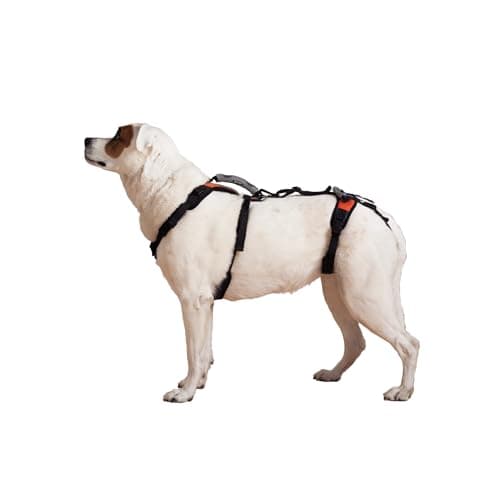
Where a purchase is genuinely justified is the dog whose back end is already unreliable — the dog you are half-catching two or three times a day, or who needs help up from lying down. On ice, that dog needs a handle on it before it slips, not after.
#2 Pick
Help 'Em Up
Help 'Em Up Harness
Our score
$95–$155
Best for
Long-term mobility support for senior or post-surgical large dogs
If your dog needs help getting up multiple times a day for the foreseeable future — post-TPLO, advanced hip dysplasia, hindquarter weakness in giant-breed seniors — this is the one to buy. It is the only harness in the category that supports the front and the back independently, which is what a dog with a bad hip and a compensating shoulder actually needs. Buy it from the manufacturer, not from Amazon: re-verified 18 August 2026, helpemup.com prices by size at $80 / $95 / $110 / $125 / $140 while Amazon runs $95 / $110 / $125 / $140 / $155 — a uniform $15 more at every size, every time we have checked.
Pros
- Two-piece (chest + hip) design lets you support either end independently
- Hip handle is purpose-built — not a converted car-seat-belt strap
- Padded chest plate distributes weight better than sling-only options
- Five sizes span 10 to 225 lb, and the rear half can be ordered a size smaller for a dog with muscle wasting
- Two hip-lift styles (Conventional and U-Band) so male dogs are not soiling the strap
Cons
- Amazon runs a uniform $15 above the maker's own price at every one of the five sizes, and the Amazon buy box is held by a third-party reseller (Veterinary Preferred) rather than by the brand — re-verified 18 August 2026
- The maker's own Mix & Match page prints two different starting prices, "From $80" and "FROM $95 USD", on the same page
- Direct pricing is no longer flat: since mid-August 2026 the maker charges $80 to $140 by size, so a giant-breed owner now pays $60 more than a terrier owner
- On 29 August 2026 the linked Amazon Medium (B0DK81SCG5) showed a future availability date rather than units on hand, while every size and style was in stock at helpemup.com the same day; on 9 September and again on 12 September 2026 the Amazon Medium still showed the future-date status at $125.00 with a maximum order of one and no ship date given, while all nine direct variants were in stock — two weeks of backorder on the channel we earn from, and one more reason the direct channel is the one to use
- Sizing is critical — measure twice, return is a hassle
- Rear straps can chafe the inner thigh if the harness is left tight while the dog lies down
- A dog filmed or gait-assessed while wearing it looks less lame than he is, because the harness offloads the limb you are trying to judge
- Bulkier than a quick-grab sling for short-term use
The Help 'Em Up is the harness we recommend for a dog who needs lifting every day for the foreseeable future, and its two-piece design is the reason: the chest and hip sections work independently, so you can lift the back end alone without hauling the whole dog up by its ribs. It stays on all day, which matters in winter, because a sling you have to fetch from a hook is a sling that is not on the dog at the moment it goes down.
The limitations are real. It is expensive: $80 to $140 by size direct from helpemup.com, and $95 to $155 for the same five sizes on Amazon, a flat $15 more at every size, with the Amazon buy box held by a third-party reseller rather than by the brand. Buy it direct. We earn nothing on that channel, which is why the advice is worth something. A correction while we are here: from July until 29 August 2026 this page said $130–180, a band that was never the maker's price at any size. On 29 August the Amazon listing for the Medium also showed a future availability date rather than units on hand, and a dog on ice cannot wait for a backorder.[10] It is bulkier than a grab-and-go sling, and sizing is genuinely unforgiving — measure twice, because the exchange window is 14 days. It is also more harness than most arthritic dogs need. If your dog is stiff but stable, skip this entirely; a folded towel under the belly is the correct tool for occasional help, and it costs nothing. Our guide to senior dogs with weak back legs covers where the threshold sits.
3. The floor gets cold, and your dog is on it for eighteen hours#

This is the part of winter care that gets the least attention and deserves the most, because of the arithmetic. A cold walk lasts twenty minutes. A cold floor lasts all night, and then most of the day. Conduction into a hard surface is a slow, continuous drain, and it acts on the dog for roughly fifty times as many hours as the walk does.
Start with the free version, because for a lot of households it is the whole fix.
- Move the bed. Off tile and onto carpet. Away from external doors and the draught line under them. Not under a window.
- Get it off the floor plane entirely if you can — even a few inches of clearance breaks the conductive path.
- Add a folded blanket underneath, not just on top. Insulation between dog and floor does more than insulation between dog and air.
If your dog is already sleeping on a thin bed, or on the floor by choice because getting into a bolstered bed hurts, then the purchase is worth making — and note that it is the same purchase you would make for the joints anyway. Several inches of foam is thermal insulation and pressure relief in one object.
#1 Pick

Big Barker
Big Barker 7-inch Pillow Top
Our score
$250–$460
Best for
Large and giant breeds with hip, elbow, or arthritis pain
The bed every senior-large-breed owner eventually buys, and the one we still recommend first for a dog over about 80 lb — because seven inches of foam is the only thing that reliably keeps a heavy dog's hip off the floor plane overnight. (It is not one solid slab, as we used to say: the maker's own copy describes a 3-layer build, a 2" base under a 3" support layer under a 2" comfort top.) It is also the only bed in the category with a clinical study attached, and we would rather you knew what that study is: forty dogs, no control group, no blinding, and outcomes scored by the owners who had just been given a free bed. That is a reason to be interested, not a reason to be convinced. Buy on the foam depth and the ten-year warranty, which are facts. On where to buy: the price is the same either way, so buy direct for the 180-night sleep trial, which Amazon's return window does not match. The two editions both sell on both channels at identical prices, re-verified 6 September 2026 — flat Large $249.95, Headrest Large $289.95. We have published two wrong things about this in the past, a $40 Amazon markup and a direct-only cheap edition; both are retired, and the honest version is that the channel decides your trial, not your price.
Pros
- Seven inches of foam — a 3-layer build (2" base, 3" support, 2" top comfort) deep enough that a 100 lb dog's hip does not reach the floor plane, which is the whole job
- 10-year warranty — foam must retain at least 90% of its original shape and support, or it is replaced
- The only bed in the category with a published clinical study behind it, even though that study is a single-arm pilot
- Made in the USA
- Microfiber cover unzips and machine-washes
Cons
- Premium price
- Editions, not channels, are what the price difference is. Both are on Amazon and both are on bigbarker.com at identical prices, re-verified 2026-09-06: the flat headrest-free Large is $249.95 (B0GRBXBPXH) and the Headrest Large is $289.95 (B0GRBX5TBL), both In Stock with the buy box held by Big Barker itself, both matching the maker's own site. We previously misread this as a $40 Amazon markup, and then as the cheap edition being direct-only. Both claims are retired
- Bulky — measure your space, not just your dog
- Cover-only style isn't bolstered (consider Sofa edition for nesters)
- The clinical study everyone cites is open-label, single-arm, and owner-scored, with no control group
Deep foam — not shredded fill, which compresses much further under a heavy dog and loses insulation at the same rate it loses support. The build is seven inches in three layers — a 2-inch base, a 3-inch support layer and a 2-inch comfort top — per the maker's own product page. We used to call it "solid" foam on this page; that is K9 Ballistics' word for its own bed and was never this maker's, and we corrected it across the site on 13 August 2026. Seven inches of foam puts more still air between your dog and a January floor than anything else we card, and the physics of insulation is mostly thickness. It does not have a memory-foam top that traps body heat — the one wintertime argument for viscoelastic — but it also will not cook the same dog in July, and a blanket is cheaper than a second bed. Two things to know before you order. The maker has traded as Barker Beds since 2024 ("In 2024, we transitioned from Big Barker to Barker Beds," in its own FAQ), and the Amazon title now carries that name while the brand, manufacturer and seller fields still read Big Barker — same company, same bed, $289.95 for the Large on 29 August 2026 and the same $289.95 on bigbarker.com. And the 180-night trial is scoped to direct purchases, so if there is any chance your dog refuses the bed, buy it from the maker rather than from us.[11]
A stock note, because it explains a change on this page: our former winter pick here, the PetFusion Ultimate — four inches of warm-running memory foam with a water-resistant liner, genuinely well-suited to this one season — has spent a month flipping between "temporarily out of stock" and "usually ships within 1 to 2 months" on Amazon: out of stock on our 16 August 2026 check, a one-to-two-month lead time again on 28 August, at $226.45. A bed that arrives after the thaw is not a winter answer, so the card stays off. The brand itself has gone quiet — petfusion.com is now a parked domain listed for sale — and we have written up what could actually be verified in What happened to PetFusion?. Its warranty, for the record, is 24 months (the listing's own field), not the three years we once printed.

K9 Ballistics
K9 Ballistics Tough Ripstop Orthopedic Crate Bed
Big Barker
Big Barker 7-inch Pillow Top

Bully Beds
Original Bully Bed Orthopedic Dog Bed
| Product | Score | Best for | Price | |
|---|---|---|---|---|
K9 Ballistics K9 Ballistics Tough Ripstop Orthopedic Crate Bed | 8.4 | Diggers, scratchers and light chewers that shred ordinary bed covers | $149–$320 | View |
Big Barker Big Barker 7-inch Pillow Top | 9.4 | Large and giant breeds with hip, elbow, or arthritis pain | $250–$460 | View |
Bully Beds Original Bully Bed Orthopedic Dog Bed | 8.5 | Large and giant breeds whose owner already knows the dog sleeps on firm foam | $160–$400 | View |
If money is the constraint, the K9 Ballistics crate bed is the honest firm-foam answer this winter: four inches of foam under a ripstop cover, $148.75 on 29 August 2026 from the brand's own Amazon storefront, a won't-flatten warranty defined concretely at 2 inches over ten years, and no bolster to climb over. It is a crate mattress, not a plush one, and its own listing cannot decide whether the foam is solid or shredded; we have not cut one open, so we print the contradiction rather than resolve it. The Bully Bed is the like-for-like seven-inch alternative to the Big Barker at $249.99, with a published foam density and a waterproof liner included, against a 30-day return window and a Large that has read "only 4 left" on every check since 13 August. The budget bed this table used to carry, the Furhaven Luxe Lounger, lost its Amazon listing on 28 August 2026 — the size we linked went "currently unavailable" — so it is out of the table rather than pointing you at a dead link. Furhaven still sells the line direct from $34.99, and it remains a far better bed than the floor, on the understanding that its budget foam mats down under a big dog — inside about eighteen months, on our own working estimate from reviewer reports, not a measured figure — and the replacement core is a planned purchase, not a surprise.[12] If your dog is over 80 lb and diagnosed, seven inches is what you eventually buy anyway. Our full orthopedic bed comparison has the size and foam-density detail.
What about coats, boots, and heated beds?#
The counterweight section, because two of these three are usually the wrong purchase.
Coats: yes, for a specific list of dogs. Thin-coated breeds, lean dogs with little subcutaneous fat, short-legged dogs whose belly contacts snow, recently clipped dogs, and frail seniors. Thick double-coated dogs generally do not need one and can overheat in it on a working walk. If you buy, buy the shape rather than the technology: a wrap-style coat fastening with adjustable straps at neck and chest, so you are never threading a stiff dog's legs through holes, and long enough to cover the lumbar spine and hips rather than stopping at the ribs. Skip anything sold on far-infrared, ceramic-fibre, or "reflects body heat" claims — that mechanism has very little canine clinical evidence behind it, and you are paying a premium for a marketing story rather than for insulation.
Boots: usually not. They are excellent in theory for salt and ice, and most dogs reject them. Worse, for the specific dog this article is about, boots can be actively counterproductive indoors — a senior with degraded proprioception is relying on the feel of the ground, and our inference — not a measured finding — is that a layer of rubber between paw and floor removes information the dog is already short of. If salt is your problem, wiping the feet at the door solves it for free.
Heated beds: with real caution. The risk is specific and it is not hypothetical. A dog with painful joints or weak hindquarters may not get up and move off a surface that has become too warm, and that is exactly the setup for a low-temperature contact burn. If you want warmth, insulation is the safer route, because several inches of foam cannot fail closed. If you use a heated product anyway, use one with a thermostat, keep it under a layer, and never use a human heating pad.
What to do this week#
Tonight: find where your dog actually sleeps and put your hand flat on that surface for thirty seconds. If it is cold to you, it has been cold to your dog every night this season. Move it or put a folded blanket underneath before you go to bed.
Tomorrow morning: give five minutes of indoor movement before the first walk, and notice the difference in the first hundred metres. That single change is free, and it is the nearest thing to a practical use the cold-and-stiffness evidence has.
This week: do not cancel a single walk. Cut them in half and double them if you have to. Then look honestly at whether this winter's stiffness is worse than last winter's — and if it is, book the appointment rather than filing it under weather. Our guides to arthritis in dogs and the pain signs owners miss are where to start, and hip dysplasia is the version to read if the stiffness is behind.
The delay is the injury. In winter the delay wears a very convincing disguise, because every month you wait has a reason attached to it that sounds like kindness. It is cold, he is old, we will start again when the weather turns. Your dog cannot tell you that the walk was the treatment. That part is yours to know.
Sources#
- Carter AJ, Hall EJ, Connolly SL, Russell ZF, Mitchell K. Drugs, dogs, and driving: the potential for year-round thermal stress in UK vehicles. Open Veterinary Journal. 2020;10(2):216-225. doi:10.4314/ovj.v10i2.11 — canine thermoneutral and critical temperature figures collated from Hammel et al. 1958, Hales & Dampney 1975, and Gerth et al. 2010.
- 9 CFR § 3.2(a). Indoor housing facilities — Animal Welfare Act standards for dogs and cats. Cornell Legal Information Institute
- Katz EM, Scott RM, Thomson CB, Mesa E, Evans R, Conzemius MG. Evaluation of the environmental bias on accelerometer-measured total daily activity counts and owner survey responses in dogs with osteoarthritis. Veterinary and Comparative Orthopaedics and Traumatology. 2017;30(6):385-390. PMID 29202500
- Wang L, Xu Q, Chen Y, Zhu Z, Cao Y. Associations between weather conditions and osteoarthritis pain: a systematic review and meta-analysis. Annals of Medicine. 2023;55(1):2196439. doi:10.1080/07853890.2023.2196439
- Alegre LM, Hasler M, Wenger S, Nachbauer W, Csapo R. Does knee joint cooling change in vivo patellar tendon mechanical properties? European Journal of Applied Physiology. 2016. doi:10.1007/s00421-016-3444-5
- Stevens C, Kawecki-Wright E, Rowlison de Ortiz A, et al. Factors influencing, and associated with, physical activity patterns in dogs with osteoarthritis-associated pain. Frontiers in Veterinary Science. 2025;12:1503009. doi:10.3389/fvets.2025.1503009
- Merck Veterinary Manual. Ethylene Glycol Toxicosis in Animals — minimum lethal dose and clinical staging.
- Todd J, Powell LL. Hypothermia. In: Silverstein DC, Hopper K, eds. Small Animal Critical Care Medicine. Elsevier Saunders. Chapter text — classification of primary hypothermia as mild 90–99°F, moderate 82–90°F, severe below 82°F.
- University of Wisconsin School of Veterinary Medicine. Protect Your Pets from Winter Hazards — short walks in very cold weather, paw and ice-melt guidance, and dogs most vulnerable to cold.
- Help 'Em Up. Help 'Em Up Harness — product and variant pricing, read from the live variant feed 29 August 2026: X-Small $80, Small $95, Medium $110, Large $125, X-Large $140, both Conventional and U-Band styles, all in stock. Amazon listing B0DK81SCG5 (Conventional, Medium, 45–80 lb), same day: $125.00, buy box held by the reseller Veterinary Preferred, availability shown as a future date rather than in-stock units.
- Barker Beds (formerly Big Barker). Original Orthopedic Dog Bed, read 29 August 2026 — "Engineered with a 3-layer system including a 2" base layer, a 3" support layer, and a 2" top comfort layer"; Large from $249.95 (Sleek) and $289.95 (Headrest). The maker's FAQ, same day: "In 2024, we transitioned from Big Barker to Barker Beds." The refund policy, same day: the 180-night trial applies to orders placed with the maker, and "orders placed via third-party retailers must follow their respective return policies." Amazon listing B0GRBX5TBL, same day: title "Barker Beds Large Orthopedic Dog Bed – 7" Pillow Top with Headrest," brand and manufacturer fields "Big Barker," merchant Big Barker, $289.95, In Stock.
- Amazon listings read 29 August 2026: B0BK2HQG18, K9 Ballistics Tough Ripstop Orthopedic Crate Bed 47 × 29 × 4, $148.75, In Stock, merchant K9 Ballistics, Inc., warranty field "10-Year Won't Flatten Guarantee | 120-Day Chew Proof Promise"; B0125QND3W, Bully Beds Orthopedic Dog Bed Large 48 × 30 × 7, $249.99, "Only 4 left in stock," merchant Bully Beds. PetFusion B07VBWN862 (Ultimate, Extra Large): $226.45, "Usually ships within 1 to 2 months," merchant Amazon.com, warranty field 24 months, read 28 August 2026. Furhaven B07PYYJV11 (Luxe Lounger, Jumbo Plus) returned "Currently unavailable" with no offers on 28 August 2026; furhaven.com direct pricing $34.99–$180.99 across the line, read 22 August 2026. Prices move; every figure above carries the date it was read.
Prices, stock states and product claims in this article were re-verified on 29 August 2026; the veterinary sources were unchanged. The correction to the Help 'Em Up price band and the removal of the "solid foam" description are noted in place above.
This article is educational and does not replace veterinary advice. Diagnosis of joint pain, and any medication decision, belongs to your veterinarian.
Frequently asked
- What temperature is too cold for a dog with arthritis?
- There is no single number, and the range between breeds is enormous. Published lower critical temperatures for dogs generally sit around 15–20°C (59–68°F), but the figure cited for Greyhounds is about 16°C (61°F) while the figure cited for Inuit sled dogs is about −25°C (−13°F). That is a spread of roughly 40°C between two dogs of the same species. The closest thing to a regulatory floor in the United States is the Animal Welfare Act housing standard, which does not let temperatures fall below 45°F for more than four consecutive hours where dogs are kept, and sets 50°F as the floor for aged, sick, or short-haired dogs. Treat 50°F as the point to start paying attention for an arthritic senior, not the point to stop going outside.
- Does cold weather actually make arthritis worse in dogs?
- Less than you would expect from how confidently it gets repeated. The one study that measured it directly put accelerometers on 62 dogs with osteoarthritis and compared daily activity against average, high, and low temperature, humidity, rainfall, barometric pressure, and daylight hours. Only average temperature and daylight reached significance, and together they explained under 1% of the variation in how much those dogs moved. Human osteoarthritis studies find a stronger link with temperature, but they measure self-reported pain in people who already believe weather affects them. Cold is probably a small real effect in dogs, and much smaller than the effect of what you decide to do about it.
- Should I stop walking my arthritic dog in winter?
- No. Shorten the walks and do more of them, but do not cancel them. Controlled daily movement is one of the core non-drug treatments for canine osteoarthritis, and a dog who loses three months of walking loses muscle over the same three months — muscle that was doing the work of stabilising the sore joint. Five to ten minutes of pottering around indoors before you open the door is, on the reasoning that moving tissue is warmer tissue, likely worth more than an extra layer — an inference from the cooling evidence, not a measured result.
- Does my arthritic dog need a coat?
- Some dogs genuinely do: thin-coated breeds, lean dogs with little body fat, short-legged dogs whose belly touches snow, recently clipped dogs, and frail seniors. A thick double-coated dog usually does not, and putting a coat on one can make it overheat on the walk. If you buy one, buy the shape rather than the technology — a wrap-style coat that fastens with straps at the neck and chest, so you are not lifting a stiff dog's legs through holes, and long enough to cover the lower back and hips. Skip anything sold on far-infrared or ceramic-fibre claims; that mechanism has almost no canine clinical evidence behind it.
- Are heated dog beds safe for an arthritic dog?
- Use them with more caution than you would for a healthy dog, and never an unregulated heat source. The specific risk is that a dog with painful joints, weak hindquarters, or reduced sensation may not get up and move away when a surface becomes uncomfortably warm, which is exactly the situation that produces low-temperature contact burns. If you want warmth, insulation is safer than heating: several inches of foam between your dog and a cold floor raises the surface temperature without any device that can fail.
- What are the signs my dog is genuinely too cold?
- Shivering, seeking heat, reluctance to keep walking, curling tightly, and lifting paws off the ground are the early ones, and they mean go home rather than panic. The serious signs are stumbling, confusion, sluggishness, and slow or laboured breathing. In veterinary critical care terms, mild hypothermia is a body temperature of 90–99°F, moderate is 82–90°F, and severe is below 82°F. A dog who is stumbling or dull after cold exposure needs a vet the same day, not a blanket and a wait.