Owner's Guide
My Dog's Back Legs Are Giving Out and He Isn't in Pain — What Is Degenerative Myelopathy?
Painless, progressive hind-leg weakness in a dog over eight points at degenerative myelopathy. What the disease is, how it is diagnosed, what the published evidence says about slowing it, and why it gets named late.

If your dog's back end is failing and nothing seems to hurt him, the absence of pain is not the reassuring part of the story. It is the most diagnostically useful thing you have noticed. Painless, progressive, slightly lopsided hind-limb weakness in a dog of eight or older is the signature of degenerative myelopathy — a spinal cord disease that is not treatable, is not painful, and moves quickly once it starts. Nothing you can buy alters its course, and the one intervention with any survival evidence behind it is daily physiotherapy you deliver yourself. Get a neurologic examination booked, and read the section on how late this disease usually gets named before you do anything else.
Affiliate disclosure: Dog Orthopedic is reader-supported. When you buy through links on our site we earn a commission at no extra cost to you — about 3% on most pet products, and the same rate on every product we compare, so no pick earns us more than another. Prescription medication earns us nothing, and seeing your vet earns us nothing; we recommend both anyway. Learn more.
Imagery: Lifestyle photographs on this site are licensed from Pexels (royalty-free) and credited per image. Pexels imagery illustrates conditions and contexts — it does not depict the specific dogs or test sessions described in the text. Product photographs come from Amazon's Creators API. Breed portraits are illustrations of typical breed type rather than photographs of individual dogs, and are not drawn to scale against one another.
Why "he's not in pain" is the most important thing you've said#
Most owners arrive at this question having already been reassured by it — by a friend, by a forum, or by themselves. He's slowing down, but he's comfortable. He's not crying. Nothing seems sore.
In almost every other article on this site, that would be a warning about how well dogs hide discomfort. Here it is the opposite. In this one disease, the absence of pain is a positive finding, and it is the finding that points at the diagnosis.
The standard clinical review of canine degenerative myelopathy puts it in one sentence: "Lack of paraspinal hyperesthesia is a key clinical feature of DM that distinguishes it from other compressive myelopathies."[1] In plainer terms: press along the spine of a dog with a slipped disc, a tumour, or a lumbosacral problem, and he tells you. Press along the spine of a dog with DM, and he does not. The University of Missouri's veterinary teaching hospital, whose researchers co-authored the paper that identified the mutation, states it just as flatly: "Dogs seem not to show pain during the course of the disease."[2]
So the sentence to bring to the appointment is not "he's struggling with the stairs." Plenty of ten-year-old large dogs struggle with the stairs, for plenty of reasons. It is: he is unsteady, not unwilling, and I cannot find anything that hurts. Those two clauses together are a different appointment from the one you would otherwise get.
What the disease actually is#
Degenerative myelopathy is a progressive degeneration of the white matter of the spinal cord — the insulated cabling that carries signals between brain and limbs. It is not arthritis, not a disc, not a muscle problem, and not a consequence of anything you did or failed to do.
In 2009 a group led by Tomoyuki Awano mapped it. Working from 38 affected Pembroke Welsh corgis and 17 related normal controls, they found the strongest genetic association in a region containing the canine SOD1 gene, then resequenced it and found a single G-to-A substitution producing an E40K missense mutation. Homozygosity for that allele was associated with DM across five breeds: Pembroke Welsh corgi, Boxer, Rhodesian ridgeback, German Shepherd dog, and Chesapeake Bay retriever. Spinal cords from affected dogs showed myelin and axon loss and neuronal inclusions that bound anti-SOD1 antibodies — inclusions much like those in people with SOD1-mutation ALS. The paper's conclusion is the sentence that made this disease matter far beyond dogs: canine DM is "the first recognized spontaneously occurring animal model for ALS."[3]
That is worth knowing for a practical reason, not a poetic one. It explains why the disease behaves the way it does, why no supplement touches it, and why the therapeutic research is aimed at silencing a gene rather than at supporting a joint. It also explains the shape of the progression: this is a motor neuron disease, so it does not stop at the hind legs.
Two further things you may be told, and both are true. The mutation is not rare and it is not confined to a handful of breeds — genotyping of 33,747 dogs found the SOD1:c.118A allele in cross-bred dogs and in 124 different breeds. A second variant, SOD1:c.52T, was found only in Bernese Mountain Dogs.[4] If your dog is a mixed breed, this is not off the table.
What the first year looks like#
The disease follows a predictable route, and clinicians stage it in four steps. Knowing which step your dog is on is the most useful thing an examination gives you, because it is what every timeline below is indexed to.[1]
| Stage | What you see | What the vet finds |
|---|---|---|
| 1 | Wobbling, scuffing, a lopsided hind end; still walking | Proprioceptive ataxia and spastic weakness in the hind limbs, reflexes intact |
| 2 | Cannot get up or walk unaided; may lose continence | Non-ambulatory hind-limb weakness or paralysis, reflexes reducing, hind-limb muscle wasting |
| 3 | Front legs beginning to go; hind legs floppy rather than stiff | Flaccid hind-limb paralysis with forelimb weakness, absent reflexes, incontinence |
| 4 | All four limbs down; trouble swallowing and breathing | Flaccid tetraplegia, generalised muscle wasting, bulbar signs |
Onset is late. The Awano cohort's signs typically began at eight years or older, and the review gives a mean age of onset of nine years.[3][1]
The two features that most often get an owner dismissed at the annual check are asymmetry and worn nails, and both are in the literature. The review notes that "worn nails and the appearance of asymmetric pelvic limb lameness can be seen on physical examination," and that asymmetry of signs at onset is reported frequently.[1] This is why DM so often gets recorded as "left hind lameness" and treated as a joint. One-sided weakness in an old large dog looks exactly like one bad hip.

Here is the distinction that does the most work, and it is worth having straight before anyone examines your dog. Owners bring in one worry — his back legs are going — and it is actually four different problems.
| Points to DM | Points to a disc | Points to hip or knee arthritis | Points to nerve injury in one leg | |
|---|---|---|---|---|
| Speed of onset | Months, steadily | Often hours to days | Months to years | Sudden |
| Pain | Characteristically absent | Usually present | Usually present | Variable |
| The core problem | Unsteady — he doesn't know where the foot is | Unwilling and sore, or suddenly unable | Unwilling and sore | One limb only |
| Paw placement | Scuffs, knuckles, catches | Can be normal early | Normal | Drags |
| After rest | Unchanged or worse with distance | Variable | Stiff, then loosens | Unchanged |
| Symmetry | Starts one-sided, becomes both | Often both at once | Often one side | Strictly one leg |
Our guide to telling a limp from weakness works through that table with the home tests, and why one back leg wastes covers the measurement that separates a joint problem from a nerve problem at home.
Thirteen months from the first sign, six from the name#
This is the section we would most like you to read, and it is two numbers out of one paper rather than anything we believe.
In 2025 a group in Zurich went back through 39 dogs that were homozygous for the SOD1 mutation, had clinical signs consistent with DM, and had spinal MRI on file. For the 28 dogs with no disc protrusion, they reported a median of 9.5 months from the first clinical sign to being unable to walk, a median survival of 13 months from the first clinical sign, and a median survival of 6 months from the day of diagnosis.[5]
Thirteen months from the first sign. Six from the name.
Be careful about what that pair of figures does and does not mean, and we would rather say so ourselves than let the numbers do more work than they can bear. They are two medians over the same 28 dogs, measured from two different starting points. The difference between them is not the delay any individual dog experienced — some of those owners will have gone in early and some very late, and subtracting one median from another does not produce a third number about anybody.
What the pair does establish is the shape of the thing, and the shape is bleak enough without embellishment: in a real referral population, the typical dog's remaining life measured from his first sign was roughly twice his remaining life measured from his diagnosis. Whichever way you slice the individual cases, a large share of this disease is happening before it has a name.
That is not a story about bad vets. It is a story about a disease whose opening months consist of a large old dog going slightly wonky, in a species where a large old dog going slightly wonky is the most ordinary thing in the world.
“Because your dog can't tell you how much pain he or she is in.”
There is one thing worth being honest about, because it changes what an early diagnosis is for. Naming this disease earlier does not extend your dog's life the way naming a torn cruciate or an infected joint would. There is no operation waiting at the end of the appointment. What the months buy is different, and in our view still worth a great deal: the chance to run the one intervention with a survival signal behind it while your dog is still in stage 1, the chance to stop treating him for a joint disease he does not have, the chance to fit a harness before you need it at 3am, and the chance to make the decisions that come later without doing it inside a fortnight.
"But my dog does have back pain" — does that rule it out?#
No, and this is the part of the standard teaching that we think is presented too cleanly everywhere else.
The textbook rule is real and it is the best single discriminator you have: DM does not hurt, so pain points away from it.[1] But rules built on typical cases meet real dogs. In that same 2025 cohort, spinal tenderness was recorded in 32% of the dogs with no disc protrusion on MRI and in 55% of those who had one.[5] Roughly a third of the cleanest DM cases in that series were sore somewhere.
The reason is not mysterious and it is the practical point of this section. A nine-year-old German Shepherd is entitled to have two diseases at once. Dogs of that age and size have arthritic hips, degenerating discs and sore lumbosacral joints as a matter of routine, and having one of those does not protect a dog from the other. The same study looked at whether the extra disease mattered and found that the two groups appeared to have similar progression and survival, with a hazard ratio of 1.20 and p = 0.6 for the disc's effect on euthanasia risk.[5] Read that for exactly what it is and no more: 11 dogs is a very small group, and a confidence interval running from 0.58 to 2.49 is compatible with the disc mattering quite a lot in either direction. What the study did not find is evidence that a coexisting disc changes the course. It is not the same as showing that it doesn't.
What that means for you, stated as plainly as we can:
- Pain does not rule DM out. If your dog is sore and progressively unsteady, do not accept "it's his hips" as a complete answer.
- The absence of pain still means something. A dog who is failing behind and genuinely non-tender is a much stronger DM picture, and that is the version most likely to be dismissed as ageing.
- Treating the pain is still right. A DM dog with arthritis deserves his arthritis treated, and it will make him more comfortable without touching the underlying disease. Our arthritis guide and hip dysplasia guide cover that half.
How it is actually diagnosed#
There is no test that confirms this disease in a living dog. That is not a gap in your vet's practice; it is a property of the disease.
The review is unambiguous: "Because a variety of common acquired compressive spinal cord diseases can mimic DM by compromising the UMN pathways, a definitive diagnosis of DM can be accomplished only at postmortem examination," and an antemortem diagnosis "is based on ruling out other spinal cord–compressive diseases."[1] Every DM diagnosis your dog will ever receive is a presumptive one, and a good clinician will tell you so.

What actually happens in practice was surveyed in 2023 across 190 neurology and 79 rehabilitation professionals in 20 countries. Most neurologists (142 of 189) required SOD1 genetic testing before making a presumptive DM diagnosis, and 82 of 189 also required spinal MRI. The authors' own conclusion: "The majority of dogs diagnosed with DM have not undergone advanced imaging, the combination of history, neurological findings, and genetic testing is heavily relied upon."[6]
So the realistic path is: neurologic examination, a cheek swab or blood sample for the SOD1 genotype, and MRI if the picture is ambiguous or if a treatable compressive lesion has to be excluded. It is reasonable to ask your vet directly whether MRI would change what you do next — for many stage-1 dogs with a classic history and an at-risk genotype, the honest answer is that it mostly rules things out, which may or may not be worth the anaesthetic and the money to you. That is the kind of question worth arriving with; our list of questions for a specialist consult is built for exactly that conversation.
On the DNA test, one clarification, because this is the result owners most often take home as a verdict. The test reports three genotypes — normal, carrier, at-risk homozygote — and the Orthopedic Foundation for Animals states directly that "not all dogs testing as A/A have shown clinical signs of DM," and that "research is ongoing to estimate what percentage of dogs testing as A/A will develop DM within their lifespan."[7] An at-risk result on a healthy six-year-old is not a sentence. An at-risk result on a nine-year-old who is already scuffing a hind paw is a very different piece of information about the same dog.
Is there anything that actually slows it?#
Here is the whole evidence base, including the parts that will disappoint you. We would rather you got it from us than from a supplement listing.
| Intervention | What the evidence is | Honest verdict |
|---|---|---|
| Intensive daily controlled physiotherapy | 22 dogs, non-randomised; mean survival 255 days vs 130 (moderate) vs 55 (none)[8] | The only intervention with a survival signal. Weak design, large effect. Do it. |
| Aminocaproic acid + N-acetylcysteine + vitamins B/C/E + prednisolone | 12 dogs, 6 months, uncontrolled; all 12 progressed to severe paraparesis or paraplegia[9] | Tested and did not work. Do not pay for this protocol. |
| Joint supplements, omega-3, CBD, stem cells, laser | No canine trial demonstrating an effect on DM progression that we could find | Not established. Buying them for DM specifically is buying hope. |
| SOD1 gene silencing (U1 Adaptor) | 12 dogs, of which 4 with early DM received the repeat-dosing course; safe; spinal cord SOD1 RNA reduced to a median 37% of normal[10] | Genuinely promising, genuinely not available. A safety and biomarker pilot, not a treatment. |
Two of those rows deserve a sentence more.
The physiotherapy study is the one your vet will mention, and it should be read carefully in both directions. Kathmann and colleagues followed 50 dogs and looked at physiotherapy in 22 of them, reporting that dogs on intensive physiotherapy survived a mean of 255 days against 130 days on moderate and 55 days on none, and that treated dogs "remained ambulatory longer than did animals that did not receive physical treatment."[8] The study's own stated limitations are lack of randomisation, lack of definitive diagnosis, small group size, and owner-perception bias — and "small" is worth taking literally, since all three arms were drawn from the same 22 dogs. And the obvious confound is one nobody can remove after the fact: owners with the resources and resolve to deliver daily physiotherapy to a dying dog are also the owners least likely to elect euthanasia early. A 200-day gap is a very large effect for a confound to fully explain, which is why the veterinary profession acts on it — 187 of 190 neurologists in the 2023 survey recommended exercise and 184 of 190 recommended physical rehabilitation.[6] We would do it too. We are not going to tell you it is proven.

The gene therapy is the row that will be different in five years. Olby and colleagues worked in 12 dogs. Seven healthy dogs and one dog with late-stage DM received a single intrathecal dose of the SOD1-targeting oligonucleotide or of vehicle, and were euthanised at 5 or 30 days so the spinal cord could be examined. Four dogs with early-stage DM received repeat injections over up to 10 months — monthly at the lower dose, then two-monthly after a dose escalation near the end of the study. The dogs tolerated the procedure and the agent, and spinal cord SOD1 expression near the injection site fell to a median of 37% of normal.[10] That is a real achievement and it is a pilot safety study. It does not show that any dog walked for longer. If someone offers to sell you this today, they are not offering you this.
What rehabilitation actually consists of, from the 79 rehabilitation professionals surveyed: at-home exercises (75 of 79), underwater treadmill (64), strength-building exercises (65) and gait training (55), aimed at maintaining strength, coordination and muscle mass.[6] Note where the weight sits. The most-used tool is the one you deliver at home, which means the referral you are being sent for is mostly a written, progressive plan for you to run — and it is worth asking for it in writing, with a review date, for the same reason we argue in how much walking is right for an arthritic dog: the part of a care plan that arrives as a verb rather than a number is the part that quietly decays to zero.
What to buy, and what not to#
Start with the sentence the rest of the internet will not give you. Nothing on this page, and nothing sold anywhere, slows this disease. There is no supplement, oil, chew, diet, brace or device with evidence of an effect on DM progression. If a listing implies otherwise, it is selling to your fear and it has nothing behind it.
Before spending anything on equipment, three things that matter more than any purchase. Two are free; the third is not, and we would rather say so:
- Book the neurologic examination and lead with "unsteady, not sore."
- Fix the floors you already own. Rubber-backed runners along the four or five routes your dog actually walks solve most of the traction problem for the price of two rugs. Our floor traction guide has the room-by-room version.
- Get the home programme in writing, with a review date. This one is not free — it takes a rehabilitation consult to obtain, and that is a real bill. What is free is delivering it, every day, for months, which is the part with the survival signal attached and the part that no purchase substitutes for.

The support you will need, and the one you will need twice#
A DM dog is a different customer from a post-surgical dog. The dog recovering from a TPLO needs help for a few weeks and then stops needing it. A DM dog needs help for a year or more, needs progressively more of it, and — because this is a motor neuron disease that ascends — eventually needs it at the front end too. That progression is the whole basis on which to choose.
#1 Pick
Help 'Em Up
Help 'Em Up Harness
Our score
$95–$155
Best for
Long-term mobility support for senior or post-surgical large dogs
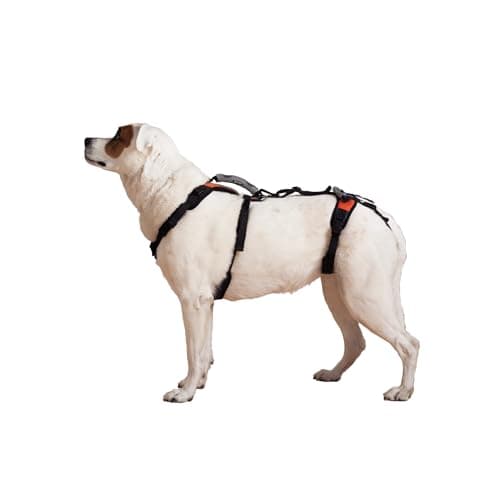
If your dog needs help getting up multiple times a day for the foreseeable future — post-TPLO, advanced hip dysplasia, hindquarter weakness in giant-breed seniors — this is the one to buy. It supports the front and the back independently, as two halves you can lift separately, which is what a dog with a bad hip and a compensating shoulder actually needs. It is not the only design that does this, but it is the one whose sizing, returns and channel prices we have read most closely. Buy it from the manufacturer, not from Amazon: re-verified 3 October 2026, helpemup.com prices by size at $80 / $95 / $110 / $125 / $140 while Amazon runs $95 / $110 / $125 / $140 / $155 — a uniform $15 more at every size, every time we have checked.
Pros
- Two-piece (chest + hip) design lets you support either end independently
- Hip handle is purpose-built — not a converted car-seat-belt strap
- Padded chest plate distributes weight better than sling-only options
- Five sizes span 10 to 225 lb, and the rear half can be ordered a size smaller for a dog with muscle wasting
- Two hip-lift styles (Conventional and U-Band) so male dogs are not soiling the strap
Cons
- Amazon runs a uniform $15 above the maker's own price at every one of the five sizes, and the Amazon buy box is held by a third-party reseller (Veterinary Preferred) rather than by the brand — re-verified 18 August 2026
- The maker's own Mix & Match page prints two different starting prices, "From $80" and "FROM $95 USD", on the same page
- Direct pricing is no longer flat: since mid-August 2026 the maker charges $80 to $140 by size, so a giant-breed owner now pays $60 more than a terrier owner
- On 29 August 2026 the linked Amazon Medium (B0DK81SCG5) showed a future availability date rather than units on hand, while every size and style was in stock at helpemup.com the same day; on 9 September and again on 12 September 2026 the Amazon Medium still showed the future-date status at $125.00 with a maximum order of one and no ship date given, while all nine direct variants were in stock — two weeks of backorder on the channel we earn from, and one more reason the direct channel is the one to use. By 3 October 2026 it had spread: every Conventional-style Amazon listing we checked (X-Small, Small, Medium, Large) showed a future availability date, and only the Large and X-Large U-Band were in stock, while all nine direct variants were available. On 15 October 2026 the linked Medium was back In Stock on Amazon at $125.00 (maximum order 30) for the first time since 29 August, but X-Small, Small and Large Conventional still showed a future availability date with a maximum order of one
- Sizing is critical — measure twice, return is a hassle
- Rear straps can chafe the inner thigh if the harness is left tight while the dog lies down
- A dog filmed or gait-assessed while wearing it looks less lame than he is, because the harness offloads the limb you are trying to judge
- Bulkier than a quick-grab sling for short-term use
Amazon, 15 October 2026: the Medium this button links is In Stock at $125, the first time since 29 August it has not shown a future availability date. X-Small, Small and Large Conventional on Amazon still had no ship date. Every size and style was in stock direct the same day, $15 cheaper.
The reason this is rank 1 for this disease specifically is the two-piece design read against the four-stage course. Most support gear holds one end of the dog. This holds both, as separate front and rear halves, which means the same equipment covers stage 1 (rear only, occasional), stage 2 (rear, constantly) and stage 3 (both ends) without a second purchase. It is also the harness designed to stay on all day, which matters when the lifts are not events but the texture of a day.
Two facts that are specific to this dog. The Mix & Match option lets you order a smaller rear half than front, which is worth knowing because hind-limb muscle wasting is part of stage 2 by definition — a rear half sized to today's dog can be hanging loose on him within a few months, so re-measure at eight weeks rather than assuming the first fitting holds. The halves are sold separately at half the matched price, so a smaller rear makes the order cheaper rather than dearer — a Medium front with a Small hip lift was $102.50 against $110 matched on 3 October 2026 — and re-sizing later means buying one $40–$70 half, not a whole harness. Until that date this paragraph said split sizing started at $95, a premium over $80; that was our misreading of the maker's ordering page, logged on our corrections page. And the rear straps can chafe the inner thigh if the harness is left tight while the dog lies down, which for a dog spending increasing hours lying down is not a footnote: loosen them, as the manufacturer instructs.
Costs, plainly. Amazon runs $95 to $155 by size, and the manufacturer's own site now prices by size — $80 X-Small up to $140 X-Large, read off its live variant feed on 14 August 2026; the flat-$80-for-every-size pricing we verified twice in early August is over. Direct still undercuts Amazon on the sizes most buyers need (Medium $110 direct vs $125 on Amazon). We earn a commission on the Amazon link and nothing on the direct one, and we would still rather you paid $80.
Before that, the cheaper thing, and for a stage-1 dog it may be the whole answer: a rolled bath towel under the belly in front of the hind legs. It stops being enough when the lifts get frequent enough to hurt your own back, or when there is no longer enough muscle for it to sit against — and with this disease, both of those arrive.
#2 Pick

Walkin' Pets
Walkin' Buddy Up Rear Harness
Our score
$39.95–$59.95
Best for
A dog with stable, non-progressive hind-end weakness whose front legs are sound — advanced hip arthritis, a healed spinal injury — where the rear half is all you will ever need. No longer the right buy for degenerative myelopathy
We can no longer recommend this for a progressive disease, and that is a reversal of what this page used to say. The harness itself is sound and the cart compatibility is still the best reason in the category to choose it — but Walkin' Pets has stopped selling the line, the front half you were told to add later cannot be bought, and what remains on Amazon is a reseller working through stock. For a dog with a stable rear-end problem who needs a good harness now and will never need a second one, at $40–$60 it is still a fair buy. For a dog with degenerative myelopathy, buy a two-piece system that will still exist in a year.
Pros
- Built for chronic rear support rather than short post-op trips, with a top handle you guide and lift from rather than a strap you hold under the belly
- Attaches to a Walkin' Wheels cart, which matters enormously for a progressive disease — most rear-support gear does not, and a harness that cannot connect to the cart your dog ends up in is a purchase you make twice
- Sized on abdomen girth as well as bodyweight, which is the dimension that actually decides fit on a barrel-chested or a wasted dog
- Neoprene contact surfaces, and it stays on between lifts
Cons
- Walkin' Pets no longer sells this harness. As of 14 August 2026 the word "Buddy Up" appears nowhere in the manufacturer's 69-product store feed or its 70-URL product sitemap, and the old product URLs return 404. What is left on Amazon is reseller stock
- The companion front harness — the one the maker's own listing tells you to "pair with... for full body support" — cannot be found on sale anywhere we looked, including a descriptive Amazon search that surfaces all three remaining sizes of the rear. The modularity this product was sold on is gone, and the Amazon bullets still advertise it
- The maker has now answered the question itself. On 4 September 2026 walkinpets.com/products/buddy-up-harness-rear — the Buddy Up rear product URL, which returned 404 on 14 August — resolves to the **Help 'Em Up Harness** page instead. A redirect to a different product is a manufacturer telling you what to buy in its place, and it is the clearest discontinuation receipt we have
- The Amazon buy box is held by a third-party reseller, "Veterinary Preferred," not by Walkin' Pets. There is no manufacturer behind your purchase in the ordinary way, and no replacement path when the neoprene wears out
- Walkin' Pets publishes no warranty at all — its site carries a refund policy and a privacy policy and nothing else. And its returns terms are harsh for exactly this buyer: no exchanges of any kind, a restocking fee of 8–12%, and a harness returned "heavily soiled with strong pet odors, embedded fur [or] visible stains" is graded ineligible for any refund
- Less padded than the Help 'Em Up, which tells against it for a dog wearing it most of the day
- Not suitable as front-end support on its own
- Determined dogs back out of it without close fitment — measure before ordering
This is the honest cheaper alternative, and the head-to-head is on one axis only: whether you are buying for today's stage or for the disease. At around $60 it does the rear-end job well, it is built for chronic use rather than short trips, and its top handle attaches to a Walkin' Wheels cart, according to the maker's listing — that is an advertised compatibility, not something we have assembled. That last point is the reason to consider it, and it is worth being exact about why: we have no figure for how many DM dogs end up in a cart, and we are not going to invent one. What we can say is that a cart is a standard option for a dog who reaches stage 2, and that if you buy one, a harness that connects to it means one fitting rather than two pieces of gear that do not talk to each other while the dog is wrestled in the gap.
What you are accepting is a module rather than a system. The manufacturer's own listing says to "pair with our Buddy Up Front Harness for full body support" and that "a front harness can be added to support weak front legs if needed" — which is exactly the second purchase the ascending course of this disease will ask for. It is also less padded than the Help 'Em Up, which tells against it for a dog wearing it most of the day. Buy it if the front end is fine, the budget is real, and you would rather spend twice than spend more now. The linked size is the Large, 65–95 lb, 22–27 inch abdomen girth — check that against your dog rather than against the range.
Traction, and one claim we are not going to repeat#
#3 Pick
Dr. Buzby's
Dr. Buzby's ToeGrips for Dogs
Our score
$34–$40
Best for
Senior dogs slipping on hardwood, tile, or laminate floors
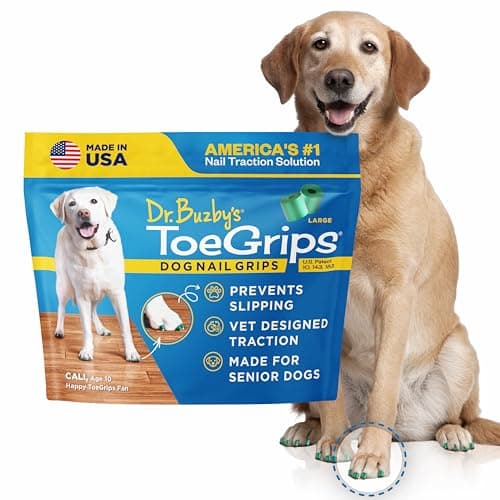
The best dog-mounted traction fix there is, and the one to buy once rugs have taken you as far as they can. Nothing touches the paw pad, which is why dogs tolerate these where they refuse socks and boots. Go in knowing the real cost: this is not a $40 purchase but a $240–$320 a year habit, so lay runners along your dog's actual routes first and buy grips for the floors you cannot cover.
Pros
- Veterinarian-developed; in clinical use for over a decade
- Slip onto each toenail — no socks, booties, or adhesives required
- Restores traction immediately, especially on hard floors
- Nothing touches the paw pad, so dogs accept them where they refuse boots
- Amazon and the manufacturer both charge $39.99 — no retailer markup
- 20 grips per bag against the 16 a dog wears, so a set includes four spares
Cons
- The only two published studies of nail grips both tested this exact product, and both were null: Roush 2017 (Front Vet Sci 4:111 — 15 sound dogs, kinetic changes "unlikely to be clinically relevant") and Repac 2022 (Animals 12(18):2312 — 30 dogs two weeks post-TPLO vs sham, no difference in weight bearing or limb function, including the owner question that asked specifically about slippery floors). Fair caveats: small samples, one used healthy dogs, the other a single early post-op timepoint — but "no positive trial exists" is the honest label, and we say it while still recommending the product for the mechanism and the owner-reported traction stories it was never tested against (verified 2026-08-14).
- A recurring cost, not a one-off. The maker publishes two different bag lives — "1–2 months" on its store page and "1-3 months, two months on average" in its FAQ (both read 2026-09-05) — which spans $160–$480 a year at $39.99. Plan on $240–$320, the two surfaces' central figures
- The Amazon listing markets specifically to dogs with "ACL injuries" — the one population where a randomised trial has been run, and where it found nothing (Repac 2022). The same bullets carry three claims with no source we could find: "more than 250,000 paws," "America's #1 nail traction solution," and "recommended by thousands of veterinarians worldwide" (listing copy verified 2026-08-17). Re-read 2026-08-31: a fourth unsourced superlative has been added to the top bullet on all four Amazon sizes — "The Only Toenail Grips for Dogs With GripZone Technology" — and the Large listing's title now leads with "Instant Traction on Wood/Hardwood Floors."
- The maker sells Scotch Super Glue Gel at $4.99 on its own store, listed as an "Alternate ToeGrips Application Method" (shop.toegrips.com, 2026-08-31). Read that as what it is: the company's own answer to the grips coming off, priced separately and not mentioned on the Amazon listing you are most likely to buy from.
- Application needs isopropyl rubbing alcohol, which is not in the box
- Initial application takes 15–20 minutes for a full set
- Some dogs chew them off in the first week
- Amazon carries only four of the seven sizes; XS, XXL and XXXL dogs have to buy direct
- Sizing by weight chart alone often misses — the accurate method needs dental floss and a ruler
Runners first, always — the cost comparison is not close. But for the floors you cannot carpet, nail grips are the best dog-mounted fix there is.
One thing to square before you click, because our own product page will otherwise contradict this one. That page lists among the dogs who should not buy grips: dogs whose slipping is new, one-sided or worsening fast, or who knuckle over, drag a paw or wear their nail tips flat. That is a description of the reader of this article, and we stand by it — with the reason attached, which is that grips make a floor safer while an unexamined neurologic problem advances. The exclusion is about buying traction instead of a diagnosis. If the appointment is booked, it does not apply to you. If it is not, buy nothing today and book it.
Now the parts specific to this disease, and one of them cuts against the product. The brand's own article about degenerative myelopathy, at toegrips.com/degenerative-myelopathy, says this in its body text: "Because DM dogs 'scuff' their paws, I recommend affixing the ToeGrips to the nails with super glue." Read that as what it is: a candid admission that on this population, the ordinary retention fails. That is useful and we would rather publish it than hide it — but it also means grips on a scuffing dog are a more fiddly, less reversible job than the listing suggests, and a knuckling dog who puts the top of his paw down is not making nail-tip contact with the floor at that moment at all. The grips help the steps where his foot lands correctly. They do nothing for the steps where it does not.
That same page also states, again in its body text, that "ToeGrips have the added benefit of providing 'proprioceptive stimulus'—meaning they help draw the brain's attention to the paws and improve the dog's gait." We are not repeating that claim. It cites no study, we could not find one, and on a disease defined by proprioceptive failure it is precisely the claim an owner most wants to be true. We recommend these for mechanical grip on hard floors, which is a real and useful thing, and for nothing else.
And the cost, which the listing will not frame for you: $39.99 a bag — the same at Amazon and direct, genuinely to their credit — but the maker says a bag lasts one to two months. That is $240 to $480 a year, or $204 to $408 on the manufacturer's own $33.99 subscription. It is a subscription, not a purchase. You will also need isopropyl rubbing alcohol, which is not in the box, and the accurate sizing method is dental floss around the nail measured in millimetres rather than the weight chart.
Our lift harness roundup and mobility aid guide cover the wider aisle, including the carts this disease eventually points toward.
What to do this week#
Tonight, look at all four paws under a lamp and photograph the hind ones from behind. Filed-flat nail tips, worse on one side, are physical evidence that survives the fifteen-minute appointment in a way that your description of a wobble does not. Then run your hands firmly along either side of the spine and note honestly whether he reacts.
This week, book the examination, and open with the two clauses rather than the symptom: he is unsteady rather than unwilling, and I cannot find anything that hurts. Ask for a neurologic examination specifically, and ask about the SOD1 test. It is a cheek swab or a blood sample, and neither we nor anyone else on this site earns anything from it — ask your vet or the testing laboratory for the current price.
Then ask for the rehabilitation referral before you feel you need it. The only intervention with any survival evidence behind it works best in stage 1, which is the stage where your dog still looks basically fine and you will feel faintly foolish asking. Ask anyway.
The reason we have pushed those two medians so hard is not that an earlier diagnosis cures anything. It is that in this disease, more than almost any other we write about, the months before are not neutral waiting. They are the months in which the one thing that helps is available and nobody has told you to start. Your dog cannot tell you that the problem is his spinal cord and not his hips. The nails, the wobble, and the absence of pain are telling you instead.
Sources#
- Coates JR, Wininger FA. "Canine degenerative myelopathy." Veterinary Clinics of North America: Small Animal Practice. 2010;40(5):929-950. doi:10.1016/j.cvsm.2010.05.001 — the standard clinical review. Adult-onset fatal neurodegenerative disease; initial upper motor neuron spastic paraparesis and general proprioceptive ataxia in the pelvic limbs progressing to flaccid lower motor neuron tetraparesis; earliest signs at 8 years or older with a mean onset age of 9 years; "Often within 6 to 12 months from the time of disease onset, dogs progress to nonambulatory paraparesis," and "the mean disease duration is 6 to 12 months in larger dog breeds, at which point dogs become nonambulatory paraparetics" — so that figure is the milestone of losing the ability to walk, not the total course; signs "progress to LMN paraplegia and ascend to affect the thoracic limbs within 18 to 24 months"; "the median disease duration in the Pembroke Welsh corgi was 19 months"; "Lack of paraspinal hyperesthesia is a key clinical feature of DM that distinguishes it from other compressive myelopathies"; "a definitive diagnosis of DM can be accomplished only at postmortem examination"; antemortem diagnosis "is based on ruling out other spinal cord–compressive diseases"; worn nails and apparent asymmetric pelvic limb lameness on physical examination, with asymmetry at onset reported frequently; four-stage clinical staging.
- University of Missouri Veterinary Health Center. "Degenerative Myelopathy." vhc.missouri.edu — initial signs are asymmetric loss of coordination and spastic weakness in the hind limbs; "Dogs seem not to show pain during the course of the disease"; dogs "often progress to becoming non-ambulatory within 11 months of their initial signs"; progression to paralysis, urinary and fecal incontinence, forelimb weakness and swallowing difficulty; "not all dogs that have the mutation will develop DM so the mutation test is currently a test for risk"; "there is no treatment for DM."
- Awano T, Johnson GS, Wade CM, Katz ML, Johnson GC, Taylor JF, Perloski M, Biagi T, Baranowska I, Long S, March PA, Olby NJ, Shelton GD, Khan S, O'Brien DP, Lindblad-Toh K, Coates JR. "Genome-wide association analysis reveals a SOD1 mutation in canine degenerative myelopathy that resembles amyotrophic lateral sclerosis." PNAS. 2009;106(8):2794-2799. doi:10.1073/pnas.0812297106 — 38 DM-affected Pembroke Welsh corgi cases and 17 related clinically normal controls; strongest associations on CFA31 in a region containing canine SOD1; resequencing revealed a G-to-A transition producing an E40K missense mutation; homozygosity for the A allele associated with DM in Pembroke Welsh corgi, Boxer, Rhodesian ridgeback, German Shepherd dog and Chesapeake Bay retriever; onset "at 8 years of age or older"; anti-SOD1-binding neuronal cytoplasmic inclusions; canine DM identified as "the first recognized spontaneously occurring animal model for ALS."
- Zeng R, Coates JR, Johnson GC, Hansen L, Awano T, Kolicheski A, Ivansson E, Perloski M, Lindblad-Toh K, O'Brien DP, Guo J, Katz ML, Johnson GS. "Breed distribution of SOD1 alleles previously associated with canine degenerative myelopathy." Journal of Veterinary Internal Medicine. 2014;28(2):515-521. doi:10.1111/jvim.12317 — DNA from 33,747 dogs genotyped; the SOD1:c.118A allele found in cross-bred dogs and in 124 different breeds; the SOD1:c.52T allele found only in Bernese Mountain Dogs; concludes the c.118A allele "is widespread and common among privately owned dogs."
- Sebestyén P, Kowalska ME, Golini L. "Survival and deterioration time of walking abilities in dogs homozygous for the SOD1 gene mutation with and without thoracolumbar intervertebral disc protrusion." Frontiers in Veterinary Science. 2025;12:1555889. doi:10.3389/fvets.2025.1555889 — retrospective cohort of 39 SOD1-homozygous dogs with compatible clinical signs and spinal MRI, stratified by T3–L3 disc protrusion. IVDP-negative (n=28): median 9.5 months from clinical onset to non-ambulatory status, median survival 13 months from clinical onset and 6 months from diagnosis. IVDP-positive (n=11): 9 months, 11 months and 7 months respectively. IVDP status not significantly associated with euthanasia risk (hazard ratio 1.20, p = 0.6). Spinal hyperesthesia recorded in 32% of the IVDP-negative and 55% of the IVDP-positive cases. Most common breed German Shepherd (9/39, 23%); mean age at diagnosis approximately 9.5 years.
- Bouché TV, Coates JR, Moore SA, Faissler D, Rishniw M, Olby NJ. "Diagnosis and management of dogs with degenerative myelopathy: A survey of neurologists and rehabilitation professionals." Journal of Veterinary Internal Medicine. 2023;37(5):1815-1820. doi:10.1111/jvim.16829 — 190 neurology and 79 rehabilitation professionals from 20 countries. 142/189 neurologists required SOD1 genetic testing and 82/189 also required spinal MRI for a presumptive diagnosis; 187/190 recommended exercise and 184/190 physical rehabilitation; rehabilitation tools reported were at-home exercises 75/79, underwater treadmill 64/79, strength-building 65/79, gait training 55/79. "Antemortem diagnosis of degenerative myelopathy (DM) in dogs is presumptive and there are no accepted guidelines for the management of this condition"; "The majority of dogs diagnosed with DM have not undergone advanced imaging."
- Orthopedic Foundation for Animals. "Degenerative Myelopathy" DNA-tested diseases. ofa.org — three reported genotypes, normal (N/N), carrier (A/N) and at-risk (A/A); "not all dogs testing as A/A have shown clinical signs of DM"; "Research is ongoing to estimate what percentage of dogs testing as A/A will develop DM within their lifespan"; a second SOD1 mutation associated with the disease occurs in some Bernese Mountain Dogs.
- Kathmann I, Cizinauskas S, Doherr MG, Steffen F, Jaggy A. "Daily controlled physiotherapy increases survival time in dogs with suspected degenerative myelopathy." Journal of Veterinary Internal Medicine. 2006;20(4):927-932. doi:10.1892/0891-6640(2006)20[927:dcpist]2.0.co;2 — 50 dogs assessed for signalment and presentation, physiotherapy examined in 22; "Animals that received intensive physiotherapy had longer survival time (mean 255 days), compared with that for animals with moderate (mean 130 days) or no (mean 55 days) physiotherapy"; treated dogs "remained ambulatory longer than did animals that did not receive physical treatment"; breed predisposition in German Shepherd Dog, Kuvasz, Hovawart and Bernese Mountain Dog; mean age at diagnosis 9.1 years. Stated limitations: lack of randomization, lack of definitive diagnosis, small group size, owner-perception bias.
- Polizopoulou ZS, Koutinas AF, Patsikas MN, Soubasis N. "Evaluation of a proposed therapeutic protocol in 12 dogs with tentative degenerative myelopathy." Acta Veterinaria Hungarica. 2008;56(3):293-301. doi:10.1556/avet.56.2008.3.3 — 12 dogs followed for 6 months on epsilon-aminocaproic acid and N-acetylcysteine with vitamins B, C and E, prednisolone for the first two weeks and on worsening, plus daily walking or swimming. Uncontrolled and non-randomized. "Neurological signs were progressively worsening in all 12 animals, eventually resulting in severe paraparesis (grade III) or paraplegia (grade IV)"; "The applied medications do not appear to be an attractive alternative to conservative management (physiotherapy) or euthanasia in canine degenerative myelopathy."
- Olby NJ, Panek W, Galifi C, Faheem K, Prasad K, Goraczniak R, Perrone M, Tokarz D, Sommer S, Gunderson SI. "Development and pilot testing of U1 Adaptor therapy targeting SOD1 expression for dogs with degenerative myelopathy." Journal of Veterinary Internal Medicine. 2026;40(1):aalaf072. doi:10.1093/jvimsj/aalaf072 — 12 dogs total: the 7 healthy dogs and the 1 stage III DM dog each received a single intrathecal dose of U1cSOD1 or vehicle and were euthanized at 5 or 30 days for histopathology; the 4 stage I DM-affected dogs received repeat intrathecal U1cSOD1 over up to 10 months, monthly at 1.5 mg/kg with the interval extended to 2 months after a dose escalation to 3 mg/kg near the end of the study. "Dogs tolerated the procedure and test agent well, exhibiting no adverse effects clinically or histopathologically"; 2 of 34 injections aborted for elevated intrathecal pressure; spinal cord SOD1 RNA expression near the injection site decreased to a median of 37% of normal (range 21–79%). A safety and biomarker pilot study; no clinical efficacy demonstrated.
This article is educational and does not replace veterinary advice. Degenerative myelopathy cannot be confirmed in a living dog, and several of the diseases it resembles are treatable — which is the reason progressive hind-limb weakness needs an examination rather than a diagnosis from a website. Nothing described here has been shown to slow the disease.
Frequently asked
- What are the first signs of degenerative myelopathy in dogs?
- A wobble in the hind end that is worse on one side than the other, a hind paw that scuffs or catches on the ground, nail tips worn flat, a foot that crosses under the body on turns, and difficulty with slick floors that seems out of proportion to the dog's age. The review literature describes the earliest signs as general proprioceptive ataxia with mild spastic weakness in the pelvic limbs, and notes that asymmetry at onset is reported frequently. The dog is unsteady rather than unwilling. What is usually absent is pain: the University of Missouri's teaching hospital states plainly that dogs seem not to show pain during the course of the disease, and the standard review calls the lack of paraspinal tenderness a key clinical feature that distinguishes DM from compressive spinal disease.
- How fast does degenerative myelopathy progress?
- Faster than most owners are led to expect, and the published numbers are consistent. The standard review states that dogs often progress to non-ambulatory hind-limb weakness within 6 to 12 months of onset, and that clinical signs progress to hind-limb paralysis and ascend to affect the front limbs within 18 to 24 months; the median total disease duration reported in Pembroke Welsh corgis, a slower course than the large breeds, was 19 months. The University of Missouri puts the loss of walking at often within 11 months of the first signs, which is the same milestone from a different source. In a 2025 retrospective of 39 SOD1-homozygous dogs, the 28 with no disc protrusion on MRI reached non-ambulatory status at a median of 9.5 months from the first clinical sign, with a median survival of 13 months from that first sign; the 11 dogs who also had a disc protrusion ran 9 and 11 months respectively, though 11 dogs is far too small a group for those two figures to carry weight on their own. Individual dogs vary widely around those medians, and the disease continues past the hind legs if a dog is kept alive long enough — the forelimbs, then swallowing and breathing.
- Does a positive DM DNA test mean my dog will get degenerative myelopathy?
- No. This result gets read as a diagnosis constantly, and it is not one. The SOD1 test reports three genotypes: normal, carrier, and at-risk homozygote. The Orthopedic Foundation for Animals states directly that not all dogs testing as at-risk have shown clinical signs of DM, and that research is ongoing to estimate what percentage of at-risk dogs will develop the disease within their lifespan. So the test is a risk test, not a diagnosis. It has real value in the other direction: in a dog with the right signs at the right age, an at-risk result supports a presumptive diagnosis, and a normal result makes DM much less likely and should push the investigation elsewhere.
- Can degenerative myelopathy be confused with a slipped disc or hip dysplasia?
- Constantly, and in both directions. All three produce a dog who struggles with stairs and the car. The distinguishing features are pain and coordination: disc disease and hip arthritis hurt and the dog is unwilling, while DM does not hurt and the dog is unsteady. But do not treat that as a clean sort. In the 2025 cohort of SOD1-homozygous dogs, spinal tenderness was recorded in 32% of the dogs with no disc protrusion on MRI and 55% of those with one. A nine-year-old German Shepherd is fully entitled to have two diseases at the same time, which is exactly why this needs an examination rather than a checklist.
- Is there any treatment that slows degenerative myelopathy?
- No drug or supplement has been shown to slow it. A 2008 study followed 12 dogs for six months on epsilon-aminocaproic acid, N-acetylcysteine and vitamins B, C and E, with prednisolone for the first two weeks and again whenever signs worsened; all 12 progressed to severe paraparesis or paraplegia, and the authors concluded the medications did not appear to be an attractive alternative to physiotherapy. The only intervention with any survival signal is physical rehabilitation: in a 2006 study of 22 dogs, those receiving intensive daily controlled physiotherapy survived a mean of 255 days against 130 days with moderate and 55 days with none. That study was not randomised, and the three groups shared 22 dogs between them, so treat it as the best available evidence rather than proof. A gene-silencing therapy was reported in a pilot safety study published in 2026; it was well tolerated and has not been shown to help.