Breed Guide
Why Does My Bulldog Move Like That? Bulldog Joint Problems, Ranked by Odds
In a peer-reviewed analysis of 921,046 OFA hip records, the Bulldog had the highest hip dysplasia prevalence of any breed. Here is what the build costs, and why most Bulldogs still never limp.

The Bulldog is the breed where the skeleton and the silhouette are the same conversation. In a peer-reviewed analysis of 921,046 hip screening records, the bulldog had the highest hip dysplasia prevalence of any breed — and yet in a study of 2,662 English Bulldogs seen in ordinary UK vet practices, the breed was no more likely to be recorded as lame than any other dog. Both of those things are true, and holding them together is the whole job of this page. What follows is what the build actually costs, what shows up and when, and why lean body weight matters more here than almost anywhere else.
Affiliate disclosure: Dog Orthopedic is reader-supported. When you buy through links on our site we earn a commission at no extra cost to you — about 3% on most pet products, and the same rate on every product we compare, so no pick earns us more than another. Prescription medication earns us nothing, and seeing your vet earns us nothing; we recommend both anyway. Learn more.
Imagery: Lifestyle photographs on this site are licensed from Pexels (royalty-free) and credited per image. Pexels imagery illustrates conditions and contexts — it does not depict the specific dogs or test sessions described in the text. Product photographs come from Amazon's Creators API. Breed portraits are illustrations of typical breed type rather than photographs of individual dogs, and are not drawn to scale against one another.
What does the build actually cost?#
Start with where the weight sits. A Finnish group put 28 English Bulldogs on a force plate and through a full radiographic workup, and found the dogs carried a mean of 67.3% of their body weight on the front limbs while standing, and 62.1% while trotting. The authors' own summary is blunt: "The static weight bearing of the dogs was heavily distributed to the front limbs."[1]
That is the sentence to carry around. In most breeds we worry about the back end. In a Bulldog, the front end is the load-bearing end, and it is built wide, short and turned out — a heavy chest slung between elbows that sit further from the midline than a normal dog's, on forelimbs that are short relative to the mass above them. Every step of a Bulldog's life is a front-loaded step.
The same study found what that costs. At least grade 1 elbow dysplasia was present in 48.2% of the elbow joints examined — nearly half — with grade 2 in 26.8% and grade 3 in 5.4%. And the interesting part is what the dogs did about it: as elbow dysplasia got worse, weight bearing shifted off the dysplastic elbows and back onto the hind limbs. The dogs were quietly rebalancing themselves. Nobody watching them at home would have called that a limp.
The second cost is the spine, and it is written on the outside of the dog. Whole-genome sequencing across 100 dogs identified a frameshift mutation in the DISHEVELLED 2 (DVL2) gene as the most strongly associated variant in the canine genome with the screw tail, and the same variant segregates with malformed vertebrae in the chest. In Bulldogs and French Bulldogs the variant is fixed — homozygous in every tested individual.[2]
So the screw tail is not a breed quirk sitting next to the spinal malformations. It is the same malformation, at the end of the same spine, where you can see it. A Bulldog's tail is a vertebral column that ran out of room.
What does this breed actually get, ranked by odds?#
Ranked honestly, with the source named in each line.
1. Hip dysplasia — close to universal on film. In an analysis of 921,046 unique OFA hip records collected through April 2015, published in the Journal of Veterinary Medicine, the bulldog had the highest prevalence of canine hip dysplasia of any breed at 77.7%. The overall prevalence across the whole database was 15.56%, and the lowest was the Italian Greyhound at 0.0%.[3] The Finnish radiographic study agrees from a completely different direction: of 28 English Bulldogs, all but one had dysplastic hips under FCI grading, and the single most common grade was E — severe — at 55.4%.[1]
2. Vertebral malformation — the norm, not the exception. A retrospective study of 171 neurologically normal screw-tailed brachycephalic dogs — 62 French Bulldogs, 68 Pugs and 41 English Bulldogs — found 80.7% of them had at least one vertebral malformation, with English Bulldogs significantly more often affected than the general hospital population (P = 0.002).[4] In the Finnish bulldogs, 78.6% (22 of 28) had at least one malformed vertebra, affecting 24.5% of all thoracic vertebrae imaged, and spondylosis was present in 89.3% of the dogs.[1]
3. Elbow dysplasia — about half of elbows. 48.2% of elbow joints in that same cohort, as above. This is the finding that gets least attention in Bulldog owner forums and, given where the weight sits, probably deserves the most.
4. Patellar luxation — real, and modest. A third of the dogs assessed in the Finnish study had medial patellar luxation (8 of 24 evaluated). In UK primary-care records, English Bulldogs had 1.51 times the odds of a patellar luxation diagnosis (95% CI 1.07 to 2.13, p = 0.018) compared with other dogs, at a recorded prevalence of 1.5%.[5] Note the gap between a third of dogs on a specialist's examination table and 1.5% in a GP's notes. Both numbers are correct. They are measuring different things.
5. Cruciate disease. Bulldogs appear on the lists of breeds at elevated risk, but we could not verify a breed-specific prevalence figure we would be willing to print, so we are not printing one. What is verified is that in 1,243,681 dogs in the Veterinary Medical Database, neutered dogs had higher odds of cruciate ligament deficiency than intact ones — 1.68 for castrated males, 2.35 for spayed females.[6] That is a population-wide finding, not a Bulldog one, but it is a real input into the timing conversation — our guide to when to spay or neuter covers the tradeoffs.

Wait — if the hips are that bad, why isn't my Bulldog limping?#
This is the most important paragraph on the page, and it is the one no breed page writes.
In a VetCompass study of anonymised primary-care records covering 2,662 English Bulldogs and 22,039 other dogs, English Bulldogs had 2.04 times the odds of being diagnosed with at least one disorder. They came out substantially worse on skin fold dermatitis (×38.12), cherry eye (×26.79), protruding lower jaw (×24.32) and brachycephalic obstructive airway syndrome (×19.20). But lameness was recorded in 1.9% of Bulldogs against 2.6% of other dogs — an odds ratio of 0.77 (95% CI 0.57 to 1.04, p = 0.088), which is to say no increase at all, and if anything a non-significant decrease. Spinal cord disorder was recorded less often: odds ratio 0.31 (95% CI 0.14 to 0.71, p = 0.005).[5]
The paper's authors say the quiet part themselves: given the breed's documented rate of hemivertebrae, it is "unexpected but reassuring" that this does not translate into a high level of recorded spinal cord disease.
There are three honest readings of the gap, and you should hold all three:
- The malformations often genuinely are incidental. A 2024 review of vertebral and spinal malformations in small brachycephalic breeds makes exactly this point: hemivertebra, transitional vertebrae and caudal articular process dysplasia occur commonly in neurologically normal dogs, and their clinical relevance has been questioned for that reason.[7]
- Bulldogs are hard to read. A dog whose normal gait is a wide, rolling waddle has enormous room to get worse before anyone calls it a limp. And a dog that stops on a walk gets attributed to the breathing, every time.
- Screening data and clinical data are different populations. The OFA figure comes from dogs whose owners chose to pay for a radiograph. The lameness figure comes from whatever walked into a GP practice.
“Because your dog can't tell you how much pain he or she is in.”
What does the timeline look like?#
| Age | What owners notice | What is likely going on |
|---|---|---|
| Puppy, 4–12 months | Nothing, usually. Maybe a wide, rolling gait taken as normal for the breed | Hips are already forming abnormally; the vertebral malformations are congenital and already present at birth |
| 1–3 years | Shorter tolerance on walks, more lying down after activity, occasional front-limb stiffness on rising | This is the age band the Finnish cohort was in — mean 3.5 years — with severe hip grades and nearly half of elbows affected, in dogs living ordinary lives |
| 3–6 years | Reluctance on stairs, a hard time getting into the car, a change in how he gets up rather than how he walks | Arthritis accumulating in joints that never fitted, plus spondylosis bridging the spine |
| 6+ years | Visible loss of muscle over the shoulders and thighs, sliding on hard floors, needing a hand up | Chronic offloading has now cost muscle, and the muscle loss makes the joints worse |
| Any age, suddenly | Wobbliness, scuffing, dragging a back foot, loss of bladder control | Not arthritis. This is a same-day neurological problem — see IVDD |
The row that matters most is the second. Those Bulldogs were three and a half years old, weighed about 22 kg, and were living normally — and their radiographs were already among the worst you will see in any breed.[1]
What is the earliest sign, in this breed specifically?#
Generic advice says watch for limping. In a Bulldog that advice is close to useless, because the limp is late and the waddle hides it. Three things come first.
The walk gets shorter at the same place. Not gradually shorter — the same corner, every time. Owners almost always file this under breathing, and in this breed they are often half right, which is exactly why the joints go unexamined for years. If the stopping point has moved closer to your front door over six months, that is data.
The rise changes before the walk does. Watch him get up from a dead sleep on a hard floor. A Bulldog with sore elbows front-loads the rise differently: a longer pause, a shuffle of the front feet to get them underneath, sometimes a push-up from the elbows rather than the paws. Film it on your phone at floor level. Thirty seconds of that video is worth more to your vet than anything you can describe.
He stops choosing the hard surfaces. A dog who used to lie on cool kitchen tile and now will not is telling you the tile has started to cost something.
If you are trying to separate "he is stiff" from "he is weak" from "he is unsteady" — and those are three different problems with three different answers — our guide to limping versus weakness is the one to read next, and how to tell if your dog is in pain covers the signs dogs give that owners are not taught to look for.
What do the screening numbers actually mean?#
Two things, and the second is the one nobody says out loud.
First, the grade is not the dog. A severe hip grade on film tells you the joint is malformed. It does not tell you how much that joint hurts, how much muscle is holding it together, or how long your dog will be comfortable. In this breed the gap between the film and the dog is wider than in any other, which is exactly what the lameness data above shows.
Second, every OFA-derived percentage you will ever read is built on dogs whose owners volunteered them. This is not a criticism of the OFA; it is the OFA's own framing of its data, and the researchers who use it say so plainly. The authors of the 921,046-record analysis wrote that their data "may not give the true prevalence of CHD, since it only represents the data on those dogs whose radiographs were submitted to the OFA. This predisposes to selection bias as it is not a truly random sample of the canine population."[3] A separate analysis of 1,056,852 hip and 275,129 elbow records made the same point and added that owners are more likely to submit radiographs that look normal.[8]
Follow that logic to its end in this breed and it does not soften the 77.7%. It suggests the true figure may be worse, because the radiographs least likely to be submitted are the bad ones.
And the honest limit on the other side: the most complete orthopedic survey of English Bulldogs we could find studied 28 dogs.[1] Every elbow, patella and vertebra figure on this page rests on that cohort. Twenty-eight dogs is a real study and a small one, and you should weight it accordingly. We would rather tell you the denominator than let you assume it was thousands.
For what OFA and PennHIP grades mean in general, and what a breeder's paperwork does and does not promise a buyer, our hip dysplasia master guide has the full breakdown.
Before you consent to any elective orthopedic surgery#
This is the part of a Bulldog's orthopedic life that is genuinely different from every other breed on this site, and it belongs in the decision, not in a footnote.
In a matched retrospective cohort of 223 brachycephalic and 223 non-brachycephalic dogs undergoing general anesthesia for routine surgery or imaging, postanesthetic complications were recorded in 13.9% (31/223) of the brachycephalic dogs against 3.6% (8/223) of the others. Perianesthetic complications overall were near-identical between groups — 49.8% versus 48.4% — so the difference is concentrated after the procedure, in recovery, not during it.[9]
That does not mean a Bulldog cannot have surgery. Bulldogs have hip and knee surgery, and it works. It means the risk-benefit line sits in a different place than it does for a Labrador, and that recovery monitoring is not an optional extra you can decline to save money.
It also means the airway deserves grading rather than guessing. In a Finnish breeding-test programme, 245 English Bulldogs were put through a standardised exercise test, and 11% failed it — the highest failure rate of the three breeds tested, ahead of French Bulldogs at 4% and Pugs at 3%. Moderate to severe nostril stenosis was present in 40% of the English Bulldogs.[10] An objective airway assessment before an elective orthopedic procedure is a reasonable thing to ask for.
We are not going to write an airway article inside a joint article. What we will do is send you into the consultation with the right questions: our list of questions to ask a veterinary orthopedic surgeon is the one to print, and add these two to it — how will you assess his airway before anesthesia, and who is watching him in recovery, for how long? If the answer to the second one is vague, that is your answer. Whether a dog is "too old" for surgery covers how these conversations tend to go when the dog is also elderly.
What actually helps#
Weight. Not a supplement, not a bed. Weight.#
It is free, it is the largest thing you control, and in this breed it is being lost. In UK primary-care records, English Bulldogs had 1.79 times the odds of an obesity diagnosis compared with other dogs (95% CI 1.54 to 2.07, p < 0.001), recorded in 9.5% of them.[5] Recorded, note — the true figure is a conversation your vet has probably been trying to have with you gently.
Here is the number that should end the argument in your household. Forty-eight Labrador Retrievers were paired with their littermates and one of each pair was fed 25% less than the other, for life. The freely-fed dogs first showed radiographic hip arthritis at a median age of 6 years. The restricted dogs, at 12 years.[11] The same cohort also lived significantly longer.[12]
Two caveats, stated before you send this to anyone. Those were Labradors, not Bulldogs, and nobody has run this study in a brachycephalic breed — read it as mechanism, not as a breed-specific promise. And 25% restriction from eight weeks of age is a lifelong protocol supervised by researchers, not a crash diet you start on a six-year-old. What it establishes is the direction and the size of the effect, and the direction is enormous: six years of joint, bought with a measuring cup.
In a Bulldog there is a second dividend. Less weight on a front end already carrying 67.3% of the load is less weight on the elbows, and less mass to move is less work for an airway that is already the limiting factor. Weight is the only intervention on this page that improves both problems at once.
Do it with your vet, on scales, with a body condition score, on a schedule. Not by eye.
Then surfaces, then activity type#
Floors. A front-loaded dog with dysplastic elbows on tile is one splay away from an acute injury. Trim the nails, clip the fur between the pads, and put rubber-backed runners on the four or five routes your dog actually walks — that is most of the problem solved, once, for very little. Our floor traction guide has the room-by-room version.
Activity. Frequent, short, flat and cool beats one long weekend walk, and in this breed the ceiling is usually respiratory rather than orthopedic — which means the walk that is right for the joints and the walk that is right for the airway are the same walk. Avoid heat entirely. How much walking an arthritic dog should do covers how to build the routine without flaring the joint.
Beds. A dog who spends most of the day lying down on a hard floor is paying for it at the elbows and hips, and a Bulldog's elbows take the contact. A supportive bed is a genuine intervention rather than a luxury — our orthopedic bed guide covers what actually matters (foam density and slab thickness, mostly), and a folded duvet on the floor is a legitimate way to find out whether your dog will use a new sleeping spot before you spend anything.

The one product that earns its place here#
Most of what gets sold to Bulldog owners does not address anything on this page. This one does, for one specific reason.
#1 Pick
Dr. Buzby's
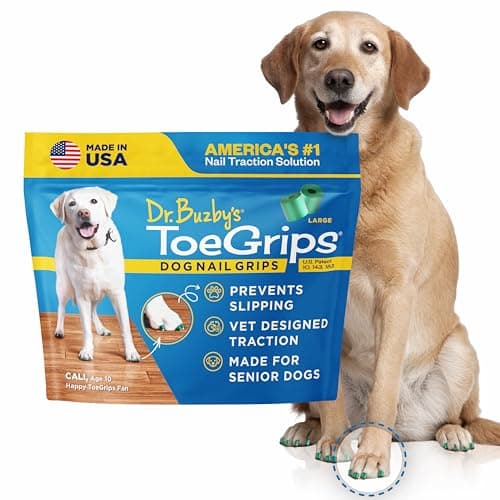
Dr. Buzby's ToeGrips for Dogs
Our score
$34–$40
Best for
Senior dogs slipping on hardwood, tile, or laminate floors
The best dog-mounted traction fix there is, and the one to buy once rugs have taken you as far as they can. Nothing touches the paw pad, which is why dogs tolerate these where they refuse socks and boots. Go in knowing the real cost: this is not a $40 purchase but a $240–$320 a year habit, so lay runners along your dog's actual routes first and buy grips for the floors you cannot cover.
Pros
- Veterinarian-developed; in clinical use for over a decade
- Slip onto each toenail — no socks, booties, or adhesives required
- Restores traction immediately, especially on hard floors
- Nothing touches the paw pad, so dogs accept them where they refuse boots
- Amazon and the manufacturer both charge $39.99 — no retailer markup
- 20 grips per bag against the 16 a dog wears, so a set includes four spares
Cons
- The only two published studies of nail grips both tested this exact product, and both were null: Roush 2017 (Front Vet Sci 4:111 — 15 sound dogs, kinetic changes "unlikely to be clinically relevant") and Repac 2022 (Animals 12(18):2312 — 30 dogs two weeks post-TPLO vs sham, no difference in weight bearing or limb function, including the owner question that asked specifically about slippery floors). Fair caveats: small samples, one used healthy dogs, the other a single early post-op timepoint — but "no positive trial exists" is the honest label, and we say it while still recommending the product for the mechanism and the owner-reported traction stories it was never tested against (verified 2026-08-14).
- A recurring cost, not a one-off. The maker publishes two different bag lives — "1–2 months" on its store page and "1-3 months, two months on average" in its FAQ (both read 2026-09-05) — which spans $160–$480 a year at $39.99. Plan on $240–$320, the two surfaces' central figures
- The Amazon listing markets specifically to dogs with "ACL injuries" — the one population where a randomised trial has been run, and where it found nothing (Repac 2022). The same bullets carry three claims with no source we could find: "more than 250,000 paws," "America's #1 nail traction solution," and "recommended by thousands of veterinarians worldwide" (listing copy verified 2026-08-17). Re-read 2026-08-31: a fourth unsourced superlative has been added to the top bullet on all four Amazon sizes — "The Only Toenail Grips for Dogs With GripZone Technology" — and the Large listing's title now leads with "Instant Traction on Wood/Hardwood Floors."
- The maker sells Scotch Super Glue Gel at $4.99 on its own store, listed as an "Alternate ToeGrips Application Method" (shop.toegrips.com, 2026-08-31). Read that as what it is: the company's own answer to the grips coming off, priced separately and not mentioned on the Amazon listing you are most likely to buy from.
- Application needs isopropyl rubbing alcohol, which is not in the box
- Initial application takes 15–20 minutes for a full set
- Some dogs chew them off in the first week
- Amazon carries only four of the seven sizes; XS, XXL and XXXL dogs have to buy direct
- Sizing by weight chart alone often misses — the accurate method needs dental floss and a ruler
The reason is the 67.3%. This is a breed whose weight sits over the front feet, whose elbows are dysplastic about half the time, and whose response to a slippery floor is to splay — and nail grips are the only fix that travels with the dog onto floors you do not own. Nothing touches the paw pad, which is why dogs tolerate these where they refuse socks and boots.
The honest costs. Runners come first because they are cheaper and they fix more; grips are for the kitchen tile and the vet's waiting room. The manufacturer's own guidance is that a set lasts one to two months, which makes this a subscription rather than a purchase — budget accordingly. Sizing is by nail circumference, not by the weight chart, and you need isopropyl rubbing alcohol to get them on, which is not in the box. And for a Bulldog specifically: this does nothing whatsoever for the underlying joint. It prevents the slip that turns a manageable elbow into an emergency.
If you want the supplement conversation instead, we have it in full in the joint supplements guide, including where the evidence is thin.
What to do this week#
Weigh him. Write the number down. Ask your vet for a body condition score at the next visit and ask what the target weight is in kilograms or pounds — a number, not "a bit less."
Film him getting up from a hard floor, at floor level, first thing in the morning. That video is the single most useful thing you can bring to an appointment, and it captures what a five-minute consult usually misses.
Put runners down on the two routes he uses most. Today, not after the next slip.
And if there is an elective orthopedic procedure on the table, do not sign anything until you have asked how the airway will be assessed and who is watching him in recovery.
A Bulldog will not tell you when the joints started costing him, because the breed's normal already looks like a dog working hard. That is the whole problem with this build: the signal is buried in the baseline. Which is exactly why the measuring cup, the video and the runners beat waiting for a limp.
Where to go next#
- Hip dysplasia in dogs — grades, screening, and the full treatment ladder
- Arthritis in dogs — what is actually happening in the joint, and what changes it
- IVDD in dogs — the same-day emergency signs, and why vertebral malformation is not the same as disc disease
- Dachshund IVDD — the other breed where the spine is the shape
- Questions to ask a veterinary orthopedic surgeon — print it
- Dog slipping on floors — the cheapest intervention on this page
Sources#
- Mölsä SH, Hyytiäinen HK, Morelius KM, Palmu MK, Pesonen TS, Lappalainen AK. "Radiographic findings have an association with weight bearing and locomotion in English bulldogs." Acta Veterinaria Scandinavica. 2020;62(1):19. doi:10.1186/s13028-020-00517-3 — 28 English bulldogs; all but one dog had FCI grade C, D or E (dysplastic) hips, most common grade E (severe) at 55.4%; at least grade 1 elbow dysplasia in 48.2% (27/56) of elbows, grade 2 in 26.8%, grade 3 in 5.4%; 78.6% (22/28) had at least one malformed vertebra, affecting 24.5% (89/364) of thoracic vertebrae; spondylosis in 89.3%; medial patellar luxation in 8 of 24 dogs evaluated; mean 67.3% of body weight on the front limbs standing and 62.1% trotting.
- Mansour TA, Lucot K, Konopelski SE, et al. "Whole genome variant association across 100 dogs identifies a frame shift mutation in DISHEVELLED 2 which contributes to Robinow-like syndrome in Bulldogs and related screw tail dog breeds." PLOS Genetics. 2018;14(12):e1007850. doi:10.1371/journal.pgen.1007850 — DVL2 frameshift variant was the most strongly associated variant in the canine genome with the screw tail phenotype; fixed (homozygous in all tested individuals) in Bulldogs and French Bulldogs; segregates with vertebral malformations.
- Loder RT, Todhunter RJ. "The Demographics of Canine Hip Dysplasia in the United States and Canada." Journal of Veterinary Medicine. 2017;2017:5723476. doi:10.1155/2017/5723476 — 921,046 unique OFA records through April 2015; overall CHD prevalence 15.56%; "the highest prevalence was in the bulldog (77.7%) and the lowest in the Italian greyhound (0.0%)"; authors note the data "may not give the true prevalence of CHD" because of selection bias in voluntary submission.
- Ryan R, Gutierrez-Quintana R, Ter Haar G, De Decker S. "Prevalence of thoracic vertebral malformations in French bulldogs, Pugs and English bulldogs with and without associated neurological deficits." The Veterinary Journal. 2017;221:25-29. doi:10.1016/j.tvjl.2017.01.018 — 171 neurologically normal screw-tailed brachycephalic dogs (62 French bulldogs, 68 Pugs, 41 English bulldogs); 80.7% had at least one vertebral malformation; significant breed effect, with malformations more frequent in French bulldogs (P < 0.0001) and English bulldogs (P = 0.002); hemivertebrae in 93.5% of French bulldogs and 17.6% of Pugs.
- O'Neill DG, Skipper A, Packer RMA, Lacey C, Brodbelt DC, Church DB, Pegram C. "English Bulldogs in the UK: a VetCompass study of their disorder predispositions and protections." Canine Medicine and Genetics. 2022;9(1):5. doi:10.1186/s40575-022-00118-5 — 2,662 English Bulldogs vs 22,039 other dogs, UK primary-care data for 2016; 2.04 times the odds of at least one disorder; increased odds for 24 of 43 specific disorders including BOAS (×19.20), skin fold dermatitis (×38.12), cherry eye (×26.79); obesity 9.5% (253/2,662), OR 1.79 (1.54–2.07, p < 0.001); patellar luxation 1.5% (41/2,662), OR 1.51 (1.07–2.13, p = 0.018); grouped musculoskeletal disorder 9.8%, OR 1.52 (1.32–1.75); lameness 1.9% vs 2.6%, OR 0.77 (0.57–1.04, p = 0.088, not significant); spinal cord disorder OR 0.31 (0.14–0.71, p = 0.005), a reduced odds.
- Witsberger TH, Villamil JA, Schultz LG, Hahn AW, Cook JL. "Prevalence of and risk factors for hip dysplasia and cranial cruciate ligament deficiency in dogs." JAVMA. 2008;232(12):1818-1824. doi:10.2460/javma.232.12.1818 — 1,243,681 dogs in the Veterinary Medical Database, 1964–2003; castrated males OR 1.68 and spayed females OR 2.35 for cranial cruciate ligament deficiency; breed-level figures are in the paper's tables rather than the abstract, and we have not reproduced a Bulldog-specific number here.
- De Decker S, Rohdin C, Gutierrez-Quintana R. "Vertebral and spinal malformations in small brachycephalic dog breeds: Current knowledge and remaining questions." The Veterinary Journal. 2024;304:106095. doi:10.1016/j.tvjl.2024.106095 — review; thoracic hemivertebra, caudal articular process dysplasia, transitional vertebra and cranial thoracic vertebral canal stenosis occur commonly in neurologically normal dogs, and their clinical relevance has therefore been questioned.
- Oberbauer AM, Keller GG, Famula TR. "Long-term genetic selection reduced prevalence of hip and elbow dysplasia in 60 dog breeds." PLOS ONE. 2017;12(2):e0172918. doi:10.1371/journal.pone.0172918 — 1,056,852 hip and 275,129 elbow OFA records, 1970–2015; "The data reflect only those dogs whose breeders and owners submitted radiographs for analysis by the OFA"; notes that owners were more likely to submit radiographs in which the hips appeared normal.
- Gruenheid M, Aarnes TK, McLoughlin MA, Simpson EM, Mathys DA, Mollenkopf DF, Wittum TE. "Risk of anesthesia-related complications in brachycephalic dogs." JAVMA. 2018;253(3):301-306. doi:10.2460/javma.253.3.301 — 223 brachycephalic and 223 matched non-brachycephalic dogs; postanesthetic complications in 13.9% (31/223) of brachycephalic vs 3.6% (8/223) of non-brachycephalic dogs; perianesthetic complications 49.8% vs 48.4%; brachycephalic status independently associated with higher peri- and postanesthetic complication rates.
- Lilja-Maula LIO, Mäki KH, Aromaa MK, Rajamäki MM. "Evaluation of brachycephalic obstructive airway syndrome breeding test results in Finland from 2017 to 2022." Acta Veterinaria Scandinavica. 2024;66(1):35. doi:10.1186/s13028-024-00755-9 — 245 English Bulldogs tested; 11% failed the standardised exercise test, the highest of the three breeds (French Bulldogs 4%, Pugs 3%); moderate to severe nostril stenosis in 40% of English Bulldogs; the authors conclude the exercise test alone was not sufficient to exclude BOAS-affected dogs from breeding.
- Smith GK, Paster ER, Powers MY, Lawler DF, Biery DN, Shofer FS, McKelvie PJ, Kealy RD. "Lifelong diet restriction and radiographic evidence of osteoarthritis of the hip joint in dogs." JAVMA. 2006;229(5):690-693. doi:10.2460/javma.229.5.690 — 48 Labrador Retrievers from 7 litters, pairmates fed ad libitum or 25% less for life; median age at first radiographic evidence of hip osteoarthritis 6 years in control-fed dogs vs 12 years in restricted-fed dogs; overall prevalence rose from 15% at 2 years to 67% by 14 years.
- Kealy RD, Lawler DF, Ballam JM, et al. "Effects of diet restriction on life span and age-related changes in dogs." JAVMA. 2002;220(9):1315-1320. doi:10.2460/javma.2002.220.1315 — same 48-Labrador paired feeding cohort; median life span significantly longer in the diet-restricted dogs, with delayed onset of chronic disease.
This article is educational and does not replace veterinary advice. The hero illustration is a generated likeness of the breed, not a photograph of a real dog, and nothing on this page is a comment on any individual dog's conformation. Sudden weakness, wobbliness, a dragged foot, or breathing difficulty in a Bulldog is an emergency, not a wait-and-see.
Frequently asked
- Do all English Bulldogs get hip dysplasia?
- Close to it, radiographically. In a peer-reviewed analysis of 921,046 hip records from the Orthopedic Foundation for Animals, the bulldog had the highest hip dysplasia prevalence of any breed at 77.7%, against 15.56% across the whole database. A separate Finnish study that radiographed 28 English Bulldogs found that every dog but one had dysplastic hips under the Fédération Cynologique Internationale grading system. But dysplastic hips on film and a dog in trouble are not the same thing — in UK primary-care records covering 2,662 English Bulldogs, the breed was no more likely to be recorded as lame than other dogs. Bad hips are close to universal in this breed. Visible suffering is not.
- Is a Bulldog's screw tail a spinal problem?
- Yes, and that is the single most useful thing to understand about this breed's skeleton. Whole-genome work published in PLOS Genetics found a frameshift mutation in the DVL2 gene that is the most strongly associated variant in the canine genome with the screw tail, and that same variant segregates with malformed vertebrae further up the spine. In Bulldogs and French Bulldogs the variant is fixed — every tested dog carried two copies. The curl in the tail and the wedge-shaped vertebrae in the chest are the same event. That does not mean your dog will develop neurological signs; most screw-tailed dogs with malformed vertebrae never do.
- What is the earliest sign of joint trouble in a Bulldog?
- Not limping. In this breed the first thing to change is usually stamina and heat tolerance on a walk — the dog who used to do the full loop now stops at the same corner, or comes home and lies flat for an hour. The trap is that this reads as a breathing problem, and in a Bulldog it very often is one, so the joints never get examined. The second early sign is a change in how the dog gets up: a long pause before rising, or pushing up with the front end and dragging the back end after it. Both are worth a video on your phone before the appointment.
- Is surgery safe for a Bulldog with a bad hip or knee?
- It is done, and it works, but the risk arithmetic is genuinely different in this breed and you should force that conversation before you consent. In a matched retrospective cohort of 446 dogs published in JAVMA, postanesthetic complications occurred in 13.9% of brachycephalic dogs versus 3.6% of non-brachycephalic dogs undergoing routine anesthesia. That is roughly a fourfold difference in recorded complications after the procedure, not during it. For an elective orthopedic procedure in a Bulldog, ask the surgeon directly about airway assessment before anesthesia, recovery monitoring, and whether the airway should be addressed first.
- What is the single most useful thing I can do for my Bulldog's joints?
- Keep him lean, and it costs nothing. In UK primary-care data, English Bulldogs had 1.79 times the odds of being recorded as obese compared with other dogs. The clearest evidence that this changes joints comes from a lifelong paired-feeding study in 48 Labrador Retrievers, not Bulldogs, so read it as a mechanism rather than a breed promise: dogs fed 25% less than their littermates developed radiographic hip arthritis at a median age of 12 years, against 6 years in the dogs fed freely. Six years of joint, bought with a measuring cup. Nothing you can buy for a Bulldog comes close to that.