Surgery Guide
TPLO vs TTA: The Decision Your Surgeon Already Made
TPLO vs TTA for a torn cruciate: what each osteotomy does, what the comparative literature actually found, and why the choice is usually made before you walk in — plus the questions that do change the outcome.

You have probably been comparing two procedures that were never both on offer. Most veterinary surgeons perform one osteotomy — the one they trained on, own the jig and the plate inventory for, and have done several hundred times — so the choice between a tibial plateau levelling osteotomy and a tibial tuberosity advancement is usually made before you book the consult. The published evidence says that is a defensible way for it to have been made: the systematic review that went looking for a winner concluded that "no method can be clearly preferred." Both work. What is still in your hands is everything around the cut — who performs it, whether the meniscus is inspected, and what the restricted weeks afterwards actually look like.
Affiliate disclosure: Dog Orthopedic is reader-supported. When you buy through links on our site we earn a commission at no extra cost to you — about 3% on most pet products, and the same rate on every product we compare, so no pick earns us more than another. Prescription medication earns us nothing, and seeing your vet earns us nothing; we recommend both anyway. Learn more.
Imagery: Lifestyle photographs on this site are licensed from Pexels (royalty-free) and credited per image. Pexels imagery illustrates conditions and contexts — it does not depict the specific dogs or test sessions described in the text. Product photographs come from Amazon's Creators API. Breed portraits are illustrations of typical breed type rather than photographs of individual dogs, and are not drawn to scale against one another.
Why you are probably not choosing#
The way this decision reaches an owner is not the way it reads online. You search the two acronyms, find a dozen pages weighing them against each other, and arrive at a consult expecting a menu. What you usually get is a recommendation, singular, and it is the procedure that practice does.
That is not a bait and switch, and it is not laziness. Both operations are technically demanding and both need procedure-specific instrumentation — a saw blade and jig for one, a cage system and its own plates for the other — which is a real reason a practice standardises on one. A surgeon who performs the operation weekly is giving you better odds by offering you that operation, even in the hypothetical world where the other one is marginally better.
So the useful version of this article is not "which should you pick." It is: what does each one do, what does the evidence comparing them actually say, and — since the headline comparison turns out to be a wash — which questions are worth the fifteen minutes you get.
What each surgery actually does to the bone#
The cranial cruciate ligament stops the femur sliding backwards off the top of the tibia every time the dog puts weight on the leg. When it fails, that sliding — cranial tibial thrust — is what makes the knee painful and unstable. Both operations leave the torn ligament where it is and change the geometry of the joint so the thrust stops mattering. Neither replaces anything.
TPLO cuts a semicircle around the top of the tibia and rotates the plateau until it sits nearly level, then fixes it with a bone plate and screws. The American College of Veterinary Surgeons describes it as "making a semicircular cut around the top of the shin bone and rotating this to a predetermined location," stabilised "by the use of a bone plate and screws."[1]
TTA makes a straight cut down the front of the tibia and moves the tibial crest forward, held out at its new position by a wedge or cage and a plate. The ACVS: it "requires a linear cut along the front of the shin (tibia) bone. The front of the tibia, is moved forward to neutralize forces around the knee," stabilised "by the use of a specifically designed wedge, bone plate, and screws."[1]
Two different solutions to one equation. Both cut bone, which is why both need weeks of confinement while it knits, and why your recovery plan barely changes between them.
One thing worth holding onto before the comparison, because it changes how you read your own dog's history: the ligament almost never snaps out of nowhere. The ACVS describes rupture as "the result of subtle, slow degeneration that has been taking place over a period of time rather than the result of a sudden trauma to an otherwise healthy ligament (which is very rare)."[1] The day he came up lame on a walk was not the day it started. It was the day the last of it went.
“Because your dog can't tell you how much pain he or she is in.”
What the comparative evidence actually found#
This is the part almost nobody publishes plainly, so here it is.
In 2022, a group at Hannover set out to answer whether one technique is superior. They identified and evaluated 72 studies on surgical management of cruciate rupture, across gait analysis, osteoarthritis, thigh circumference, goniometry, joint stability, pain and complications. Their finding on the state of the field is as important as their finding on the surgeries: 47.2% of the studies were rated low quality of evidence, and out of 72 studies there were only eleven blinded randomised clinical trials, of which five had a low overall risk of bias. Their conclusion: both techniques are successful management options, most dogs show no lameness at long-term evaluation, TTA appeared to give better osteoarthritis scores up to six months while TPLO had a lower rate of surgical site infections, and "no method can be clearly preferred, as most of the study evaluated were subpar."[2]
Read the arithmetic underneath that. Of 72 studies on one of the most frequently performed orthopedic operations in dogs, three contained enough data to pool complication rates between the two procedures — and pooled, the review reports, "none of the surgical techniques is superior to the other."[2]
The arthritis question has the same shape. A 2026 knowledge summary reviewed the three studies comparing postoperative radiographic osteoarthritis between the two: the first found less progression after TTA, the second found less after TPLO, neither significantly, and the third found significantly more after TTA. Its rating of the strength of that evidence is a single word — weak — and its conclusion is that there is minimal evidence either procedure reduces osteoarthritis progression relative to the other.[3] A separate 2026 study scored osteoarthritis at 14 individual anatomic locations in the stifles of 55 dogs before surgery and six months after, and found no substantial difference between the techniques — both progressed most in the caudal tibial plateau and the lateral condyles, with the low rate of change elsewhere suggesting both procedures redistribute joint stress effectively.[4]
An older and broader systematic review — 444 papers screened, 34 included — concluded that the evidence most strongly supports TPLO for returning dogs to normal function, and it is fair to say the weight of published opinion leans that way.[5] It leans. It does not decide.
Side by side, with the receipts#
Read the rows below, but do not read them as a league table. The complication percentages come from different countries, different decades, different definitions of "complication" and — critically — different settings: one is a referral series, one is general practice, one pools many techniques. The systematic review that tried to compare them properly found three studies' worth of usable data and no difference. That is the honest comparison. Everything else is arithmetic between things that were never measured the same way.
| TPLO | TTA | |
|---|---|---|
| What is cut | Semicircular cut through the top of the tibia; the plateau is rotated nearly level | Straight cut down the front of the tibia; the crest is advanced forward |
| What is implanted | Bone plate and screws | Wedge or cage plus plate and screws |
| Complication rate, large published series | 11.4% total, 3.1% major, across 1,519 procedures | 15.2% total, 7.5% major, across 374 forkless TTAs in primary-care practice |
| Complication rate, wider cohorts | 20.0% of 670 stifles — but this cohort is TPLO and cranial closing wedge together, not TPLO alone | 33.5% minor and 10.67% major across new-generation TTA techniques |
| Named risk factors | German Shepherd Dog (OR 3.2), plateau angle over 30° (OR 1.6), body weight (OR 1.10 per 4.5 kg) | Late meniscal injury commoner when cage size to bodyweight ratio was ≤0.25 |
| Surgical site infection | 8.5% across 769 TPLOs; 6.8% major SSI | No comparable single-centre series located; the systematic review favours TPLO on this axis |
| Meniscal tears found at surgery | Not reported separately in the TPLO series above — an absence in our sources, not a zero | 40.21% of stifles at surgery; 4.28% suffered late meniscal tears |
| Osteoarthritis at 6 months | No substantial difference between techniques across 14 scored locations | No substantial difference between techniques across 14 scored locations |
| Range of motion after surgery | Significant improvement in extension by 1 month; in flexion by 6 months | Significant worsening of flexion at 1 month |
| Price | Charged higher in the one published pricing study | Charged lower in the same study |
| Restriction | "Several weeks of confinement" per the ACVS | "Several weeks of confinement while the bone heals" per the ACVS |
Sources for the rows, in order: the 1,519-procedure TPLO series reporting 11.4% total and 3.1% major complications with German Shepherd Dogs at OR 3.2, plateau angle over 30° at 1.6 and heavier weight at 1.10 per 4.5 kg;[6] 374 forkless TTAs performed by six non-specialist veterinarians in primary care, with complications in 15.2%, major in 7.5%, and postliminary meniscal injury more common when the cage-size-to-bodyweight ratio was ≤0.25 (P = .019);[7] 670 stifles undergoing high tibial osteotomy with complications in 20.0%;[8] the TTA-techniques systematic review reporting meniscal tears in 40.21% of stifles at surgery, late meniscal tears in 4.28%, minor complications in 33.5% and major in 10.67%;[9] 769 TPLOs at a single institution with an overall complication rate of 19.3%, surgical site infection in 8.5% and major SSI in 6.8%;[10] the range-of-motion cohort;[11] and the German pricing analysis.[12]

The three places they genuinely differ#
Infection. The one axis where the systematic review committed to a direction: TPLO had a lower rate of surgical site infections, and the review's own conclusion says "current evidence indicates that TPLO is favorable regarding certain complications, such as SSIs."[2] This is a difference in favour of the more expensive procedure, and it is still not large enough to overturn a surgeon's own experience. Worth knowing anyway, because infection after either operation usually means implant removal and a second anaesthetic. In the 769-TPLO series, dogs who had already had a TPLO on the other side carried twice the odds of infection (OR 2.01), and German Shepherd Dogs 4.41 times the odds.[10]
The meniscus. Both procedures leave the meniscus in the joint, and a meniscus that tears after the surgery is a recognised reason a dog who did well at his last recheck is lame again months later. We have not found a published figure ranking the causes of late post-operative lameness, so treat "the commonest reason" — which you will read elsewhere, including in earlier drafts of this page — as unestablished. What is published is the rates. The TTA literature quantifies this better than the TPLO literature does: 40.21% of stifles had a meniscal tear already present at surgery, and 4.28% developed one afterwards.[9] The primary-care TTA series found late meniscal injury in 3.2% and identified something practical: it was commoner when the advancement was small relative to the dog.[7] This is the strongest argument in the article for a question you can actually ask: how will you inspect the meniscus, and what will you do if it is torn?
What the joint does in the first month. In a retrospective cohort comparing TTA, TPLO and tightrope, the one-month picture separated: dogs treated with TTA showed a significant worsening of flexion (abnormal in 69.6% before surgery, 80.4% at one month, p = 0.0208), while TPLO dogs significantly improved in extension (normal in 16.7% before, 33.3% at one month, p < 0.0001) and in flexion by six months.[11] The finding that matters most in that paper applies to both, though: at six months, range of motion was still not normal in 100% of the stifles, even though lameness had significantly improved after every procedure. Your dog can walk soundly on a knee that has permanently lost some of its arc. That is a reason to take the rehabilitation seriously, not a reason to prefer one cut.
The number that argues against both, and what it is worth#
Here is the finding we did not expect and are printing anyway.
Seventy-one dogs with cruciate disease — 18 TPLO, 23 TTA, 30 lateral fabellotibial suture — were followed to a median of 4.6 years and scored with the Canine Orthopaedic Index. Compared with the old, cheap, extracapsular suture, the risk of stiffness and lameness was increased in the dogs who had the modern osteotomies: TPLO stiffness IRR 1.33 (p = 0.015) and lameness IRR 1.34 (p = 0.020); TTA stiffness IRR 1.26 (p = 0.035) and lameness IRR 1.31 (p = 0.026).[13]
Now the caveats, in full, because they are load-bearing. The authors state them themselves: no follow-up veterinary examination was performed, the data came from only two university animal hospitals, and referral bias towards more complicated cases is possible — which limits generalisability. And it is very likely that the dogs sent for an osteotomy were the bigger, more active, more badly affected ones in the first place. A 4.6-year owner questionnaire cannot separate the operation from the dog who needed it.
So this is not evidence that you should ask for a lateral suture. It is evidence that the confidence with which the two osteotomies are compared to each other exceeds the confidence with which either has been compared to anything else. If you were carrying guilt about not being able to afford the expensive option, this number is the honest thing to put beside it.
The questions that do change the outcome#
Since the osteotomy choice is largely made for you, spend the consult on what is not. Our full list is in what to ask the veterinary orthopedic surgeon; these four are specific to this decision.
- "How many of these do you do a year, and what is your own complication rate?" There is no per-surgeon registry in this field, which is precisely why the question has to be asked directly. The published range for the same operation spans practice types and decades; the number that applies to your dog is the one in that room.
- "How will you assess the meniscus, and what do you do if it is torn?" Arthroscopy, arthrotomy, and what happens on finding a tear are all real choices, and late meniscal injury is a documented cause of a good result going bad, at 4.28% and 3.2% in the two TTA series above.
- "What is the written rehabilitation plan, with dates?" Range of motion does not fully return on its own — 100% abnormal at six months in the cohort above. Ask for the plan on paper, with a review date, before you leave. This is the single most reliable place a recovery quietly stops.
- "What is the plan for the other knee?" In 831 medium-to-large dogs aged eight or older at their first rupture, 19.1% ruptured the contralateral cruciate, at a median of 12.9 months.[14] One in five is a real number to plan around. Note the population before you carry it anywhere: these were dogs already eight or older when the first side went, so they had fewer years left in which to rupture the second. It is not a figure for a five-year-old Labrador, and it is not a correction of the higher numbers you will see quoted for younger dogs.
If the conversation you are actually having is knee-versus-hip rather than knee-versus-knee, that is a different article: TPLO vs total hip replacement covers why those two are not competing options at all. And if you are not yet certain the problem is the knee, start at is my dog limping, or is it something else.

The restricted weeks are the same either way#
This is the practical consequence of everything above: whichever osteotomy your surgeon performs, you are buying the same aftermath. A bone cut, several weeks of confinement, controlled lead walks, and a household that has to keep a large dog from doing the one thing he wants to do. Our TPLO recovery guide and the recovery gear checklist both apply to a TTA dog unchanged.
Two pieces of equipment earn their place, and both come with a caveat we would rather you had before you spend.
Start with what costs nothing. A folded bath towel under the belly is a genuine rear-support sling for a dog who needs help for a few days, and for plenty of medium dogs with a competent adult on the other end it is the whole answer. It stops working when the dog is heavy enough that your grip fails before his legs do, or when he needs support several times a day for weeks rather than days — a towel has no handle, so your wrists take the load in the worst possible geometry. Likewise, rug runners along the routes your dog will actually walk in those restricted weeks — bed to door, door to garden — cost well under $100 once and fix the floors he crosses most.
#1 Pick

GingerLead
GingerLead Dog Support and Rehabilitation Harness
Our score
$32–$70
Best for
Short-term post-surgical assistance and rear-end weakness
The right tool for one specific job: a dog whose back end has failed while his front end is still working. In the first days to weeks after hip or stifle surgery (for as long as he cannot yet steady himself on a hard floor, which after a pelvic osteotomy is often only days), or for a senior who can get his front paws onto the sill of a car but cannot follow through, it is faster to fit than a full harness and it costs less. It is not a general mobility aid — it does nothing for the front half of the dog, and the maker expects you to buy a chest harness separately for older dogs. Size it with the towel test before you order, because the 10-day return window is short for a product whose commonest failure is sizing. If your dog needs help at both ends, or will need help for more than a couple of months, buy the Help 'Em Up Harness instead — though note that is no longer a $10 decision: Help 'Em Up prices by size direct ($80 XS to $140 XL, re-verified 18 Aug 2026), so the medium-to-large dog this sling fits pays $110 or $125 there against $69.95 here.
Pros
- Single-piece sling — fast to put on for bathroom trips
- Cutout in the support pad clears male anatomy, so it can be left in position without soiling
- Integrated leash takes one accessory off your hands, and detaches if you don't want it
- Machine washable and dryable, which matters more than it sounds on a post-surgical dog
- No Amazon markup — $69.95 on Amazon and $69.95 direct from the manufacturer, re-verified 12 September 2026 (Amazon via the Creators API, direct from the Med/Lg product page); Amazon re-read through the Creators API on 19 October 2026, $69.95 in stock, unchanged
- The maker sells reconditioned units — inspected, laundered and re-packaged, "Save up to 45%". On 8 October 2026 we observed a reconditioned price for the first time: the $44.95 second offer on the Amazon listing we link, from the maker's own storefront, is listed as Used / Like New with the note "A reconditioned GingerLead dog sling may have only been used a few times." That is 36% off the $69.95 new unit. (Corrected 2026-09-05 — we had printed "roughly $45" as the direct discount before we could tell what the $44.95 offer was; it is the reconditioned unit.)
- Manufacturer publishes a free towel test that sizes the sling before you spend anything
- Credit where it is due: as of 1 September 2026 the Amazon listing carries "CHEST HARNESS NOT INCLUDED" in capitals in its first feature bullet and in the retail title. This was the single most commonly missed thing about the product and the maker now says it before you click buy
- Stay-on straps are included, which is what stops the sling sliding backwards on a dog with wasted hindquarters
Cons
- Rear-end only — not the right tool if a dog also needs front support
- Chest harness is not included, and the maker's own copy recommends clipping the leash to one for older dogs
- Only a 10-day clean return window; days 11–30 carry a $10 restocking fee and nothing is refunded after 30
- Long-term use can rub thighs without careful fitment
- Strap-end handles are less ergonomic than padded handles
- Sized by pad width and by the dog's sex, not by a simple size ladder — easy to order wrong
- The Amazon listing contradicts itself on the weight floor — one bullet says "FEMALE dogs over 45 lbs and MALE dogs over 60 lbs", another says "dogs weighing over 45 pounds" flat (both live 19 Aug 2026)
- On Amazon the cheaper of the maker's two offers on this ASIN is not the one in the buy box, so the default click costs $25 more. The cheaper offer comes and goes: 7 units on 19 August, a backorder (AVAILABLE_DATE) on 1 and 23 September, back in stock with 7 left on 8 October 2026, when the listing data showed it as Used / Like New, a reconditioned unit. Open the other-offers panel and check the condition before you rely on it
The sling is the right shape for this specific job because the job has an end date. A post-osteotomy dog needs support for the weeks of restriction his surgeon prescribes, and then progressively less; that is a different purchase from the one a dog with a progressive neurologic disease needs, where the requirement lasts years and a full body harness worn all day wins. The failure mode it prevents is the one that costs the most: a dog whose back end slides out from under him on a hard floor while an osteotomy is still healing, in the first fortnight, when the plate is doing the work the bone has not taken over yet. What it is bad at: the chest harness the maker's own guidance expects an older dog to wear is not included, and the return window is a strict 10 days clean, with a $10 restocking charge from day 11 to 30 — which means buying it the week before surgery rather than on day two, when you least want to be shopping and shipping decides whether it arrives in time.
#2 Pick
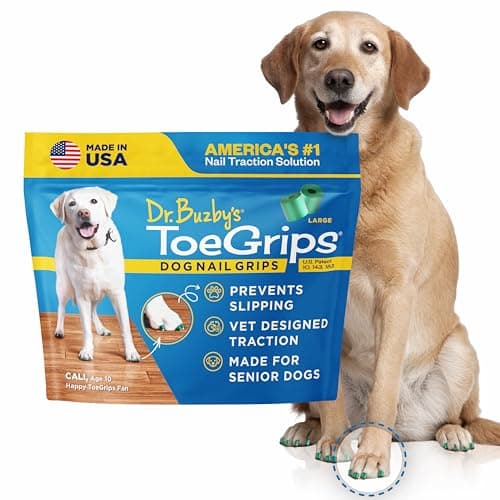
Dr. Buzby's
Dr. Buzby's ToeGrips for Dogs
Our score
$34–$40
Best for
Senior dogs slipping on hardwood, tile, or laminate floors
The best dog-mounted traction fix there is, and the one to buy once rugs have taken you as far as they can. Nothing touches the paw pad, which is why dogs tolerate these where they refuse socks and boots. Go in knowing the real cost: this is not a $40 purchase but a $240–$320 a year habit, so lay runners along your dog's actual routes first and buy grips for the floors you cannot cover.
Pros
- Veterinarian-developed; in clinical use for over a decade
- Slip onto each toenail — no socks, booties, or adhesives required
- Restores traction immediately, especially on hard floors
- Nothing touches the paw pad, so dogs accept them where they refuse boots
- Amazon and the manufacturer both charge $39.99 — no retailer markup
- 20 grips per bag against the 16 a dog wears, so a set includes four spares
Cons
- The only two published studies of nail grips both tested this exact product, and both were null: Roush 2017 (Front Vet Sci 4:111 — 15 sound dogs, kinetic changes "unlikely to be clinically relevant") and Repac 2022 (Animals 12(18):2312 — 30 dogs two weeks post-TPLO vs sham, no difference in weight bearing or limb function, including the owner question that asked specifically about slippery floors). Fair caveats: small samples, one used healthy dogs, the other a single early post-op timepoint — but "no positive trial exists" is the honest label, and we say it while still recommending the product for the mechanism and the owner-reported traction stories it was never tested against (verified 2026-08-14).
- A recurring cost, not a one-off. The maker publishes two different bag lives — "1–2 months" on its store page and "1-3 months, two months on average" in its FAQ (both read 2026-09-05) — which spans $160–$480 a year at $39.99. Plan on $240–$320, the two surfaces' central figures
- The Amazon listing markets specifically to dogs with "ACL injuries" — the one population where a randomised trial has been run, and where it found nothing (Repac 2022). The same bullets carry three claims with no source we could find: "more than 250,000 paws," "America's #1 nail traction solution," and "recommended by thousands of veterinarians worldwide" (listing copy verified 2026-08-17). Re-read 2026-08-31: a fourth unsourced superlative has been added to the top bullet on all four Amazon sizes — "The Only Toenail Grips for Dogs With GripZone Technology" — and the Large listing's title now leads with "Instant Traction on Wood/Hardwood Floors."
- The maker sells Scotch Super Glue Gel at $4.99 on its own store, listed as an "Alternate ToeGrips Application Method" (shop.toegrips.com, 2026-08-31). Read that as what it is: the company's own answer to the grips coming off, priced separately and not mentioned on the Amazon listing you are most likely to buy from.
- Application needs isopropyl rubbing alcohol, which is not in the box
- Initial application takes 15–20 minutes for a full set
- Some dogs chew them off in the first week
- Amazon carries only four of the seven sizes; XS, XXL and XXXL dogs have to buy direct
- Sizing by weight chart alone often misses — the accurate method needs dental floss and a ruler
And now the caveat that our own product page carries, because it is directly about this reader. The only trial of nail grips in exactly this population was null. Thirty dogs were randomised to nail grips or sham grips for the first two weeks after TPLO and assessed by blinded observers: no difference in visual lameness score or total pressure index at day 14 or any timepoint, and no difference on the client-specific outcome measures — including the one that asked specifically about walking on slippery flooring (p = 0.78).[15] The authors are careful — the grips were well tolerated, the sample is small, day 14 is one early timepoint — but the honest label is that no positive trial exists, and that the manufacturer's Amazon listing markets specifically to dogs with "ACL injuries" while the only study in post-cruciate dogs found nothing (listing copy verified 2026-08-17). We still recommend them for the floors you cannot cover, on the mechanism — a rubber cleat on the nail tip where a hard nail meets a hard floor — rather than on any trial, at a running cost of $240–$480 a year that we would rather you knew before the first bag than after the fourth. Rugs first. Full detail on the ToeGrips page and in dogs slipping on hardwood floors.
We earn the same commission rate whichever of these you buy, and nothing at all if you use the towel and the rugs you already own. That last outcome is a perfectly good one.
What to do this week#
If the consult has not happened yet, stop researching the acronyms. The comparison is a wash and the fifteen minutes are not. Write down the four questions above, and add one line to the top of the page: how long has he been off this leg? The ligament degenerates over months before it fails, so the answer is almost always longer than the limp — and a surgeon who knows the leg has been sore since spring plans differently from one who is told it happened on Tuesday.
If the surgery is booked, order the sling now rather than on day two, put the runners down before he comes home, and ask for the rehabilitation plan in writing with a review date on it. The osteotomy is one morning. The weeks after it are where the leg is actually made, and they are the part nobody schedules.
Frequently asked
- Which is better for a dog, TPLO or TTA?
- Neither, on the published evidence. The 2022 systematic review that set out to answer exactly this question (Wemmers et al., Front Vet Sci 2022;9:1004637) identified and evaluated 72 studies of surgical management of cruciate rupture and concluded that 'no method can be clearly preferred,' with almost half the studies rated low quality and only five of 72 qualifying as blinded randomised trials at low risk of bias. Its authors could find enough data in only three studies to pool complication rates at all, and pooled, the two procedures were not different. Both restore function in most dogs. The realistic differences are small and specific: TPLO looks slightly better on surgical site infection, that same review found TTA gave better osteoarthritis scores up to six months, TTA carries its own late meniscal injury profile, and the surgeon's experience with the technique they actually perform matters more than the technique.
- Is a TTA cheaper than a TPLO?
- Yes, in the only published pricing study we could find — by about 3%, which is almost certainly not enough to decide on. The study reviewed 162 invoices from a single German veterinary hospital that performs both procedures, over 2018 and 2019: median net price EUR 1,525.97 for TPLO against EUR 1,475.60 for TTA (p = 0.0006). That is a gap of roughly EUR 50, and the authors' own point is that it may be too small — they write that it 'might not be sufficient to offset the additional staffing costs required for TPLO.' Read the setting before you carry the number anywhere: one hospital, German fees set within a mandatory schedule (the GOT), and prices that rose with the dog's weight for both procedures. There is no equivalent US pricing survey we could locate, so any American dollar figure you read online is collected from quotes and owner reports rather than measured. Get two written estimates and ask what is inside each number — radiographs, recheck films and follow-up visits are where estimates diverge far more than the two techniques do.
- Can my dog have a TPLO if the TTA fails?
- Yes, and it is a documented salvage route rather than a theoretical one. There is a published case series of tibial plateau levelling performed in dogs with persistent lameness and suspected persistent instability after a tibial tuberosity advancement (Serrani et al., Vet Sci 2022;9(1):16), and a case report of a TPLO carried out on a 38 kg Labrador six months after a TTA Rapid, after the cage and screws were removed (Zhalniarovich et al., Animals 2023;13(22):3444). That is worth knowing, but it is not a reason to pick one procedure first — we have no published rate for how often either operation needs revising, so nobody can tell you which is more likely to need this. The question to ask your surgeon is what their own plan is if the first surgery does not settle the knee.
- How long is the recovery after a TTA compared to a TPLO?
- Practically the same, and that is the useful thing to plan around. Both cut bone, and the ACVS describes both as requiring 'several weeks of confinement.' It does not put a number on it and neither will we: restriction protocols are set by the surgeon, not by the literature, and the only one that governs your dog is the one on your discharge sheet — get it in writing with dates. For orientation, published TPLO bone-healing research routinely takes recheck radiographs at six and eight weeks (Leal et al., Front Vet Sci 2023;10:1147386), which is roughly the window most protocols work to. What is worth knowing is that passive range of motion does not simply return: in a retrospective cohort of dogs treated with TTA, TPLO or tightrope (Pinna et al., Vet J 2024;308:106253), joint range of motion was still outside the normal range in 100% of stifles at six months even though lameness had significantly improved with every procedure.
- Does one procedure prevent arthritis better than the other?
- No, and the honest answer here is more useful than a winner. A 2026 knowledge summary (Grech, Veterinary Evidence 2026;11(3)) reviewed the three studies that compared postoperative radiographic osteoarthritis between TPLO and TTA and found them contradicting each other — one favoured TTA, one favoured TPLO, neither significantly, and the third found significantly more osteoarthritis progression after TTA. Its verdict on the strength of that evidence was one word: weak. A separate 2026 study (Pinna and Tassani, Vet J 2026;318:106761) scoring 14 individual anatomic locations in 55 dogs six months after surgery found no substantial difference between the techniques. One finding does point TTA's way and we would rather state it than bury it: the 2022 systematic review reported that TTA appeared to give better osteoarthritis scores up to six months postoperatively, on the same body of evidence it rated largely subpar. Arthritis follows a cruciate rupture in most dogs whatever is done about it. Weight control and long-term management do more about that than the choice of osteotomy.