Recovery · Checklist
TPLO Recovery Gear: What You Actually Need at Home (2026)
The complete TPLO recovery gear checklist, organized by phase — what's essential in weeks 0–2, what can wait until walks start, and what to skip entirely.

Seven pieces of gear cover a TPLO recovery: a soft cone, a rear-support sling, a firm bed, a car ramp, toe grips, a warming coat, and a first-aid kit — and only the first three are essential from day one. This is the complete shopping list for dog ACL (technically CCL) surgery, organized by recovery phase, with honest calls on what to skip.
Affiliate disclosure: Dog Orthopedic is reader-supported. When you buy through links on our site we earn a commission at no extra cost to you — about 3% on most pet products, and the same rate on every product we compare, so no pick earns us more than another. Prescription medication earns us nothing, and seeing your vet earns us nothing; we recommend both anyway. Learn more.
Imagery: Lifestyle photographs on this site are licensed from Pexels (royalty-free) and credited per image. Pexels imagery illustrates conditions and contexts — it does not depict the specific dogs or test sessions described in the text. Product photographs come from Amazon's Creators API. Breed portraits are illustrations of typical breed type rather than photographs of individual dogs, and are not drawn to scale against one another.
The full checklist, phase by phase#
Screenshot this table. The phases follow a typical eight-week TPLO protocol — if your surgeon's discharge sheet says something different, the discharge sheet wins, every time.
| Item | Weeks 0–2 (strict rest) | Weeks 2–8 (controlled walks) | Week 8+ (gradual return) | Verdict |
|---|---|---|---|---|
| Soft e-collar (Comfy Cone) | On around the clock | Off once the surgeon clears the incision, usually days 10–14 | Not needed | Essential |
| Crate or exercise pen | Home base at all times except bathroom trips | Between walks | Phasing out | Essential |
| Rear-support sling (GingerLead) | Every bathroom trip | Stairs and slick surfaces only | As needed | Essential |
| Non-slip runners or yoga mats | Every path the dog walks | Same | Keep them for the senior years | Essential |
| Firm low-profile bed (Big Barker) | In or beside the pen | Same | Keep for life | Essential |
| Car ramp (Pet Gear Tri-Fold) | The ride home and recheck visits | Every car trip | Keep for seniors | Essential if your dog travels by car |
| Toe grips (Dr. Buzby's ToeGrips) | Where mats can't cover slick floors | Same | Seniors keep them | Helpful |
| Warming coat (Back on Track) | — | Stiff dogs, cold-morning starts | Arthritis-prone dogs | Helpful |
| Pet first-aid kit (RC Pets) | In the house before pickup day | Same | Keep it stocked | Helpful |
| Knee brace | Skip | Skip | Skip | Skip unless your surgeon prescribes one |
| Inflatable donut collar | Skip | Skip | Skip | Skip for most dogs — many can still reach the incision |
| Home laser / ultrasound devices | Skip | Skip | Skip | Skip — fund professional rehab visits instead |
The seven items, compared#

All Four Paws
Comfy Cone Soft E-Collar

GingerLead
GingerLead Dog Support and Rehabilitation Harness

Big Barker
Big Barker 7-inch Pillow Top

Pet Gear
Pet Gear Tri-Fold Pet Ramp
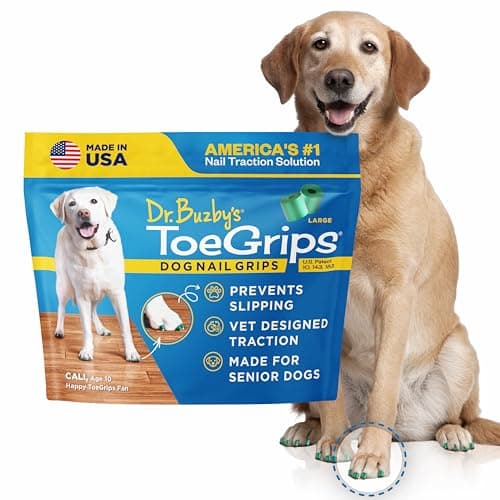
Dr. Buzby's
Dr. Buzby's ToeGrips for Dogs
| Product | Score | Best for | Price | |
|---|---|---|---|---|
All Four Paws Comfy Cone Soft E-Collar | 7.9 | Replacing the hard plastic e-collar after orthopedic or skin surgery | $19.79 | Unavailable |
GingerLead GingerLead Dog Support and Rehabilitation Harness | 8.3 | Short-term post-surgical assistance and rear-end weakness | $32–$70 | View |
Big Barker Big Barker 7-inch Pillow Top | 9.4 | Large and giant breeds with hip, elbow, or arthritis pain | $250–$460 | View |
Pet Gear Pet Gear Tri-Fold Pet Ramp | 8.5 | Hesitant and refusing dogs, indoor steps, couches, and cars up to about a 30-inch sill | $85–$120 | View |
Dr. Buzby's Dr. Buzby's ToeGrips for Dogs | 8.4 | Senior dogs slipping on hardwood, tile, or laminate floors | $34–$40 | View |
What does my dog need in weeks 0–2?#
The first two weeks are about three jobs: protect the incision, prevent all athletic movement, and get the dog to the yard and back without a slip. Three purchases cover them.
#1 Pick
All Four Paws
Comfy Cone Soft E-Collar
Our score
$19.79
Best for
Replacing the hard plastic e-collar after orthopedic or skin surgery
Almost no dog tolerates the standard plastic Elizabethan collar well, and the best evidence we have says the collar itself — not just the surgery — makes most animals measurably worse off while it is on. The Comfy Cone is the soft option most dogs accept: padded enough to sleep in, structured enough with the stays in to stop most licking. Buy it by the tape measure rather than by breed, and if your dog has a long nose, look hard at the two "long" sizes before you default to sizing up.
Pros
- Soft foam-backed padding — the dog can rest its head on it and sleep
- Removable plastic stays, so you can add structure when the dog is unsupervised and take it out to let the cone fold back for eating and drinking
- Two "long" sizes — Small-Long and Medium-Extra Long — that give a long-nosed dog the cone length he needs without a neck opening built for a thicker dog. Almost nothing else in the category solves this
- Reflective binding on the edge
- Hook-and-loop sizing strips adjust as post-operative swelling changes
- Water-resistant surface that wipes clean with soapy water
Cons
- Determined dogs can fold it back to reach the surgical site — the same flexibility that lets your dog sleep is the flexibility that lets him reach. Supervise the first day
- Larger sizes can flop forward and obscure peripheral vision
- It is not machine washable and there is no washable liner. All Four Paws advertises *disposable* liners, and as of 14 August 2026 its own product page still says they "will be available soon"
- All Four Paws publishes no warranty, guarantee or returns policy anywhere on its 25-page site. Whatever protection you have comes from the retailer, not the maker
- More expensive than the standard plastic cone
- The maker's own size chart carries the disclaimer that its breed recommendations are "just a suggestion NOT a guarantee in fit" — so measure, do not shop by breed name
- As of 2026-09-13 you cannot buy this cone on Amazon in any size that fits a dog over about 12 in around the neck. We pulled the full variant family through the Amazon Creators API that day: of sixteen variants, the two X-Small listings had 6 and 16 units; the XX-Large Black was "Temporarily out of stock"; Small-Long, Medium-Extra Long, X-Large and XX-Large Tan were all "Currently unavailable"; and Small, Medium and Large returned no offer at all. A week earlier three of those sizes were buyable. We have turned the Amazon button on this page off rather than send you to a dead listing or to a size that will not fit. The maker's own site has no cart and routes buyers to its Amazon store; Chewy lists every size, but its pages blocked our checks (HTTP 429) so we are not asserting Chewy has stock either
The cone is non-negotiable for orthopedic incisions, and the numbers say why. Following 189 TPLO incisions over an 8-week recovery, dehiscence at two weeks occurred in 22% of incisions closed with external nylon and 11% closed with barbed suture, with the proximal third of the incision most likely to break down.[1] Postoperative infection ran at 6.6% across 1,000 consecutive TPLOs.[2] Neither study isolates licking as the cause and we are not going to pretend otherwise — but the incision is genuinely fragile through exactly the window the cone covers.
The hard plastic version is why so many owners give up on cones, and that has been quantified too: in a survey of 434 owners, 77.4% reported a worse quality-of-life score for their animal while an Elizabethan collar was worn, significantly so where it interfered with drinking or playing.[3] It is a self-selected owner survey rather than a controlled measurement, so read it as a strong signal rather than a precise figure. The practical conclusion holds either way: a cone the dog can sleep in is the one that stays on for fourteen days.
Two caveats, and they are geometry rather than testing we did: determined dogs can fold a soft cone back far enough to reach a rear-leg incision, so supervise the first day and size up if in doubt, and the largest sizes can flop into the dog's peripheral vision on walks.
#2 Pick
GingerLead
GingerLead Dog Support and Rehabilitation Harness
Our score
$32–$70
Best for
Short-term post-surgical assistance and rear-end weakness
The right tool for one specific job: a dog whose back end has failed while his front end is still working. In the first four to six weeks after hip or stifle surgery, or for a senior who can get his front paws onto the sill of a car but cannot follow through, it is faster to fit than a full harness and it costs less. It is not a general mobility aid — it does nothing for the front half of the dog, and the maker expects you to buy a chest harness separately for older dogs. Size it with the towel test before you order, because the 10-day return window is short for a product whose commonest failure is sizing. If your dog needs help at both ends, or will need help for more than a couple of months, buy the Help 'Em Up Harness instead — though note that is no longer a $10 decision: Help 'Em Up prices by size direct ($80 XS to $140 XL, re-verified 18 Aug 2026), so the medium-to-large dog this sling fits pays $110 or $125 there against $69.95 here.
Pros
- Single-piece sling — fast to put on for bathroom trips
- Cutout in the support pad clears male anatomy, so it can be left in position without soiling
- Integrated leash takes one accessory off your hands, and detaches if you don't want it
- Machine washable and dryable, which matters more than it sounds on a post-surgical dog
- No Amazon markup — $69.95 on Amazon and $69.95 direct from the manufacturer, re-verified 12 September 2026 (Amazon via the Creators API, direct from the Med/Lg product page)
- The maker sells reconditioned units — inspected, laundered and re-packaged, "Save up to 45%". We have never observed the reconditioned price itself, so treat this as arithmetic rather than a quote: 45% off the $69.95 Medium/Large is about $38 at the maximum discount, and less at anything below it. (Corrected 2026-09-05 — we previously printed "roughly $45", which was the Amazon behind-the-buy-box offer of $44.95 conflated with the direct discount.)
- Manufacturer publishes a free towel test that sizes the sling before you spend anything
- Credit where it is due: as of 1 September 2026 the Amazon listing carries "CHEST HARNESS NOT INCLUDED" in capitals in its first feature bullet and in the retail title. This was the single most commonly missed thing about the product and the maker now says it before you click buy
- Stay-on straps are included, which is what stops the sling sliding backwards on a dog with wasted hindquarters
Cons
- Rear-end only — not the right tool if a dog also needs front support
- Chest harness is not included, and the maker's own copy recommends clipping the leash to one for older dogs
- Only a 10-day clean return window; days 11–30 carry a $10 restocking fee and nothing is refunded after 30
- Long-term use can rub thighs without careful fitment
- Strap-end handles are less ergonomic than padded handles
- Sized by pad width and by the dog's sex, not by a simple size ladder — easy to order wrong
- The Amazon listing contradicts itself on the weight floor — one bullet says "FEMALE dogs over 45 lbs and MALE dogs over 60 lbs", another says "dogs weighing over 45 pounds" flat (both live 19 Aug 2026)
- On Amazon the cheaper of the maker's two offers on this ASIN is not the one in the buy box, so the default click costs $25 more — and as of 1 September 2026 that cheaper $44.95 offer is no longer straightforwardly buyable: the same merchant now returns it as AVAILABLE_DATE with an empty message (backorder), where on 19 August it showed 7 units in stock. Corrects our own earlier advice — opening the other-offers panel is still worth doing, but it may no longer save you anything today
For the first week or two, every bathroom trip is an assisted trip. The GingerLead is a single-piece sling with an integrated leash, which means you can have it under a groggy dog's belly in seconds — that speed matters at 2 a.m. The padded male and female versions are cut differently so the sling doesn't sit in the wrong place, a small detail you'll appreciate roughly six times a day.
Three things to know before you order, all verified 6 August 2026. It is $69.95 on Amazon and $69.95 direct, so there is no channel saving either way. The chest harness is not included, even though GingerLead's own copy expects older dogs to wear one alongside the sling. And the clean-return window is 10 days, with a $10 restocking fee from days 11 to 30 and no returns after that.[4] On a product this hard to size, ten days is short — so time the order to about a week before surgery rather than buying months ahead, or the window closes before first use.
Try the free version first. A folded bath towel under the belly is the same idea for nothing, and GingerLead publishes a towel test for sizing that also tells you whether a rear boost is even the fix. It stops being enough when the dog is too heavy to control one-handed or you need the other hand for a door.
It supports the rear end only. If your dog also needs front-end help, you want a two-piece harness instead — see our guide to dog lift harnesses.
#3 Pick
Big Barker
Big Barker 7-inch Pillow Top
Our score
$250–$460
Best for
Large and giant breeds with hip, elbow, or arthritis pain
The bed every senior-large-breed owner eventually buys, and the one we still recommend first for a dog over about 80 lb — because seven inches of foam is the only thing that reliably keeps a heavy dog's hip off the floor plane overnight. (It is not one solid slab, as we used to say: the maker's own copy describes a 3-layer build, a 2" base under a 3" support layer under a 2" comfort top.) It is also the only bed in the category with a clinical study attached, and we would rather you knew what that study is: forty dogs, no control group, no blinding, and outcomes scored by the owners who had just been given a free bed. That is a reason to be interested, not a reason to be convinced. Buy on the foam depth and the ten-year warranty, which are facts. On where to buy: the price is the same either way, so buy direct for the 180-night sleep trial, which Amazon's return window does not match. The two editions both sell on both channels at identical prices, re-verified 6 September 2026 — flat Large $249.95, Headrest Large $289.95. We have published two wrong things about this in the past, a $40 Amazon markup and a direct-only cheap edition; both are retired, and the honest version is that the channel decides your trial, not your price.
Pros
- Seven inches of foam — a 3-layer build (2" base, 3" support, 2" top comfort) deep enough that a 100 lb dog's hip does not reach the floor plane, which is the whole job
- 10-year warranty — foam must retain at least 90% of its original shape and support, or it is replaced
- The only bed in the category with a published clinical study behind it, even though that study is a single-arm pilot
- Made in the USA
- Microfiber cover unzips and machine-washes
Cons
- Premium price
- Editions, not channels, are what the price difference is. Both are on Amazon and both are on bigbarker.com at identical prices, re-verified 2026-09-06: the flat headrest-free Large is $249.95 (B0GRBXBPXH) and the Headrest Large is $289.95 (B0GRBX5TBL), both In Stock with the buy box held by Big Barker itself, both matching the maker's own site. We previously misread this as a $40 Amazon markup, and then as the cheap edition being direct-only. Both claims are retired
- Bulky — measure your space, not just your dog
- Cover-only style isn't bolstered (consider Sofa edition for nesters)
- The clinical study everyone cites is open-label, single-arm, and owner-scored, with no control group
A post-op dog needs a firm bed, not a plush one. Soft, pillowy surfaces make standing up harder and wobblier at exactly the moment your dog is pushing up on three good legs, and standing up is something he will do dozens of times a day for eight weeks.
The Big Barker is 7 inches deep and firm enough to push off, and low enough to step onto rather than climb. On the maker's own description that depth is a three-layer build — a 2-inch base, a 3-inch support layer and a 2-inch comfort top — not the single slab the category usually implies, and no brand in this tier publishes a foam density figure, ours included. Direct pricing verified 13 August 2026 runs $249.95 / $299.95 / $359.95 for the flat Large, XL and Giant, and $289.95 / $339.95 / $399.95 with the headrest, flat across all ten cover colours; the previous "$229–$429" band on this page was stale at both ends.[5]
One buying note specific to recovery: the 180-night trial is a direct-only term, and the refund policy scopes it away from third-party retailers — so if you are not sure your dog will accept firm foam, buy from the maker rather than through our link. We earn nothing on the direct sale. It is still the right advice.
It is the bed your dog should keep for life after an orthopedic surgery, and the full reasoning is in the best dog beds for post-surgery recovery. If money is tight, the honest cheaper route is a high-density foam topper cut to size inside a washable cover — the same physics without the logo.

Two more things belong in this phase that aren't products we score: a crate or exercise pen sized so the dog can stand, turn, and lie down but not pace or leap, and cheap traction — yoga mats, rug runners, anything with grip — laid over every slick floor between the pen and the door. If your floors are hardwood or tile throughout, read what to do about a dog slipping on floors before pickup day.
What do I need once controlled walks start (weeks 2–8)?#
Around week 2–3, most protocols move from strict rest to short, controlled leash walks. Two pieces of gear earn their keep here.
#4 Pick
Pet Gear
Pet Gear Tri-Fold Pet Ramp
Our score
$85–$120
Best for
Hesitant and refusing dogs, indoor steps, couches, and cars up to about a 30-inch sill
The ramp we reach for first when a dog has already refused one. The extra width and the raised side edges do more for acceptance than any other feature at this price, and the carpet tread solves the surface problem that stops most dogs before height is ever the issue. It is heavier than its "portable" billing suggests, and the 200 lb ceiling rules it out for giant breeds. Buy it for the hesitant dog, not for the hiking-and-rain dog. Two corrections we owe you before you click: the warranty is 30 days, not the year this page used to print, and Pet Gear now sells the same 71-inch frame with a removable washable supertraX mat instead of fixed carpet — if your dog goes out in the wet, pay the extra sixteen dollars for it.
Pros
- 19.5 inches wide — roughly 3.5 inches wider than most ramps in this price band, which is the difference between a stiff dog placing four feet confidently and refusing
- Raised edges along both sides give a dog a boundary he can feel without looking down
- Carpet-textured skid-resistant tread, so a nail-scraping dog will walk it without you having to cover it with a towel
- 71 inches long — a 25-degree incline to a 30-inch SUV floor, within an inch of what a fully extended telescoping ramp achieves
- Safety tether and rubber base grippers included; attached carry handle
- Rated to 200 lb
Cons
- The warranty is 30 days, not a year — Pet Gear's own listing field reads "30 day non-transferrable limited warranty" on every 71-inch variant we checked on 11 August 2026. We had published a 1-year warranty since this page was created and it was wrong
- Heavy — 25.2 lb on Amazon's own figure for the reflective 71-inch sibling and 27 lb for the supertraX version. The 15 lb figure floating around the range belongs to the 16-inch-wide Travel Lite, a different ramp. Two-hand carry
- Carpet absorbs water and stays damp — not the ramp for a dog who goes out in the rain daily. The newer supertraX variant has a removable washable mat and solves this for about $16 more
- 200 lb rating is a real ceiling for giant breeds, and for anyone who wants to walk up alongside their dog
- Fixed 71-inch length: there is no shortening it for a 16-inch couch, so it is a large object to store and to swing around a hallway
- The Titanium variant (9300TI) that this page linked until 29 August 2026 read "Only 4 left in stock (more on the way)" on five consecutive checks a month apart (30 July, 11, 15, 23 and 29 August) — a standing availability problem, not a blip — so our link now goes to the reflective sibling (AM9300RF), the same 71 × 19.5 × 4 inch frame, 200 lb rating and 30-day warranty, which was cleanly in stock at $89.50 on 29 August 2026, $4.70 cheaper than the Titanium that day
The heaviest routine load in weeks 2–8 is the jump down from a vehicle, and this one is measured rather than asserted: fifteen healthy dogs jumping from a 0.75 m platform — about an SUV cargo floor — landed with a peak forelimb vertical ground reaction force of 34.12 N/kg, roughly 3.5 times body weight, against 27.35 N/kg from a 0.55 m hatchback sill.[6] That study measured loading, not injuries, so nobody can give you the odds for a specific repair. A ramp deletes the load entirely, which is a better deal than managing it.
Its carpet surface gives hesitant post-op dogs more confidence than slick plastic, and at 19.5 inches wide it is roomier underfoot than most — width is the real acceptance feature and almost nobody explains it.
Two specs on this page were wrong until August 2026 and both are now corrected. We said it "folds to about 18 inches deep" — unverified, and removed from our product page in July. And we said it "weighs under 11 pounds": the 71-inch model we link actually weighs about 25 lb. The sub-11-pound figure always described a shorter or narrower ramp, not this one. If carrying weight is your constraint, that changes the purchase, so we would rather say it plainly. Also verified: the warranty is 30 days, not the year we previously published, and the 200 lb rating is a combined dog-plus-handler-load ceiling.[7]
Watch out for the Travel Lite: same brand, same 71-inch length, only 16 inches wide, and it costs more. For giant breeds or tall pickup beds you want a longer telescoping ramp instead — our dog ramp guide covers the alternatives. If stairs exist between your dog and the outside world, read the week-by-week rules in stairs after TPLO.
#5 Pick
Dr. Buzby's
Dr. Buzby's ToeGrips for Dogs
Our score
$34–$40
Best for
Senior dogs slipping on hardwood, tile, or laminate floors
The best dog-mounted traction fix there is, and the one to buy once rugs have taken you as far as they can. Nothing touches the paw pad, which is why dogs tolerate these where they refuse socks and boots. Go in knowing the real cost: this is not a $40 purchase but a $240–$320 a year habit, so lay runners along your dog's actual routes first and buy grips for the floors you cannot cover.
Pros
- Veterinarian-developed; in clinical use for over a decade
- Slip onto each toenail — no socks, booties, or adhesives required
- Restores traction immediately, especially on hard floors
- Nothing touches the paw pad, so dogs accept them where they refuse boots
- Amazon and the manufacturer both charge $39.99 — no retailer markup
- 20 grips per bag against the 16 a dog wears, so a set includes four spares
Cons
- The only two published studies of nail grips both tested this exact product, and both were null: Roush 2017 (Front Vet Sci 4:111 — 15 sound dogs, kinetic changes "unlikely to be clinically relevant") and Repac 2022 (Animals 12(18):2312 — 30 dogs two weeks post-TPLO vs sham, no difference in weight bearing or limb function, including the owner question that asked specifically about slippery floors). Fair caveats: small samples, one used healthy dogs, the other a single early post-op timepoint — but "no positive trial exists" is the honest label, and we say it while still recommending the product for the mechanism and the owner-reported traction stories it was never tested against (verified 2026-08-14).
- A recurring cost, not a one-off. The maker publishes two different bag lives — "1–2 months" on its store page and "1-3 months, two months on average" in its FAQ (both read 2026-09-05) — which spans $160–$480 a year at $39.99. Plan on $240–$320, the two surfaces' central figures
- The Amazon listing markets specifically to dogs with "ACL injuries" — the one population where a randomised trial has been run, and where it found nothing (Repac 2022). The same bullets carry three claims with no source we could find: "more than 250,000 paws," "America's #1 nail traction solution," and "recommended by thousands of veterinarians worldwide" (listing copy verified 2026-08-17). Re-read 2026-08-31: a fourth unsourced superlative has been added to the top bullet on all four Amazon sizes — "The Only Toenail Grips for Dogs With GripZone Technology" — and the Large listing's title now leads with "Instant Traction on Wood/Hardwood Floors."
- The maker sells Scotch Super Glue Gel at $4.99 on its own store, listed as an "Alternate ToeGrips Application Method" (shop.toegrips.com, 2026-08-31). Read that as what it is: the company's own answer to the grips coming off, priced separately and not mentioned on the Amazon listing you are most likely to buy from.
- Application needs isopropyl rubbing alcohol, which is not in the box
- Initial application takes 15–20 minutes for a full set
- Some dogs chew them off in the first week
- Amazon carries only four of the seven sizes; XS, XXL and XXXL dogs have to buy direct
- Sizing by weight chart alone often misses — the accurate method needs dental floss and a ruler
ToeGrips are small rubber rings that slide onto the toenails and restore grip on hardwood, tile, and laminate. They're the fix for the floors your mats can't cover — the kitchen the dog crosses to reach the back door, the landing at the bottom of the gated stairs.
The number that reclassifies them. A bag is $39.99 and the manufacturer's own copy says a set lasts one to two months, with grips lasting one to three months. That is $240–$480 a year for one dog, or $204–$408 on the maker's subscription — not a $40 purchase but a subscription, and over a twelve-week convalescence it is two or three bags.[8] We used to price them at $22–$30 on this page and call the running cost small. Both were wrong, and the second was wrong in the flattering direction.
Which is why rugs come first. Runners and yoga mats on the paths your dog actually walks cost less, cover more area, and need replacing never. Buy grips for the surfaces you genuinely cannot cover.
Practical notes for the first application: budget 15–20 minutes, and buy isopropyl rubbing alcohol separately, because it is not in the box and it is the commonest reason a first attempt fails. Expect replacement every one to three months as nails grow, and watch for the occasional dog who chews a set off in week one.
What helps but isn't essential?#
A ceramic-fabric "therapy" coat used to hold this slot. We retired it on 14 August 2026: there is no controlled canine evidence for the far-infrared mechanism it is sold on, the one live listing ships in six to seven months, and the manufacturer's current catalog no longer contains the product. The full record of what we got wrong and why is on the retired product's page.
What survives from that recommendation is the modest, mechanism-free part: passive warmth is comfortable for a stiff dog before movement, and a plain, well-fitted insulated coat from any maker does that job for a thin-coated or clipped dog in a cold climate. That is a comfort purchase, not therapy, and it needs no technology story to justify it.
You should own a pet first-aid kit whether or not your dog just had surgery; recovery is simply when most owners finally buy one. We have not re-verified this kit's contents list against its current packaging, so check the listing before you order rather than taking a contents description from us — kit contents in this category change without the listing changing. What you want it to contain for a post-op dog is gauze, self-adhering bandage wrap to cover a licked-raw spot until you reach the vet, antiseptic wipes and tweezers.
Whatever kit you buy, add a roll of spare vet wrap, and write your surgeon's number and the nearest 24-hour emergency hospital on the fridge rather than leaving them in your phone. The kit is the cheap part. Knowing where to drive at 2 a.m. is the part that matters, and no product on this page substitutes for a phone call when an incision looks wrong.
What should I not waste money on?#
- A knee brace. Braces have a role in some non-surgical management plans, but after a TPLO the bone geometry has already been corrected and plated. Unless your surgeon prescribes one, it's money spent on a solved problem.
- A second, plusher bed "for comfort." Weeks 0–8 are exactly when a soft bed works against you. One firm bed, correctly placed, is the setup.
- Inflatable donut collars. They look kinder than a cone, and for short-nosed dogs they can work. Most dogs with normal muzzles can still reach a stifle incision around one. Test under supervision before trusting it, or skip it.
- Home therapy gadgets. Consumer laser, ultrasound, and PEMF devices are heavily marketed to post-op owners. Evidence for the home versions is thin, and the money is better spent on sessions with a certified canine rehabilitation practitioner once your surgeon green-lights structured rehab, typically around weeks 4–6. The nearest thing to a head-to-head is a small controlled study after TPLO in which dogs given supervised physiotherapy three times a week had significantly greater thigh circumference and stifle range of motion at six weeks than dogs on a home walking programme — with the operated-versus-sound limb difference gone in the physiotherapy group.[9] Eight dogs, four per group, so treat it as a pointer rather than proof. It is still more evidence than any device in this bullet has.
The bottom line#
Buy the cone, the sling, and the firm bed before surgery day, and lay down traction everywhere your dog will walk — the traction is the cheapest item here and the one most often skipped. Add the ramp and ToeGrips by the time controlled walks start at week 2–3, budgeting the grips as a running cost rather than a purchase. Skip the braces and the gadgets entirely.
The gear list is short because the job is short on complexity: keep a bored, healing dog from slipping, jumping, or licking for eight weeks. But "still" is not the goal, and this is the thing worth carrying out of the article. In a randomised, double-blinded, placebo-controlled trial of 100 dogs after TPLO, the placebo group lost 1.21 cm of thigh circumference in the operated leg over the first eight weeks — and 2.04 cm in the other one, the leg that had been doing all the standing.[10] The trial was funded by the manufacturer of the supplement it tested and reports no statistical test between the two limbs, so hold the exact figures loosely. The direction is not in doubt.
Restriction has a price, and the dog pays it in both hind legs. Every prescribed leash walk is the countermeasure, and every item on this list exists to make those walks physically possible for the person delivering them at 6 a.m. in the rain. For the day-by-day protocol the gear supports, read our full TPLO recovery guide, and for the broader kit beyond TPLO, see the best recovery gear for dogs.
Sources#
- Mans CE, Pawenski MC, Deahl LE, Frederick SW. "Incidence of dehiscence and erythema in tibial plateau leveling osteotomy incisions closed with barbed, bidirectional monoderm suture is equal to external nylon sutures." JAVMA. 2025;263:1-7. doi:10.2460/javma.24.08.0530 (PMID 40367980) — prospective clinical trial, 183 dogs and 189 incisions monitored over an 8-week recovery; dehiscence at 2 weeks 22% (nylon) vs 11% (barbed); proximal third the likeliest site. The study compares suture materials; it does not attribute dehiscence to licking.
- Fitzpatrick N, Solano MA. "Predictive variables for complications after TPLO with stifle inspection by arthrotomy in 1000 consecutive dogs." Veterinary Surgery. 2010;39(4):460-474. doi:10.1111/j.1532-950X.2010.00663.x (PMID 20345526) — 1,000 dogs, 1,146 stifles, single experienced surgeon; overall complication rate 14.8%, major 6.6%, postoperative infection 6.6%; increased body weight predicted both. A single-surgeon referral series, not a general population.
- Shenoda Y, Ward MP, McKeegan D, Fawcett A. "'The Cone of Shame': Welfare Implications of Elizabethan Collar Use on Dogs and Cats as Reported by their Owners." Animals. 2020;10(2):333. doi:10.3390/ani10020333 (PMID 32093257) — 434 owner respondents; 77.4% reported a worse quality-of-life score while the collar was worn. Self-selected survey, owner-reported.
- Pardey D, Tabor G, Oxley JA, Wills AP. "Peak forelimb ground reaction forces experienced by dogs jumping from a simulated car boot." Veterinary Record. 2018;182:716. doi:10.1136/vr.104788 (PMID 29622683) — 15 healthy adult dogs; peak forelimb vertical GRF 27.35, 30.84 and 34.12 N/kg from 0.55, 0.65 and 0.75 m. Measures loading only; no injury outcomes and no post-surgical dogs.
- Monk ML, Preston CA, McGowan CM. "Effects of early intensive postoperative physiotherapy on limb function after tibial plateau leveling osteotomy in dogs with deficiency of the cranial cruciate ligament." American Journal of Veterinary Research. 2006;67(3):529-536. doi:10.2460/ajvr.67.3.529 (PMID 16506922) — 8 dogs, 4 per group; significantly greater thigh circumference and stifle flexion/extension ROM in the physiotherapy group at 6 weeks. Very small sample.
- White DA, Harkin KR, Roush JK, Renberg WC, Biller D. "Fortetropin inhibits disuse muscle atrophy in dogs after tibial plateau leveling osteotomy." PLoS ONE. 2020;15(4):e0231306. doi:10.1371/journal.pone.0231306 (PMID 32271840) — 100 client-owned dogs, prospective randomised double-blinded placebo-controlled; placebo group lost 1.21 cm (affected limb) and 2.04 cm (unaffected limb) of thigh circumference between weeks 0 and 8. Manufacturer-funded; no statistical test of the between-limb difference is reported.
- Product prices, ASINs, weights, warranty terms and return windows: our own dated verifications through the Amazon Creators API and the manufacturers' own pages, recorded in
content/products/product-ledger.md— Dr. Buzby's ToeGrips 4 August 2026, GingerLead 6 August 2026, Pet Gear Tri-Fold 11 August 2026, Big Barker 13 August 2026.
Corrected on this page in the August 2026 repair: the Pet Gear "weighs under 11 pounds" and "folds to about 18 inches deep" specs (the first describes a different model, the second was never verified), its warranty (30 days, not 1 year), the ToeGrips price band and the claim that their running cost was small, the Big Barker price band, the Back on Track efficacy framing, and a description of caveats as coming from a test home when no such testing took place. Our correction log is at /corrections.
This article is educational and does not replace veterinary advice. Your surgeon's discharge instructions override every timeline here.
Frequently asked
- What do I actually need before my dog comes home from TPLO surgery?
- Five things before pickup day: a crate or exercise pen, a soft e-collar like the Comfy Cone (about $20–$77 by size when Amazon has it — on 13 September 2026 only the X-Small was buyable there, so check Chewy or your clinic for larger sizes), a rear-support sling for bathroom trips ($50–$90), non-slip runners or yoga mats on every path your dog will walk, and a firm low-profile bed. Order all of it before the surgery date — the first 48 hours home, with a groggy post-anesthesia dog, is the wrong time to be waiting on deliveries.
- How long does my dog wear the cone after TPLO surgery?
- Plan on two weeks minimum — through suture or staple removal at days 10–14, and until the surgeon confirms the incision has closed cleanly. The reason is that incision breakdown after TPLO is common rather than rare: in a prospective trial following 189 TPLO incisions across an 8-week recovery, dehiscence at two weeks occurred in 22% of incisions closed with external nylon and 11% closed with barbed suture, and the proximal third of the incision was the likeliest place to fail (Mans et al., JAVMA 2025;263:1-7). Postoperative infection ran at 6.6% in a series of 1,000 consecutive TPLOs (Fitzpatrick and Solano, Veterinary Surgery 2010;39:460-474). None of those studies isolates licking as the cause, so we will not claim a percentage for it — but the incision is fragile in exactly the window the cone covers. A padded soft cone the dog can sleep in makes two weeks realistic; most dogs never tolerate the hard plastic version well.
- Do I need a sling or a full lift harness after TPLO?
- For most dogs, a simple sling like the GingerLead ($70) covers the job: quick rear-end support for 30-second bathroom trips during weeks 1–2. Step up to a two-piece harness like the Help 'Em Up ($80 direct from the manufacturer, $95–$155 on Amazon) if your dog is over roughly 70 pounds, stairs are unavoidable in your home, or you expect months of assistance — bilateral cases and senior dogs wear out sling-only setups.
- Is an exercise pen okay instead of a crate for TPLO recovery?
- Yes, if it prevents the same three things a crate prevents: jumping, running starts, and furniture access. The standard is a space where the dog can stand, turn around, and lie down but cannot build speed. A small room with non-slip flooring works too. What fails is the honor system — an uncrated dog alone in the house will test the leg the moment something exciting happens.
- What TPLO recovery gear is a waste of money?
- Skip knee braces unless your surgeon specifically prescribes one, soft pillowy beds during the first 8 weeks, inflatable donut collars for long-nosed dogs that can still reach the incision, and home laser or ultrasound gadgets. Put that money toward professional rehab sessions once your surgeon green-lights structured rehab, typically around weeks 4–6. The comparison is not just intuition: in a small controlled study after TPLO, dogs given supervised physiotherapy three times a week had significantly greater thigh circumference and stifle range of motion at six weeks than dogs on a home walking programme, and the difference between operated and unoperated limbs had disappeared in the physiotherapy group (Monk et al., American Journal of Veterinary Research 2006;67:529-536). That study had 8 dogs, so it is suggestive rather than conclusive — but it is more evidence than exists for any consumer device sold for the same job.