Owner's Guide
Do Orthopedic Dog Beds Actually Help, or Is It Marketing?
The word orthopedic is unregulated and the pain-relief claim is essentially untested in dogs. Two things a bed provably does are worth paying for. Here is how to tell them apart.

Both things are true at once, and separating them saves you either $250 or a bad purchase. The pain-relief claim is essentially untested in dogs: there is no randomised trial of a dog bed anywhere, and the word "orthopedic" is unregulated marketing that any manufacturer may print. What is measurable is that the surface a dog lies on changes the contact pressure over his hip, shoulder and ribs, and changes how fast he loses body heat to the floor. Buy for those two things. Ignore the word on the box, read the foam depth, and before you spend anything, press your fist into the bed you already own.
Affiliate disclosure: Dog Orthopedic is reader-supported. When you buy through links on our site we earn a commission at no extra cost to you — about 3% on most pet products, and the same rate on every product we compare, so no pick earns us more than another. Prescription medication earns us nothing, and seeing your vet earns us nothing; we recommend both anyway. Learn more.
Imagery: Lifestyle photographs on this site are licensed from Pexels (royalty-free) and credited per image. Pexels imagery illustrates conditions and contexts — it does not depict the specific dogs or test sessions described in the text. Product photographs come from Amazon's Creators API. Breed portraits are illustrations of typical breed type rather than photographs of individual dogs, and are not drawn to scale against one another.
What does "orthopedic" actually mean on a dog bed?#
Nothing. There is no standard behind it, no certifying body, no minimum foam thickness, no density floor, and no test a bed must pass before the word appears on the label. A bed stuffed with shredded polyester offcuts can legally be sold as an orthopedic dog bed, and a great many are.
It is worth sitting with how unusual that is, because the human version of this product is regulated. Pressure-redistributing mattresses for people are a medical device category with an evidence base you can read: the Cochrane review of support surfaces covers 59 randomised trials and concludes that people at high risk of pressure ulcers should use higher-specification foam rather than standard hospital foam, with foam alternatives reducing pressure ulcer incidence at a relative risk of 0.40.[1] Fifty-nine trials, and the conclusion is still hedged. In the canine category, the number of randomised trials of any bed against any other bed is zero.
So the honest position is not that orthopedic beds are a scam. It is that the industry sells a claim it cannot support — pain relief — while the two things a bed genuinely does go almost entirely unmentioned. That mismatch has a cost, and it lands on you. A sceptical owner correctly detects the overreach, concludes the whole category is nonsense, and buys nothing. She was right about the marketing and wrong about the bed.
What the evidence actually shows, in three tiers#
Sorting by how directly it applies to your dog.
Tier one: contact pressure, measured in dogs. This is the strongest direct evidence in the category and almost nobody cites it, probably because it was published for veterinary nurses rather than for shoppers. Caraty and colleagues at VetAgro Sup compared four surfaces — blankets on the floor, a standard mattress, a veterinary memory foam mattress and a human-medicine memory foam mattress — recording contact pressures under laterally recumbent dogs over four hours with a pressure mat.[2] Three findings matter to you. Pressure concentrates in three specific places: the scapulohumeral joint, the greater trochanter, and the thirteenth rib. Memory foam produced significantly lower pressures in those zones than a standard mattress or blankets. And — the part a bed brand would never print — even the best static surface was generally insufficient to hold pressures under the 60 mmHg safety threshold in those zones, which is why nursing protocols require repositioning as well as padding.
Read the second and third findings together and you get the real shape of the claim. Better foam measurably reduces the load on the hip. It does not eliminate it. It was three cadaver dogs, so treat it as physics rather than as a clinical outcome.
Tier two: the one clinical study, read properly. The only study of a specific dog bed is the University of Pennsylvania pilot on the Big Barker mattress, and we retrieved the report itself rather than the marketing page. Its own study-design section calls it "a single center, open-label, proof of concept study": forty dogs over 70 lb with radiologist-confirmed osteoarthritis, 38 days, day 28 the primary endpoint. No control group. No blinding. Every headline improvement — 21.6% in Pain Severity, 17.6% in Joint Function, 15.1% in Quality of Life — is an owner-completed questionnaire.
That design has a specific, quantified problem in this population. Conzemius and Evans took the placebo arm of a blinded canine osteoarthritis trial with force-plate gait analysis running alongside, and found owners judged their own dog's lameness improved 39.7% of the time while the dog received nothing.[3] Four owners in ten see improvement that is not there. Hand forty owners a several-hundred-dollar bed and ask them to score their dog, and you cannot tell the foam from the hope. This does not make the pilot worthless — it makes it a pilot, which is exactly what its title says.
Tier three: that arthritis genuinely disturbs canine sleep. This is the strongest reason to care about the sleeping surface at all, and it is the tier people skip. Gruen, Samson and Lascelles ran a double-masked, placebo-controlled crossover trial in 15 dogs with spontaneous osteoarthritis pain and found that dogs on meloxicam had decreased night-time activity between 23:00 and 06:00 versus placebo, with owner-scored sleep quality improving on the NSAID at p = 0.001.[4] Treat the pain and the dog sleeps better. That is a blinded, placebo-controlled finding, which is more than anything in this article's product section can claim.

Now the honest counterweight, because it cuts against the intuition most bed copy relies on. It is widely assumed that an arthritic dog is restless at night and that you will see it. A 14-day accelerometry study comparing 22 healthy dogs with 23 osteoarthritic dogs found the opposite: night-time activity in the arthritic dogs was lower, not higher — 77.55 ± 19.64 against 106.09 ± 28.02 in healthy dogs, p = 0.004 — with no evidence of increased nocturnal restlessness.[5]
So a dog in pain may lie very still all night. Stillness is not comfort. It is what a sore dog does when moving costs something, and it is precisely the signal an owner reads as "he slept fine."
“Because your dog can't tell you how much pain he or she is in.”
The two things a bed provably does#
It changes where the pressure goes#
The greater trochanter is the bony crest at the top of the femur — the point of the hip you can feel through the skin. It is one of the three pressure concentration points Caraty identified, and it is padded from the outside by the gluteal muscle sitting over it.
Here is the distinction worth carrying out of this article. Chronic joint pain wastes exactly that muscle. A dog who has been favouring one hind leg for a year loses bulk over the hip on that side — it is why thigh and gluteal circumference are used as objective markers of chronic unilateral pain. The Caraty study, on three cadaver dogs, reported that contact pressures "appeared to depend on body condition score, with maximal pressures observed in thin dogs"; it scored fat cover, and applying it to muscle loss is our inference.
Put those together: the dog who most needs padding is the dog whose own padding has already gone. And he lost it to the same disease that has him lying down more hours a day than he used to. If you want a single mechanical reason a bed matters more for an arthritic senior than for a healthy five-year-old, that is it, and it has nothing to do with the word on the box.
| Contact zone | Why it concentrates load | What thins the natural padding |
|---|---|---|
| Greater trochanter (hip) | Bony crest, minimal soft tissue over it | Gluteal atrophy from chronic hind-limb pain |
| Scapulohumeral joint (shoulder point) | Bony prominence, takes weight in lateral recumbency | Forelimb disuse; general age-related muscle loss |
| Thirteenth rib | Last floating rib, unsupported by the rib cage arch | Weight loss, low body condition score, cachexia |
It changes how fast he loses heat#
The second thing is duller and easier to verify: a dog lying on tile, laminate or concrete loses body heat by conduction for as long as he lies there, and several inches of closed foam is an insulator. This is not a pain claim at all, it is a thermodynamic one, which is why we are comfortable making it. Our guide to how cold is too cold for an arthritic dog covers the temperature side properly.
And the thing it does not do#
A bed does not treat arthritis. It is not analgesia, it is not weight management, and it is not the exercise dose that maintains the muscle holding the joint together — that last one is covered in how much walking is right for a dog with arthritis. If your dog has become stiffer over the past three months, the bed is the second purchase and the vet appointment is the first. Buying a bed instead of booking that appointment is the single most expensive thing this article could accidentally talk you into.
The test that tells you whether the bed you own has already failed#
Do this before you read another word about products, because for a good number of readers it ends the question.
Press down hard with your fist, knuckles first, on the spot where your dog's hip lands when he sleeps. Not the middle of the bed, and not the edge — the actual dent. If you can feel the floor through it, so can he, every hour he lies there.
A bed that has bottomed out does not look like a broken bed. It looks like a bed. The cover is intact, the shape is right, the colour is fine. This is the whole reason the failure goes unnoticed for months: there is no moment at which a foam bed visibly stops working, only a gradual loss of the one property you bought it for, under a surface that never changes. Shredded fill migrates out from under the load point. Cheap egg-crate takes a compression set. Both look identical from standing height.
If your bed passes the fist test, it is doing its job and you do not need to buy anything today. Move it off tile onto carpet, put a folded blanket underneath rather than on top, and check it again next month. That advice costs nothing and it is the right advice for a lot of people reading this.

How thick does it actually need to be?#
There is no published veterinary standard for this, and we are not going to invent one. What follows is our working rule, derived from the bottoming-out principle rather than from a trial. Treat it as a starting point you verify with your own fist.
| Dog's weight | Minimum solid foam depth | Notes |
|---|---|---|
| Under 25 lb | 2 in | A light dog doesn't sink far; below this weight, bolster shape usually matters more |
| 25–40 lb | 3 in | Most mid-priced beds clear this |
| 40–80 lb | 4 in | The band where shredded fill starts failing within a year |
| 80–110 lb | 5–7 in | Solid foam only; egg-crate at this weight compresses within months |
| Over 110 lb | 7 in | Also check the bed's footprint, not just its depth |
| Any weight, visible muscle loss over the hip | Go up one band | Less natural padding over the trochanter |
Two specification notes that matter more than depth alone. Solid beats shredded at every price, because shredded fill migrates away from the point of highest load, which is precisely the point you needed it. And density matters as much as thickness — the Cochrane review of foam surfaces notes evidence that higher-density viscoelastic foam (40–60 kg/m³) may outperform lower-density foam (33 kg/m³), though it rates the certainty of most of its comparisons as low or very low.[6] Most dog-bed brands will not publish a density figure. That silence is information.
What we would actually buy, and why#
The cheapest route first#
If your current bed has bottomed out and the budget is tight, a high-density foam mattress topper cut to the right footprint and slid inside a washable cover is genuinely the same physics for less money. It is uglier, it has no waterproof liner, and you will be re-cutting foam with a bread knife on your kitchen floor. But it does the one thing the bed does, and nobody selling beds will tell you that.
If a manufactured bed is the answer, the honest budget pick:
#3 Pick
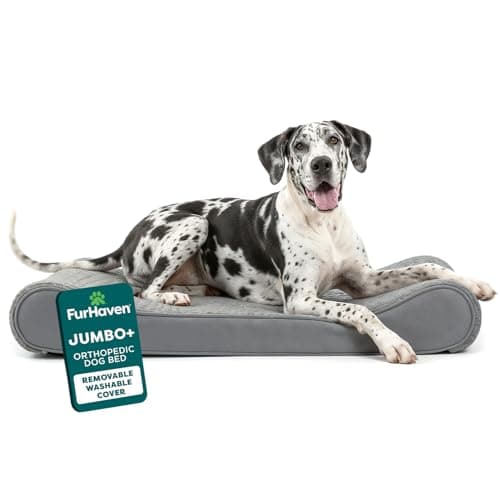
Furhaven
Furhaven Ultra Plush Luxe Lounger
Our score
$34.60
Best for
Budget-conscious owners of light and medium dogs, and nesting sleepers who like a low step-on entry
If Big Barker is out of budget, this is the bed we recommend for a dog under about 50 lb — solid orthopedic foam, a low step-on entry, and a washable cover at a price that is a tenth of the premium picks. Its foam is budget-density and it will mat down; the honest way to own one is to expect that, test it with your fist monthly, and spend $25.99 (Large) on a replacement core when it fails rather than pretending it won't. Under a heavy dog, buy depth and density once instead.
Pros
- The cheapest genuinely solid-foam orthopedic bed we track — $34.60 for the Large on Amazon and $34.99 base price direct from Furhaven, re-checked 2026-09-06
- Replacement foam cores are sold as spare parts priced by size — $13.99 Small to $69.99 Giant, $25.99 for the Large we link (verified against Furhaven's variant feed 2026-08-13) — so the bed's one predictable failure, the foam matting down, costs $25.99 to fix on this size rather than a whole new bed. The $13.99 figure is the Small's core and we have quoted it here as though it were this bed's; corrected 2026-09-06
- Contoured step-on lounger shape with no wall to climb — the low entry is a real feature for a stiff dog, and the contour supports a dog who sleeps with his head posted on an edge
- Removable, machine-washable cover with CertiPUR-US certified foam core
- Five sizes, Medium through Giant, in three core types (orthopedic foam, memory foam top, cooling gel top)
Cons
- Budget-density foam. Reviewers report cores matting down flat inside 18 months under bigger dogs, and the 10-year no-flatten warranties on premium beds exist precisely because this failure mode is real — plan on replacing the core (a $25.99 spare for the Large) on a schedule, not on faith
- Thinner in the middle than the photos suggest — reviewers measuring the foam report roughly 4.5 inches at the center against taller contoured edges, and "much thinner than what the pictures show" is a recurring complaint
- Furhaven rates sizes far above what this foam supports. The Jumbo Plus listing claims dogs up to 150 lb and the Large claims up to 38 lb; at this foam density we would not put a dog anywhere near 150 lb on it long term, and we treat the Large's 38 lb as the honest ceiling for the Large
- Cover fit is loose on some sizes per reviews, and the faux-fur top pills with washing
- The Amazon listing's fourth bullet opens "True Orthopedic Support: Stop buying beds that flatten" (read 2026-09-15), and nothing on Furhaven's own warranty page backs that sentence: the 90-day warranty covers fabric, sewing, gluing, stapling and zipper defects only, excludes "damage inflicted on products by animals", and there is no flatten term, threshold or remedy anywhere. Read the bullet as copy, not as a promise
- The Amazon listing we link disagrees with itself about what is inside it (read 9 October 2026). Its title says "Orthopedic Dog Bed" and its first bullet says "solid orthopedic foam slab"; its fourth bullet says "solid, high-density memory foam". Furhaven sells orthopedic, memory and cooling-gel cores as separate options at different prices, and its own page describes the orthopedic core as "dense and thick" with no density figure, so "high-density" has no number behind it anywhere we can find. If you want the memory-foam core, buy that option by name, direct, rather than trusting one bullet on the orthopedic listing
- Amazon availability moves by size. The Jumbo Plus ASIN (B07PYYJV11) went from "15 left" on 2026-08-18 to "Currently unavailable" on 2026-08-28 and was still dead on 2026-09-06, so our link now goes to the Large (B073PZHJZY, 36 × 24 × 5.5 in, rated to 38 lb, $34.60, sold by Amazon). That is a smaller bed than the one this page used to point at — check the size selector against your dog before you check out. Furhaven's own site still sells the whole line direct ($34.99–$180.99 across sizes when we checked 2026-08-22)
We keep this on the list because it is real solid orthopedic foam under $65 — a correction, incidentally: we previously called this bed's core egg-crate, and both Furhaven's own page and the current listing say solid slab — and we keep the same warning attached: it is budget-density foam, reviewers report it matting down inside 18 months under bigger dogs, and we would plan on that. The redeeming fact is that Furhaven sells replacement foam cores priced by size — $13.99 Small up to $69.99 Giant, $25.99 for the Large; a correction, August 2026, as we previously printed the flat $13.99 — so the predictable failure costs a $14–$26 part for most dogs, not a new bed. Under a 30 lb senior that is fine value. Under a 95 lb Shepherd no core swap fixes a density problem, and buying properly once is cheaper than pretending.
The warranty is the only testable claim in the category#
#1 Pick

Big Barker
Big Barker 7-inch Pillow Top
Our score
$250–$460
Best for
Large and giant breeds with hip, elbow, or arthritis pain
The bed we still recommend first for a dog over about 80 lb. Our reason is depth: seven inches, published layer by layer, is more than most beds we cover print, and for a heavy dog we would rather have the depth than not. That is our judgement; nobody has measured how far a hip sinks into this bed. (It is not one solid slab, as we used to say: the maker's own copy describes a 3-layer build, a 2" base under a 3" support layer under a 2" comfort top.) It is also the only bed we cover with a clinical study attached, and we would rather you knew what that study is: forty dogs, no control group, no blinding, and outcomes scored by the owners who had just been given a free bed. That is a reason to be interested, not a reason to be convinced. Buy on the foam depth and the ten-year warranty, which are facts. On where to buy: the price is the same either way, so buy direct for the 180-night sleep trial, which Amazon's return window does not match. Read its conditions first: no return in the first 30 days except size exchanges, the bed is donated to a shelter rather than shipped back, and one trial return per household (bigbarker.com refund policy, 2026-10-04). The two editions both sell on both channels at identical prices, re-verified 4 October 2026 — flat Large $249.95, Headrest Large $289.95. We have published two wrong things about this in the past, a $40 Amazon markup and a direct-only cheap edition; both are retired, and the honest version is that the channel decides your trial, not your price.
Pros
- Seven inches of foam in a 3-layer build (2" base, 3" support, 2" top comfort), printed on the maker's own page, which not every maker does
- 10-year warranty — foam must retain at least 90% of its original shape and support, or it is replaced
- The only bed we cover with a clinical study behind it, though it is the sponsor's single-arm pilot report, not a peer-reviewed paper
- Made in the USA
- Microfiber cover unzips and machine-washes
Cons
- Premium price
- Editions, not channels, are what the price difference is. Both are on Amazon and both are on bigbarker.com at identical prices, re-verified 2026-09-06: the flat headrest-free Large is $249.95 (B0GRBXBPXH) and the Headrest Large is $289.95 (B0GRBX5TBL), both In Stock with the buy box held by Big Barker itself, both matching the maker's own site. We previously misread this as a $40 Amazon markup, and then as the cheap edition being direct-only. Both claims are retired
- Bulky — measure your space, not just your dog
- Cover-only style isn't bolstered (consider Sofa edition for nesters)
- The clinical study everyone cites is open-label, single-arm, and owner-scored, with no control group
- The product page says the three layers "maintain proper spinal alignment and eliminate pressure points" (bigbarker.com, read 2026-10-04). Nobody has measured that on this bed, and the one canine pressure-mapping study we know of (Caraty 2019, three cadavers) found even memory foam generally not enough to keep the hip, shoulder and rib risk zones at safe pressures. It is the same unmeasured claim we criticise on elevated cots
Everyone writes about this bed's foam depth. The thing nobody explains is the warranty, and the warranty is the most useful sentence on the product page.
Ten years, with the foam warranted to retain at least 90% of its original shape and support, is not a customer-service gesture. It is a falsifiable claim about compression set — the exact failure mode this entire article is about, the one your fist test detects and your eyes do not. A manufacturer offering that term is betting real money that its foam will not bottom out within a decade. "Orthopedic" costs nothing to print. A decade of replacement liability does not.
Use that as your filter rather than as a brand loyalty. Checking this article's own claims against the manufacturers, we found K9 Ballistics offers a comparable ten-year won't-flatten warranty, defined in absolute inches — if the mattress flattens by more than two inches within ten years, they replace it once. Two companies willing to write that down is two companies you can hold to something. Everyone else in the category is selling an adjective.
So the reason to buy this one is different from the reason in the advertising. The percentages from the Penn pilot are not why. The seven inches of foam and the ten-year term are, because they are the two things you can verify.
The costs, plainly. It is a premium price. It is bulky — the Giant is 60 by 48 inches, which is furniture, and people underestimate it until it arrives. The pillow-top has no bolster, so a dog who sleeps pressed into a raised edge will use your wall instead. And a correction, August 2026: we previously reported Amazon running about $40 above the manufacturer's site — that was our own edition confusion. Like-for-like (the Headrest Large Amazon actually sells), both channels charge $289.95; the real saving is that bigbarker.com also sells a Sleek edition of the same 48×30×7 bed for $249.95 — direct-only until 13 Aug 2026, when a matching Amazon listing appeared at the same price; either way the trial only comes with the direct purchase. We earn a commission on the Amazon link and would still rather you bought the cheaper Sleek direct.
If your bed keeps failing for a different reason#
#2 Pick

K9 Ballistics
K9 Ballistics Tough Ripstop Orthopedic Crate Bed
Our score
$140–$320
Best for
Diggers, scratchers and light chewers that shred ordinary bed covers
The right bed for a dog who digs, scratches and roughhouses his bedding into the bin, and a genuinely good crate mattress at 4 inches with a warranty against flattening. Be precise about which problem you have, because we were not precise enough here until August 2026: this is the Tough Ripstop line, built for digging, scratching and occasional light chewing, and on this bed the chew warranty — 1 year, 365 days, re-verified 2026-09-06 — covers the cover only. A dog who has actually eaten three beds needs K9 Ballistics' separate Chew Proof Armored line, where the guarantee replaces the whole bed. Buy the right line and this is excellent. Buy this one for a determined chewer and you will be disappointed by a product that never claimed to do that job.
Pros
- Ripstop ballistic cover genuinely survives digging and scratching, which is what kills most bed covers
- Replaceable covers sold separately — repair, don't replace
- Carries a 10-year won't-flatten warranty as well as the chew guarantee, and it is defined concretely: more than 2 inches of flattening in 10 years and they replace the mattress once
- Foam is CertiPUR-US certified and made in the USA
- Corner anchor loops let you zip-tie the pad to a wire crate floor
Cons
- Cover texture is less plush than memory-foam beds
- Heavy at larger sizes — awkward to move around
- Premium price for the durable construction
- Not the bed for a determined chewer — the Tough Ripstop line is rated for digging, scratching and occasional light chewing only, and on this bed the 1-year chew warranty replaces the cover only, with the mattress excluded
- The Amazon listing contradicts itself on the foam: one bullet says CertiPUR-US shredded foam, another says a 4-inch solid foam mattress
- The 10-year won't-flatten warranty explicitly excludes chewing, scratching and water damage, so on a bed sold for rough dogs the two guarantees do not overlap
- Durability is the split verdict in the reviews, not a settled strength: Amazon's review summary for the linked listing (4.5 stars, 827 ratings, read 8 October 2026) says some owners find it outlasts other beds while others report it destroyed in less than two months and not chew-resistant enough. That matches the line's own rating (digging, scratching, light chewing), and it is why the cover-only chew warranty matters
- The listing's marketing outruns its own warranty: a bullet claims the mattress "won't flatten over time, even for the biggest and heaviest of breeds" and is "designed to last decades," while the brand's warranty defines acceptable performance as up to 2 inches of flattening in 10 years — half the mattress. The enforceable promise is the 2-inch threshold, not the bullet (listing re-read 25 August 2026)
Buy against the failure mode you actually have. If your beds die by compression, the paragraph above is your answer. If they die because your dog dismantles them, no amount of foam depth helps, and you need to know exactly which grade of destruction you are insuring against — because we got this wrong on our own product page until we checked it this week.
K9 Ballistics runs two separate lines. The Tough Ripstop series, which is what the link below goes to, is built for digging, scratching and occasional light chewing, and its 120-day guarantee replaces the cover only — the mattress is excluded. The Chew Proof Armored series is the one built for determined chewers, and on that line the guarantee replaces the whole bed. If you have already lost three beds to a dog who eats them, the Tough Ripstop is not your bed and we previously implied it was. Both lines carry the separate ten-year won't-flatten warranty, which excludes chewing damage entirely — as you would expect, and as is worth knowing before you plan on it.
The honest costs. The ballistic cover is noticeably less plush than memory foam, which some dogs mind and most do not. The larger sizes are heavy and awkward to shift for cleaning. You are paying a premium specifically for the cover, so if your dog does not chew, you are buying durability you will never use. And Amazon's own listing for this bed contradicts itself on the thing that matters most — one bullet describes CertiPUR-US shredded foam and another describes a four-inch solid foam mattress, which are meaningfully different products under a heavy dog. We publish the disagreement rather than picking the flattering half. Before you spend anything, a dog who destroys beds usually has a reason — boredom, anxiety, or a change in the household — and finding it is cheaper than armouring against it.
What to do this week#
Tonight, do the fist test on the bed your dog already owns. Thirty seconds, no cost. That answers the question this article is about better than any specification will.
If it passes, move the bed off any hard cold surface and slide a folded blanket underneath it, then put a monthly reminder in your phone to test it again. That is the whole intervention and it is free.
If your knuckles hit the floor, work out which failure you have before you shop. Compression is one problem, destruction is another, and size is a third — our size chart covers the last one, the full roundup has the picks across budgets, and how we test beds sets out what we do and do not claim to have measured.
And if your dog has been slower to get up over the past few months, buy nothing yet and book the appointment instead. A bed changes the hours he spends lying down. It does not change why he is lying down more. The delay between the first quiet sign and the day someone names it is where the damage accumulates, and a new bed arriving in the hallway is a very easy way to feel that something has been done.
Sources#
- McInnes E, Jammali-Blasi A, Bell-Syer SEM, Dumville JC, Middleton V, Cullum N. "Support surfaces for pressure ulcer prevention." Cochrane Database of Systematic Reviews. 2015;(9):CD001735. doi:10.1002/14651858.CD001735.pub5 — 59 randomised trials; foam alternatives to standard hospital mattresses reduced pressure ulcer incidence, RR 0.40 (95% CI 0.21 to 0.74). Human evidence, included here for context, not as a canine finding.
- Caraty J, De Vreught L, Cachon T, Moissonnier P, Bongartz A, Viguier E, Carozzo C. "Comparison of the different supports used in veterinary medicine for pressure sore prevention." Journal of Small Animal Practice. 2019;60(10):623-630. doi:10.1111/jsap.13061 — three cadaver dogs, four surfaces, contact pressures recorded over four hours; risk zones at the scapulohumeral articulation, greater trochanter and thirteenth rib; memory foam significantly lower than standard mattress or blankets; static surfaces generally insufficient to hold pressures below 60 mmHg in risk zones; lean dogs showed substantially higher peak pressures.
- Conzemius MG, Evans RB. "Caregiver placebo effect for dogs with lameness from osteoarthritis." Journal of the American Veterinary Medical Association. 2012;241(10):1314-1319. PMID 23113523 — placebo arm of a blinded, placebo-controlled multicentre trial; caregiver placebo effect in owners assessing their own dog's lameness 39.7% of the time.
- Gruen ME, Samson DR, Lascelles BDX. "Functional linear modeling of activity data shows analgesic-mediated improved sleep in dogs with spontaneous osteoarthritis pain." Scientific Reports. 2019;9:14192. doi:10.1038/s41598-019-50623-0 — double-masked, placebo-controlled crossover, 15 dogs; decreased night-time activity 23:00–06:00 on meloxicam versus placebo; owner-scored sleep quality improved on NSAID, p = 0.001.
- Rowlison de Ortiz A, Belda B, Hash J, Enomoto M, Robertson J, Lascelles BDX. "Initial exploration of the discriminatory ability of the PetPace collar to detect differences in activity and physiological variables between healthy and osteoarthritic dogs." Frontiers in Pain Research. 2022;3:949877. doi:10.3389/fpain.2022.949877 — 22 healthy versus 23 osteoarthritic dogs over 14 days; night-time activity lower in osteoarthritic dogs (77.55 ± 19.64 vs 106.09 ± 28.02, p = 0.004), with no evidence of increased nocturnal restlessness.
- Shi C, Dumville JC, Cullum N, Rhodes S, McInnes E. "Foam surfaces for preventing pressure ulcers." Cochrane Database of Systematic Reviews. 2021;5(5):CD013621. doi:10.1002/14651858.CD013621.pub2 — 29 studies, over 9,500 participants; evidence on higher-density versus lower-density viscoelastic foam, with most comparisons rated low or very low certainty. Human evidence.
- Mengel GA. A Pilot Study to Evaluate the Big Barker Therapeutic Mattress in Dogs with Osteoarthritis — Final Study Report Summary. University of Pennsylvania Veterinary Clinical Investigations Center. Single-centre, open-label, proof-of-concept study; 40 dogs over 70 lb with radiologist-confirmed osteoarthritis; 38-day enrolment, day 28 primary endpoint; no control group, no blinding; headline outcomes owner-completed questionnaires. Read in full and summarised on our Big Barker product page.
This article is educational and does not replace veterinary advice. A dog who is slower to rise, stiffer after rest, or reluctant to lie down in his usual position needs examining, not shopping for.
Frequently asked
- Do orthopedic dog beds actually reduce arthritis pain?
- Nobody has demonstrated that, and anybody telling you otherwise is going beyond the evidence. There is no randomised controlled trial of a dog bed. The single clinical study in the category is an open-label, single-arm pilot at the University of Pennsylvania on the Big Barker mattress — forty dogs, no control group, no blinding, and every headline outcome scored by the owners who had just been given the bed. That design cannot separate the foam from hope, which matters because the caregiver placebo rate in this exact population has been measured at 39.7%. What a bed provably does is redistribute contact pressure and stop heat draining into a hard floor. Those are worth paying for. Pain relief is a claim the category has not earned.
- What does 'orthopedic' legally mean on a dog bed?
- Nothing at all. There is no standard, no certifying body, no minimum foam depth or density, and no test a bed has to pass before the word goes on the box. A bed filled with shredded polyester offcuts can be sold as orthopedic and frequently is. The specifications that do mean something are all printed elsewhere on the listing: the thickness of the solid foam layer, whether it is solid or shredded, the foam density in kilograms per cubic metre or pounds per cubic foot if the maker will publish it, and the length and terms of the warranty.
- How thick does an orthopedic dog bed need to be?
- Thick enough that the dog's hip does not reach the floor plane when he is lying on it, which depends on his weight and how much muscle he has left over the joint. As a working rule we use two inches of solid foam under a dog below 25 lb, three inches from 25 to 40 lb, four inches from 40 to 80 lb, and five to seven inches above 80 lb. That is our rule of thumb from the bottoming-out principle, not a published veterinary standard, and no such standard exists. The test that matters more than the number: press hard into the bed where the hip sits. If your knuckles reach the floor, so does the hip.
- Is a memory foam dog bed better than a regular one?
- For pressure distribution specifically, there is direct canine evidence that it is. A study at VetAgro Sup measured contact pressures under laterally recumbent dogs across four surfaces and found memory foam mattresses produced significantly lower pressures over the risk zones than a standard mattress or blankets on the floor. The same study is the reason not to overclaim it: even on the best surface, static support alone was generally insufficient to hold pressures below the 60 mmHg safety threshold in those zones. Memory foam's real drawback is heat, since it traps warmth against a dog who cannot sweat, so a dog who pants at night on foam may genuinely be more comfortable on something cooler.
- How do I know when to replace my dog's bed?
- When it bottoms out, which will happen long before it looks worn. Do the fist test monthly: press down hard with your knuckles at the spot where your dog's hip lands. If you can feel the floor, the bed has stopped doing the only job you bought it for, regardless of how it looks from above. A body impression that stays after the dog gets up is normal for memory foam and is not the same failure. Cheap egg-crate foam typically reaches this point somewhere around 18 to 24 months of daily use by a large dog; premium solid foam should not, and if it does within its warranty term, claim it.