Read the bag
Is the Omega-3 in Your Dog's Food Already a Joint Dose? Six Bags Read Against the Trial Doses
Six joint and fish kibbles read at source: only one prints EPA and DHA, and it is the one nobody prescribed. What a 75 lb dog actually gets from each bag, against the doses the arthritis trials used.

The sentence on the front of the bag, "with omega-3 fatty acids for healthy joints," has been doing the work of a dose in your head for as long as you have been buying it. Read the back, and for five of the six bags below it cannot. The two placebo-controlled fish oil trials in arthritic dogs dosed EPA plus DHA, in milligrams per kilogram. The bags print "omega-3", a family that includes flaxseed ALA, which dogs convert poorly, as a minimum, sometimes on a dry-matter basis the feeding guide does not share. Only one of the six prints EPA and DHA on their own lines, and it is the ordinary fish kibble nobody prescribed. For a 75 lb dog at maintenance calories its guaranteed floor works out to about 4,400 mg a day, the top of the Colorado State chart, while the prescription bag with the most trials behind it prints EPA at about 1,550 mg and leaves DHA blank. Below is each bag at source, the arithmetic, and what to do when the number you need is not on the panel.
Affiliate disclosure: Dog Orthopedic is reader-supported. When you buy through links on our site we earn a commission at no extra cost to you — about 3% on most pet products, and the same rate on every product we compare, so no pick earns us more than another. Prescription medication earns us nothing, and seeing your vet earns us nothing; we recommend both anyway. Learn more.
Imagery: Lifestyle photographs on this site are licensed from Pexels (royalty-free) and credited per image. Pexels imagery illustrates conditions and contexts — it does not depict the specific dogs or test sessions described in the text. Product photographs come from Amazon's Creators API. Breed portraits are illustrations of typical breed type rather than photographs of individual dogs, and are not drawn to scale against one another.
The number the trials used, and the number the bag prints#
Two placebo-controlled trials of fish oil over ordinary food exist in dogs with osteoarthritis, and both stated their dose in the same unit. The 2016 US trial gave "an average dose of 69mg EPA+DHA/kg/day" for 84 days and reported that "all clinical outcomes for measuring discomfort, lameness, and joint severity" improved against placebo.[12] The Helsinki trial gave about 110 mg per kg for 16 weeks and found no significant difference from corn oil on any of its four main outcomes.[13] Colorado State's teaching hospital publishes a chart that tops out at 4,374 mg of EPA and DHA a day for a 75 lb dog, with the note that "the maximum dose is not tolerated by all animals."[14] For a 34 kg dog those three waypoints are roughly 2,350, 3,740 and 4,374 mg a day. Our dosing article covers where they come from; the diet-versus-bottle article covers what each trial actually found. This one is about the bag.
The unit matters because omega-3 is a family, not a compound. EPA and DHA are the marine members the trials fed. ALA, the plant member in flaxseed, is also an omega-3 and counts toward any "total omega-3" line, and the Helsinki authors put the conversion problem plainly: "much more vegetable ω-3 ALA is needed for the ineffective conversion of ALA into EPA than if you give fish oil EPA directly."[13] So a bag can print a large omega-3 number that is mostly ALA, and the panel gives you no way to tell.
Two more things about the panel before the arithmetic. A guaranteed analysis is a floor: "min" is what the maker will stand behind, not what the batch contains. And the basis varies. The FDA states that "the guaranteed analysis on a pet food label expresses nutrient levels on an 'as-fed,' or moisture-included, basis," while AAFCO profiles are on dry matter, and that "dry pet food is typically 10 to 12 percent moisture."[11] Hill's publishes its product tables on the dry-matter basis, which flatters every percentage by about a tenth against the as-fed labels of everyone else, so the two cannot be compared until the water is put back.

Six bags, read at source#
We read each maker's own product page on 18 September 2026 where the maker allowed it, and say so where it did not. The 75 lb dog is fed at the maker's feeding guide where one is published, and at 1,500 kcal a day, roughly what the Hill's guides give a dog that size, where it is not. Every milligram figure below is the guaranteed minimum or, for Hill's, the published average; none is a measurement of a batch.
Hill's Prescription Diet j/d. The bag with the trials behind it. Nutrient table on a dry-matter basis: total omega-3 3.6%, EPA 0.411%, no DHA row, no moisture row. Feeding guide 395 g at 70 lb and 445 g at 80 lb; ingredients open whole grain wheat, whole grain corn, flaxseed, chicken meal, corn protein meal, chicken fat, chicken liver flavor, fish oil.[1] At 420 g a day and 10% moisture that is about 1,550 mg of EPA, plus an unprinted amount of DHA, inside a total omega-3 figure of about 13,600 mg that flaxseed in third place suggests is mostly ALA. $134.99 for 27.5 lb at PetSmart with "Vet authorization required."[7]
Hill's Science Diet Adult Healthy Mobility Large Breed. The over-the-counter sibling. The page says "EPA from fish oil helps keep joint cartilage healthy, supporting improved mobility," and the nutrient table, also dry matter, prints total omega-3 at 1.3% with no EPA row, no DHA row and no moisture row. Fish oil is the 13th ingredient, after soybean oil; flaxseed is 14th. The feeding guide gives 365 g at 60 lb and 460 g at 80 lb, so about 436 g at 75 lb; 361 kcal per cup.[2] That is roughly 5,100 mg of total omega-3 a day and no way to say how much of it is the EPA the sentence on the page is about. $89.99 for the 30 lb bag on Amazon.[16]
Purina Pro Plan Veterinary Diets JM Joint Mobility. Purina's own product pages, its vet-direct store and its Canadian site all refused our fetch on the day (HTTP 403), and Chewy rate-limited us, so the panel below is from two retailer listings that agree with each other. Guaranteed analysis, as fed: omega-3 fatty acids 0.85% min, glucosamine 1,000 mg/kg min, no EPA row, no DHA row; 401 kcal per cup, 3,775 kcal/kg; fish oil 10th, behind trout and salmon meal, no flaxseed; feeding guide 3½–4½ cups for 51–75 lb.[3][4] At the top of that band, 4½ cups is about 478 g and 4,060 mg of total omega-3; at 1,500 kcal it is about 3,380 mg. With no flax in the recipe the marine share is probably high, but "probably" is not a dose. What makes this one worth a second look is that Purina prints the missing number in another market: its UK veterinary product guide for a differently formulated JM gives a typical analysis, as fed, of EPA 0.32% and DHA 0.48%, and cites Moreau 2013, the force-plate diet trial whose abstract names neither its diet nor its funder, as the evidence for the product.[5][17] The company measures EPA and DHA in its joint diet. The US label does not print them. $109.99–$123.99 for 32 lb across the two listings.
Royal Canin Veterinary Diet Canine Advanced Mobility Support. Guaranteed analysis, as fed: omega-3 fatty acids 0.5% min, with the asterisk "not recognized as an essential nutrient by the AAFCO Dog Food Nutrient Profiles"; no EPA, DHA, glucosamine or chondroitin rows; 3,470 kcal/kg and "316 kilocalories ME per cup on an as fed basis (calculated)"; fish oil 10th, no flax; and the claim "In a clinical study, 88% of dogs showed an improvement in mobility when fed Advanced Mobility Support," with no citation on the page. The feeding table sits behind a "What is the right portion?" widget and is not published as text.[6] At 1,500 kcal a day, about 432 g, the floor is roughly 2,160 mg of total omega-3. $134.99 for 26.4 lb at PetSmart, vet authorization required.[19]
Blue Buffalo Life Protection Formula Adult Fish & Brown Rice. The ordinary "fish recipe" a lot of households already feed. Guaranteed analysis, as fed: omega-3 fatty acids 0.9% min, omega-6 2.5% min, glucosamine 400 mg/kg min, the same AAFCO asterisk; 379 kcal per cup, 3,634 kcal/kg; feeding guide 3½–4¼ cups for 61–80 lb. There is no fish oil in the recipe at all. The omega-3 comes from whitefish, "Fish Meal (source of Omega 3 Fatty Acids)" in second place, and flaxseed in ninth, which the ingredient statement labels "(source of Omega 6 Fatty Acids)" while the same page's ingredient blurb calls flaxseed "a rich source of essential omega 3 fatty acids."[8] At 4 cups, about 417 g, the floor is about 3,750 mg of total omega-3 with no published split between the fish and the flax. $72.97 for 30 lb on Amazon.[20]
Orijen Six Fish Recipe. The one that prints it. Guaranteed analysis, as fed: EPA 0.4% min, DHA 0.7% min, omega-3 1.8% min, omega-6 2.1% min, glucosamine 300 mg/kg, moisture 12% max; 451 kcal per cup, 3,760 kcal/kg, 43% of calories from protein and 38% from fat; the first ten ingredients are whole fish and fish meals, herring oil 15th, no flax. The feeding guide is a calculator rather than a table.[9] At 1,500 kcal a day, about 399 g, the floor is 1,596 mg of EPA and 2,793 mg of DHA, 4,388 mg combined, inside about 7,180 mg of total omega-3. One caution the maker created: a second Six Fish page is live on the same US site with a different panel, EPA 0.5%, DHA 0.7%, omega-3 2.1%, 3,880 kcal/kg, and a percentage-labelled ingredient list that reads like a different kitchen's recipe.[10] We used the "Recipe" page because its bag sizes match what is on sale in the US; read the bag in your hand. $126.99 for 23.5 lb on Amazon at the buy box, in stock, with a second offer at $120.64; a $115.95 offer with two units left had sold out between our morning and afternoon reads the same day.[21]

The table#
A 75 lb (34 kg) dog. "Guide" rows use the maker's published feeding guide; "1,500 kcal" rows are isocaloric where no table is published. All figures are the guaranteed minimum, or Hill's published average, converted as described above; the Hill's rows assume 10% moisture.
| Bag | What the panel prints | Omega-3 unit and basis | Ration used | Total omega-3 / day | EPA+DHA / day | $/day |
|---|---|---|---|---|---|---|
| Hill's j/d[1] | Total omega-3, EPA | Dry matter, average | 420 g (guide) | ~13,600 mg | EPA ~1,550 mg; DHA not printed | $4.54 |
| Hill's SD Healthy Mobility LB[2] | Total omega-3 only | Dry matter, average | 436 g (guide) | ~5,100 mg | Not printed | $2.88 |
| Purina JM[3] | Total omega-3 only | As fed, min | 397–478 g (1,500 kcal to top of guide) | ~3,380–4,060 mg | Not printed (UK guide: 0.32% + 0.48%) | $3.01 at $109.99 and 1,500 kcal |
| Royal Canin AMS[6] | Total omega-3 only | As fed, min | 432 g (1,500 kcal) | ~2,160 mg | Not printed | $4.87 |
| Blue LPF Fish & Brown Rice[8] | Total omega-3 only | As fed, min | 417 g (guide) | ~3,750 mg | Not printed; no fish oil, flax 9th | $2.24 |
| Orijen Six Fish Recipe[9] | Total omega-3, EPA, DHA | As fed, min | 399 g (1,500 kcal) | ~7,180 mg | ~4,390 mg (EPA 1,600 + DHA 2,790) | $4.75 |
| Trial and chart doses[12][13][14] | EPA+DHA, mg/kg | — | — | — | 2,350 (69 mg/kg) · 3,740 (110 mg/kg) · 4,374 (CSU max) | — |
Read down the EPA+DHA column and the shape of the market is there in one line: the bags that carry the prescription print the least, and the bag nobody prescribed prints the most. That is not an accusation. It is a description of which unit each maker chose, and the unit is the whole difference between a number you can act on and a number you can only feel reassured by.
What the table does and does not say#
It does not say Orijen is the best joint food. No trial has fed it to dogs with osteoarthritis. Its guaranteed floor happens to land on the Colorado State maximum for a 75 lb dog at maintenance calories, which is a striking fact about a label, not a clinical result. Two further things count against reading it as a prescription. The oils in the trials were EPA-heavy: the Helsinki product was 450 mg EPA to 100 mg DHA per mL, and Orijen's floor is the reverse, DHA 0.7% to EPA 0.4%, so the combined figure matches the chart while the composition matches none of the trials.[13] And 38% of its calories are fat at 451 kcal per cup, which is the wrong direction for the overweight arthritic dog whose weight is the largest thing anyone can change, and a reason for a dog with a pancreatitis history not to be switched to it without a vet in the room.[9]
It does not say the therapeutic diets deliver less EPA and DHA. It says they do not print it. Purina JM has trout, salmon meal and fish oil and no flax, and its UK sibling's typical analysis shows the company knows the figure to two decimal places. Royal Canin's 0.5% floor may sit well under the batch. Hill's j/d's 0.411% EPA is a published average with the DHA line simply absent. Every one of these could be delivering a trial-level dose. The point is that you, holding the bag, cannot show it, and neither can the vet who recommended it unless the company has told them.
It does say total omega-3 is not a joint dose. Hill's j/d has the largest total in the table at about 13,600 mg, three times the chart maximum, and flaxseed is its third ingredient. Blue's 3,750 mg comes from whole fish, fish meal and flax with no fish oil at all. On both, the big number is a family reunion, and the two relatives the trials fed are somewhere inside it.
It does say the basis can hide a tenth. Hill's dry-matter tables read about 11% higher than the same food would on an as-fed label. That is not deception, and the footnote says what the basis is. It is a reason not to lay a Hill's percentage beside a Purina one without doing the moisture arithmetic first.
What to do if your bag prints only "omega-3"#
This is most readers, and the honest instruction has three steps and no purchase in the first two.
Ask the maker for the number. Three of these five companies have shown they measure EPA and DHA: Purina prints them abroad, Hill's prints half, Orijen prints both; Royal Canin and Blue Buffalo have published nothing either way. Email or phone the consumer line and ask, in these words, for "typical EPA plus DHA, as fed, in milligrams per 100 g" of the exact recipe on your bag. Write down the date and the answer. A company that will not give it has told you something about the number.
Read the ingredient order as a hint, not a computation. Ingredients are listed by weight before cooking. If flaxseed appears before fish oil, fish meal or whole fish, treat the omega-3 line as mostly ALA. If the fish sources come first and flax is absent, the marine share is probably high. This narrows the guess; it does not give you a dose, and the household that acts on "probably high" for a year has been feeding a hope.
If you decide to dose, dose from zero and measure. Treat the bag's omega-3 as unknown, choose a dose with your vet from the trial waypoints in the table, deliver it from a bottle whose guaranteed analysis is in EPA and DHA per scoop, and take a score before the first scoop and six weeks later. That is exactly what a measured liquid is for, and it is the reason the bottle earns its place beside a bag that already says "omega-3" on the front.
#1 Pick
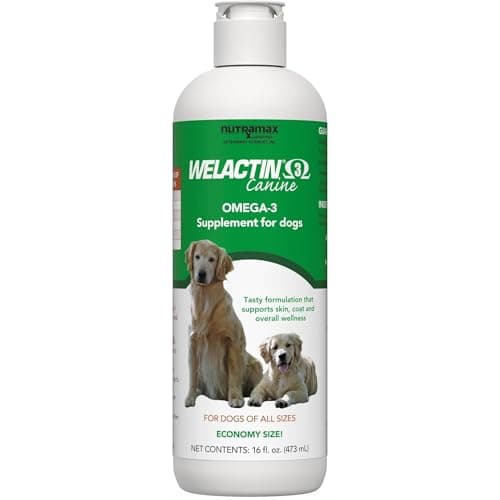
Nutramax
Welactin Canine Omega-3 Liquid
Our score
$22–$58
Best for
Households where a fish-oil-enriched therapeutic diet is closed off — multi-dog kitchens, elimination or kidney diets, dogs who refuse the food — and owners who want a dose they can compute and score against
The omega-3 we recommend when a fish-oil-enriched therapeutic diet is not an option, on one honest basis: the omega-3 trials in arthritic dogs were run on a diet, not on this bottle, none of them separated from control on a force plate, and the two placebo-controlled bottle trials disagree — so a dosed liquid with a published guaranteed analysis is the honest hardware for pursuing the same mechanism at a dose you and your vet chose, not a proven duplicate of anything (corrected 14 September 2026; we previously called the diet trial "the strongest evidence" and compared it as a head-to-head). Welactin earns the slot on concentration per dollar and on being made by Nutramax — not on the "#1 vet recommended" line, which is the brand's claim, not ours — and whose footnote, read 19 August 2026, defines its universe as vets "who recommended omega-3 supplements." Score lowered 8.6 to 8.4 on 19 August 2026, not because the oil changed but because a fine-print pass found the printed chart delivers under half the EPA+DHA that Colorado State's canine osteoarthritis chart calls for, that Nutramax prints the joint dose on its Advanced product and not on this one, that a retailer and the maker publish different guaranteed analyses for the same bottle, and that no calorie figure exists on any surface. It remains a cheap, concentrated, well-made oil. It is not a product you can dose for arthritis by reading its own label.
Pros
- High concentration: 1,330 mg combined EPA+DHA per 6 mL scoop on the manufacturer's guaranteed analysis
- Liquid over food scales to any body weight — no chew-splitting arithmetic
- Manufactured by Nutramax, the same company as Cosequin and Dasuquin
- Runs about $0.58/day for a 60 lb dog at the verified Amazon price — cheap for the category
Cons
- Smells fishy, and a bowl-refuser can start refusing dosed food
- Dosing hardware changed: current bottles pour by measuring scoop, not the pump our older copy described — dose accuracy now depends on you levelling a scoop
- A 6 mL scoop is coarse for small dogs — the label drops to half-scoop every-other-day under 10 lb
- Amazon's listing now leads with "Skin & Coat," not joints — the joint claim is the softer half of the marketing
- The printed chart is a skin-and-coat dose, not a joint dose, and Nutramax says so without giving a number: welactin.com's administration note read "Veterinarians may recommend increased amounts for enhanced joint health support" on 19 August 2026, and by 25 August 2026 had been reworded to "Your veterinarian may recommend to increase this amount for maximum joint health benefits" — the wording moved, the missing number stayed missing. At the chart's 1½ scoops, a 75 lb dog gets 1,995 mg of EPA+DHA against the 4,374 mg Colorado State's published canine osteoarthritis chart calls for at that weight — about 46%. Nutramax's own Welactin Advanced 3TA prints a separate "Joint Health" column at exactly double its broad-spectrum dose; this product prints one column and a footnote
- Retailer panels and the maker's panel disagree. On 19 August 2026 welactin.com published 1,610 mg total omega-3 and 1,330 mg EPA+DHA per 6 mL scoop, while a veterinary supply retailer's page for the same 16 oz bottle published 1,770 mg total, 870 mg EPA and 570 mg DHA (1,440 mg EPA+DHA) per the same 6 mL scoop. We use the maker's figures. If you are computing a dose against a study, read the panel on the bottle in your hand
- No calorie figure is published anywhere we could find — not on welactin.com and not on the Amazon listing, verified absent 19 August 2026. Fish oil is the most calorie-dense thing you can add to a bowl, and weight is the largest modifiable factor in canine osteoarthritis, so this is the number the category should print and does not
- Fish, obviously — which disqualifies it for any dog on a fish-based novel protein elimination diet, and doubles up on any dog already eating a fish-based food
- No use-within-after-opening period, no refrigeration instruction and no full ingredient list are published on the maker's product page, verified absent 9 September 2026. A 16 oz bottle lasts a 20–44 lb dog about 11 weeks and a 10–19 lb dog about 22 weeks, and fish oil oxidises once opened, so the buyer of the small dog is being sold five months of exposure with no stated shelf life. Follow whatever the bottle in your hand says; the website does not say
This bottle is here for one axis only: it prints the unit the trials used, 1,330 mg of EPA plus DHA per 6 mL scoop on the maker's own guaranteed analysis, which five of the six bags above do not.[15] Who should not buy it, plainly: anyone feeding Orijen Six Fish, where a scoop and a half on top of the bag's floor puts a 75 lb dog near 6,400 mg a day, about 46% over the Colorado State maximum, with the loose stools that chart warns about and no way to say which change did what; anyone whose vet has just put the dog on j/d, for the reasons in the diet-versus-bottle article; and any dog on a fish-based elimination diet, because this is fish. The maker's own chart is a skin-and-coat dose, the maker does not publish calories, and at the Colorado State chart dose the bottle lasts a 75 lb dog about three and a half weeks. Every one of those is already on the product page. They are repeated here because the bag's front panel is exactly the kind of sentence that makes people skip them.
The calories are the second thing a top-up adds. Veterinary literature puts fish oil at about 42 kcal per 5 mL, so a scoop and a half is about 76 kcal and the Colorado State dose about 165, on top of a ration that was already set for the dog's weight.[18] The bag has to come down by that much or the dog goes up, and cups cannot take 20 g off a ration repeatably. A gram scale can.
#2 Pick

Etekcity
Etekcity Food Kitchen Scale EK6015, Digital Grams and Ounces, 11 lb
Our score
$13.99
Best for
A growing large-breed puppy, or any dog whose hips have been graded loose, in a household that currently feeds by the cup
The cheapest object on this site backed by a lifelong paired-feeding trial. In 48 Labrador Retrievers fed from eight weeks of age, the 24 dogs fed 25% less than their pair-mates had hip dysplasia by OFA score in 7 cases at two years against 16 in the free-fed group, and their median age at first radiographic hip osteoarthritis was 12 years against 6. That result was produced by weighing food, every meal, for life. Separately, when 100 owners measured kibble with a cup or scoop, individual error ran from 47.83% under to 152.17% over. A gram scale closes that gap for under fifteen dollars. Buy this one or any other with 1 g resolution; the brand is not the point. What it cannot do is pick the target — that is a body condition score, set with your vet, and re-weighed monthly.
Pros
- Weighs in 1 g increments to 5 kg / 11 lb, which is the resolution a dog's daily ration actually needs — the feeding intervention with the strongest controlled-trial evidence for reducing hip dysplasia was a 25% restriction, and a quarter of a ration is not something a scoop can hold steady
- Tare button, so the bowl goes on first and the display reads the food alone
- Five units (g, oz, lb:oz, mL, fl oz); the one that matters is grams, because every feeding chart on a dog-food bag is in grams or in cups, and only one of those is repeatable
- Flat 304 stainless steel platform that wipes clean; 0.75 in tall, so it lives on the counter next to the food bin rather than in a drawer
- Two AAA batteries included; the maker states a 2-year warranty on the listing
Cons
- A scale tells you how much you fed. It does not tell you how much to feed. The 25% figure from the Labrador trials was 25% below what a pair-mate ate ad libitum, which is not a number you can read off a bag; the feeding target still has to come from a body condition score agreed with your vet
- The 5 kg limit is generous for a bowl of kibble but too small to weigh a bag, and it is a food scale, not a dog scale — weighing the dog is a separate monthly job most clinics will do for free
- The listing carries no star rating we can read and we have not used this unit; the recommendation rests on the resolution and the price, not on durability we have observed
- Battery-only; no USB or mains. Reviewer complaints in this category are overwhelmingly about auto-off timing and battery drain, and we could not verify either for this model
The scale's job in this article is narrower than usual. It is not here to restrict a puppy. It is here because every percentage in the table above became a milligram only after meeting a weight in grams, and the feeding guides on all six bags are printed in cups that weigh anywhere from 91 g to 120 g depending on the kibble. If you want to know what your dog is getting from the bag, or to cut 20 g to pay for a scoop, the cup will not tell you and this will. Any kitchen scale already in the house does the same job for nothing.

What we still do not know#
- What any of the five unlabelled bags actually delivers in EPA and DHA. Not the floor, not the average, not the split from flax. We asked the pages; the pages do not say. This is the finding, and a reply from a consumer line is the only way past it.
- Whether Purina's US JM matches its UK typical analysis. The recipes differ (the UK ingredient list opens rice and dried salmon protein; the US opens brewers rice and trout), so the 0.32% and 0.48% cannot be carried across. They show the company has the figure, not what it is here.
- Which Orijen panel is the bag on your shelf. Two live pages, two sets of numbers, one product name. The 0.4% and 0.7% floors we used are the lower of the two EPA figures; the bag wins.
- Whether a bag's marine omega-3 behaves like a scoop's. No trial has compared a fish-heavy ordinary kibble against an oil at matched EPA and DHA in arthritic dogs, and the diet trials that exist were run on therapeutic foods whose panels are the ones that do not print the number. Our diet-versus-bottle article works through what those trials found; the supplement roundup puts fish oil beside the other options by evidence.
What to do this week#
- Turn the bag over and find the unit. Write down whether it says EPA, DHA, or only "omega-3," and whether the table is as fed or dry matter. Thirty seconds, and it decides everything below.
- Weigh one day's ration in grams. Not the cup count, the grams. Multiply by the percentage and by 10, after removing 10% moisture if the table is dry matter. That is your daily milligrams of whatever the bag chose to guarantee.
- If the unit is EPA and DHA, compare it to the waypoints and take the answer to your vet before adding anything. If the sum is already at the chart, the scoop you were about to add is the mistake, not the fix.
- If the unit is "omega-3," send the email asking for typical EPA plus DHA as fed. While you wait, treat the bag as delivering nothing toward a joint dose, because for the purposes of a decision that is what an unknown is.
- If you and your vet choose to dose, take a score first. The limp-scoring method takes ten minutes, and it is the only instrument in the house that will tell you in six weeks whether the number you finally pinned down did anything.
The delay this shortens is the one the front of the bag creates. A sentence about omega-3 and healthy joints has stood in for a dose in a great many kitchens for a great many years, and it was never a lie; it was a family name where a first name was needed. The bag that can answer the question is the one that printed the first name. For the rest, the answer is on the other end of an email, and until it arrives, the bag is not a dose. Treat it as one and the delay runs on quietly while everybody in the house believes the joints are being handled.
Sources#
- Hill's Pet Nutrition. "Prescription Diet j/d Dry Dog Food," product page. hillspet.com — re-read 18 September 2026: nutrient table on a dry-matter basis, Total Omega-3 FA 3.6%, EPA 0.411%, no DHA row, no moisture row; 364 kcal/cup, 3,670 kcal/kg; feeding guide 4 cups (395 g) at 70 lb, 4½ cups (445 g) at 80 lb; ingredients open whole grain wheat, whole grain corn, flaxseed, chicken meal, corn protein meal, chicken fat, chicken liver flavor, fish oil.
- Hill's Pet Nutrition. "Science Diet Adult Healthy Mobility Large Breed Chicken Meal, Barley & Brown Rice Recipe," product page. hillspet.com — read 18 September 2026: "Average Nutrient & Caloric Content" table with the footnote "The nutrient in the product after moisture is removed"; Total Omega-3 FA 1.3%, Total Omega-6 FA 3.79%, Glucosamine 609 ppm, Chondroitin Sulfate 1,026 ppm; no EPA, DHA or moisture rows; 361 kcal/cup, 3,635 kcal/kg; feeding guide 3⅔ cups (365 g) at 60 lb, 4⅔ cups (460 g) at 80 lb, no 70 lb row; fish oil 13th ingredient, flaxseed 14th, soybean oil 12th; claim "EPA from fish oil helps keep joint cartilage healthy, supporting improved mobility," no EPA figure and no citation; sold as a 30 lb bag.
- Southern Agriculture. "Purina Pro Plan Veterinary Diets – JM Joint Mobility Formula Dry Dog Food," product listing. southernagriculture.com — read 18 September 2026: guaranteed analysis crude protein 30.0% min, crude fat 12.0% min, moisture 10.0% max, omega-3 fatty acids 0.85% min, glucosamine 1,000 mg/kg min; 401 kcal/cup, 3,775 kcal/kg; fish oil 10th ingredient; $123.99 for 32 lb. Purina's own US product page, proplanvetdirect.com and purina.ca all returned HTTP 403 to our fetch on the day; chewy.com returned HTTP 429.
- 1Family 1Health Pharmacy. "Purina Pro Plan Veterinary Diets JM Joint Mobility Dry Dog Food," product listing. 1family1health.com — read 18 September 2026: same ingredient list and same omega-3 0.85% min, glucosamine 1,000 mg/kg min, 401 kcal/cup, 3,775 kcal/kg; moisture 11.0% max on this listing; feeding guide "51 – 75 lbs. – 3 1/2 – 4 1/2" cups; $33.99–$109.99 across 6, 18 and 32 lb.
- Purina Vet Centre UK. "Pro Plan Veterinary Diets Canine JM Joint Mobility," product guide (PDF). vetcentre.purina.co.uk — read 18 September 2026: dry formula "Typical analysis in the final product as fed": moisture 7.5%, protein 30.0%, fat 12.0%, omega-6 1.6%, omega-3 1.1%, EPA 0.32%, DHA 0.48%; 372 kcal/100 g; ingredients open "Rice, dried salmon protein, dried poultry protein, wheat flour, soya protein powder, corn, dried egg, digest, fish oil"; reference 1 is Moreau M et al. (2013) J Anim Physiol Anim Nutr 97:830–7. A different recipe from the US product; cited only to show the company publishes EPA and DHA where it chooses to.
- Royal Canin US. "Canine Advanced Mobility Support," dry dog food product page. royalcanin.com — read 18 September 2026: guaranteed analysis crude protein 23.0% min, crude fat 10.0% min, crude fiber 5.2% max, moisture 10.0% max, vitamin E 315 IU/kg min, ascorbic acid 220 mg/kg min, "Omega-3 fatty acids* (min.) 0.5%" with "*Not recognized as an essential nutrient by the AAFCO Dog Food Nutrient Profiles"; no EPA, DHA, glucosamine or chondroitin rows; "3470 kilocalories of metabolizable energy (ME) per kilogram or 316 kilocalories ME per cup on an as fed basis (calculated)"; ingredients brewers rice, wheat, chicken by-product meal, corn, corn gluten meal, chicken fat, pea fiber, wheat gluten, natural flavors, fish oil; "In a clinical study, 88% of dogs showed an improvement in mobility when fed Advanced Mobility Support," no citation; feeding table not published as text; bag sizes 8.8 and 26.4 lb.
- PetSmart. "Hill's Prescription Diet j/d Joint Care Adult Dog Food – Chicken," 27.5 lb. petsmart.com — read 14 September 2026: $134.99; "Vet authorization required."
- Blue Buffalo. "Life Protection Formula Adult Dog Fish and Brown Rice Recipe," product page. bluebuffalo.com — read 18 September 2026 from the page's embedded guaranteed-analysis and feeding-chart markup: crude protein 22.0% min, crude fat 14.0% min, crude fiber 5.0% max, moisture 10.0% max, "Omega 3 Fatty Acids* 0.9% min," "Omega 6 Fatty Acids* 2.5% min," "Glucosamine* 400 mg/kg min," "*Not recognized as an essential nutrient by the AAFCO Dog Food Nutrient Profiles"; 3,634 kcal/kg, 379 kcal/cup; feeding chart 61 to 80 lbs 3½–4¼ cups; ingredients open Whitefish, Fish Meal (source of Omega 3 Fatty Acids), Brown Rice, Barley, Oatmeal, Peas, Pea Starch, Chicken Fat, Flaxseed (source of Omega 6 Fatty Acids); no fish oil in the list; bag sizes 15, 30 and 34 lb.
- Orijen. "Six Fish Recipe Dry Dog Food," US product page. orijenpetfoods.com — read 18 September 2026: guaranteed analysis crude protein 40% min, crude fat 16% min, moisture 12% max, "DHA (Docosahexaenoic acid) (min.) 0.7%," "EPA (Eicosapentaenoic acid) (min.) 0.4%," omega-6 2.1% min, omega-3 1.8% min, glucosamine 300 mg/kg min; 3,760 kcal/kg, 451 kcal per 8 oz cup, 43% protein / 19% carbohydrate / 38% fat; ingredients open whole herring, salmon, monkfish, Acadian redfish, flounder, whole hake, sardine meal, herring meal, blue whiting meal, pollock meal, whole red lentils, whole pinto beans, with herring oil 15th; feeding guide is a calculator; bag sizes 4.5, 13 and 23.5 lb.
- Orijen. "Six Fish Dry Dog Food," a second product page live on the same US site. orijenpetfoods.com — read 18 September 2026: EPA 0.5%, DHA 0.7%, omega-3 2.1%, omega-6 2.1%, crude protein 38%, fat 18%, crude ash 8.5%, moisture 12%; 3,880 kcal/kg, "466 kcal per 250ml/120g cup"; ingredients open "Raw whole pilchard (18%), raw whole mackerel (11%), raw whole hake (10%) … herring oil (4%)"; the page states "Proudly crafted in Canada," which is consistent with a different kitchen's recipe from the US "Recipe" page.
- US Food and Drug Administration. "Complete and Balanced Pet Food." fda.gov — re-read 18 September 2026: "Dry pet food is typically 10 to 12 percent moisture"; "The AAFCO Dog and Cat Food Nutrient Profiles express nutrient levels on a 'dry matter,' or moisture-free, basis. But, the guaranteed analysis on a pet food label expresses nutrient levels on an 'as-fed,' or moisture-included, basis."
- Mehler SJ, May LR, King C, Harris WS, Shah Z. "A prospective, randomized, double blind, placebo-controlled evaluation of the effects of eicosapentaenoic acid and docosahexaenoic acid on the clinical signs and erythrocyte membrane polyunsaturated fatty acid concentrations in dogs with osteoarthritis." Prostaglandins, Leukotrienes and Essential Fatty Acids. 2016;109:1–7. doi:10.1016/j.plefa.2016.03.015 — abstract re-read 18 September 2026 via the Europe PMC API: 78 enrolled, 74 completed; "an average dose of 69mg EPA+DHA/kg/day"; "All clinical outcomes for measuring discomfort, lameness, and joint severity at day 84 … significantly (p<0.05) improved compared with placebo."
- Hielm-Björkman A, Roine J, Elo K, Lappalainen A, Junnila J, Laitinen-Vapaavuori O. "An un-commissioned randomized, placebo-controlled double-blind study to test the effect of deep sea fish oil as a pain reliever for dogs suffering from canine OA." BMC Veterinary Research. 2012;8:157. doi:10.1186/1746-6148-8-157 — abstract and full text (PMC3514349) re-read 18 September 2026: 77 dogs, 16 weeks; 1 mL of oil per 5 kg, 450 mg EPA / 100 mg DHA per mL; "no significant difference in any of the main outcome variables"; "much more vegetable ω-3 ALA is needed for the ineffective conversion of ALA into EPA than if you give fish oil EPA directly."
- Colorado State University Veterinary Teaching Hospital. "Canine fish oil dosing chart." csuveterinaryhealth.org — re-read 18 September 2026: "310 mg/kg^0.75 of EPA/DHA per day" for osteoarthritis; 50 lb 3,227 mg, 75 lb 4,374 mg, 100 lb 5,427 mg; "The maximum dose is not tolerated by all animals, and a lower dose may be preferable."
- Nutramax Laboratories. "Welactin Canine Omega-3 Supplement, liquid," guaranteed analysis. welactin.com — 1,610 mg total omega-3 and 1,330 mg EPA+DHA per 6 mL scoop, re-read 9 September 2026; Amazon B001FB6ECQ $29.99 in stock on 14 September 2026.
- Amazon. "Hill's Science Diet Adult Healthy Mobility Large Breed Dry Dog Food," 30 lb, B003PU2IKW — $89.99, in stock, read via the Creators API 18 September 2026. Cost-per-day figures in the table divide the bag price by the days a bag lasts at the ration shown.
- Moreau M, Troncy E, Del Castillo JR, Bédard C, Gauvin D, Lussier B. "Effects of feeding a high omega-3 fatty acids diet in dogs with naturally occurring osteoarthritis." Journal of Animal Physiology and Animal Nutrition. 2013;97(5):830–837. doi:10.1111/j.1439-0396.2012.01325.x — the diet and its funder are not named in the abstract; Purina's UK product guide (source 5) cites it as reference 1 for JM.
- Lenox CE, Bauer JE. "Potential adverse effects of omega-3 fatty acids in dogs and cats." Journal of Veterinary Internal Medicine. 2013;27(2):217–226. doi:10.1111/jvim.12033 — the ~42 kcal per 5 mL fish oil figure used for the calorie arithmetic.
- PetSmart. "Royal Canin Veterinary Diet Canine Advanced Mobility Support Adult Dry Dog Food," 26.4 lb. petsmart.com — read 18 September 2026: $134.99; "Vet authorization required"; guaranteed analysis and "316 kilocalories ME per cup" matching the Royal Canin page; no feeding table.
- Amazon. "Blue Buffalo Life Protection Formula Fish Adult Dry Dog Food," 30 lb, B000XZFZI4 — $72.97, in stock, read via the Creators API 18 September 2026.
- Amazon. "ORIJEN Six Fish Recipe Dry Dog Food," 23.5 lb, B01N0R7V8D — $126.99 at the Amazon.com buy box, in stock, second offer $120.64, read via the Creators API on the afternoon of 18 September 2026; a morning read the same day showed a $115.95 offer with "Only 2 left in stock," since gone.
Frequently asked
- Does my dog's food already have enough omega-3 for his joints?
- For five of the six bags we read, nobody can tell you, including the maker's label. The two placebo-controlled bottle trials in arthritic dogs dosed EPA plus DHA at 69 and 110 mg per kg per day, and Colorado State's osteoarthritis chart tops out at 4,374 mg a day for a 75 lb dog. Hill's j/d prints EPA but not DHA; Hill's Healthy Mobility, Purina JM, Royal Canin Advanced Mobility Support and Blue Buffalo's fish recipe print a total omega-3 figure that lumps plant ALA in with the marine fatty acids the trials used. Only Orijen Six Fish prints EPA and DHA separately, and at maintenance calories its guaranteed minimum works out to about 4,400 mg for a 75 lb dog, which is the chart maximum. If your bag prints only 'omega-3', the honest answer is that the number on the panel is not the number the trials used, and you cannot convert one into the other.
- What is the difference between omega-3 and EPA/DHA on a dog food label?
- Omega-3 is a family of fatty acids. EPA and DHA are the two marine members the arthritis trials used. ALA, from flaxseed, is also an omega-3 and dogs convert it to EPA inefficiently, which the Helsinki trial authors state directly. A bag that prints 'Omega-3 fatty acids 0.9% min' with flaxseed in the ingredients is telling you the size of the family, not how much EPA and DHA is in it. Three of the six bags carry an asterisk saying omega-3 is not recognised as an essential nutrient by AAFCO, which means the guarantee is voluntary and the maker chose its unit.
- How do I convert the omega-3 percentage on the bag into milligrams a day?
- Multiply the grams your dog eats per day by the percentage, then by 10 to get milligrams, and check the basis first. Retail guaranteed analyses are as-fed, so use the grams straight from the feeding guide. Hill's publishes its nutrient tables on a dry-matter basis instead, so first remove the moisture, and the FDA says dry food is typically 10 to 12 percent water. A 75 lb dog eating 420 g of j/d at 0.411% EPA on dry matter gets about 1,550 mg of EPA a day. The same arithmetic on a bag that only prints total omega-3 gives you a total, not a dose.
- Should I add fish oil on top of a joint food?
- Not without a number. On a bag that prints EPA and DHA, add them up first: Orijen Six Fish already delivers about 4,400 mg for a 75 lb dog at maintenance calories, and a scoop and a half of Welactin on top would put the dog roughly 46% over the Colorado State maximum. On Hill's j/d, our diet-versus-bottle article works the same warning. On a bag that prints only total omega-3, you cannot compute the sum, so the choice is between treating the bag as delivering nothing and dosing the bottle from zero, or asking the maker for a typical EPA plus DHA figure before you buy anything. Purina publishes exactly that figure for its UK version of JM, so the number exists; the US label does not print it.
- Which dog food has the most EPA and DHA?
- Of the six we read, the only one that lets you answer is Orijen Six Fish Recipe, at a guaranteed minimum of 0.4% EPA and 0.7% DHA as fed, which is 1.1% combined and about 4,400 mg a day for a 75 lb dog. That is not the same as saying it is the best joint food: no trial has fed it to arthritic dogs, its DHA-to-EPA ratio is the reverse of the oils the trials used, 38% of its calories come from fat, and it costs about $4.75 a day at maintenance calories. The therapeutic diets carry the trials and do not print the number; the ordinary fish kibble prints the number and carries no trials.