Read the bag
Which Dog Food Has the Most EPA and DHA? Fourteen Bags Read, Ten Ranked per 1,000 Calories for an Arthritic Dog
Fourteen fish and joint kibbles ranked by the EPA+DHA they print per 1,000 kcal: an eightfold spread, two bags past the NRC per-calorie ceiling on their minimums, and why a diet cuts the dose.

Before you buy a new bag, read the one you already have, and read it per calorie rather than per cup. We read fourteen widely fed fish and joint kibbles at source on 25 September 2026. Nine print both EPA and DHA, and among them the printed floor runs from about 510 to about 4,270 mg per 1,000 kcal, an eightfold spread. A tenth prints DHA alone. Four print only "omega-3", including the one sold on weight and joints. The top bag carries about 153% of the NRC's per-calorie safe upper limit on its printed minimum alone, which is not a recommendation. For most bags the useful question is whether they reach the dose used in the placebo-controlled fish oil supplement trial that found a benefit, and at the ration a quiet 75 lb dog eats, only the top three do. The part nobody puts on a label is this: if the dose is in the food, it shrinks when the ration does. Put a heavy dog on a diet and you have put his fish oil on a diet too.
Affiliate disclosure: Dog Orthopedic is reader-supported. When you buy through links on our site we earn a commission at no extra cost to you — about 3% on most pet products, and the same rate on every product we compare, so no pick earns us more than another. Prescription medication earns us nothing, and seeing your vet earns us nothing; we recommend both anyway. Learn more.
Imagery: Lifestyle photographs on this site are licensed from Pexels (royalty-free) and credited per image. Pexels imagery illustrates conditions and contexts — it does not depict the specific dogs or test sessions described in the text. Product photographs come from Amazon's Creators API. Breed portraits are illustrations of typical breed type rather than photographs of individual dogs, and are not drawn to scale against one another.
Start with the bag in the cupboard#
The question that brings most people here is "which food should I switch to," and it is usually asked by someone already holding a bag that says "salmon" or "ocean" or "joint support" on the front. That bag is the first thing to audit, because it may already be doing the job, or it may be doing nothing toward it, and the front panel cannot tell you which.
Our earlier piece, is the omega-3 in your dog's food already a joint dose?, read six joint and fish bags and found that only one printed EPA and DHA on their own lines. This one goes wider, and asks the next question: among the bags that do print the number, what does a dog actually get, what does it cost, and what else comes with it?
The unit that makes bags comparable: milligrams per 1,000 kcal#
Percentages on a bag cannot be compared across bags, because kibbles differ in energy density. A cup of Purina Pro Plan Sport 30/20 carries 534 kcal; a cup of Hill's Perfect Weight & Joint Support carries 327.[7][11] A dog is fed to calories, so the honest unit is milligrams of EPA plus DHA per 1,000 kcal. Multiply it by what your dog eats in thousands of calories and you have his dose.
That also answers the question of which dog to model. The usual worked example, ours included, is a 75 lb dog at 1,500 kcal a day. An arthritic 75 lb dog is often not that dog. Orijen's own feeding table for 60 to 80 lb gives 225 to 280 g of Six Fish a day for a less active dog, which at 3,760 kcal/kg is about 850 to 1,050 kcal.[1] So the table below shows both: a dog eating 1,000 kcal and a dog eating 1,500.
The targets for a 34 kg dog, from the dosing article: about 2,350 mg a day at the 69 mg/kg used in the placebo-controlled supplement trial that found a benefit,[16] about 3,740 mg at the 110 mg/kg of omega-3, predominantly EPA and DHA, given in the Helsinki trial, which did not separate from placebo on its main outcomes,[17] and 4,374 mg on Colorado State's osteoarthritis chart. That last figure is a ceiling, not a goal: the hospital calls it "the maximum daily dosage," says "the maximum dose is not tolerated by all animals, and a lower dose may be preferable," and recommends starting "with approximately a quarter of the maximum dose."[15]
Controlled trials of fish-oil-enriched food exist too. In one, 127 dogs at 18 practices were randomized and double-blinded to a test food with 31 times the control food's omega-3 content, and their owners reported better rising and playing at six weeks and better walking at 12 and 24 weeks.[25] That was a therapeutic diet, not one of the fourteen bags below, and its abstract states the omega-3 as a multiple of the control food rather than as milligrams of EPA and DHA per kilogram, so it gives no number to hold a bag against.
And the ceiling. The National Research Council's safe upper limit for EPA plus DHA in dogs is quoted in the scientific literature as "2800 mg/1000 kcal of diet," which the same paper gives as equivalent to 2,080 mg for a 10 kg dog, that is, 370 mg per kilogram of metabolic body weight.[18][19] Hold on to the fact that the limit comes in two forms. It matters in a moment.

Fourteen bags, ranked by what they print#
Every figure is the maker's guaranteed minimum, as fed, read on the maker's page on 25 September 2026. Purina's own sites refused our requests again (HTTP 403), so its three rows come from retailer listings that agree with each other. Fat as a share of calories is the maker's own figure where printed (Orijen, Acana); Hill's prints 4.1 g of fat per 100 kcal, which we converted at 8.5 kcal per gram.[11] Every other row is our floor estimate: the guaranteed fat minimum at 8.5 kcal per gram, the modified Atwater factor AAFCO uses for fat in pet food, divided by the printed kcal/kg.[24] Because it uses the minimum, the true share should be at or above it. Prices are Amazon one-time prices for the largest standard bag, in stock and sold by Amazon.com on the day, except Farmina, where Amazon had only a 5.5 lb bag from a third party and we used Farmina's own US price for 26.4 lb. Each row's Amazon listing number and price are in its numbered source below.
| Bag | Prints | EPA+DHA per 1,000 kcal | % of NRC per-calorie limit | Dog at 1,000 kcal | Dog at 1,500 kcal | Fat, % of calories | $ per 1,000 kcal |
|---|---|---|---|---|---|---|---|
| Farmina N&D Ocean Cod, Pumpkin & Orange Med/Maxi[6] | EPA 0.70%, DHA 1.00% | 4,271 | 153% | 4,271 mg | 6,407 mg | ≥38 | $2.52 |
| Orijen Six Fish Recipe[1] | EPA 0.4%, DHA 0.7% | 2,926 | 104% | 2,926 mg | 4,388 mg | 38 | $3.17 |
| Orijen Amazing Grains Six Fish[2] | EPA 0.4%, DHA 0.6% | 2,564 | 92% | 2,564 mg | 3,846 mg | 42 | $3.19 |
| Acana Wholesome Grains Sea to Stream[3] | EPA 0.2%, DHA 0.3% | 1,484 | 53% | 1,484 mg | 2,226 mg | 43 | $2.79 |
| Acana Classics Salmon & Barley[4] | EPA 0.2%, DHA 0.2% | 1,210 | 43% | 1,210 mg | 1,815 mg | 39 | $1.93 |
| Acana Freshwater Fish Blend[5] | EPA 0.2%, DHA 0.2% | 1,151 | 41% | 1,151 mg | 1,727 mg | 42 | $2.26 |
| Pro Plan Sensitive Skin & Stomach Large Breed Salmon & Rice[9] | EPA 0.12%, DHA 0.12% | 673 | 24% | 673 mg | 1,009 mg | ≥28 | $1.78 |
| Pro Plan Sport 30/20 Salmon & Rice[7] | EPA 0.12%, DHA 0.12% | 541 | 19% | 541 mg | 812 mg | ≥38 | $1.13 |
| Pro Plan Sensitive Skin & Stomach Adult Salmon & Rice[8] | EPA 0.10%, DHA 0.10% | 512 | 18% | 512 mg | 769 mg | ≥34 | $1.34 |
| Diamond Naturals Skin & Coat[10] | DHA 0.05% only | 139 (DHA) | 5% | 139 mg | 208 mg | ≥33 | $0.90 |
| Hill's Science Diet Perfect Weight & Joint Support[11] | Omega-3 1.0% only | not printed | — | — | — | 35 | $2.61 |
| Nulo FreeStyle Salmon & Peas[12] | Omega-3 0.45% only | not printed | — | — | — | ≥39 | $2.17 |
| Wellness CORE Ocean Whitefish, Herring & Salmon[13] | Omega-3 2.0% only | not printed | — | — | — | ≥32 | $1.87 |
| Taste of the Wild Pacific Stream[14] | Omega-3 0.3% only | not printed | — | — | — | ≥35 | $1.29 |
| Trial doses and Colorado State maximum, 75 lb dog[17][16][15] | EPA+DHA, mg/kg (Helsinki: total omega-3) | — | — | 2,350 · 3,740 · 4,374 mg | same | — | — |
Four things in that table are worth saying out loud.
The range is eightfold among the bags that print both, and the name on the front predicts almost none of it. "Skin & Coat" prints the least. "Sensitive Skin & Stomach" and "Sport" sit together at roughly a fifth of the per-calorie limit. The three bags with "Ocean," "Stream" and "Salmon" in the name that print only omega-3 are, on their own ingredient lists, bags without a separate fish oil: Wellness CORE Ocean lists canola oil 6th and flaxseed 9th, Taste of the Wild lists canola oil 7th, and Nulo FreeStyle's list has no added oil of fish, flax or canola at all.[13][14][12] Whole fish carries some EPA and DHA; how much, nobody printed.
The bag with "Joint" in its name is one of the four that print nothing. Hill's gives no EPA or DHA figure for either the regular or the Large Breed Perfect Weight & Joint Support, on hillspet.com or on its own store. Soybean oil is 11th in the ingredients, fish oil 14th, flaxseed 15th.[11] The weight half of that name is a real treatment. The joint half rests on "Clinically tested Omega-3 rich fish oil to support hip and joint health and mobility," with fish oil 14th in the ingredients and no EPA or DHA figure anywhere to check the dose against.
None of the bags is EPA-heavy, and the Helsinki trial's oil was. It was 450 mg EPA to 100 mg DHA per mL.[17] Every bag above prints DHA at or above EPA. The combined figure can match that trial's dose; the mixture does not match its oil.
These are floors. A minimum is the least the maker will defend. The real batch should be at or above it, which matters most for the two rows at the top.

Put him on a diet and you put his fish oil on a diet too#
Here is the problem in one dog. A 75 lb dog, heavy, stiff, eating Acana Wholesome Grains Sea to Stream at 1,500 kcal, gets about 2,230 mg of EPA plus DHA a day, within about 5% of the dose used in the supplement trial that found a benefit. His vet, rightly, asks for weight loss. The ration comes down to 1,000 kcal. His dose is now about 1,480 mg, about 63% of that trial dose. Nobody changed the fish oil. The diet did.
To be fair to the richest bags: the same cut on Orijen Six Fish takes the dog from about 4,390 mg, at Colorado State's maximum, to about 2,930 mg, still above the trial dose, and on that bag the diet moves him toward a more comfortable number, not away from one. The loss bites in the middle of the table, from the Acana rows down, which is where most fish kibbles sit.
The diet is the right call. In an open 16-week trial of 14 obese dogs with osteoarthritis fed a restricted-calorie diet, lameness improved significantly from a weight loss of 6.10% onward, with force-plate gait analysis agreeing from 8.85%.[20] It is a small open trial with no control group, so it does not outrank the placebo-controlled fish oil work, where the supplement trial that found a benefit was randomized and double-blind.[16] We are not ranking the two treatments. The point is narrower: both are worth having, and on a food-only plan one quietly shrinks the other.
So the two treatments pull against each other whenever the oil is carried in the food. The dog who most needs both, heavy and in pain, is the one eating the least, and so the one getting the least of whatever the bag carries. That is not a flaw in any one food. It is what happens when a dose and a ration share a scoop.
The per-calorie ceiling, and the two bags already over it#
Now go back to the two forms of the NRC limit. For our 34 kg dog, the body-weight form works out to about 5,210 mg a day,[18] comfortably above Colorado State's maximum. The per-calorie form is 2,800 mg per 1,000 kcal. For a dog eating 1,000 kcal, that is 2,800 mg a day, below Colorado State's maximum of 4,374 but above the 2,350 mg trial dose.
So, on the per-calorie form, no food can carry Colorado State's maximum into a 75 lb dog eating 1,000 kcal without carrying more EPA and DHA per calorie than the NRC's ceiling. That matters less than it sounds, because the maximum was never the goal, and the trial dose fits under the ceiling, with about 16% headroom on paper and less than that in practice, since the bag figures are minimums. What the ceiling does flag is the top of the table. Farmina N&D Ocean Cod prints 4,271 mg per 1,000 kcal on its minimum, 153% of the per-calorie limit. Orijen Six Fish's floor is 104%. Farmina's Herring & Orange sibling prints EPA 0.40% and DHA 0.70% at 3,999 kcal/kg, about 2,750 mg per 1,000 kcal, or 98% of the NRC per-calorie limit.[21]
We are not going to tell you which form of the limit your vet should apply, because we do not know of a source that settles it for a low-intake dog, and the two forms agree only for a dog eating well over the calories a quiet 75 lb dog eats. What we can say plainly: crossing a safe upper limit is not the same as proven harm, it means you are past the point the NRC was prepared to call safe, and the potential adverse effects reviewed for omega-3 supplementation in dogs include altered platelet function, gastrointestinal effects, detrimental effects on wound healing, and weight gain.[19] If your dog eats Farmina Ocean Cod or Orijen Six Fish, tell your vet the name of the bag, and do not add a fish oil on top of it without one.
And the fat. The top six rows are 38 to 43% of calories from fat. Pro Plan Sport, which prints a modest EPA and DHA figure, is at least 38% by our arithmetic and packs 534 kcal into a cup, the densest bag here, so a scoop that looks like a normal meal is a large one. A dog with a pancreatitis history should not be moved onto any of them without the vet who knows that history.
Switch the bag, or top up the one you have?#
Take a dog eating Acana Classics Salmon & Barley at 1,000 kcal: about 1,210 mg a day. Suppose you and your vet settle on the 69 mg/kg dose from the supplement trial that found a benefit, about 2,350 mg.
Switching to Orijen Six Fish gets him to about 2,930 mg for about $1.24 more a day, $3.17 against $1.93 per 1,000 kcal. It also changes the protein, the fat share, the fibre and every other line of his diet at once, which is exactly what you do not want if you are also trying to find out whether anything helped. The placebo-controlled supplement trial that found a benefit examined its dogs at day 42 and day 84, and reports the clinical improvement at day 84; the blood changes it reports from day 42.[16] Its abstract reports a clinical difference only at day 84, while the fish-oil food trial above reported owner-scored gains at six weeks. Give any change twelve weeks before you judge it.
Topping up the bag he eats needs about 1,140 mg more, roughly 0.85 of a Welactin scoop at 1,330 mg per 6 mL.[22] At $29.99 for about 78 scoops, that is about $0.33 a day. Matching the whole Orijen switch instead, about 1,700 mg more, takes about 1.3 scoops, roughly $0.50 a day. It changes one number. It also adds calories. Nutramax publishes no calorie figure, so take salmon oil as a stand-in: USDA puts it at 902 kcal per 100 g and a teaspoon at 4.5 g, about 41 kcal a teaspoon, so the 0.85 of a scoop above is roughly 40 kcal and a full 6 mL scoop about 49, which has to come off the kibble or the dog gains.[23]
The cheaper thing first, though, costs nothing: if your current bag prints EPA and DHA, multiply its per-1,000-kcal figure by what your dog eats and see whether it already lands where your vet wants it. For a lot of dogs on the top three bags, it does, and the right purchase is none.

#1 Pick
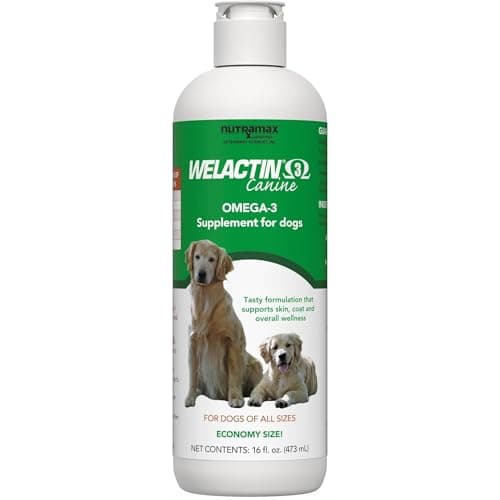
Nutramax
Welactin Canine Omega-3 Liquid
Our score
$22–$58
Best for
Households where a fish-oil-enriched therapeutic diet is closed off — multi-dog kitchens, elimination or kidney diets, dogs who refuse the food — and owners who want a dose they can compute and score against
The omega-3 we recommend when a fish-oil-enriched therapeutic diet is not an option, on one honest basis: the omega-3 trials in arthritic dogs were run on a diet, not on this bottle, none of them separated from control on a force plate, and the two placebo-controlled bottle trials disagree — so a dosed liquid with a published guaranteed analysis is the honest hardware for pursuing the same mechanism at a dose you and your vet chose, not a proven duplicate of anything (corrected 14 September 2026; we previously called the diet trial "the strongest evidence" and compared it as a head-to-head). Welactin earns the slot on concentration per dollar and on being made by Nutramax — not on the "#1 vet recommended" line, which is the brand's claim, not ours — and whose footnote, read 19 August 2026, defines its universe as vets "who recommended omega-3 supplements." Score lowered 8.6 to 8.4 on 19 August 2026, not because the oil changed but because a fine-print pass found the printed chart delivers under half the EPA+DHA that Colorado State's canine osteoarthritis chart calls for, that Nutramax prints the joint dose on its Advanced product and not on this one, that a retailer and the maker publish different guaranteed analyses for the same bottle, and that no calorie figure exists on any surface. It remains a cheap, concentrated, well-made oil. It is not a product you can dose for arthritis by reading its own label.
Pros
- High concentration: 1,330 mg combined EPA+DHA per 6 mL scoop on the manufacturer's guaranteed analysis
- Liquid over food scales to any body weight — no chew-splitting arithmetic
- Manufactured by Nutramax, the same company as Cosequin and Dasuquin
- Runs about $0.58/day for a 60 lb dog at the verified Amazon price — cheap for the category
Cons
- Smells fishy, and a bowl-refuser can start refusing dosed food
- Dosing hardware changed: current bottles pour by measuring scoop, not the pump our older copy described — dose accuracy now depends on you levelling a scoop
- A 6 mL scoop is coarse for small dogs — the label drops to half-scoop every-other-day under 10 lb
- Amazon's listing now leads with "Skin & Coat," not joints — the joint claim is the softer half of the marketing
- The printed chart is a skin-and-coat dose, not a joint dose, and Nutramax says so without giving a number: welactin.com's administration note read "Veterinarians may recommend increased amounts for enhanced joint health support" on 19 August 2026, and by 25 August 2026 had been reworded to "Your veterinarian may recommend to increase this amount for maximum joint health benefits" — the wording moved, the missing number stayed missing. At the chart's 1½ scoops, a 75 lb dog gets 1,995 mg of EPA+DHA against the 4,374 mg Colorado State's published canine osteoarthritis chart calls for at that weight — about 46%. Nutramax's own Welactin Advanced 3TA prints a separate "Joint Health" column at exactly double its broad-spectrum dose; this product prints one column and a footnote
- Retailer panels and the maker's panel disagree. On 19 August 2026 welactin.com published 1,610 mg total omega-3 and 1,330 mg EPA+DHA per 6 mL scoop, while a veterinary supply retailer's page for the same 16 oz bottle published 1,770 mg total, 870 mg EPA and 570 mg DHA (1,440 mg EPA+DHA) per the same 6 mL scoop. We use the maker's figures. If you are computing a dose against a study, read the panel on the bottle in your hand
- No calorie figure is published anywhere we could find — not on welactin.com and not on the Amazon listing, verified absent 19 August 2026. Fish oil is the most calorie-dense thing you can add to a bowl, and weight is the largest modifiable factor in canine osteoarthritis, so this is the number the category should print and does not
- Fish, obviously — which disqualifies it for any dog on a fish-based novel protein elimination diet, and doubles up on any dog already eating a fish-based food
- No use-within-after-opening period, no refrigeration instruction and no full ingredient list are published on the maker's product page, verified absent 9 September 2026. A 16 oz bottle lasts a 20–44 lb dog about 11 weeks and a 10–19 lb dog about 22 weeks, and fish oil oxidises once opened, so the buyer of the small dog is being sold five months of exposure with no stated shelf life. Follow whatever the bottle in your hand says; the website does not say
This bottle earns the card for one reason that is specific to this article: its dose does not live in the ration. When the vet cuts the food by a third, the scoop stays the same size. That is the failure it prevents, the silent dose cut that rides in with a weight-loss plan, and it is the only reason we would suggest it over a food change for a dieting dog. What it is bad at, plainly: the printed chart on the bottle is a skin-and-coat chart: for a dog of 45 to 79 lb it gives 1½ scoops, about 1,995 mg, some 15% under the trial dose,[22] so do the arithmetic rather than follow the label, the maker publishes no calorie figure, and the 6 mL scoop is a coarse step for a small dog. Who should not buy it: any dog on Farmina Ocean Cod or Orijen Six Fish, where the bag's own floor is already over the per-calorie limit; any dog on a fish-based elimination diet; and any household that has not yet read its own bag, because the answer may already be in the cupboard. The full dose and cost arithmetic is on the product page.
What we still do not know#
- What the four omega-3-only bags actually deliver in EPA and DHA. Hill's, Nulo, Wellness and Taste of the Wild did not print it on any page we could read. An email to each consumer line asking for "typical EPA plus DHA, as fed, per 100 g" is the only way past it.
- Whether any of these foods helps an arthritic dog. No trial we know of has fed any of the fourteen to dogs with osteoarthritis. The table ranks labels, not outcomes.
- Which form of the NRC limit applies to a dog eating 1,000 kcal. The two forms part ways for exactly the heavy, quiet dog this article is about, and we found nothing that says which should govern.
- Several labels were moving on the day. Purina's Sensitive Skin & Stomach Adult is listed at one retailer as a "new" formula at 4,049 kcal/kg with no EPA or DHA figure published for it;[26] an older Pro Plan Sport label at one retailer guaranteed 0.15% each rather than today's 0.12%;[27] Acana's Sea to Stream page prints "Crude fiber (max.) 15%," which may be a typo;[3] and Orijen keeps a second, European-style Six Fish page live on its US site with a higher panel. Read the bag in your hand.
What to do this week#
- Find the unit on your bag. EPA and DHA on their own lines, or only "omega-3"? Thirty seconds, and it decides the rest.
- Find the calories. The kcal/kg line is on every bag. Divide EPA plus DHA (as a percentage, times 10,000) by kcal/kg, times 1,000, and you have milligrams per 1,000 kcal. Or use the table above.
- Multiply by what your dog actually eats. Not the feeding guide's active row: the calories your vet wants him on. If a weight-loss plan is coming, do the sum at the new ration, not the old one.
- Take that number and the bag to your vet and agree a target, from the waypoints above, before buying anything. Colorado State's figure is its maximum; the trial dose is the one that was tested against placebo. If the bag already lands there, you are done. If it is Farmina Ocean Cod or Orijen Six Fish, say so first.
- If you add anything, score the dog first. The limp-scoring method gives you a baseline to hold the dog against at twelve weeks, the point at which the positive trial reports its clinical improvement. It is an owner's score, not a force plate, and that article is plain about the limits. The supplement roundup and the diet-versus-bottle comparison cover the rest of the evidence.
The delay this shortens is a quiet one. A household does the right thing, the diet, and in the same week undoes part of the other right thing without anyone noticing, because the dose was never written down anywhere except as a percentage on the back of a bag. Write it down in milligrams, at the ration the dog is actually eating, and the two treatments stop pulling against each other.
Sources#
- Orijen. "Six Fish Recipe Dry Dog Food," US product page and feeding table. orijenpetfoods.com — read 25 September 2026: EPA 0.4% min, DHA 0.7% min, omega-3 1.8% min, crude fat 16% min, moisture 12% max; 3,760 kcal/kg, 451 kcal per cup; 43% protein, 19% carbohydrate, 38% fat by calories; feeding table 60–80 lb (fifth of seven weight bands in the page's calculator, values from the maker's feeding-table endpoint): 225–280 g less active, 330–420 g active; bags 4.5, 13, 23.5 lb. A second page on the same site (ns-ori-sixfish) prints EPA 0.5%, DHA 0.7%, 3,880 kcal/kg, cites FEDIAF and lists no bag sizes. Amazon B01N0R7V8D 23.5 lb $126.99, in stock, Amazon.com, read via the Creators API 25 September 2026.
- Orijen. "Amazing Grains Six Fish," US product page. orijenpetfoods.com — read 25 September 2026: EPA 0.4% min, DHA 0.6% min, omega-3 2%, crude fat 16% min; 3,900 kcal/kg, 488 kcal per cup; 42% of calories from fat; catfish oil 11th, ground flaxseed 16th. Amazon B09QLKRW29 22.5 lb $126.99, in stock, Amazon.com.
- Acana. "Wholesome Grains Sea to Stream Recipe," US product page. acana.com — read 25 September 2026: EPA 0.2% min, DHA 0.3% min, omega-3 1.0%, crude fat 17% min, "Crude fiber (max.) 15%" as printed; 3,370 kcal/kg, 371 kcal per cup; 43% of calories from fat; salmon oil 12th. Amazon B08359KGBK 22.5 lb $95.99, in stock, Amazon.com.
- Acana. "Classics Salmon & Barley Recipe," US product page. acana.com — read 25 September 2026: EPA 0.2% min, DHA 0.2% min, omega-3 0.8%, crude fat 15% min, crude fiber 6% max; 3,305 kcal/kg, 397 kcal per cup; 39% of calories from fat. Amazon B0CTD8HKLP 22.5 lb $64.99, in stock, Amazon.com.
- Acana. "Freshwater Fish Blend," US product page. acana.com — read 25 September 2026: EPA 0.2% min, DHA 0.2% min, omega-3 1%, crude fat 17% min; 3,475 kcal/kg, 396 kcal per cup; 42% of calories from fat. Amazon B002BRBAC2 25 lb $88.99, in stock, Amazon.com.
- Farmina Pet Foods. "N&D Ocean Cod, Pumpkin & Orange Adult Medium & Maxi," US product page. farmina.com — read 25 September 2026: crude protein 30.00%, crude fat 18.00%, crude fiber 2.90% max, moisture 9.00% max, ash 7.30% max, "Docosahexaenoic Acid (DHA) (min): 1.00%," "Eicosapentaenoic Acid (EPA) (min): 0.70%," omega-3 2.30%; "EM Kcal/lb 1805" (about 3,980 kcal/kg), 398 kcal per cup; herring oil 4th ingredient; bags 5.5 and 26.4 lb, $119.99 for 26.4 lb in farmina.com's size selector (SKU 582-1-26400) on 25 September; on 26 September the page showed $41.99 for 5.5 lb and no price for the 26.4 lb bag, so treat Farmina's cost row as a one-day read. Amazon carried only the 5.5 lb bag (B07PXMMF4G, $46.91, third-party seller).
- Purina Pro Plan Sport Performance 30/20 Salmon & Rice Formula. PetSmart and Lee's Pet Supply, agreeing — read 25 September 2026: EPA 0.12% min, DHA 0.12% min, crude fiber 3.0% max, 4,433 kcal/kg, 534 kcal per cup; fish oil 11th. The Mill Stores still shows an older label at 0.15% each. Purina's own sites returned HTTP 403. Amazon B00HHN06T8 33 lb $74.98, in stock, Amazon.com.
- Purina Pro Plan Adult Sensitive Skin & Stomach Salmon & Rice Formula. PetSmart and Grange Co-op, agreeing — read 25 September 2026: EPA 0.1% min, DHA 0.1% min, omega-3 0.75% min, 3,903 kcal/kg, 449 kcal per cup. Feeders Pet Supply lists a "new" formula at 4,049 kcal/kg with no EPA or DHA published. Amazon B0BTMZJ6H9 40 lb $94.98, in stock, Amazon.com.
- Purina Pro Plan Sensitive Skin & Stomach Large Breed Salmon & Rice. PetSmart and Petsense, agreeing — read 25 September 2026: crude fat 12% min, EPA 0.12% min, DHA 0.12% min, omega-3 0.65%, 3,567 kcal/kg, 404 kcal per cup; fish oil 14th. Amazon B0CPRDCTJ5 34 lb $97.98, in stock, Amazon.com.
- Diamond Pet Foods. "Diamond Naturals Skin & Coat All Life Stages Salmon & Potato Formula." diamondpet.com — read 25 September 2026: DHA 0.05% min, no EPA line, omega-3 0.4% min; 3,600 kcal/kg, 408 kcal per cup; canola oil 7th, flaxseed 11th, salmon oil 12th. Amazon B079FHJMMG 30 lb $43.99, in stock, Amazon.com.
- Hill's Pet Nutrition. "Science Diet Adult Perfect Weight & Joint Support," hillspet.com (dry-matter table) and Hill's store (as-fed) — read 25 September 2026 (the Hill's store refused automated requests with HTTP 403 on 26 September, so its as-fed columns rest on the 25 September read; hillspet.com re-read 26 September still says "Clinically tested Omega-3 rich fish oil to support hip and joint health and mobility" and prints Total Omega-3 FA 1.4% dry matter): omega-3 1.0% guaranteed minimum and 1.29% typical as fed on the Hill's store, 1.4% on the hillspet.com dry-matter table, no EPA or DHA figure for the regular or Large Breed version; 3,204 kcal/kg, 327 kcal per cup (Large Breed 300); 4.1 g fat per 100 kcal; soybean oil 11th, fish oil 14th, flaxseed 15th. Amazon B0C12YM569 25 lb $94.99, in stock, Amazon.com.
- Nulo. "FreeStyle Salmon & Peas Recipe for Dogs." nulo.com — read 25 September 2026: omega-3 0.45%, no EPA or DHA line; 3,475 kcal/kg, 411 kcal per cup; no fish oil, flaxseed or canola oil in the ingredient list. Amazon B08CG8SYYM 26 lb $88.99, in stock, Amazon.com. A sibling, Challenger Haddock, Salmon & Redfish, prints EPA 0.32% and DHA 0.25% at 3,622 kcal/kg (about 1,570 mg per 1,000 kcal); price not read.
- Wellness Pet Food. "CORE Grain Free Ocean Whitefish, Herring & Salmon." wellnesspetfood.com and its linked nutrient profile PDF — read 25 September 2026: omega-3 2.00% min, no EPA or DHA line; 3,635 kcal/kg, 422 kcal per cup; canola oil 6th, flaxseed 9th, no fish oil. Amazon B0013QRY22 26 lb $79.99, in stock, Amazon.com.
- Taste of the Wild. "Pacific Stream Canine Recipe with Smoke-Flavored Salmon." tasteofthewildpetfood.com — read 25 September 2026: omega-3 0.3% min, no EPA or DHA line; 3,600 kcal/kg, 408 kcal per cup; canola oil 7th, no fish oil. Amazon B07L9JHXJR 28 lb $58.99, in stock, Amazon.com.
- Colorado State University Veterinary Teaching Hospital. "Canine fish oil dosing chart." csuveterinaryhealth.org — 310 mg/kg^0.75 EPA+DHA per day for osteoarthritis; 75 lb 4,374 mg in the column headed "Recommended dose (mg) of combined EPA/DHA for osteoarthritis"; re-read 27 September 2026: "The maximum daily dosage of fish oil for animals with osteoarthritis (310 mg/kg0.75 of EPA/DHA per day)," "The maximum dose is not tolerated by all animals, and a lower dose may be preferable," and "A recommendation is to start with approximately a quarter of the maximum dose and then increase the dose slowly while monitoring for any side effects."
- Mehler SJ, May LR, King C, Harris WS, Shah Z. "A prospective, randomized, double blind, placebo-controlled evaluation of the effects of eicosapentaenoic acid and docosahexaenoic acid on the clinical signs and erythrocyte membrane polyunsaturated fatty acid concentrations in dogs with osteoarthritis." Prostaglandins, Leukotrienes and Essential Fatty Acids. 2016;109:1–7. doi:10.1016/j.plefa.2016.03.015 — average dose 69 mg EPA+DHA/kg/day; clinical outcomes improved against placebo at day 84.
- Hielm-Björkman A, Roine J, Elo K, Lappalainen A, Junnila J, Laitinen-Vapaavuori O. "An un-commissioned randomized, placebo-controlled double-blind study to test the effect of deep sea fish oil as a pain reliever for dogs suffering from canine OA." BMC Veterinary Research. 2012;8:157. doi:10.1186/1746-6148-8-157 — about 110 mg/kg; 450 mg EPA and 100 mg DHA per mL; no significant difference in the main outcomes.
- Dillon GP, Cardinall C, Keegan JD, Yiannikouris A, Brandl W, Moran CA. "The Analysis of Docosahexaenoic Acid (DHA) in Dried Dog Food Enriched with an Aurantiochytrium limacinum Biomass." Journal of AOAC International. 2021;104(1):68–77. doi:10.1093/jaoacint/qsaa097 — full text (PMC8372133) read 25 September 2026: "a safe upper limit of combined EPA + DHA has been established as 2800 mg/1000 kcal of diet, which is equivalent to 2080 mg for a 10 kg dog," citing the National Research Council's Nutrient Requirements of Dogs and Cats (2006) and Lenox & Bauer 2013. 2,080 mg for a 10 kg dog is 370 mg per kg of metabolic body weight (10^0.75 = 5.62), the body-weight form of the same limit, which gives about 5,210 mg a day for a 34 kg dog.
- Lenox CE, Bauer JE. "Potential adverse effects of omega-3 fatty acids in dogs and cats." Journal of Veterinary Internal Medicine. 2013;27(2):217–226. doi:10.1111/jvim.12033 — abstract read 25 September 2026: potential adverse effects of omega-3 supplementation include "altered platelet function, gastrointestinal adverse effects, detrimental effects on wound healing, lipid peroxidation, potential for nutrient excess and toxin exposure, weight gain"; no calorie figure is taken from this paper.
- Marshall WG, Hazewinkel HA, Mullen D, De Meyer G, Baert K, Carmichael S. "The effect of weight loss on lameness in obese dogs with osteoarthritis." Veterinary Research Communications. 2010;34:241–253. doi:10.1007/s11259-010-9348-7 — abstract read 25 September 2026 via Europe PMC: 14 obese dogs, open prospective trial, 16 weeks; lameness decreased significantly from 6.10% weight loss onward, kinetic gait analysis from 8.85%.
- Farmina Pet Foods. "N&D Ocean Herring & Orange Adult Medium & Maxi," US product page. farmina.com — read 25 September 2026: EPA 0.40% min, DHA 0.70% min, 3,999 kcal/kg.
- Nutramax Laboratories. "Welactin Canine Omega-3 Supplement, liquid." welactin.com — 1,330 mg EPA+DHA per 6 mL scoop on the maker's guaranteed analysis. Amazon B001FB6ECQ 16 oz $29.99, in stock, Amazon.com, read via the Creators API 25 September 2026.
- US Department of Agriculture, FoodData Central. "Fish oil, salmon," SR Legacy food 172343. api.nal.usda.gov — read via the FDC API 25 September 2026: energy 902 kcal per 100 g; portion 1 tsp = 4.5 g, so about 41 kcal per teaspoon and roughly 49 kcal per 6 mL scoop. Used for the top-up calorie arithmetic.
- AAFCO. "Calorie Content." aafco.org — read 26 September 2026: "Metabolizable Energy = [(3.5 X crude protein) + (8.5 X crude fat) + (3.5 X nitrogen-free extract)] X 10." Used for the fat-share floor estimates in the ranking table.
- Roush JK, Dodd CE, Fritsch DA, Allen TA, Jewell DE, Schoenherr WD, Richardson DC, Leventhal PS, Hahn KA. "Multicenter veterinary practice assessment of the effects of omega-3 fatty acids on osteoarthritis in dogs." Journal of the American Veterinary Medical Association. 2010;236(1):59–66. doi:10.2460/javma.236.1.59 — abstract read 27 September 2026 via Europe PMC: randomized, double-blind, 127 client-owned dogs at 18 clinics; test food with a 31-fold higher omega-3 content than the control; owner-reported improvement in ability to rise and play at 6 weeks and to walk at 12 and 24 weeks. Hill's-affiliated authors.
- Feeders Pet Supply. "Pro Plan Adult Sensitive Skin & Stomach Salmon & Rice Formula." feederspetsupply.com — read 25 September 2026: a "new" formula at 4,049 kcal/kg with no EPA or DHA published.
- The Mill Stores. "Purina Pro Plan Sport All Life Stages Performance 30/20 Salmon & Rice Formula." themillstores.com — read 25 September 2026: an older label guaranteeing EPA 0.15% and DHA 0.15%.
Frequently asked
- Which dog food has the most EPA and DHA?
- Of the fourteen fish and joint dry foods we read at source on 25 September 2026, Farmina N&D Ocean Cod, Pumpkin & Orange Adult Medium & Maxi prints the most: EPA 0.70% and DHA 1.00% as guaranteed minimums, which is about 4,270 mg of EPA plus DHA per 1,000 kcal. Orijen Six Fish Recipe is second at about 2,930 mg, and Orijen Amazing Grains Six Fish third at about 2,560 mg. The three Acana fish recipes print 1,150 to 1,480 mg, the three Purina Pro Plan salmon formulas 510 to 670 mg, and Diamond Naturals Skin & Coat prints DHA only, at about 140 mg. Four more bags, including Hill's Science Diet Perfect Weight & Joint Support, print only a total omega-3 figure and cannot be ranked. Most does not mean best: Farmina's printed floor alone is about 153% of the National Research Council's safe upper limit when that limit is expressed per calorie.
- Should I switch my arthritic dog to a high-omega-3 kibble or add fish oil?
- For a dog who is also dieting, the bottle is the more controllable route, and from a mid-table bag such as Acana Classics it is cheaper per milligram than every switch in our table except to Farmina Ocean Cod, whose floor is already over the NRC per-calorie limit. Switching a 75 lb dog eating about 1,000 kcal a day from Acana Classics Salmon & Barley to Orijen Six Fish adds roughly 1,700 mg of EPA plus DHA for about $1.24 more a day, and changes the fat, protein and calories of the whole diet at the same time. Adding enough Welactin to cover the same gap costs about $0.50 a day at Amazon's $29.99 price, and moves one number. The switch makes sense when the dog genuinely needs a new food anyway and your vet agrees the fat content suits him. Either way, choose the target dose with your vet first and count what the bag already delivers before adding anything.
- Can a dog food have too much fish oil?
- On paper, yes. The National Research Council's safe upper limit for EPA plus DHA in dogs is quoted in the scientific literature as 2,800 mg per 1,000 kcal of diet, which the same paper equates to 2,080 mg a day for a 10 kg dog, about 370 mg per kilogram of metabolic body weight by our arithmetic. Farmina N&D Ocean Cod's guaranteed minimums work out to about 4,270 mg per 1,000 kcal, and Orijen Six Fish's to about 2,930, so both sit over the per-calorie form of the limit before any top-up, and a minimum is the least the bag contains. Crossing a safe upper limit is not the same as proven harm; it means you are past the point the NRC was prepared to call safe. It is a reason to tell your vet exactly which bag the dog eats, and a strong reason not to pour a supplement on top of either of those two foods.
- Why does weight loss change my dog's fish oil dose?
- Because on a food-only plan the dose rides in the ration. A 75 lb dog on Acana Wholesome Grains Sea to Stream gets about 2,230 mg of EPA plus DHA at 1,500 kcal a day, close to the 2,350 mg a 75 lb dog would get at the dose used in the placebo-controlled supplement trial that found a benefit, and about 1,480 mg at 1,000 kcal, roughly two-thirds of it. Cut the ration by a third to take weight off and the dose falls by exactly a third, on the day the diet starts. On the three richest bags the same cut still leaves the dog above that dose; it bites on the middle of the table, where most fish kibbles sit. Weight loss is worth having for its own sake, and in one small 16-week open trial in obese arthritic dogs lameness improved from about 6% weight loss onward, so keep the diet and move the dose into something the ration does not control.
- Is Hill's Perfect Weight & Joint Support a good source of omega-3 for joints?
- It may be, but it does not tell you. Hill's promotes "Clinically tested Omega-3 rich fish oil to support hip and joint health and mobility" and prints no EPA or DHA figure for either the regular or the Large Breed version on hillspet.com or its own store. Hill's own store gives a total omega-3 guaranteed minimum of 1.0% as fed (1.29% typical), with soybean oil 11th, fish oil 14th and flaxseed 15th in the ingredient list, so an unknown share of that total is plant ALA, whose conversion to EPA the Helsinki fish oil trial authors call ineffective. It is a weight-loss food, and the weight loss is worth having. For the fish oil half of the name, ask Hill's for a typical EPA plus DHA figure as fed before counting on it.