Surgery Guide
Is Pet Insurance Worth It for a Big Dog's Knees? Read the Bilateral Clause First
We pulled the actual policy documents. The knee waiting period runs 14 days to 6 months by brand, one knee's history can delete the other knee's coverage, and one state form caps year-one cruciate claims at $200.

You are probably asking whether the premium is worth it. The policy has already moved on to a more specific question: which knee, and when. We pulled the actual policy documents — not the marketing pages — for the major US pet insurers on 26 August 2026, and the answer to "does this cover my dog's knees" turns out to be written in three clauses almost nobody reads before paying: a knee-specific waiting period that runs anywhere from 14 days to 6 months depending on brand, a bilateral clause under which one knee's history deletes the other knee's coverage, and, on one state form, a first-year cruciate cap of $200 against a surgery whose measured price spread runs to several thousand. Three of the brands below share a single underwriter and still disagree by 166 days on how long your dog's knee must stay healthy before it is insured. Read those clauses before you compare a single premium.
Affiliate disclosure: Dog Orthopedic is reader-supported. When you buy through links on our site we earn a commission at no extra cost to you — about 3% on most pet products, and the same rate on every product we compare, so no pick earns us more than another. Prescription medication earns us nothing, and seeing your vet earns us nothing; we recommend both anyway. Learn more.
Imagery: Lifestyle photographs on this site are licensed from Pexels (royalty-free) and credited per image. Pexels imagery illustrates conditions and contexts — it does not depict the specific dogs or test sessions described in the text. Product photographs come from Amazon's Creators API. Breed portraits are illustrations of typical breed type rather than photographs of individual dogs, and are not drawn to scale against one another.
The knee is where an insurance policy stops being abstract#
For most of a healthy dog's life, a pet insurance policy is a premium going out and nothing coming back, and whether it was "worth it" stays comfortably theoretical. A big dog's stifle is where the theory ends. Cranial cruciate ligament rupture is among the most common reasons a large dog ever generates a four-figure veterinary bill, the repair is a real operation with a real anaesthetic and real hardware, and — this is the part that makes it the perfect test of a policy — it very often happens twice.
That second part is measured, not folklore. In a longitudinal study of 380 dogs presenting with rupture on one side, the median survival of the contralateral cruciate ligament was 947 days.[1] A separate series restricted to medium-to-large dogs aged eight or older found 19.1% ruptured the second side, at a median of 12.9 months.[2] The bill it happens twice to has been outrunning inflation for a decade: the US consumer price index for veterinarian services rose 67.6% in the ten years to July 2026, against 38.8% for all items.[3] And the operation itself has no standard price: the only large published survey including TPLO found a 2.3-fold spread, EUR 2,710 to 6,307, for the same named procedure in the same two countries in the same year.[4] We have taken both of those numbers apart in what a TPLO actually costs.
Here is the reframe this article rests on. Every one of those studies has another reader: the actuary. The clauses below are not arbitrary legal caution — they are the veterinary literature, priced. When a policy singles out the cruciate ligament for a waiting period twelve times longer than any other injury, and then writes a clause connecting one knee to the other, it is telling you exactly what its data says is likely to happen to your dog. Read the exclusions as the insurer's own literature review. The conditions carved out hardest are the ones most likely to occur. Nothing else you can read before buying is that honest, because nothing else in the transaction has money behind every sentence.
The waiting period: 14 days or 6 months, for the same knee#
Every policy makes you wait after enrollment before coverage starts — a couple of days for accidents, about two weeks for illnesses. Then almost every policy adds a separate, much longer clock that exists for one joint. Here is what the documents themselves say, each read at source on 26 August 2026, with the form number so you can hold your own paperwork against it.
| Brand | Underwriter | Knee/cruciate waiting period | Waivable by exam? | Document |
|---|---|---|---|---|
| Spot | Independence American | 14 days (same as any illness) | — | Sample policy PET-P-20000-1024[5] |
| AKC Pet Insurance | Independence American | 180 days (other injuries: 2 days) | No | Policy form IAIC PPI AI POL 007 OR 1120 (Oregon)[6] |
| Figo | Independence American | 6 months (orthopedic, dogs) | Yes — exam + form within 30 days | Sample policy IAIC FPI POL 0320[7] |
| Pets Best | American Pet Insurance Co. | 6 months (Cruciate Ligament Events) | Yes — exam −3/+7 days of start | Texas form APIC-PBI0001-ILL (12/2015)[8] |
| Lemonade | Lemonade Insurance Co. | 6 months (Cruciate Ligament Events) | Not stated in disclosure | Insurer Disclosure of Important Policy Provisions[9] |
| Embrace | (per its own help center) | 180 days (cruciate, IVDD, patella, hip dysplasia) | Yes — Orthopedic Report Card, to 14 days | Embrace Help Center[10] |
| Trupanion, Healthy Paws, Nationwide | — | Could not be verified at source — every retrieval attempt returned HTTP 403 on 26 August 2026 | — | — |
Two things in that table deserve to be read twice.
The same underwriter wrote the 14-day row, the 180-day row and the 6-month row. Spot, AKC and Figo policies are all underwritten by Independence American Insurance Company. The identical risk — a dog's cruciate ligament — waits 14 days under one of its brands, 180 under another, and six months under a third. AKC's Oregon form states it in one sentence: "There is a two (2) day Waiting Period per Pet before We will cover an Injury, except for cruciate ligament related condition, where there is a one hundred and eighty (180)-day Waiting Period."[6] Spot's, from the same underwriter: "There is a 14 day waiting period for: diagnosis, treatment or surgery related to accidents, illnesses and ligament and knee conditions."[5] A spread that wide inside one company is not actuarial necessity. It is product design, which means it is negotiable the only way insurance ever is — by choosing the other product.
The state on the form number matters as much as the brand. Pets Best's Texas booklet runs a clean 6-month cruciate clock. Its New York booklet, form NP 13 68 02 08, does something entirely different: cruciate ligament rupture is covered from the ordinary waiting period but "Subject to policy sub limit during first annual policy term (12 months)" — and the sub-limit table reads $50, $100 or $200 depending on plan tier.[11] Hold that against the measured EUR 2,710–6,307 spread for a TPLO: a New York buyer in year one is insured for the operation in the sense that a $200 umbrella covers a hurricane. Every quote in this article names its state form because this is what states do to policies. Yours is the only form that matters, and the form number in the footer is how you confirm you are reading it.
The bilateral clause: your dog has two knees, the policy sees one#
The waiting period decides when the first knee is covered. The bilateral clause decides whether the second one ever is — and given the 947-day median above, the second knee is not a hypothetical. It is closer to a scheduled event that neither of you has put in the calendar.
Here is the clause in three insurers' own words, and it is worth reading them slowly, because this is the paragraph that will decide the largest claim of your dog's life.
AKC (Oregon form): "Bilateral Conditions, presenting on one (1) side of the body will be considered Pre-existing Conditions. For example, a cruciate tear in the left leg that showed Symptoms prior to the Coverage Period or during a Waiting Period, a subsequent cruciate tear in the right leg will be considered a Pre-existing Condition."[6] The policy's drafters chose a cruciate tear as their own illustrative example. They know exactly which claim this clause exists to decline.
Spot: "Conditions involving a ligament, patella, meniscus or soft tissue disorder of the knee. These are considered bilateral conditions and related, regardless of cause; meaning an occurrence on one side of the body affects both sides of the body."[5] Regardless of cause: a torn left ligament from a car door and a degenerating right one are, by definition, one condition.
Pets Best (Texas form): bilateral conditions are excluded "if your Pet had at any time any Pre-Existing Conditions consistent with that same Bilateral Condition on either side of the body." And its definition of the triggering event is the broadest sentence we found in any document: a Cruciate Ligament Event is "any strain, sprain, rupture, tear, or degeneration of any cruciate ligament in the knee of your Pet."[8] A sprain, noted once, at any time, in either knee.
And the door most policies leave open for everything else — the cured-condition reset — is bolted shut for this one joint, by name. Spot: a cured condition becomes insurable again after 180 symptom-free days, but "This does not apply to chronic conditions or ligament and knee conditions." Figo: cured conditions shed pre-existing status after twelve clean months, then the same eight words: "This does not apply to ligament and knee conditions."[7] Pets Best lists "Cruciate Ligament Event" in its definition of chronic conditions — conditions that "can be treated or managed, but not cured" — which quietly reclassifies a fully healed surgical repair as a permanent fact about the dog.
A dog has two cruciate ligaments. Every full policy we could read underwrites them as one — and never lets that one heal. The lone exception in our stack runs the other way: AKC's Oregon form makes pre-existing conditions eligible again "after three hundred and sixty-five (365) days of continuous coverage" — the only document we read in which a pre-existing knee can ever come back inside a policy.[6] On the same form, note, an unrelated list puts hip dysplasia, OCD and osteoarthritis itself among excluded congenital and inherited conditions "unless You purchase Optional HereditaryPlus" — a reminder that on this aisle the base product and the product you assumed you were buying can be two different things.

The word "occurred" reaches further back than you think#
The clauses above all hang on when a condition first "occurred," and the definitions of that word are where the fine print does its quietest work. Spot's is the one to read twice: a condition occurs "when signs or symptoms related to a condition first were observed by any individual, recorded in your pet's medical record, or would have been detectable by a routine physical veterinary exam."[5] Not observed. Not diagnosed. Detectable. A dog who was quietly offloading a sore stifle for a year before anyone noticed — which is what dogs do, and what this entire site exists because of — can satisfy that clause without a single line in his record.
“Because your dog can't tell you how much pain he or she is in.”
Figo's version cuts the other way, and in your favour: its pre-existing definition for non-chronic conditions looks back only at "the twelve (12) months prior to the Original Start Date," and if you cannot produce records of an annual exam in that window, "the first documented veterinary examination after the effective date of the Policy will be used as the basis for determining any Pre-existing Condition(s)."[7] How that limited lookback interacts with the knee carve-out two paragraphs above is a question we are not going to answer for you, because the document does not answer it either — it is exactly the kind of question to put to the insurer in writing, before buying, the way we suggest preparing questions for a surgical consult: base rates and clauses, not impressions.
One more find from the same document, filed under things a careful reader notices: Figo's sample policy defines "Bilateral Condition" in its definitions section — and then, in the entire remainder of the sample document, never uses the term again. We ran the search twice. A defined term with no operative clause is probably drafting residue, but it means a Figo buyer cannot tell from the sample what the bilateral rule actually is, and should ask.
The waiver exam: the only clause with a deadline you control#
Buried in three of these documents is the single most valuable, least advertised action available to the owner of a big dog with currently healthy knees — and every version of it expires within days of enrollment.
Embrace reduces its 180-day orthopedic exclusion to 14 days if a vet examines the dog after purchase and completes an Orthopedic Report Card; done within the first 14 days of the policy, the reduction is maximal.[10] Figo waives its entire 6-month orthopedic wait, but "The Orthopedic Exam must be completed and the Orthopedic Waiver Form must be submitted to Us within thirty (30) days of the Policy effective date."[7] Pets Best requires the exam within a window of 3 days before to 7 days after the effective date, submitted within 30 days — and prints the honest limit on its own form: "This waiver does not alter the pre-existing conditions exclusion."[12]
Think about what the waiver actually is: the insurer offering to swap a blanket 6-month suspicion for one documented data point about your specific dog. It is the policy behaving, for one appointment, the way this site keeps asking the whole industry to behave — measure the dog, not the category. It costs one exam fee. The number of enrolling owners who are told about it is, in our experience of reading these brands' marketing pages, approximately none: the waiver lives in the policy PDF and the help center, not in the quote flow that sells the policy.

Who answered the door#
A note on method, because on this topic it is a finding. Everything quoted above came from a document we could retrieve and read at source on 26 August 2026 — a sample policy PDF, a state filing on the insurer's own download endpoint, or the insurer's own help center. Three major insurers could not be audited this way: Trupanion, Healthy Paws and Nationwide's petinsurance.com each returned HTTP 403 — access denied — to every automated retrieval we attempted that day, on their sample-policy, waiting-period and exclusions pages alike. Lemonade publishes its short-form insurer disclosure openly (quoted above) but the full policy wording sits behind enrollment.
We are not suggesting those companies' terms are worse; we could not read them, and that is the whole point. A human with a browser may get through. But if you — like a growing share of readers — ask an AI assistant to compare pet insurance policies, the assistant meets the same wall we did, and its comparison will be built from the insurers who publish against summaries-of-summaries for the ones who do not. On a purchase where 166 days of coverage and the entire second knee turn on exact wording, "the document was retrievable" is now part of what you are buying.
What this means for the dog in your house#
If your dog is young, large, and has never had a knee problem: the policies above are cheapest, in coverage terms, right now — every month of delay is a month of the knee's history accumulating toward somebody's definition of "occurred." If you buy, do three things in the first fortnight, in this order: read your own form's cruciate waiting period and bilateral clause (search the PDF for "cruciate," "bilateral" and "knee" — it takes four minutes); book the waiver exam inside its window if your insurer offers one; and keep the paperwork. If you decide against insurance, decide it out loud and put the premium somewhere — the self-insurance arithmetic only works if the account exists. What loses the most money is the middle path: paying premiums for years without ever reading the clause that decides the claim.
If your dog has already hurt one knee: under every full policy we could read, the other knee is now effectively uninsurable — permanently at Spot, Pets Best and Figo, and for at least 365 days of continuous coverage at AKC. That is a hard sentence, but it is better read now than discovered inside a claim denial, and it converts the question from insurance to budgeting: the second operation has a measured probability (about one in five for older large dogs[2], a median arrival around two and a half years after the first across one whole cohort[1]), a known price anatomy, and a decision framework that does not depend on the dog's age alone. Budget for it the way the actuary did: as a probability, not a surprise.
Either way, the gear is yours to buy. One clause almost nobody quotes: Spot's policy excludes "non-medical supplies such as but not limited to toys, leashes, ramps, bedding or other devices intended to prevent injury or illness, but that do not treat a condition."[5] Prevention is excluded by name. The traction, the ramp, the support harness — the things that lower the odds of the claim — are out-of-pocket in every scenario, which is worth knowing when you plan the budget the policy is only part of.
For the recovery weeks themselves, the free option first, as always: a folded bath towel under the belly works as a lift for short assists, and for a defined eight-week recovery a simple rear sling is the right shape. Where a full harness earns its price is the scenario this article is about — the dog with one repaired knee and one statistically loaded one, on stairs, for years. The specific failure it prevents is the one the literature says to expect: the hindquarters skidding out on a hard floor or a staircase while the other leg is the one doing all the compensating, which is precisely the loading history the 947-day median is made of. A handle on the hips means those stairs happen with a human holding the loaded side.
#1 Pick
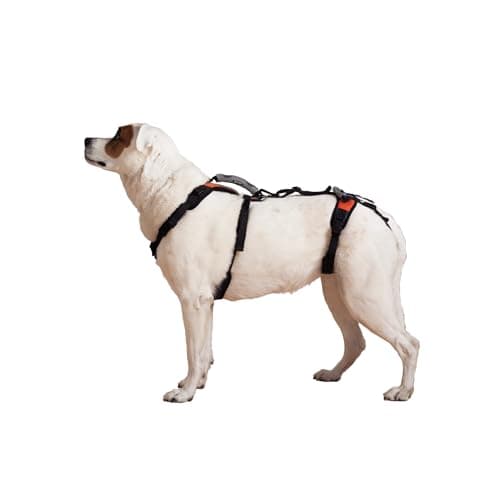
Help 'Em Up
Help 'Em Up Harness
Our score
$95–$155
Best for
Long-term mobility support for senior or post-surgical large dogs
If your dog needs help getting up multiple times a day for the foreseeable future — post-TPLO, advanced hip dysplasia, hindquarter weakness in giant-breed seniors — this is the one to buy. It supports the front and the back independently, as two halves you can lift separately, which is what a dog with a bad hip and a compensating shoulder actually needs. It is not the only design that does this, but it is the one whose sizing, returns and channel prices we have read most closely. Buy it from the manufacturer, not from Amazon: re-verified 3 October 2026, helpemup.com prices by size at $80 / $95 / $110 / $125 / $140 while Amazon runs $95 / $110 / $125 / $140 / $155 — a uniform $15 more at every size, every time we have checked.
Pros
- Two-piece (chest + hip) design lets you support either end independently
- Hip handle is purpose-built — not a converted car-seat-belt strap
- Padded chest plate distributes weight better than sling-only options
- Five sizes span 10 to 225 lb, and the rear half can be ordered a size smaller for a dog with muscle wasting
- Two hip-lift styles (Conventional and U-Band) so male dogs are not soiling the strap
Cons
- Amazon runs a uniform $15 above the maker's own price at every one of the five sizes, and the Amazon buy box is held by a third-party reseller (Veterinary Preferred) rather than by the brand — re-verified 18 August 2026
- The maker's own Mix & Match page prints two different starting prices, "From $80" and "FROM $95 USD", on the same page
- Direct pricing is no longer flat: since mid-August 2026 the maker charges $80 to $140 by size, so a giant-breed owner now pays $60 more than a terrier owner
- On 29 August 2026 the linked Amazon Medium (B0DK81SCG5) showed a future availability date rather than units on hand, while every size and style was in stock at helpemup.com the same day; on 9 September and again on 12 September 2026 the Amazon Medium still showed the future-date status at $125.00 with a maximum order of one and no ship date given, while all nine direct variants were in stock — two weeks of backorder on the channel we earn from, and one more reason the direct channel is the one to use. By 3 October 2026 it had spread: every Conventional-style Amazon listing we checked (X-Small, Small, Medium, Large) showed a future availability date, and only the Large and X-Large U-Band were in stock, while all nine direct variants were available. On 15 October 2026 the linked Medium was back In Stock on Amazon at $125.00 (maximum order 30) for the first time since 29 August, but X-Small, Small and Large Conventional still showed a future availability date with a maximum order of one
- Sizing is critical — measure twice, return is a hassle
- Rear straps can chafe the inner thigh if the harness is left tight while the dog lies down
- A dog filmed or gait-assessed while wearing it looks less lame than he is, because the harness offloads the limb you are trying to judge
- Bulkier than a quick-grab sling for short-term use
Amazon, 15 October 2026: the Medium this button links is In Stock at $125, the first time since 29 August it has not shown a future availability date. X-Small, Small and Large Conventional on Amazon still had no ship date. Every size and style was in stock direct the same day, $15 cheaper.
Honest costs, as ever: it runs $80–$140 direct from the maker (Amazon charges a uniform $15 more at every size, and we earn a commission only on the dearer channel — buy direct); the rear straps can chafe the inner thigh if left tight on a dog who lies down a lot, so loosen them when he settles; and if your dog's problem is a single defined recovery with an end date, the cheaper sling is the better buy — our own Help 'Em Up page says so.
This week#
The version of "the delay is the injury" that lives in this aisle is written into the contract: every policy above contains a period during which the knee you are worried about is, by design, not covered — and the only one of those clocks you control is the one that starts the day you enroll. If insurance is on your list, the highest-value hour this week is not comparing premiums. It is opening the actual policy form for your state, reading the three clauses this article quoted, and booking the waiver exam before its window closes. The premium tells you what the policy costs. The bilateral clause tells you what it is.
Frequently asked
- Does pet insurance cover cruciate ligament (ACL/CCL) surgery in dogs?
- Usually yes, but only if the policy was in force — and the knee clean — before the knee's own waiting period ended, and that waiting period is the single most variable number in the industry. In the policy documents we read on 26 August 2026: Spot applies its ordinary 14-day waiting period to ligament and knee conditions; Lemonade's insurer disclosure states 6 months for cruciate ligament events; Pets Best's Texas form states 6 months; Figo's sample policy states 6 months for orthopedic conditions in dogs; and AKC Pet Insurance's Oregon form covers ordinary injuries after 2 days but cruciate-related conditions only after 180 days. Embrace's own help center states that cruciate injuries showing symptoms in the first 180 days are excluded, reducible to 14 days with a vet exam. Three of those brands are underwritten by the same company, Independence American Insurance Company, so the spread from 14 days to 6 months is a product decision, not an actuarial constant.
- What is a bilateral exclusion in pet insurance?
- It is the clause that makes one knee's history count against the other knee. AKC's Oregon form states it with a knee as its own example: 'Bilateral Conditions, presenting on one (1) side of the body will be considered Pre-existing Conditions. For example, a cruciate tear in the left leg that showed Symptoms prior to the Coverage Period or during a Waiting Period, a subsequent cruciate tear in the right leg will be considered a Pre-existing Condition.' Spot's policy defines ligament and knee conditions as 'bilateral conditions and related, regardless of cause; meaning an occurrence on one side of the body affects both sides of the body.' Pets Best excludes bilateral conditions 'if your Pet had at any time any Pre-Existing Conditions consistent with that same Bilateral Condition on either side of the body.' The reason insurers write this clause is measured: in a longitudinal study of 380 dogs with a rupture on one side, the median survival of the other knee's ligament was 947 days.
- Can I get insurance coverage if my dog already tore one ACL?
- For the other knee, under the policies we could read: effectively no. Spot's policy states that its cured-condition reset 'does not apply to chronic conditions or ligament and knee conditions,' and separately excludes ligament and knee conditions if any such condition occurred before coverage. Pets Best defines a Cruciate Ligament Event as 'any strain, sprain, rupture, tear, or degeneration' and lists it among chronic conditions, which its policy defines as conditions that can be managed but not cured — and its bilateral exclusion reaches the opposite leg. Figo's sample policy allows most cured conditions to shed pre-existing status after 12 symptom-free months and then adds: 'This does not apply to ligament and knee conditions.' The one different design we found: AKC's Oregon form makes pre-existing conditions eligible after 365 days of continuous coverage — the only document we read in which a pre-existing knee can ever re-enter coverage. Confirm any of this against the current form for your own state before acting on it.
- How do I waive the 6-month orthopedic waiting period?
- Three of the insurers we read publish a waiver route, and every one of them has a deadline measured in days from enrollment. Embrace: a vet completes an Orthopedic Report Card after purchase; done within the first 14 days, the waiting period drops to the end of the 14-day illness window. Figo: 'The Orthopedic Exam must be completed and the Orthopedic Waiver Form must be submitted to Us within thirty (30) days of the Policy effective date.' Pets Best: a Waiting Period Health Assessment exam within 3 days before or 7 days after the effective date, submitted within 30 days — and the form itself warns, 'This waiver does not alter the pre-existing conditions exclusion.' If you enroll a big dog and do nothing else, do this. It is close to free, it has a deadline nobody advertises, and it is the difference between a covered rupture in month three and a denied one.
- Is pet insurance worth it for a large-breed dog?
- That is a premium-versus-risk question no honest page can answer for your dog, but the inputs are measurable. US veterinarian-services prices rose 67.6% in the ten years to July 2026 against 38.8% for all items (Bureau of Labor Statistics). The only large published price survey including TPLO found a 2.3-fold spread, EUR 2,710 to 6,307, for the same operation in the same year. And the second knee is a real probability, not a fear: median contralateral ligament survival was 947 days in one 380-dog cohort, and 19.1% of older medium-to-large dogs ruptured the second side in another. What we can say flatly: the premium is the least informative number in the transaction. Two policies with identical premiums can differ by 166 days of knee exclusion, a permanent bilateral bar, and — on one New York form — a $200 first-year cruciate cap. Read those three clauses first; then the premium comparison means something.