Home nursing
Home Physio for a Dog Who Can't Get Up: Standing, Weight Shifting and Sling Walking, and What Has to Wait for the Clinic
Discharge sheets give standing doses from 2 to 50 minutes a day. A randomized trial counted the sinks instead. What to do at home after disc surgery, when each step opens, and what waits for the clinic.

After disc surgery, home physio is three jobs, not one: things done to him (range of motion, massage, heat and cold), things done by him with your support (standing, weight shifting, sit-to-stand, walking in a sling), and things that belong in a clinic (water work and electrical stimulation). The rehabilitation timelines the ACVIM consensus collected from published studies tie several of the active steps to something the dog can do, not only a date: standing once he can bear some weight, balance once he can stand, obstacles not before he is walking. The owner sheets we read give standing doses from about 2 to 50 minutes a day. A randomized trial counted something different: stand him, let him sink, lift him back, up to fifteen times or two minutes, and write down the longest stand. That number, kept daily, gives you something to report at the recheck besides an impression. For a dog with deep pain sensation, the extras did not make him walk sooner in that trial. For a dog without it, ask about a rehabilitation referral this week.
Affiliate disclosure: Dog Orthopedic is reader-supported. When you buy through links on our site we earn a commission at no extra cost to you — about 3% on most pet products, and the same rate on every product we compare, so no pick earns us more than another. Prescription medication earns us nothing, and seeing your vet earns us nothing; we recommend both anyway. Learn more.
Imagery: Lifestyle photographs on this site are licensed from Pexels (royalty-free) and credited per image. Pexels imagery illustrates conditions and contexts — it does not depict the specific dogs or test sessions described in the text. Product photographs come from Amazon's Creators API. Breed portraits are illustrations of typical breed type rather than photographs of individual dogs, and are not drawn to scale against one another.
The first time he pushes back#
It can come during the range-of-motion exercises. You are bending the hock the way the sheet showed you and the leg pushes against your hand. Or you lift him to the grass and, for a second, the back end does not fold. The question that follows is the one this page answers: can we do more now, and what?
One caution before the answer. After a spinal cord injury, a leg that pushes back or a back end that holds for a moment is not always voluntary movement returning; reflexes below the injury can produce both. One study shows how much reflexes can do: of 81 dogs with permanent spinal cord damage, 59% learned an involuntary reflex walk without ever regaining deep pain sensation, after physiotherapy twice a day for a median of about 75 days, most of them in hospital.[15] So treat the push as a reason to ask the surgeon what it means, not as proof. The exercises below are reasonable either way; what changes is what the push tells you about recovery.
The sources do give an answer, but it is scattered across a consensus table, a trial supplement and nine owner handouts that each cover part of it. Put together, the answer starts with a distinction. Our range-of-motion page covers the work done to him: you move the joint, he does nothing. Everything below is the work done by him, with you taking away as much support as he can manage without. That is a different kind of exercise. It uses his own muscles, it can fail, and the failing is part of the exercise.
What can I do at home besides range of motion?#
The ACVIM consensus statement on thoracolumbar disc extrusion, written by a panel of eight veterinary specialists, collected the rehabilitation timelines reported in the published studies into one table. Its minimum basic protocol, which it says can be done "with no specialized equipment or training," is cold and warm packs, passive range of motion, massage, assisted standing and walking.[1] Here is the table, shortened, with the column that matters most to an owner added: whose job it is.
| Exercise (ACVIM Table 9) | Starts | Gate written into the table | Where |
|---|---|---|---|
| Cold, then warm packs | 24–48 h after surgery | None; cold for 48 h, warm for 1–4 weeks | Home |
| Range of motion and massage | 24–48 h | None | Home |
| Sensory stimulation (toe pinching, brushing, different floor surfaces) | 48 h to 3 weeks | None | Floor surfaces at home if your sheet includes them; ask before toe pinching |
| Assisted standing, weight shifting, sit-to-stand | 24–48 h | "once able to bear some weight" | Home |
| Assisted walking over ground | 24–48 h | None | Home, within the surgeon's restriction |
| Balance exercises (e.g. balance boards) | 3–14 days | "once able to stand" | Clinic first |
| Cavaletti rails, uneven ground, inclines | 7–14 days | "not before ambulatory" | Clinic first |
| Swimming or underwater treadmill | 2–3 to 14 days | "typically once able to bear weight or motor is present" (treadmill) | Clinic only |
| Land treadmill, manual gait patterning | 3 days to 3 weeks | None | Clinic only |
Read the third column again. The table gives a window of days for every row shown here, but in four of the rows the real gate is a skill. The table records what studies have reported rather than laying down readiness rules, and the sources do not all draw the line in the same place: the randomized trial stood its non-ambulatory dogs from the day they entered it, and the Billings sheet uses standing practice to help a dog begin to bear weight. But the direction of the table is clear enough. Discharge sheets mostly run on the calendar (sutures out at 10 to 12 days and a reassessment at 6 to 8 weeks on one sheet,[4] evaluations at 2 and 4 weeks on another[5]), and owners naturally wait for the next date. The table is telling you to watch the dog as well, and to ask when he changes rather than when the date arrives.
Two cautions before any of it. First, the surgeon's activity restriction overrides everything on this page; the consensus describes what has been used, not what your dog's spine is cleared for. Second, these exercises are meant for the back legs of a dog with mid-back disc disease, which is what the trial and most of the sheets were written about. A dog with neck disease, a stabilised fracture or implants is a question for the surgeon before the first session.
How long should he stand, and how many times a day?#
On 8 October 2026 we read every owner-facing discharge sheet we could find that gives a dose for assisted standing, plus the trial protocol. Four sheets give one, and they do not agree.
| Source | Instruction | Per day, by our arithmetic |
|---|---|---|
| Partner Veterinary Emergency and Specialty Center[2] | Hold standing 30–60 seconds, rest 60 seconds; 2–3 repetitions, 2–3 times a day | 2–9 minutes |
| Southwest Veterinary Surgical Service[3] | Assisted standing 3–5 minutes, 2–3 times a day | 6–15 minutes |
| Veterinary Surgical Centers[4] | Standing exercises 5–10 minutes, 3–5 times a day | 15–50 minutes |
| Animal Clinic of Billings[5] | Lift him back each time he collapses; start with 5–10 repetitions, build to 5 minutes a session | Sessions a day not stated |
| Zidan trial, intensive group[6] | Stand him, let him sink, lift him back: up to 15 stands or 2 minutes, whichever comes first | Sessions a day not stated in the protocol |
From the bottom of the first sheet's range (hold time only, rests not counted) to the top of the third's is a 25-fold difference; the midpoints are about 6-fold apart. And the ACVIM panel, having surveyed the studies, said that reported frequency for home exercises runs from one to five times a day, "but frequency commonly is not specified."[1]
Look at the last two rows, though, because they count something besides time. The Billings sheet: let him bear as much weight as possible, and "as he/she weakens and begins to slowly collapse, lift back to standing position with the limbs squarely underneath the body." The trial protocol says the same thing more precisely. Dogs "were placed in a standing position and allowed to stand or sink. After sinking, patients were placed back into a standing position," up to fifteen times or two minutes per session. The staff then recorded two numbers: how many stand-and-sink cycles he did, and how long his longest stand lasted. And the trial had a rule for when to move on: once a dog could stand long enough that fifteen cycles took more than two minutes, balance work was added.
That is the distinction worth taking from this page, and it is our reading of the protocol rather than something the trial tested. In the trial's version of the exercise, the repetition is the sink. The clock-based sheets make it easy to read a dog who folds after eight seconds as a dog who failed the exercise. The trial counts that as one repetition done, and the length of the stand before it as the measurement. The sheets tell you how long to hold him up. The trial counted how long he held himself. (The trial ran it with trained staff in hospital, as part of a package that did not change when dogs walked, and it did not test the longest stand as a measure of progress. We suggest keeping it because it is a number, not because it has been validated.)
What we would do, and this is our reading, not a published rule: if your surgeon gave you a standing dose, use it. If not, take the Partner sheet's numbers and the trial's method to them together and ask which they want. Either way, keep two numbers each day: how many times he stood, and his longest stand in seconds. If his longest stand is getting steadily longer, that is a trend written down, which an impression of his walk is not, and the surgeon will want to hear about it. If it stops getting longer, or gets shorter, that is worth a call too. Bring the notebook to the recheck.
How to do one, putting the sheets together:
- Surface first. Carpet, a rubber-backed bath mat or yoga mat on a hard floor, or grass. Not polished wood or tile. The trial walked its dogs on "a flat non-slip surface," and a dog learning to stand on a floor that slides is learning to fall.
- Support under the belly, in front of the back legs. A towel or sling under the abdomen: Billings uses "a towel or sling for support" for standing, and Partner says "either harness or sling." Your forearm works for a small dog. Front feet on the ground.
- Place the feet. Partner: put the feet in a weight-bearing position, "not knuckled over," then remove some of the support "to allow your pet to bear as much weight on their own as possible." Paws square under the hips, toes flat.
- Take your support away gradually, and let him sink. Lower him gently when he goes, then lift him back. Count it.
- Stop on the signs of pain or distress. West Midlands Referrals: if at any point he shows signs of discomfort, the session should end.[7] Our own list of what counts, not the sheet's: panting, turning to look at his back, trembling or crying. Stop and try later, and treat new pain as a call to the surgeon.

Weight shifting and sit-to-stand: the next rung#
Once he can hold a stand, the sheets add movement to it.
- Rocking. West Midlands Referrals: with him supported standing, all feet square, "gently rock the hindquarters from side to side and front to back. Repeat this several times." North Downs Specialist Referrals describes the same thing as bouncing him gently on his toes and swaying him side to side.[8]
- The nudge. Billings' sheet for dogs who can already walk a little: stand him squarely on firm footing, gently nudge at the point of the hip so the weight shifts onto the other leg, alternate sides, start at 30 seconds and build to 5 minutes a session.[9]
- Three-leg standing. Partner: with him standing, lift one back leg slightly off the ground and back so the other one carries more, hold 30–40 seconds, rest 30–60, 2–3 repetitions twice or three times a day for each back leg.[2]
- Paw up. Partner: front paws on a low step or stool to shift weight backwards, hold 20–30 seconds, 2–3 repetitions, 2–3 times a day.[2]
- Sit-to-stand. The ACVIM table puts it in the same row as assisted standing.[1] None of the owner sheets we read gives it a dose.
Each of these assumes the step before it is solid. Three-leg standing in a dog who cannot yet hold a four-leg stand is simply a fall with you holding the lead.
Walking with a sling: where the sheets disagree#
This is where the sources split, and the split is large.
| Source | Walking allowed |
|---|---|
| Veterinary Surgical Centers | "Very short leash walks three times daily for the purpose of going outside to the bathroom only," restricted for 8 weeks; belly sling until he walks "at near-normal standards"[4] |
| Southfields Veterinary Specialists | Keep him "as still as possible for at least three weeks," then increase gradually[10] |
| Zidan trial, both groups, weeks 2–6 (by then all but 1 of 30 dogs were walking unaided) | 5 minutes on a flat non-slip surface, sling if needed, three times a day, adding 2 minutes every 2 days[6] |
| University of Liverpool small animal hospital | "Controlled exercise (5-10 minutes, 2-3 times daily)" alongside crate rest for 4–6 weeks; no sling mentioned[11] |
| ACVIM Table 9 | Assisted walking from 24–48 hours, for 4–6 weeks or until he walks[1] |
Follow the trial's instruction through to the end of week six and, by our arithmetic, a walk that started at 5 minutes would be about 33 minutes if every walk grew on that schedule. The protocol does not say whether that was the intention or how many owners managed it. And the schedule started at discharge on day 14, when all but one of the trial's dogs were already walking unaided, at a median of 7.5 days after surgery.[6] It is a progression for a dog who has just started walking, not a sling dose for one who has not. The Veterinary Surgical Centers sheet, for the same operation, allows the bathroom and back for eight weeks, whatever the dog can do. Both were written by people who do this surgery.
They are less opposed than they look. The strict sheets are protecting a healing spine from a dog who will run, jump or twist the moment he feels able; the trial's walks were on a lead, on flat ground, with a sling if needed, between periods of confinement in a crate or pen, in dogs who were nearly all walking already. Our reading is that the restriction is about uncontrolled movement and the trial's walking was the controlled kind. But that is our reading, and your surgeon wrote your sheet. So ask the specific question: "Are sling walks on a flat surface allowed, and for how many minutes, starting when?" Then write the answer down.
Two things worth taking from the walking sources even where they disagree. West Midlands Referrals: walking "should be controlled and slow," so that every leg has time to step. The same sheet has the sling walk done over different surfaces (carpet, grass, cushions, bark chippings, gravel) for the sensory feedback, which is the one place an owner handout puts varied ground in a dog who is not yet walking; the consensus table holds uneven terrain until he is.[7] And check his feet. Veterinary Surgical Centers says to watch the tops of the paws for abrasions from dragging and scuffing, and Partner warns that dogs with neurological weakness scuff their feet, recommends grass or packed dirt over concrete for dogs who drag, booties for protection and grip, and checking the feet daily for redness or sores.[2] Scuffed toes are the sign of knuckling, and the tops of the toes are easy to miss unless you look on purpose.

Heat, cold and massage#
These are done to him, but they belong here because the sheets fold them into the same session.
Cold first, then warm. The trial's basic care, which every dog had: an ice pack on the incision for 10 minutes every 8 hours for the first 48 hours, then a warm pack for 10 minutes every 12 hours.[6] ACVIM: cold for 48 hours, warm for one to four weeks.[1] West Midlands Referrals: no heat over the surgical site for at least 72 hours.[7] Billings: a towel between the surgery site and the warm pack, 10–20 minutes, checking the skin every 5 minutes for redness, and stop until the next session if it is red.[5]
The reason to be strict about that last instruction is ours, not the sheets': a dog with reduced feeling in his back end may not react to a pack that is too hot. Check the skin on the clock, not on his face.
Massage. Southwest Veterinary Surgical Service: massage the leg muscles for 10 to 15 minutes.[3] West Midlands Referrals: from the foot up to the hip, strokes or small circles, 10 minutes, after the warm pack.[7] Billings: light strokes from the hind end forward along the spine.[5] If you have not been shown how to massage near a fresh incision, ask at the suture check before you try.
What has to wait for the clinic#
Water. The consensus: hydrotherapy "is safely initiated anywhere from 3 (with incision protection) to 14 days postoperatively."[1] Veterinary Surgical Centers: no bathing or swimming for 14 days.[4] Southfields: hydrotherapy in a specialised centre is generally advised after the sutures are out.[10] And the one study we found that looked specifically at early water work, 83 dogs starting hydrotherapy within five days of disc surgery, recorded 26 complications (10 minor, 16 major) in 26 of the dogs, the majority judged unlikely, though not excluded, to be caused by the timing. Among them were one wound infection, and one further extrusion of the operated disc that the authors said may have been influenced by the early start; they concluded that early hydrotherapy needs further study before it can be recommended.[12] In the randomized trial, early water work looked like this: swimming in a life jacket, supported by a handler, one to two minutes a day.[6] None of the owner sheets we read tells an owner to do it in a bath, and we would not.
Electrical muscle stimulation, laser and the rest. The consensus says there is "no specific evidence" for the benefit of electrical muscle stimulation after this surgery, and that it is "poorly tolerated once motor function returns."[1] None of these is a home job, and laser therapy made no difference to recovery times in the Bennaim trial.[18]
Balance boards, cavaletti, obstacles. The timelines in the table start balance work "once able to stand" and obstacles "not before ambulatory." The first sessions belong with someone trained who can watch him on it.

Does any of this make him walk sooner?#
It depends, more than anything else on this page, on one fact from his neurological exam: whether he still had deep pain sensation in his back toes. Ask the surgeon if you do not know.
If he had deep pain sensation, the extras did not help in the trial built around those dogs. Zidan and colleagues enrolled 32 non-ambulatory dogs of 20 kg or less, all with deep pain sensation, after disc surgery, and 30 completed the trial. The basic group had cold and warm packs, range of motion and sling walks for the toilet. The intensive group had all of that plus the stand-and-sink exercise, weight shifting over a therapy ball, balance board, electrical stimulation and underwater treadmill. Gait scores at 14 days did not differ, no secondary measure at 42 days differed, and the authors report no adverse events associated with rehabilitation.[6] Be precise about what that means: the standing exercise on this page was part of the package that did not speed walking in small dogs with deep pain. The ACVIM panel, reading both randomized trials, still concluded that the evidence supports basic exercises as standard care for all dogs (moderate-level evidence), and recommends assisted standing and walking in the minimum protocol (low-level evidence). So do the basics, safely, and keep the notebook. The other randomized trial, Bennaim and colleagues, split 32 non-ambulatory dogs three ways (laser therapy, physical rehabilitation with sham laser, or sham only) and found no difference in time to supporting weight, first limb movements or walking; it calls itself preliminary.[18] The ACVIM panel notes that it was not adequately powered to evaluate dogs without deep pain sensation,[1] so it tells us little about those dogs either way. For small dogs with deep pain sensation, the evidence does not support paying for an intensive package on the promise that it will bring the walking forward; for large dogs, we found no trial of home exercises at all.
A 2026 study points the other way and shows why the question is hard. Seventeen dogs who had underwater treadmill twice a week for six weeks were matched with seventeen who had owner-guided exercises; the treadmill dogs walked at a median of 14 days against 28.[13] But the treadmill dogs also stayed in hospital until their sutures came out, with daily supervised standing and weight shifting, while the others went home earlier. And the authors say the home programme "was not objectively monitored," with compliance taken from what owners said. It is retrospective, not randomized, and it cannot separate the water from the extra days of trained hands. A quarter of its dogs (9 of 34) had neck surgery rather than mid-back surgery, so it is not quite the population the rest of this page is about.
If he had lost deep pain sensation, the picture is different, and more uncertain. The ACVIM panel says the evidence in these dogs is conflicting, that intensive rehabilitation "might enhance the recovery of ambulation," and that among dogs who stay paraplegic, starting rehabilitation at about one week rather than three might improve the chance of walking.[1] The studies behind that are not trials.
| Study | Design | Dogs without deep pain | Result |
|---|---|---|---|
| Martins and colleagues, 2021[14] | Intensive inpatient programme, with a prescription drug (4-aminopyridine) added after about 30 days in some dogs, vs a control group from earlier records that had basic physiotherapy | 94 vs 43 | 58.5% walked vs 32.6% |
| Gallucci and colleagues, 2017[15] | Twice-daily hour-long physiotherapy, no control group | 81 (two-thirds disc disease) | 59% achieved "spinal walking," median 75.5 days |
| Rauber and colleagues, 2024[16] | Physiotherapy twice a week vs none, retrospective | 30 vs 21 | Within 21 days, 10% vs 19% recovered; after 21 days, 43.3% vs 61.9%; no significant difference |
The Martins authors themselves write that "it is difficult to assess the contribution" of the programme. They put part of the gap down to the fact that no control dog developed a reflex walk, and most of their control dogs without deep pain were euthanised at their owners' decision after three weeks. The drug matters too: 26 of the dogs who regained deep pain sensation and walked did so after it was added, and every reflex walk in the study came after it.[14] Our reading is that a control group drawn from old records, in a study that also added a drug, cannot separate the programme from those differences. Gallucci had no comparison group. "Spinal walking" there is a reflex gait without deep pain returning, which the authors define as walking that can go on indefinitely and getting back up unaided after a fall. Rauber found nothing, at a lower intensity. None of these is a reason to do clinic-level work in your living room. What they add up to, with the panel's one-versus-three-weeks line, is a reason to ask early.
“Because your dog can't tell you how much pain he or she is in.”
What to buy, if anything#
For many dogs, nothing. Every dog in the randomized trial weighed 20 kg or less,[6] and a dachshund or a small terrier can be stood with your two hands or a bath towel folded lengthways under his belly. Add carpet, or a rubber-backed bath mat or yoga mat on the hard floor, and you have everything the sheets ask for.
If you buy something, start with the one the sheet itself names. Partner's handout says many brands and configurations of support device can be used, and that its neurology department recommends the Help 'Em Up harness for support at both ends.[2] That is the Help 'Em Up: a harness with a front section and a rear section, each with its own handle, sold by weight band from an X-Small for 10–25 lb dogs to an X-Large.[19]
#1 Pick
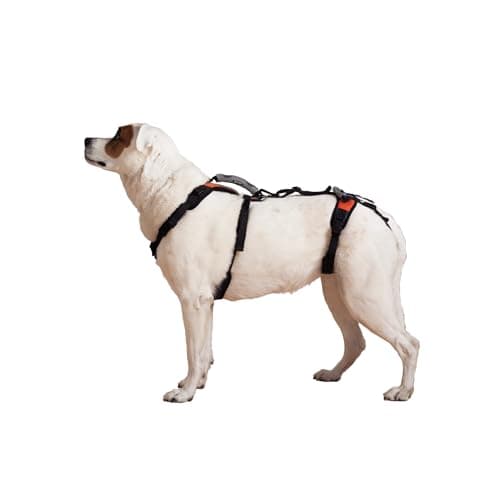
Help 'Em Up
Help 'Em Up Harness
Our score
$95–$155
Best for
Long-term mobility support for senior or post-surgical large dogs
If your dog needs help getting up multiple times a day for the foreseeable future — post-TPLO, advanced hip dysplasia, hindquarter weakness in giant-breed seniors — this is the one to buy. It supports the front and the back independently, as two halves you can lift separately, which is what a dog with a bad hip and a compensating shoulder actually needs. It is not the only design that does this, but it is the one whose sizing, returns and channel prices we have read most closely. Buy it from the manufacturer, not from Amazon: re-verified 3 October 2026, helpemup.com prices by size at $80 / $95 / $110 / $125 / $140 while Amazon runs $95 / $110 / $125 / $140 / $155 — a uniform $15 more at every size, every time we have checked.
Pros
- Two-piece (chest + hip) design lets you support either end independently
- Hip handle is purpose-built — not a converted car-seat-belt strap
- Padded chest plate distributes weight better than sling-only options
- Five sizes span 10 to 225 lb, and the rear half can be ordered a size smaller for a dog with muscle wasting
- Two hip-lift styles (Conventional and U-Band) so male dogs are not soiling the strap
Cons
- Amazon runs a uniform $15 above the maker's own price at every one of the five sizes, and the Amazon buy box is held by a third-party reseller (Veterinary Preferred) rather than by the brand — re-verified 18 August 2026
- The maker's own Mix & Match page prints two different starting prices, "From $80" and "FROM $95 USD", on the same page
- Direct pricing is no longer flat: since mid-August 2026 the maker charges $80 to $140 by size, so a giant-breed owner now pays $60 more than a terrier owner
- On 29 August 2026 the linked Amazon Medium (B0DK81SCG5) showed a future availability date rather than units on hand, while every size and style was in stock at helpemup.com the same day; on 9 September and again on 12 September 2026 the Amazon Medium still showed the future-date status at $125.00 with a maximum order of one and no ship date given, while all nine direct variants were in stock — two weeks of backorder on the channel we earn from, and one more reason the direct channel is the one to use. By 3 October 2026 it had spread: every Conventional-style Amazon listing we checked (X-Small, Small, Medium, Large) showed a future availability date, and only the Large and X-Large U-Band were in stock, while all nine direct variants were available
- Sizing is critical — measure twice, return is a hassle
- Rear straps can chafe the inner thigh if the harness is left tight while the dog lies down
- A dog filmed or gait-assessed while wearing it looks less lame than he is, because the harness offloads the limb you are trying to judge
- Bulkier than a quick-grab sling for short-term use
Amazon, 8 October 2026: the Medium this button links was on backorder with no ship date, as at every check since 29 August. Every size and style was in stock direct the same day.
Why it suits this job: standing practice needs you to hold the back end up and keep the front steady at the same time, and then to take away support at the back without letting go of the front. Two handles do that. It also stays on, so the same harness does the toilet trips, the turns and the standing sessions without being put on four times a day. What it is bad at: it costs more, $80 to $140 direct by size on 8 October 2026, and on Amazon the Medium we link was on backorder that day with no ship date (it was at our earlier checks too, as our Help 'Em Up page records), while every size was in stock direct.[19] Buy it direct; the card's first button goes there, and we earn nothing on that route. It is also more harness than a dog needs if his front end is fine and the problem will be over in weeks.
That dog, if he is large, is where the GingerLead fits: a rear-only padded belly sling, and cheaper.
#2 Pick

GingerLead
GingerLead Dog Support and Rehabilitation Harness
Our score
$32–$70
Best for
Short-term post-surgical assistance and rear-end weakness
The right tool for one specific job: a dog whose back end has failed while his front end is still working. In the first days to weeks after hip or stifle surgery (for as long as he cannot yet steady himself on a hard floor, which after a pelvic osteotomy is often only days), or for a senior who can get his front paws onto the sill of a car but cannot follow through, it is faster to fit than a full harness and it costs less. It is not a general mobility aid — it does nothing for the front half of the dog, and the maker expects you to buy a chest harness separately for older dogs. Size it with the towel test before you order, because the 10-day return window is short for a product whose commonest failure is sizing. If your dog needs help at both ends, or will need help for more than a couple of months, buy the Help 'Em Up Harness instead — though note that is no longer a $10 decision: Help 'Em Up prices by size direct ($80 XS to $140 XL, re-verified 18 Aug 2026), so the medium-to-large dog this sling fits pays $110 or $125 there against $69.95 here.
Pros
- Single-piece sling — fast to put on for bathroom trips
- Cutout in the support pad clears male anatomy, so it can be left in position without soiling
- Integrated leash takes one accessory off your hands, and detaches if you don't want it
- Machine washable and dryable, which matters more than it sounds on a post-surgical dog
- No Amazon markup — $69.95 on Amazon and $69.95 direct from the manufacturer, re-verified 12 September 2026 (Amazon via the Creators API, direct from the Med/Lg product page)
- The maker sells reconditioned units — inspected, laundered and re-packaged, "Save up to 45%". On 8 October 2026 we observed a reconditioned price for the first time: the $44.95 second offer on the Amazon listing we link, from the maker's own storefront, is listed as Used / Like New with the note "A reconditioned GingerLead dog sling may have only been used a few times." That is 36% off the $69.95 new unit. (Corrected 2026-09-05 — we had printed "roughly $45" as the direct discount before we could tell what the $44.95 offer was; it is the reconditioned unit.)
- Manufacturer publishes a free towel test that sizes the sling before you spend anything
- Credit where it is due: as of 1 September 2026 the Amazon listing carries "CHEST HARNESS NOT INCLUDED" in capitals in its first feature bullet and in the retail title. This was the single most commonly missed thing about the product and the maker now says it before you click buy
- Stay-on straps are included, which is what stops the sling sliding backwards on a dog with wasted hindquarters
Cons
- Rear-end only — not the right tool if a dog also needs front support
- Chest harness is not included, and the maker's own copy recommends clipping the leash to one for older dogs
- Only a 10-day clean return window; days 11–30 carry a $10 restocking fee and nothing is refunded after 30
- Long-term use can rub thighs without careful fitment
- Strap-end handles are less ergonomic than padded handles
- Sized by pad width and by the dog's sex, not by a simple size ladder — easy to order wrong
- The Amazon listing contradicts itself on the weight floor — one bullet says "FEMALE dogs over 45 lbs and MALE dogs over 60 lbs", another says "dogs weighing over 45 pounds" flat (both live 19 Aug 2026)
- On Amazon the cheaper of the maker's two offers on this ASIN is not the one in the buy box, so the default click costs $25 more. The cheaper offer comes and goes: 7 units on 19 August, a backorder (AVAILABLE_DATE) on 1 and 23 September, back in stock with 7 left on 8 October 2026, when the listing data showed it as Used / Like New, a reconditioned unit. Open the other-offers panel and check the condition before you rely on it
Here is why it can do the standing exercise well. Partner's instruction is to get him up "with either harness or sling support" and then "remove some of the support to allow your pet to bear as much weight on their own as possible." A towel can do it: Billings uses a towel or sling for standing practice, and Veterinary Surgical Centers, West Midlands Referrals and North Downs use a towel for supported walking. In our view, not from any source, a towel is harder to grade in a big dog, because it bunches and your grip tends to be all or nothing. A padded sling with a handle lets you lower your hand a little at a time and feel the strap go slack as he takes over, and lets you catch the sink without dropping him.
Now what it is bad at, and who should not buy it. The Medium/Large we link is sized, per its own listing, for females over 45 lb and males over 60 lb (another line of the same listing says over 45 lb flat), which, either way, is bigger than any dog in the trial. It is rear support only, and the chest harness its leash is meant to clip to for older dogs is not included. Our product page lists rubbing on the thighs with long use, without careful fitting, as a con. And the maker's direct return terms, as recorded on our GingerLead page, are short: 10 days for a clean return, then a restocking fee. On 8 October 2026 it was $69.95 in the buy box, sold by the maker's own storefront, and the same seller had a second offer on the same listing at $44.95, with 7 left, which you only see by opening the other offers. That one is listed as used, like new: a reconditioned sling the maker describes as inspected, laundered and re-packaged.[17] We have not used either of these; the case for each is the design, not our testing.
One more caution, which applies to any sling or harness. It makes standing easier for him and easier for you, which is exactly why it can hide progress. The longest-stand number only means something if you take it the same way each day. Write down how much support you were giving, not just the seconds.
What we could not find#
- A shared standing dose. Four sheets and a trial, five instructions, a range of about 2 to 50 minutes a day, and the trial's protocol does not state how many standing sessions a day it ran.
- A dose for sit-to-stand in any owner sheet. The consensus lists it; nobody we read says how many.
- Any trial of home physio in large dogs. Zidan's trial enrolled dogs of 20 kg or less.[6]
- A randomized trial in dogs without deep pain sensation. The studies in the table above are uncontrolled, historically controlled or retrospective.
- Any owner sheet that teaches toe pinching or reflex stimulation. The consensus lists sensory stimulation (toe pinching, brushing, different floor surfaces) from 48 hours to 3 weeks. Of the handouts we read, only West Midlands Referrals covers the floor-surface part, and none teaches toe pinching; we will not write instructions for it.
- Any objective measure of how much home physio owners actually do. The 2026 treadmill study's home arm was "not objectively monitored." In Zidan's trial, owners kept a treatment log and had a weekly phone call, which is better, and still self-report.
What to do this week#
The delay is the injury, and in this stage it can hide in two places. One is the calendar, and it matters most for the dog who has lost deep pain sensation and stays paraplegic: the consensus panel's reading is that starting rehabilitation at about one week rather than three might improve his chance of walking, and on two of the sheets we read the first recheck falls 10 days to 2 weeks after surgery.[4][5] The other, for every dog, is the absence of a number: weeks of standing practice that nobody measured, so nobody can say at the recheck whether anything is changing.
So this week, add two lines to the sheet on the fridge, under the bladder times and the range-of-motion dose: stands today and longest stand, in seconds, with a note of how much support you gave. Fill them in every session. Then call the surgeon's office with three questions: Is he cleared for assisted standing now, and at what dose? Are sling walks on a flat surface allowed, and for how many minutes? And did he have deep pain sensation, and if not, should we be seeing a rehabilitation clinic this week rather than at the recheck? The back-surgery recovery page covers the lifting and the pen; the left-alone page covers fitting all of it around a working day; IVDD in dogs covers the disease itself.
He cannot tell you he held himself up for longer today than yesterday. A notebook can.
Sources#
- Olby NJ, Moore SA, Brisson B, Fenn J, Flegel T, Kortz G, Lewis M, Tipold A. "ACVIM consensus statement on diagnosis and management of acute canine thoracolumbar intervertebral disc extrusion." Journal of Veterinary Internal Medicine. 2022;36(5):1570-1596. doi:10.1111/jvim.16480 — full text read via Europe PMC (PMC9511077) on 8 October 2026. Table 9 rows quoted: "Assisted standing, weight shifting, sit‐to‐stand | Initiation: 24 to 48 h postop, once able to bear some weight Duration: 5 d to 6 wk or until normal body weight support, ambulation or normal mobility"; "Assisted walking (over ground) | Initiation: 24 to 48 h postop Duration: 4 to 6 wk or until ambulation"; "Hydrotherapy (swimming or UWTM walking) | Initiation: 2 (swimming) or 3 (UWTM) to 14 d postop, typically once able to bear weight or motor is present (for UWTM)"; "Balance exercises (eg, balance boards) | Initiation: 3 d to 14 d, once able to stand"; "Advanced gait & proprioception exercises (eg, cavaletti rails, variable terrain or inclines) | Initiation: 7 to 14 d, not before ambulatory"; "Sensory stimulation (eg, toe pinching, hair brushing, different flooring surfaces) | Initiation: 48‐h to 3‐wk postop." Text: "At a minimum, a basic rehabilitation protocol can be recommended to include cryotherapy, PROM, massage, assisted standing and walking, which can be performed with no specialized equipment or training"; frequency "1 to 5 times per day for at-home exercises, but frequency commonly is not specified"; hydrotherapy "safely initiated anywhere from 3 (with incision protection) to 14 days postoperatively"; "No specific evidence is available regarding the benefit of inclusion of neuromuscular electrical stimulation (NMES)"; "NMES is poorly tolerated once motor function returns"; DPN dogs: "evidence is conflicting," "Intensive rehabilitation might enhance the recovery of ambulation in paraplegic DPN dogs," "earlier initiation of rehabilitation (at approximately 1 vs 3 weeks) might improve the likelihood of recovery of ambulation."
- Partner Veterinary Emergency and Specialty Center. "Home exercises for the neurologic patient." partnervesc.com — read 8 October 2026: "While many different brands/configurations of support devices can be used, the Neurology Department at PVESC recommends the Help 'Em Up® harness for overall (forelimb and hind limb support)"; supported standing, "place the feet in an appropriate weight bearing position (not knuckled over), and remove some of the support to allow your pet to bear as much weight on their own as possible. Hold them in a standing position for 30-60 seconds, then give them a 60 second break. Perform 2-3 repetitions two to three times daily"; three-leg standing "30-40 seconds," rest "30-60 seconds," "2-3 repetitions two to three times daily for each rear leg"; paw up "20-30 seconds"; leash walks "When your veterinarian feels it is appropriate"; scuffing: softer surfaces "such as grass or packed dirt," booties, "Check your pets' feet daily for development of redness or sores."
- Southwest Veterinary Surgical Service. "Hemilaminectomy or dorsal laminectomy." swvetsurgery.com — read 8 October 2026: "We recommend the following physical therapy be performed 2-3 times daily"; "Assisted standing (with support) for 3-5 minutes"; "Massage leg muscles for 10 to 15 minutes"; "Swimming after consulting with the surgeon."
- Veterinary Surgical Centers. "Post-operative instructions: intervertebral disc disease." vscdsurgerycenters.com — read 8 October 2026: "Perform standing exercises 3-5 times daily for 5-10 minutes each session"; "Restrict activity for the next 8 weeks"; "very short leash walks three times daily for the purpose of going outside to the bathroom only"; "Use a belly sling to support your pet until he/she can walk at near-normal standards"; "No bathing or swimming for 14 days"; suture removal 10–12 days, reassessment 6–8 weeks.
- Animal Clinic of Billings. "Non-ambulatory spine surgery." animalclinicofbillings.com — read 8 October 2026: "Using a towel or sling for support, allow him/her to bear as much weight as possible. As he/she weakens and begins to slowly collapse, lift back to standing position with the limbs squarely underneath the body. Start with 5-10 repetitions, and gradually increase to 5 minutes per session"; heat "2-3 times daily," towel between surgery site and pack, "10-20 minutes," "check the skin every 5 minutes for redness"; massage "light strokes starting near the hind end and work forward up the spinal column"; evaluations at 2 and 4 weeks.
- Zidan N, Sims C, Fenn J, Williams K, Griffith E, Early PJ, Mariani CL, Muñana KR, Guevar J, Olby NJ. "A randomized, blinded, prospective clinical trial of postoperative rehabilitation in dogs after surgical decompression of acute thoracolumbar intervertebral disc herniation." Journal of Veterinary Internal Medicine. 2018;32(3):1133-1144. doi:10.1111/jvim.15086 — full text and Supplementary Data 2 read via Europe PMC (PMC5980307) on 8 October 2026. Basic protocol: ice pack "applied to the incision for 10 minutes every 8 hours for the first 48 hours," then hot pack "for 10 minutes every 12 hours"; PROM every 12 hours; "Walking outside (using sling if needed) every 8 hours for elimination." Intensive, supported standing: "placed in a standing position and allowed to stand or sink. After sinking, patients were placed back into a standing position and allowed to sink again for up to 15 'stand' repetitions OR for a total of 2 minutes per session – whichever was shorter. The duration of the longest stand and the number of stand/sink cycles was recorded. Once patients were able to stand long enough that it took more than 2 minutes to complete 15 stand/sink cycles, the balance board activity described below was introduced." Weight shifting over a therapy peanut twice daily from 48 hours; hydrotherapy from day 7, "swimming using a life jacket supported by a handler for 1-2 minutes each day." Post-discharge, both groups: "walk their dogs on a flat non-slip surface for 5 minutes using a sling if needed, and to increase the duration of the walks by 2 minutes every 2 days," leash walks 3 times a day with crate or pen confinement between. Owners got "a treatment log for daily recording of exercises" and "were contacted once a week by telephone to ensure adherence to protocol." Inclusion ≤ 20 kg, deep pain present; 30 dogs completed; no difference in gait at 14 days or secondary measures at 42; "no adverse events associated with rehabilitation."
- West Midlands Referrals. "Information sheet: physiotherapy after spinal surgery." PDF — document metadata dated 2012, read 8 October 2026: exercises "2-3 times daily"; heat pack "for 10 minutes before massaging"; "Heat should not be applied over the surgical site for at least 72 hours after the surgery"; massage "for 10 minutes"; weight-shifting, "gently rock the hindquarters from side to side and front to back. Repeat this several times"; assisted walking with a towel sling "Until your pet can support themselves," and "best done over different surfaces- carpet, grass, cushions, bubble wrap, bark chippings, gravel which will stimulate the feet"; "If at any point your pet is showing signs of discomfort the session should end."
- North Downs Specialist Referrals. "Canine pelvic limb physiotherapy." ndsr.co.uk — read 8 October 2026 by our research pass: in assisted standing, "bounce your pet gently on their toes and sway them gently from side to side."
- Animal Clinic of Billings. "Semi-ambulatory spine surgery." animalclinicofbillings.com — read 8 October 2026: "Stand your dog squarely on firm footing and gently nudge his or her side at the point of the hip to make the weight shift onto the other leg"; "Alternate from side to side"; "Begin with a 30 second session and gradually increase to 5 minutes per session."
- Southfields Veterinary Specialists. "Spinal surgery recovery." southfields.co.uk — read 8 October 2026 by our research pass: "keep your pet as still as possible for at least three weeks"; "Hydrotherapy in a specialised centre is generally advised after suture removal by us."
- University of Liverpool Small Animal Teaching Hospital. "Intervertebral disc disease." PDF — read 8 October 2026 by our research pass: "Controlled exercise (5-10 minutes, 2-3 times daily)"; "Physiotherapy and hydrotherapy to rebuild strength and coordination."
- Mojarradi A, De Decker S, Bäckström C, Bergknut N. "Safety of early postoperative hydrotherapy in dogs undergoing thoracolumbar hemilaminectomy." Journal of Small Animal Practice. 2021;62(12):1062-1069. doi:10.1111/jsap.13412 — abstract read via Europe PMC on 8 October 2026: 83 dogs starting hydrotherapy within 5 days; "Ten minor and 16 major complications were recorded in a total of 26 dogs. The majority of recorded complications were unlikely, but not excluded to be, caused by the initiation time"; one surgical site infection and one further extrusion "which may have been influenced by early initiation of hydrotherapy"; further investigation needed "before early initiation of hydrotherapy can be recommended." Full text not read.
- Kuricová M, Török M, Zelezník P, Lipták T. "Effect of postoperative underwater treadmill therapy on functional recovery in dogs undergoing intervertebral disc surgery: a retrospective matched cohort study." Journal of Veterinary Internal Medicine. 2026;40(4):aalag134. doi:10.1093/jvimsj/aalag134 — full text read via Europe PMC (PMC13372091) on 8 October 2026: 17 vs 17 matched dogs; "The median time to walking was 14 days (IQR 7–21) in the UWTM group compared with 28 days (IQR 21–35) in the CONTROL group"; treadmill dogs "remained hospitalized until suture removal and received structured, daily supervised rehabilitation, including ... assisted standing, weight-shifting exercises," controls "discharged earlier"; "cervical disc extrusions (ventral slot procedures) represented 9 cases (26%)"; "the home-based rehabilitation program was not objectively monitored, the compliance was assessed only based on owner verbal report."
- Martins Â, Gouveia D, Cardoso A, Carvalho C, Coelho T, Silva C, Viegas I, Gamboa Ó, Ferreira A. "A controlled clinical study of intensive neurorehabilitation in post-surgical dogs with severe acute intervertebral disc extrusion." Animals. 2021;11(11):3034. doi:10.3390/ani11113034 — full text read via Europe PMC (PMC8614363) on 8 October 2026: "retrospective controlled clinical study"; 99.4% (167/168) of deep-pain-positive and 58.5% (55/94) of deep-pain-negative dogs ambulatory in the study group, 32.6% of deep-pain-negative controls; "it is difficult to assess the contribution of INR for recovery"; control deep-pain-negative dogs mostly euthanised at owner request after 3 weeks.
- Gallucci A, Dragone L, Menchetti M, Gagliardo T, Pietra M, Cardinali M, Gandini G. "Acquisition of involuntary spinal locomotion (spinal walking) in dogs with irreversible thoracolumbar spinal cord lesion: 81 dogs." Journal of Veterinary Internal Medicine. 2017;31(2):492-497. doi:10.1111/jvim.14651 — full text read via Europe PMC (PMC5354022) on 8 October 2026: "Autonomous SW was achieved in 48 dogs (59%). Median time to achieve SW was of 75.5 days (range: 16–350 days)"; associated with younger age and lighter weight (≤7.8 kg); 54 of 81 disc disease; sessions about 60 minutes twice a day; no control group.
- Rauber JDS, Chaves JNF, Wrzesinski MR, et al. "Physiotherapy in the recovery of paraplegic dogs without nociception due to thoracolumbar intervertebral disc extrusion treated surgically." Animals. 2024;14(18):2648. doi:10.3390/ani14182648 — read via Europe PMC (PMC11428865) on 8 October 2026: retrospective, 30 with physiotherapy twice a week vs 21 without; "up to 21 days postoperatively was 10% (3/30) in the PG and 19% (4/21) in the CG. After 21 days postoperatively, the rates were 43.33% (13/30) in the PG and 61.9% (13/21) in the CG, with no observed difference between the groups (p = 0.258)"; physiotherapy "does not appear to influence functional recovery."
- Amazon listing B00GPYFA50, "GingerLead K9 Sling Hind Leg Support, M/LG Unisex with Cutout, Made in USA." amazon.com — read via the Amazon Creators API on 8 October 2026: $69.95 In Stock, buy box GingerLead Dog Support Sling Harnesses; second offer from the same merchant $44.95, "Only 7 left in stock," condition Used / Like New, note: "A reconditioned GingerLead dog sling may have only been used a few times. It's been inspected, laundered, re-packaged and is like new."; "Typically fits FEMALE dogs over 45 lbs and MALE dogs over 60 lbs"; "CHEST HARNESS NOT INCLUDED"; "Includes Stay on Straps."
- Bennaim M, Porato M, Jarleton A, Hamon M, Carroll JD, Gommeren K, Balligand M. "Preliminary evaluation of the effects of photobiomodulation therapy and physical rehabilitation on early postoperative recovery of dogs undergoing hemilaminectomy for treatment of thoracolumbar intervertebral disk disease." American Journal of Veterinary Research. 2017;78(2):195-206. doi:10.2460/ajvr.78.2.195 — abstract read via Europe PMC on 8 October 2026: 32 nonambulatory dogs; photobiomodulation (11), physical rehabilitation with sham photobiomodulation (11), sham only (10); "Time to reach recovery grades B, C, and D ... did not differ among groups"; "Larger studies are needed." Full text not read.
- Help 'Em Up harness. helpemup.com product feed read 8 October 2026: X-Small (10–25 lb) $80, Small $95, Medium $110, Large $125, X-Large $140, all variants available; Amazon listing B0DK81SCG5 (Medium, Conventional) read via the Amazon Creators API the same day: $125.00, availability AVAILABLE_DATE with no message, buy box Veterinary Preferred.
This article is educational and does not replace the discharge instructions from the hospital treating your dog. What he is cleared to do, and when, is your surgeon's call, not ours.
Frequently asked
- What exercises can I do at home with my dog after IVDD surgery, besides range of motion?
- The ACVIM consensus on thoracolumbar disc disease lists a basic protocol that needs no special equipment or training: cold and warm packs, passive range of motion, massage, assisted standing and assisted walking. Its table adds weight shifting and sit-to-stand to the standing row. In the timelines the panel collected from published studies, several steps are tied to what the dog can do, not only to the date: assisted standing and weight shifting open 24 to 48 hours after surgery once he can bear some weight, balance work once he can stand, and obstacles or uneven ground not before he is walking. Underwater treadmill, swimming and electrical muscle stimulation are clinic work, done with a trained handler and the surgeon's timing.
- How long should my dog stand during assisted standing exercises?
- The three owner sheets that give enough to add up a daily total range from about 2 minutes to about 50. Partner Veterinary Emergency and Specialty Center says hold him standing 30 to 60 seconds, rest 60 seconds, 2 to 3 repetitions, 2 to 3 times a day, which is 2 to 9 minutes a day of standing, not counting the rests. Veterinary Surgical Centers says 5 to 10 minutes, 3 to 5 times a day, which is 15 to 50 minutes. The randomized trial by Zidan and colleagues used a different rule: stand him, let him sink, lift him back, up to 15 stands or 2 minutes per session, whichever came first, and record the longest stand. If your surgeon gave you a number, use it. If not, ask which of these they mean.
- How far can my dog walk in a sling after back surgery?
- It depends on the surgeon's restriction, and the sources disagree. One discharge sheet allows only very short leash walks three times a day for the bathroom, for 8 weeks. In the randomized trial by Zidan and colleagues, owners from week 2 were told to walk their dogs on a flat non-slip surface for 5 minutes, using a sling if needed, three times a day, adding 2 minutes every 2 days; but by then all but one of the trial's 30 dogs were already walking unaided, so that schedule was written for dogs who had just started walking, not for a dog who still cannot. The University of Liverpool's sheet allows 'controlled exercise (5-10 minutes, 2-3 times daily)' alongside 4 to 6 weeks of crate rest, without mentioning a sling. Ask your surgeon which kind of walk they mean, and get the minutes in writing.
- Can I take my dog swimming or do hydrotherapy at home after disc surgery?
- Not at home, and not without the surgeon. The ACVIM consensus says hydrotherapy has been started safely anywhere from 3 days (with the incision protected) to 14 days after surgery. Veterinary Surgical Centers says no bathing or swimming for 14 days, Southfields advises hydrotherapy in a specialised centre after the sutures are out, and a 2021 study of 83 dogs started on hydrotherapy within 5 days recorded 26 complications (10 minor, 16 major) in 26 of the dogs, most judged unlikely to be caused by the timing; among them were one wound infection, and one further extrusion of the operated disc that the authors said may have been influenced by the early start. In the Zidan trial, early water work was swimming in a life jacket, supported by a handler, for one to two minutes. None of the owner sheets we read tells an owner to do it in a bathtub.
- Will home physio make my dog walk again sooner?
- For a dog who still had deep pain sensation, the randomized trial by Zidan and colleagues (32 dogs of 20 kg or less enrolled, 30 completed, 14 days in hospital) found that adding an intensive programme (supported standing, weight shifting, balance work, electrical stimulation and underwater treadmill) to basic care did not change when the dogs walked. The ACVIM panel still recommends the basic exercises for every dog. For a dog who has lost deep pain sensation, the evidence is weaker and conflicting: one study with a control group drawn from earlier records reports better recovery with an intensive clinic programme that also added a prescription drug, an uncontrolled study reports 59% of dogs learning a reflex walk, one retrospective study found no benefit, and the panel says earlier rehabilitation might help. If your dog is deep-pain negative, ask about a rehabilitation referral in the first week, not at the six-week recheck.