Breed Guide
Older Samoyed, Weak Back Legs: Degenerative Myelopathy, Hip Dysplasia, or the Breed Risk Nobody Types Into the Search Box
An older Samoyed with weak back legs: what the breed's own numbers say about hips, knees and degenerative myelopathy, the diabetes risk nobody connects to the back end, and the checks that tell them apart.

If your older Samoyed's back legs are going and you have been reading about degenerative myelopathy and hip dysplasia, you have been reading the right diseases in the wrong order for this breed. Hip dysplasia is real in Samoyeds and worth ruling in or out. Degenerative myelopathy is possible, but the Samoyed is not on the OFA's published list of breeds in which it has been confirmed at the spinal cord. The breed's own measured outlier is diabetes, a disease of the same senior years, and it reaches the back end through wasted muscle that a Samoyed coat hides almost perfectly. So before any harness or any DNA test, feel the thighs, measure the water bowl, and ask your vet for a urine glucose alongside the orthopedic and neurologic exam.
Affiliate disclosure: Dog Orthopedic is reader-supported. When you buy through links on our site we earn a commission at no extra cost to you — about 3% on most pet products, and the same rate on every product we compare, so no pick earns us more than another. Prescription medication earns us nothing, and seeing your vet earns us nothing; we recommend both anyway. Learn more.
Imagery: Lifestyle photographs on this site are licensed from Pexels (royalty-free) and credited per image. Pexels imagery illustrates conditions and contexts — it does not depict the specific dogs or test sessions described in the text. Product photographs come from Amazon's Creators API. Breed portraits are illustrations of typical breed type rather than photographs of individual dogs, and are not drawn to scale against one another.
The two diseases you typed, and the one you didn't#
The search that brought this page into being reads, word for word, samoyed older dog hind leg weakness degenerative myelopathy hip dysplasia. Those are the two diseases every page about weak back legs names, and they are the right ones to know. But the Samoyed is not one of the breeds in which degenerative myelopathy has been confirmed, and the one it is measured to over-represent is not in that sentence.
When the breed's own documents are read instead, the order changes. The UK Kennel Club's Breed Health and Conservation Plan for the Samoyed, agreed with the breed's representatives in September 2021, names three priorities: diabetes mellitus, glaucoma and hip dysplasia. Degenerative myelopathy does not appear anywhere in its 23 pages.[9]
That does not mean DM cannot happen to a Samoyed. It means a reader who arrives with two diseases in mind can miss the one her breed actually over-represents. Here is how the four fit together.
| Hip dysplasia and arthritis | Cruciate (knee) | Degenerative myelopathy | Diabetes (muscle loss, rarely nerve damage) | |
|---|---|---|---|---|
| Does it hurt? | Yes. Unwilling to rise, sit or climb | Yes, often suddenly after activity | Usually not. "Dogs seem not to show pain during the course of the disease"[20] | Not usually |
| What it looks like | Stiff, short-strided, better once warmed up | Toe-touching or holding one hind leg | Wobbly, hind toes or nails scuff, often worse on one side first[20] | Generally weak and tired, back end thinner, drinking and urinating more |
| Samoyed evidence | Screened and heritable; see below | Reported in owner surveys, 9 of 356 dogs in 2004 and 2 of 100 in 2014[9] | Not confirmed at the spinal cord in the published lists we could find | Highest odds of any breed in the UK diabetes register[11] |
| Cheapest first check | Your vet extending the hip; X-rays | Your vet testing the knee for drawer and effusion | A neurologic exam: foot placement, reflexes, spinal palpation | A urine glucose strip, and a measured water bowl at home |
What the numbers say about Samoyed hips#
Samoyed hips are a real problem and not the breed's worst one. The Samoyed Club of America, quoting data from the Orthopedic Foundation for Animals, reports dysplasia in screened Samoyeds falling from 13.21% through the 1980s to 7.22% between 2005 and 2010.[7] In a 2017 analysis of more than a million OFA hip records, 1970 to 2015, the Samoyed appears in neither the 15 breeds with the most hip dysplasia (the fifteenth, the Greater Swiss Mountain Dog, sat at 16.6%) nor the 15 with the least (the fifteenth, the Vizsla, at 6.2%). Its elbows were among the best in the database, at 1.9% dysplastic. The same paper puts the heritability of the Samoyed hip score at 0.52, which means screening can work in this breed; the Samoyed Club of America's figures above suggest it has.[6]
The British scheme lets you set the breed against its neighbours. The 2024 breed statistics give these five-year medians (lower is better):[8]
| Breed | Dogs scored, 2020–2024 | Five-year median | Five-year range |
|---|---|---|---|
| Siberian Husky | 310 | 6 | 0–24 |
| Labrador Retriever | 17,179 | 8 | 0–106 |
| Samoyed | 216 | 10 | 4–48 |
| German Shepherd Dog | 2,525 | 11 | 0–104 |
| Golden Retriever | 5,479 | 11 | 0–104 |
Two things stand out. The Samoyed's hips score closer to a German Shepherd's than to a Husky's. And in five years of British scoring, no Samoyed scored below 4. All of these are voluntary figures: owners decide which films get sent, so every number here is a floor on the problem, not the rate. Our German Shepherd statistics page shows how far that can move a figure.
What this means for an older dog is simpler than the tables. A dysplastic hip becomes an arthritic hip, and arthritis hurts. If your Samoyed is slow to get up but walks better after five minutes, stiff after rest, and objects when the vet extends the hip, that is the orthopedic pattern. It is treatable. Our hip dysplasia guide covers what treatment involves.

Does a Samoyed get degenerative myelopathy?#
Possibly. The honest answer is that nobody has shown it the way it has been shown in other breeds.
DM is diagnosed for certain only by examining the spinal cord after death; in a living dog it is a diagnosis reached by ruling other things out.[1] The mutation most associated with it, SOD1:c.118A, is widespread: a 2014 survey genotyped 33,747 dogs and found it in 124 breeds and in crossbreds.[3] OMIA, the reference catalogue of inherited animal disease, includes the Samoyed in its breed list for DM.[5]
But the OFA's list of breeds in which DM has been confirmed at the spinal cord, read today, names the Siberian Husky, the American Eskimo Dog, the German Shepherd, both Corgis and others, and not the Samoyed. The OFA adds that it is "reluctant to recommend testing for members of breeds where the University of Missouri has not yet proven susceptibility to DM through microscopic examination of spinal cords."[2] And the Samoyed Health Foundation's research page, live when we read it today, asks owners of Samoyeds "suspected of having DM or ... diagnosed with DM" to contribute samples to a study that began, by its own description, with DNA from only 10 dogs.[4]
Put together: the mutation is spread across more than a hundred breeds, a Samoyed might carry it and might develop the disease, and the breed's DM risk has not been measured. That changes what a DNA test is worth. An "at-risk" result in a German Shepherd with the right signs supports a presumptive diagnosis. In a Samoyed, it tells you about a gene whose effect in this breed nobody has yet measured. Our page on the DM test explains why the result answers a narrower question than it seems to, even in the confirmed breeds.
If your Samoyed does have the DM pattern, which is painless, progressive, wobbly, and usually starting on one side, it still needs a neurologic workup. Plenty of treatable conditions look like DM. And "painless" is a lean, not a rule: in a 2025 cohort of dogs carrying two copies of the mutation, 32% of those with no disc problem on MRI were still tender on spinal palpation.[16] Our degenerative myelopathy guide covers the disease itself, and the limp-versus-weakness guide covers how the patterns get confused.
The knee nobody expected#
One more orthopedic cause deserves a place on the list. In the Kennel Club's 2004 health survey of 356 living Samoyeds, cruciate ligament rupture was among the six most frequently reported specific conditions (nine cases), and the only orthopedic one in that group. The 2014 survey, of 100 dogs, recorded cruciate disease twice.[9] Both surveys are small and owner-reported, so treat them as a signal rather than a rate. The general lesson comes from elsewhere: when the records of 369 dogs referred to one teaching hospital for hip dysplasia or hip pain were reviewed, 32% turned out to have a ruptured cranial cruciate ligament as the main cause of the hind-limb lameness. Most of the dogs with a torn ligament also had dysplastic-looking hips on film, which is the point: the hips were real and the knee was what made them lame. Those dogs were mostly younger and of other breeds, so the number is about how often a knee hides behind a hip, not about Samoyeds.[10] A hind leg held up or toe-touched after a run deserves a knee examination before anyone settles on the hips, in any breed.
The breed's real outlier: diabetes, and what it does to the back end#
The Samoyed is one of the most diabetes-prone breeds on record. In a Swedish cohort of 182,087 insured dogs aged five to twelve, the Samoyed was one of the four breeds with the highest incidence of diabetes. Across all breeds the incidence was 13 cases per 10,000 dog-years.[12] The Kennel Club's reading of that study puts the Samoyed at 104 per 10,000, almost eight times the all-breed rate.[9] In the UK diabetes register, compared against crossbreds in general practice, the Samoyed had the highest odds of adult-onset diabetes of any breed: an odds ratio of 23.5 (95% CI 14.2–39.0), ahead of the Tibetan Terrier at 11.1. The 17 Samoyeds in that analysis group, males and spayed females, were diagnosed at a mean age of 8.5 years, which is not significantly different from crossbreds.[11]
So diabetes in a Samoyed is a disease of the senior years, which is when this page's reader is looking at the back legs. The Missouri teaching hospital puts the onset of degenerative myelopathy "near 9 years of age"[20], and arthritis is the older dog's disease by definition. All three arrive in the same window.
The route from diabetes to weak back legs is mostly unglamorous. The early signs listed for the disease are increased thirst, increased urination, lethargy, weight loss and a bigger appetite.[9] A dog losing weight loses muscle, and the big muscles of the thigh are what get a dog up off the floor. A true diabetic nerve disorder is rarer, and the calibration matters here. The Merck Veterinary Manual describes it as an uncommon complication "seen in cats and rarely dogs."[13] It has been documented, though. A report of three diabetic dogs aged eight to ten described severe hind-limb weakness and muscle wasting, and noted that the signs can develop even in dogs whose blood sugar is adequately controlled.[14]
So the honest claim is not that your Samoyed's weak legs are probably diabetes. It is that in this breed, at this age, diabetes is common enough and cheap enough to check that it should be ruled out first rather than found last. The check is a urine glucose strip at the vet.

How to measure the water, tonight. Put a known volume in the bowl at the same time each morning, add only from a measuring jug, and subtract what is left 24 hours later. Repeat it on a few days, because one hot day or one long walk can mislead, and count every other source of water, including bowls in the garden. A UK referral hospital's guidance puts normal intake for dogs at 20 to 70 ml per kg per day and calls intake "definitively increased at over 100 ml/kg/day."[15] For a 25 kg (55 lb) Samoyed, that means:
| Per day, 25 kg (55 lb) dog | |
|---|---|
| Normal range | 0.5 to 1.75 litres (about 17 to 59 fl oz) |
| Definitively increased | More than 2.5 litres (about 85 fl oz) |
Diabetes is not the only cause of high thirst. Kidney, liver, hormonal and calcium problems are on the same list. But a number that high in an older Samoyed with a thinning back end is worth taking to the vet this week, on its own, before any orthopedic question gets asked.
The coat hides the most important sign#
Every weak-back-leg page tells you to look for muscle loss over the thighs. On a Samoyed you cannot look. The double coat makes a wasting dog and a well-muscled dog look the same size from across the room, and it makes both look heavier than they are.
So the check has to be done by hand. Run your palms down both thighs at the same time, pressing through the coat to the muscle, and compare left with right and with how he felt last season. If you can feel the bones of the pelvis more easily than you remember, or if one side feels thinner than the other, that is a finding. It also tells you the problem did not start this week. A tape measure around each thigh, taken at the same spot each time, turns the impression into a number. Our muscle wasting guide explains where to put the tape.
This is also how the slow version of this story gets missed in this breed. A short-coated dog losing his back end looks it. A Samoyed losing his back end looks like a Samoyed, until the day he cannot get up.
“Because your dog can't tell you how much pain he or she is in.”

What to buy: nothing yet, then something you have weighed him for#
Until you know which of these four problems you are dealing with, the right purchase is a measuring jug and a tape measure, which you probably own. A folded bath towel passed under the belly just in front of the back legs will help him up the steps for the next fortnight at no cost. Our guide to senior dogs' weak back legs matches cheap aids to the moment that fails, and slippery floors are worth fixing whatever the diagnosis turns out to be.
If the back end is going to need help every day for months, which is true of arthritic hips, a slow neurologic disease or a wasted diabetic dog, a harness that stays on beats a towel you have to find and thread each time.
#1 Pick
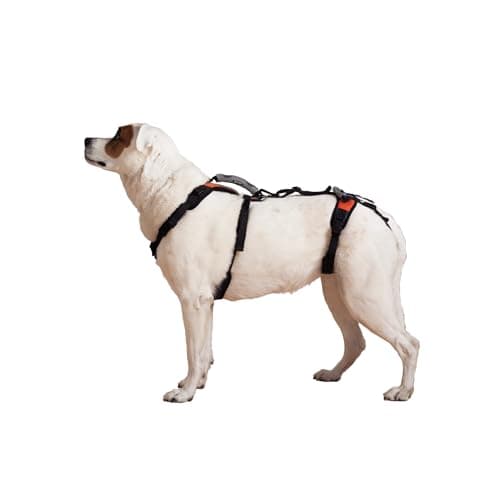
Help 'Em Up
Help 'Em Up Harness
Our score
$95–$155
Best for
Long-term mobility support for senior or post-surgical large dogs
If your dog needs help getting up multiple times a day for the foreseeable future — post-TPLO, advanced hip dysplasia, hindquarter weakness in giant-breed seniors — this is the one to buy. It is the only harness in the category that supports the front and the back independently, which is what a dog with a bad hip and a compensating shoulder actually needs. Buy it from the manufacturer, not from Amazon: re-verified 18 August 2026, helpemup.com prices by size at $80 / $95 / $110 / $125 / $140 while Amazon runs $95 / $110 / $125 / $140 / $155 — a uniform $15 more at every size, every time we have checked.
Pros
- Two-piece (chest + hip) design lets you support either end independently
- Hip handle is purpose-built — not a converted car-seat-belt strap
- Padded chest plate distributes weight better than sling-only options
- Five sizes span 10 to 225 lb, and the rear half can be ordered a size smaller for a dog with muscle wasting
- Two hip-lift styles (Conventional and U-Band) so male dogs are not soiling the strap
Cons
- Amazon runs a uniform $15 above the maker's own price at every one of the five sizes, and the Amazon buy box is held by a third-party reseller (Veterinary Preferred) rather than by the brand — re-verified 18 August 2026
- The maker's own Mix & Match page prints two different starting prices, "From $80" and "FROM $95 USD", on the same page
- Direct pricing is no longer flat: since mid-August 2026 the maker charges $80 to $140 by size, so a giant-breed owner now pays $60 more than a terrier owner
- On 29 August 2026 the linked Amazon Medium (B0DK81SCG5) showed a future availability date rather than units on hand, while every size and style was in stock at helpemup.com the same day; on 9 September and again on 12 September 2026 the Amazon Medium still showed the future-date status at $125.00 with a maximum order of one and no ship date given, while all nine direct variants were in stock — two weeks of backorder on the channel we earn from, and one more reason the direct channel is the one to use
- Sizing is critical — measure twice, return is a hassle
- Rear straps can chafe the inner thigh if the harness is left tight while the dog lies down
- A dog filmed or gait-assessed while wearing it looks less lame than he is, because the harness offloads the limb you are trying to judge
- Bulkier than a quick-grab sling for short-term use
Why this one: it supports the front and the back independently, which matters when you do not yet know which end is failing. The thing to get right for a Samoyed is sizing. The AKC standard gives Samoyed females 35 to 50 lb and males 45 to 65 lb.[17] Help 'Em Up's Small covers 25 to 45 lb and its Medium 45 to 80 lb, so the breed sits across the maker's boundary, and a thick coat makes it easy to guess heavy. The maker's own advice runs the other way: "If your dog's weight is between sizes, we recommend sizing down." For older dogs "struggling with atrophy or degenerative hind quarters," it suggests a smaller rear half than the front, giving the example of "a 55lb dog with a degenerative hind" who "may benefit from a small size rear."[18] 55 lb is the middle of the AKC range for a male Samoyed. Weigh him on a scale, not by eye, and if he is near 45 lb or has lost muscle behind, order the rear half a size down through Mix & Match.
What it is bad at: it is a lot of money and a lot of harness for a dog who only needs a hand on the back steps, where the towel does the same job. And it will not tell you which of the four problems you have, so it belongs after the appointment, not before. Buy it direct: on 24 September 2026 the maker lists the Small at $95 and the Medium at $110.[18] The Amazon Medium was $125 through a third-party reseller, with no ship date given, as at every check we have made since 29 August.[19] Our lift harness comparison covers the alternatives if this one is not right.
What to do this week#
- Tonight: feel both thighs through the coat, left against right, and write down what you find. Put him on a scale.
- Starting tomorrow morning: measure the water over several days. Anything over about 100 ml per kg per day goes to the vet on its own.
- Book one appointment and ask for three things: a hip and knee examination, a neurologic examination including spinal palpation and paw placement, and a urine glucose. Bring your water numbers and your thigh notes.
- Hold off on the DNA test until the exam is done. In this breed, an at-risk result tells you less than the three checks above.
- Fold a towel and use it on the steps until you know what you are treating.
A Samoyed will not tell you his back end hurts, and his coat will not show you it is thinning. Part of the delay in this breed can come from reading a list written for another dog. The checks above take a week, and the first two cost nothing.
Sources#
- Coates JR, Wininger FA. "Canine degenerative myelopathy." Veterinary Clinics of North America: Small Animal Practice. 2010;40(5):929-950. doi:10.1016/j.cvsm.2010.05.001 — the standard clinical review; lack of paraspinal hyperesthesia a key feature distinguishing DM from compressive myelopathies; asymmetric onset reported frequently.
- Orthopedic Foundation for Animals. "Degenerative Myelopathy." ofa.org — read 24 September 2026: list of breeds in which DM association has been confirmed by spinal cord examination (Samoyed not listed; Siberian Husky, American Eskimo Dog, German Shepherd Dog, both Corgis included); "At this time we are reluctant to recommend testing for members of breeds where the University of Missouri has not yet proven susceptibility to DM through microscopic examination of spinal cords from deceased dogs that exhibited symptoms of the disease."
- Zeng R, Coates JR, Johnson GC, Hansen L, Awano T, Kolicheski A, Ivansson E, Perloski M, Lindblad-Toh K, O'Brien DP, Guo J, Katz ML, Johnson GS. "Breed distribution of SOD1 alleles previously associated with canine degenerative myelopathy." Journal of Veterinary Internal Medicine. 2014;28(2):515-521. doi:10.1111/jvim.12317 — 33,747 dogs genotyped; SOD1:c.118A found in 124 breeds and crossbreds; full text read via Europe PMC (PMC4238831); the Samoyed does not appear in the main genotype tables. The full list of examined spinal cords is in a supplementary table we could not retrieve, so we make no claim from it.
- Samoyed Health Foundation. "Degenerative Myelopathy study needs samples." samoyedhealthfoundation.org — read 24 September 2026: study by Dr Mary Whiteley (DOGenes Inc) begun with DNA from 10 Samoyeds; the page does not say what the "unique link" found was, or whether SOD1 is involved.
- OMIA (Online Mendelian Inheritance in Animals). "Degenerative myelopathy in Canis lupus familiaris (dog)," OMIA 000263-9615. omia.org — read 24 September 2026; the Samoyed is included in the entry's breed list.
- Oberbauer AM, Keller GG, Famula TR. "Long-term genetic selection reduced prevalence of hip and elbow dysplasia in 60 dog breeds." PLOS ONE. 2017;12(2):e0172918. doi:10.1371/journal.pone.0172918 — OFA records 1970–2015; full text read via Europe PMC (PMC5325577): the Samoyed is absent from both the 15 highest-prevalence (lowest listed 16.6%) and 15 lowest-prevalence (highest listed 6.2%) hip lists; elbow dysplasia 1.9%; hip score heritability 0.52 ± 0.03.
- Samoyed Club of America. "Health Issue — Skeletal System." samoyedclubofamerica.org — page dated 31 March 2026, citing OFA 2015: hip dysplasia in screened Samoyeds from 13.21% through the 1980s to 7.22% in 2005–2010; elbow dysplasia 2.2% through 2014.
- British Veterinary Association. "Hip Dysplasia Scheme Breed Specific Statistics 2024." bva.co.uk (PDF) — read 24 September 2026. Samoyed: 652 scored over 15 years (mean 12, median 10); 216 over 5 years (mean 12, minimum 4, maximum 48, median 10); 35 in 2024. Siberian Husky 5-year median 6; Labrador Retriever 8; German Shepherd Dog 11; Golden Retriever 11.
- The Kennel Club. "Breed Health and Conservation Plan: Samoyed." Version 1, September 2021. samoyedbreedcouncil.co.uk (PDF) — priorities agreed with breed representatives: diabetes mellitus, glaucoma, hip dysplasia; no mention of degenerative myelopathy. 2004 survey: 356 live dogs, cruciate ligament rupture among the most frequently reported conditions (9 cases); 2014 survey: 100 live dogs, cruciate disease reported twice; 223 deaths, median age at death 12 years 6 months. Reports the Swedish incidence for the Samoyed as 104 per 10,000 dog-years at risk. Lists early signs of diabetes as increased thirst, increased urination, lethargy, weight loss and increased appetite.
- Powers MY, Martinez SA, Lincoln JD, Temple CJ, Arnaiz A. "Prevalence of cranial cruciate ligament rupture in a population of dogs with lameness previously attributed to hip dysplasia: 369 cases (1994-2003)." JAVMA. 2005;227(7):1109-1111. PMID 16220671
- Denyer AL, O'Neill DG, Brodbelt DC, Holder A, Catchpole B, Davison LJ. "Epidemiology and clinical management of 1072 dogs with diabetes mellitus in a UK diabetes register." Companion Animal Health and Genetics. 2025;12:7. doi:10.1186/s40575-025-00146-x — full text read via Europe PMC (PMC12512512): adult-onset non-dioestrus group against VetCompass controls, Samoyed OR 23.5 (95% CI 14.2–39.0) versus crossbreds, the highest of any breed; 17 Samoyeds in that group (males and neutered females), mean age at diagnosis 8.51 years, not significantly different from crossbreds (p = 0.620). An entire-female OR of 118.7 is reported with the authors' caution about the control group and is not used on this page.
- Fall T, Hamlin HH, Hedhammar Å, Kämpe O, Egenvall A. "Diabetes mellitus in a population of 180,000 insured dogs: incidence, survival, and breed distribution." Journal of Veterinary Internal Medicine. 2007;21(6):1209-1216. doi:10.1892/07-021.1 — 182,087 insured Swedish dogs aged 5–12; overall incidence 13 per 10,000 dog-years at risk; Samoyeds among the four breeds with the highest incidence. Abstract read; the full text was not accessible to us.
- Merck Veterinary Manual. "Metabolic Disorders of the Peripheral Nerves and Neuromuscular Junction in Animals." merckvetmanual.com — read 24 September 2026: diabetic neuropathy is "an uncommon complication of diabetes mellitus ... seen in cats and rarely dogs."
- Morgan MJ, Vite CH, Radhakrishnan A, Hess RS. "Clinical peripheral neuropathy associated with diabetes mellitus in 3 dogs." Canadian Veterinary Journal. 2008;49(6):583-586. PMID 18624068 — three dogs aged 8–10 with severe pelvic limb paresis and muscle atrophy; signs may develop in dogs with adequate glycemic control.
- Davies Veterinary Specialists (Linnaeus). "Polydipsia in Dogs and Cats (increased drinking) Fact Sheet." vetspecialists.co.uk — read 24 September 2026: normal intake 20–70 ml/kg/day; "definitively increased at over 100 ml/kg/day"; diabetes mellitus among the causes.
- Sebestyén P, Kowalska ME, Golini L. "Survival and deterioration time of walking abilities in dogs homozygous for the SOD1 gene mutation with and without thoracolumbar intervertebral disc protrusion." Frontiers in Veterinary Science. 2025;12:1555889. doi:10.3389/fvets.2025.1555889 — 39 SOD1-homozygous dogs; spinal hyperesthesia in 32% of those without disc protrusion on MRI and 55% of those with.
- American Kennel Club. "Samoyed." akc.org — read 24 September 2026: weight 45–65 lb (male), 35–50 lb (female); height 21–23.5 in (male), 19–21 in (female); life expectancy 12–14 years.
- Help 'Em Up. "Help 'Em Up Harness" product page and variant feed. helpemup.com — read 24 September 2026: Small 25–45 lb $95, Medium 45–80 lb $110; "If your dog's weight is between sizes, we recommend sizing down"; for older dogs with atrophy or degenerative hindquarters, a smaller rear via Mix & Match; rear halves sold separately at $47.50 (Small) and $55 (Medium).
- Amazon listing B0DK81SCG5 (Help 'Em Up Medium Conventional, 45–80 lb), read via the Amazon Creators API 24 September 2026: $125.00, buy box Veterinary Preferred, availability type AVAILABLE_DATE with no date given.
- University of Missouri Veterinary Health Center. "Degenerative Myelopathy." vhc.missouri.edu — read 24 September 2026: "Dogs seem not to show pain during the course of the disease"; initial signs include "an asymmetric loss of coordination (ataxia) and spastic weakness in the hind limbs"; "Onset of DM is near 9 years of age."
This article is educational and does not replace veterinary advice. Weak back legs in an older dog have several causes, some of them treatable and some urgent, and telling them apart needs an examination. Nothing here is a diagnosis. We have no veterinary reviewer on this article yet; it is marked as awaiting review.
Frequently asked
- Do Samoyeds get degenerative myelopathy?
- Possibly, but the breed is not on the list you would expect. The mutation linked to DM, SOD1:c.118A, has been found in 124 breeds and in crossbreds, and OMIA, the reference catalogue of inherited animal disease, includes the Samoyed in its breed list for DM. But the Orthopedic Foundation for Animals' list of breeds in which DM has been confirmed by examining the spinal cord after death, read on 24 September 2026, does not include the Samoyed, and neither does the table of confirmed cases in the largest breed survey of the mutation (Zeng 2014, 33,747 dogs). The Samoyed Health Foundation is still asking owners of Samoyeds suspected of having DM to send samples. So DM in a Samoyed is possible and not established, and the OFA says it is reluctant to recommend testing in breeds where susceptibility has not been proven that way.
- How common is hip dysplasia in Samoyeds?
- Common enough to screen for, and less common than in the breeds people usually worry about. The Samoyed Club of America, citing OFA data, reports dysplasia in screened Samoyeds falling from 13.21% through the 1980s to 7.22% between 2005 and 2010. In the OFA's 1970–2015 database the Samoyed sat in neither the 15 worst nor the 15 best breeds for hips. In the British scheme, the five-year breed median to the end of 2024 is 10 across 216 Samoyeds, against 6 for the Siberian Husky, 8 for the Labrador and 11 for the German Shepherd. All of these are voluntary screening figures, so they undercount the dogs whose films were never sent.
- How can I tell degenerative myelopathy from hip dysplasia in my Samoyed?
- Pain and coordination are the first split. A dog with sore hips is unwilling: slow to rise, reluctant on stairs, sore when the hip is extended. A dog with DM is unsteady: the back end wobbles, a hind paw scuffs or knuckles, the nails wear flat, and nothing seems to hurt. The University of Missouri's teaching hospital puts it plainly: dogs with DM seem not to show pain. But it is not a clean sort, because an older dog can have both, and in one 2025 cohort of dogs carrying two copies of the DM mutation, a third of those with no disc problem were still tender on the spine. In a Samoyed specifically, add a third question before either: is he drinking more?
- Why would diabetes cause back leg weakness in a Samoyed?
- Mainly through muscle. Weight loss and lethargy are early signs of diabetes, and a thick coat hides a thinning back end very well. A true diabetic nerve disorder is uncommon in cats and rare in dogs, but it has been documented, with severe weakness in the hind legs, and the authors note it can develop even when blood sugar is adequately controlled. The reason it belongs on a Samoyed page is the breed's risk: in the UK diabetes register the Samoyed had the highest odds of adult-onset diabetes of any breed, 23.5 times a crossbred's, and the 17 Samoyeds in that analysis group were diagnosed at an average of about eight and a half. Diabetes in this breed is a disease of the senior years, which is exactly when the back legs are being looked at.
- What size Help 'Em Up harness does a Samoyed need?
- It depends on the weighed dog, not the silhouette, and the breed sits right on the maker's boundary. The AKC standard gives Samoyed females 35 to 50 lb and males 45 to 65 lb; Help 'Em Up's Small covers 25 to 45 lb and its Medium 45 to 80 lb. The maker's own instruction for a dog between sizes is to size down, and for older dogs with wasting or degenerative hindquarters it suggests a smaller rear half through its Mix & Match option. Put the dog on a scale before ordering. A Samoyed looks heavier than he is, and a wasting one more so.