Care Guide
The Best Beds for Dogs Going Through Chemo or a Long Illness (2026)
The best bed for a dog going through chemo is washable first and orthopedic second. Our picks for dogs in treatment, plus a two-cover rotation strategy for accident days.

A dog in chemotherapy or managing a long illness may have accidents, and may lose the padding over its hips and elbows — so the bed brief changes: washable first, easy to get onto second, genuinely supportive third. Our pick for most dogs in treatment is the K9 Ballistics Tough Ripstop, because the cover strips off for the wash and spare covers are sold separately, which turns accident days from a crisis into a swap. Nothing on this page treats anything. It is a comfort decision, and it is one of the few parts of a hard season you get to fully control.
Affiliate disclosure: Dog Orthopedic is reader-supported. When you buy through links on our site we earn a commission at no extra cost to you — about 3% on most pet products, and the same rate on every product we compare, so no pick earns us more than another. Prescription medication earns us nothing, and seeing your vet earns us nothing; we recommend both anyway. Learn more.
Imagery: Lifestyle photographs on this site are licensed from Pexels (royalty-free) and credited per image. Pexels imagery illustrates conditions and contexts — it does not depict the specific dogs or test sessions described in the text. Product photographs come from Amazon's Creators API. Breed portraits are illustrations of typical breed type rather than photographs of individual dogs, and are not drawn to scale against one another.
Our picks at a glance#

K9 Ballistics
K9 Ballistics Tough Ripstop Orthopedic Crate Bed

Big Barker
Big Barker 7-inch Pillow Top
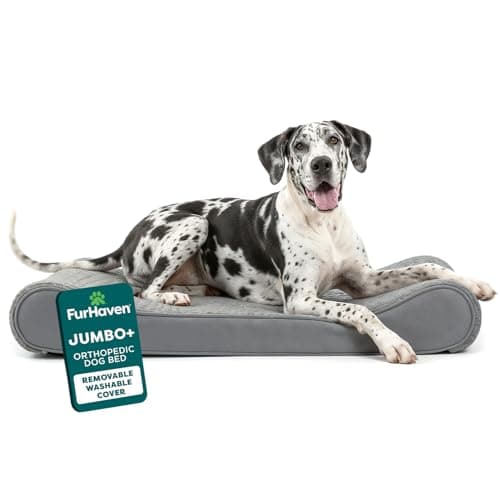
Furhaven
Furhaven Ultra Plush Luxe Lounger
| Product | Score | Best for | Price | |
|---|---|---|---|---|
K9 Ballistics K9 Ballistics Tough Ripstop Orthopedic Crate Bed | 8.4 | Diggers, scratchers and light chewers that shred ordinary bed covers | $149–$320 | View |
Big Barker Big Barker 7-inch Pillow Top | 9.4 | Large and giant breeds with hip, elbow, or arthritis pain | $250–$460 | View |
Furhaven Furhaven Ultra Plush Luxe Lounger | 8.1 | Budget-conscious owners of light and medium dogs, and nesting sleepers who like a low step-on entry | $34.60 | View |
These three come from the same test pool as our master orthopedic bed roundup, re-ranked for what a long stretch of treatment actually demands. None of this is specialty "medical" gear at specialty markup — it's the sturdiest, most washable equipment from a lineup we already trust.
One change to this page in August 2026, stated openly. Our previous third pick was a Frisco bolster bed. When we re-checked the listing we link, the ASIN no longer sold that bed — it now returns a different brand's product entirely, a Reddy by Petco bolster at $109.99. We have pulled the pick rather than send you to a bed we never reviewed, and replaced it with one we verified against the manufacturer's own price feed the same day.
What matters in a bed during chemo or a long illness?#
The priorities reorder. For a healthy senior we rank foam quality first; for a dog in treatment, the list runs like this:
| Priority | What to look for | Why it matters during treatment |
|---|---|---|
| 1. Washability | Removable machine-washable cover, plus a waterproof layer between dog and foam | Accidents and spills happen, and foam that soaks up an accident is very hard to truly clean. A cover you can strip in thirty seconds is worth more here than any other feature. |
| 2. Easy, low entry | Low profile, or a contoured bed with a step-on front | A dog on a rough day should not have to work to reach its own bed. |
| 3. Genuine pressure relief | Enough foam depth that a fist pressed where the hip lands does not reach the floor plane | More hours lying down, with less flesh over bony points, is exactly the recipe for pressure sores if the foam bottoms out. |
| 4. Warmth without overheating | Draft-free placement and a washable blanket, rather than heavy insulation | Thin dogs chill easily — and overheat easily. Layers you can add and remove beat a bed that's committed to one temperature. |
What we removed from this table. It used to specify "support foam of at least 1.8 lb/cu ft density." We have deleted that threshold across the beds pillar, because it is unenforceable: of the premium brands we track, only one publishes a foam density figure at all. A rule you cannot check on any listing is not a buying rule. Depth and the fist test are checkable, so those are what we give you.
How rough does chemo actually get? The honest numbers#
Owners arrive at this page frightened, and the internet is not helpful on this point — it swings between "dogs sail through chemo" and horror stories. The measured version, from 155 dogs treated across a range of protocols at one referral centre and graded on the standard veterinary oncology criteria: adverse events of some grade were recorded at least once in 124 dogs (80%), and severe adverse events in 50 (32.3%). Of those, 23 dogs (14.8%) had severe gastrointestinal events and 31 (20.0%) had severe myelotoxic ones — the bone-marrow suppression that drops white cell counts. Severe events led to hospitalisation in 37 dogs (23.9%), to stopping chemotherapy in 12 (7.7%), and to death or euthanasia in 9 (5.8%). Dogs over 10 kg had fewer severe haematological events than smaller dogs, and multi-agent protocols carried more.[1]
Two things follow, and they are the reason this page leads with washability rather than foam.
One in five dogs in that series had a severe drop in blood cell counts at some point. That is the honest, sourced version of the sentence this page used to wave at — "treatment can suppress immune function." It is not universal, it is not constant, and it is concentrated at specific points in the cycle that your oncology team can name for your dog. But it is common enough that clean, dry bedding stops being cosmetic and starts being basic hygiene, in the same way you would wash your hands before handling a wound.
And a fifth of these dogs spent time in hospital. A bed that is easy to strip and reset is worth more to you on the day your dog comes home than any foam specification.
#1 — K9 Ballistics Tough Ripstop: the most washable real orthopedic bed#
#1 Pick
K9 Ballistics
K9 Ballistics Tough Ripstop Orthopedic Crate Bed
Our score
$149–$320
Best for
Diggers, scratchers and light chewers that shred ordinary bed covers
The right bed for a dog who digs, scratches and roughhouses his bedding into the bin, and a genuinely good crate mattress at 4 inches with a warranty against flattening. Be precise about which problem you have, because we were not precise enough here until August 2026: this is the Tough Ripstop line, built for digging, scratching and occasional light chewing, and on this bed the chew warranty — 1 year, 365 days, re-verified 2026-09-06 — covers the cover only. A dog who has actually eaten three beds needs K9 Ballistics' separate Chew Proof Armored line, where the guarantee replaces the whole bed. Buy the right line and this is excellent. Buy this one for a determined chewer and you will be disappointed by a product that never claimed to do that job.
Pros
- Ripstop ballistic cover genuinely survives digging and scratching, which is what kills most bed covers
- Replaceable covers sold separately — repair, don't replace
- Carries a 10-year won't-flatten warranty as well as the chew guarantee, and it is defined concretely: more than 2 inches of flattening in 10 years and they replace the mattress once
- Foam is CertiPUR-US certified and made in the USA
- Corner anchor loops let you zip-tie the pad to a wire crate floor
Cons
- Cover texture is less plush than memory-foam beds
- Heavy at larger sizes — awkward to move around
- Premium price for the durable construction
- Not the bed for a determined chewer — the Tough Ripstop line is rated for digging, scratching and occasional light chewing only, and on this bed the 1-year chew warranty replaces the cover only, with the mattress excluded
- The Amazon listing contradicts itself on the foam: one bullet says CertiPUR-US shredded foam, another says a 4-inch solid foam mattress
- The 10-year won't-flatten warranty explicitly excludes chewing, scratching and water damage, so on a bed sold for rough dogs the two guarantees do not overlap
- The listing's marketing outruns its own warranty: a bullet claims the mattress "won't flatten over time, even for the biggest and heaviest of breeds" and is "designed to last decades," while the brand's warranty defines acceptable performance as up to 2 inches of flattening in 10 years — half the mattress. The enforceable promise is the 2-inch threshold, not the bullet (listing re-read 25 August 2026)
The feature that puts the K9 Ballistics on top is almost boring: replacement covers are sold separately. For a dog in treatment, that's the whole game — buy a spare cover with the bed and you can run the two-cover rotation described below, so the bed is never out of service while a cover is in the machine.
Be precise about which bed you are buying, because we were not precise enough here until this August. The variant we link is the Tough Ripstop Orthopedic Crate Bed, 47 × 29 inches, 4-inch mattress, $175 on Amazon with the buy box held by K9 Ballistics itself.[2] This page previously claimed the line runs "up to 60 × 42 inches." It does not. On the maker's own product feed the rectangle orthopedic line runs Small 24 × 18 × 3, Medium 33 × 27 × 5, Large 40 × 34 × 5, XL 54 × 38 × 5 and XXL 68 × 40 × 5 inches, at $120 to $325 direct depending on size and cover finish.[3] Neither figure was 60 × 42, and the price band we printed was wrong at the bottom end. Measure your dog and pick from that list.
What the brand says about its own cover, which is better than what we used to say. We described the ballistic shell as "built to survive chewers." The maker is more careful, and publishes numeric durability scores: Chew Proof 6/10, "recommended for light to mild chewers only"; Scratch Proof 8/10; Waterproof 8/10, with the note that "seams can be a point of entry for fluid" and that the mattress liner adds extra protection. Its own copy sends determined chewers elsewhere: "For more determined or aggressive chewers that treat their beds like a rawhide bone, our Chew Proof Armored style dog beds will be a much better fit."[3]
That waterproofing caveat is the single most useful line for this page. An 8/10 cover with permeable seams, under a dog having accidents, is a cover that will eventually pass fluid to the foam. Layer a washable waterproof pad on top. It costs a few dollars and it is the difference between washing a pad and replacing a mattress.
The warranty terms, read off the maker's own page today: a 120-Day Chew Proof Warranty giving "a one-time replacement of the cover or bed (dependent on product type)," and a separate 10 Year Won't Flatten Warranty — if the mattress "flattens more than 2 inches within 10 years of receipt, we will replace it once free of charge," applying to both shredded and solid foam mattresses.[4] Note the flatten threshold is two inches on a four-inch mattress — half the bed — which is a far looser promise than the premium tier's, and worth knowing before you rely on it.
One unresolved thing we will not paper over: the Amazon listing describes the foam as "CertiPUR-US certified shredded foam" in one bullet and a "4-inch thick mattress… made of solid foam" in the next, while the brand's own site says solid.[2] It matters, because shredded fill migrates away from the point of highest load and solid foam does not. If you are buying this for pressure relief rather than for its cover, ask the seller which one your SKU ships with.
The trade-off in this context: the cover is less plush than a fleecy bed. Solve that with a washable blanket on top, which you want anyway — the blanket catches most of the mess and washes daily without drama.
#2 — Big Barker 7-inch: for the big dog losing weight#
#2 Pick
Big Barker
Big Barker 7-inch Pillow Top
Our score
$250–$460
Best for
Large and giant breeds with hip, elbow, or arthritis pain
The bed every senior-large-breed owner eventually buys, and the one we still recommend first for a dog over about 80 lb — because seven inches of foam is the only thing that reliably keeps a heavy dog's hip off the floor plane overnight. (It is not one solid slab, as we used to say: the maker's own copy describes a 3-layer build, a 2" base under a 3" support layer under a 2" comfort top.) It is also the only bed in the category with a clinical study attached, and we would rather you knew what that study is: forty dogs, no control group, no blinding, and outcomes scored by the owners who had just been given a free bed. That is a reason to be interested, not a reason to be convinced. Buy on the foam depth and the ten-year warranty, which are facts. On where to buy: the price is the same either way, so buy direct for the 180-night sleep trial, which Amazon's return window does not match. The two editions both sell on both channels at identical prices, re-verified 6 September 2026 — flat Large $249.95, Headrest Large $289.95. We have published two wrong things about this in the past, a $40 Amazon markup and a direct-only cheap edition; both are retired, and the honest version is that the channel decides your trial, not your price.
Pros
- Seven inches of foam — a 3-layer build (2" base, 3" support, 2" top comfort) deep enough that a 100 lb dog's hip does not reach the floor plane, which is the whole job
- 10-year warranty — foam must retain at least 90% of its original shape and support, or it is replaced
- The only bed in the category with a published clinical study behind it, even though that study is a single-arm pilot
- Made in the USA
- Microfiber cover unzips and machine-washes
Cons
- Premium price
- Editions, not channels, are what the price difference is. Both are on Amazon and both are on bigbarker.com at identical prices, re-verified 2026-09-06: the flat headrest-free Large is $249.95 (B0GRBXBPXH) and the Headrest Large is $289.95 (B0GRBX5TBL), both In Stock with the buy box held by Big Barker itself, both matching the maker's own site. We previously misread this as a $40 Amazon markup, and then as the cheap edition being direct-only. Both claims are retired
- Bulky — measure your space, not just your dog
- Cover-only style isn't bolstered (consider Sofa edition for nesters)
- The clinical study everyone cites is open-label, single-arm, and owner-scored, with no control group
When a large dog gets thin, its elbows and hips meet the bed with less and less natural padding — and that is not a figure of speech, it is the measured finding. Cadaver dogs of differing body condition scores were laid in lateral recumbency across four support surfaces and mapped with a pressure mat over four hours. Regardless of the dog or the surface, the same three zones came up as recurrent pressure-risk sites: the scapulohumeral articulation, the greater trochanter of the hip, and the thirteenth rib. And the thinnest dogs produced the highest peak pressures on every surface tested.[5]
Lean muscle loss is also the defining feature of cancer cachexia, which a veterinary nutrition review describes as ultimately driven by inflammation in pets with chronic, debilitating or terminal disease.[6] So the argument for deep foam under a thinning dog is a physics argument, not a marketing one: less tissue over the trochanter, more hours lying on it, higher peak pressure at that exact point.
Seven inches is what buys you the margin. The maker's own build description — on both its Amazon listing and its site — is a three-layer system: a 2-inch base, a 3-inch support layer and a 2-inch top comfort layer.[7] We used to describe it as one solid slab, and that was our error, not the maker's.
The prices on this page were badly out of date and are now corrected. We printed "$229 for a Large and $429 for a Giant." Read off Big Barker's own live variant feed today, the flat Sleek edition runs $249.95 Large (48 × 30 × 7), $299.95 XL (52 × 36 × 7) and $359.95 Giant (60 × 48 × 7), and the Headrest edition $289.95 and $339.95 for Large and XL — with one price across all ten cover colours, which is unusual and to the brand's credit.[8] The 10-year no-flatten warranty is real and is the strictest threshold in the category — the foam must retain at least 90% of its original shape and support.
And the claim we have to walk back. This page said "a 2018 University of Pennsylvania pilot study documented measurable joint-metric improvements after 28 days on this bed." A study exists; that sentence oversells it. The maker's own study page reports seven percentage improvements — 17.6% joint function, 21.6% pain severity, 12.5% joint stiffness, 9.6% gait, 15.1% quality of life — across forty dogs at least three years old and over 70 lb, and attributes them plainly to what "Owners reported." The page does not state whether there was a control group, whether anyone was blinded, or that the report describes itself as an open-label proof-of-concept study.[9] There was no control group, and the assessments were owner-completed weekly.[10]
Why that matters here more than anywhere else on the site: when owners scored their own dog's lameness in the placebo arm of a blinded trial with a force plate running alongside, they judged the dog improved 39.7% of the time.[11] An unblinded, uncontrolled, owner-scored study cannot separate the foam from the hope — and if you are buying a bed for a dog with cancer, you are the most hopeful reader we will ever have. Buy this bed for the seven inches and the ten-year warranty, which are physical facts. Do not buy it for the percentages.
Two honest trade-offs for this situation. The 7-inch height is a taller step up than a 4-inch mattress, so watch your dog manage it on a weak day before committing. And the bed does not ship with a waterproof liner — Big Barker sells one separately — so layer a washable waterproof pad between cover and blanket from day one. Protecting a $250-plus foam core from accidents is not optional.

#3 — Furhaven Luxe Lounger: the budget option, with real limits#
#3 Pick
Furhaven
Furhaven Ultra Plush Luxe Lounger
Our score
$34.60
Best for
Budget-conscious owners of light and medium dogs, and nesting sleepers who like a low step-on entry
If Big Barker is out of budget, this is the bed we recommend for a dog under about 50 lb — solid orthopedic foam, a low step-on entry, and a washable cover at a price that is a tenth of the premium picks. Its foam is budget-density and it will mat down; the honest way to own one is to expect that, test it with your fist monthly, and spend $25.99 (Large) on a replacement core when it fails rather than pretending it won't. Under a heavy dog, buy depth and density once instead.
Pros
- The cheapest genuinely solid-foam orthopedic bed we track — $34.60 for the Large on Amazon and $34.99 base price direct from Furhaven, re-checked 2026-09-06
- Replacement foam cores are sold as spare parts priced by size — $13.99 Small to $69.99 Giant, $25.99 for the Large we link (verified against Furhaven's variant feed 2026-08-13) — so the bed's one predictable failure, the foam matting down, costs $25.99 to fix on this size rather than a whole new bed. The $13.99 figure is the Small's core and we have quoted it here as though it were this bed's; corrected 2026-09-06
- Contoured step-on lounger shape with no wall to climb — the low entry is a real feature for a stiff dog, and the contour supports a dog who sleeps with his head posted on an edge
- Removable, machine-washable cover with CertiPUR-US certified foam core
- Five sizes, Medium through Giant, in three core types (orthopedic foam, memory foam top, cooling gel top)
Cons
- Budget-density foam. Reviewers report cores matting down flat inside 18 months under bigger dogs, and the 10-year no-flatten warranties on premium beds exist precisely because this failure mode is real — plan on replacing the core (a $25.99 spare for the Large) on a schedule, not on faith
- Thinner in the middle than the photos suggest — reviewers measuring the foam report roughly 4.5 inches at the center against taller contoured edges, and "much thinner than what the pictures show" is a recurring complaint
- Furhaven rates sizes far above what this foam supports. The Jumbo Plus listing claims dogs up to 150 lb and the Large claims up to 38 lb; at this foam density we would not put a dog anywhere near 150 lb on it long term, and we treat the Large's 38 lb as the honest ceiling for the Large
- Cover fit is loose on some sizes per reviews, and the faux-fur top pills with washing
- The Amazon listing's fourth bullet opens "True Orthopedic Support: Stop buying beds that flatten" (read 2026-09-15), and nothing on Furhaven's own warranty page backs that sentence: the 90-day warranty covers fabric, sewing, gluing, stapling and zipper defects only, excludes "damage inflicted on products by animals", and there is no flatten term, threshold or remedy anywhere. Read the bullet as copy, not as a promise
- Amazon availability moves by size. The Jumbo Plus ASIN (B07PYYJV11) went from "15 left" on 2026-08-18 to "Currently unavailable" on 2026-08-28 and was still dead on 2026-09-06, so our link now goes to the Large (B073PZHJZY, 36 × 24 × 5.5 in, rated to 38 lb, $34.60, sold by Amazon). That is a smaller bed than the one this page used to point at — check the size selector against your dog before you check out. Furhaven's own site still sells the whole line direct ($34.99–$180.99 across sizes when we checked 2026-08-22)
Illness makes a lot of dogs want to burrow, and the Furhaven is the budget answer for a nester: a contoured step-on lounger with a low lip rather than a wall to climb, a solid orthopedic foam core rather than loose fill, and a removable washable cover. Verified against Furhaven's own variant feed today, the orthopedic-core prices are Medium $34.99 in Cream and $42.99 in Chocolate or Gray; Large $49.99 Cream, $64.99 Chocolate or Gray; Jumbo $68.99 Cream, $96.99 otherwise; Giant $142.99.[12] Note the colour, not just the size — this brand prices the identical bed differently by colourway, and almost nobody notices.
The feature that earns it a place on this specific page is one Furhaven does not advertise: it sells replacement foam cores as spare parts. Priced by size, today, $13.99 Small, $19.99 Medium, $25.99 Large, $37.99 Jumbo, $53.99 Jumbo Plus, $69.99 Giant.[13] For a dog having accidents, that changes the arithmetic completely. The worst outcome with any foam bed is fluid reaching the core, because a soaked core cannot really be cleaned. On most beds that means replacing the whole bed. On this one it means a $25.99 part. (We printed a flat $13.99 for every size until August 2026; that was the Small's price, read off a page's "from" figure, and correcting it is what produced the table above.)
Now the limits, because they are real. There is no flatten warranty of any kind — 90 days on defects in material and workmanship, and the terms explicitly exclude "damage inflicted on products by animals." Reviewers report cores matting down inside 18 months under bigger dogs. And the faux-fur top pills with repeated washing, which on a bed you will wash a great deal is a genuine objection. For a dog over about 50 pounds who needs pressure relief for months, buy up. For a smaller dog, or for a second bed so the household has one upstairs and one down, this is the honest budget answer and the replaceable core makes it the right one.
How do you run accident days without losing your mind?#
The two-cover rotation is the single most useful piece of logistics on this page:
- Buy the spare the same day you buy the bed. For the K9 Ballistics, that's a second cover. For any other bed, two washable waterproof pads sized to the bed do the same job.
- Layer the bed the same way every time: foam, then cover, then waterproof pad, then washable blanket. Accidents hit the top two layers; the foam stays dry. This is not fussiness — the maker of our top pick rates its own cover 8/10 waterproof and says seams can pass fluid.[3]
- When an accident happens, strip and swap. Soiled layers go to the machine, spare layers go on, the dog is back in bed in two minutes — no midnight scrubbing, no dog displaced to the floor.
- Wash on the care-label cycle and dry completely. Fully dry before it returns to service. Rotate the layers so both sets stay in use.
A pack of disposable absorbent pads under the blanket adds a cheap extra margin during the roughest weeks. If your dog's incontinence is ongoing rather than episodic, mention it to your vet team — sometimes it's manageable medically, and they'll want to know either way.
Where should the bed go?#

Dogs in treatment generally want their people more than they want quiet. Put the main bed where the household actually is — a corner of the living room, not a spare room — while keeping it out of walk paths so the dog can rest undisturbed. The rest of the checklist:
- Out of drafts. A thin dog loses heat faster; doorways, window lines, and AC vents are the usual offenders.
- Ground floor, water a few steps away. If nights happen upstairs, add a second inexpensive bed rather than a nightly carry.
- Non-slip approach. Weak or tired dogs slip more, and a fall costs more now. Rugs or mats along the routes the dog walks — our floor-traction guide covers the quick fixes.
- Size it generously. A dog that hurts somewhere will keep shifting to find the comfortable position; give it room to. Our size chart has the method and the numbers.
What should you watch for on a thinning dog?#
Weight loss takes away the natural padding over the elbows, hips, and hocks at exactly the time the dog is lying down the most. The three zones to check are not a guess — they are the three the pressure mapping study found in every dog on every surface: the shoulder joint, the point of the hip, and the thirteenth rib, which is the last one back along the ribcage.[5]
Make a weekly habit of running your hand over those spots while your dog is settled: you're looking for redness that doesn't fade, hair loss, or skin that feels thickened or broken. On a good bed these spots should stay unremarkable; if they don't, the foam may have quietly failed — press your fist into the bed where the dog lies, and if the imprint doesn't recover within 30 seconds, the foam is done.
If your dog's illness comes with mobility loss — or a surgery is part of the road ahead — the equipment list grows beyond bedding; our recovery gear guide and after-surgery bed guide cover that territory. And if you are trying to read whether your dog is tired or hurting, our guide to reading pain in dogs is the better companion to this page than any product list.
The bottom line#
Buy the K9 Ballistics Tough Ripstop for most dogs in treatment, and buy the spare cover in the same order — the rotation is the feature. Buy the Big Barker for a big dog losing weight, where seven inches of foam between a bony trochanter and the floor is the point, and add a waterproof pad from day one. Buy the Furhaven when budget decides, or as the second bed — the replaceable foam core is the reason it belongs on a page about accidents.
Then set it up once, properly: near the family, out of the drafts, layered for the swap. Your dog will spend more hours on this bed than anywhere else for the duration. It will not change a blood count or a scan. It will change where he is comfortable while everything else is being decided by other people — and that is worth an afternoon of setting up properly.
Sources#
Every source below was opened and read on 14 August 2026. Three claims that previously appeared on this page were corrected: the Big Barker price range (we printed $229 Large / $429 Giant, both wrong), the K9 Ballistics size range (we printed "up to 60 × 42 inches," which matches no variant in the line), and the description of the University of Pennsylvania pilot as documenting "measurable joint-metric improvements." A minimum foam density threshold was deleted as unenforceable, and a product pick was withdrawn because the listing we linked had changed brands. Each change is stated in the text above.
- Chavalle T, Chamel G, Denoeux P, Lajoinie M, Sayag D, Berny P, Ponce F. "Are severe adverse events commonly observed in dogs during cancer chemotherapy? A retrospective study on 155 dogs." Veterinary and Comparative Oncology. 2022;20(2):393-403. doi:10.1111/vco.12782 (PMID 34775666) — 155 dogs, various protocols, 2013–2018, graded on VCOG-CTCAE criteria. Adverse events at least once in 124 (80%); severe adverse events in 50 (32.3%), of which gastrointestinal 23 (14.8%) and myelotoxic 31 (20.0%). Hospitalisation 37 (23.9%), chemotherapy arrest 12 (7.7%), euthanasia or death 9 (5.8%). Haematopoietic tumours associated with higher sAE frequency (p=.004); body weight over 10 kg associated with fewer haematological sAE (p<.001); multi-agent protocols a risk factor (p=.038). Single-centre retrospective; not a survival study.
- Amazon listing B0BK2HQG18, "K9 Ballistics Tough Ripstop Orthopedic Crate Bed, 47 x 29, Obsidian Black." amazon.com — retrieved via the Amazon Creators API 14 August 2026: $175.00, In Stock, buy box held by K9 Ballistics, Inc. Feature bullets state both "CertiPUR-US certified shredded foam manufactured in the USA" and "this 4" thick mattress is made of solid foam," in adjacent bullets; cover "will withstand scratching, digging, and mild chewing."
- K9 Ballistics. "Tough Ripstop Rectangle Orthopedic Dog Bed," live product feed at k9ballistics.com, read 14 August 2026. k9ballistics.com — sizes Small 24 × 18 × 3 in (under 30 lb), Medium 33 × 27 × 5 (30–50 lb), Large 40 × 34 × 5 (50–80 lb), XL 54 × 38 × 5 (over 80 lb), XXL 68 × 40 × 5 (120+ lb). Prices $120/$175/$230/$275/$315 in Obsidian Black, $10 more in premium finishes. Copy: "The dense, solid-foam mattress provides firm support"; published durability scores Chew Proof 6/10 "Recommended for light to mild chewers only," Scratch Proof 8/10, Waterproof 8/10 "Seams can be a point of entry for fluid. Mattress liner adds extra protection"; "For more determined or aggressive chewers that treat their beds like a rawhide bone, our Chew Proof Armored style dog beds will be a much better fit."
- K9 Ballistics. "Built to Last Promise / Warranty Coverage." k9ballistics.com — read 14 August 2026: "120 Day Chew Proof Warranty — If your dog damages their bed within 120 days after receiving it, we will provide you with a one-time replacement of the cover or bed (dependent on product type)"; "10 Year Won't Flatten Warranty — If your bed mattress flattens more than 2 inches within 10 years of receipt, we will replace it once free of charge. This warranty applies to both shredded and solid foam-style mattresses"; plus a 1-year manufacturer's warranty on defects. One claim per eligible item within the 120-day period; warranty replacements do not carry their own warranty.
- Caraty J, De Vreught L, Cachon T, Moissonnier P, Bongartz A, Viguier E, Carozzo C. "Comparison of the different supports used in veterinary medicine for pressure sore prevention." Journal of Small Animal Practice. 2019;60(10):623-630. doi:10.1111/jsap.13061 (PMID 31364781) — three cadaver dogs of differing body condition scores but similar size, positioned in lateral recumbency on four supports (blankets on the floor, a standard mattress, a veterinary memory foam mattress, a human memory foam mattress), pressures mapped over four hours with a TexiSense pressure mat. Recurrent risk zones at the scapulohumeral articulation, greater trochanter and thirteenth rib regardless of body condition or surface; the thinnest dogs produced the highest peak pressures on every surface. Cadaver study, three dogs — a mechanism, not an incidence.
- Saker KE. "Nutritional Concerns for Cancer, Cachexia, Frailty, and Sarcopenia in Canine and Feline Pets." Veterinary Clinics of North America: Small Animal Practice. 2021;51(3):729-744. doi:10.1016/j.cvsm.2021.01.012 (PMID 33773650) — review. The unifying feature of cachexia and frailty is lean muscle loss, "ultimately driven by inflammation," in pets with chronic, debilitating or terminal disease including cancer. A narrative review, not primary data.
- Amazon listing B0GRBX5TBL, "Barker Beds Large Orthopedic Dog Bed — 7" Pillow Top with Headrest — 50-70 lbs — 48x30x7 — Stormcloud Linen." amazon.com — retrieved via the Amazon Creators API 14 August 2026: $289.95, In Stock, buy box held by Big Barker. Feature bullet: "7 inches of orthopedic foam: Engineered with a 3-layer system including a 2" base layer, a 3" support layer, and a 2" top comfort layer." The listing's first bullet begins "Clinically proven benefits" — the maker's language, which we quote and decline.
- Barker Beds. "Original Orthopedic Dog Bed," live variant feed. bigbarker.com — read 14 August 2026: Sleek edition Large 48 × 30 × 7 $249.95, XL 52 × 36 × 7 $299.95, Giant 60 × 48 × 7 $359.95; Headrest edition Large $289.95, XL $339.95. Identical price across all ten cover colours (Driftwood Linen, Mocha Linen, Khaki, Chocolate, Charcoal Gray, Stormcloud Linen, Tough Cordura, Fawn Microplush, Pebble Microplush, Jade Microplush).
- Barker Beds. "Clinical Study" page. bigbarker.com — read 14 August 2026: "forty dogs — each at least three-years-old and weighing 70+ pounds"; University of Pennsylvania School of Veterinary Medicine; improvements of 17.6% joint function, 21.6% pain severity reduction, 12.5% joint stiffness reduction, 9.6% gait, 15.1% quality of life, with 50% of dogs showing at least a 13% decrease in night-time activity and 25% at least 33%; attributed to what "Owners reported," alongside collar-worn activity monitors. The page does not state whether the study had a control group or any blinding. It links the full report PDF.
- Mengel GA (principal investigator). A Pilot Study to Evaluate the Big Barker Therapeutic Mattress in Dogs with Osteoarthritis — Final Study Report Summary. University of Pennsylvania School of Veterinary Medicine, Veterinary Clinical Investigations Center. Full report PDF, read 14 August 2026 — Study Design section verbatim: "This clinical trial was a single center, open-label, proof of concept study." Forty dogs, 38 days enrolled with day 28 the primary endpoint, no control group, no blinding, assessment instruments "completed by the owners weekly." Not a peer-reviewed journal publication. Note also that the study population is osteoarthritic dogs, not dogs undergoing cancer treatment — nobody has studied bedding in oncology patients.
- Conzemius MG, Evans RB. "Caregiver placebo effect for dogs with lameness from osteoarthritis." JAVMA. 2012;241(10):1314-1319. doi:10.2460/javma.241.10.1314 (PMID 23113523) — placebo arm of a prospective, randomised, double-blinded, placebo-controlled multicentre trial, 58 dogs, force platform running alongside; owners judged their dog's lameness improved 39.7% of the time, veterinarians 43.1–44.8%.
- Furhaven. "Luxe Lounger Contour Dog Bed — Ultra Plush," live variant feed, read 14 August 2026. furhaven.com — orthopedic-core direct prices by size and colour: Medium $34.99 Cream / $42.99 Chocolate and Gray; Large $49.99 Cream / $64.99 Chocolate and Gray; Jumbo $68.99 Cream / $96.99; Jumbo Plus $118.99 Gray / $122.99 Cream and Chocolate; Giant $142.99 in all three colours. Memory-foam and cooling-gel versions of every size run higher. Furhaven publishes no flatten warranty; its 90-day limited warranty covers defects in material and workmanship and excludes "damage inflicted on products by animals."
- Furhaven. "Foam for Luxe Lounger Beds," live variant feed, read 14 August 2026. furhaven.com — replacement orthopedic cores $13.99 Small, $19.99 Medium, $25.99 Large, $37.99 Jumbo, $53.99 Jumbo Plus, $69.99 Giant; memory-foam and cooling-gel cores $24.99–$86.99. "THIS IS JUST THE FOAM INSERT REPLACEMENT, COVER IS NOT INCLUDED."
What we could not verify. No study has looked at bedding, pressure relief or sleep surfaces in dogs undergoing chemotherapy — the pressure-mapping work is in cadavers and the bed study is in osteoarthritic dogs. Nor could we find published data on how much of the day a dog in cancer treatment spends lying down, so this page no longer asserts a figure. Neither Big Barker nor K9 Ballistics publishes a foam density, so no article, including this one, can compare their foams directly.
This article is educational and does not replace veterinary advice. Fever, lethargy, refusing food, or any skin break in a dog on chemotherapy is a same-day call to your oncology team, not a bedding problem — the points in a cycle when white cell counts are lowest are exactly when an infection matters most.
Frequently asked
- What is the best bed for a dog going through chemo?
- Prioritize hygiene first, comfort second: a removable machine-washable cover, a waterproof layer between dog and foam, and genuine orthopedic foam thick enough that your dog's hip does not reach the floor plane. Our top pick is the K9 Ballistics Tough Ripstop because replacement covers are sold separately, so you can rotate a clean spare on while the first is in the wash. One caveat the maker publishes itself and most articles skip: it rates its own ripstop cover 8 out of 10 for waterproofing and notes that 'seams can be a point of entry for fluid.' Put a washable waterproof pad on top from day one.
- How do I handle accidents on a dog bed during treatment?
- Run a two-cover rotation: keep a spare cover or a second washable waterproof pad, strip the soiled layer immediately, and put the spare on while the first goes through the machine. The dog never loses its bed, and you never face a 2 a.m. scrub. Dry everything completely before it goes back — and if your dog's counts are low at that point in the cycle, that is not a fussy detail. Ask your oncology team where your dog sits in the cycle when accidents start.
- Why check a thin dog for pressure sores?
- Because thinness is measurably the risk factor. When cadaver dogs of differing body condition were laid in lateral recumbency across four support surfaces and mapped with a pressure mat for four hours, the same three zones lit up every time — the shoulder joint, the point of the hip, and the thirteenth rib — and the thinnest dogs produced the highest peak pressures on every surface tested. A dog losing muscle to a long illness is that dog. Check those spots weekly for redness, hair loss, or thickened or broken skin, and tell your vet team early.
- Where should a sick dog's bed go in the house?
- Near the family, not isolated — most dogs in treatment want company more than silence. Pick a ground-floor spot out of drafts and out of walkways, with water a few steps away and non-slip footing on the approach. If evenings happen in the living room and nights happen upstairs, a second inexpensive bed beats carrying a tired dog up and down stairs.
- Should I keep my dog warm during chemo?
- Comfortably warm, not hot. Dogs that have lost weight often seek warmth, and a draft-free spot plus a washable blanket usually covers it. Skip electric heating pads a dog lies on unsupervised, and avoid heavily insulated beds in warm rooms — overheating is as real a problem as chill. Your oncology team can tell you what's right for your dog's specific situation.