Owner's Guide
How Often Should You Replace Your Dog's Bed? The Two-Minute Audit That Answers It
Foam fails silently, and nobody hands you a service schedule. Here is the monthly two-minute audit, realistic service life by construction, and when the fix is a $14 to $70 replacement core instead of a new bed.

Not on a calendar — on a test. A bed can be replaced while it is still working and kept long after it is mechanically dead, because foam fails by quietly losing the thickness you paid for, at the one spot your dog loads, while looking identical from standing height. So before you spend anything, run the two-minute audit below — a fist test and a ruler against the corner. If the bed passes, keep it and re-check monthly. If it fails, the fix is often a replacement core for $14 to $70 depending on size, or a cover, not a new bed. The realistic service lives, and the two warranties on the beds this article links — with the size and purchase-channel catches that decide whether you can actually file — are further down.
Affiliate disclosure: Dog Orthopedic is reader-supported. When you buy through links on our site we earn a commission at no extra cost to you — about 3% on most pet products, and the same rate on every product we compare, so no pick earns us more than another. Prescription medication earns us nothing, and seeing your vet earns us nothing; we recommend both anyway. Learn more.
Imagery: Lifestyle photographs on this site are licensed from Pexels (royalty-free) and credited per image. Pexels imagery illustrates conditions and contexts — it does not depict the specific dogs or test sessions described in the text. Product photographs come from Amazon's Creators API. Breed portraits are illustrations of typical breed type rather than photographs of individual dogs, and are not drawn to scale against one another.
The schedule nobody gives you#
Almost everything else in a dog's care arrives with a number attached. The heartworm chew is monthly. The flea and tick dose is monthly. The nails get done when they click on the floor; even the food bag prints a date. The surface he spends more hours on than all of those combined arrives with nothing. No inspection interval, no replacement criterion, no gauge. It is the only piece of equipment in the house that is simply expected to announce its own death.
It never announces it. So the household defaults to replacing the bed when it looks finished — cover torn, stuffing out, smell beyond the washing machine — and a foam bed can look composed for years after it has stopped doing its job. If your dog's bed matters medically (and for an arthritic or post-surgical dog it does — the case is laid out in our evidence review of orthopedic beds), then it deserves what every other medical variable in the house gets: a schedule and an instrument. Both fit in two minutes a month, and both are free.
One thing this article will not do is rush you to a checkout. For many readers the audit will end with "your bed is fine"; for others it will end with a $14 to $70 part. The new-bed cases are real, and we would rather you know which one you are before you spend.
Why a dead bed looks exactly like a live one#
Foam fails by a mechanism with an unglamorous engineering name: compression set — the permanent, unrecovered loss of thickness after long compression. It is not a vague idea; it is a standardized, measured property. The industry test standard for flexible polyurethane foam, ASTM D3574, runs nineteen separate tests on the material, and one of them — the constant-deflection compression set test — exists precisely to measure how much height a foam never gets back after being held compressed.[1] The foam industry's own trade body describes the test in plain terms: samples are compressed between metal plates to 50, 75 or 90% of their thickness for 22 hours, allowed 30 minutes to recover, and then measured "to see how much of their original height is recovered." The same bulletin states the one rule of thumb that matters for a bed buyer — density "affects foam durability and support. Typically, the higher the polymer density, the better the foam will perform" — and describes the dynamic fatigue test, which pounds a sample 80,000 times with a 168-pound indenter and then measures the thickness it lost.[2] Manufacturers measure this before a bed is ever sewn. Nobody prints the result on the box, and almost nobody prints the density either.
Set has two properties that make it invisible at home. It is gradual — no day is the day the bed stopped working. And it is local — it happens where the load is, which is the dent your dog's hip has been pressing into for a year, while the rest of the bed keeps its loft and its looks. The stakes of that dent are specific: a lying dog concentrates contact pressure at a few bony points, the greater trochanter of the hip chief among them. The study that measured it — three cadaver dogs of different body condition scores, laid on four surfaces — found the pressures depended on body condition, with the maximal pressures in the thin dog.[3] That is a small study and it measured fat cover, not muscle; the inference from it is ours. But the mechanism it points at is plain: less tissue over the bone means more pressure at the bone. A dog who has spent a year favouring a sore hip is losing muscle over exactly that joint (see why muscle wastes on one leg), and the bed under him has spent the same year losing foam in exactly that spot. Both declines are slow, silent, and pointed at the same joint.
One distinction saves a lot of beds from premature replacement. Memory foam is supposed to hold a body impression briefly — slow recovery is the material working. An impression that fades over minutes to hours is normal. The impression that is still there tomorrow morning, hours after the dog got up, is set. Judge the bed empty and rested, never fresh from under the dog.
“Because your dog can't tell you how much pain he or she is in.”
The two-minute monthly audit#
Do this once a month, empty bed, dog elsewhere. Put a recurring reminder in your phone now — the whole point of a schedule is that nobody has to remember it.
| Step | How | Fail condition |
|---|---|---|
| Fist test | Press down hard, knuckles first, at the exact spot the hip lands | You feel the floor through the foam |
| Corner test | Ruler: measure loft at a flat, unloaded spot — a corner on a flat mattress, the least-used edge of the sleeping surface on a contoured bed — then at the hip spot, hours after use | Hip spot down 25% or more against the reference (our working threshold; no published one exists) |
| Migration check (shredded fill only) | Flatten your palm, sweep across the sleeping zone | A basin under the hips, a levee of fill at the edges |
| Cover and liner | Run the zip; check the waterproof layer for cracks or peeling | A dead liner over live foam — a part, not a bed |
The corner test deserves a sentence, because it is the piece nobody tells owners: a bed carries its own baseline. Corners and edges are barely loaded, so they preserve the foam's original height for years. One caveat before you trust it: this only works where the bed was flat to begin with. On a contoured lounger — including the Furhaven below, whose moulded edges stand taller than its centre by design — the corner is not the baseline; use the least-used flat spot on the sleeping surface instead, usually the foot end, or compare the hip dent to the same spot on the bed's other side. You do not need to know what a flat bed measured new — the ruler at the corner tells you, and the difference between corner and hip-spot is the compression set, in inches, of the only square foot that matters. It is a home version of the industry test — a load held for a long time, a rest, then a ruler — and it is the same measurement the serious warranties are written in, which is why it can double as a claim photo.

How long each construction actually lasts#
There is no published service-life standard for dog beds, and we will not pretend one exists. These are working figures assembled from warranty terms, manufacturers' own parts pages, and the failure reports that recur across retail reviews — and the audit above outranks every number in this table.
| Construction | Realistic service under a 50 lb+ dog | How it fails |
|---|---|---|
| Polyester / shredded fill | 6–12 months | Fill migrates off the load point; basin under the hips |
| Egg-crate / convoluted foam | 12–24 months | Peaks take set first; the dent stops recovering |
| Budget solid foam (~$35–65 beds) | 18–24 months | Gradual set at the hip spot; cover usually outlives the core |
| Solid foam with a written flatten warranty (Big Barker's 7 in is a layered 2″+3″+2″ system; K9 Ballistics' crate beds run 2–4 in by size) | Warranted 10 years by the two brands below, 20 by Bully Beds | Cover and zip typically die before the foam |
| Elevated mesh (cot) | Fabric sags over seasons | No foam to set; the suspension stretches — covered in our elevated-bed guide |
Lighter dogs stretch every one of these figures; a dog near a bed's weight ceiling shortens them. And a bed can be outgrown rather than worn out — a dog who has gained weight, lost muscle over the hips (worth reading alongside why muscle wastes on one leg), or switched from curling to sprawling needs the size chart, not this table.
When the fix is a part, not a bed#
If the audit failed, work out which part failed before shopping, because the industry quietly sells the answer for less than a takeaway.
The core died, the cover is fine. Furhaven sells replacement foam cores for its lounger line on its own parts page, priced by size: $13.99 Small, $19.99 Medium, $25.99 Large, $37.99 Jumbo, $53.99 Jumbo Plus, $69.99 Giant for the solid orthopedic core; the Small comes in the orthopedic core only, and from Medium up the memory-top and cooling-gel cores run $24.99, $31.99, $47.99, $69.99 and $86.99. All sixteen variants re-read on the page, one by one, on 19 September 2026 — and selecting a memory or gel Small quietly serves the orthopedic Small's SKU, which is how a "from $13.99" figure gets misread as a range.[4] Correction, August 2026: we previously printed "$13.99 in every size" — that is the Small's price, and the error came from reading the page's "from" price instead of the per-variant feed. (A second correction, September 2026: the running-cost example below used to price the Large bed's replacement core at $13.99 as well, contradicting this paragraph. It is $25.99, and the arithmetic below now uses it.) For any zippered bed of roughly standard footprint, the generic version of the same move is a high-density foam slab cut to size with a bread knife. Same physics, no logo.
The cover or liner died, the foam is fine. A cracked waterproof liner over foam that passes the fist test is a cover problem, and the part is cheap at the bottom of the market and not at the top: a replacement cover for the Furhaven Large we link is $23.99 on Furhaven's parts page (the same part number as the bed's own cover; $16.99 Medium, up to $46.99 Giant; no Small cover is sold),[13] while a replacement cover for a Big Barker Large is $79.95 direct — nearly a third of the bed.[5] That is not a criticism of either; it is the arithmetic of a ten-year mattress, where the cover is the consumable.
#1 Pick
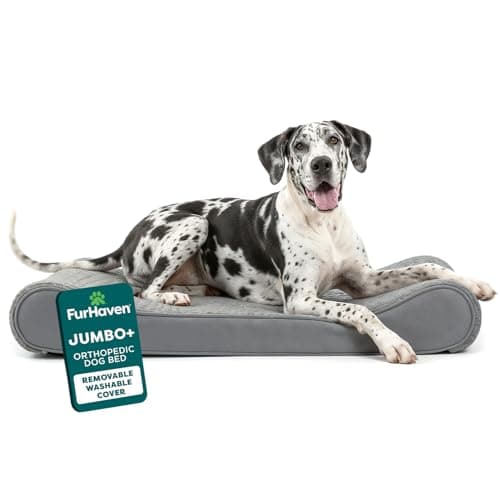
Furhaven
Furhaven Ultra Plush Luxe Lounger
Our score
$34.60
Best for
Budget-conscious owners of light and medium dogs, and nesting sleepers who like a low step-on entry
If Big Barker is out of budget, this is the bed we recommend for a dog under about 50 lb — solid orthopedic foam, a low step-on entry, and a washable cover at a price that is a tenth of the premium picks. Its foam is budget-density and it will mat down; the honest way to own one is to expect that, test it with your fist monthly, and spend $25.99 (Large) on a replacement core when it fails rather than pretending it won't. Under a heavy dog, buy depth and density once instead.
Pros
- The cheapest genuinely solid-foam orthopedic bed we track — $34.60 for the Large on Amazon and $34.99 base price direct from Furhaven, re-checked 2026-09-06
- Replacement foam cores are sold as spare parts priced by size — $13.99 Small to $69.99 Giant, $25.99 for the Large we link (verified against Furhaven's variant feed 2026-08-13) — so the bed's one predictable failure, the foam matting down, costs $25.99 to fix on this size rather than a whole new bed. The $13.99 figure is the Small's core and we have quoted it here as though it were this bed's; corrected 2026-09-06
- Contoured step-on lounger shape with no wall to climb — the low entry is a real feature for a stiff dog, and the contour supports a dog who sleeps with his head posted on an edge
- Removable, machine-washable cover with CertiPUR-US certified foam core
- Five sizes, Medium through Giant, in three core types (orthopedic foam, memory foam top, cooling gel top)
Cons
- Budget-density foam. Reviewers report cores matting down flat inside 18 months under bigger dogs, and the 10-year no-flatten warranties on premium beds exist precisely because this failure mode is real — plan on replacing the core (a $25.99 spare for the Large) on a schedule, not on faith
- Thinner in the middle than the photos suggest — reviewers measuring the foam report roughly 4.5 inches at the center against taller contoured edges, and "much thinner than what the pictures show" is a recurring complaint
- Furhaven rates sizes far above what this foam supports. The Jumbo Plus listing claims dogs up to 150 lb and the Large claims up to 38 lb; at this foam density we would not put a dog anywhere near 150 lb on it long term, and we treat the Large's 38 lb as the honest ceiling for the Large
- Cover fit is loose on some sizes per reviews, and the faux-fur top pills with washing
- The Amazon listing's fourth bullet opens "True Orthopedic Support: Stop buying beds that flatten" (read 2026-09-15), and nothing on Furhaven's own warranty page backs that sentence: the 90-day warranty covers fabric, sewing, gluing, stapling and zipper defects only, excludes "damage inflicted on products by animals", and there is no flatten term, threshold or remedy anywhere. Read the bullet as copy, not as a promise
- The Amazon listing we link disagrees with itself about what is inside it (read 9 October 2026). Its title says "Orthopedic Dog Bed" and its first bullet says "solid orthopedic foam slab"; its fourth bullet says "solid, high-density memory foam". Furhaven sells orthopedic, memory and cooling-gel cores as separate options at different prices, and its own page describes the orthopedic core as "dense and thick" with no density figure, so "high-density" has no number behind it anywhere we can find. If you want the memory-foam core, buy that option by name, direct, rather than trusting one bullet on the orthopedic listing
- Amazon availability moves by size. The Jumbo Plus ASIN (B07PYYJV11) went from "15 left" on 2026-08-18 to "Currently unavailable" on 2026-08-28 and was still dead on 2026-09-06, so our link now goes to the Large (B073PZHJZY, 36 × 24 × 5.5 in, rated to 38 lb, $34.60, sold by Amazon). That is a smaller bed than the one this page used to point at — check the size selector against your dog before you check out. Furhaven's own site still sells the whole line direct ($34.99–$180.99 across sizes when we checked 2026-08-22)
The reason this bed leads the article is not that it is the best foam we cover — it is not, and its own listing history says so: budget-density foam, with reviewers on its Amazon listing reporting it matting down under bigger dogs, some within months; eighteen months is our rounding of those scattered, undated reports, not a measured figure, and it is the number the arithmetic below rests on.[6] The reason is that Furhaven is a budget brand that has priced that failure honestly, with a per-size parts page anyone can read. The Large we link was $34.60 on Amazon on 19 September 2026, down from $48.99 in August,[6] and its replacement core is the $25.99 Large, not the $13.99 Small we once printed. That is $34.60 plus one core at eighteen months, about $61 across three years — roughly $20 a year, with the mattress never older than eighteen months. At August's $48.99 the same sum was $75, or $25 a year. Either way, for the dog this size fits, that is as cheap as a bed with a solid, replaceable core honestly gets; the decade-warranty route below runs about $25 a year. The honest limits, and the first is the one that matters: the Large we link is 36 × 24 inches and its own listing rates it to 38 lb, so this arithmetic is for a small-to-medium dog. A bigger dog needs the Jumbo or Jumbo Plus, where the core is $37.99 or $53.99 and the budget-density problem grows with the load, so the cycle shortens. The swap is a wrestle the first time, the corner test needs the contour caveat above, and the fix assumes the cover survives — check the zip before ordering the part.
The warranty route: buying once, in writing#
For the readers at the other end of the spend, the question is whether "buy once" is real. Four of the brands we cover have put a flatten promise in writing: Barker Beds, K9 Ballistics, Bully Beds[12] and Paw.com. This article reads the two on the beds it links; Bully's twenty-year term, with its 2.5-inch and 1-inch thresholds on two different pages, and Paw.com's threshold-free "any flattening" are read line by line in our seven-warranty comparison, which is also where the three catches below came from — we had not reported any of them until September.
| The promise, in writing | Barker Beds (Big Barker) | K9 Ballistics |
|---|---|---|
| Term | 10 years | 10 years |
| Failure threshold | Foam retains at least 90% of original shape and support[7] | Mattress "flattens more than 2 inches within 10 years of receipt"[8] |
| How many times they replace | Not stated | Once |
| Claim evidence | Not published — the FAQ says only to register on the warranty page | Order confirmation + photo of the uncovered mattress with a ruler |
| Where you must have bought it | Not stated; the warranty registration form's order-source dropdown lists Amazon, Chewy, Target and Walmart alongside bigbarker.com, which is the only evidence a marketplace bed can be registered | Direct, or K9 Ballistics' own Amazon storefront. Third-party resellers not covered; Chewy orders follow Chewy's policy. A second K9 page, written for Amazon customers, says "only to items purchased directly"[9] |
| Stated exclusions | None published — the promise is written on the foam, so plan on covers and chew damage being on you | Covers; chewing, scratching, water damage, misuse; fiberfill products |
A correction, in the open: we previously described Big Barker's threshold as "more than 15% loss of shape" on several pages. The company's own FAQ states the foam "will retain at least 90% of its original shape and support" — a 10% threshold, which is a stricter promise than the one we printed. We have corrected it across the site.
The two thresholds are also written in different units, and that matters more than the number of years. Barker's is a proportion, so it scales with the bed: on a seven-inch mattress the maker owes you a replacement at about three-quarters of an inch of loss. K9's is a fixed distance on a mattress whose thickness changes with size — 2 inches on the Small, 3 on the Medium and Large, 4 on the XL and XXL crate beds we link.[10] Read literally, that is:
| K9 Ballistics crate bed | Mattress | Loss before a claim opens | Share of the bed gone |
|---|---|---|---|
| Small | 2 in | more than 2 in | cannot be reached |
| Medium, Large | 3 in | more than 2 in | two-thirds |
| X-Large, XXL | 4 in | more than 2 in | half |
The Small row is not a joke. On the main warranty page a 2-inch mattress cannot flatten by more than 2 inches. The brand's separate page for Amazon customers quietly fixes this by writing the threshold as "more than 2 inches or 50%"[9] — and on the same page says the warranty applies "only to items purchased directly", which the main page contradicts by covering its Amazon storefront. We report both pages as they read on 19 September 2026 and cannot tell you which one a claims desk will apply; if you buy through our Amazon link, the buy box on that day was K9 Ballistics, Inc. itself, which is the storefront the main page names. Both warranties are still ten-year, money-where-the-foam-is commitments in a category where three of the seven warranties we have read have no flatten term at all. They are just not the same commitment, and neither is as simple as the number of years suggests.
#2 Pick

Big Barker
Big Barker 7-inch Pillow Top
Our score
$250–$460
Best for
Large and giant breeds with hip, elbow, or arthritis pain
The bed we still recommend first for a dog over about 80 lb. Our reason is depth: seven inches, published layer by layer, is more than most beds we cover print, and for a heavy dog we would rather have the depth than not. That is our judgement; nobody has measured how far a hip sinks into this bed. (It is not one solid slab, as we used to say: the maker's own copy describes a 3-layer build, a 2" base under a 3" support layer under a 2" comfort top.) It is also the only bed we cover with a clinical study attached, and we would rather you knew what that study is: forty dogs, no control group, no blinding, and outcomes scored by the owners who had just been given a free bed. That is a reason to be interested, not a reason to be convinced. Buy on the foam depth and the ten-year warranty, which are facts. On where to buy: the price is the same either way, so buy direct for the 180-night sleep trial, which Amazon's return window does not match. Read its conditions first: no return in the first 30 days except size exchanges, the bed is donated to a shelter rather than shipped back, and one trial return per household (bigbarker.com refund policy, 2026-10-04). The two editions both sell on both channels at identical prices, re-verified 4 October 2026 — flat Large $249.95, Headrest Large $289.95. We have published two wrong things about this in the past, a $40 Amazon markup and a direct-only cheap edition; both are retired, and the honest version is that the channel decides your trial, not your price.
Pros
- Seven inches of foam in a 3-layer build (2" base, 3" support, 2" top comfort), printed on the maker's own page, which not every maker does
- 10-year warranty — foam must retain at least 90% of its original shape and support, or it is replaced
- The only bed we cover with a clinical study behind it, though it is the sponsor's single-arm pilot report, not a peer-reviewed paper
- Made in the USA
- Microfiber cover unzips and machine-washes
Cons
- Premium price
- Editions, not channels, are what the price difference is. Both are on Amazon and both are on bigbarker.com at identical prices, re-verified 2026-09-06: the flat headrest-free Large is $249.95 (B0GRBXBPXH) and the Headrest Large is $289.95 (B0GRBX5TBL), both In Stock with the buy box held by Big Barker itself, both matching the maker's own site. We previously misread this as a $40 Amazon markup, and then as the cheap edition being direct-only. Both claims are retired
- Bulky — measure your space, not just your dog
- Cover-only style isn't bolstered (consider Sofa edition for nesters)
- The clinical study everyone cites is open-label, single-arm, and owner-scored, with no control group
- The product page says the three layers "maintain proper spinal alignment and eliminate pressure points" (bigbarker.com, read 2026-10-04). Nobody has measured that on this bed, and the one canine pressure-mapping study we know of (Caraty 2019, three cadavers) found even memory foam generally not enough to keep the hip, shoulder and rib risk zones at safe pressures. It is the same unmeasured claim we criticise on elevated cots
We have covered this bed's evidence file at length elsewhere; what belongs in this article is the ownership math and the newly corrected term. Ten warranted years against a budget bed's 18-month cycle is the entire argument: roughly $25 a year for the Large bought direct at $249.95 (Sleek edition, same price on Amazon on 19 September 2026),[5] within a few dollars a year of the re-cored budget route — so the premium buys the decade in writing, the foam depth, and never doing the swap, rather than a lower annual cost. The standing costs have not changed: it is a genuinely premium outlay up front; both editions sell on both channels at the same price — the flat Sleek Large at $249.95 and the Headrest Large at $289.95 on Amazon and on bigbarker.com alike on 19 September 2026 (we have published two wrong things about this in the past, a $40 Amazon markup and a direct-only cheap edition, and both are retired; the channel decides your return window, not your price); and the warranty is written on the foam rather than the covers — and the covers are the part a decade actually wears out, at $79.95 a time for the Large. The other thing the decade does not come with is a procedure: Barker publishes no claim steps, no evidence standard and no exclusions, which is why the ruler photo you take this weekend is the only record of what the bed measured new.
#3 Pick

K9 Ballistics
K9 Ballistics Tough Ripstop Orthopedic Crate Bed
Our score
$140–$320
Best for
Diggers, scratchers and light chewers that shred ordinary bed covers
The right bed for a dog who digs, scratches and roughhouses his bedding into the bin, and a genuinely good crate mattress at 4 inches with a warranty against flattening. Be precise about which problem you have, because we were not precise enough here until August 2026: this is the Tough Ripstop line, built for digging, scratching and occasional light chewing, and on this bed the chew warranty — 1 year, 365 days, re-verified 2026-09-06 — covers the cover only. A dog who has actually eaten three beds needs K9 Ballistics' separate Chew Proof Armored line, where the guarantee replaces the whole bed. Buy the right line and this is excellent. Buy this one for a determined chewer and you will be disappointed by a product that never claimed to do that job.
Pros
- Ripstop ballistic cover genuinely survives digging and scratching, which is what kills most bed covers
- Replaceable covers sold separately — repair, don't replace
- Carries a 10-year won't-flatten warranty as well as the chew guarantee, and it is defined concretely: more than 2 inches of flattening in 10 years and they replace the mattress once
- Foam is CertiPUR-US certified and made in the USA
- Corner anchor loops let you zip-tie the pad to a wire crate floor
Cons
- Cover texture is less plush than memory-foam beds
- Heavy at larger sizes — awkward to move around
- Premium price for the durable construction
- Not the bed for a determined chewer — the Tough Ripstop line is rated for digging, scratching and occasional light chewing only, and on this bed the 1-year chew warranty replaces the cover only, with the mattress excluded
- The Amazon listing contradicts itself on the foam: one bullet says CertiPUR-US shredded foam, another says a 4-inch solid foam mattress
- The 10-year won't-flatten warranty explicitly excludes chewing, scratching and water damage, so on a bed sold for rough dogs the two guarantees do not overlap
- Durability is the split verdict in the reviews, not a settled strength: Amazon's review summary for the linked listing (4.5 stars, 827 ratings, read 8 October 2026) says some owners find it outlasts other beds while others report it destroyed in less than two months and not chew-resistant enough. That matches the line's own rating (digging, scratching, light chewing), and it is why the cover-only chew warranty matters
- The listing's marketing outruns its own warranty: a bullet claims the mattress "won't flatten over time, even for the biggest and heaviest of breeds" and is "designed to last decades," while the brand's warranty defines acceptable performance as up to 2 inches of flattening in 10 years — half the mattress. The enforceable promise is the 2-inch threshold, not the bullet (listing re-read 25 August 2026)
Named here for one under-explained feature: its warranty claim is this article's audit. K9 Ballistics asks a claimant for a photo of the uncovered mattress with a ruler showing current thickness — the corner test, performed for their benefit instead of yours. If you own this bed, your monthly measurement doubles as a claim file. The honest limits sit where they did when we corrected our own overclaim about this brand: the Tough Ripstop line we link is for diggers and mild chewers, not determined destroyers (that is their separate Armored line), the chew promise on this line is one year and one replacement, and it replaces the cover only (we previously printed it as 120 days, a figure that still appears on the maker's Amazon-customer page and site banner but not on the warranty policy page, which was updated 1 September 2026 — one more place the two pages disagree),[8] and the ten-year flatten warranty excludes chew damage entirely. Its two-inch threshold is also, per the tables above, the more forgiving of the two promises — half the mattress on the 4-inch X-Large we link, and two-thirds on the 3-inch Medium and Large — so buy the size whose threshold you can actually reach, buy it direct or from K9's own Amazon storefront, and measure accordingly. On 19 September 2026 the X-Large was $175.00 in both places. And since this article is about parts: K9 sells the crate-bed mattress on its own, $44 Small, $55 Medium, $66 Large, $82 X-Large, $99 XXL on the same day, so a bed that flattens outside the warranty, or by less than its threshold, is an $82 fix rather than a $175 one.[10][11]

Replace it anyway, whatever the ruler says#
Three cases where a passing bed still goes. A surgery is scheduled and the recovery needs a waterproof, low-entry setup — sort that before the operation, not during week one. The dog has become incontinent, and the foam has taken on what no washing machine removes; parts-level fixes exist, but a soaked core is not one of them. Or the dog himself has changed shape — weight, muscle, sleeping posture — and the bed fits the dog he used to be.
And one case where the bed is innocent: a dog who is slower to get up from every surface has not worn out his bed. He is telling you something about himself, and reading that signal properly matters more than anything in this article. The bed can wait a week. The appointment should not.
What to do this week#
Tonight: the fist test at the hip spot, thirty seconds. This weekend: the ruler at the corner and at the dent, and write both numbers somewhere you will find them — they are the baseline every future check compares against, and if you own a warranted bed, they are the start of a claim file the manufacturer has already agreed to honour in inches — and, for one of the two, the only evidence standard that exists, because the maker never published one.
Then set the monthly reminder, because that is the actual intervention this article is selling, and it is free. A dog cannot tell you his bed died a year ago. He just lies down on it anyway, a little more carefully than he used to — and the months a household spends not noticing are the same months the sore hip spends pressing through dead foam into the floor. The delay is the injury. This is one of the few places you can delete the delay with a phone reminder.
Sources#
- ZwickRoell. "ASTM D3574 flexible foam testing." Overview — ASTM D3574 comprises 19 tests on flexible cellular polyurethane, including Test D, the constant-deflection compression set test; re-read 19 September 2026.
- Polyurethane Foam Association. "Tests of Foam Performance, Part 1: Laboratory Methods." In-Touch Vol 4 No 2, July 1994, revised 2022. pfa.org (PDF) — compression set: samples "compressed between metal plates to 50%, 75% or 90% of their thickness at specified conditions for 22 hours … allowed to recover for 30 minutes, and measured to see how much of their original height is recovered"; density "affects foam durability and support. Typically, the higher the polymer density, the better the foam will perform"; dynamic fatigue: "a 10″ indenter weighing 168 pounds at 70 cycles/minute for a total of 80,000 times. After one hour, loss of thickness and IFD are measured." Read 19 September 2026.
- Caraty J, De Vreught L, Cachon T, Moissonnier P, Bongartz A, Viguier E, Carozzo C. "Comparison of the different supports used in veterinary medicine for pressure sore prevention." Journal of Small Animal Practice. 2019;60(10):623-630. doi:10.1111/jsap.13061 — cadaver dogs in lateral recumbency across four surfaces; recurrent pressure-risk zones at the scapulohumeral articulation, greater trochanter and thirteenth rib; three cadaver dogs; contact pressures "appeared to depend on body condition score, with maximal pressures observed in thin dogs."
- Furhaven. "Foam for Luxe Lounger Beds" (replacement core, "THIS IS JUST THE FOAM INSERT REPLACEMENT, COVER IS NOT INCLUDED"). furhaven.com — read variant by variant 19 September 2026: Orthopedic Foam $13.99 Small, $19.99 Medium, $25.99 Large, $37.99 Jumbo, $53.99 Jumbo Plus, $69.99 Giant; Memory Foam and Cooling Gel Foam $24.99 Medium, $31.99 Large, $47.99 Jumbo, $69.99 Jumbo Plus, $86.99 Giant; no memory or gel Small exists — selecting one returns the orthopedic Small's SKU (FOAM-312) at $13.99. Sixteen variants in all. Orthopedic prices unchanged from our 13 August 2026 read.
- Barker Beds. Live product and variant feed. bigbarker.com/products.json — read 19 September 2026: Original Orthopedic Dog Bed, Sleek Edition, Large 48″ × 30″ × 7″, $249.95, available; "Cover | Original Bed", Sleek Large $79.95 (available in Khaki and three linen colours; Chocolate, Charcoal and Cordura unavailable that day), Extra Large $89.95, Giant $109.95. Amazon the same day via the Creators API: Sleek Large B0GRBXBPXH $249.95 and Headrest Large B0GRBX5TBL $289.95, both In Stock, buy box Big Barker.
- Amazon listing B073PZHJZY, Furhaven Ultra Plush Luxe Lounger, Large (36 × 24 × 5.5 in). amazon.com — read via the Creators API 19 September 2026: $34.60, In Stock, buy box Amazon.com, list price shown as $64.99. Was $48.99 on 14 August 2026.
- Barker Beds. "Frequently Asked Questions," Warranty section. bigbarker.com — read 19 September 2026: "Barker Beds come with a 10-year 'No Flatten' warranty, ensuring the foam will retain at least 90% of its original shape and support over time. If your bed flattens or sags within this period, we'll replace it at no cost to you." Claim route: "visit our Warranty Registration." No exclusions, no claim procedure, no evidence standard and no statement of whether replacement is one-time appear anywhere on the page; verified absent that day.
- K9 Ballistics. "Built to Last Promise" (warranty page), "Last updated: 9/1/26." k9ballistics.com — read 19 September 2026: "If your dog bed mattress flattens more than 2 inches within 10 years of receipt, we will replace it once free of charge"; excludes polyester fiberfill products and chewing, scratching, water damage and misuse; claim by email with order confirmation and "a photo featuring the mattress, uncovered, with a ruler showing the current thickness of the bed"; covers purchases direct and through K9 Ballistics' Amazon storefront, third-party resellers not covered, Chewy orders follow Chewy's policies; chew-proof warranty "1 year (365 days) after receiving it", one claim per eligible item.
- K9 Ballistics. "Extended Warranty Registration | Amazon Customers." k9ballistics.com — read 19 September 2026: "If your orthopedic mattress flattens more than 2 inches or 50% in 10 years we will replace it once"; "120-Day Chew Proof Warranty™ one time replacement"; "Warranty applicable only to items purchased directly from K9 Ballistics." The 120-day and direct-only wording contradicts the main warranty page above; we report both.
- K9 Ballistics. Tough Ripstop™ Orthopedic Dog Crate Bed, sizing information in the live product feed. k9ballistics.com/products.json — read 19 September 2026: Small 29″ × 18″ × 2″, Medium 35″ × 22″ × 3″, Large 41″ × 27″ × 3″, XL 47″ × 29″ × 4″, XXL 50″ × 33″ × 4″; direct prices $100 / $120 / $140 / $175 / $210 in standard finishes, all available. The same feed lists "Tough Ripstop™ Orthopedic Dog Crate Bed Mattress" as a standalone part: S $44, M $55, L $66, XL $82, XXL $99, all available.
- Amazon listing B0BK2HQG18, K9 Ballistics Tough Ripstop Orthopedic Crate Bed, X-Large 47 × 29 × 4. amazon.com — read via the Creators API 19 September 2026: $175.00, In Stock, buy box K9 Ballistics, Inc.
- Bully Beds. "20 Year Warranty." bullybeds.com — read 19 September 2026: "If it flattens by more than 2.5 inches anytime within those 20 years, we'll replace it one time, at no charge, for you"; original owner only; covers the flat sleeping area, not the bolsters. The brand's product-info page states a different threshold (1 inch in 10 years); both are set side by side in our warranty comparison. Paw.com's "any flattening" guarantee is read at source in the same article.
- Furhaven. "Luxe Lounger Ultra Plush Cover" replacement-cover page. furhaven.com — read by size and colour 19 September 2026: Medium $16.99, Large $23.99 (Chocolate, SKU CVR-31435085 — the cover of the Large bed we link, part 31435085), Jumbo $29.99, Giant $46.99. No Small cover variant is offered; selecting one returns the Medium SKU.
The service-life figures in the table are our editorial working figures assembled from the warranty terms above, manufacturers' parts pages and recurring retail-review reports; no published standard for dog-bed service life exists and we say so rather than borrow one. Per-year costs are our own arithmetic from the prices above.
This article is educational and does not replace veterinary advice. A dog who has recently changed how he uses his bed — slower to lie down, slower to rise, or avoiding it entirely — needs examining before he needs new equipment.
Frequently asked
- How often should a dog bed be replaced?
- There is no published standard, so treat these as working figures from warranty terms, manufacturer parts pages, and recurring owner reports. Shredded-fill and polyester beds under a dog over 50 lb: often within 6 to 12 months. Egg-crate and convoluted foam: roughly 12 to 24 months of daily use by a large dog. Budget solid foam: around 18 to 24 months under heavier dogs, though Furhaven sells replacement cores that reset the clock for $13.99 to $69.99 depending on size. High-density solid foam: four of the brands we cover put a flatten promise in writing — ten years at Barker Beds and K9 Ballistics, twenty at Bully Beds, and a threshold-free ten-year or lifetime promise at Paw.com, depending on which of its pages you read. But the calendar is the wrong instrument — the bed is done when it fails a fist test at the spot where your dog's hip lands, whenever that happens.
- How can I tell if my dog's bed has bottomed out?
- Two checks, two minutes, no tools beyond a ruler. First the fist test: press down hard, knuckles first, at the exact spot where your dog's hip lies — not the middle, not the edge. If you can feel the floor, so can he. Second the corner test: a bed's corners and edges are barely loaded, so they preserve the foam's original height. Measure the loft at the corner, then at the hip spot, and compare. A slab that is four inches at the corner and two and a half where the hip lands has lost more than a third of its thickness at the only point that matters, however normal it looks from standing height.
- My memory foam dog bed holds a dent after my dog gets up. Is it ruined?
- Not necessarily. A body impression that fades over minutes to hours is memory foam behaving as designed — slow recovery is the material. The failure is the impression that never comes back: foam engineers call it compression set, the permanent loss of thickness a foam takes after long compression, and it is a standardized, measured property of foam, not a vague idea. Check the bed a few hours after the dog has been off it. Whatever depth has not recovered by then is gone for good, and the fist test tells you whether what remains is still doing anything.
- Can I replace just the foam instead of buying a whole new bed?
- Often, yes, and it is the best-value move in the category. Furhaven sells replacement foam cores for its Luxe Lounger beds on its own parts page, priced by size: $13.99 Small, $19.99 Medium, $25.99 Large, $37.99 Jumbo, $53.99 Jumbo Plus and $69.99 Giant for the solid orthopedic core, re-read variant by variant on 19 September 2026. Memory-top and cooling-gel cores exist from Medium up at $24.99 to $86.99; the Small comes in orthopedic only. K9 Ballistics sells its crate-bed mattress on its own too, $44 to $99 by size. For any bed with a zippered cover, a high-density foam slab cut to the footprint does the same job generically. Two honest caveats: a fresh budget-density core under a heavy dog will fail on the same schedule the old one did, and if the cover or waterproof liner is also worn out, the arithmetic starts favouring a new bed.
- Do dog bed warranties against flattening actually pay out?
- The two serious ones are written concretely enough to invoke, but each has a catch that is only visible when you read the whole page. Barker Beds' 10-year warranty promises the foam retains at least 90% of its original shape and support — flatter than that, they replace it — and publishes no exclusions, no claim procedure and no evidence standard, so the record of what the bed measured is yours to keep from day one. K9 Ballistics replaces a mattress once if it flattens by more than 2 inches within 10 years, asks for a photo of the uncovered mattress with a ruler against it, and covers only beds bought direct or from its own Amazon storefront, not third-party resellers or Chewy. Its threshold is also a fixed distance on a mattress whose thickness varies by size — 2 inches on the Small, 3 on Medium and Large, 4 on XL and XXL — so on the Small it cannot be reached at all, and on the 3-inch sizes it is two-thirds of the bed gone. Keep the order confirmation, register the warranty where the brand offers it, and photograph the ruler against the corner and the dent now — the manufacturers have defined failure as a number, which means you can too.