Mobility
How Do I Help a Stiff Old Dog Up Off the Floor Without Hurting His Hips or My Back? And When Is a Harness Worth Buying?
A stiff dog who walks once he is up needs help with the part he cannot do, not a lift. The rug, the towel, the order of the rise, the lifting numbers for your back, and when a sling or a Help 'Em Up earns its price.

Help him up; do not lift him up. A stiff dog who walks normally once he is standing needs help with the part he cannot do, and nothing more. Put a rug where he sleeps, so his feet grip. Let him get his front end up first. Then slide a long towel flat under his belly, spread forward rather than bunched against his hips, and take only as much weight as he cannot, easing off as his legs come under him. At floor level a 70 lb dog is far over every lifting guideline written for people, so the less of him you carry, the better for your back. And it leaves him the work of standing up, which in healthy dogs drives the main thigh muscle several times harder than walking does. Buy a sling if you do this daily for weeks. Buy a two-piece harness only if he needs help all day, not just at the first rise.
Affiliate disclosure: Dog Orthopedic is reader-supported. When you buy through links on our site we earn a commission at no extra cost to you — about 3% on most pet products, and the same rate on every product we compare, so no pick earns us more than another. Prescription medication earns us nothing, and seeing your vet earns us nothing; we recommend both anyway. Learn more.
Imagery: Lifestyle photographs on this site are licensed from Pexels (royalty-free) and credited per image. Pexels imagery illustrates conditions and contexts — it does not depict the specific dogs or test sessions described in the text. Product photographs come from Amazon's Creators API. Breed portraits are illustrations of typical breed type rather than photographs of individual dogs, and are not drawn to scale against one another.
The towel, at 6am#
You are probably already doing some version of this. He shifts on the floor, gets his front legs out, pushes, and the back end does not follow. So you crouch, get your hands or a towel under his belly, and pull him up. He walks off, a little stiff, and by the time you have made the coffee he is fine.
Nothing about that is wrong. It is what most people do, and it works. But it has two costs that build up quietly, and both come from the same habit: taking all of his weight instead of the part he cannot manage. One cost is to your back. The other is to his legs. This page is about how to stop paying both, and when a piece of equipment actually helps.
One thing first. A dog who could get up yesterday and cannot today, or who cries out, drags a back foot or knuckles over, is not stiff. That needs a vet today, not a better towel. Our page on limping, stiffness and weakness explains the difference.
Why "trouble rising" deserves an appointment, not just a technique#
A proposed 2026 framework for managing osteoarthritis in adult dogs, written by a seven-author advisory group convened by the animal-drug company Vetoquinol USA, lists "trouble rising" among the functional changes "commonly associated with OA pain in adult dogs".[1] A rehabilitation review of older dogs goes further and names rising from a down position as the first of the most basic tasks a dog needs to stay independently mobile.[2]
So helping him up well is half the job. The other half is getting the reason looked at. If you have not yet timed his mornings, our page on morning stiffness has a one-week log to take to the vet. The rest of this page assumes you are doing both.
Getting up is hard work for his back legs#
Standing up is not a small movement for a dog.
In six healthy beagles fitted with surface sensors, the main muscle on the front of the thigh, which straightens the knee, peaked at an average of 337% of its walking peak while the dogs stood up from a sit.[3] A computer model built from greyhounds standing up from lying, a breed its authors describe as an extreme athlete, pointed the same way: the key extensor muscles of the back legs "operate near their ~50% limits of length change", and standing up needs high muscle activation, above 50%.[4] The authors open the paper by calling standing up "a critical daily activity for animals: failing to do so effectively may cause an injurious fall".
Be clear about what these studies are. They are healthy dogs, a handful in each, one of them a sprinting breed, and neither tested an arthritic dog, a dog being helped, or how standing up compares with stairs or jumping. Nobody has studied whether lifting a stiff dog every morning makes him weaker. That part is our reasoning, not a finding.
But the reasoning is simple. Every morning he gets up, he does a hard set of a movement that rehabilitation uses as an exercise: the beagle study opens by calling sit-to-stand one of the "fundamental tasks" among rehabilitation exercises. If you take his whole weight every time, he skips it. If you take only the part he cannot do, he keeps it, and you keep your back. Canine Arthritis Resources and Education, an owner education site about arthritis in dogs, says the same about slings: "The purpose of using a sling is to act as a safety net or provide some gentle support, not to prevent weight bearing."[5]
Help him get up. Do not get him up. That is the whole technique, and the rest of this page is detail.

The floor comes before the towel#
Some of the struggle you see at 6am may be his feet slipping rather than his legs failing. The client sheet on helping a dog rise in the Clinical Veterinary Advisor, a standard veterinary reference, is blunt about this: "Hardwood floors and linoleum are slippery; a better, higher-traction surface (covering an area at least twice the length of the pet, square) can make all the difference in helping a pet to rise."[6]
It also rules out the obvious shortcut. A towel or blanket laid on a smooth floor is "rarely useful because the cloth just slides on the floor under a pet's scrambling feet." The sheet recommends an area rug or a piece of carpet instead. Canine Arthritis Resources and Education goes as far as saying rugs, runners and non-slip flooring "might be one of the most effective things you can do" for a dog with arthritis,[5] and the 2026 framework lists rugs, mats and carpet runners among the changes worth recommending.[1]
If your Labrador is roughly 3 ft long from nose to tail base (measure yours), "twice the length of the pet, square" means a rug about 6 ft by 6 ft. That is bigger than most people put down, and it is the size that matters, because a dog pushing up from lying scrambles further than you would expect. If he sleeps in one spot, that is where it goes. If he sleeps on a bed, put the rug where his feet land when he steps off it. Our page on dogs slipping on floors covers the rest of the house.

The rise, step by step#
This order follows the Clinical Veterinary Advisor sheet, which was written for dogs who cannot rise on their own. Your dog can do more than those dogs, so you will do less at every step.
- Let him bring his front end up first. The sheet's instruction: "If the front legs are healthy and strong, encourage him or her to rise into a sitting position." Call him, or put a treat just ahead of his nose. Then wait, and give him time to try more than once before you step in.
- Slide a long towel under his belly, flat and spread forward. The sheet warns that homemade slings "may bunch up at the back, just ahead of the hips", and says to keep the sling spread forward under the abdomen and chest. For a male dog it puts the sling "about halfway between their shoulders and hips so the penis is not trapped".
- Stand as tall as the towel lets you. The sheet's position: "standing upright with a straight back, sling ends in each hand", with knees slightly bent and your legs doing the work. A towel that is too short forces you to bend over and hold him with your back, which the sheet calls "not recommended". A bath sheet is long enough for most people. A hand towel is not.
- Take only what he cannot. Lift as he pushes, not before. As his back legs come under him, ease the towel until it is barely taut. If you have done it right, he is carrying almost all of his own weight by the time he is standing.
- Keep the towel there for the first few steps. The first steps after a night's rest are often the stiffest of his day. Walk beside him with the towel slack, ready to take weight if a back leg gives, then let it go.
One caution from the same sheet: a dog in pain "may respond by biting", and the sheet's answer is a muzzle if that is a risk. If he has ever snapped when handled around the hips, use one, and ask your vet to show you the lift before you do it alone.
What your back is being asked to do#
The lift itself is the bit you cannot make safe by trying harder. Here is why.
The UK Health and Safety Executive publishes guideline weights for lifting at work, by where your hands are. A dog lying on the floor puts your hands in the lowest zone, below mid-shin.[7]
| Hands at floor level (below mid lower leg) | Women | Men |
|---|---|---|
| Load held close to the body | 7 kg (15 lb) | 10 kg (22 lb) |
| Arms stretched out | 3 kg (7 lb) | 5 kg (11 lb) |
| A 70 lb Labrador | 32 kg | 32 kg |
The HSE is careful to say these are "not 'safe limits'". They are the weights below which it considers the risk low, and they assume a load that is "easily grasped with both hands". A dog is not that. In the United States, the ergonomist behind the revised NIOSH lifting equation worked out a recommended maximum of 35 lb for lifting human patients, and only for patients who are "cooperative and unlikely to move suddenly". Above that, he wrote, "assistive devices should be used."[8]
A large dog lying on the floor is well over every one of those numbers, and he can move suddenly. You cannot make that lift low-risk. What you can do is not make it: if he takes most of his own weight, the share in your hands may fall back toward the numbers in the table. That is the second reason to help rather than lift, and the reason a handle that keeps you standing taller is worth paying for once you are doing this every day. Our page on getting a dog into the car covers the lift that really is a lift, where he cannot do any of the work.
Towel, sling or harness: what each is for#
| What you see | What to use | What it costs |
|---|---|---|
| Gets up on his own on a rug, slowly | Nothing. The rug was the fix | A rug you may already own |
| Front end up easily, back end needs a hand, walks fine once up | A long towel under the belly | Free |
| As above, every day for weeks, or your back is complaining | A rear sling with proper handles | $35.95 to $69.95 by size at the GingerLead store, 2 November 2026 |
| Needs help through the day as well: walks, stairs, the car | A two-piece harness that stays on through the day | $80 to $140 direct, by size |
| Front legs struggle too, or he cannot stand once up | See your vet first, then a full harness | As above |
| Could get up yesterday and cannot today | A vet today | — |
The towel is not a lesser option. For many stiff dogs it is the right one indefinitely. A product earns its place when the towel stops working: when it bunches back toward the hips, when you cannot stand up straight with it, or when the help is needed at moments the towel is not to hand.
If the towel is not enough: a rear sling#
#1 Pick

GingerLead
GingerLead Dog Support and Rehabilitation Harness
Our score
$32–$70
Best for
Short-term post-surgical assistance and rear-end weakness
The right tool for one specific job: a dog whose back end has failed while his front end is still working. In the first days to weeks after hip or stifle surgery (for as long as he cannot yet steady himself on a hard floor, which after a pelvic osteotomy is often only days), or for a senior who can get his front paws onto the sill of a car but cannot follow through, it is faster to fit than a full harness and it costs less. It is not a general mobility aid — it does nothing for the front half of the dog, and the maker expects you to buy a chest harness separately for older dogs. Size it with the towel test before you order, because the 10-day return window is short for a product whose commonest failure is sizing. If your dog needs help at both ends, or will need help for more than a couple of months, buy the Help 'Em Up Harness instead — though note that is no longer a $10 decision: Help 'Em Up prices by size direct ($80 XS to $140 XL, re-verified 18 Aug 2026), so the medium-to-large dog this sling fits pays $110 or $125 there against $69.95 here.
Pros
- Single-piece sling — fast to put on for bathroom trips
- Cutout in the support pad clears male anatomy, so it can be left in position without soiling
- Integrated leash takes one accessory off your hands, and detaches if you don't want it
- Machine washable and dryable, which matters more than it sounds on a post-surgical dog
- No Amazon markup — $69.95 on Amazon and $69.95 direct from the manufacturer, re-verified 12 September 2026 (Amazon via the Creators API, direct from the Med/Lg product page); Amazon re-read through the Creators API on 19 October 2026, $69.95 in stock, unchanged; re-read 2 November 2026 — Amazon B00GPYFA50 $69.95 In Stock via the Creators API, buy box GingerLead's own storefront; gingerlead.com shop page lists the Medium/Large at $69.95 and the range from $35.95 (Mini) to $69.95.
- The maker sells reconditioned units — inspected, laundered and re-packaged, "Save up to 45%". On 8 October 2026 we observed a reconditioned price for the first time: the $44.95 second offer on the Amazon listing we link, from the maker's own storefront, is listed as Used / Like New with the note "A reconditioned GingerLead dog sling may have only been used a few times." That is 36% off the $69.95 new unit. (Corrected 2026-09-05 — we had printed "roughly $45" as the direct discount before we could tell what the $44.95 offer was; it is the reconditioned unit.)
- Manufacturer publishes a free towel test that sizes the sling before you spend anything
- Credit where it is due: as of 1 September 2026 the Amazon listing carries "CHEST HARNESS NOT INCLUDED" in capitals in its first feature bullet and in the retail title. This was the single most commonly missed thing about the product and the maker now says it before you click buy
- Stay-on straps are included, which is what stops the sling sliding backwards on a dog with wasted hindquarters
Cons
- Rear-end only — not the right tool if a dog also needs front support
- Chest harness is not included, and the maker's own copy recommends clipping the leash to one for older dogs
- Only a 10-day clean return window; days 11–30 carry a $10 restocking fee and nothing is refunded after 30
- Long-term use can rub thighs without careful fitment
- Strap-end handles are less ergonomic than padded handles
- Sized by pad width and by the dog's sex, not by a simple size ladder — easy to order wrong
- The Amazon listing contradicts itself on the weight floor — one bullet says "FEMALE dogs over 45 lbs and MALE dogs over 60 lbs", another says "dogs weighing over 45 pounds" flat (both live 19 Aug 2026)
- On Amazon the cheaper of the maker's two offers on this ASIN is not the one in the buy box, so the default click costs $25 more. The cheaper offer comes and goes: 7 units on 19 August, a backorder (AVAILABLE_DATE) on 1 and 23 September, back in stock with 7 left on 8 October 2026, when the listing data showed it as Used / Like New, a reconditioned unit. Open the other-offers panel and check the condition before you rely on it
For the morning rise on its own, this is the sling we would start with. Canine Arthritis Resources and Education names it, recommending "a sling such as the Ginger Lead" and saying it "may be worth investing in" when a sling will be needed for an extended time.[5] It also fits the order above. Once his front end is up, it goes under his belly from the side, the way the towel does. The pad stays flat where a towel bunches, and the Medium/Large has a cutout so it sits clear of a male dog's penis without your having to judge the spot every morning. It was $69.95 on Amazon on 2 November 2026, in stock, the same price as the maker's own store. What it is bad at:
- It is a rear support only. No chest harness is included, so it does nothing for a dog whose front legs are the problem.
- Its handles are strap ends, not padded grips. That is fine for a few seconds at 6am, and less comfortable over a long walk.
- It is not for wearing all day. Left on and tight while he lies down, slings like this rub the inner thigh. Take it off once he is walking.
- The size we link is not for every big dog. The Medium/Large is for females over 45 lb and males over 60 lb, per the maker. A 50 lb male falls below that line, so do the maker's towel test before ordering; our product page has it.
- The return window is short. Ten days from delivery when bought direct, so do the towel test before you order.
- It costs $70 to do what a bath sheet does. Use the towel for a week first. If the towel works and your back is fine, keep the money.
When a harness earns its price#
#2 Pick
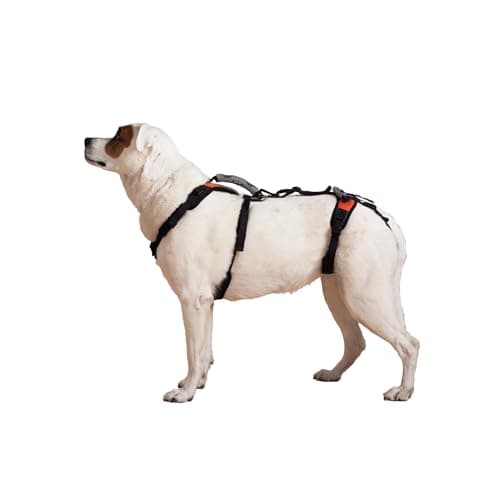
Help 'Em Up
Help 'Em Up Harness
Our score
$95–$155
Best for
Long-term mobility support for senior or post-surgical large dogs
If your dog needs help getting up multiple times a day for the foreseeable future — post-TPLO, advanced hip dysplasia, hindquarter weakness in giant-breed seniors — this is the one to buy. It supports the front and the back independently, as two halves you can lift separately, which is what a dog with a bad hip and a compensating shoulder actually needs. It is not the only design that does this, but it is the one whose sizing, returns and channel prices we have read most closely. Buy it from the manufacturer, not from Amazon: re-verified 3 October 2026, helpemup.com prices by size at $80 / $95 / $110 / $125 / $140 while Amazon runs $95 / $110 / $125 / $140 / $155 — a uniform $15 more at every size, every time we have checked.
Pros
- Two-piece (chest + hip) design lets you support either end independently
- Hip handle is purpose-built — not a converted car-seat-belt strap
- Padded chest plate distributes weight better than sling-only options
- Five sizes span 10 to 225 lb, and the rear half can be ordered a size smaller for a dog with muscle wasting
- Two hip-lift styles (Conventional and U-Band) so male dogs are not soiling the strap
Cons
- Amazon runs a uniform $15 above the maker's own price at every one of the five sizes, and the Amazon buy box is held by a third-party reseller (Veterinary Preferred) rather than by the brand — re-verified 18 August 2026
- The maker's own Mix & Match page prints two different starting prices, "From $80" and "FROM $95 USD", on the same page
- Direct pricing is no longer flat: since mid-August 2026 the maker charges $80 to $140 by size, so a giant-breed owner now pays $60 more than a terrier owner
- On 29 August 2026 the linked Amazon Medium (B0DK81SCG5) showed a future availability date rather than units on hand, while every size and style was in stock at helpemup.com the same day; on 9 September and again on 12 September 2026 the Amazon Medium still showed the future-date status at $125.00 with a maximum order of one and no ship date given, while all nine direct variants were in stock — two weeks of backorder on the channel we earn from, and one more reason the direct channel is the one to use. By 3 October 2026 it had spread: every Conventional-style Amazon listing we checked (X-Small, Small, Medium, Large) showed a future availability date, and only the Large and X-Large U-Band were in stock, while all nine direct variants were available. On 15 October 2026 the linked Medium was back In Stock on Amazon at $125.00 (maximum order 30) for the first time since 29 August, but X-Small, Small and Large Conventional still showed a future availability date with a maximum order of one. On 2 November 2026 the linked Medium was back to a future availability date ($125.00, maximum order one), while all nine direct variants were in stock at $80 to $140
- Sizing is critical — measure twice, return is a hassle
- Rear straps can chafe the inner thigh if the harness is left tight while the dog lies down
- A dog filmed or gait-assessed while wearing it looks less lame than he is, because the harness offloads the limb you are trying to judge
- Bulkier than a quick-grab sling for short-term use
Amazon, 2 November 2026: the Medium this button links is back to a future availability date at $125, maximum order one, no ship date given, after reading In Stock on 15 October. Every size and style was in stock direct the same day, $15 cheaper.
The Help 'Em Up is a two-piece harness, a chest half and a hip half, each with its own handle. It is the one Canine Arthritis Resources and Education calls "the best tool out there for dogs that well, need help getting up".[5] But read the maker's wear instructions before you buy it for the morning, because they exclude the morning.
Its fitting guidance says the harness "can stay on your dog during the day, but we do recommend you take it off at night," says it can often be worn for 8 to 10 hours, and says to loosen or unclip the straps, especially at the hip, whenever the dog lies down.[9] Its FAQ is plainer: "Let them sleep without it if possible."[10] So the dog it is built for gets out of bed without it, and the first rise is a towel or sling job anyway. The harness goes on after that, for the rest of his day.
That is the honest test. Buy it when he needs help through the day, not just at the first rise: on and off the walk, at the stairs, into the car, out to the garden at 4pm. It also does something no rear sling can: when his front legs are weak too, you can hold the chest handle on a bad-elbow day and the hip handle on a bad-hip day. What it is bad at:
- It does not solve the 6am rise. For the reasons above.
- The price, and where you pay it. Direct from helpemup.com it was $80 to $140 by size on 2 November 2026, with all nine size and style options in stock. The Amazon Medium we link was $125, but showed a future availability date with no ship date, the same backorder signal it showed on and off from late August into October. Buy direct.
- Sizing. Medium is 45 to 80 lb and Large 80 to 125 lb, so a big male Labrador can sit on the line. Our product page explains the size-down rule and the smaller rear half for a dog who has lost muscle behind.
- Chafing. The recurring complaint is the hip straps rubbing the inner thigh when left tight. That is the reason for the maker's loosen-when-lying-down rule.
What we do not know#
- Whether lifting a stiff dog fully every day weakens him over months. Nobody has studied it. The muscle studies on this page are of healthy dogs.
- How dogs with arthritis get up. We found no study of the way arthritic dogs rise from lying, or of how much weight they shift onto their front legs to do it.
- Whether a rug, a sling or a harness changes anything measurable. We found no trial of any of them for this. The traction advice comes from expert guidance, not from experiments.
- What share of his weight you are taking. You can feel it, but nobody has measured it for an owner and a stiff dog, so we cannot give you a number.
What to do this week#
Tonight, put a big rug where he sleeps, bigger than feels necessary. Tomorrow morning, before you reach for him, wait. Let him get his front end up. Then put a bath sheet flat under his belly, stand as tall as it lets you, and lift only as he pushes. Notice how little you needed to take. Do it the same way for a week before you buy anything.
Then book the vet visit, if you have not already. The founder of this site read her own dog's quiet signs as age, and one of them was that he took longer to get up off the floor. A towel makes that sign easier to live with. It does not make it go away, and it makes it easier to stop noticing. Help him up every morning, and keep asking why he needs it. Our pages on weak back legs in senior dogs and how to tell if your dog is in pain are the next to read, and the lift harness comparison covers the gear in more detail.
Frequently asked
- How do I help my old dog get up without hurting him?
- Put him on a rug, not a bare floor, let him bring his front end up first, then slide a long towel flat under his belly, spread forward under the abdomen rather than bunched just ahead of the hips (for a male dog, about halfway between shoulders and hips), and take only as much weight as he cannot. A veterinary client sheet in the Clinical Veterinary Advisor (Cohn and Côté, 4th edition) describes the same order: encourage the dog to rise into a sit if his front legs are strong, then slip the sling under the belly and lift the hips into standing. Canine Arthritis Resources and Education puts the aim plainly: a sling is 'a safety net or ... gentle support, not to prevent weight bearing.' Once his legs are under him, ease off, and keep the towel in place for the first few steps.
- Is it bad to lift my dog up every morning?
- It can be bad for you, and we think it is a missed chance for him. Getting up is hard muscle work: in six healthy beagles, the main thigh muscle worked at a peak of about 337% of its walking peak during a sit-to-stand (Yoshikawa 2025). No study has tested whether lifting an arthritic dog every day weakens him, so that part is our reasoning. But if he can stand once he is up, help with the part he cannot do and leave him the rest. For your own back, the UK Health and Safety Executive's guideline weights at floor level are 7 kg for women and 10 kg for men with the load close to the body, less with arms stretched out. A 70 lb dog is 32 kg.
- Should a towel go under my dog's feet on a slippery floor?
- No. The Clinical Veterinary Advisor client sheet says a towel or blanket over a smooth floor is 'rarely useful because the cloth just slides on the floor under a pet's scrambling feet.' It recommends an area rug or a piece of carpet covering at least twice the length of the pet, square, where he sleeps. The towel belongs under his belly, not under his feet.
- Can my dog sleep in a Help 'Em Up harness so it is on for the morning?
- The maker says not to, if you can avoid it. Its fitting guidance says the harness 'can stay on your dog during the day, but we do recommend you take it off at night,' and its FAQ says 'Let them sleep without it if possible.' It says the harness can often be worn for 8 to 10 hours, and advises loosening or unclipping the straps, especially at the hip, whenever the dog lies down. So the first rise of the morning is usually done without it: a towel or a rear sling for that, then the harness on for the day.
- When is a lift harness worth buying for a stiff old dog?
- When the help is needed through the day, not only at the first rise. If he gets up on his own once he is on a rug, buy nothing. If he needs a hand at the back end only, a long towel does it; a rear sling such as the GingerLead ($69.95) is better if you are doing it daily for weeks or your back is complaining. A two-piece harness like the Help 'Em Up ($80 to $140 direct, by size) earns its price when he needs help on walks, stairs and in and out of the car as well, or when his front end needs help too.